

Lead vs Prospect: Why Your Team Can't Agree (and How to Fix It)
Your marketing team sent over 200 MQLs from last month's webinar. Your SDRs called through the list - 18 emails bounced, 3 people picked up, and one of them said "I just wanted the PDF."
Meanwhile, your VP of Sales is asking why pipeline is flat when marketing "generated 200 leads." The problem isn't effort. Nobody in your org agrees on what a "lead" actually means versus a "prospect," and that misalignment is silently wrecking your funnel. 80% of new leads never convert into sales. Most of that waste starts with a definitional gap that turns into an operational one.
The Short Version
Two valid models exist for defining leads and prospects: Lead-First (marketing-driven) and Prospect-First (sales-driven). Neither is wrong, but mixing them in one org creates chaos - marketing thinks they're delivering qualified pipeline, sales thinks they're getting garbage.
Pick one model, then enforce three stage gates: Fit, Interest, and Intent. Build a scoring model with explicit thresholds. And before you score anything, make sure your contact data is actually accurate - a scoring model built on bounced emails and wrong phone numbers is just a spreadsheet exercise.
What's the Difference Between a Lead and a Prospect?
The standard B2B taxonomy runs three stages: Lead → Prospect → Opportunity. Salesforce's framework maps these to distinct CRM objects and actions, and most modern sales orgs follow some version of this progression.
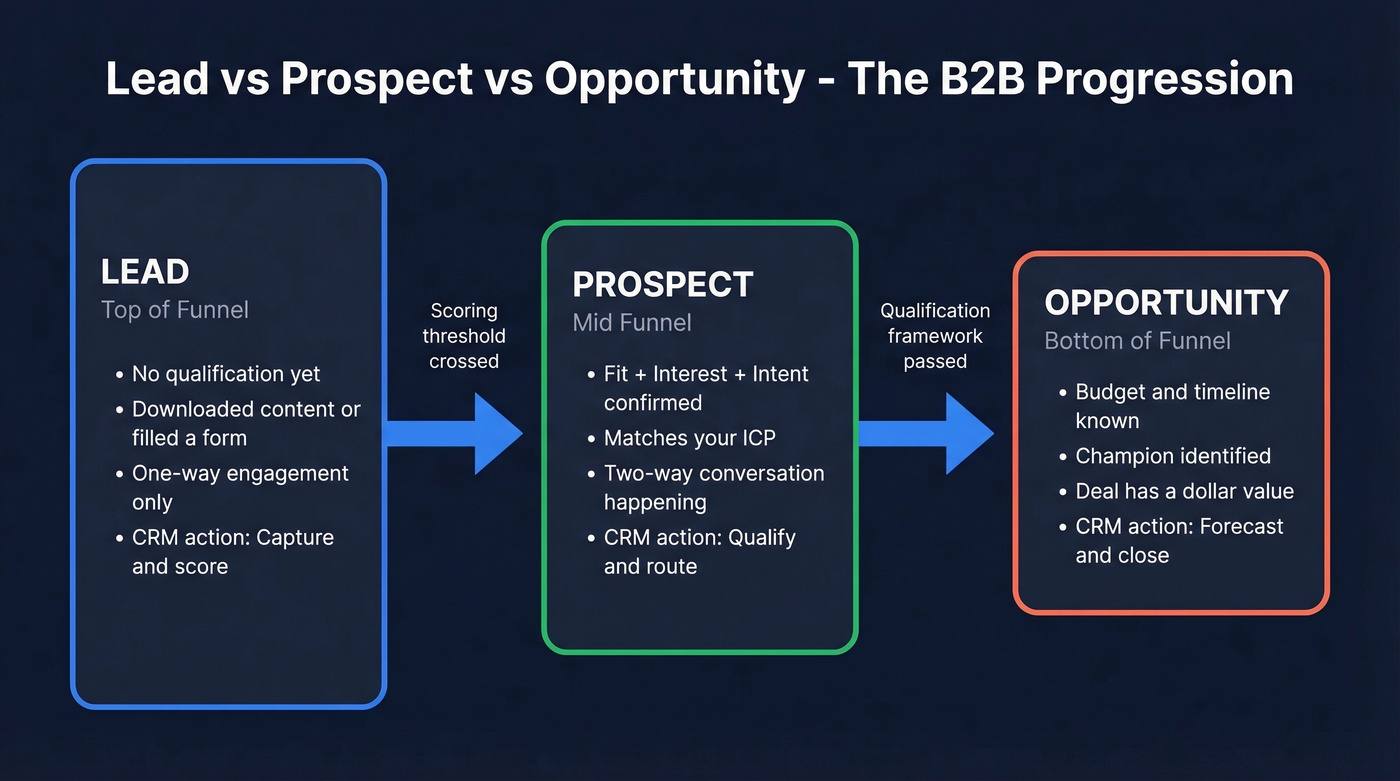
A lead is someone who's shown potential interest but hasn't been vetted. They downloaded something, filled out a form, or showed up in a purchased list. You know their name and maybe their email. That's it.
A prospect is a qualified lead - they fit your ICP, they've shown meaningful interest, and there's evidence of intent. The relationship has shifted from one-way to two-way. You're actually talking.
An opportunity is a qualified deal with a dollar value, a close date, an identified champion, and a concrete next step. Not every prospect becomes an opportunity, and that's fine.
| Dimension | Lead | Prospect | Opportunity |
|---|---|---|---|
| Funnel stage | Top | Mid | Bottom |
| Qualification | None | Fit + Interest + Intent | Budget, timeline, champion |
| Engagement | One-way | Two-way conversation | Deal in progress |
| CRM action | Capture & score | Qualify & route | Forecast & close |
The tricky part isn't the definitions. It's that your CRM, your marketing team, and your sales team are all using different versions of them.
Why Your Team Disagrees
This isn't about semantics. It's about two fundamentally different models that have been floating around B2B sales for years, and Salesgenie's research lays out the split clearly.
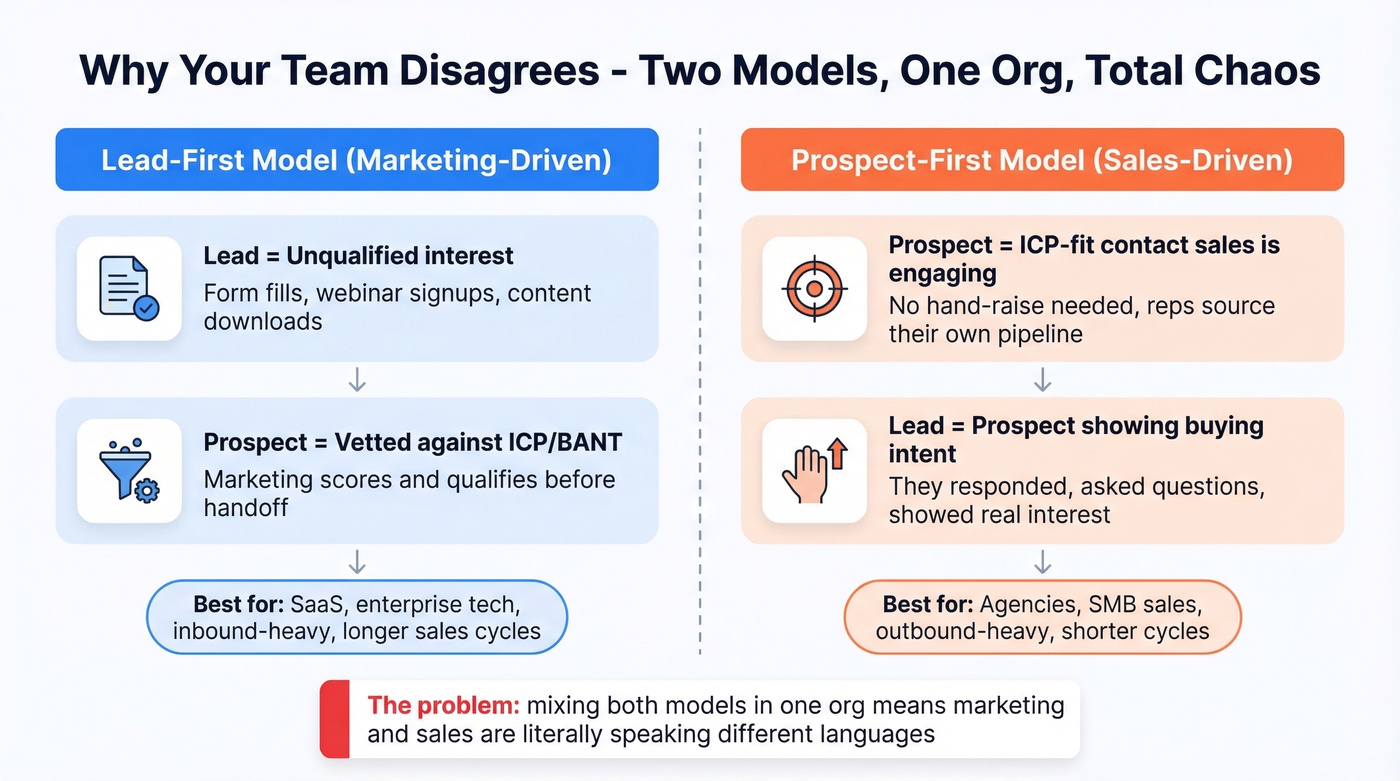
The Lead-First Model (Marketing-Driven) treats a "lead" as any unqualified interest - a form fill, a webinar attendee, a content download. A "prospect" is what that lead becomes after marketing vets it against ICP criteria, BANT qualifiers, or a scoring threshold. This model dominates in SaaS and enterprise tech, where inbound generates volume and marketing needs to filter before handing off.
The Prospect-First Model (Sales-Driven) flips it. A "prospect" is an ICP-fit contact that sales is actively engaging - they haven't raised their hand at all. A "lead" is a prospect who's shown clear buying intent. You'll see this more in agencies, SMB sales, and outbound-heavy motions where reps source their own pipeline. The framing is essentially reversed, which is exactly why cross-functional alignment breaks down.
| Lead-First (Marketing) | Prospect-First (Sales) | |
|---|---|---|
| "Lead" means | Unqualified interest | Engaged, showing intent |
| "Prospect" means | Vetted against ICP/BANT | ICP-fit, sales engaging |
| Best for | Longer B2B cycles, inbound | Shorter cycles, outbound |
| Common in | SaaS, enterprise tech | Agencies, SMB sales |
Ask five SDRs whether someone is a prospect or lead and you'll get five different answers. The consensus on r/sales is basically: a lead is anyone in the CRM, a prospect is someone you'd actually call back.
CRMs make this worse. Salesforce uses a Lead object that converts into a Contact on an Account. HubSpot treats everything as a Contact with lifecycle stages. Pipedrive is more deal-centric and can de-emphasize leads depending on how you set it up. Your team's disagreement isn't just philosophical - it's baked into the software.
The fix requires discipline more than cleverness. Pick one model, document it in a one-page internal glossary, and map it to your CRM objects. We've seen teams waste entire quarters arguing about MQL definitions when the real problem was that nobody wrote down what the words meant.

Your scoring model is only as good as the data underneath it. 18 bounced emails from 200 MQLs? That's a data problem, not a scoring problem. Prospeo's 5-step verification delivers 98% email accuracy on 300M+ profiles - so every lead you score is actually reachable.
Fix the data before you fix the funnel.
How to Turn a Lead Into a Prospect
This is where definitions become operations. The Fit + Interest + Intent framework gives you three gates that a lead must pass before it earns "prospect" status. All three are required - hitting one or two isn't enough.
Fit means the person matches your ICP. Right title, right company size, right industry, right geography. If someone downloads your whitepaper but works at a 3-person nonprofit and you sell enterprise security software, they're not a prospect. They're a reader.
Interest means they've taken actions that signal more than casual curiosity. Multiple website visits, pricing page views, email engagement, webinar attendance. One touchpoint isn't interest - it's a click.
Intent means there's evidence they're actively evaluating solutions. They've requested a demo, asked about pricing, or their company is showing buying signals on intent data platforms. Intent separates "educating themselves" from "building a business case."
The Scoring Model
Lead scoring turns these gates into numbers your CRM can act on.
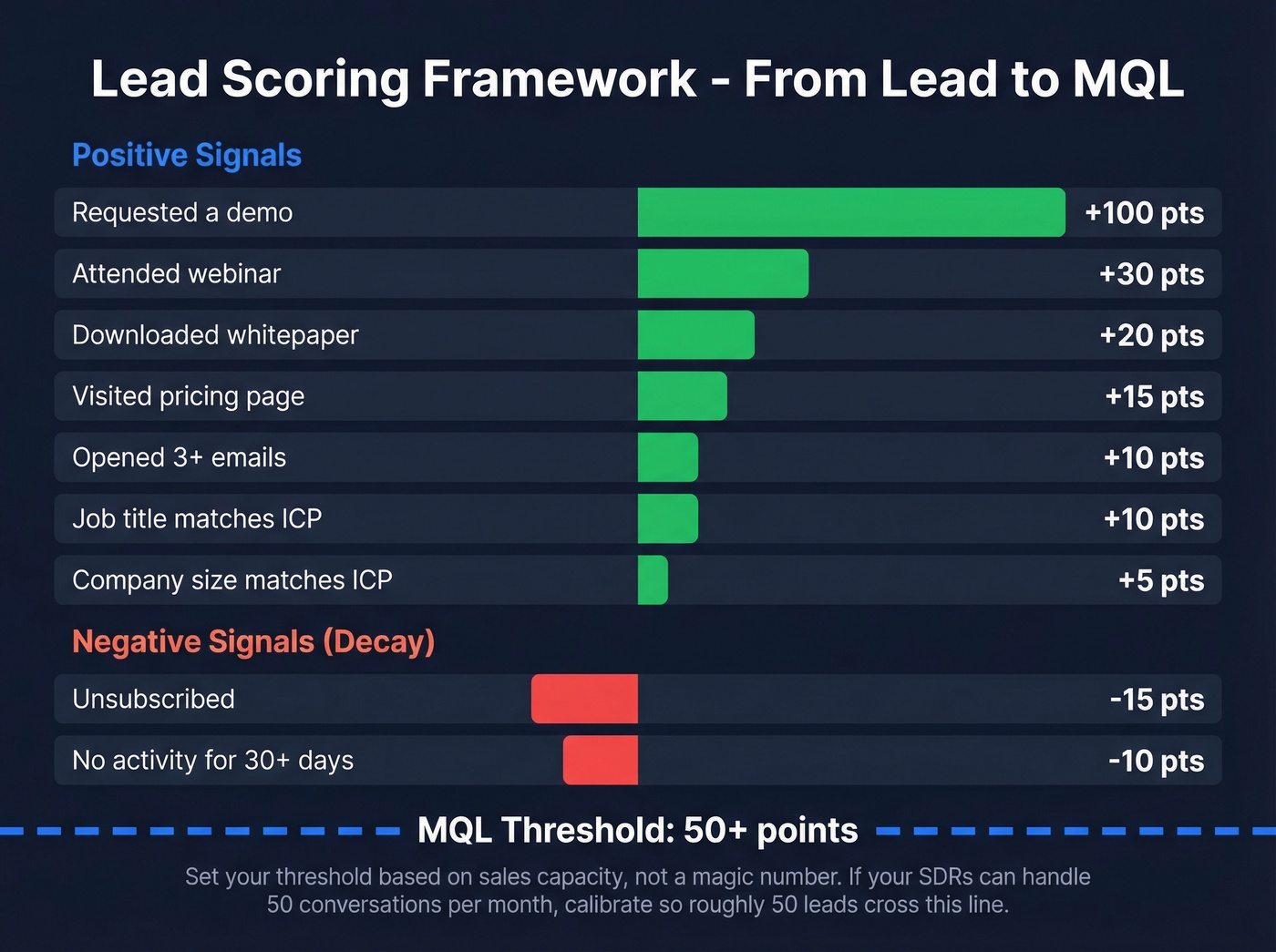
| Action/Attribute | Points |
|---|---|
| Requested demo | +100 |
| Attended webinar | +30 |
| Downloaded whitepaper | +20 |
| Visited pricing page | +15 |
| Opened 3+ emails | +10 |
| Job title matches ICP | +10 |
| Company size matches ICP | +5 |
| Unsubscribed | -15 |
| No activity 30+ days | -10 |
| MQL threshold | >50 |
Most scoring guides skip the operational details that actually matter. Negative scoring is as important as positive scoring - a lead who unsubscribes or goes dark for 30 days shouldn't sit in your "hot" bucket forever. Decay keeps your pipeline honest.
Your MQL threshold should be driven by sales capacity, not a magic number. If your SDR team can handle 50 qualified conversations per month, set the threshold so roughly 50 leads cross it. One client we worked with saw a 13% lift in MQL-to-meeting rate after lowering an activity threshold while tightening title and seniority filters.
Per Databox data via LeadsBridge, the typical score distribution skews heavily toward the middle: about 40% of leads score 41-60, roughly a third score 61-80, and fewer than 10% ever hit 81-100. If your model shows 40% of leads as "hot," your thresholds are too loose.
One critical rule that too many teams ignore: if someone requests to talk to sales, route them to a human immediately. No nurture sequence, no "we'll get back to you in 24 hours." That hand-raiser is your hottest lead. Treat them like it.
Before you score a single lead, verify your contact data. Prospeo's 5-step verification delivers 98% email accuracy on a 7-day refresh cycle, giving your scoring model real inputs instead of guesses. A lead with a verified email and confirmed job title is worth scoring. A lead with a generic Gmail address and no company info is noise.
The Opportunity Litmus Test
Once a prospect passes scoring, they still need to clear one more gate before becoming an opportunity:
- Confirmed problem the prospect acknowledges
- Champion identified inside the account
- Budget and timeline roughly known
- Concrete next step scheduled
Miss any of those and it's still a prospect - not a deal.
Which Qualification Framework?
Your scoring model gets leads to the MQL line. A qualification framework is what your reps use to push prospects toward (or away from) opportunity status.
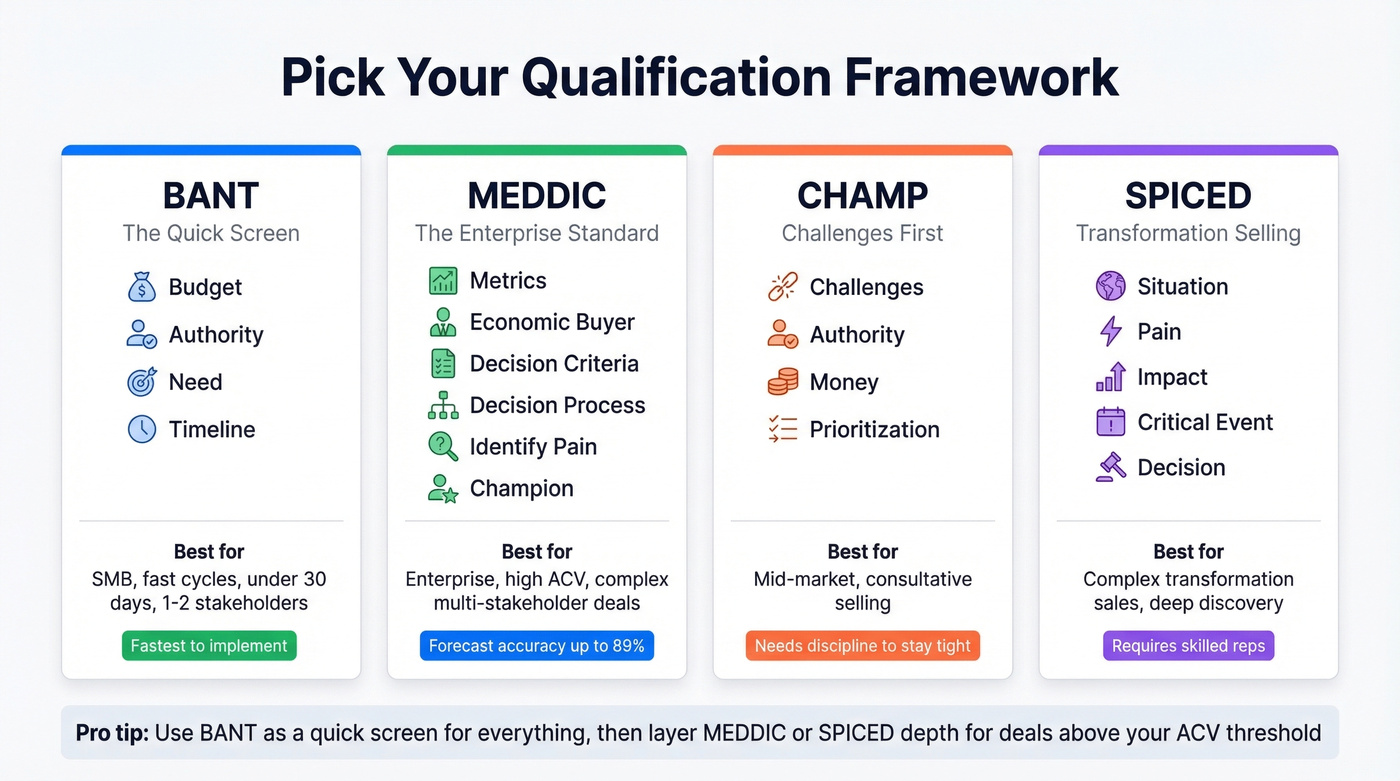
| Framework | Best For | Core Focus | Weakness |
|---|---|---|---|
| BANT | SMB / fast cycles | Budget, Authority, Need, Timeline | Too simple for multi-stakeholder |
| MEDDIC | Enterprise / high-ACV | Metrics, Economic Buyer, Decision Process, Champion | Slows deals if rigid |
| CHAMP | Mid-market consultative | Challenges first, then Authority, Money, Priority | Too loose without discipline |
| SPICED | Transformation selling | Situation, Pain, Impact, Critical Event, Decision | Requires deep discovery skills |
BANT is the fastest screen. If you're closing deals in under 30 days with one or two stakeholders, it's all you need. But it falls apart in complex enterprise sales where the "budget holder" is three levels removed from the person you're talking to.
MEDDIC is the gold standard for enterprise. One story cited in framework writeups shows forecast accuracy improving from 62% to 89% after standardizing on it. The tradeoff is real though - applied too rigidly, it turns every discovery call into an interrogation.
Here's the thing: most teams overthink framework selection. Use BANT as a quick screen for everything, then layer in MEDDIC or SPICED depth for deals above a certain ACV. If your average contract value is under $15k, you don't need a six-field qualification methodology. You need faster follow-up and better data. Map whichever framework you choose directly into your CRM - if your reps can't fill in the Champion field, the deal isn't qualified.
Funnel Benchmarks
Let's ground this in numbers so you know what "good" looks like.
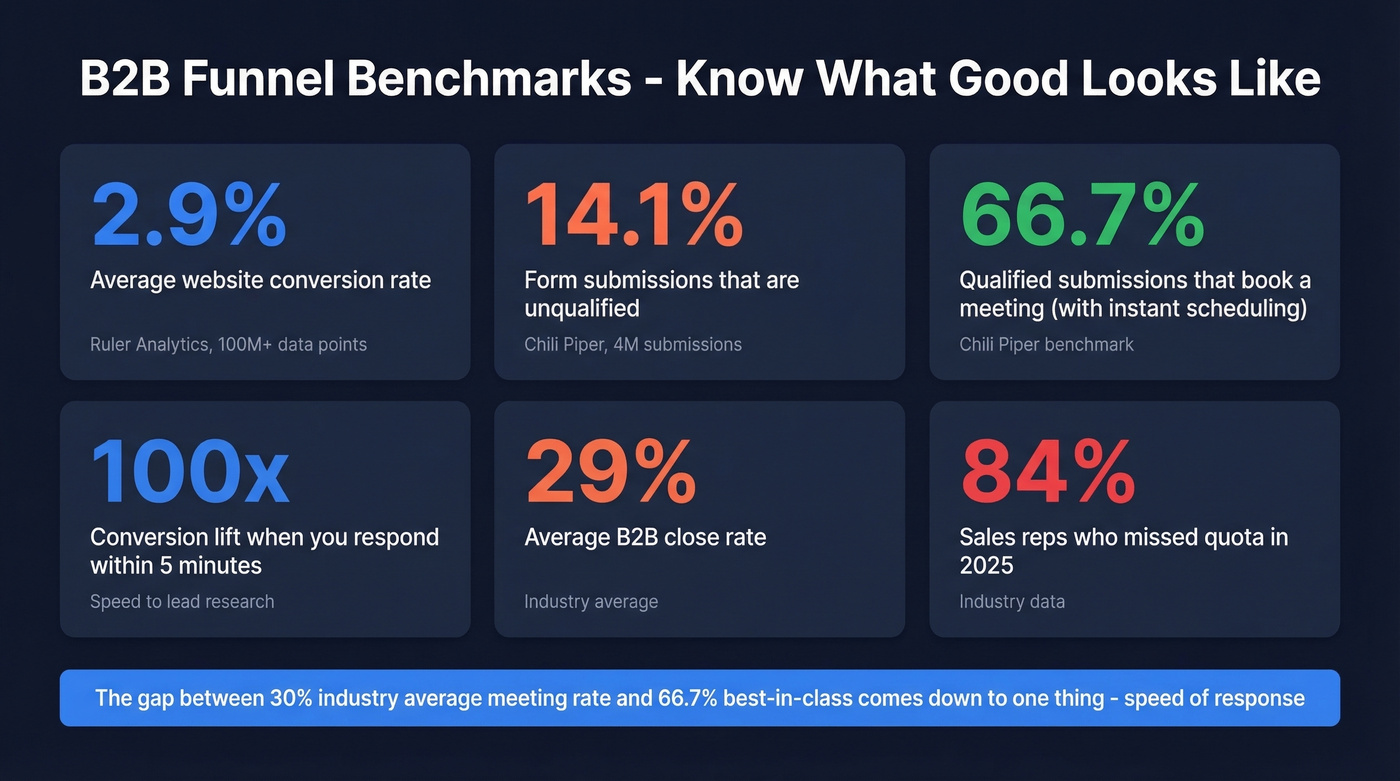
Chili Piper analyzed roughly 4 million form submissions across their B2B customer base. Of those, 14.1% were unqualified. Of the qualified submissions, 66.7% booked a meeting - compared to an industry average of about 30%. The difference? Immediate scheduling after the form fill. Responding within 5 minutes increases conversion rates by 100x. Speed to lead isn't a cliche.
Ruler Analytics' dataset of 100M+ data points across 14 industries puts the average website conversion rate at 2.9%. That's form fills plus calls. Form-only rate is 1.7%.
The downstream picture is tougher. 84% of sales reps missed quota in 2025. The average B2B close rate sits around 29%. And Gartner's data shows 80% of B2B sales interactions now happen in digital channels - meaning your lead qualification process increasingly runs before a rep ever gets involved.
These numbers tell a clear story. If 2.9% of visitors become leads, 80% of those leads never convert, and your close rate is 29%, every percentage point you gain at the lead-to-prospect stage compounds dramatically downstream. Companies that invest in lead nurturing generate 50% more sales-ready leads at 33% lower cost. Qualify better, not louder.
The Data Quality Problem Nobody Talks About
Scoring models and qualification frameworks are great on a whiteboard. But here's a scenario we've seen play out too many times.
It's pipeline review day. Your CRM shows 47 "prospects" in active sequences. Your manager is optimistic. Then someone actually checks - 12 have bounced emails, 8 have wrong phone numbers, 6 changed jobs three months ago, and 15 have never responded to anything. You don't have 47 prospects. You have maybe 6.
The difference between a prospect and a lead becomes meaningless when neither category contains accurate data.
When Snyk's 50 AEs switched to Prospeo, their bounce rate dropped from 35-40% to under 5%, and AE-sourced pipeline jumped 180% - generating 200+ new opportunities per month. That's not a marginal improvement. That's the difference between a scoring model that works and one that's fiction.
The data quality gap is the most underrated problem in lead qualification. Teams spend weeks debating BANT vs MEDDIC while their CRM is full of stale records that no framework can fix. Before you optimize your qualification process, fix your data. Everything else is downstream.
If you're rebuilding your stack, start with data enrichment and a clear lead status taxonomy so your CRM reflects reality.
You just built Fit + Interest + Intent gates. Now you need contact data that survives them. Prospeo refreshes every 7 days, verifies emails and mobiles before you pay, and returns 50+ data points per contact - so your prospects stay prospects, not bounces.
Qualify leads with data that's actually current - starting at $0.01 per email.
FAQ
Is a prospect the same as an MQL?
No. An MQL has hit a scoring threshold but hasn't been vetted by sales. A prospect has cleared all three gates - Fit, Interest, and Intent - and a real two-way conversation has started. Most MQLs never reach prospect status.
Can a prospect revert to a lead?
Yes. If they go dark, lose budget, or change roles, recycle them back to lead status. Build "recycle" triggers into your CRM automation so your pipeline reflects reality - qualification only holds as long as the conditions do.
How many leads typically become prospects?
Inbound leads convert to prospects at roughly 10-15%. Outbound prospecting with verified data and ICP targeting can hit 20-30%. The 2.9% average website conversion rate is the top-of-funnel baseline before any of that math kicks in.
Does contact data quality affect lead scoring?
It's the single biggest variable most teams ignore. If a third of your emails bounce, your scoring model is grading ghosts. A 7-day refresh cycle and multi-step verification process ensures your framework operates on contacts who actually exist at the companies you think they do.
What's the difference between a prospect and an opportunity?
A prospect is a qualified contact with confirmed ICP fit and two-way engagement. An opportunity is a qualified deal - dollar value attached, close date set, champion identified, and a concrete next step scheduled.