

Lead411 vs Nymeria: The Honest Comparison
Lead411 and Nymeria aren't competing for the same buyer. One is a sales intelligence platform with intent data and built-in outreach. The other is a lightweight contact finder with a cheap entry point. Teams still cross-shop them because both promise verified contact data without ZoomInfo-level pricing - so here's how the Lead411 vs Nymeria decision actually shakes out in 2026.
30-Second Verdict
- Pick Lead411 if you want a real prospecting platform: a big database, Bombora intent data on annual plans, CRM integrations, and built-in outreach for email + SMS.
- Pick Nymeria if you're a solo operator who mainly needs emails from professional profiles and you want the lowest entry price.
- Skip both if data freshness matters most. Prospeo delivers 98% email accuracy with a 7-day refresh cycle and a free tier, so you can test quality before you commit.
What Each Tool Does
Lead411 at a Glance
Lead411 is built for teams doing repeatable outbound: list building, enrichment, and sequencing. The database covers 450M contacts and 20M companies, and the product wraps that data in sales workflows - not just "find email, export CSV."
The differentiator is intent plus triggers. On annual plans, you get Bombora-powered buyer intent alongside growth signals like hiring surges, new funding rounds, exec changes, IPO announcements, and new location signals. The built-in outreach tool (Reach) lets reps launch email and SMS touches without switching platforms, which removes friction from the daily prospecting loop. Unused exports roll over - a small detail that matters at scale.
Nymeria at a Glance
Nymeria is a contact lookup tool with a developer-friendly edge. It covers personal emails, work emails, mobile and direct-dial numbers, biographic data, social links, and company firmographics. The core pitch: pre-verified emails (not guessed formats), quick enrichment, and you only burn credits on successful lookups. You can cancel anytime.
Nymeria lives in your browser and your stack. It offers extensions for all major browsers and a public API with SDKs in Go, Python, JavaScript, and Ruby. That's great for scrappy workflows where you're enriching on the fly or building your own pipeline.
The tradeoff is market depth. Nymeria's footprint is thin, and you feel that when you look for proof beyond a handful of reviews.
Side-by-Side Feature Comparison
| Feature | Lead411 | Nymeria |
|---|---|---|
| Entry price | $490/yr (~$40.83/mo) | $39/mo ($390/yr) |
| Database size | 450M contacts, 20M cos | Unclear (3.5M-3.5B) |
| G2 rating | 4.5/5 (477 reviews) | 4.7/5 (6 reviews) |
| Intent data | Bombora (annual plans) | No |
| Built-in outreach | Yes (Reach - email + SMS) | No |
| CRM integrations | 27 | API/export only |
| Email verification | Re-verified every 3 months | "Pre-verified" |
| Credit rollover | Yes | No |
| Free tier | Trial (terms vary) | 5 credits/mo |
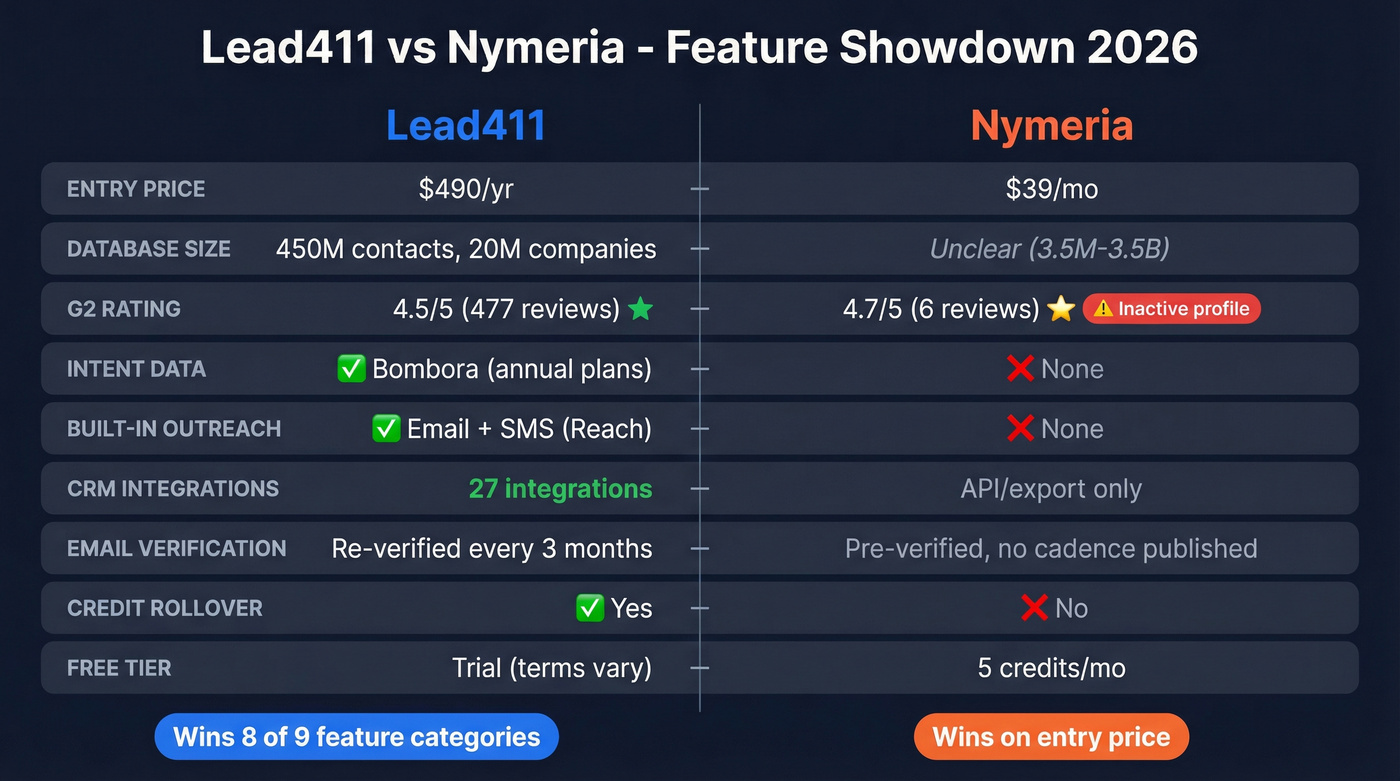
Lead411 takes eight of ten feature rows. Nymeria wins on entry price and free-tier simplicity. If you're spending $390+/year anyway, Lead411's extra $100 buys you an entirely different class of tool.

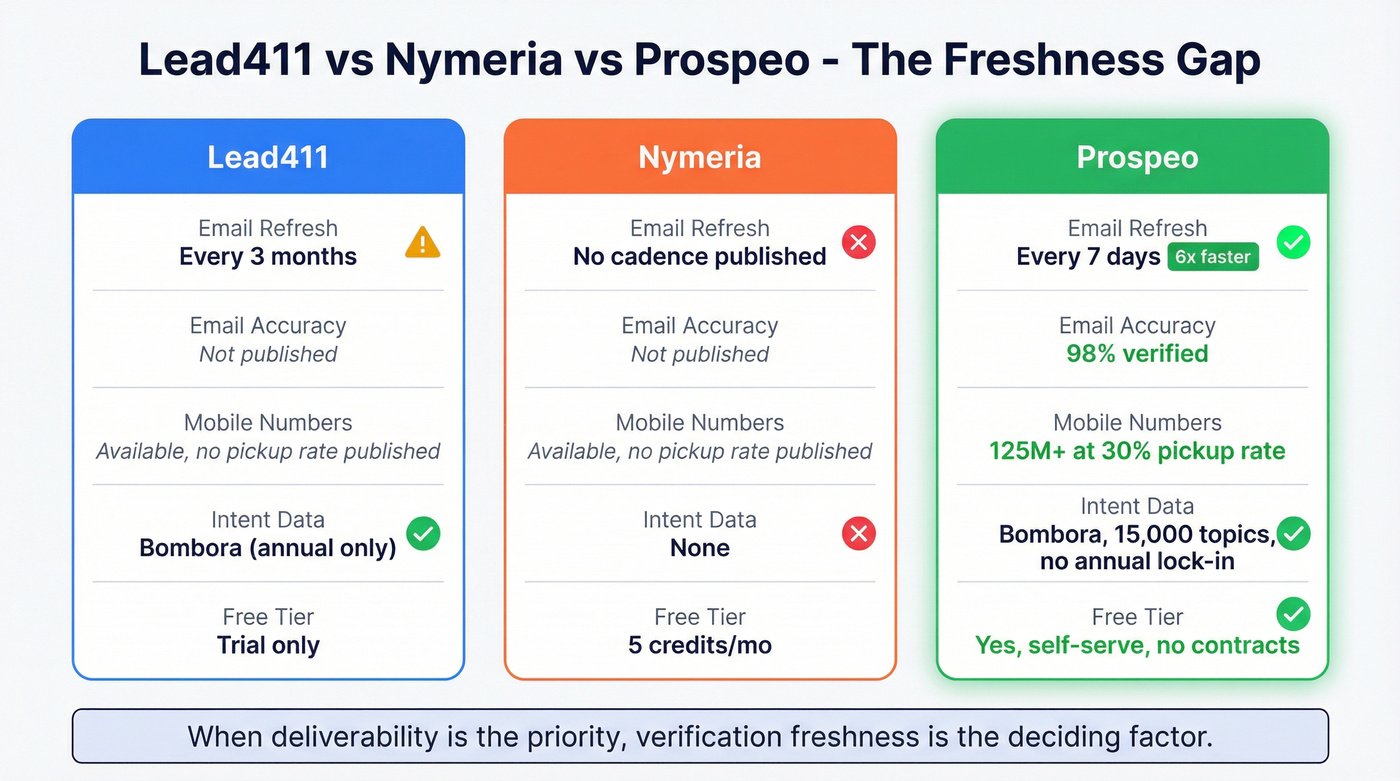
Lead411 re-verifies every 3 months. Nymeria doesn't publish a cadence at all. Prospeo refreshes all 300M+ profiles every 7 days - 6x faster than Lead411 - with 98% email accuracy and 125M+ verified mobiles at a 30% pickup rate. Plus you get Bombora intent data on 15,000 topics without an annual lock-in.
Stop debating stale data - test the freshest database free today.
Where They Actually Differ
Pricing and Credit Economics
Nymeria wins the "cheapest" headline at $39/mo for the Nano plan. It scales to Micro at $79/mo, Kilo at $159/mo, and a custom Enterprise tier. Annual billing drops those by roughly a month's cost - Nano lands at $390/yr.
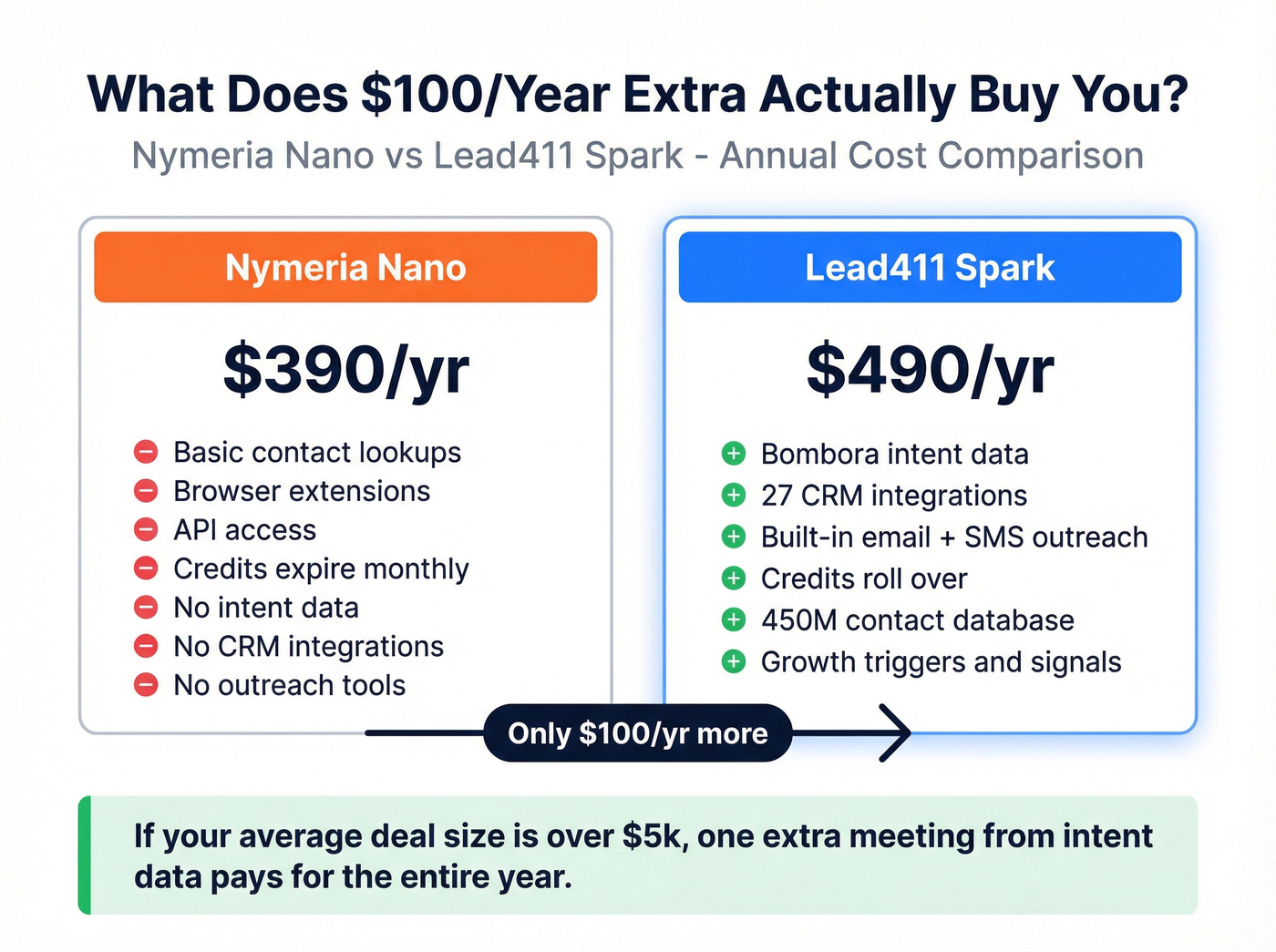
Lead411's Spark plan is $490/yr billed annually. For $100/year more than Nymeria Nano, you get intent data, built-in outreach, rollover credits, and 27 CRM integrations. That's not a minor upgrade; it's a different category of tool.
Credits don't roll over on Nymeria, so if you're doing real volume, expiring credits become a monthly tax. Based on typical enrichment-tool packaging, expect roughly 1,000 / 5,000 / 10,000 credits across Nano/Micro/Kilo tiers.
Here's the thing: if your average deal size is under $5k, Nymeria's simplicity might be all you need. Above that threshold, the intent signals in Lead411 pay for themselves after one or two meetings that wouldn't have happened otherwise.
Data Quality and Freshness
Lead411 re-verifies emails every 3 months. That cadence is fine for mid-market outbound, but it's not "always fresh." Job changes, role shifts, and company turnover can make a contact stale in weeks, not months.
Nymeria doesn't publish a re-verification cadence at all. And the database size story is messy - you'll see 3.5M in one place and 3.5B in another (more on that in the FAQ). When a vendor can't keep its own coverage numbers consistent, the data supply chain isn't mature.
Phone coverage is where most tools disappoint. On Reddit, a buyer trying to enrich 300 rows reported roughly 20% phone match as their baseline - and that tracks with the 10-30% range we've seen across bake-offs in this category. Neither Lead411 nor Nymeria publishes a mobile pickup rate, which makes it hard to benchmark either one.
Market Validation
Lead411 has 477 reviews on G2. Nymeria has 6, and G2 flags the profile as inactive for over a year.
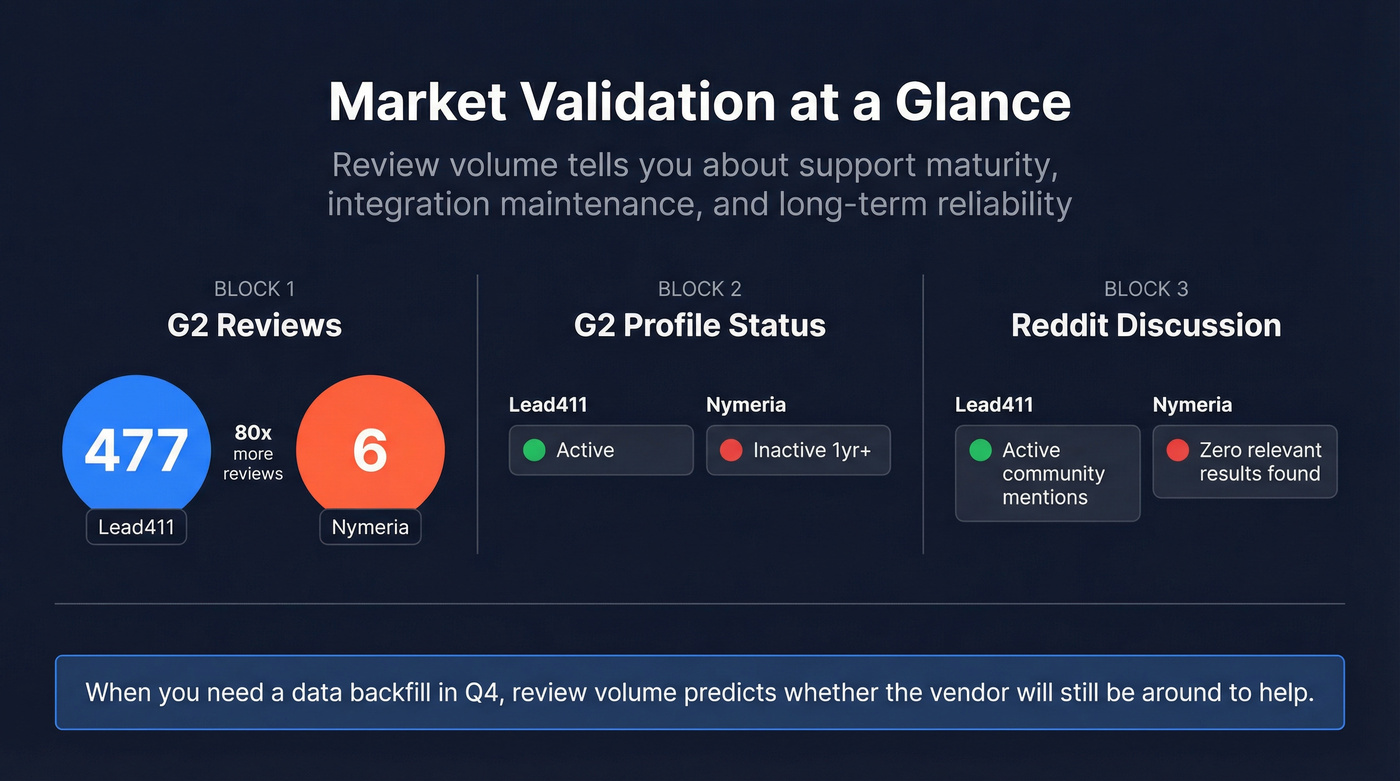
That disparity tells you a lot about long-term reliability. Review volume correlates with support maturity, integration maintenance, and whether the vendor will still be around when you need a data backfill in Q4. We tried finding real-world Nymeria discussion on Reddit and came up empty - the matches were all unrelated to the B2B data tool. That alone makes it tough to recommend for a multi-seat rollout.
Features Beyond Contact Data
Lead411 is a Swiss Army knife: database + intent + triggers + enrichment + outreach. Nymeria is a bottle opener: fast contact lookup, credits, API, extensions.
That's not an insult. If your workflow is "find a person, get an email, send one-off outreach," Nymeria's simplicity is the point. But Lead411 is closer to a mini ZoomInfo with intent and workflows, while Nymeria is a lightweight enrichment utility. ZoomInfo still wins on breadth, but a 10-seat contract with intent and mobile runs $40-60k/year - overkill for most teams under 50 reps.
What Users Actually Say
Lead411 on G2: Reviewers praise accurate contact info (32 mentions) and ease of use (30). The recurring complaint is outdated contacts (13 mentions) and data that sometimes needs cross-referencing. That tracks - every database benefits from a verification layer on top.
Nymeria on G2: One reviewer called it "the only reliable tool for the job." Another said accuracy can be "a bit outdated" but still helpful "90% of the time." The strongest Nymeria proof point: one user reported getting "more access to personal contact information than Lusha and even ZoomInfo." Bold claim from a tool with six reviews, but it suggests Nymeria punches above its weight on personal email coverage specifically.
Let's be honest - six reviews isn't enough to draw conclusions. If you're considering Nymeria for a team, run your own test against 200-300 contacts from your ICP before committing.
A Third Option Worth Testing
If neither tool feels right, Prospeo fills the freshness gap in this matchup. It runs 300M+ profiles with 98% email accuracy and a 7-day refresh cycle - Lead411 re-verifies every 3 months, Nymeria doesn't publish a cadence. You also get Bombora intent data on 15,000 topics, 125M+ verified mobile numbers with a 30% pickup rate, and fully self-serve onboarding with no contracts.
Beyond raw data, Prospeo's 5-step verification process - including catch-all handling, spam-trap removal, and honeypot filtering - means fewer bounces wrecking your sender reputation. Teams like Snyk cut bounce rates from 35-40% to under 5% after switching, and Stack Optimize maintains 94%+ deliverability across all client campaigns. When your outbound volume is high enough that sender reputation becomes a revenue lever, verification quality stops being a nice-to-have.

Neither Lead411 nor Nymeria publishes a mobile pickup rate, so you're guessing. Prospeo gives you 125M+ verified mobile numbers with a documented 30% pickup rate, 98% email accuracy, and credits starting at $0.01/email. No contracts, no expiring credits drama.
Get verified mobiles and emails that actually connect - from a free tier.
The Verdict
Choosing between Lead411 and Nymeria comes down to what kind of buyer you are:
Team outbound + intent workflows: Lead411. It's the closest thing to ZoomInfo-style capability without ZoomInfo-style overhead.
Solo prospecting on a tight budget: Nymeria - but go in eyes-open about the tiny review footprint and inactive G2 profile. Skip it if you need phone numbers at scale or any kind of intent signal.
Accuracy + freshness without commitment: Prospeo. Weekly refresh, 98% verified emails, and 125M+ mobile numbers win when deliverability is the priority.
If you're still comparing tools in this category, it helps to zoom out and benchmark against other sales prospecting databases and data enrichment services before you lock in.
FAQ
Is Nymeria's database really 3.5 billion profiles?
Nymeria's database size numbers conflict across the ecosystem: one place shows 3.5 million, another lists 3.5 billion. When coverage metrics don't match across listings, treat the larger number as marketing noise and validate with a real sample test against your ICP.
Does Lead411 include intent data on all plans?
No. Bombora intent data comes with Lead411's annual plans only. Monthly plans don't include it. The $490/year Spark plan is the clean entry point if intent signals matter - it bundles the intent layer with the core database and keeps budgeting predictable.