

Leads vs. Prospects: Definitions, Benchmarks, and the System That Converts Them
Your pipeline says $2M. Your forecast confidence is 40%. The VP of Sales wants to know why, and the honest answer is that nobody agrees on what separates leads and prospects. 84% of reps missed quota last year, and a big chunk of that failure traces back to fuzzy definitions, no scoring model, and a CRM full of contacts that haven't been touched in weeks.
The average website converts visitors to qualified leads at just 2.9%. Your funnel is already brutally narrow before sales gets involved. If you're losing a chunk of those leads because nobody knows when a lead becomes a prospect, you've got a systems problem - not a volume problem.
Here's the thing: most teams don't need more leads. They need a shared definition of what a qualified prospect actually looks like, and the discipline to enforce it. Fix that, and your existing pipeline starts converting dramatically better.
Quick Definitions
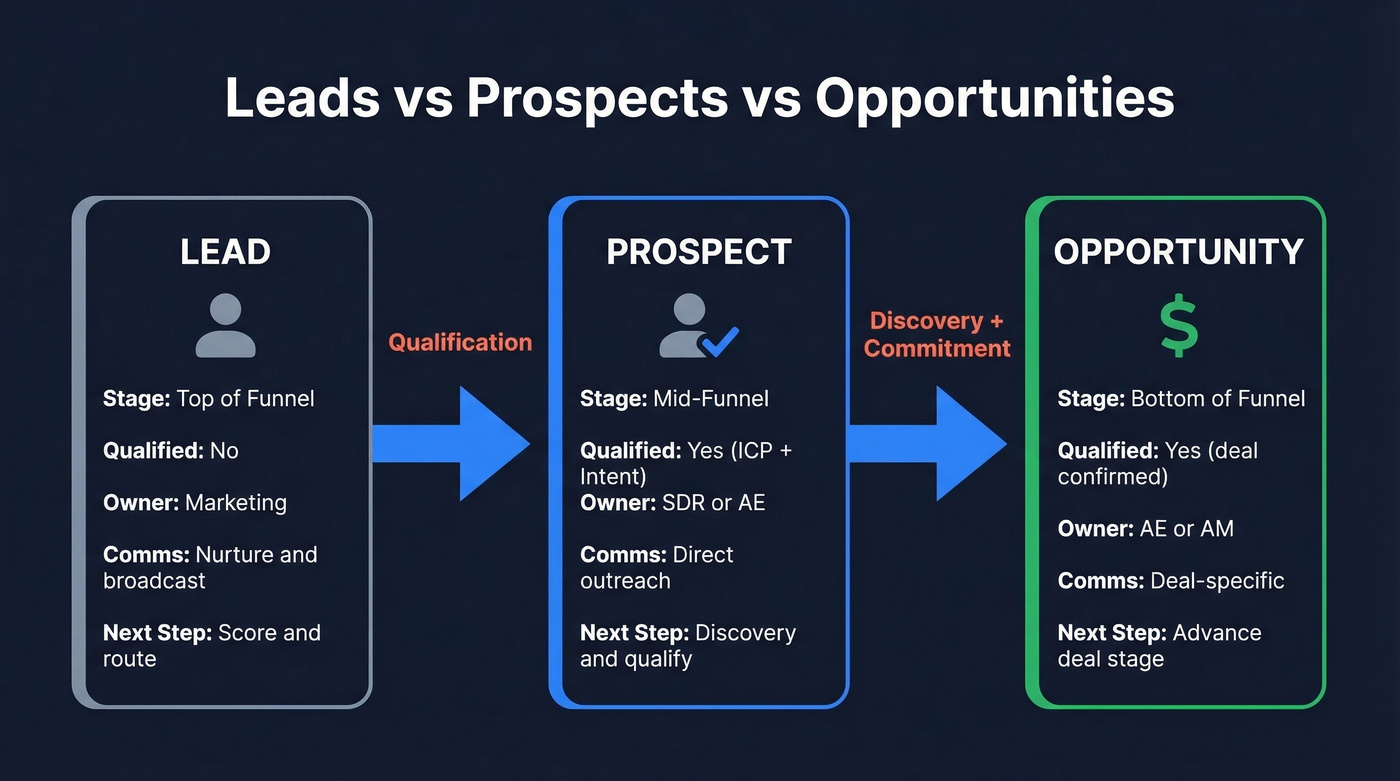
- Lead - anyone who's entered your funnel through a form fill, content download, event scan, or purchased list
- Prospect - a lead that's been qualified against your ICP and shows real buying signals
- Opportunity - a prospect in an active sales cycle with defined next steps
Two valid models exist for defining when a lead becomes a prospect. Pick the one that matches your sales motion, align your team on it, and build a scoring model around it.
Understanding the Difference
Most sales teams use these terms interchangeably, and it costs them. When marketing calls something a "qualified lead" and sales calls it "not even close," you get finger-pointing instead of pipeline.
What's a Lead?
A lead is anyone who's entered your orbit - they filled out a form, downloaded a whitepaper, attended a webinar, or got added from a purchased list. You know they exist, but you don't yet know if they can or will buy. Leads are raw material. Most won't convert, and that's fine - the system's job is to sort them.
What's a Prospect?
A prospect is a lead that's been vetted. They match your ideal customer profile and they've shown intent, and someone has confirmed they're worth pursuing. Communication shifts from broadcast nurture to direct, personalized outreach. Prospects have names on them. Someone owns the relationship.
What's an Opportunity?
An opportunity is a prospect in a defined sales cycle - a specific deal, a timeline, identified stakeholders, and a next step in the CRM. Everything before this stage is pipeline potential. Opportunities are pipeline reality.
Side-by-Side Comparison
| Attribute | Lead | Prospect | Opportunity |
|---|---|---|---|
| Funnel stage | Top | Mid | Bottom |
| Qualified? | No | Yes (ICP + intent) | Yes (deal confirmed) |
| Typical owner | Marketing | SDR / AE | AE / AM |
| Communication | Nurture / broadcast | Direct outreach | Deal-specific |
| CRM label | Lead / Contact | MQL or SQL | Opportunity |
| Next action | Score and route | Discovery / qualify | Advance deal stage |
Two Models: Pick One
There isn't one universal definition - there are two competing operating models:
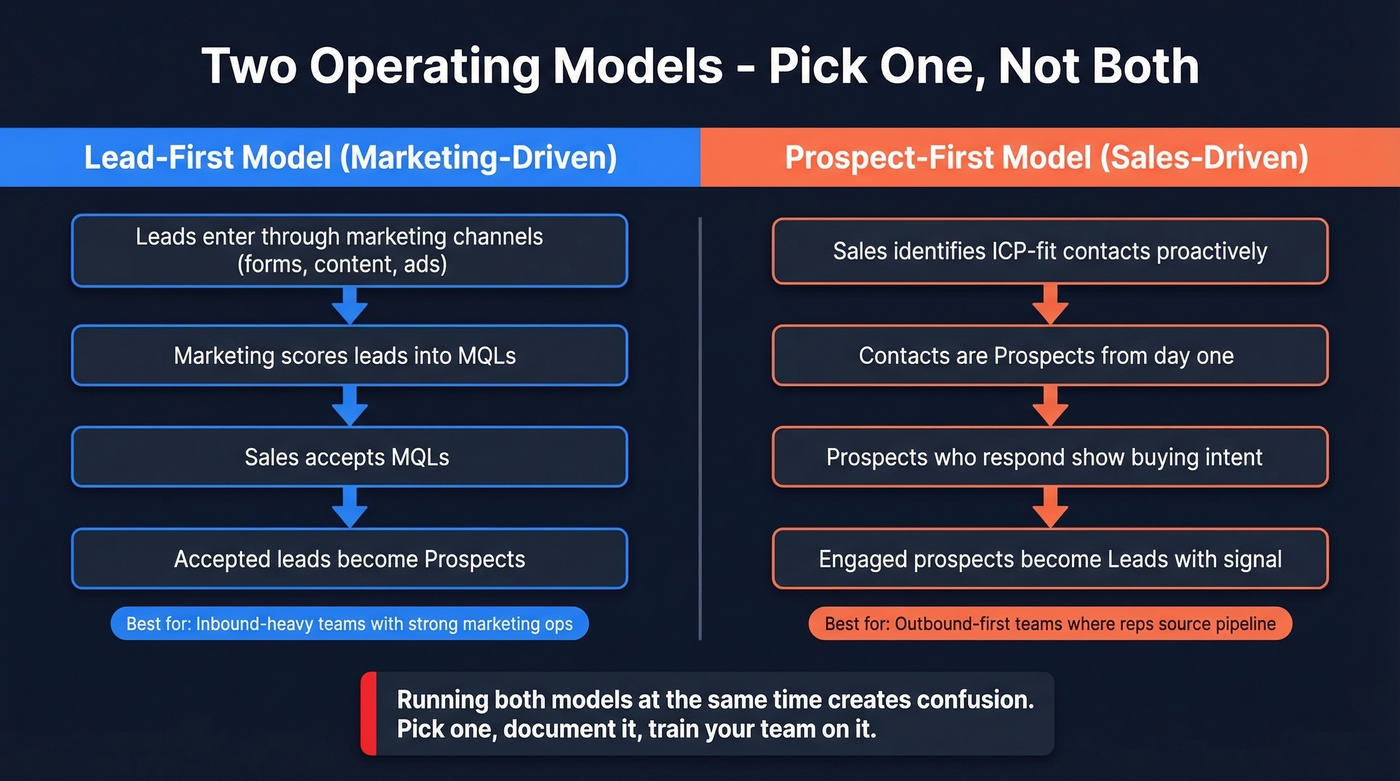
Lead-First (marketing-driven): Leads enter through marketing channels. Marketing scores them into MQLs. Once accepted by sales, they become prospects. This works for inbound-heavy teams with strong marketing ops.
Prospect-First (sales-driven): Sales identifies ICP-fit contacts and proactively engages them - they're "prospects" from day one. A "lead" is someone who responds or shows buying intent. This fits outbound-first teams where reps source their own pipeline.
Neither model is wrong. Running both simultaneously is. Pick one, document it, train on it.
Conversion Benchmarks by Stage
Definitions are useless without numbers. The average lead-to-MQL conversion rate across all industries is 31%. But that average hides massive variation.
By Industry
| Industry | Lead-to-MQL Rate |
|---|---|
| Environmental Services | 45% |
| Commercial Insurance | 40% |
| B2B SaaS | 39% |
| Cybersecurity | 39% |
| IT & Managed Services | 25% |
| Construction | 17% |
By Channel
| Channel | Lead-to-MQL Rate |
|---|---|
| Client Referrals | 56% |
| Executive Events | 54% |
| SEO | 41% |
| Email Marketing | 38% |
| PPC | 29% |
| Webinars | 19% |
Referrals convert nearly 3x better than webinars. That's not a knock on webinars - it's a reminder that channel mix matters as much as volume.
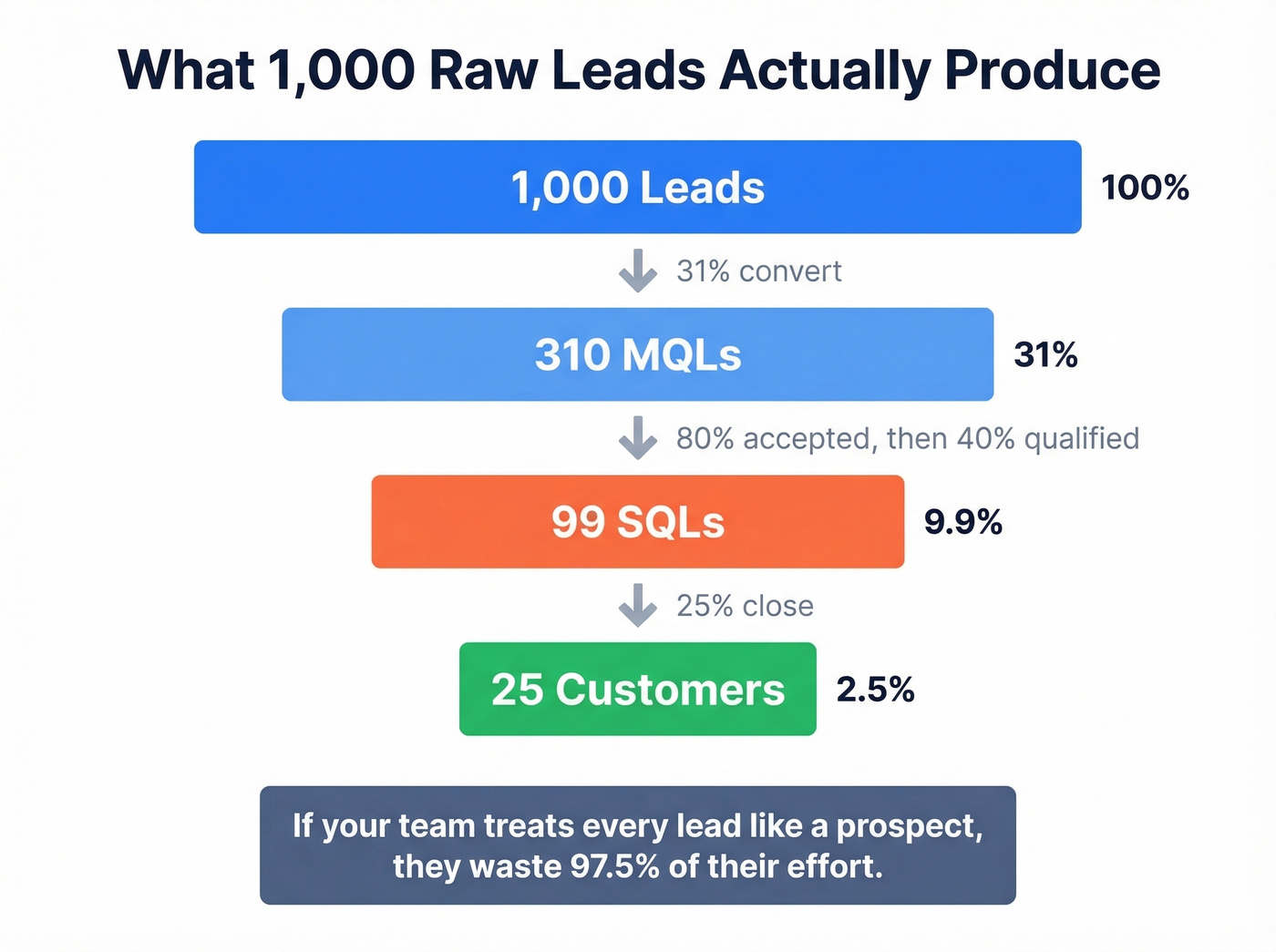
Now the full funnel math. Using benchmark ranges from common B2B lifecycle data, here's what 1,000 raw leads actually produce:
- Lead to MQL (31%): 310 MQLs
- MQL to SAL (80%): 248 sales-accepted leads
- SAL to SQL (40%): 99 sales-qualified leads
- SQL to Customer (25%): ~25 customers
One thousand leads. Twenty-five customers. If your team treats every lead like a prospect, they're wasting 97.5% of their effort on contacts who won't close.
There's a growing debate among practitioners about whether MQL is even a meaningful metric anymore. Some teams are shifting to pipeline velocity and SQL conversion as primary KPIs - and honestly, we think they're right for any team with deal sizes above $25K. MQL counts feel good in dashboards but tell you almost nothing about revenue trajectory.

Only 25 out of 1,000 leads become customers. The bottleneck isn't volume - it's data quality. Prospeo's 30+ search filters let you skip unqualified leads entirely and build prospect lists pre-filtered by buyer intent, technographics, headcount growth, and funding stage. Every email is 98% verified. Every record refreshes every 7 days.
Start with prospects, not leads. Build your first list in under 2 minutes.
How to Qualify Leads Into Prospects
The funnel math makes one thing clear: qualification is where revenue lives. We use a three-level model that works regardless of which framework you pick.
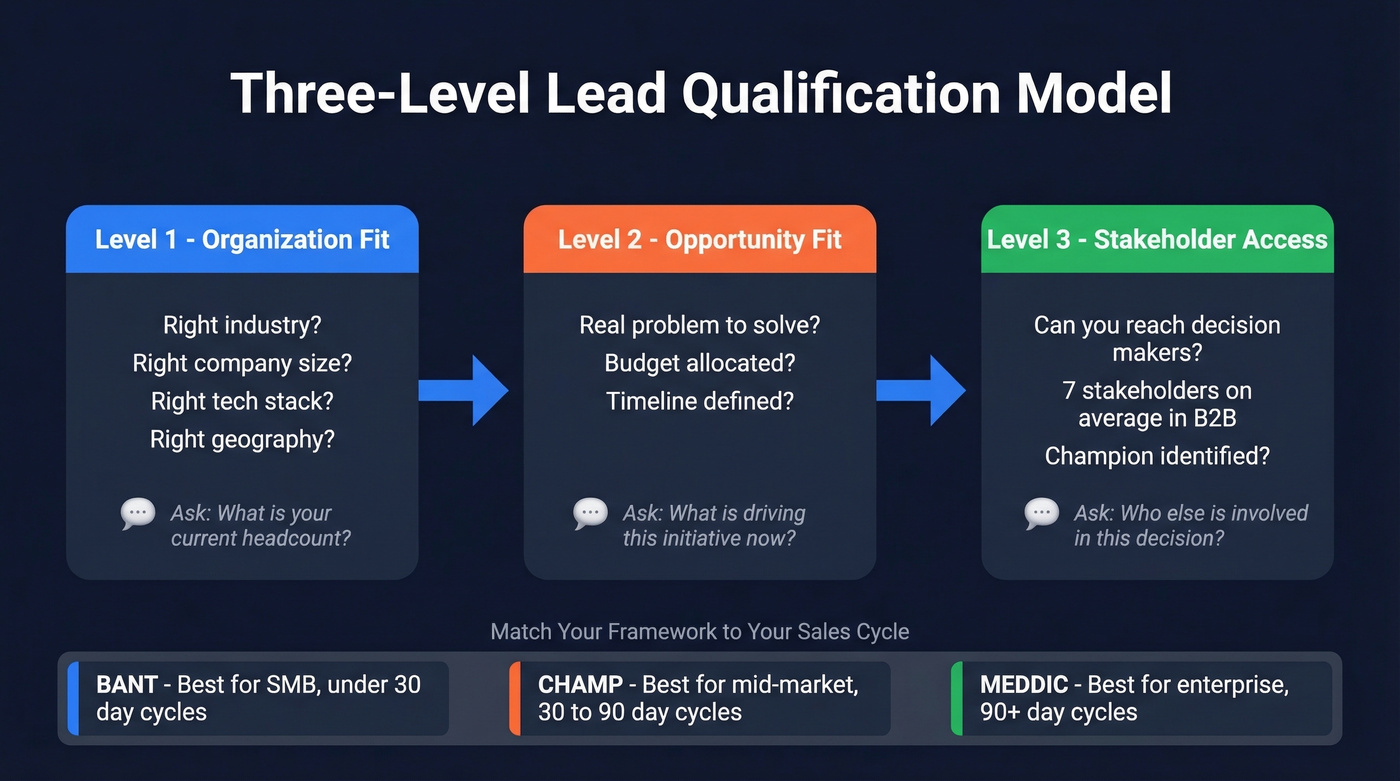
Level 1 - Organization Fit. Does this company match your ICP? Right industry, size, tech stack, geography? Ask: What's your current headcount? What tools are you using for [problem area]?
Level 2 - Opportunity Fit. Is there a real problem you can solve, with budget and timeline? Ask: What's driving this initiative now? Is there budget allocated?
Level 3 - Stakeholder Access. Can you reach the people who sign off? With an average of seven stakeholders in B2B purchases, this level matters more than ever. Ask: Who else is involved in this decision?
Which framework wraps around those levels? Three matter:
| Framework | Best For | Strengths | Weaknesses |
|---|---|---|---|
| BANT | High-velocity SMB | Simple, fast to teach | Weak on multi-stakeholder |
| CHAMP | Mid-market consultative | Pain-first, flexible | Loose without discipline |
| MEDDIC | Enterprise / complex | Better forecast accuracy | Requires training |
BANT originated at IBM in the 1950s and still works for transactional sales. MEDDIC is the gold standard for enterprise deals where a single missed stakeholder can kill a $200K opportunity. CHAMP sits in the middle - consultative enough to build trust, structured enough to keep reps honest. Use BANT when your sales cycle is under 30 days, CHAMP for 30-90 day cycles, and MEDDIC for anything longer.
Let's be honest: consistency matters more than framework choice. A simple framework used by 100% of your team beats a sophisticated one used by 30%. Pick one, enforce it, review adherence weekly.
Lead Scoring That Works
Frameworks tell reps what to ask. Scoring tells them who to ask first. Without it, reps either cherry-pick or spray-and-pray. Both waste time.
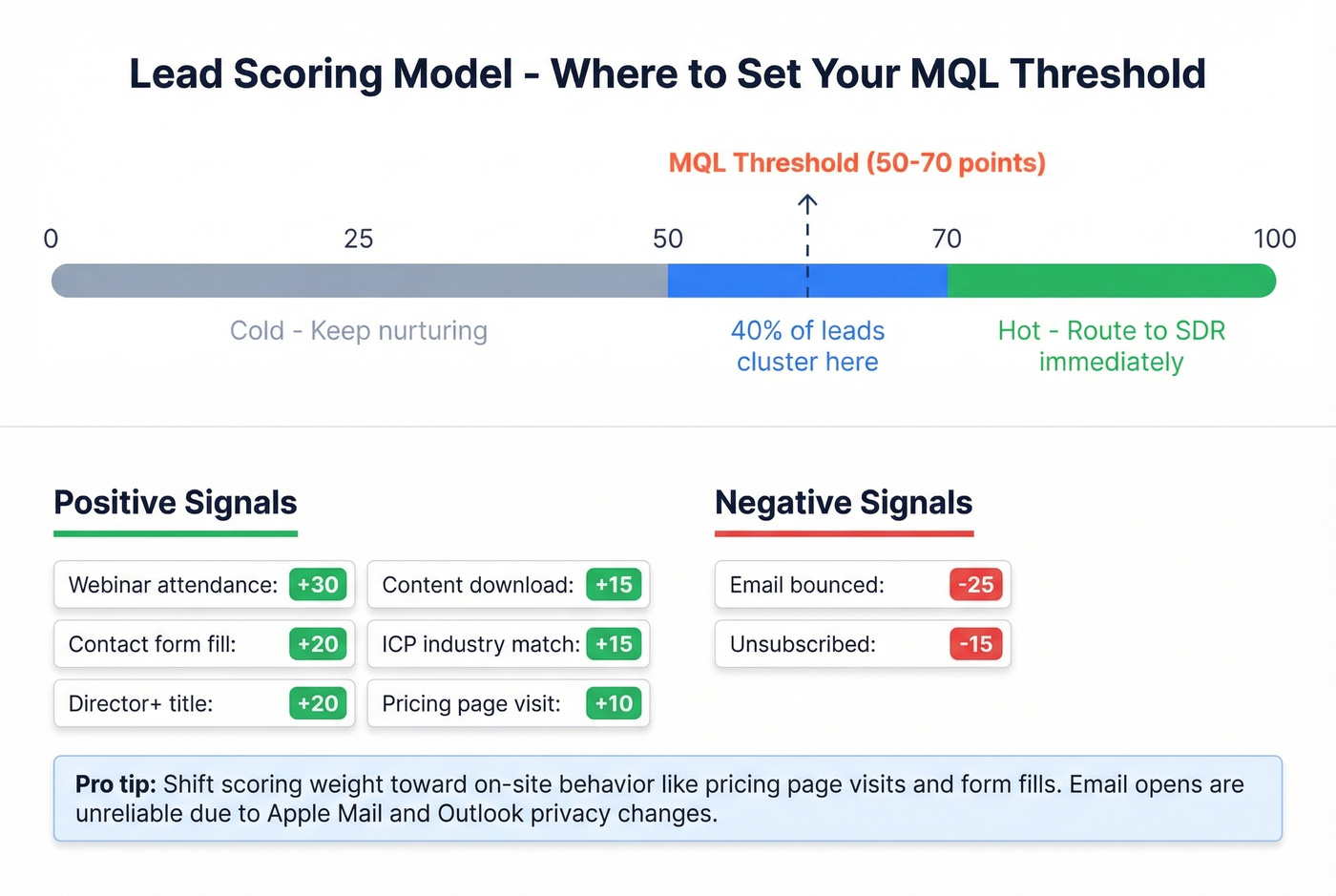
Here's a starter model you can copy into HubSpot, Pardot, or Marketo today:
| Signal | Points | Category |
|---|---|---|
| Pricing page visit | +10 | Behavioral |
| Content download | +15 | Behavioral |
| Webinar attendance | +30 | Behavioral |
| Clicked 10+ emails | +10 | Engagement |
| Filled contact form | +20 | Behavioral |
| Director+ title | +20 | Firmographic |
| ICP industry match | +15 | Firmographic |
| Company size 50-500 | +10 | Firmographic |
| Email bounced | -25 | Data quality |
| Unsubscribed | -15 | Disengagement |
Set your MQL threshold at 50-70 points. When a lead crosses that line, trigger a sales alert and route to an SDR. In Pardot, pair this with a letter grade for fit - scoring measures engagement, grading measures ICP alignment.
One nuance worth flagging: email opens are becoming unreliable as a scoring signal thanks to privacy changes in Apple Mail and Outlook. Shift your weight toward on-site behavior - pricing page visits, form submissions, and repeat sessions carry far more signal than open rates ever did.
About 40% of your leads will cluster in the 41-60 score range. That's your "warm but not hot" bucket. The scoring model's job is to separate the leads above your threshold from the rest, so reps focus where conversion probability is highest.
The thing that makes or breaks scoring? Data completeness. If you're missing job titles, company size, or tech stack data on half your leads, your firmographic scores are meaningless. Data enrichment tools like Prospeo fill those gaps - 92% API match rate, 50+ data points per contact - so your scoring model reflects reality, not guesswork.
Data Quality: The Step Everyone Skips
I've watched teams build beautiful scoring models, import 10,000 trade show leads, and then watch their sequences bounce at 35% because half the records were outdated. Domain reputation tanks, deliverability craters for months, and the scoring model gets blamed for what was actually a data problem.
Before leads enter your scoring model, run them through verification. Prospeo's 5-step verification process - catch-all handling, spam-trap removal, honeypot filtering - delivers 98% email accuracy on 143M+ verified addresses. Data refreshes every 7 days versus the 6-week industry average, so you're not scoring against stale records.
The proof is in the numbers. Meritt went from a 35% bounce rate to under 4% after switching to verified data, and their pipeline tripled from $100K to $300K per week. Garbage in, garbage out isn't a cliche - it's the single most common reason scoring models fail, and the easiest one to fix.
Mistakes That Inflate Your Pipeline
These are the patterns we see kill forecasts repeatedly:
Treating every lead the same. A whitepaper download and a pricing page visit aren't equal signals. Score them differently.
Inconsistent prospecting cadence. Reps prospect heavily in slow weeks and ignore it when deals are active. Pipeline dries up 60 days later. Build prospecting into the daily schedule - a steady flow of prospective contacts today prevents a dry pipeline next quarter. (If you need a repeatable system, start with these sales prospecting techniques.)
Keeping stagnant deals in pipeline. If a deal hasn't moved in 30 days, it's stalled. Remove it or move it back to nurture.
Relying on purchased lists without verification. Lists decay fast - a six-month-old list can be 15-18% dead. Verify before you sequence. (If you're comparing tools, see our guide to email verification.)
No follow-up strategy. Most lost sales trace back to inadequate qualification and insufficient follow-up. Define your cadence: how many touches, which channels, what timeframe. Use a set of proven sales follow-up templates to standardize execution.
Skipping pipeline reviews. Weekly reviews are the minimum. If your sales cycle is under 30 days, make them daily. Skip this if you enjoy surprise misses at quarter-end. (For what to track, use these pipeline health metrics.)
Your qualification framework is only as good as the data behind it. BANT, CHAMP, MEDDIC - none of them work when 35% of your emails bounce and you can't reach decision-makers. Prospeo delivers 98% email accuracy, 125M+ verified mobile numbers with a 30% pickup rate, and intent data across 15,000 topics so you know who's actually in-market.
Connect with real buyers instead of dead leads. At $0.01 per email.
FAQ
Can a prospect revert to a lead?
Yes. A prospect who goes dark for 90+ days should be reclassified back into nurture. Re-engage with fresh content and let the scoring model re-qualify them based on new intent signals rather than stale activity.
Is an MQL the same as a prospect?
In a Lead-First model, an MQL is essentially a prospect - marketing has qualified them for sales handoff. In a Prospect-First model, they're different stages entirely. Align your team on one definition and document it in your CRM.
How many leads does it take to close one customer?
Roughly 40, based on the benchmark math above. Construction teams might need 60+ per customer given their 17% lead-to-MQL rate, while environmental services teams might need closer to 25. Track your own funnel to calibrate.
What's the best CRM for tracking lead-to-prospect progression?
HubSpot for SMBs, Salesforce for enterprise, Pipedrive for lean teams. The CRM matters far less than consistent usage - a perfectly configured Salesforce that reps don't update is worse than a spreadsheet that gets filled in daily.
How do I verify lead data before scoring?
Upload your list to a verification tool before it enters your scoring model. Bulk verification flags bounced emails, spam traps, and outdated records - cleaning data at this stage prevents meaningless scores and protects domain reputation downstream.