

LeadsForge vs NoParam: A Comparison That Doesn't Actually Make Sense
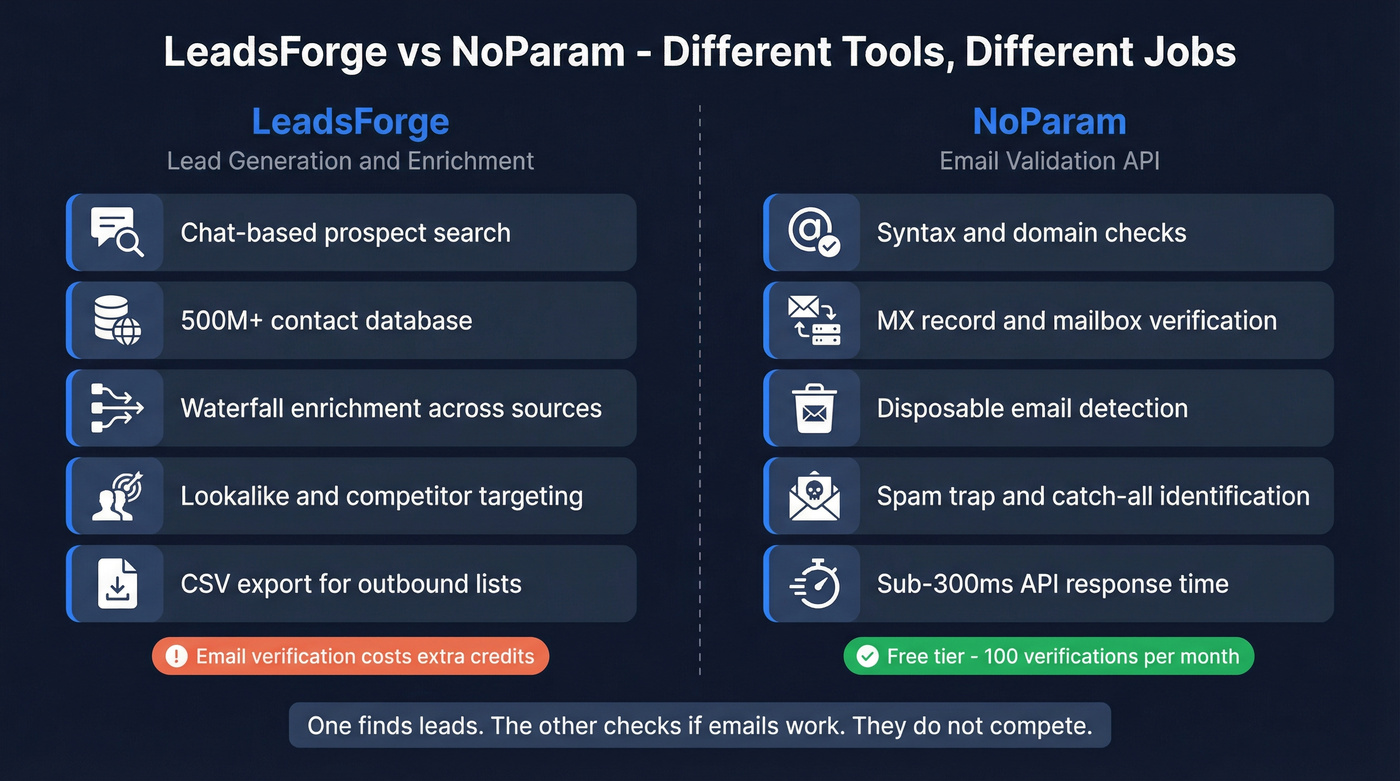
LeadsForge vs NoParam is one of those matchups that auto-generated software sites love to surface, but the two tools don't compete. LeadsForge is a lead generation engine - you use it to find prospects. NoParam is an email validation API - you use it to check whether an email address actually works. Both involve email, sure, but they solve completely different problems.
The comparison is useful, though, because it exposes a gap in most outbound stacks: the space between finding leads and trusting those leads enough to hit send.
30-Second Verdict
- Need to build prospect lists from scratch? LeadsForge. Chat-based search across 500M+ contacts, waterfall enrichment, CSV export.
- Need a lightweight API to block disposable emails on signup forms? NoParam. Real-time validation in under 300ms, free tier included.
What Each Tool Actually Does
LeadsForge - Lead Generation & Enrichment
Use this if you're building outbound lists from scratch and want a chat-based interface instead of a traditional filter dashboard. LeadsForge lets you describe your ICP in natural language, and its AI translates that into search filters across a 500M+ contact database. It runs waterfall enrichment - querying multiple data sources until it finds a verified email, phone number, or profile URL. You also get lookalike search, competitor follower targeting, and signal-based lead qualification.

Pricing is $49/month for 2,000 export credits, with a 100-credit free trial on signup and a 14-day trial available. Here's the catch: email validation can require additional credits, so the emails you export aren't necessarily verified unless you spend more. One G2 reviewer noted that initial emails "may not be reliable until validated" - which somewhat defeats the purpose of an enrichment tool.
That often pushes your effective cost per verified email higher than the base plan price suggests. On the positive side, Trustpilot reviewers praise the time savings - one agency wrote it "saves us 10 hours" of manual research a week. Users rate it 4.5/5 on G2 (12 reviews) and 4.0/5 on Trustpilot (11 reviews). Multiple Trustpilot reviews flag difficulty canceling, so keep that in mind before committing.
NoParam - Email Validation API
NoParam is purpose-built for developers who need to block disposable and invalid emails at the form level. It's an API-first tool (web-only, no desktop client) that checks syntax, domain existence, MX records, mailbox existence, disposable status, role-based addresses, spam-trap detection, and catch-all identification - all in under 300ms.
The privacy-first positioning is NoParam's main differentiator: zero data storage or resale, with GDPR, CCPA, and PIPEDA compliance. Pricing starts free (100 verifications/month), then $29/mo for 10,000 and $69/mo for 50,000. Current integrations include Mailchimp and an official WordPress plugin, with HubSpot and Brevo coming soon. The founder has positioned it on Indie Hackers as a privacy-focused alternative to Abstract API.
Here's the thing: NoParam doesn't have meaningful third-party review coverage yet on major software review sites. They highlight "100+ developers and businesses worldwide," but there aren't any published accuracy benchmarks from independent sources. That doesn't make it bad - it means you can't evaluate it the way you'd evaluate a mature tool. Skip this if you need a battle-tested validator with published accuracy rates and a track record at scale.

Managing two tools, two credit systems, and two invoices just to get verified leads into your sequencer? Prospeo combines 300M+ profiles with built-in 5-step email verification - every lookup comes back verified at 98% accuracy. No extra credits for validation. About $0.01 per email.
One platform. One credit. Verified leads out the door.
Side-by-Side Feature Comparison
| LeadsForge | NoParam | Prospeo | |
|---|---|---|---|
| Primary function | Lead gen + enrichment | Email validation API | Lead gen + verification |
| Database | 500M+ contacts | N/A (validation only) | 300M+ profiles |
| Entry price | $49/mo (2K credits) | Free (100/mo) | Free (75 emails/mo) |
| Mid-tier | $49/mo + add-ons | $69/mo (50K) | Paid plans (~$0.01/email) |
| Verification included? | Extra credits needed | Core product | Included in every lookup |
| Deployment | Web app | API + WordPress plugin | Web app + Chrome extension + API |
| G2 rating | 4.5/5 (12 reviews) | No review footprint yet | N/A |
| Trustpilot rating | 4.0/5 (11 reviews) | No review footprint yet | N/A |
| Best for | Building lists fast | Dev-side form validation | Verified leads in one step |
When to Use Which
Building prospect lists from scratch. LeadsForge is the right tool. Its chat-based search and waterfall enrichment get you from ICP description to exportable list fast. Budget extra credits for email validation - the base exports aren't fully verified.
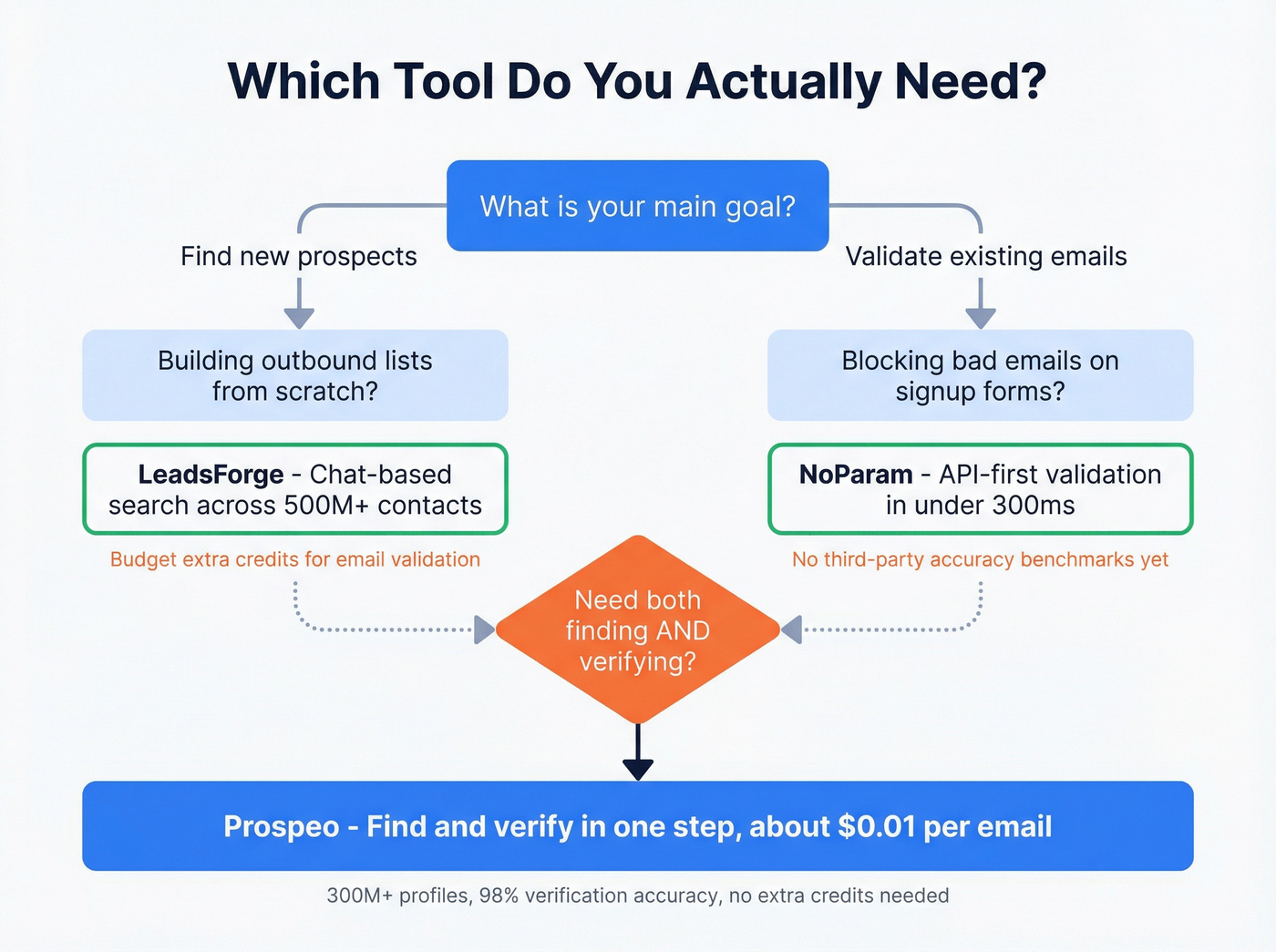
Blocking disposable emails on signup forms. NoParam fits. Lightweight API, sub-300ms response times, free tier to test. Use the 100 free verifications to benchmark accuracy against a known-good list before committing budget.
You exported 2,000 leads and need to validate them before loading into your sequencer. This is where the stack gap bites. LeadsForge found the leads but didn't fully verify them. NoParam can validate, but now you're managing two tools, two credit systems, and two billing cycles for what should be one workflow. We've seen teams waste hours reconciling credits and dealing with data format mismatches between separate lead gen and validation tools - it's a surprisingly common headache that eats into the time you saved by automating prospecting in the first place.
Let's be honest: if your outbound volume is under 5,000 emails per month, you almost certainly don't need two separate tools. A single platform that finds and verifies is faster, cheaper, and less likely to break.
What If You Need Both?
Instead of stitching together a lead gen tool and a separate validator, Prospeo combines a 300M+ lead database with built-in email verification at 98% accuracy. Every lookup includes verification - no separate credits, no extra step. Data refreshes every 7 days versus the 6-week industry average, and pricing runs about $0.01 per email with a free tier of 75 emails per month.

One platform, one credit system, verified contacts out the door. Native integrations with Salesforce, HubSpot, Smartlead, Instantly, and Lemlist mean you go from prospect to sequence without duct tape. Teams like Snyk cut bounce rates from 35-40% to under 5% after switching, while Stack Optimize maintains 94%+ deliverability across all client campaigns.
If you're still building your stack, it can help to compare categories like lead enrichment tools and bulk email verification services before you commit.
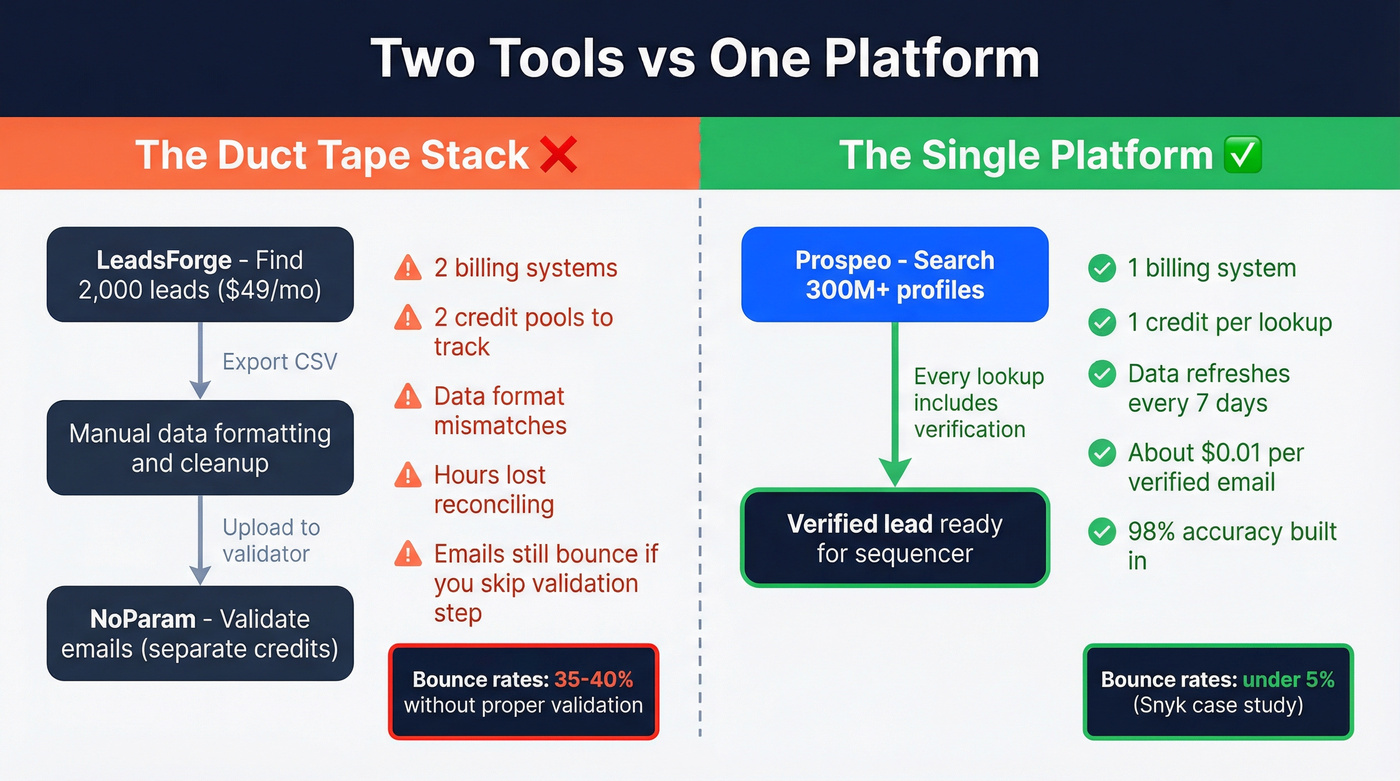
Snyk's 50 AEs cut bounce rates from 35-40% to under 5% after switching to Prospeo. Stack Optimize built a $1M agency on it with 94%+ deliverability. Data refreshes every 7 days - not 6 weeks - so you're never emailing someone who left three months ago.
Skip the LeadsForge + NoParam duct tape. Get verified leads in one step.
FAQ
What's the main difference between LeadsForge and NoParam?
LeadsForge finds leads - names, emails, phones - from a 500M+ contact database. NoParam validates whether an existing email address is deliverable. They solve different problems: one builds lists, the other cleans them. They aren't direct competitors despite appearing on the same comparison pages.
Is NoParam accurate enough for cold email lists?
No third-party accuracy benchmarks exist yet for NoParam. Their free tier (100 verifications/month) lets you run a small test against a known-good list before committing budget. For high-volume cold outreach, we'd recommend a validator with published accuracy rates and a longer track record.
Is there a tool that combines lead generation and email verification?
Prospeo combines a 300M+ lead database with built-in 98%-accuracy email verification on every lookup. At roughly $0.01 per email with a free tier of 75 emails/month, it eliminates the need to pair a separate lead gen tool with a standalone validator.