

The 9 Best Email Verification Checkers in 2026, Ranked by Real Accuracy Data
A practitioner on r/coldemail ran the same list of ~100 leads through every major email verification checker and got different results for 40% of them. Valid in one tool, non-existent in another. No clear winner. That's the reality of email verification - self-reported accuracy claims of 97-99% don't survive contact with real data. It's bad enough that one Reddit user built a free validator from scratch because "existing tools charge too much" and still disagree with each other.
When ESPs start flagging your domain at around 2% total bounces, the stakes aren't theoretical. We dug into benchmark-style tests, actual pricing mechanics, and the technical gaps most roundups gloss over. Here are the nine tools worth your time.
Our Picks (TL;DR)
- Prospeo - Best for teams that want finding and verification in one workflow. 98% email accuracy, 5-step verification, 7-day data refresh. Verification is included with email finding - no separate per-credit cost.
- ZeroBounce - Best standalone verifier for deep list cleaning. 100 free verifications/month, SOC 2 / ISO 27001 / HIPAA compliant, credits that never expire.
- NeverBounce - Best raw accuracy in benchmark-style testing. 99.1% in a 47,000-email benchmark, with 94% catch-all detection.
What an Email Verification Checker Actually Does
Most people think verification means "check if the address exists." It's more nuanced than that. A proper verification tool runs a multi-step chain, and no email is actually sent during the process. Some tools market "30+ verification steps," but the meaningful checks boil down to six.

- Syntax check - catches typos and formatting errors like john@@company.com
- Domain and MX lookup - confirms the domain exists and accepts mail
- SMTP mailbox ping - connects to the mail server and asks if the specific mailbox is real
- Catch-all detection - identifies domains that accept everything, real or fake
- Disposable email filtering - flags throwaway addresses from services like Guerrilla Mail
- Spam-trap and honeypot removal - strips addresses designed to catch spammers
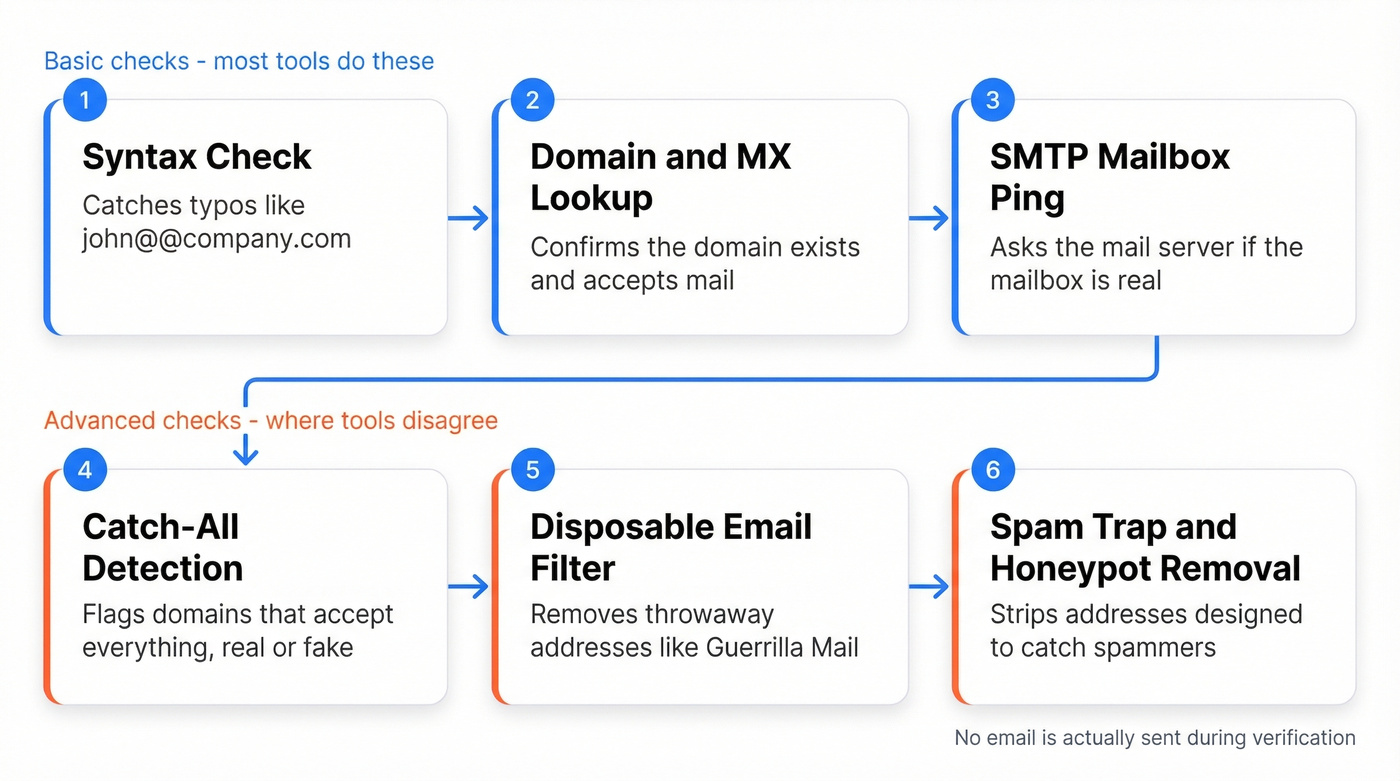
Tools that skip steps 4-6 are the ones that produce those maddening disagreements across providers. If you want to confirm emails are actually deliverable - not just syntactically correct - you need a tool that runs the full chain. (If you're troubleshooting bounces end-to-end, see our email deliverability guide.)
The 9 Best Email Verification Tools in 2026
Prospeo
Prospeo runs a 5-step verification process covering every stage of the chain above - catch-all handling, spam-trap removal, and honeypot filtering included. The database holds 143M+ verified emails across 300M+ professional profiles, all refreshed on a 7-day cycle. That refresh cadence matters: the industry average is six weeks, and email addresses decay at roughly 2-3% per month. GDPR compliant with DPAs available.
Use this if: You're a sales team or agency that needs verified emails from the start - not as a separate cleanup step. Prospeo finds and verifies in one workflow, so you're not paying twice. (If you're building a repeatable outbound motion, start with these sales prospecting techniques.)
Pricing: ~$0.01/email. Free tier gives you 75 emails + 100 Chrome extension credits/month. No contracts, cancel anytime. Integrations with Salesforce, HubSpot, Smartlead, Instantly, Lemlist, Clay, Zapier, and Make. (If you're comparing sources, see our guide to data enrichment services.)
The results back it up: Snyk's team of 50 AEs dropped their bounce rate from 35-40% to under 5% after switching, generating 200+ new opportunities per month.
ZeroBounce
ZeroBounce is one of the most feature-complete standalone verifiers on the market. It's certified for SOC 2 Type 2 and ISO 27001, and it's HIPAA compliant, with 45+ integrations and a pricing model that's unusually transparent for this space. Credits never expire, unknowns aren't charged, and duplicate removal is free.
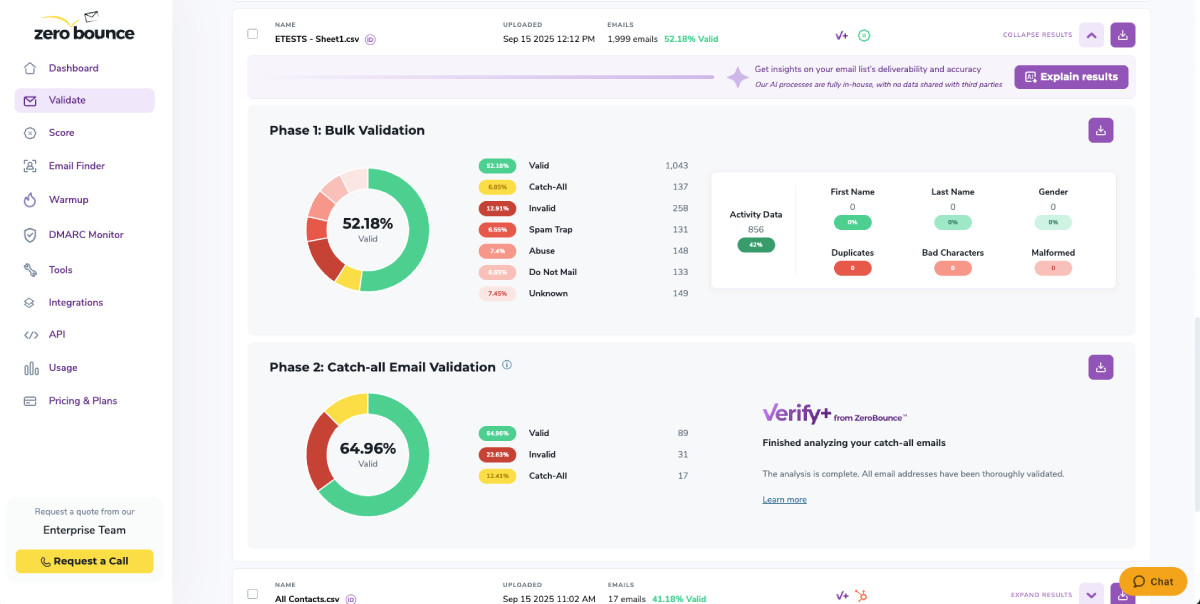
In the La Growth Machine 47,000-email benchmark, ZeroBounce hit 96.5% accuracy - solid, though below the top performers. ZeroBounce also guarantees 99.6% accurate results on their end.
Use this if: You have existing lists that need deep cleaning and you want enterprise-grade compliance certifications.
Skip this if: You're price-sensitive at scale. ZeroBounce's PAYG pricing starts at $39 for 2,000 credits, scaling down to ~$0.003/credit at 1M volume. The ZeroBounce ONE subscription runs $99/mo for 10,000 verifications. That's premium territory.
NeverBounce
NeverBounce posted the highest accuracy in the La Growth Machine benchmark: 99.1% across 47,000 emails tested over 90 days against actual bounce data. Their catch-all detection accuracy hit 94% - the best result in that benchmark for that specific problem.
Use this if: Raw verification accuracy is your top priority and you're willing to pay for it.
Skip this if: You need the cheapest option. NeverBounce runs ~$125/mo for 10,000 verifications on a subscription, and pay-as-you-go is typically ~$50-$80 per 10K depending on volume. Competitive but not budget-tier.
Self-reported accuracy is often listed as 97% in comparison tables - actually lower than the benchmark result. That's unusual, and it's a good sign.
Bouncer
Bouncer hit 97.8% in the La Growth Machine benchmark, placing it solidly in the top tier for tested accuracy. Processing speed clocks 180K emails/hour, and 16 integrations cover the basics. At ~$45-49 per 10K verifications with 100 free to start, Bouncer is the sweet spot for mid-volume teams that want strong accuracy without paying ZeroBounce or NeverBounce premiums. (If you're evaluating similar tools, see our Bouncer alternatives.)
Clearout
Here's the thing about Clearout: it scored 98.4% in the La Growth Machine benchmark (second-highest tested) but only 68.37% in Hunter's benchmark. That spread tells you how much methodology matters. At ~$40-$58 per 10K depending on plan, with 38 integrations and 160K emails/hour processing, Clearout is a strong budget pick - just know that results will vary depending on your list composition.
Emailable
Emailable processes 2M emails/hour - the fastest in any benchmark-style table we've reviewed - and tested at 97.2% accuracy in the La Growth Machine test. The free tier is the most generous among standalone tools at 250 verifications. Paid plans run ~$50-$69 per 10K. If you're processing massive lists and need results fast, Emailable makes sense. (Related: Emailable vs Generect.)
Hunter
Hunter's an interesting case. In their own benchmark of 3,000 real emails across 15 providers, Hunter scored 70% - the highest in that test. But the La Growth Machine benchmark uses a completely different methodology and dataset, which is why the numbers look so different.
The real gotcha is pricing: Hunter's Starter plan is $49/mo for 2,000 credits - that's 4,000 verifications at 0.5 credits each, but only if you don't use any credits for email finding. Free tier gives you 50 credits. Best if you're already in Hunter's ecosystem; confusing if you're not. (If you're shopping around, see our Hunter alternatives.)
Kickbox
Kickbox scored 97.0% in the La Growth Machine benchmark. Pricing runs ~$70-$80 per 10K with 27 integrations. It's a reliable, API-first option, but pricier than Bouncer and Clearout for similar accuracy. Pick Kickbox if your workflow is developer-driven and you value clean API documentation over flashy dashboards.
EmailListVerify
The budget pick. At ~$24 per 10K, EmailListVerify is the cheapest standalone verifier on this list by a wide margin. Self-reported accuracy is 97%, with 11 integrations. The free single-email checker is limited to a handful of lookups, though "100 free verifications" appears in some comparison tables as a trial allowance. Best for high-volume, budget-first use cases where you can tolerate a wider accuracy margin. (If you're also sourcing contacts, compare with these email list providers.)

Most verification checkers disagree on 40% of results because they skip catch-all detection, spam-trap removal, and honeypot filtering. Prospeo's 5-step verification runs the full chain - 143M+ verified emails, 98% accuracy, refreshed every 7 days instead of the 6-week industry average.
Start with 75 free verified emails and see the difference yourself.
Side-by-Side Comparison
All tested accuracy figures come from the La Growth Machine 47,000-email benchmark. Hunter's figure is from their own 3,000-email test using different methodology. Prospeo and EmailListVerify weren't included in either benchmark - their figures are self-reported. (For bounce thresholds and what “good” looks like, see email bounce rate.)
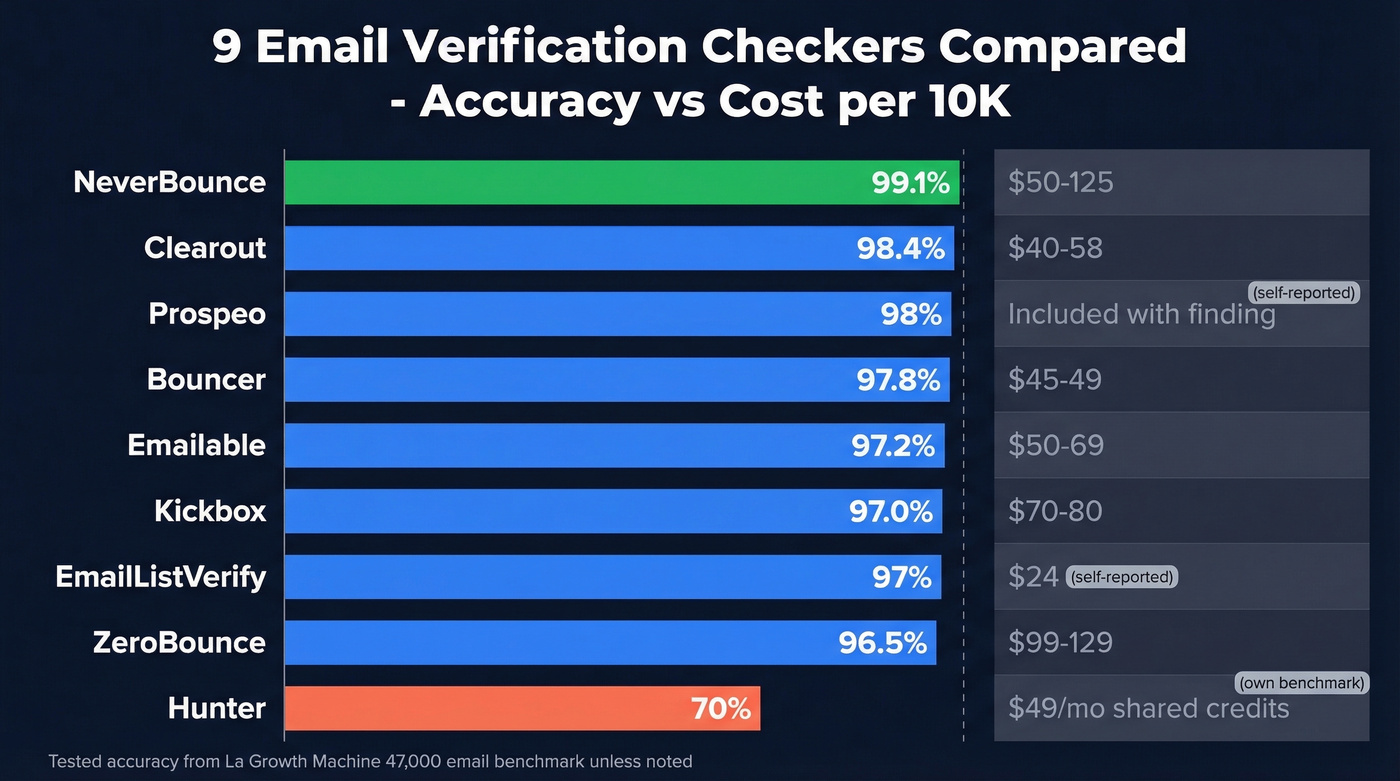
| Tool | Tested Accuracy | Free Tier | Cost/10K | Best For |
|---|---|---|---|---|
| Prospeo | 98% (self-reported) | 75/mo | Included w/ finding | Finding + verification |
| ZeroBounce | 96.5% | 100/mo | ~$99-$129 | Deep list cleaning |
| NeverBounce | 99.1% | 10 | ~$50-$125 | Max accuracy |
| Bouncer | 97.8% | 100 | $45-49 | Mid-volume balance |
| Clearout | 98.4% | 100 | $40-58 | Budget + accuracy |
| Emailable | 97.2% | 250 | $50-69 | Speed at scale |
| Hunter | 70%† | 50 credits | $49/mo shared | Hunter ecosystem |
| Kickbox | 97.0% | 100 | $70-80 | API-first teams |
| EmailListVerify | 97% (self-reported) | Limited | $24 | Budget bulk |
†Hunter's score uses their own benchmark methodology with stricter "Unknown" penalties.
The Catch-All Problem
Catch-all domains accept mail sent to any address - real or fake. When a verification tool pings the SMTP server, it gets a 250 response regardless of whether the mailbox exists. That's why catch-all emails are the single biggest source of disagreements between providers.
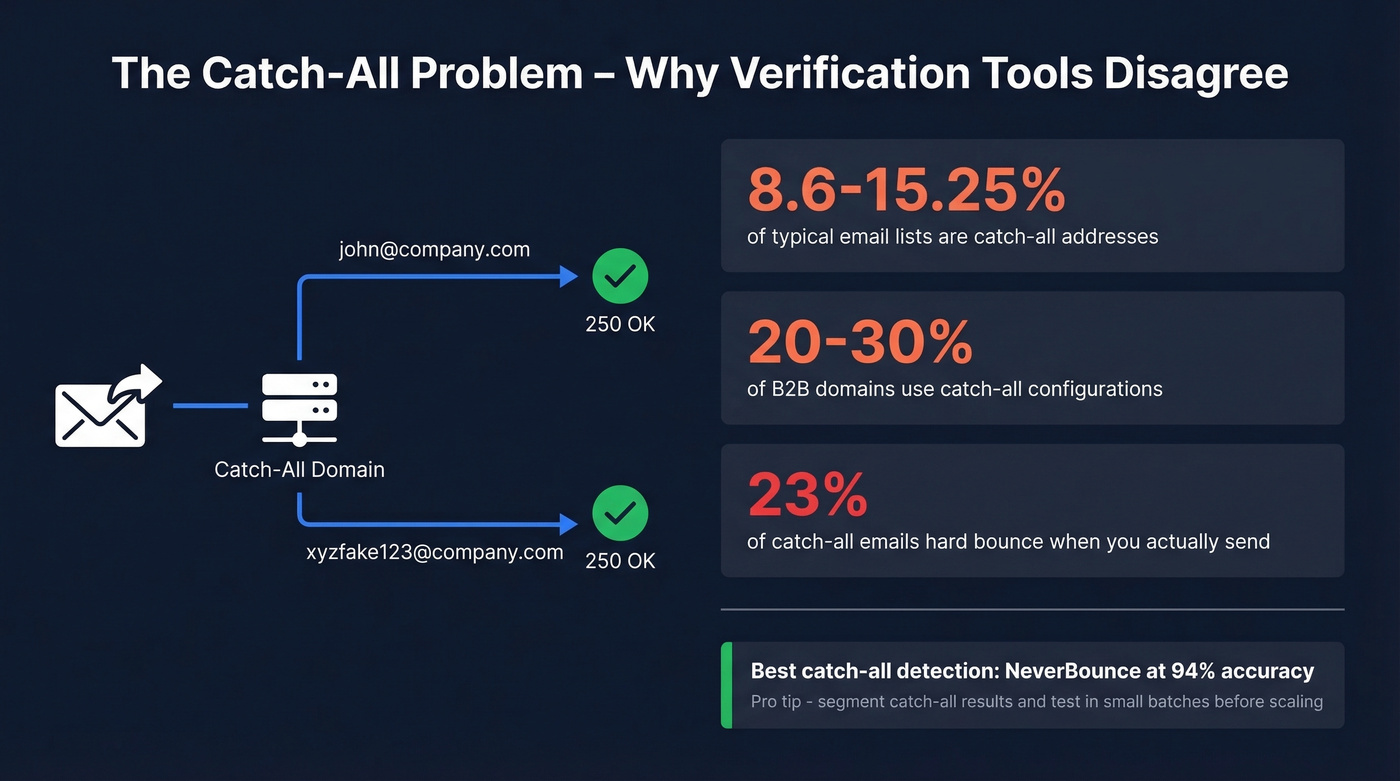
The numbers are significant: 8.6-15.25% of typical email lists are catch-all addresses, and 20-30% of B2B domains use catch-all configurations. Left unverified, 23% of catch-all emails hard bounce when you actually send. Let's be honest - most tools just label these "risky" and leave you to figure it out.
NeverBounce's 94% catch-all detection rate is the best result we've seen in benchmark testing. The practical advice: segment catch-all results separately and test in small batches before scaling sends. Never blast your full catch-all segment at once.
Pricing at Scale
The Reddit complaint about per-verification pricing feeling "brutal" at 5,000-10,000 verifications per month is legitimate. Here's what real pricing looks like:
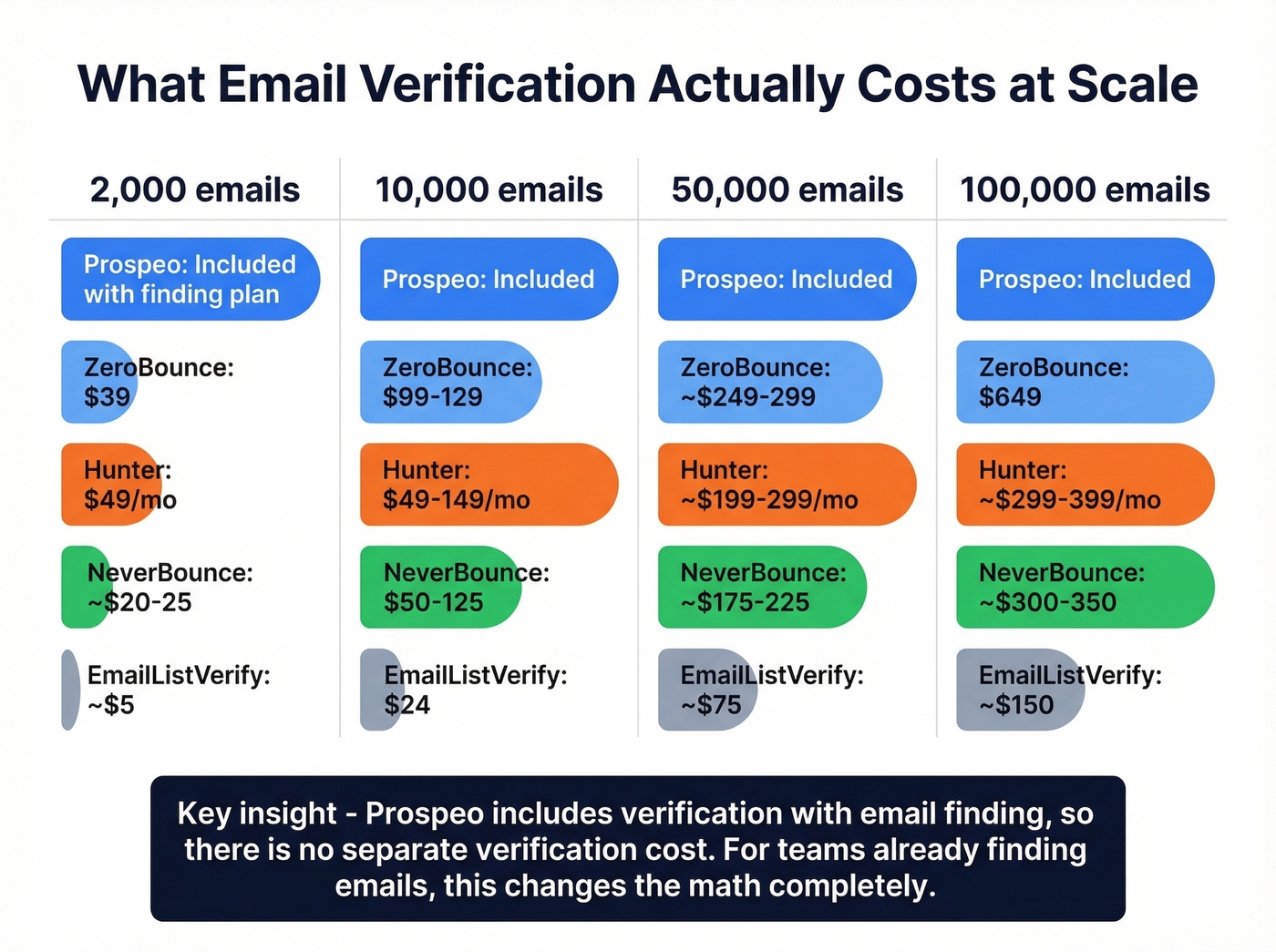
- ZeroBounce PAYG: $39 for 2,000 credits; $129 for 10,000 credits; $649 for 100,000 credits. Unknowns aren't charged; credits never expire.
- Hunter: $49/mo for 2,000 credits (4,000 verifications if you spend credits only on verification). $149/mo for 10,000 credits.
- NeverBounce: ~$125/mo for 10,000 verifications on subscription; pay-as-you-go runs ~$50-$80 per 10K depending on volume.
Look - if your deal sizes sit below five figures, you probably don't need a standalone verifier at all. You need a tool that verifies at the point of collection so you never pay to clean data that should've been clean from the start. That's the fundamental difference between a verification-first workflow and a cleanup-after-the-fact workflow, and it's where most teams waste money. (If you're building lists in Clay, see Clay list building.)
How to Verify Emails Before You Hit Send
Standalone verification is a band-aid. We've seen this pattern over and over: a team buys a list, pays to verify it, finds 15% are bad, then repeats the cycle next quarter. If your emails are verified at the point of collection - through a multi-step process with regular refresh cycles - you're paying to re-verify data that was already clean.
For teams that insist on standalone tools, waterfall verification is the power-user move: run emails through 2-3 providers sequentially and use consensus to determine validity. It reduces false positives but doubles or triples your cost. In our experience, most teams are better off investing that budget in a higher-quality source upfront rather than layering verification tools on top of bad data.
Either way, target keeping total bounces under 2%, and treat hard bounces past 1% as a red alert. (To keep sending safe as you scale, see email velocity.)
Snyk's 50 AEs dropped their bounce rate from 35-40% to under 5% because Prospeo verifies at the point of finding - no separate cleanup step, no extra credits. At ~$0.01/email with no contracts, you get enterprise-grade verification without enterprise pricing.
Stop cleaning lists you never should have bought dirty.
FAQ
How accurate is an email verification checker?
Benchmark tests show wide variance: the La Growth Machine 47,000-email test found top tools ranging from 96.5% to 99.1%. Hunter's separate 3,000-email benchmark scored tools in the 65-70% range due to stricter "Unknown" penalties. Methodology matters more than the headline number.
Is a free email verifier enough for real campaigns?
Free tiers work for spot-checking individual addresses - most tools offer 50-250 free verifications per month. For bulk list cleaning at any real volume (1,000+ contacts/month), you'll need a paid plan. Prospeo's free tier includes 75 verified emails monthly with full enrichment, which covers light prospecting.
How often should I re-verify my email list?
Re-verify every 30-90 days. Email addresses decay at roughly 2-3% per month as people change jobs, companies rebrand, or domains lapse. Tools with shorter refresh cycles reduce the need for manual re-verification significantly.
What should I do with catch-all emails?
Segment them separately and send in small batches - 23% of unverified catch-all emails hard bounce. Use a tool with strong catch-all detection and never blast your full catch-all segment at once.
What is waterfall verification?
It's running emails through 2-3 verification tools sequentially and using consensus to determine validity. It reduces false positives but increases cost proportionally. Reserve it for high-stakes campaigns - product launches, executive outreach - where deliverability is non-negotiable.