

7 Ideal Customer Profile Examples You Can Copy Today
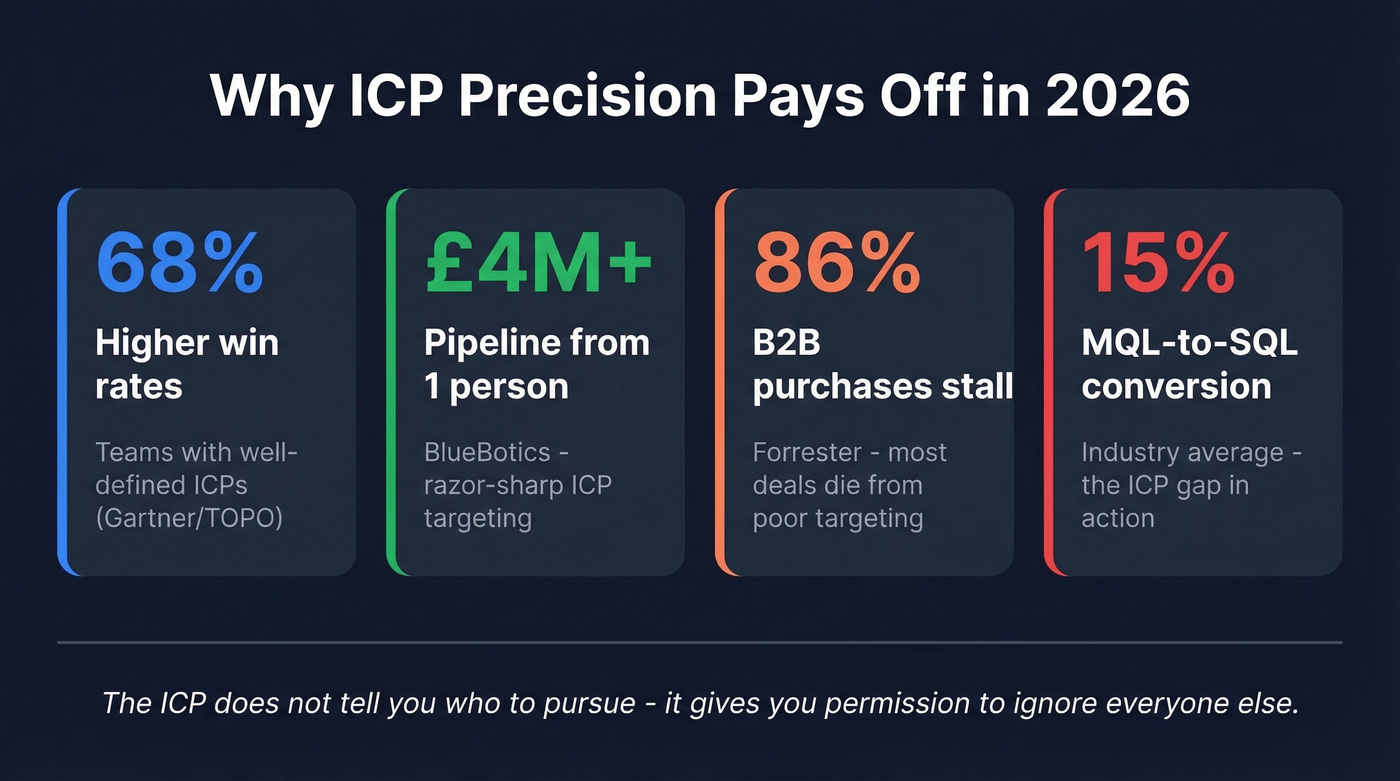
You send 500 MQLs to sales. They accept 75. That's a ~15% MQL-to-SQL conversion rate - and it's the norm, not the exception. The gap between "marketing qualified" and "actually worth a rep's time" is almost always an ICP problem.
The ideal customer profile examples below are designed to close that gap. You'll get seven filled-out ICPs across industries you can copy and customize, a 100-point scoring rubric that turns your ICP into a lead-prioritization tool, and 25+ interview questions to validate your ICP with real customers. Scroll to the examples if you're in a hurry.
What Is an Ideal Customer Profile?
An ideal customer profile is a company-level description of the accounts most likely to buy, expand, and stay. It's not a buyer persona. Personas tell you who you're speaking to. ICPs tell you which companies are worth speaking to in the first place.
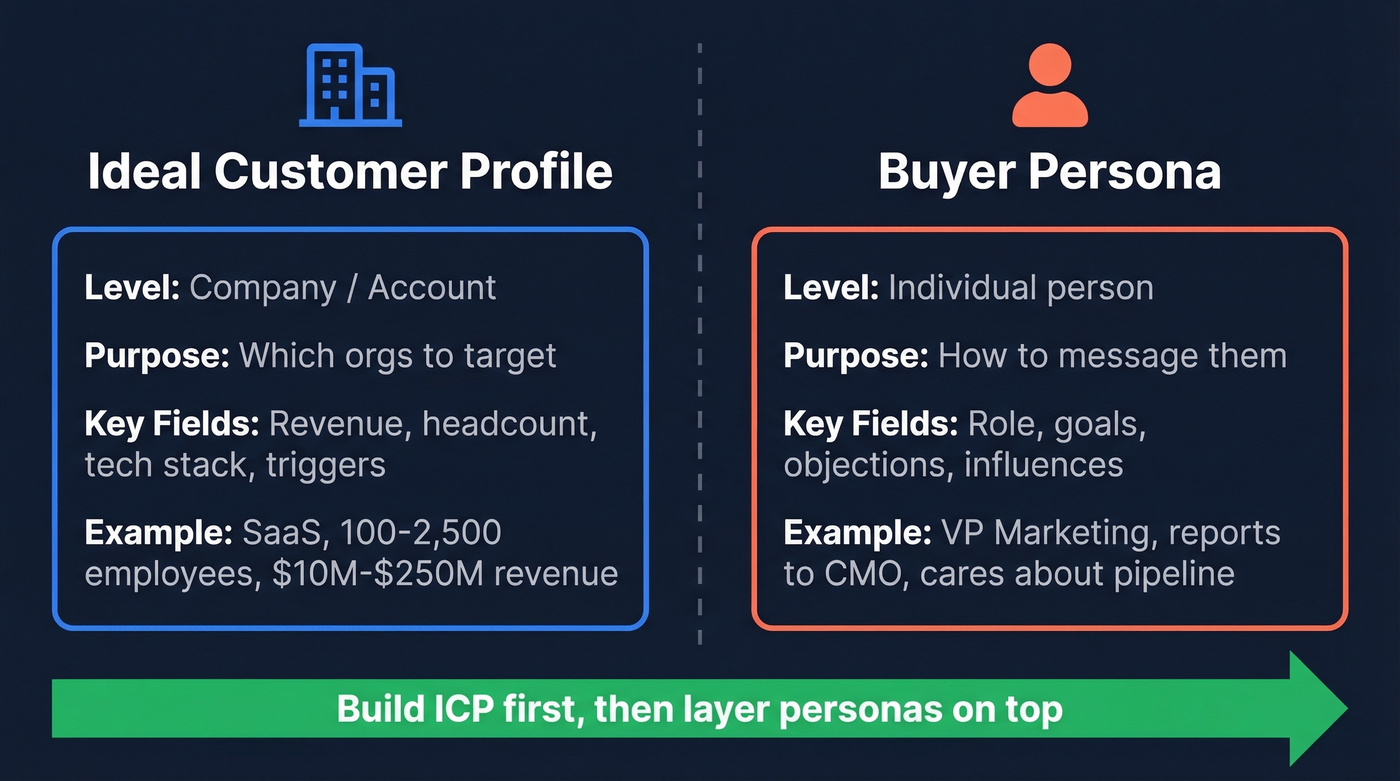
Zapier's ICP is a good illustration: fast-growing companies with 50-500 employees, using 5+ disconnected software tools, with dedicated operations teams, losing 10+ hours weekly to manual data entry between systems. Notice what's missing - there's no "Marketing Mary, 34, likes podcasts." It's all company-level criteria: firmographic and behavioral attributes, nothing demographic.
| Ideal Customer Profile | Buyer Persona | |
|---|---|---|
| Level | Company / account | Individual person |
| Purpose | Which orgs to target | How to message them |
| Key fields | Revenue, headcount, tech | Role, goals, objections |
| Example | "SaaS, 100-2,500 FTEs" | "VP Marketing, reports to CMO" |
Build the ICP first. Then layer personas on top for messaging. Teams that skip the ICP end up targeting the right people at the wrong companies - and wondering why deals stall.
Why ICP Precision Matters in 2026
The B2B buying environment is compressing fast. 6Sense's latest data shows sales cycles dropped from 11.3 months to 10.1 months year-over-year, and the point of first contact moved from 69% of the buyer's journey to 61%. Buyers are engaging sellers earlier, but they're also defining requirements before they ever talk to you - 83% of the time.
That means your window to influence is narrower and earlier. If you're spending that window on the wrong accounts, you're burning it.
Forrester puts it bluntly: 86% of B2B purchases stall. And Dentsu found 68% of buyers feel B2B brands all sound the same. A tight ICP fixes both problems - it focuses your reps on accounts with real urgency and gives marketing the specificity to craft messaging that doesn't blend into the noise.
The companies that get this right see outsized returns. BlueBotics, a small industrial automation firm, generated £4M+ in pipeline opportunities with a team of one - by targeting a razor-sharp ICP instead of spraying across verticals. Acxiom built £1.5M in pipeline within 120 days of entering a new vertical by defining a precise ICP before writing a single piece of outreach. AVEVA drove £7M in pipeline from targeted accounts. These aren't enterprise-only results. They're what happens when you stop treating "everyone who might buy" as your market.
The higher your deal size, the more precise your ICP needs to be. A $75K ACV can't afford the same broad targeting as a $5K self-serve product - every misallocated rep hour costs you real pipeline. Gartner/TOPO research confirms it: teams with well-defined ICPs see 68% higher win rates. That's not a marginal improvement. That's the difference between a pipeline that converts and one that just looks busy.
Here's the thing: most companies don't have a targeting problem. They have a saying no problem. The ICP's real job isn't telling you who to pursue - it's giving you permission to ignore everyone else.
What to Include in Your ICP
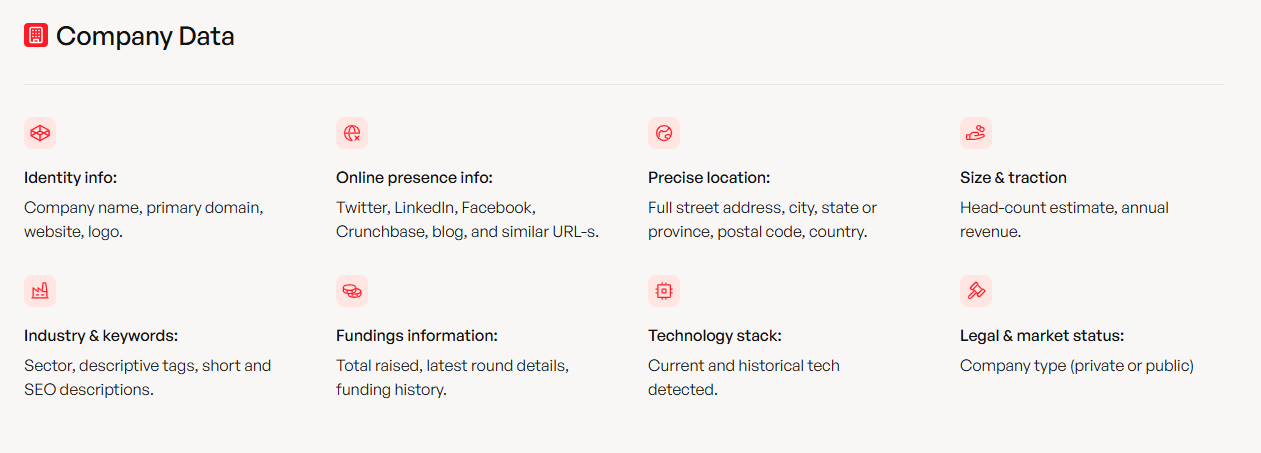
Most ICP templates cover the basics and stop. Here are the seven categories that actually matter, plus the four fields most templates miss entirely.
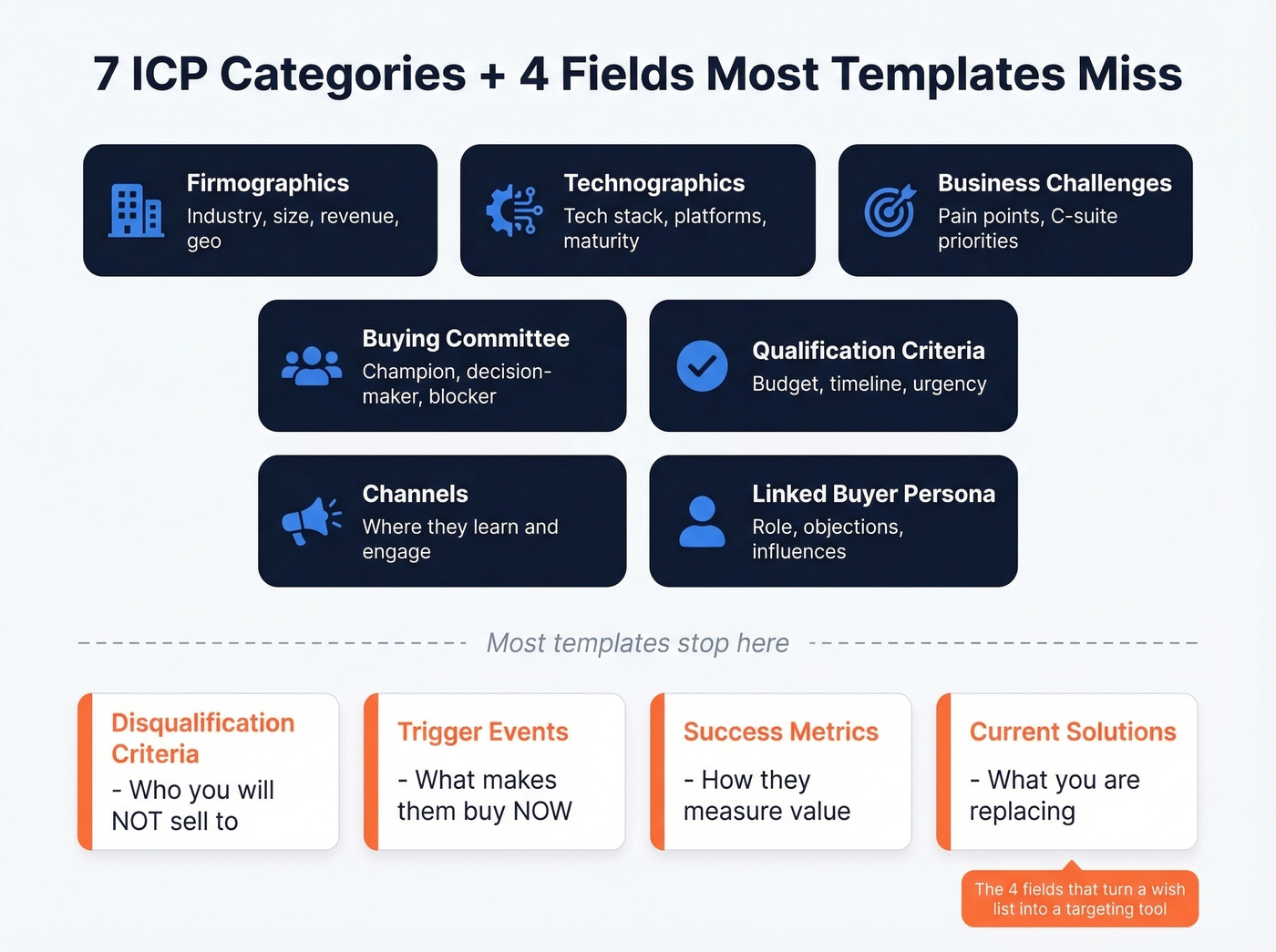
Firmographics - Industry, sub-industry, employee count, revenue range, geography, funding stage. This is your baseline filter.
Technographics - Current tech stack, technology maturity, key platforms like CRM, ERP, and marketing automation. A company running Salesforce Enterprise has a fundamentally different buying process than one on spreadsheets.
Business challenges and goals - What's keeping the C-suite up at night? What are they measured on? This is where your solution connects to their world.
Buying committee - Champion, decision-maker, influencer, blocker. Map the roles, not just the titles. A VP of Marketing who champions your tool is useless if the CFO blocks every new vendor.
Qualification criteria - Budget authority, timeline, urgency signals. The stuff that separates "interested" from "ready to buy."
Channels - Where do they learn? Conferences, podcasts, Reddit communities, industry newsletters, analyst reports. This drives your distribution strategy.
Linked buyer persona - The individual-level profile that sits on top of the company-level ICP. Role, objections, influences, stage they enter the buying process.
Fields most templates miss: Disqualification criteria (who you won't sell to), trigger events (what makes them buy now), success metrics/KPIs (how they measure value), and current solutions (what you're replacing). Without these four, your ICP is a wish list, not a targeting tool.
7 Ready-to-Use ICP Examples
Each example below is complete and filled out so you can copy it into a doc and customize. They cover the fields that matter - firmographics, tech stack, buying committee, triggers, and disqualification criteria.
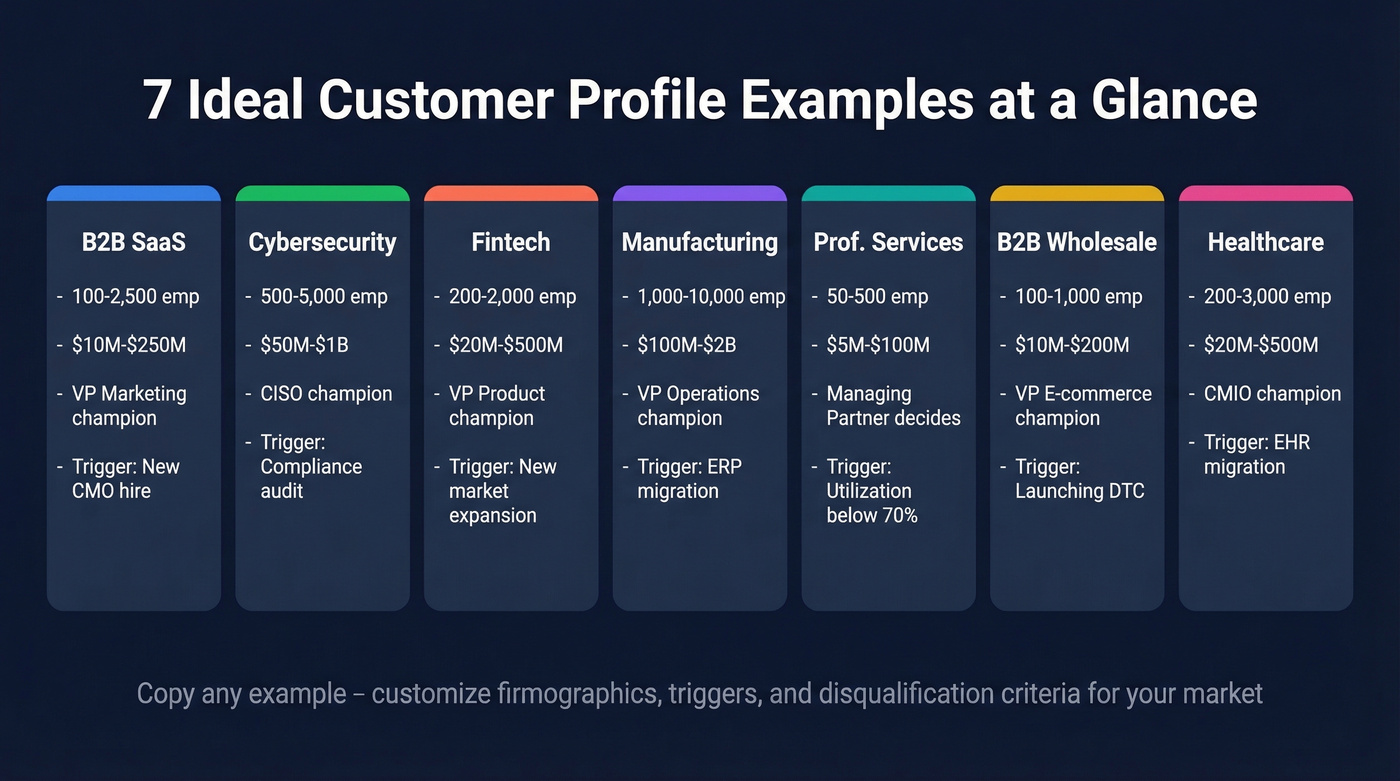
B2B SaaS (Mid-Market)
| Field | Details |
|---|---|
| Industry | B2B SaaS |
| Company size | 100-2,500 employees |
| Revenue | $10M-$250M |
| Tech stack | Salesforce, fragmented martech (3+ tools) |
| Buying committee | VP Marketing (champion), CMO (decision-maker), RevOps (influencer) |
| Trigger events | New CMO hire, Series B+ funding, martech consolidation initiative |
| Disqualification | <$5M revenue, no CRM, competitor locked in 2+ years |
| One-liner | Mid-market SaaS companies outgrowing their cobbled-together martech stack and ready to consolidate. |
Cybersecurity
| Field | Details |
|---|---|
| Industry | Cybersecurity (selling to regulated verticals) |
| Company size | 500-5,000 employees |
| Revenue | $50M-$1B |
| Tech stack | Legacy SIEM, regulated industry (finance or healthcare) |
| Buying committee | CISO (champion/decision-maker), VP IT (influencer), Compliance Officer (blocker) |
| Trigger events | Compliance audit, breach incident, board-level security mandate |
| Disqualification | Fully outsourced SOC, no dedicated CISO, <500 employees |
| One-liner | Mid-to-large enterprises in regulated industries running legacy security infrastructure that can't keep pace with compliance demands. |
Fintech
| Field | Details |
|---|---|
| Industry | Fintech / payments |
| Company size | 200-2,000 employees |
| Revenue | $20M-$500M |
| Tech stack | Processing $1B+ annually, API-first architecture |
| Buying committee | VP Product (champion), CTO (decision-maker), Head of Compliance (influencer) |
| Trigger events | New market expansion, regulatory change, payment rail migration |
| Disqualification | Pre-revenue, banking charter holder (different buying process entirely) |
| One-liner | Growth-stage fintechs processing serious volume and expanding into new markets or regulatory environments. |
Manufacturing
| Field | Details |
|---|---|
| Industry | Manufacturing (discrete or process) |
| Company size | 1,000-10,000 employees |
| Revenue | $100M-$2B |
| Tech stack | Legacy ERP (SAP/Oracle), 3+ production facilities |
| Buying committee | VP Operations (champion), CIO (decision-maker), Plant Manager (influencer) |
| Trigger events | ERP migration, supply chain disruption, digital transformation budget approved |
| Disqualification | Single-site operation, no digital transformation budget, family-owned with no succession plan |
| One-liner | Multi-site manufacturers mid-migration from legacy systems, with budget and executive sponsorship for modernization. |
Professional Services
| Field | Details |
|---|---|
| Industry | Professional services (consulting, legal, accounting) |
| Company size | 50-500 employees |
| Revenue | $5M-$100M |
| Tech stack | Billable-hours model, PSA or time-tracking software |
| Buying committee | Managing Partner (decision-maker), COO (champion), Practice Lead (influencer) |
| Trigger events | Utilization dropping below 70%, partner-level turnover, M&A activity |
| Disqualification | Solo practitioners, government-only contracts, <50 employees |
| One-liner | Mid-size professional services firms feeling margin pressure from underutilization or talent churn. |
B2B Wholesale / E-commerce
| Field | Details |
|---|---|
| Industry | B2B wholesale / e-commerce |
| Company size | 100-1,000 employees |
| Revenue | $10M-$200M |
| Tech stack | 500+ SKUs, selling through distributors + direct |
| Buying committee | VP E-commerce (champion), CEO (decision-maker), Head of Supply Chain (influencer) |
| Trigger events | Launching DTC channel, replatforming, distributor consolidation |
| Disqualification | Pure marketplace seller, <100 SKUs, no owned inventory |
| One-liner | B2B wholesalers with complex catalogs moving toward direct-to-customer channels or replatforming their commerce stack. |
Healthcare / Healthtech
| Field | Details |
|---|---|
| Industry | Healthcare / healthtech |
| Company size | 200-3,000 employees |
| Revenue | $20M-$500M |
| Tech stack | HIPAA-regulated, EHR system (Epic, Cerner, etc.) |
| Buying committee | CMIO (champion), CFO (decision-maker), IT Director (influencer), Compliance (blocker) |
| Trigger events | EHR migration, value-based care transition, M&A integration |
| Disqualification | Single-physician practice, no IT department, <200 employees |
| One-liner | Mid-size healthcare organizations navigating EHR transitions or value-based care mandates with dedicated IT and compliance teams. |

An ICP is only as useful as your ability to act on it. Prospeo's B2B database lets you filter 300M+ profiles by industry, headcount, revenue, tech stack, funding stage, and buyer intent - the exact fields in the ICPs above. Every email is 98% verified. Every record refreshes every 7 days.
Turn your ICP from a Google Doc into a live pipeline in minutes.
How to Build Your Own ICP
Don't start with a blank template. Start with your data.
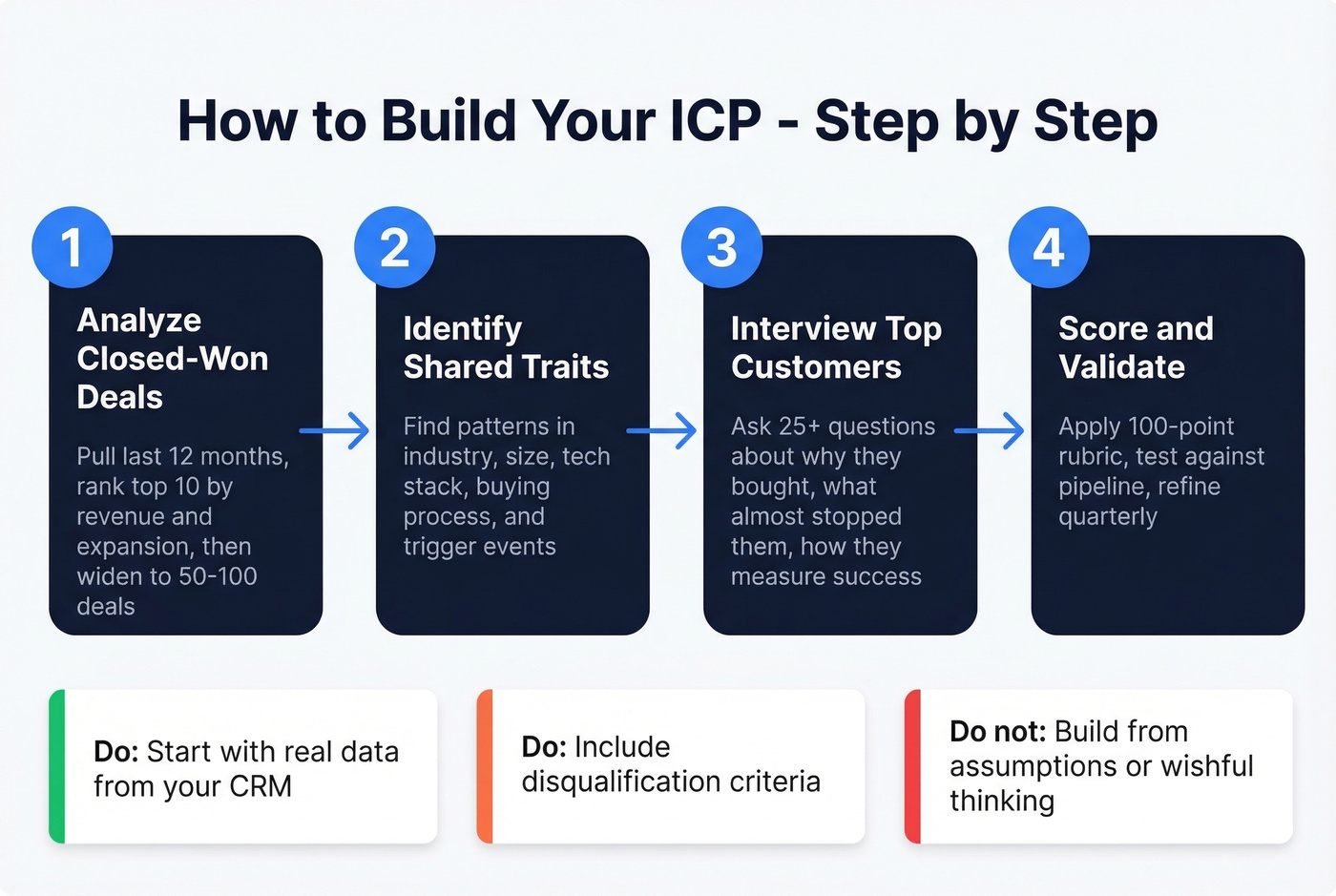
1. Analyze your closed-won deals. Pull the last 12 months and rank your top 10 customers by revenue and expansion - they're your pattern. Then widen the lens to 50-100 deals to confirm the trend. Your best customers are the blueprint, not a hypothetical exercise.
2. Identify shared traits. In our experience, 70-80% of your best wins share 3-5 common attributes. Industry, company size, and tech stack are the usual suspects. Look for the overlap, not the outliers.
3. Interview your best customers. Aim for at least eight interviews. Don't have your sales or CS team run them - use a neutral interviewer. The goal is an 85/15 talk ratio: 85% customer, 15% you. As one r/b2bmarketing thread put it, most B2B personas are "fairytale" documents that collect dust because nobody talked to actual customers. Adele Revella's buyer persona framework suggests nine segments to cover: buyer triggers, success factors, perceived barriers, buyer journey, decision criteria, demographics, content preferences, organizational buy-in, and post-purchase insights. You don't need to hit all nine in one interview, but cover them across your set.
4. Draft and validate with Sales. Share the draft ICP with your top-performing reps. They'll catch the criteria that look right on paper but don't match reality. Run mandatory checks before finalizing: does this account have financial readiness? Urgency? Willingness to change? Systems that support adoption?
5. Score and tier. Once you've got the ICP, turn it into a scoring model. This is where most teams stop - and it's where the real value starts. The profile you build from your own data will always outperform a generic template borrowed from a blog post.
ICP Interview Question Bank
Copy these into a doc before your next customer interview. Pick the ones that matter most for your product.
Learning patterns
- How do you typically learn about new tools or solutions in your space?
- What publications, podcasts, or communities do you follow?
- Which industry events or conferences do you attend?
Industry context
- What are the biggest challenges your industry is facing right now?
- What objections do you hear most often when proposing new solutions internally?
Role and org dynamics
- What does success look like in your role this year?
- Who do you report to, and how is your team's performance measured?
- How many people are typically involved in a purchase decision like this?
Goals and challenges
- What triggered you to look for a solution?
- What steps had you already taken before finding us?
- What's standing in the way of hitting your goals this quarter?
Past solutions
- What were you using before? What worked and what didn't?
- Have you tried solving this problem before? What happened?
Buying process
- How do you research new products?
- Who else was involved in the decision?
- What almost stopped you from buying?
How to Score and Tier Your ICP
A filled-out ICP is useful. A scored ICP is a weapon. Here's a 100-point model you can implement this week.
| Category | Weight | Criteria | Points |
|---|---|---|---|
| Firmographics | 40 pts | Industry match (15), company size (15), geography (10) | 0-40 |
| Technographics | 30 pts | CRM fit (15), complementary tools (10), competitor products (5) | 0-30 |
| Intent signals | 30 pts | Pricing page visit (10), case study/webinar (8), G2/analyst research (7), funding/expansion (5) | 0-30 |
Tier thresholds:
- Tier A (80-100): Route immediately to senior AE. These accounts get white-glove treatment.
- Tier B (50-79): Nurture with targeted content. SDR outreach on trigger events.
- Tier C (0-49): Marketing automation only. Don't waste rep time.
Let's make the scoring concrete with a worked example. A 400-person SaaS company using Salesforce, in your target industry, with a recent Series B. Firmographics: 35/40 - right size, right industry, US-based. Technographics: 20/30 - Salesforce yes, but missing complementary tools. Intent: 20/30 - visited pricing page, downloaded a case study. Total: 75/100, Tier B+. Worth pursuing, but not the top of the queue.
The payoff is real. Tier A accounts typically convert at 1.5-2x the rate of Tier B, with 15-20% shorter sales cycles.
Negative scoring matters too. Subtract points for churn-correlated attributes: -50 for free email domains like @gmail on a business inquiry, -20 for competitor lock-in when they've signed a 2-year contract with your competitor, -25 for legacy stack that makes integration painful. These guardrails keep bad-fit accounts from sneaking into Tier A.
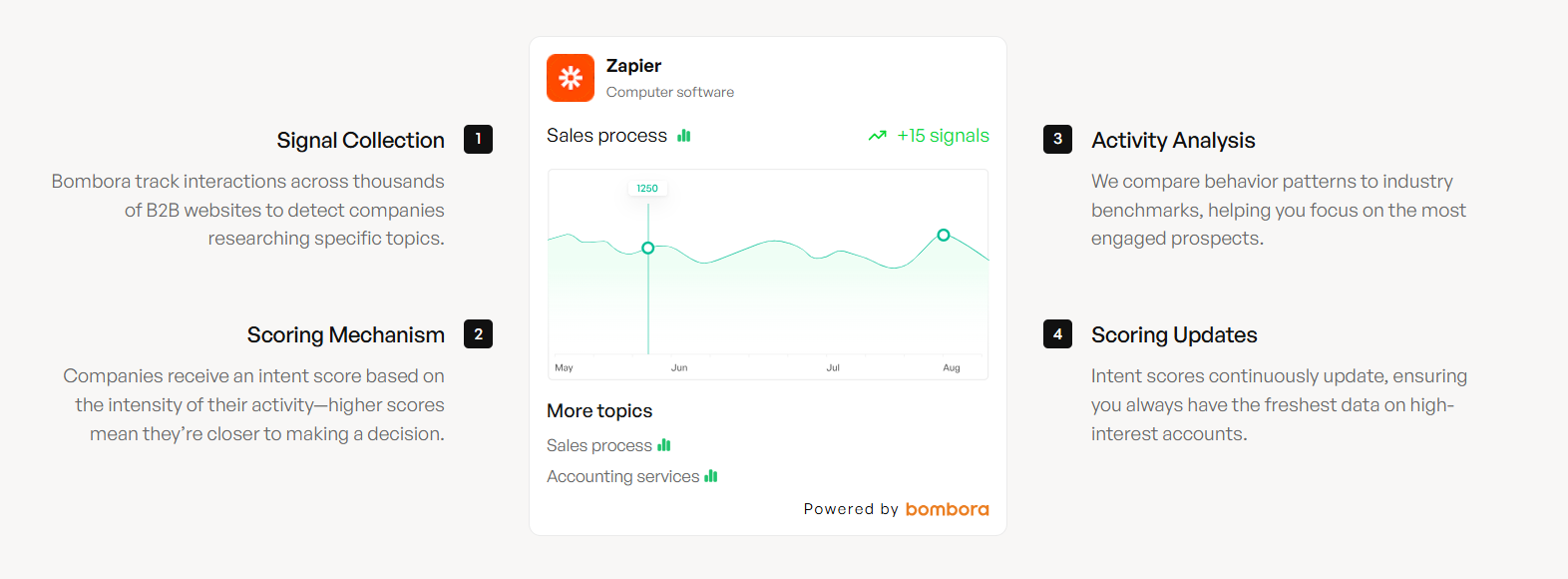
One advanced concept worth implementing: intent signal decay. If an intent signal hasn't updated in 14 days, decay the score by 15% weekly. A pricing page visit from six weeks ago isn't the same as one from yesterday. Layer intent data on top of your firmographic score - tools like Prospeo track 15,000 intent topics via Bombora, so if a Tier A account is actively researching your category, that's a signal to move fast.
Turn Your ICP Into a Prospect List
Every ICP guide stops at "create the document." Nobody shows you how to actually use it.
Your ICP is a filter. Now you need an engine. The fields in your ICP - industry, headcount, revenue, tech stack, trigger events - map directly to search filters in a B2B data platform. We've tested this workflow extensively with Prospeo's 30+ filters, including technographics, buyer intent across 15,000 topics, headcount growth, funding signals, and job changes. Set your ICP criteria as filters, and you've got a live prospect list instead of a static document sitting in a shared drive.
What makes this work in practice is data quality. A 98% email accuracy rate on a 7-day refresh cycle means the list you pull today is still accurate next week. Native integrations with Salesforce, HubSpot, Lemlist, and Instantly let you push contacts straight into your outbound and CRM workflows without manual CSV juggling.
If you want a starting point, use an ICP template and then operationalize it with firmographic filters and intent signals.

You just defined trigger events, technographics, and buying committees. Now layer those criteria into 30+ search filters - including intent data across 15,000 topics - and pull verified emails at $0.01 each. No contracts. No sales calls. Companies using Prospeo book 35% more meetings than Apollo users.
Stop defining your ICP and start filling it with real buyers.
ICP Mistakes That Kill Pipeline
1. Fairytale personas built without interviews. If nobody's talked to a real customer in 90 days, your ICP is fiction. It'll collect dust while reps ignore it.
2. B2C demographics instead of firmographics. "Marketing managers aged 30-45 who like coffee" is a consumer persona. B2B needs company size, tech stack, and buying committee structure.
3. Blending segments into one generic profile. Mid-market SaaS and enterprise manufacturing aren't the same ICP. Blending them produces positioning that resonates with nobody. Skip this shortcut - it'll cost you more time than it saves.
4. No disqualification criteria. If your ICP doesn't tell you who to say no to, it's a marketing exercise, not a pipeline tool. We've seen teams waste entire quarters chasing accounts that were never going to close because nobody defined the "don't bother" list.
5. Building it once and forgetting it. Markets shift. Your product evolves. Review quarterly, refresh annually. An ICP from two years ago is already stale.
If you're building outbound around your ICP, pair it with proven sales prospecting techniques and a repeatable lead generation workflow.
FAQ
How many ICPs should a company have?
Most B2B companies need 2-4 ICPs, one per distinct market segment or product line. More than five usually means you haven't prioritized. Start with one, validate it with closed-won data, then expand as you enter new segments.
How often should you update your ICP?
Review quarterly and do a full refresh annually. Trigger an immediate update after major shifts - a new product launch, market expansion, or a noticeable change in your closed-won patterns. Stale ICPs produce stale pipelines.
What's the difference between an ICP and a target account list?
Your ICP defines the criteria; your target account list is the specific companies matching those criteria. One is a strategy document, the other is a spreadsheet. Build the profile first, then use a data platform with firmographic and intent filters to generate the list.
How do you validate whether your ICP is working?
Compare win rates, cycle times, and churn rates between Tier A and Tier B accounts. If Tier A isn't outperforming Tier B by at least 1.5x on win rate, your criteria need refinement. Also check that reps are actually using it - an accurate profile that nobody references is worthless.
What free tools help operationalize an ICP?
Prospeo's free tier (75 emails + 100 Chrome extension credits/month) lets you test ICP-to-list workflows with 30+ filters including technographics, intent data, headcount growth, and funding signals. HubSpot's free CRM can store and segment the output. Start there before committing to paid plans.