

LeadsForge vs QuickEnrich: Which B2B Enrichment Tool Wins?
Organizations with high-quality B2B data are 2.5x more likely to exceed revenue targets, yet 44% still rely on a single provider. That's a recipe for stale pipelines and bounced emails. Here's an honest breakdown of LeadsForge vs QuickEnrich - and a third option worth testing if neither fits.
30-Second Verdict
LeadsForge wins if you're already using Salesforge and want AI chat-based search across 500M+ contacts with intent signals baked in.
QuickEnrich wins if you need a lightweight, API-first enrichment workflow with double-verified emails and minimal platform overhead.
Feature Comparison at a Glance
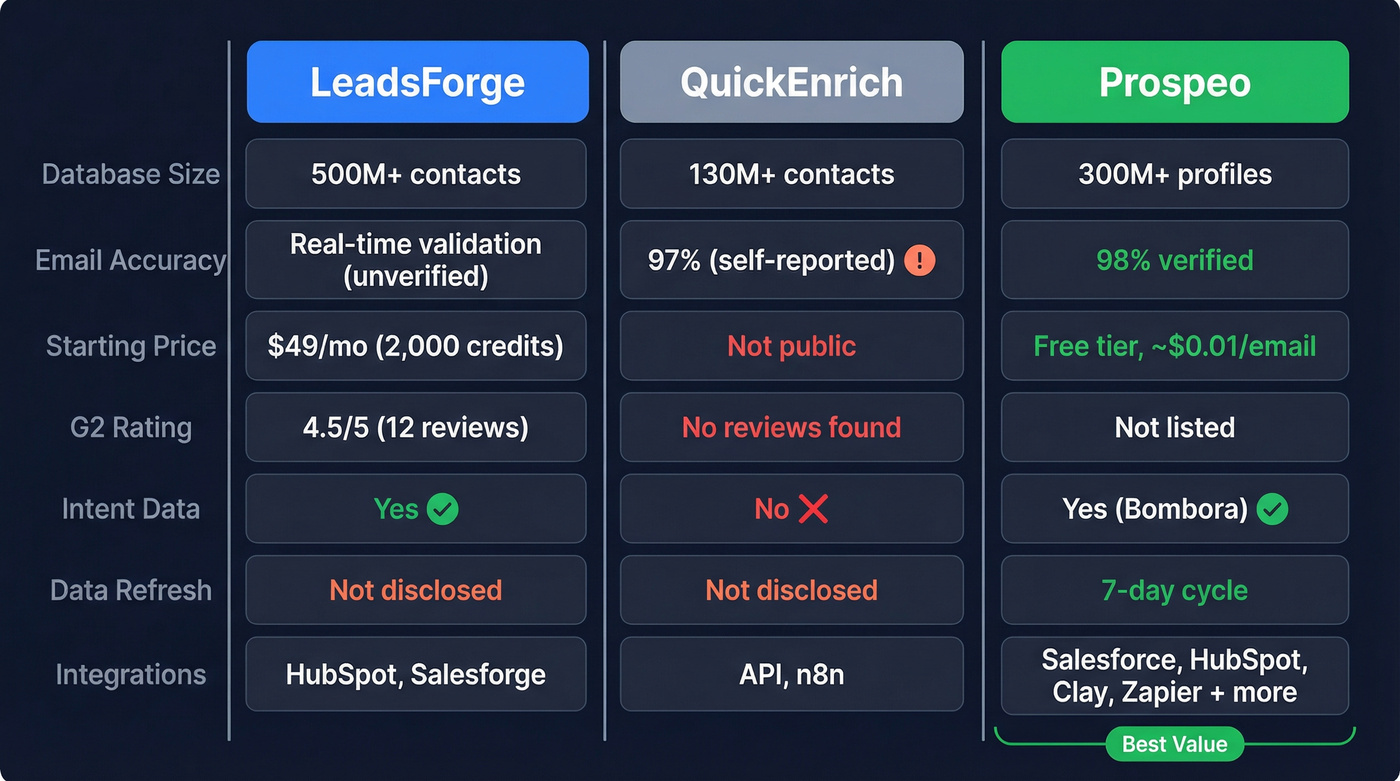
| Database | 500M+ contacts | 130M+ contacts | 300M+ professional profiles |
| Email accuracy | Real-time validation (unverified) | 97% (self-reported) | 98% verified |
| Pricing | $49/mo (2,000 export credits) | Not public; ~$49-$199/mo est. | Free tier; ~$0.01/email |
| G2 rating | 4.5/5 (12 reviews) | No reviews found | Not listed |
| Integrations | HubSpot Marketing Hub, Salesforge | API, n8n | Salesforce, HubSpot, Smartlead, Instantly, Lemlist, Clay, Zapier, Make |
| Intent data | Yes (signals) | No | Yes (signals) |
| Data refresh | Not disclosed | Not disclosed | 7-day cycle |
LeadsForge: What You Get

LeadsForge's chat-based search is genuinely different from a traditional filter panel. You describe what you need in plain language, and the AI builds the query across 500M+ contacts. Waterfall enrichment - querying multiple sources until data is found - signals, and a direct push into Salesforge for sequencing round out the platform. New users get 100 free credits to test before committing.
The G2 rating sits at 4.5/5 across 12 reviews, with strong marks for filtering and support. Trustpilot lands at 4.0/5 from 11 reviews - one reviewer mentions saving 10 hours a week on manual research. Because it's built to work closely with Salesforge, the integration between prospecting and outreach is tight. If you're already in that ecosystem, the handoff is seamless.
Watch out for credit drain. Exporting an email costs 1 credit, email validation burns additional credits, and phone numbers run 10 credits each. We've seen credit-based tools with validation surcharges cost 3-4x the headline price once a team starts pulling mobile numbers regularly. Trustpilot reviews also flag cancellation friction and weak coverage in LatAm markets.
If you're comparing options across the category, it's also worth scanning a broader list of data enrichment services to sanity-check feature claims and pricing models.

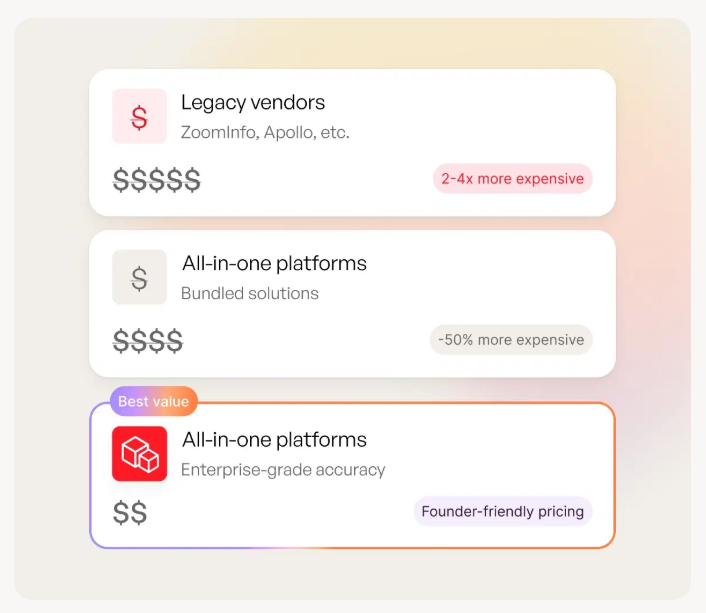
LeadsForge charges extra credits for validation. QuickEnrich won't even show you pricing. Prospeo gives you 98% verified emails at $0.01 each with a 7-day data refresh - no hidden surcharges, no guessing games.
Stop paying mystery prices for unverified data.
QuickEnrich: What You Get
QuickEnrich takes the opposite approach: no heavy platform, just an API-first email finder. It covers 130M+ contacts with double-verified emails and mobile numbers, and positions itself as having 30% more coverage than most providers because it includes data not found on social media.
The API supports professional profile URL lookup and company URL + first/last name matching, with a 1,000 requests/minute rate limit. The n8n community node makes it easy to plug into automation workflows, which is a nice touch for technical teams building custom pipelines.
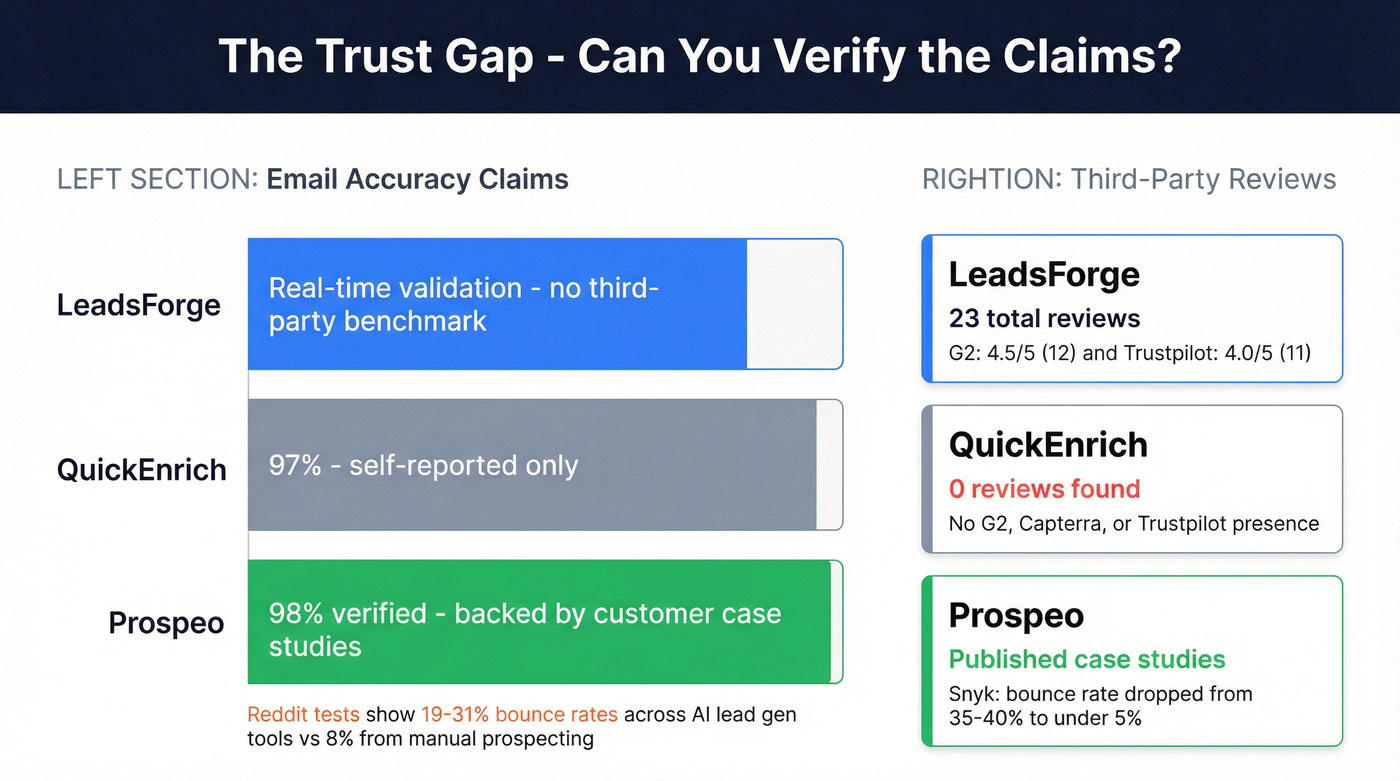
Here's the thing: trust is a real issue. QuickEnrich doesn't have a visible review footprint on G2, Capterra, or Trustpilot. That 97% accuracy figure comes from their own site with no third-party benchmark behind it. Pricing isn't published either. For a tool handling your pipeline data, that's a lot of faith to extend without social proof.
If you're building outbound at scale, pairing enrichment with better sales prospecting techniques can matter as much as the tool choice.
Head-to-Head Breakdown
Neither tool has widely cited independent accuracy benchmarks. Reddit threads testing AI lead gen platforms report 19-31% bounce rates across the category, compared to roughly 8% from manual prospecting. That's the reality check both tools face.
Let's be honest: if your average deal size is under $15k, you probably don't need a 500M-contact database. You need 5,000 accurate contacts in your ICP. The enrichment tool that verifies best matters more than the one that claims the biggest database. (If you're trying to reduce bounces specifically, see email bounce rate benchmarks and fixes.)
The integrations gap is real, too. LeadsForge plugs into HubSpot Marketing Hub and Salesforge, giving you a prospecting-to-sequencing pipeline. QuickEnrich is API-first - powerful for technical teams, but you're building the workflow yourself. LeadsForge also offers intent signals that QuickEnrich doesn't emphasize, so if knowing when a prospect is in-market matters to your outbound motion, that's a clear differentiator.
And the social proof gap matters more than most buyers realize. LeadsForge has 23 total reviews across G2 and Trustpilot. QuickEnrich? We couldn't find any third-party reviews at all.
When to Pick Each
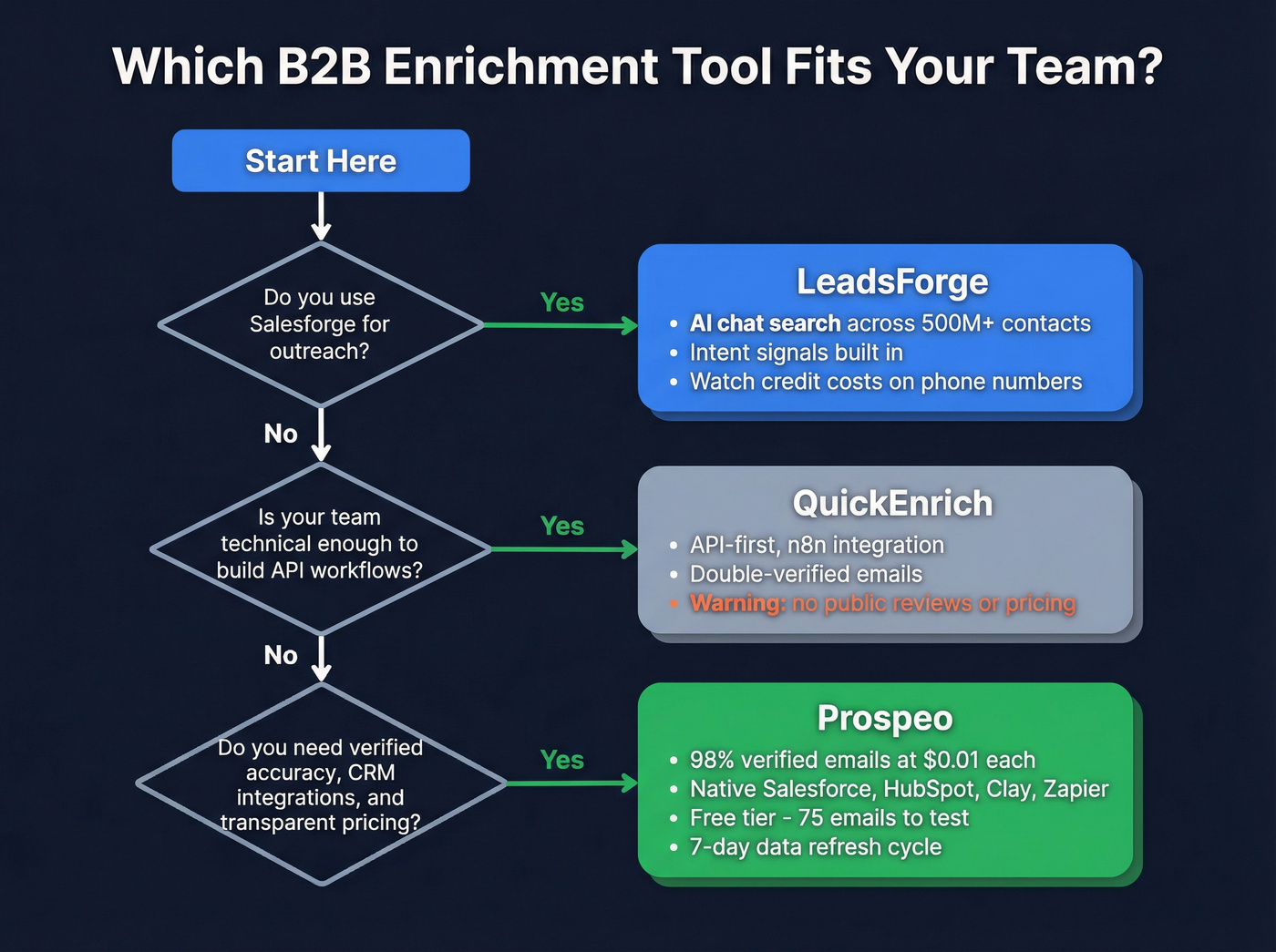
Pick LeadsForge if you:
- Already use Salesforge for outreach
- Want intent signals layered into prospecting
- Prefer AI chat-based search over manual filters
Pick QuickEnrich if you:
- Want an API-first workflow with n8n or custom integrations
- Prioritize double-verified emails over platform features
- Are comfortable being an early adopter with a limited review trail
Skip QuickEnrich if you need CRM integrations out of the box or if your team isn't technical enough to wire up API calls. Skip LeadsForge if you're not in the Salesforge ecosystem - the tight coupling that's a strength for Salesforge users becomes a limitation for everyone else.
Why We'd Test Prospeo First
Both tools ask you to trust accuracy claims without much proof. Prospeo delivers 98% email accuracy across 300M+ professional profiles, with 143M+ verified emails and 125M+ verified mobile numbers. The 30% mobile pickup rate is backed by a 7-day data refresh cycle, compared to the 6-week industry average most providers quietly operate on.
If you're evaluating alternatives beyond these two, start with a shortlist of outbound lead generation tools and compare verification methodology, not just database size.
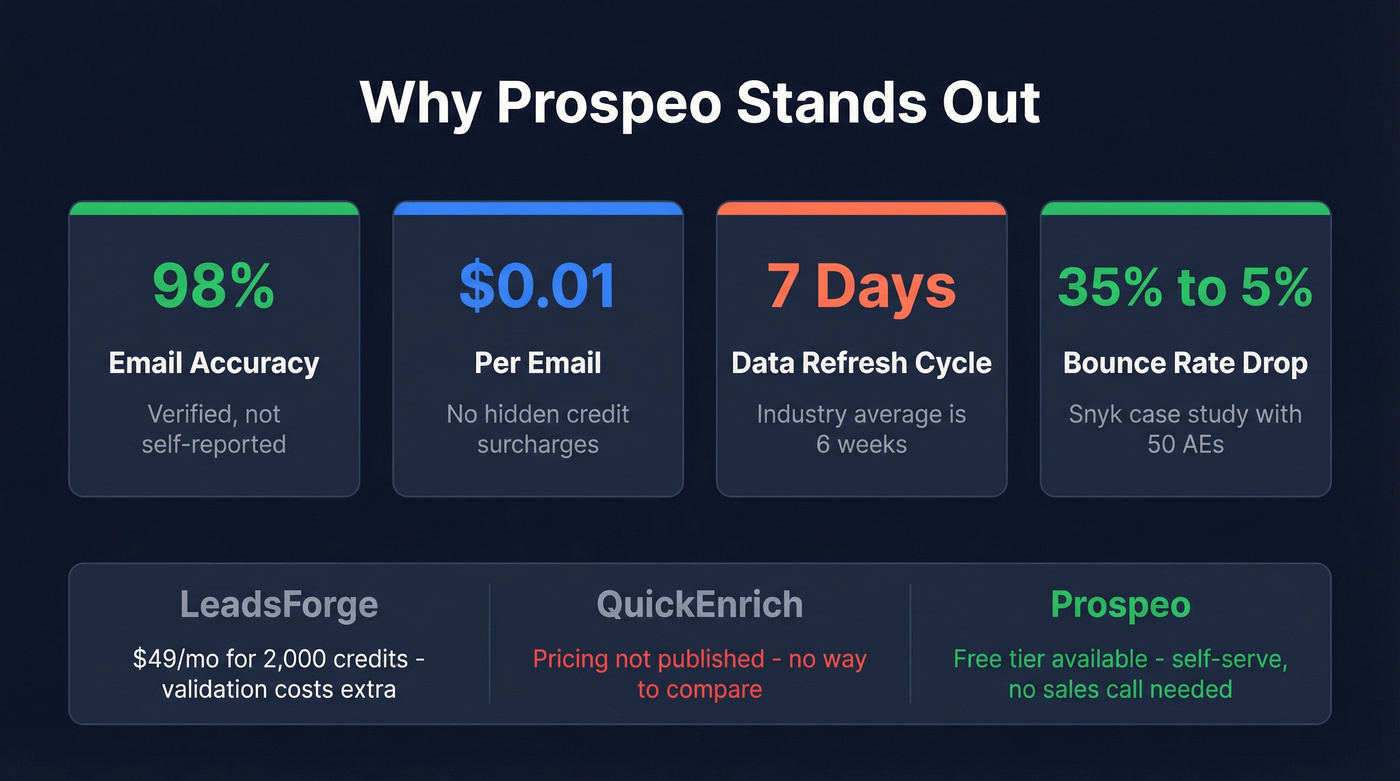
Where LeadsForge charges extra credits for validation and QuickEnrich hides its pricing entirely, Prospeo runs at roughly $0.01 per email with transparent, self-serve plans. There's a free tier with 75 emails and 100 Chrome extension credits per month, no contracts, and self-serve onboarding - you're testing data quality in minutes, not waiting on a sales call. Native integrations with Salesforce, HubSpot, Smartlead, Instantly, Lemlist, Clay, Zapier, and Make mean you won't be duct-taping an API together either. (For more on list-building workflows with Clay, see Clay list building.)
One of our customers, Snyk, cut their bounce rate from 35-40% to under 5% after switching, with 50 AEs now generating 200+ new opportunities per month. That's the kind of result that's hard to argue with.

Snyk's 50 AEs dropped their bounce rate from 35-40% to under 5% with Prospeo - generating 200+ new opportunities per month. Neither LeadsForge nor QuickEnrich has a single case study like that.
75 free emails, no contract - prove the accuracy yourself.
FAQ
Is QuickEnrich's 97% accuracy verified?
No third-party benchmarks support it. The figure comes from QuickEnrich's own site, and there's no review footprint on G2, Capterra, or Trustpilot. Always test with a small batch before committing budget to any enrichment provider.
Does LeadsForge charge extra for email validation?
Yes. Exporting an email costs 1 credit, validation uses additional credits, and phone numbers run 10 credits each. Teams pulling mobile numbers regularly can burn through 2,000 credits in under a week.