


Lemcal Review 2026: Pricing, Real User Feedback, and Honest Pros & Cons
You're on Calendly's free plan and stuck with one event type. Or you're paying $10/seat/month billed yearly and using maybe 20% of it. Either way, your booking page looks like everyone else's - a generic blue-and-white form that screams "I grabbed the first scheduling link I found."
Lemcal is the design-first alternative that keeps showing up in conversations about outbound scheduling. At $7/user/month billed annually, it's cheaper than Calendly and noticeably better-looking. But is that enough? Let's break it down.
30-Second Verdict
Lemcal costs $0-$9/month (or $7/month billed annually) and carries a 4.7/5 on G2 from 61 reviews. It's the best-looking scheduling tool on the market. Best for: freelancers, consultants, and founders who want branded booking pages that don't look like a template. Skip it if: you need enterprise integrations, SMS reminders, or a massive ecosystem.
What Is Lemcal?
Lemcal is the scheduling arm of the lempire ecosystem - the same team behind lemlist and lemwarm. It's a design-first booking tool, and Zapier's editorial team named it the best option "for beautiful booking pages." Where Calendly optimizes for workflow complexity, lemcal optimizes for how your booking page looks when a prospect lands on it.
The tool also claims it can drive no-show rates down to 30%. That tracks with what we've seen: a polished, professional-looking page signals that the meeting is worth showing up to, which is a subtle psychological nudge that generic templates don't provide.
If you've spent time in Reddit threads about scheduling tools, you've seen the pattern. People frustrated by unintuitive UX, texting/SMS reminder add-ons that run $300+/year, and free plans that feel deliberately crippled. Lemcal targets exactly that frustration.
Pricing Breakdown
Lemcal keeps it simple: two plans. Starter (free) and Pro ($9/month, or $7/month on annual billing). Budget $7/user/month if you're paying yearly, $9 if you want month-to-month flexibility.
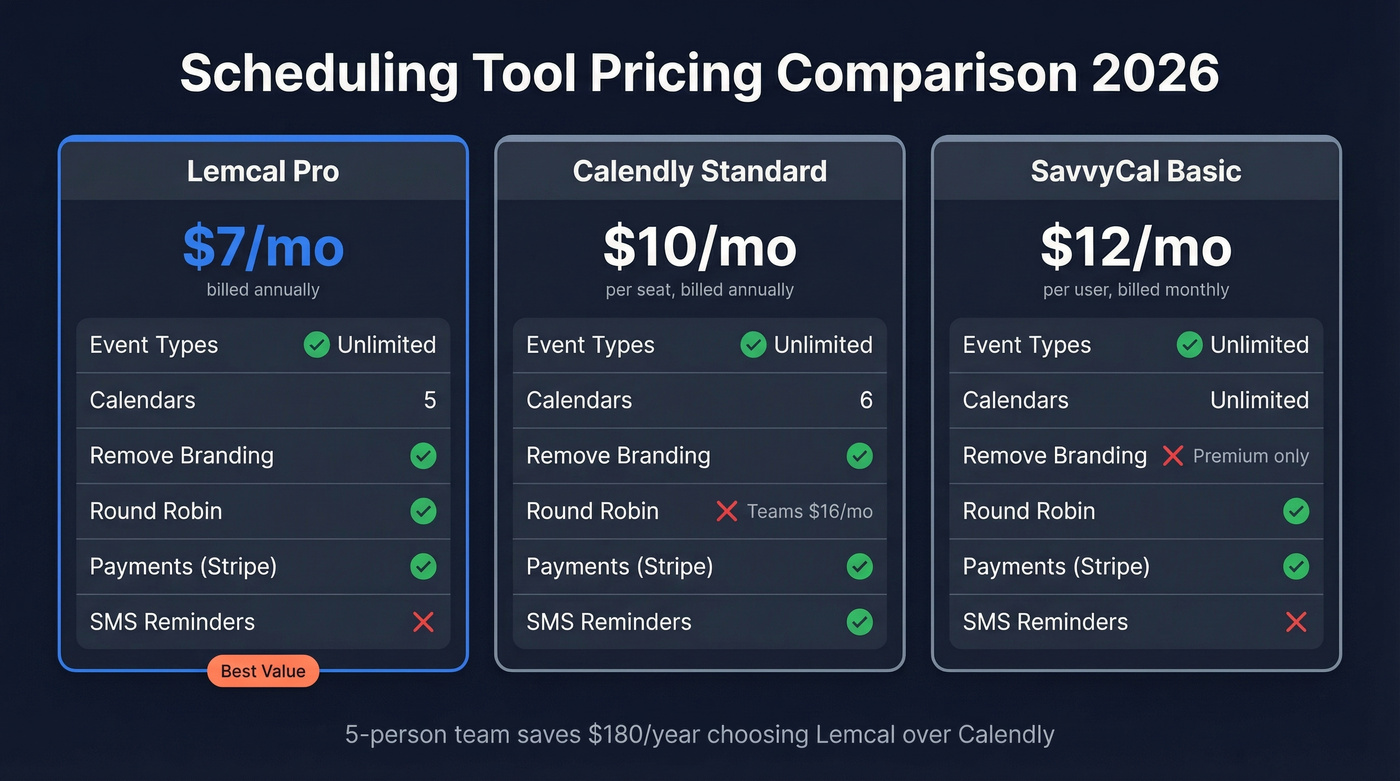
The free plan is genuinely generous - 3 meeting types and 1 calendar connection, where Calendly's free tier gives you just 1 meeting type. Pro unlocks unlimited meeting types, 5 calendars, round robin, paid bookings via Stripe, and removes lemcal branding. An "Ultimate" plan is listed as coming soon, promising Salesforce integration and custom domains.
| Lemcal Free | Lemcal Pro | Calendly Free | Calendly Std | SavvyCal Basic | Cal.com Free | |
|---|---|---|---|---|---|---|
| Price | $0 | $9/mo ($7 annual) | $0 | $10/seat/mo | $12/user/mo | $0 |
| Event types | 3 | Unlimited | 1 | Unlimited | Unlimited | Unlimited |
| Calendars | 1 | 5 | 1 | 6 | Unlimited | Unlimited |
| Remove branding | No | Yes | No | Yes | No (Premium) | No |
| Round robin | No | Yes | No | No (Teams $16) | Yes | No |
| Payments | No | Yes (Stripe) | No | Yes | Yes | Yes |
Lemcal Pro at $7/user/month billed annually undercuts Calendly Standard ($10) and SavvyCal Basic ($12). For a solopreneur, that's $36/year saved vs Calendly and $60/year vs SavvyCal. Not life-changing money, but it adds up across a small team.
What Real Users Say
The reviews paint a consistent picture: lemcal nails the booking experience. A CEO and founder wrote that it's "simple, smooth, ultra-professional... clients book in a few clicks, without friction." A hypnotherapist praised the Stripe integration, buffer time settings, and email automation - the practical stuff that makes scheduling actually useful for service businesses.
The 85% five-star rate across 61 reviews is strong. But context matters.
G2 shows it's been a couple of months since this profile received a new review, and 96.7% of reviewers are small businesses. This isn't a tool battle-tested in 500-person sales orgs. It's built for and loved by solopreneurs and small teams. We've seen this pattern before: tools that nail design and simplicity for small teams but haven't yet proven themselves at scale.


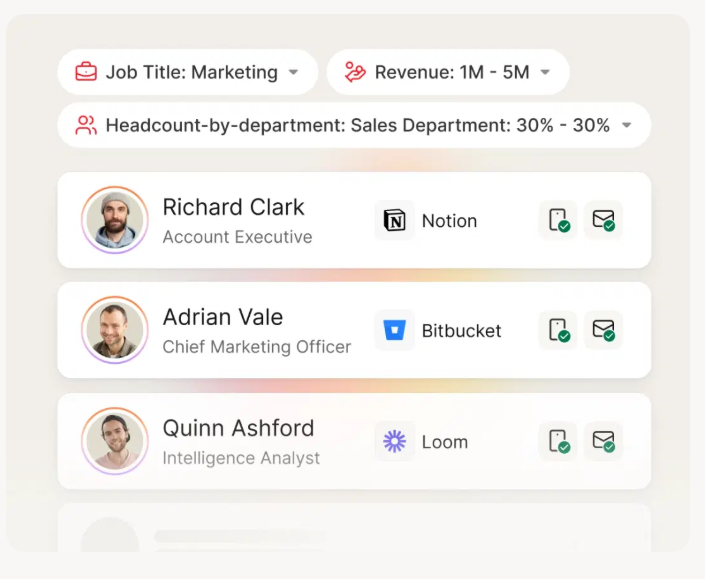
Lemcal makes your booking page look great. But a polished scheduling link with no one clicking it is just decoration. Prospeo feeds your lemlist sequences with 98% accurate emails from 300M+ profiles - refreshed every 7 days, not every 6 weeks.
Fill your lemcal calendar with meetings that actually happen.
Honest Pros and Cons
Pros:
- Best-in-class booking page design - cover photos, social media widgets, video embeds. Nothing else in this price range looks this good.
- Aggressive pricing at $7/user/month annual, undercutting Calendly ($10) and SavvyCal ($12).
- Generous free plan with 3 meeting types vs. Calendly's single event type.
- Native lemlist integration for outbound sales workflows - no Zapier middleman needed.
- Fast setup and intuitive UX.
- Stripe payments on Pro for coaches, consultants, and freelancers selling time.
Cons:
- Fewer native integrations than Calendly. For most tools beyond lemlist, you're routing through Zapier.
- No SMS reminders. Email only. If no-shows are your problem and people ignore emails, this is a real gap.
- Small ecosystem - 61 reviews vs. Calendly's 2,562. Fewer templates, community resources, and third-party guides.
- Free plan keeps key upgrades behind Pro - removing branding and deeper customization require paying.
- Analytics and reporting are basic. Detailed conversion data on booking pages isn't there yet.
Who Should Use Lemcal
Use it if you're a freelancer, consultant, or founder who cares about how your booking page represents your brand. If you're already in the lemlist ecosystem for outbound, lemcal is the obvious scheduling layer. Budget-conscious solopreneurs who need more than Calendly's free plan but don't want to pay $10+/month will find the sweet spot here.
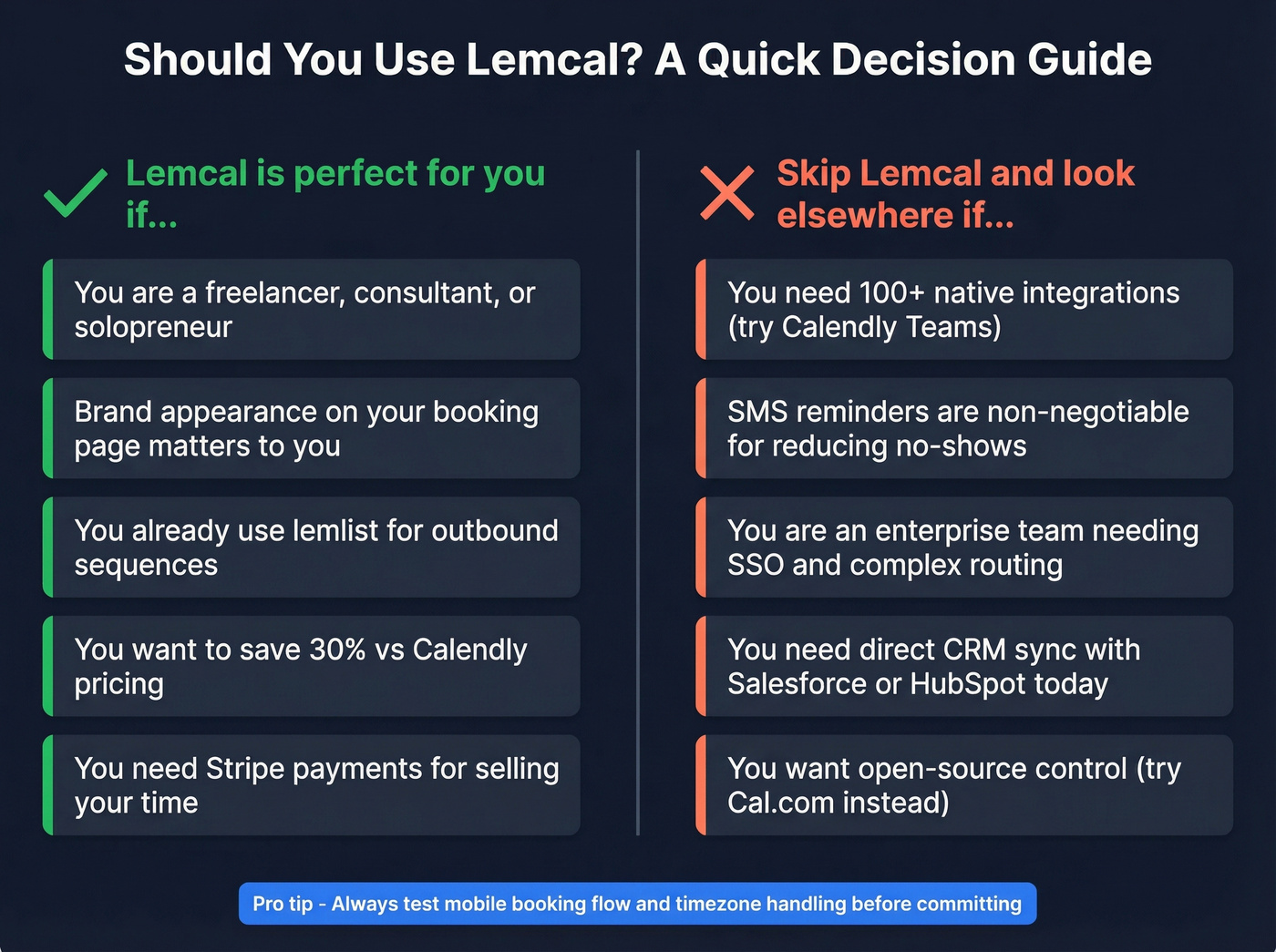
Skip it if you're an enterprise team needing SSO, 100+ native integrations, or complex routing logic - Calendly Teams is your lane. If SMS reminders are non-negotiable, lemcal can't help you today. Technical users who want open-source control should look at Cal.com instead.
Here's the thing: before committing, test the mobile booking flow, timezone handling across regions, and reminder reliability with a few real bookings. These are the things that break scheduling tools in practice, and no feature page will tell you how they perform for your specific setup.
Lemcal in a Sales Stack
A beautiful booking page doesn't generate pipeline on its own. The workflow that actually works: find verified contacts, run outbound sequences, book meetings. Lemcal handles that last step. Lemlist handles the sequences. Both need accurate contact data feeding the top of the funnel.
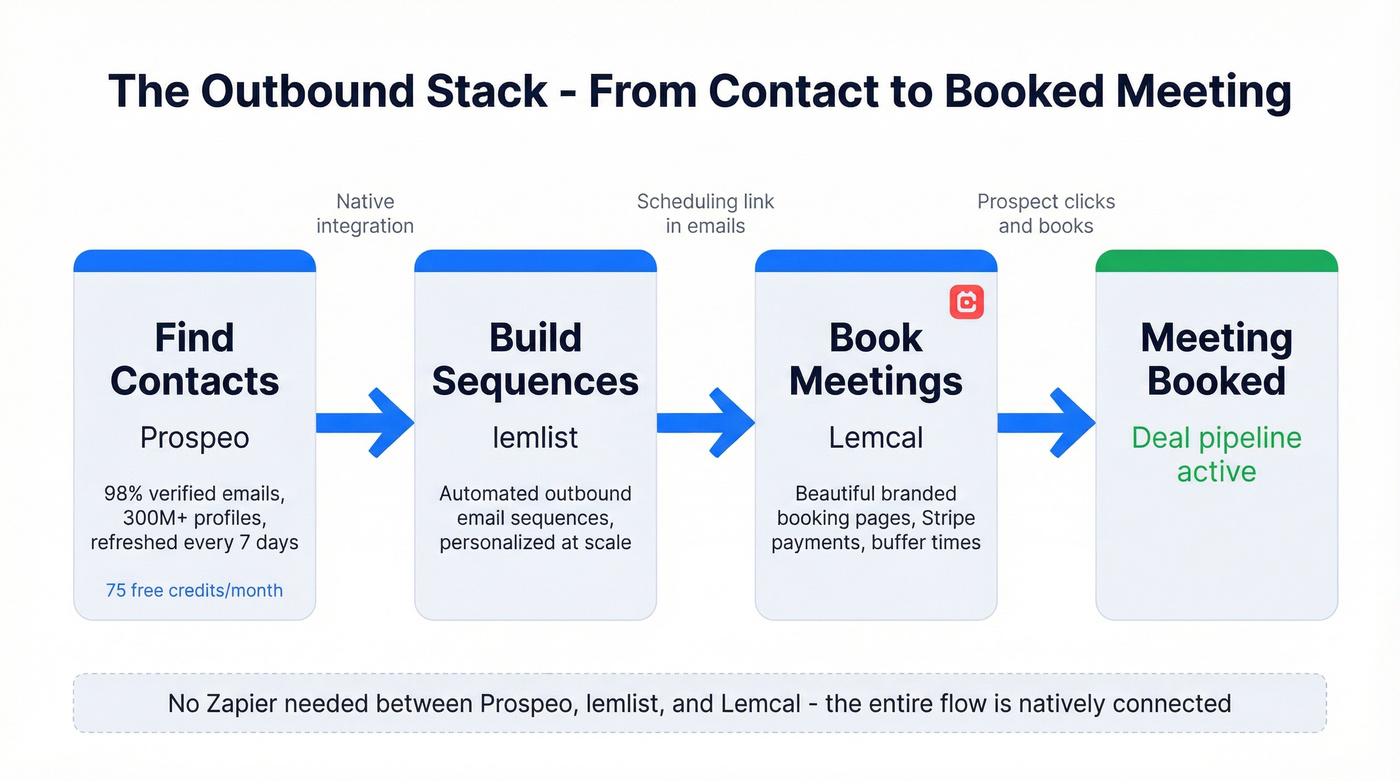
For teams running real outbound volume, data quality is the difference between a booked calendar and a dead pipeline. We've tested this stack ourselves - pairing Prospeo for verified contacts (98% email accuracy on a 7-day refresh cycle) with lemlist sequences that drive bookings through lemcal keeps the entire flow from prospecting to booked meeting inside one connected stack, with no gaps where leads fall through.
If you're building lists at scale, it also helps to understand sales prospecting techniques and where lead enrichment fits in your workflow.
You're saving $36/year choosing lemcal over Calendly. Now save on the data feeding your pipeline too. Prospeo delivers verified emails at $0.01 each - 90% cheaper than ZoomInfo - with native lemlist integration so contacts flow straight into sequences.
Stop paying enterprise prices for the top of your funnel.
The Bottom Line
Feature checklists miss the point. What actually matters: does the booking page convert, do reminders reduce no-shows, and does it connect to your stack?
Lemcal wins on design and price. Calendly wins on integrations and ecosystem depth. That's the real tradeoff.
My hot take: if your average deal size is under $5k and you're selling to individuals rather than committees, lemcal's design advantage matters more than Calendly's integration depth - first impressions close small deals. Budget for Pro ($7/user/month billed annually) from day one. The free plan's customization limits will frustrate you within a week.
And if you're running outbound, don't stop at the scheduling layer. The booking page is the finish line, not the starting block. Tighten the rest of the funnel with a clear lead generation workflow and track the right lead generation metrics.
FAQ
Is lemcal really free?
Yes - lemcal's Starter plan is genuinely free with 3 meeting types, 1 calendar connection, and basic customization. You'll hit limits on branding removal and advanced features like round robin, which require the $9/month Pro plan. Compared to Calendly's free tier (1 event type), it's a stronger starting point for solopreneurs.
How does lemcal compare to Calendly on price?
Lemcal Pro costs $7/user/month billed annually versus Calendly Standard at $10/seat/month - a 30% savings. For a 5-person team, that's $180/year saved. Calendly justifies the premium with deeper integrations and SMS reminders, but if design and cost matter most, lemcal wins.
Does lemcal integrate with CRMs?
Currently, lemcal's native integrations are limited to the lempire ecosystem (lemlist, lemwarm). For Salesforce, HubSpot, or other CRMs, you'll need Zapier or wait for the upcoming Ultimate plan. Teams needing direct CRM sync today should factor in Zapier costs ($19.99+/month).
What's the best way to feed leads into lemcal meetings?
Use a verified data source like Prospeo (75 free credits/month) to build targeted lists, push contacts into lemlist sequences via native integration, and let those sequences drive bookings through lemcal. That three-tool stack covers prospecting through to the booked meeting without gaps.