

Most Lost Leads Aren't Dead - Your Data Is
Your VP pulls up the CRM and points to 400 Closed-Lost deals from the last 18 months. "What's our plan for these?" You don't have one. Neither do most teams - 63.5% of companies never even respond to inbound leads, let alone circle back to the ones that went cold.
Here's the reframe: those lost leads aren't dead. They're dormant. And dormant contacts are a data problem first, a process problem second, and a messaging problem third.
Most teams pour budget into top-of-funnel acquisition while sitting on a CRM full of contacts who already know their name. If your average deal size clears five figures, recovering even 5% of your Closed-Lost pipeline will outperform most new-lead campaigns dollar for dollar. A solid recovery strategy pays for itself before the quarter ends.
The Quick Version
Fix your contact data - 30% of it decays every year. Build automated re-engagement sequences across multiple channels. Measure reactivation rate, not just open rate.
If you do one thing today, pull up 10 Closed-Lost contacts and check how many emails still work. The answer will tell you exactly how much pipeline you're leaving on the table.
What Dormant Leads Actually Cost You
CRM graveyards are revenue graveyards. Every dormant contact in a "Closed-Lost" bucket represents acquisition dollars already spent, and reactivating one costs roughly 5x less than acquiring a new customer. Inactive subscribers still generate about 7% of overall business revenue, which means ignoring them is leaving money in the system.
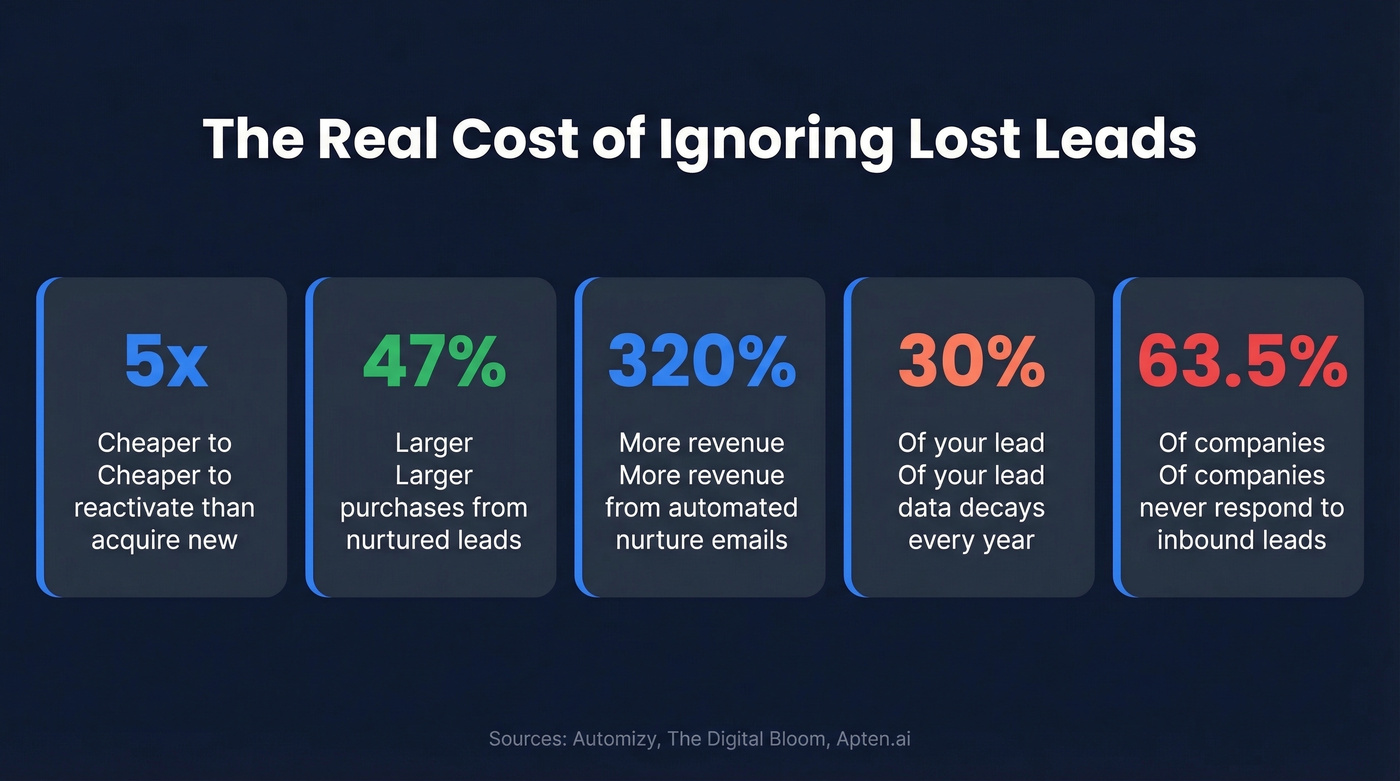
The math gets more compelling at scale. Nurtured leads make 47% larger purchases and convert 23% faster than non-nurtured ones. Companies that excel at nurturing generate 50% more sales-ready leads at 33% lower cost. Automated nurturing emails generate 320% more revenue than manual campaigns - a number that still surprises us every time we pull benchmarks for clients.
Run a quick scenario. Say you have 25,000 monthly website visitors and your visitor-to-demo rate sits under 1%, which is typical at that traffic level. If you could recover just 50 additional demo bookings per month from your existing pipeline - at a 20% close rate and $15,000 average deal size - that's $150,000 in recovered ARR from contacts you already paid to acquire. In B2B sales, these overlooked deals represent one of the largest untapped revenue sources most teams ignore.
Why Leads Go Cold
Not every stale contact is a bad fit. Most of the time, the problem is operational. As one practitioner put it on r/sales, leads die from "sales cracks" - process failures that let contacts slip through before anyone notices.
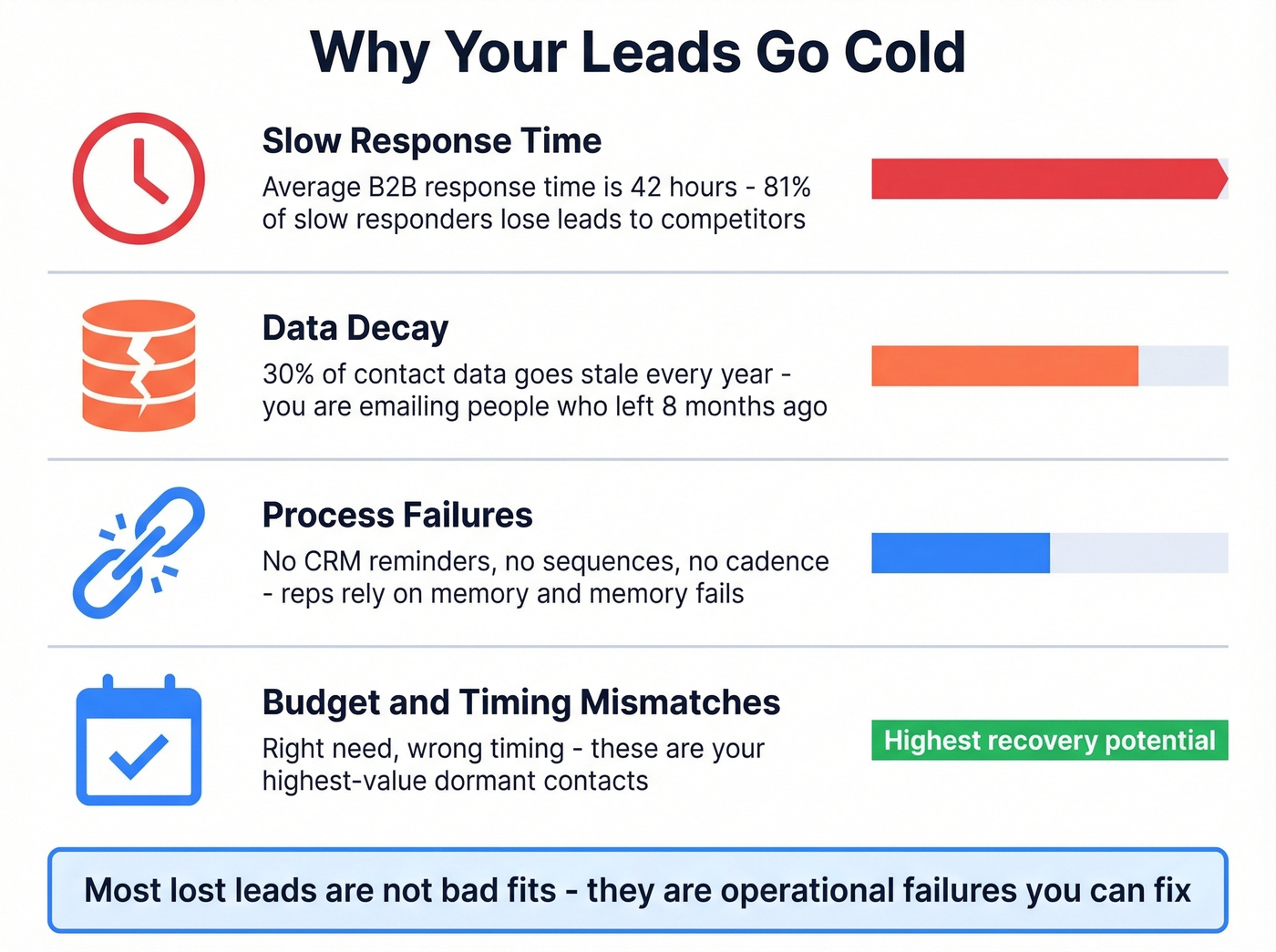
Slow response time is the #1 killer. The average B2B lead response time is 42 hours. On weekends, teams go silent for 61 hours on average. Meanwhile, 81.2% of companies that take longer than an hour to respond report losing leads to faster competitors. That's not a gap. That's a canyon.
Data decay is the silent one. About 30% of your lead data goes stale every year - people change jobs, companies rebrand, email addresses get deactivated. You're emailing ghosts.
Then there are the process failures that compound over time: no CRM reminders, no automated sequences, no defined cadence. Reps rely on memory, and memory fails. Generic "Hi {First Name}" templates that read like templates. And the leads who picked a competitor but aren't necessarily happy six months later, or who had the right need but wrong timing - these budget-and-timing mismatches are the highest-value dormant contacts in your CRM because the only thing that changed is the calendar.
The 3-Layer Recovery Framework
Stop writing better re-engagement emails. Fix your data first, build your sequences second, and automate the system third.
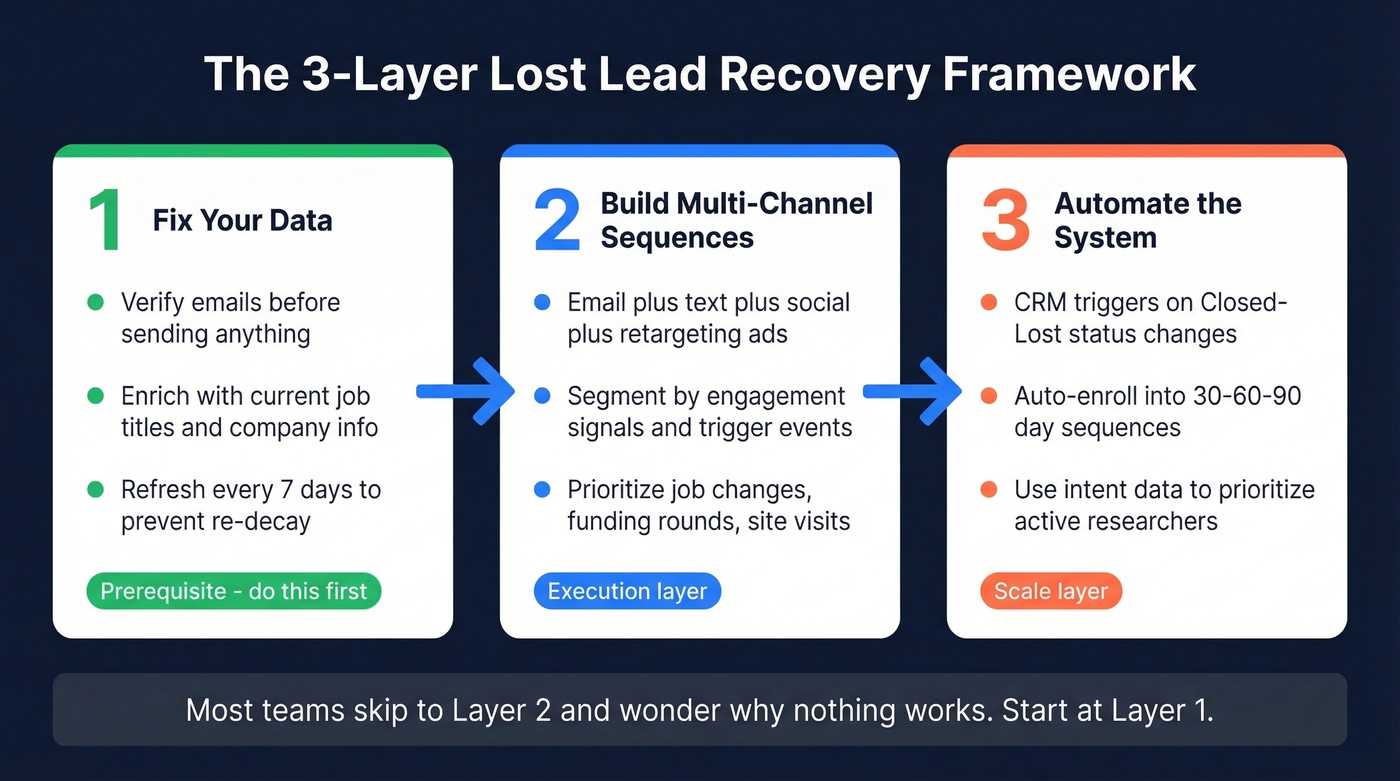
Layer 1: Fix Your Data
Here's a scenario we've watched play out dozens of times: an SDR pulls 200 contacts from the Closed-Lost bucket, loads them into a sequence, and hits send. 47 emails bounce. 12 land in spam. One reply comes back: "I left that company 8 months ago."
That SDR just torched their sender reputation for nothing.
Data verification isn't optional - it's the prerequisite for everything else. When 30% of lead data decays annually, any list older than six months is high-risk. Bounced emails don't just waste time; they damage your domain reputation, which tanks deliverability for every future campaign you run.
We've found that running stale CRM lists through Prospeo's enrichment returns 83% of leads with updated contact data - 50+ data points per record, including current email, job title, and company info. The 98% email accuracy rate means you can stop guessing and send with confidence, and the 7-day refresh cycle ensures the data isn't already stale by the time you use it. Most enrichment tools refresh around every 6 weeks. By then, your "fresh" data is already decaying.
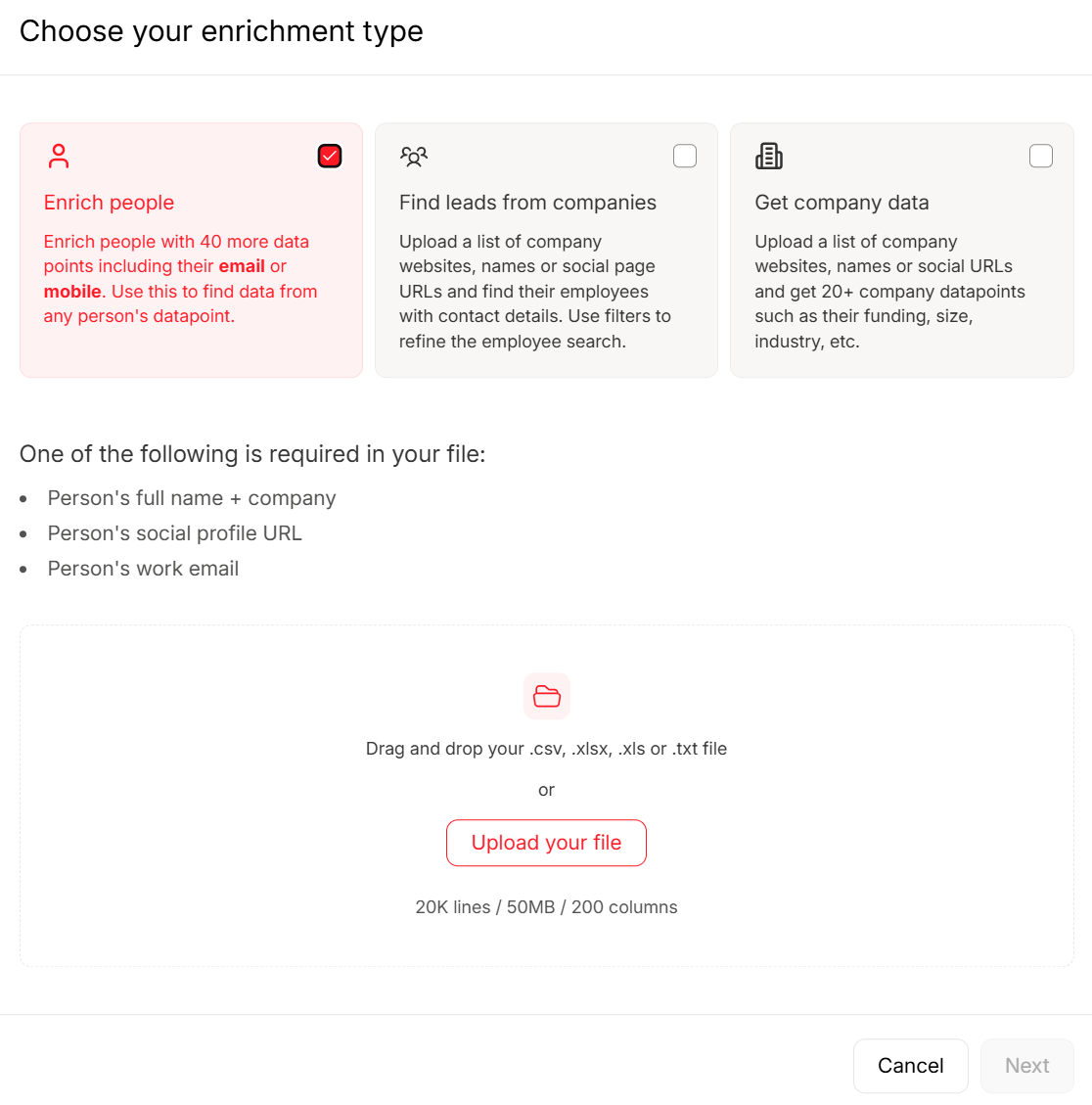

Your Closed-Lost list is a goldmine buried under decayed data. Prospeo's CRM enrichment returns 83% of leads with updated emails, titles, and company info - 50+ data points per record at 98% accuracy. Stop emailing ghosts.
Recover your dormant pipeline before your competitors do.
Layer 2: Build Multi-Channel Sequences
Email alone won't cut it. The teams getting the best reactivation numbers run multi-channel sequences: email, text, social touches, and retargeting ads working in parallel.
One case that stands out: a team using Go High Level's AI chatbot to re-engage dormant contacts via text messaging converted 343 out of 700 MQLs back into SQLs, with response rates up 40% and quarterly sales up 17%. The thread on r/SaaS sparked a long discussion about why text outperformed email - it felt personal and immediate, not like another drip campaign.
Segment before you sequence. Prioritize contacts who previously replied (even to say "not now"), those who repeatedly opened past emails, and anyone who visited key pages on your site in the last 90 days. Layer in trigger events - job changes, funding rounds, product launches - as re-entry signals. A person who just switched roles has an empty tech stack and real budget to spend. These aren't cold leads. They're warm leads with stale data, and reconnecting at the right trigger moment turns a dead deal into an active opportunity.
Layer 3: Automate the System
Manual re-engagement doesn't scale. Here's the workflow that works:
Set a CRM trigger so that when a deal gets marked "Closed-Lost" in Salesforce, the contact auto-enrolls into a re-engagement sequence in HubSpot. Add a second trigger: any lead that goes cold for 30+ days syncs back into marketing automation for targeted nurturing. Then build a 3-month re-engagement workflow - a light-touch sequence that fires at 30, 60, and 90 days post-close with different angles each time.
The layer most teams miss is intent data for prioritization. Tools like Prospeo track 15,000 topics via Bombora, so you can see which dormant leads are actively researching solutions again and prioritize those contacts for immediate outreach instead of treating every Closed-Lost deal the same.
Job changes, new titles, dead emails - 30% of your lead data decays every year. Prospeo refreshes every 7 days (not 6 weeks like everyone else) so your re-engagement sequences actually land. At $0.01 per email, reactivating Closed-Lost deals costs a fraction of new acquisition.
Turn your CRM graveyard into your best-performing pipeline source.
5 Experiments to Win Back Deals This Week
You don't need a full reactivation program to start. Pick one, run it, measure what happens.
1. The 3-minute reconnect email. Pick 5 leads from the last 3-6 months. Send a 2-sentence check-in - no links, no attachments, no meeting ask. Tuesday through Thursday, 10am-2pm. Success metric: 1-2 replies out of 5. (If you need copy, start with these follow-up templates.)
2. Social pulse check. Engage genuinely with a dormant contact's recent post. Wait 2-3 days, then send a message under 50 words with no ask. Track profile views and responses.
3. Industry news share. Send a relevant article with a short "thought of you" note. Two or three opens and a click? That's a warm signal worth pursuing.
4. Feedback-first outreach. Ask what changed since your last conversation. The goal isn't to sell - it's to learn. Detailed replies are a strong re-engagement signal, even if the answer is "we went with a competitor."
5. Contact data refresh audit. Pull 10 leads dormant for 6+ months. Run them through an enrichment tool to check which emails still work and who changed jobs. First-mover advantage on a new hire's empty inbox is real. (If you're comparing vendors, see data enrichment services.)
Re-Engagement Email Templates
Three templates you can copy, paste, and send today. Wait 3-4 days between touches, and segment by scenario.
Template 1: The Friendly Check-In
Subject: Quick question, {{first_name}}
Hi {{first_name}},
It's been a while. How are things going with {{their initiative or pain point}}?
No agenda here - just curious.
Best, {{your name}}
Template 2: The Value-Add Update
Subject: {{Company}} just shipped something you asked about
Hi {{first_name}},
Last time we spoke, {{specific objection or missing feature}} was a sticking point. We've since rolled out {{new feature or improvement}}. Worth a 15-minute look?
{{your name}}
Template 3: The Win-Back
Subject: Honest question about our last conversation
Hi {{first_name}},
I've been thinking about our conversation from {{timeframe}}. We didn't end up working together, and I'd genuinely love to understand what tipped the decision. If anything's changed on your end, happy to pick it back up.
{{your name}}
Let's be honest - none of these are revolutionary. The magic isn't in the copy. It's in sending them to verified emails at the right moment, which circles back to Layer 1. (If you're tightening deliverability, start with an email deliverability guide.)
Measuring Recovery Success
If you're not measuring reactivation rate, you're guessing. Here are the benchmarks that matter.
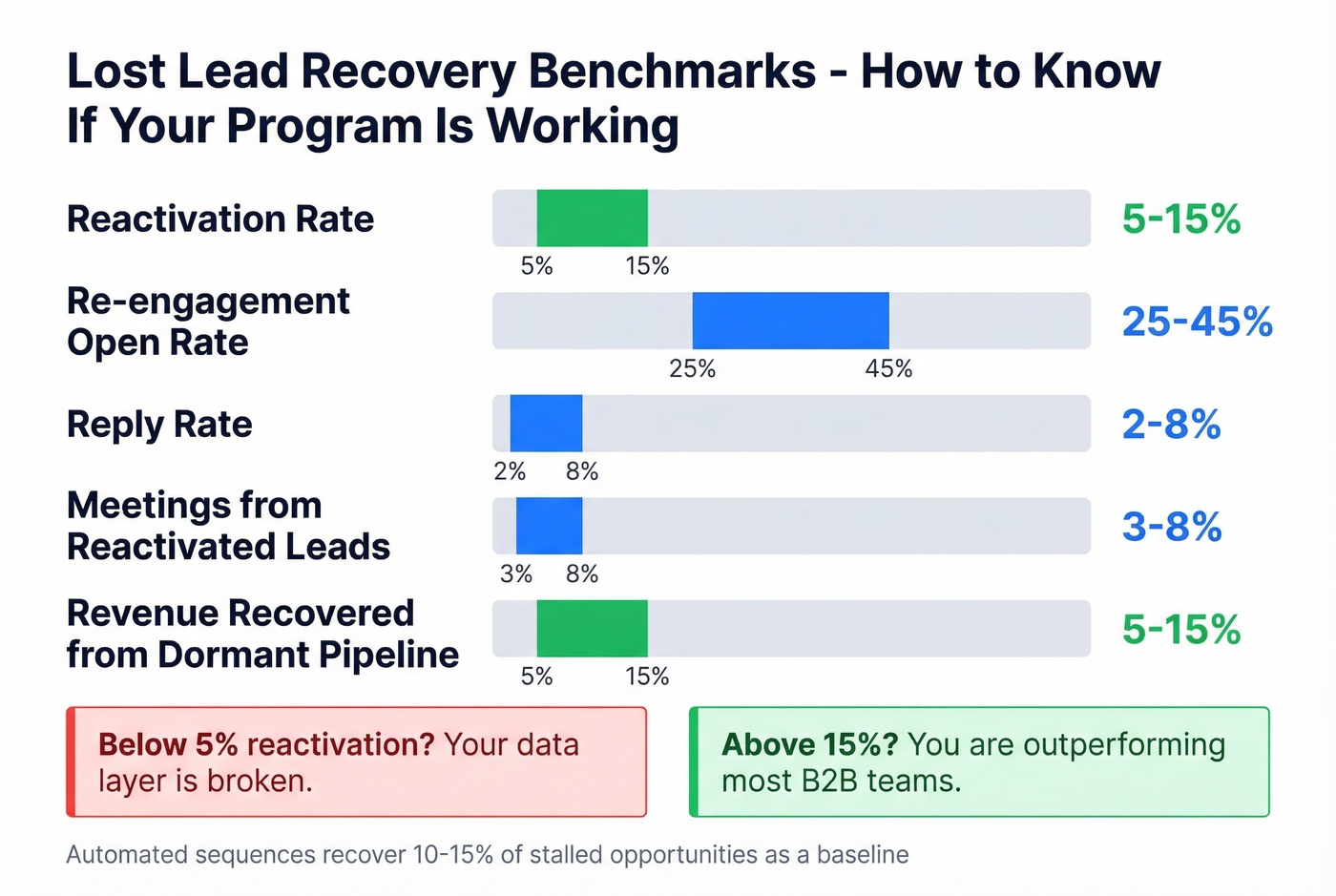
| KPI | Benchmark Range |
|---|---|
| Reactivation rate | 5-15% |
| Re-engagement open rate | 25-45% |
| Reply rate | 2-8% |
| Meetings from reactivated leads | 3-8% of reactivated contacts |
| Revenue recovered | 5-15% of dormant pipeline value |
Automated re-engagement sequences can recover 10-15% of stalled opportunities. That's not a moonshot - it's a baseline. If you're below 5% reactivation, your data layer is broken. If you're above 15%, your definition of "lost" needs tightening - you're probably not losing those leads in the first place.
Skip the vanity metrics. Open rates feel good but don't pay the bills. Track reactivation rate (contacts re-entering active pipeline) and revenue recovered (actual dollars from reactivated deals) as your north stars. (For more KPI ideas, use these funnel metrics.)
Lost Leads FAQ
How do you re-engage lost leads effectively?
Combine clean data, multi-channel sequences, and trigger-based timing. Verify contact info first since 30% decays annually, then run coordinated email, text, and social touches timed to events like job changes or funding rounds. After verification, segment by engagement history and prioritize contacts showing fresh intent signals.
What counts as a lost lead?
Any contact with zero engagement for 30-90 days, a deal marked Closed-Lost, a bounced email address, or someone who unsubscribed. The key distinction: dormant leads are recoverable with the right data and timing, while truly dead ones - permanent opt-outs or defunct companies - should be purged from your CRM entirely.
How long before a lead is considered lost?
Most teams use 30-90 days of zero engagement as the threshold. Trigger re-engagement at 30 days for warm contacts that went quiet, and 90 days for formally Closed-Lost deals. The HubSpot community recommends building these triggers directly into your CRM automation so nothing slips through.
What's the cheapest way to verify stale lead data?
Prospeo's free tier includes 75 email verifications per month - enough to audit a small Closed-Lost list and see how much data has decayed. For larger lists, credit-based pricing starts at roughly $0.01 per email with 98% accuracy, which is significantly cheaper than enterprise-tier tools.
Can you recover lost leads without a CRM?
Yes, but it's harder to scale. Export your contacts to a CSV, run them through an enrichment tool to update emails and job titles, then load verified contacts into a sequencing tool like Instantly or Lemlist. You'll miss automation triggers, but you can still run the 3-layer framework manually for lists under 500 contacts.