

7 Mail-Tester Alternatives That Show Where Your Emails Actually Land
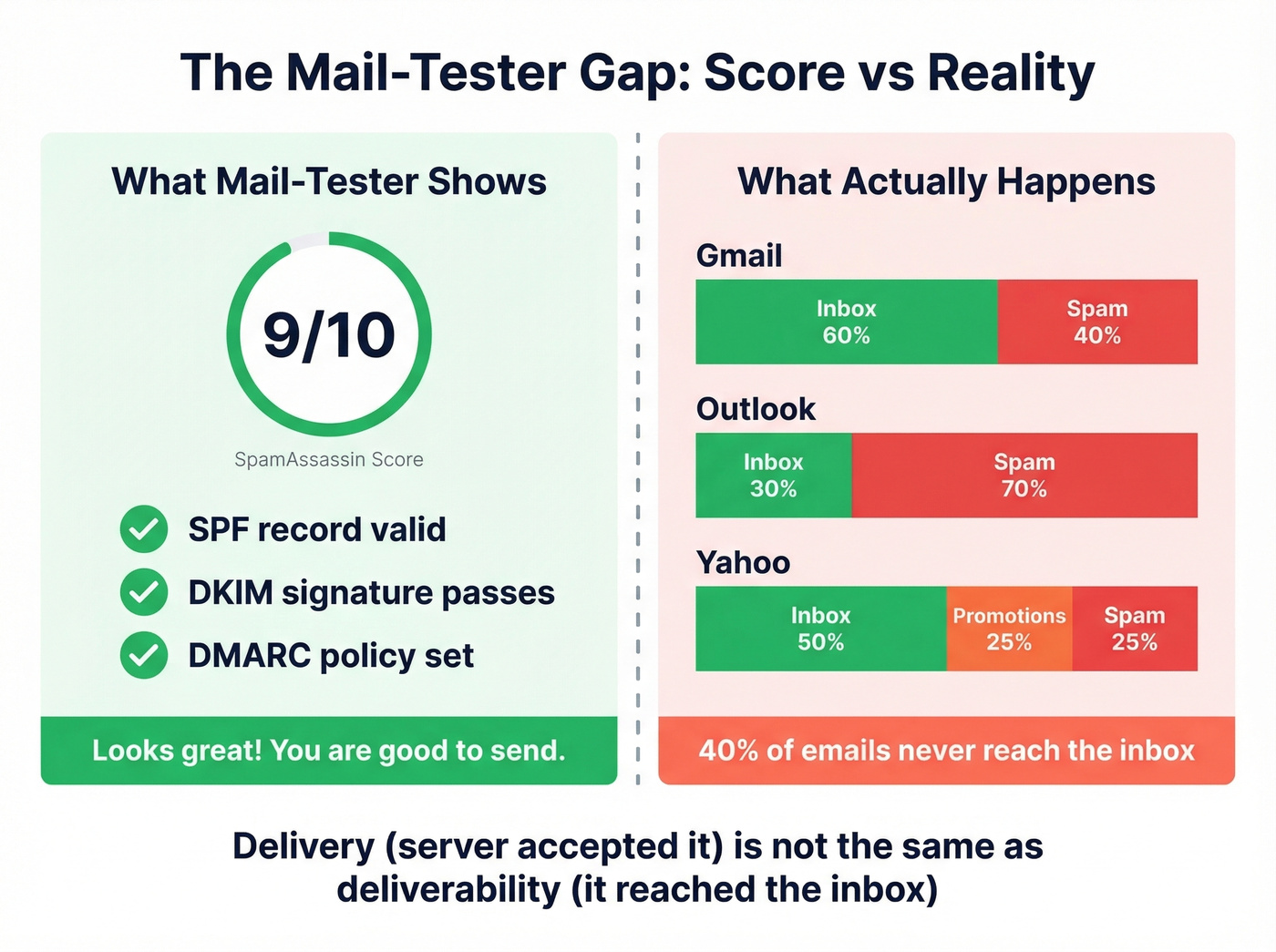
You scored a 9/10 on Mail-Tester. You high-fived yourself. Then you launched the campaign and 40% of your emails landed in spam.
The r/Emailmarketing threads tell the same story: people get a near-perfect score and still can't reach the inbox. That's because a SpamAssassin score and actual inbox placement are two completely different things - and finding the right mail tester alternative starts with understanding that gap. Here are seven tools that go deeper, plus a framework for picking the right combination.
Our Picks (TL;DR)
- GlockApps - Best for real inbox placement testing. Seed-list methodology shows exactly where you land across Gmail, Outlook, and Yahoo. Starts at $59/mo.
- Prospeo - Best for fixing the root cause. Most deliverability problems are data problems. Verify your list before you test anything. Starts free, ~$0.01/email.
- Unspam.email - Best budget option. Inbox placement testing, email previews, and heatmaps for $9/mo. The most underrated tool on this list.
Why Mail-Tester Falls Short
Mail-Tester does one thing well: it runs your email through SpamAssassin and checks your SPF, DKIM, and DMARC records. That's useful. It's also not enough.
Here's what it doesn't do:
- No provider-level breakdown. You don't know if Gmail inboxed you but Outlook junked you. That distinction matters enormously for B2B outbound, where Outlook dominates.
- No actual inbox placement testing. A 10/10 score means your authentication is clean and your content doesn't trigger SpamAssassin. It doesn't mean your email reaches the inbox.
- Free tier caps at 3 tests/day. Fine for a quick check, not for ongoing monitoring.
The core issue is one Litmus articulates well: delivery (the server accepted it) and deliverability (it reached the inbox) are different metrics. Mail-Tester measures the first. You need tools that measure the second.
Why Deliverability Tools Disagree
If you test the same email across three tools, you'll often get three different verdicts. Reddit threads are full of people calling this "laughable." Frustrating, sure - but it makes sense once you understand the methodologies.
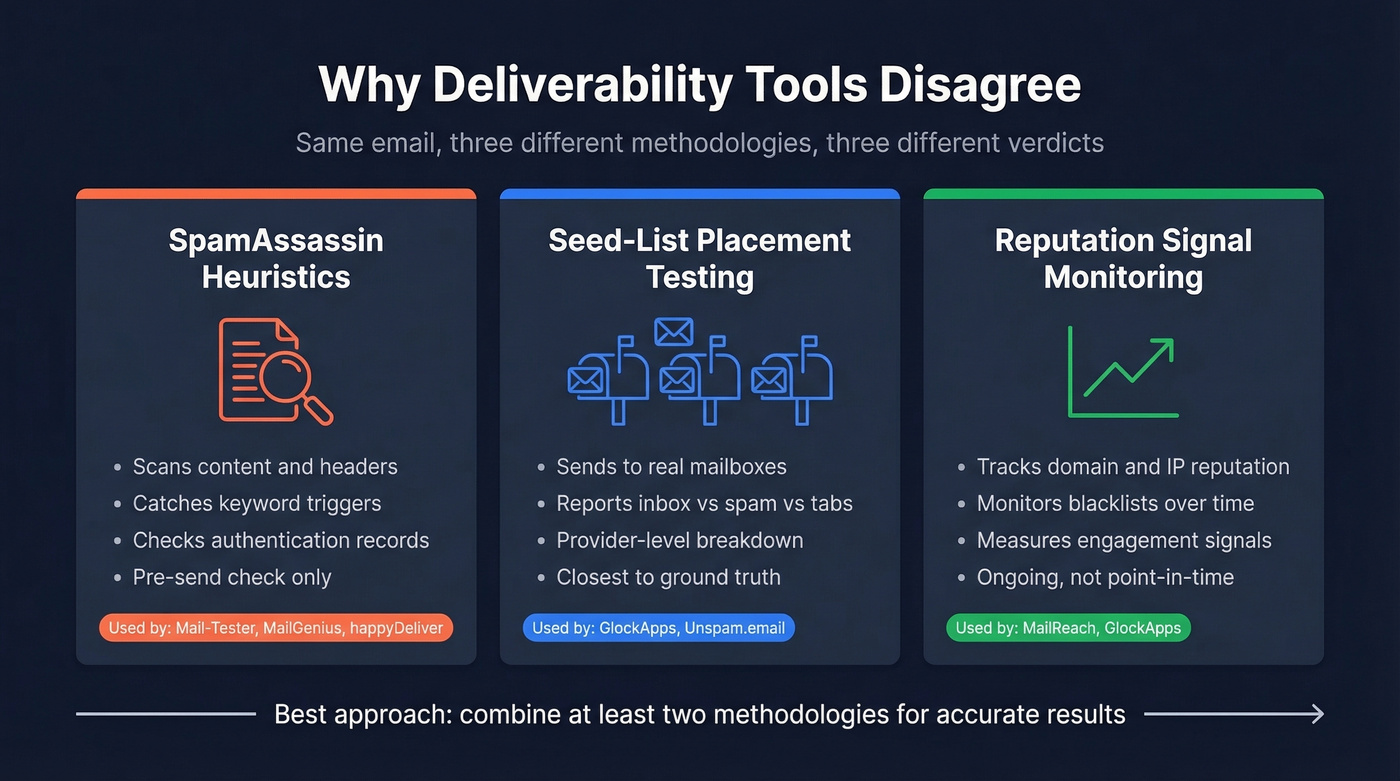
SpamAssassin heuristics scan your content and headers against a rule set. They catch keyword triggers, broken authentication, and formatting issues. They're pre-send checks - useful but limited.
Seed-list placement testing sends your email to real mailboxes across providers and checks where it lands. This is the closest thing to ground truth, though results vary by seed account history and timing.
Reputation signal monitoring looks at your domain and IP reputation over time - blacklists, engagement signals, warm-up progress. It's ongoing rather than point-in-time, which makes it complementary to the other two approaches.
Same email, different methodologies, different verdicts. That's why you need at least two tools testing different layers. Litmus found that successful email marketers are 22% more likely to actively monitor inbox placement - not just glance at a spam score once and move on.
Here's the thing, though: most deliverability problems aren't content problems at all. They're data problems. You can obsess over subject lines and spam words, but if 15% of your list is bouncing off invalid addresses, none of that matters. The fastest way to tank sender reputation is sending to addresses that don't exist. Fix the list first, then worry about the copy.


You don't have a deliverability problem - you have a data problem. Prospeo's 5-step verification catches spam traps, honeypots, and catch-all domains before they torch your sender reputation. 98% email accuracy. Data refreshed every 7 days, not 6 weeks.
Fix your list first. The inbox placement scores will follow.
7 Email Testing Tools to Replace Mail-Tester
GlockApps - Best for Inbox Placement
Use it if you need to know exactly where your emails land across Gmail, Outlook, Yahoo, and other providers - broken down by inbox, spam, and promotions tab. That promotions-tab detection is critical for marketers whose emails technically "inbox" but get buried where nobody looks.
GlockApps uses seed-list methodology, sending your email to real mailboxes and reporting back. It's the gold standard for placement testing, and in our experience it's the tool we recommend first when someone says "I have a 10/10 on Mail-Tester but my open rates are garbage."
Pricing is straightforward: Free gives you 2 test credits. Essential runs $59/mo with 360 tests. Growth is $99/mo for 1,080 tests across 10 sending accounts. Enterprise hits $129/mo for 1,800 tests and 20 accounts. Every plan includes DMARC analytics, uptime monitors, and IP reputation monitoring.
Skip it if you only need authentication checks or content scoring. GlockApps is overkill for "does my SPF record work?" - Mail-Tester handles that fine for free. The $59/mo minimum also makes it a tough sell for low-volume senders.
Prospeo - Best for Fixing the Root Cause
This isn't a deliverability testing tool. It's the reason your deliverability tests come back clean.
Most inbox placement problems trace back to list quality. Bounces, spam traps, and honeypot addresses destroy sender reputation faster than any content issue. Prospeo's 5-step verification process handles all of it: catch-all domain handling, spam-trap removal, honeypot filtering, syntax validation, and SMTP verification. The result is 98% email accuracy across 143M+ verified addresses.
Records refresh every 7 days - the industry average is 6 weeks. That matters because email addresses go stale fast, especially in B2B where people change jobs constantly. One customer, Meritt, saw bounce rates drop from 35% to under 4% after switching, which is the difference between your domain getting flagged and your sequences actually reaching people.
Free tier includes 75 email verifications per month. Paid plans run ~$0.01 per email, with native integrations into Smartlead, Instantly, and Lemlist - verified contacts flow straight into your sequences without manual exports.
Unspam.email - Best Budget Option
At $9/mo for the Basic plan, you get 50 spam tests, 50 email previews, 10 heatmaps, and 10 inbox placement tests. That's real inbox placement testing - not just a SpamAssassin score - for less than the cost of a lunch.
The email previews and heatmaps are the unique differentiator here. You see exactly how your email renders across clients and where recipients' eyes go. The AI assistant flags content issues before you send. Even the free tier gives you 10 spam tests and 3 inbox tests per month, enough for occasional checks.
Business plan at $19/mo bumps you to 200 spam tests and 50 inbox tests. Agency plans start at $29/mo with 500 tests. For teams running multiple domains or client accounts, the value per test is unbeatable.
MailGenius - Best Free Starting Point
MailGenius works best as a content-level pre-send checker. Its AI-powered copywriting analysis rewrites flagged content for you, which is a nice touch. The Genius plan at $39/mo lets you test competitors' emails - useful for benchmarking.
A heads-up on pricing: many directory listings still show $8/mo, but that's outdated. Current plans start at $23/mo for Beginner with 60 tests/month. And there's no seed-list inbox placement testing - it's content and authentication analysis only. Don't confuse it with actual placement testing.
MailReach - Best for Warm-Up + Testing
MailReach is fundamentally a warm-up tool that includes testing - not the other way around. At $19.50/mailbox/month, you get AI-driven warm-up sending, reputation tracking, and at least 20 spam test credits bundled in. It holds a 5.0/5 rating on Capterra across 24 reviews - small sample but spotless.
The distinction matters. Every other tool on this list tells you where you stand. MailReach tries to fix it by gradually building your sender reputation through automated warm-up conversations.
Skip it if you just need a quick spam check. There's no free trial, and the per-mailbox pricing adds up fast across a team. It's best for cold emailers warming new domains.
Mailtrap - Best for Developers
Mailtrap is built for dev and QA teams testing transactional emails in staging environments. It catches rendering issues and validates email flows before they hit production. Free tier available, paid plans from $14/mo with annual billing. If you're a marketer or cold emailer, this isn't for you - it solves a completely different problem.
happyDeliver - Best Self-Hosted Option
happyDeliver is an open-source, self-hosted alternative that checks SPF, DKIM, DMARC, BIMI, and ARC authentication, then runs SpamAssassin scoring and grades your email A+ through F. Deploy it as a single Docker image. It's not polished, but the methodology is fully transparent - and it's free. Best for technical teams who want full control over their testing infrastructure.
Pricing Comparison
Here's every tool side by side, with Mail-Tester as the baseline.
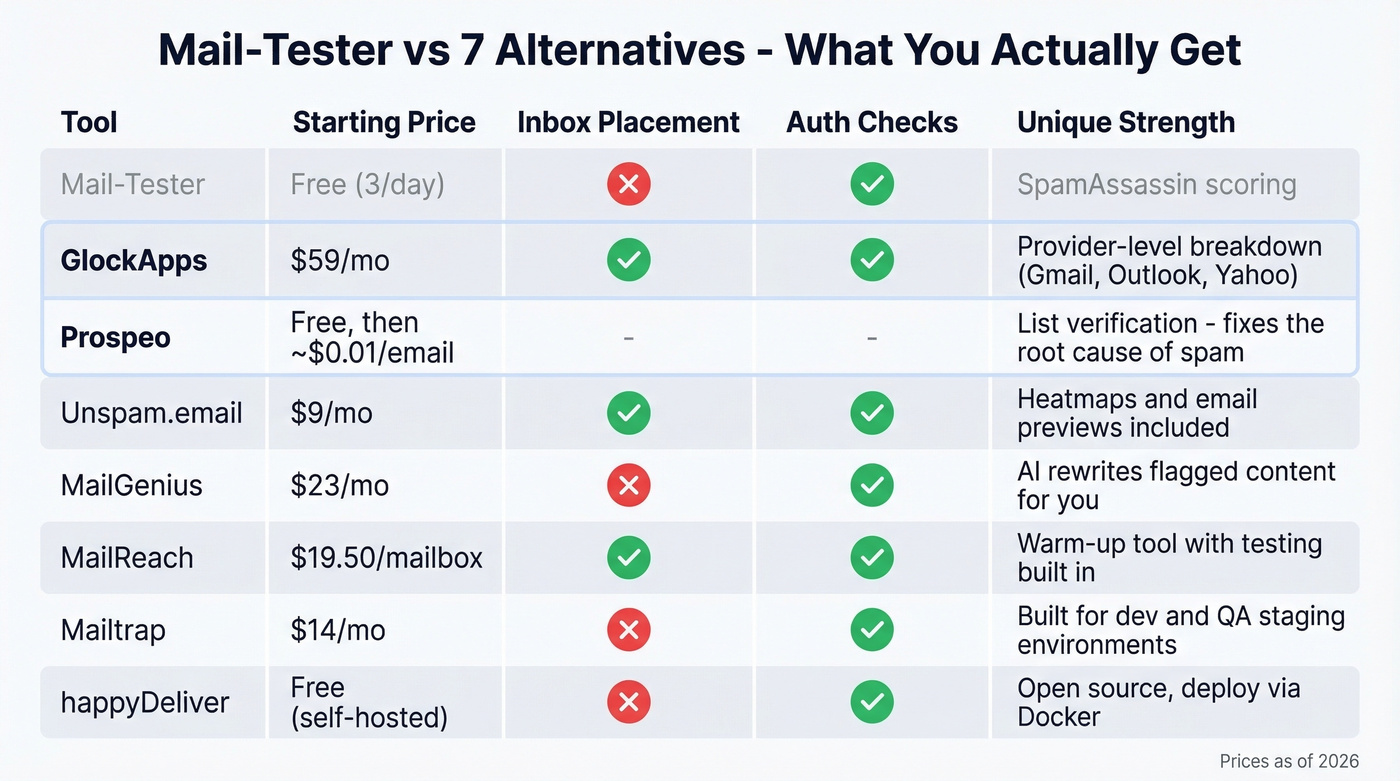
| Tool | Free Tier | Paid From | Best For |
|---|---|---|---|
| Mail-Tester | 3 tests/day | N/A | Quick auth checks |
| GlockApps | 2 credits | $59/mo | Inbox placement |
| Prospeo | 75 emails/mo | ~$0.01/email | List verification |
| Unspam.email | 10 tests/mo | $9/mo | Budget testing |
| MailGenius | Limited | $23/mo | Content analysis |
| MailReach | None | $19.50/mailbox | Warm-up + testing |
| Mailtrap | Yes | $14/mo (annual) | Dev/QA testing |
| happyDeliver | Fully free | N/A | Self-hosted checks |
A quick cautionary note on metered billing: One Reddit user reported getting hit with a $30,000 invoice from a validation platform after millions of unexpected validations ran on their account. Always set usage caps and monitor billing on any metered service.
Why not Litmus or Email on Acid? Both are excellent for email rendering and previews, but they're full email marketing platforms - not focused deliverability testing tools. For focused spam and placement testing, the tools above are better fits.
Building Your Stack
You don't need 10 tools. You need three that do different jobs.
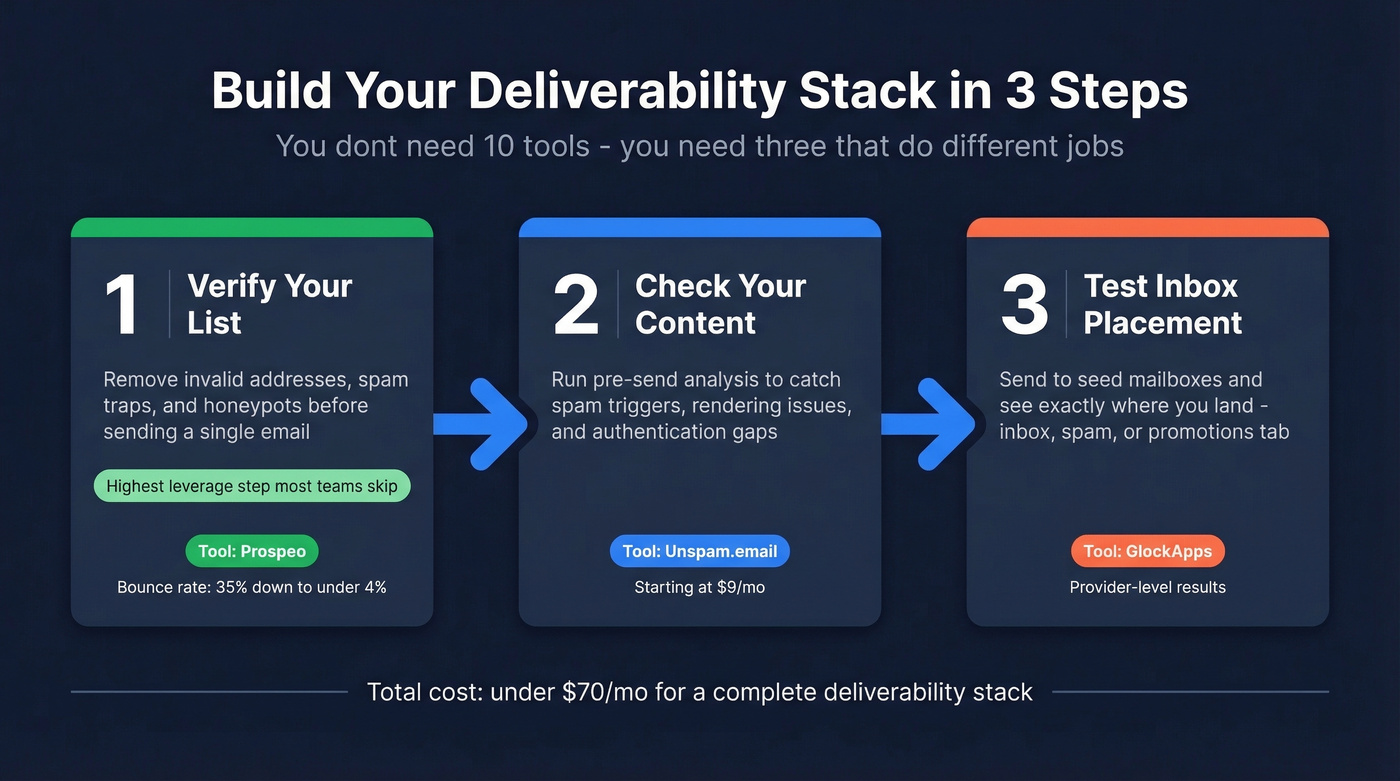
Step 1: Verify your list. Remove invalid addresses, spam traps, and honeypots before you send a single email. This is the highest-leverage step most teams skip. If you want the full framework, start with an email deliverability guide and then go deeper on spam trap removal.
Step 2: Check your content. Run your email through pre-send analysis with Unspam.email to catch spam triggers, rendering issues, and authentication gaps. If you're still troubleshooting, a dedicated email spam checker can help you isolate content vs. reputation issues.
Step 3: Test inbox placement. Send to seed mailboxes with GlockApps and see exactly where you land across Gmail, Outlook, and Yahoo.
Total cost: under $80/mo. That covers list hygiene, content validation, and real inbox placement data. We've seen teams pair Unspam.email with GlockApps for pre-send content checks and deeper placement analysis - at a combined $68/mo, that's a serious testing stack for less than most single email testing platforms charge.
Let's be honest: the teams that consistently land in the inbox aren't the ones with the fanciest tools. They're the ones who verify their data, test before sending, and monitor results over time. A 9/10 Mail-Tester score is a starting point, not a finish line. If you're scaling outbound, it also helps to understand email velocity and keep an eye on your email bounce rate.
Meritt dropped their bounce rate from 35% to under 4% - no deliverability tool tweak did that. Clean data did. Prospeo verifies 143M+ emails at ~$0.01 each and pushes verified contacts straight into Smartlead, Instantly, or Lemlist.
Stop testing spam scores on a list full of dead addresses.
FAQ
Is Mail-Tester accurate?
Yes, for what it measures. SPF, DKIM, and DMARC checks are reliable, and SpamAssassin scoring catches common content triggers. But it doesn't test actual inbox placement - a 9/10 score doesn't confirm Gmail or Outlook inboxed your message.
Do I need inbox placement testing or just a spam score?
You need both. A spam score catches content and authentication issues pre-send. Inbox placement testing shows where emails actually land post-send. 70% of emails have at least one spam-related issue, so pre-send checks catch a lot - but only seed-list testing confirms real-world delivery.
What's the best free mail tester alternative?
happyDeliver is fully free and open-source if you can self-host. Unspam.email offers 10 free spam tests and 3 inbox placement tests monthly. For list verification, Prospeo's free tier includes 75 email verifications per month - enough to clean a small campaign list before testing.
Why do deliverability tools give different results?
They use different methodologies. Mail-Tester runs SpamAssassin heuristics. GlockApps uses seed-list inbox placement. MailReach tracks reputation signals over time. Same email, three different measurement approaches, three different verdicts. Use at least two tools testing different layers for a complete picture.