


7 MailerCheck Alternatives That Actually Handle Catch-All Emails
One Capterra reviewer nailed it: you "gamble a little bit with the catch-all category" on MailerCheck because you genuinely don't know if it's safe to send. That's fine for a newsletter list. It's not fine when you're running cold outbound and every bounce chips away at your domain reputation.
If you're shopping for MailerCheck alternatives, here are seven that handle the catch-all problem better - with real pricing so you can actually compare.
Why People Leave MailerCheck
MailerCheck does the basics well. It plugs into MailerLite, support is responsive, and setup is quick. But the cracks show when you push it.
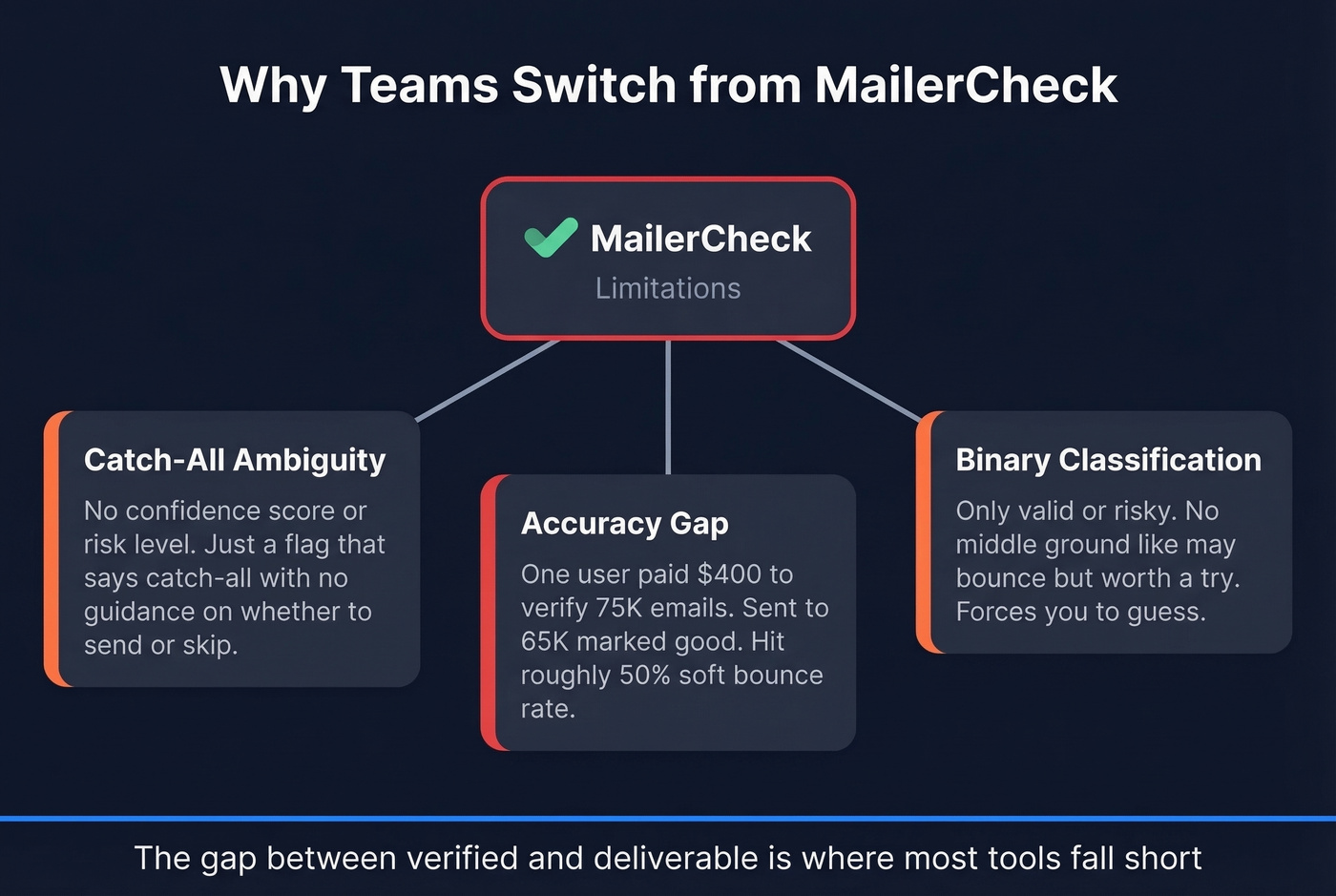
Catch-all ambiguity is the biggest issue. MailerCheck flags catch-all addresses but gives you no scoring or confidence signal - just a shrug. One G2 reviewer noted it's "invalidating a few more emails than other services" and wished for more nuanced categories like "may bounce but worth a try." There's no middle ground between "valid" and "risky," which forces you to either send blind or throw away potentially good contacts.
Then there's the Reddit horror story: a user spent $400 verifying a 75k list through MailerCheck, sent to the 65k addresses marked "good," and hit a ~50% soft bounce rate. We've seen similar patterns across client lists - the gap between "verified" and "deliverable" is real, and it's where most tools fall short.
Our Top Picks
- Prospeo - Best when your verification problem is actually a data source problem. 98% email accuracy from the source, catch-all handling included. Free tier available.
- ZeroBounce - Best full-featured verification platform. Credits never expire, 100 free monthly verifications, deliverability toolkit included.
- Bouncer - Best for simplicity and value. ~$7-$8 per 1,000 verifications, 1,000 free credits to start, 4.9/5 on Capterra.
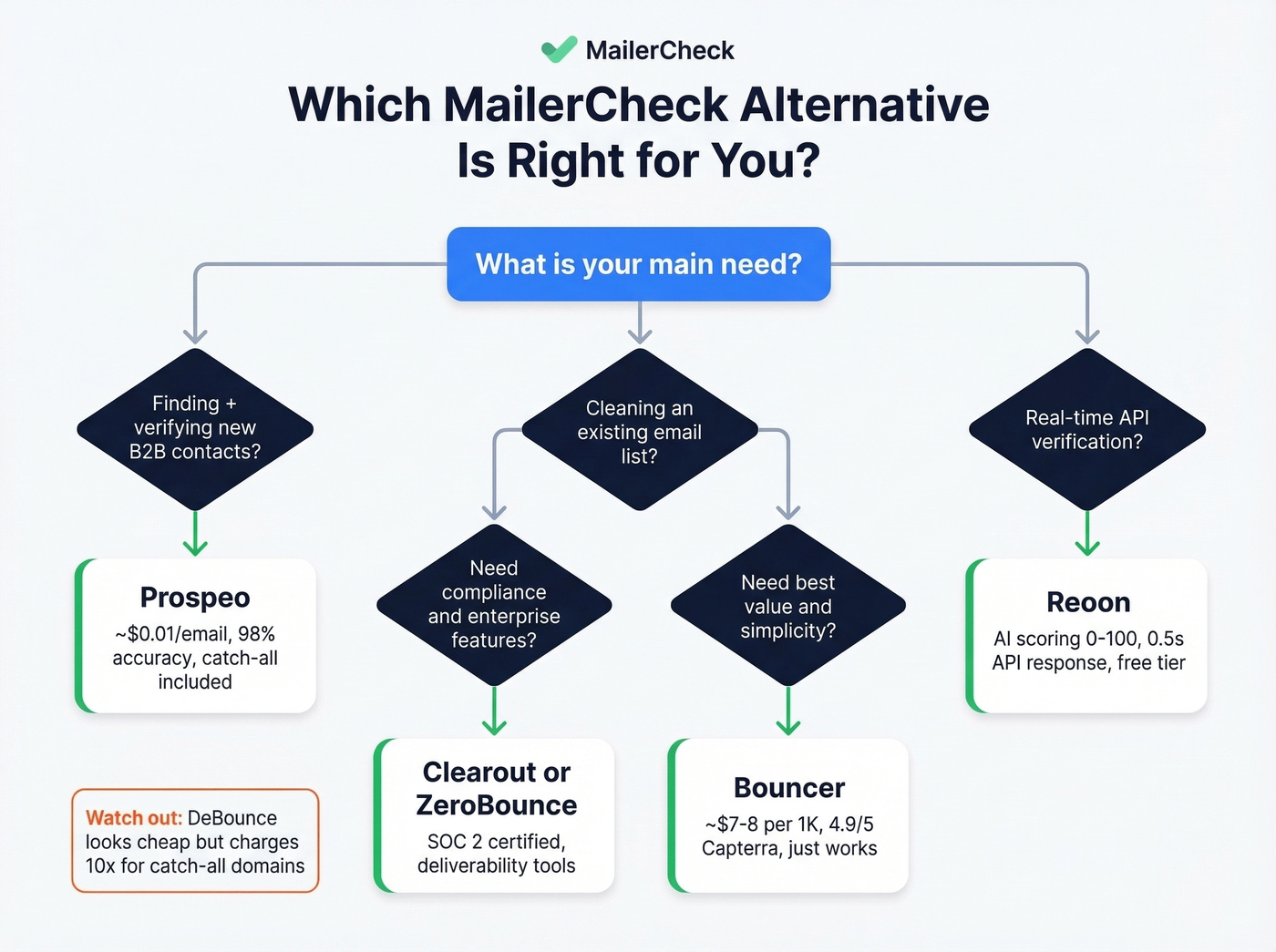

The $400 horror story above happens when you separate finding and verifying emails. Prospeo's 5-step verification - with catch-all handling, spam-trap removal, and honeypot filtering - is built into the search. 98% accuracy at ~$0.01/email. No surprise credit multipliers for catch-all domains.
Stop cleaning bad data. Start with good data.
Pricing at a Glance
Numbers on the table before the reviews. The catch-all column matters more than you'd think - for a 50,000-email list with 30% catch-all addresses, DeBounce's effective cost jumps from $22.50 to $83.25.
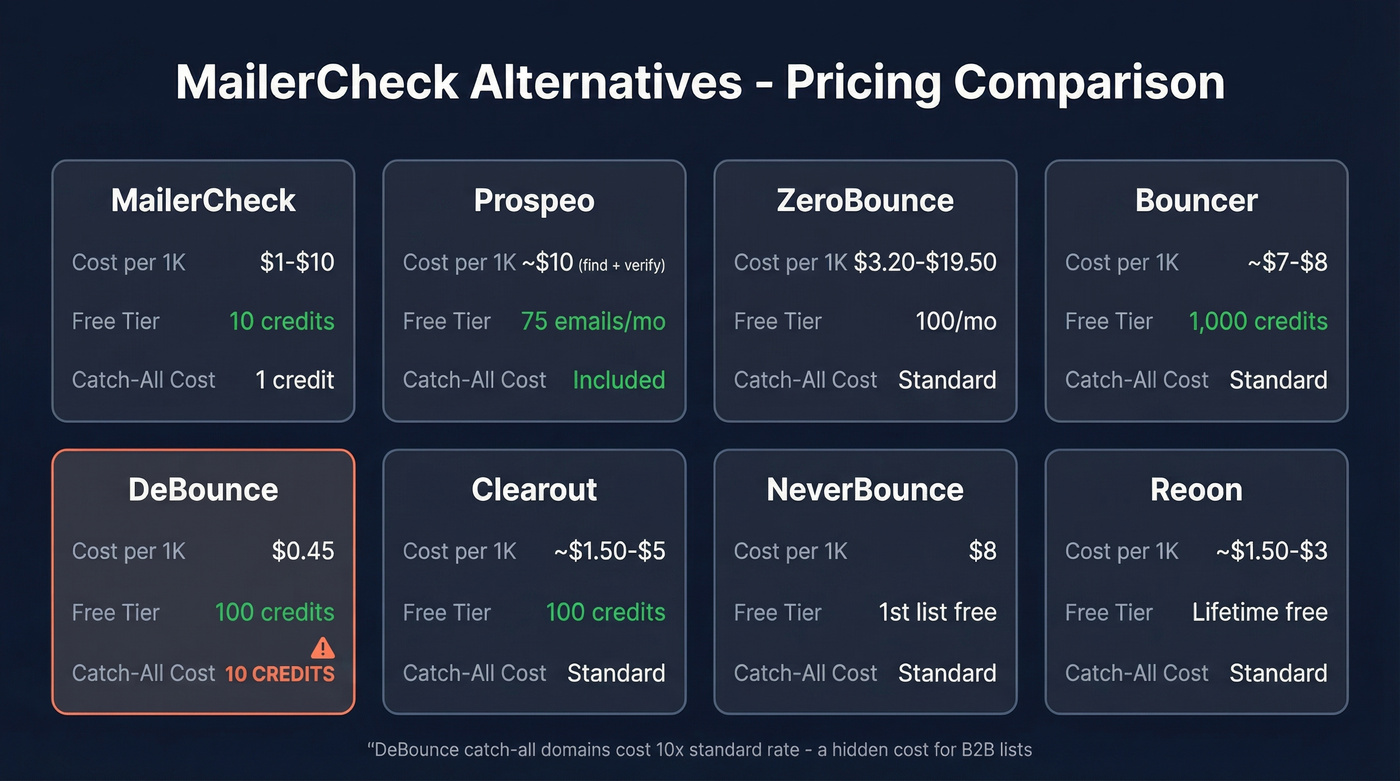
| Tool | Cost / 1,000 | Free Tier | Credits Expire? | Catch-All Cost |
|---|---|---|---|---|
| MailerCheck | $1-$10 | 10 credits | Never | 1 credit |
| Prospeo | ~$10 (find + verify) | 75 emails + 100 extension credits/mo | No | Included |
| ZeroBounce | $3.20-$19.50 | 100/mo | Never | Standard |
| Bouncer | ~$7-$8 | 1,000 credits | - | Standard |
| DeBounce | $0.45 | 100 credits | Never | 10 credits |
| Clearout | ~$1.50-$5 | 100 credits | Never | Standard |
| NeverBounce | $8 | First list free (no card) | Yes (12 mo) | Standard |
| Reoon | ~$1.50-$3 | Lifetime free | Never | - |
The Best MailerCheck Alternatives Compared
Prospeo
Most email verification tools clean data after you've already collected it. Prospeo finds and verifies B2B emails in one step, so you skip the separate cleaning workflow entirely. If you're comparing tools in the broader email search category, this “find + verify” approach is the main differentiator.
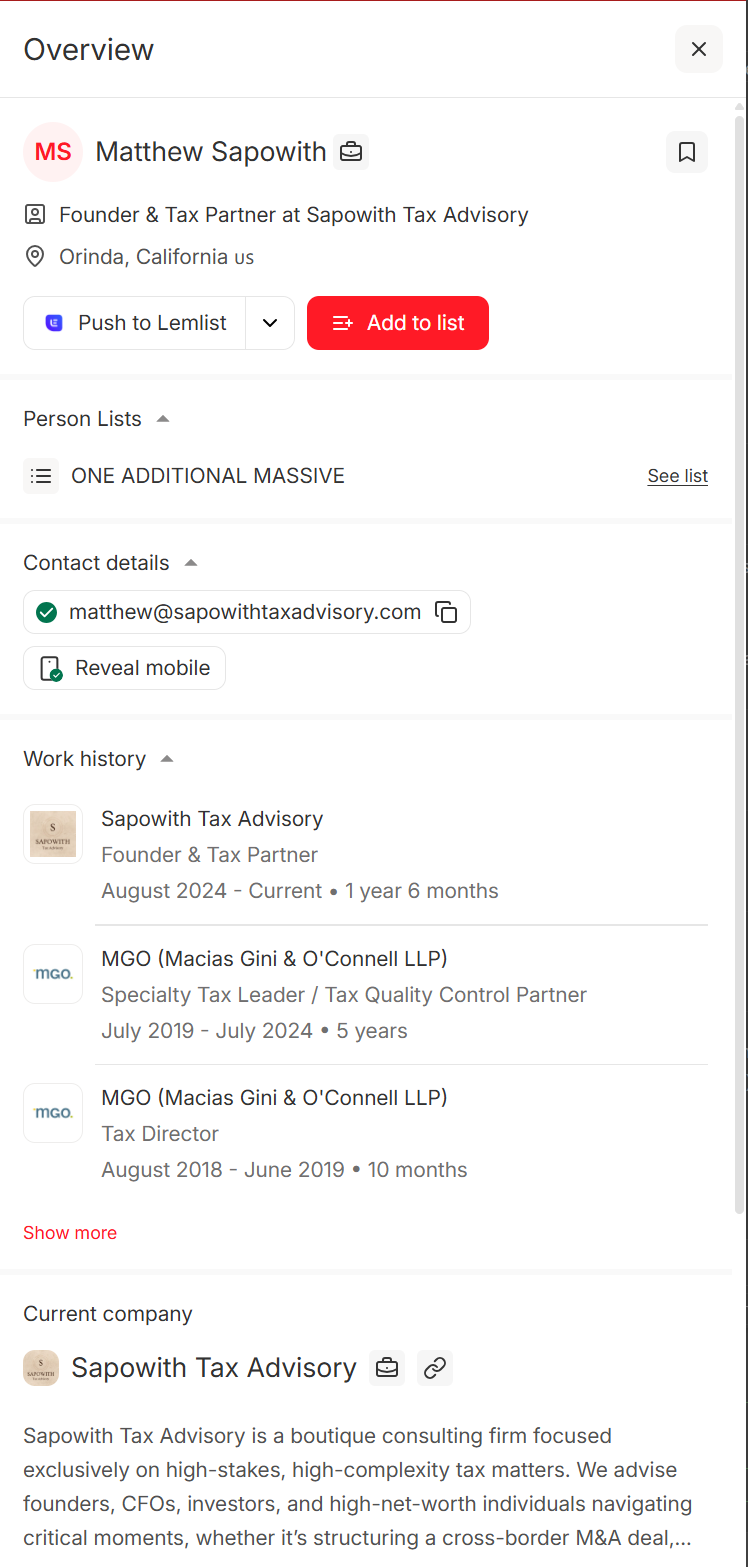
The 5-step verification process includes catch-all domain handling, spam-trap removal, and honeypot filtering - all on proprietary infrastructure, no third-party email providers involved. The result is 98% email accuracy in production. Stack Optimize built their agency to $1M ARR on Prospeo data, maintaining client deliverability above 94% with bounce rates under 3% across all clients and zero domain flags.
Pricing runs ~$0.01 per email with a free tier of 75 emails per month. No contracts, no sales calls.
Best for: Teams whose verification problem is actually a data source problem - bad emails in, bad emails out.
Skip if: You only need to clean an existing marketing list and don't need new contacts.
ZeroBounce
ZeroBounce is the most complete verification platform on this list. It goes beyond pass/fail to include AI scoring, deliverability testing, inbox placement monitoring, and email append services. If you want one tool for everything email-quality-related, this is it.
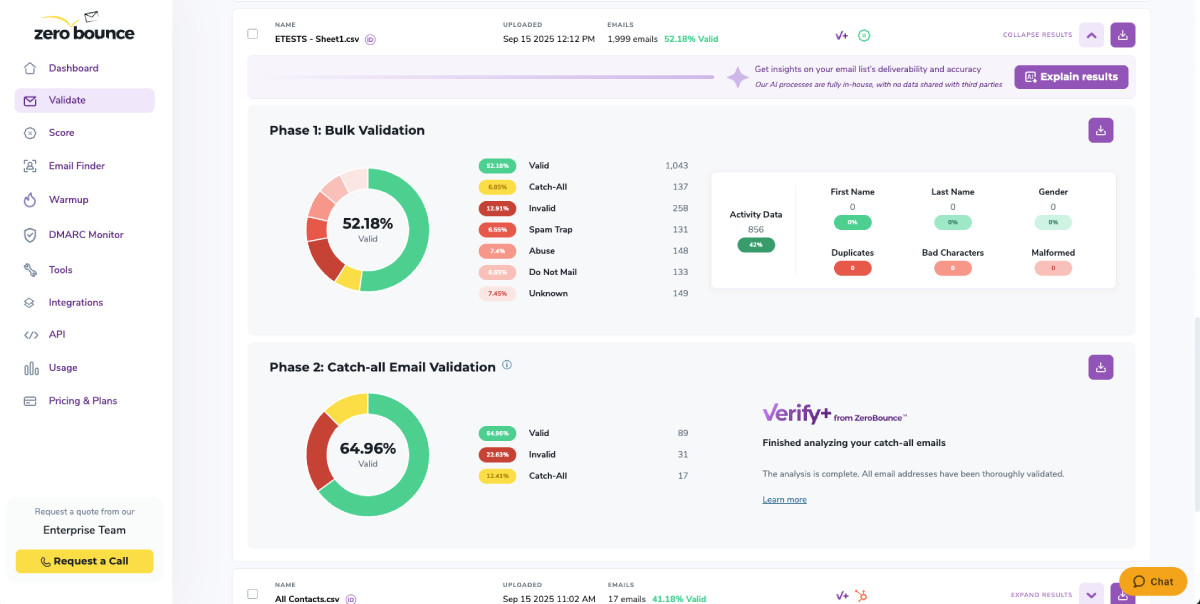
Pricing scales from $0.003199 to $0.0195 per credit depending on volume, with a minimum purchase of 2,000 credits ($39). The ZeroBounce ONE subscription runs $99/mo for 10,000 credits plus deliverability tools - or $79/mo billed annually. Credits never expire, and unknown results don't cost you a credit.
The 100 free monthly verifications are generous enough to test properly. Capterra gives it 4.7/5 across 550 reviews - a massive sample compared to MailerCheck's 9.
Best for: Email marketers who want verification plus deliverability monitoring in one platform.
Skip if: You only need basic verification and don't want a $39 minimum buy-in.
Bouncer
Reddit loves Bouncer, and for good reason. One user called it "my fave - easy to use, solid results," which captures the product perfectly. It doesn't try to be a deliverability suite. It verifies emails quickly, accurately, and cheaply.
At ~$7-$8 per 1,000 verifications with 1,000 free credits to start, Bouncer is the best value on this list for straightforward list cleaning. It delivers 99.5% accuracy and carries a 4.9/5 on Capterra across 279 reviews - the highest rating of any tool here with a meaningful review count. The consensus on r/sales and r/Emailmarketing threads is consistent: Bouncer just works, and the pricing doesn't punish you for catch-all domains the way DeBounce does. If you want more options in this lane, see our Bouncer alternatives.
Best for: Teams wanting simple, reliable verification without feature bloat.
Skip if: You need advanced deliverability monitoring, enrichment, or anything beyond clean/dirty classification.
DeBounce
Here's the thing about DeBounce: the headline pricing is incredible. From $0.00045 per check, it's the cheapest verification service by a wide margin. Trustpilot backs it up with a 4.8/5 across 1,340 reviews, and the 97.5% deliverability guarantee is solid.
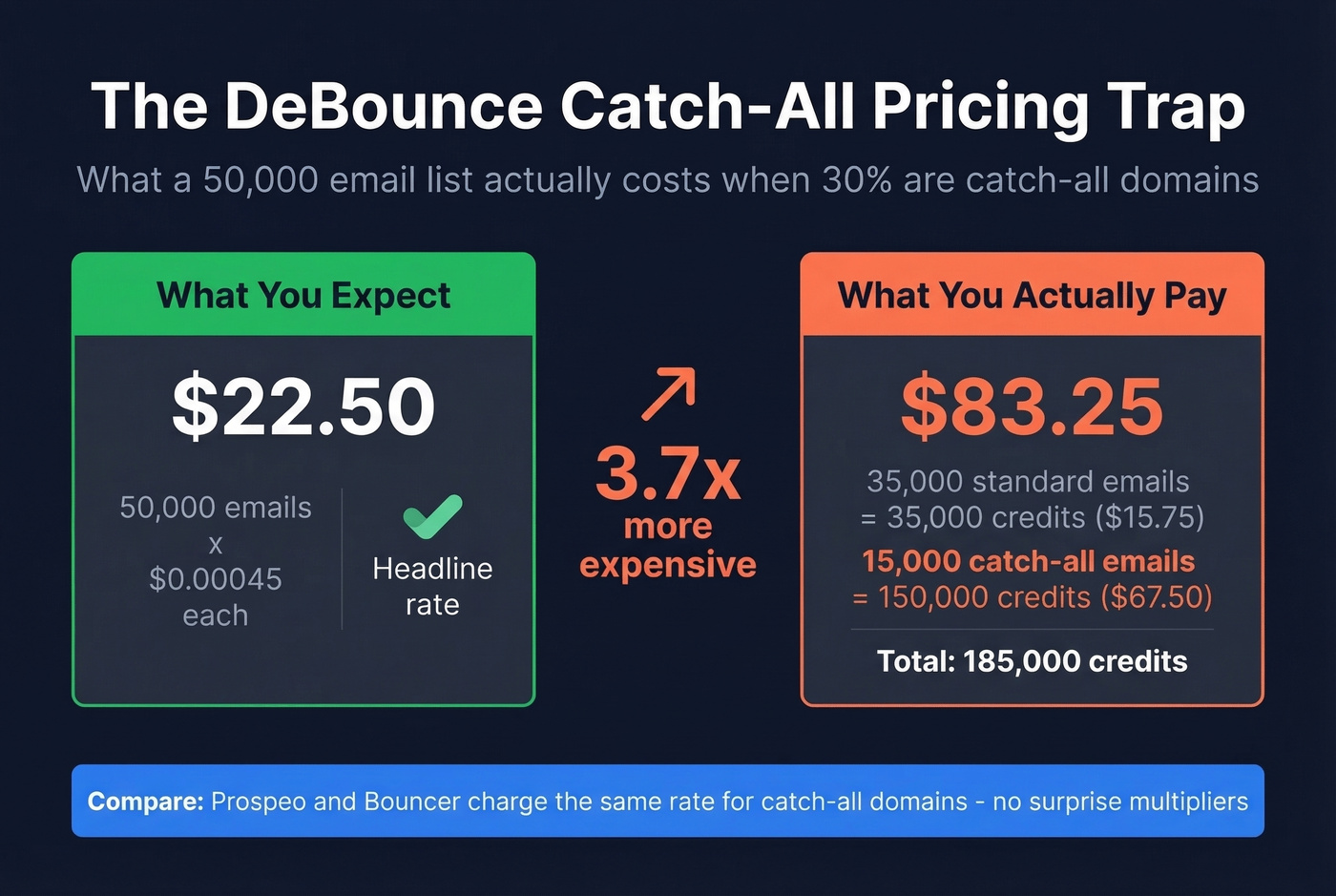
But read the fine print. Catch-all validation costs 10 credits per check instead of the standard 1 credit. If 30% of your list sits on catch-all domains - common in B2B - your effective cost per verification jumps dramatically. DeBounce's headline rate is deceptive once you model real-world lists. That's not a dealbreaker for B2C, but it's a pricing trap for outbound teams who didn't do the math before buying credits.
Best for: High-volume list cleaning where catch-all domains are rare - B2C, newsletter lists, consumer databases.
Skip if: Your lists are heavy on catch-all domains. The 10-credit catch-all cost adds up fast.
Clearout
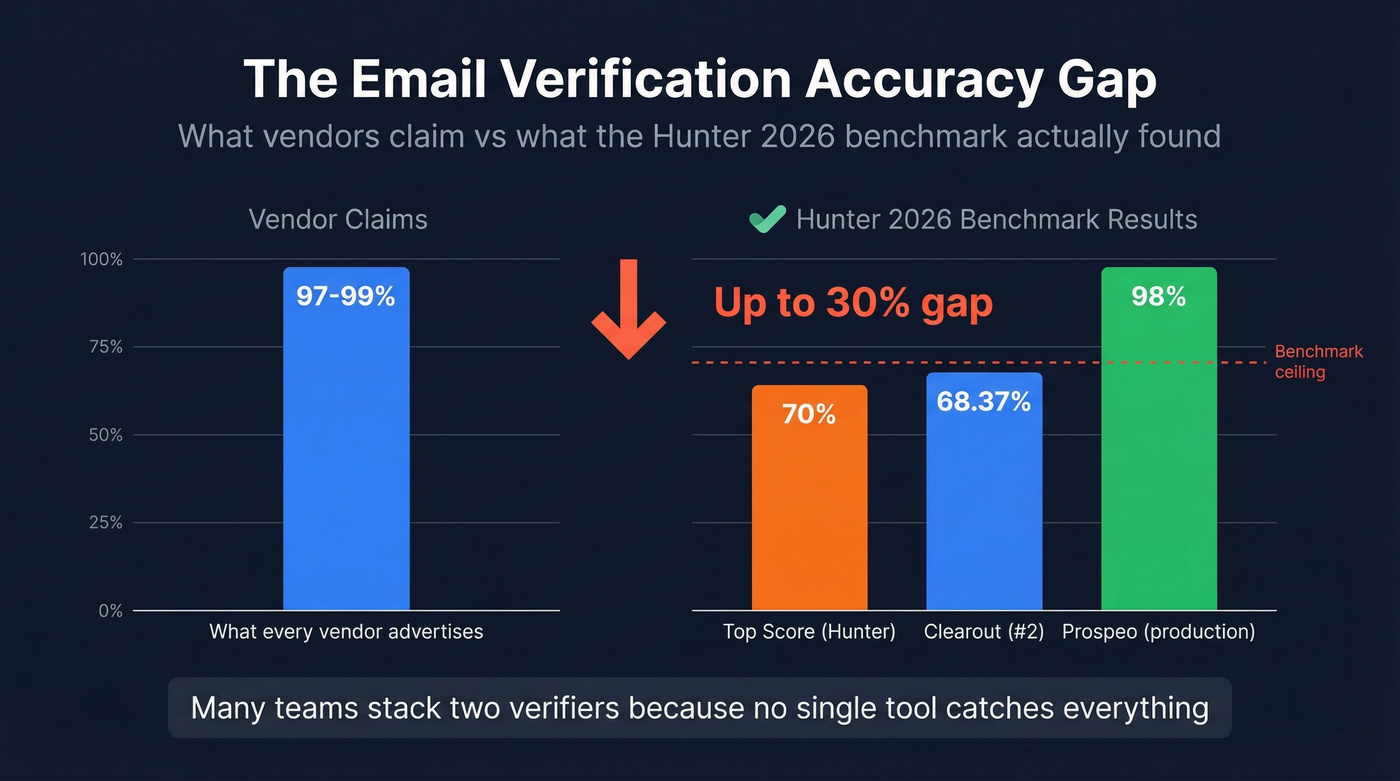
Clearout earned the #2 overall spot in Hunter's 2026 email verifier benchmark with 68.37% real-world accuracy - which sounds low until you realize the top score was 70%, from Hunter's own tool with an obvious home-field advantage in its own benchmark. It's ISO and SOC 2 Type II certified, making it the compliance pick for enterprise teams. G2 rates it 4.6/5 across 510 reviews. Credits roll over and never expire, with 100 free to start.
Best for: Enterprise teams needing compliance certifications alongside verification.
Skip if: Budget is tight - pricing runs around $1.50-$5 per 1,000 depending on plan, higher than DeBounce or Bouncer.
NeverBounce
NeverBounce is well-known and reliable at $8 per 1,000 credits, with a $49/mo growth plan for regular verifiers. Verifying your first list free with no card required is a nice onboarding touch. It delivers 99.9% accuracy and integrates well if you're already in the Validity/DemandTools ecosystem.
The catch: credits expire after 12 months. If you verify in irregular batches - say, quarterly campaign pushes - you'll lose unused credits. That's a meaningful downside compared to ZeroBounce or DeBounce where credits last forever.
Best for: Teams already using Validity products who verify on a regular cadence.
Skip if: You buy credits in advance and verify sporadically. Expiring credits will burn you.
Reoon Email Verifier
Under-the-radar pick. Reoon offers AI-powered email scoring on a 0-100 scale and live API verification in 0.5 seconds - useful for real-time form validation. The free lifetime tier makes it zero-risk to test, and it delivers 99%+ accuracy. Paid plans scale up for higher volumes, starting around $1.50-$3 per 1,000 verifications.
Best for: Developers needing real-time API verification with granular scoring.
Skip if: You need bulk list cleaning at scale - the free tier is limited and paid plan details are sparse compared to the other tools here.
The Accuracy Problem Nobody Talks About
Let's be honest: every verification vendor advertises 97-99% accuracy. The Hunter 2026 benchmark tested 15 tools against 3,000+ real business emails and found the top score was 70%. That gap between claimed and real-world accuracy is enormous, and it gets worse on mid-market and enterprise domains where server configurations are stricter.

In our testing, this gap is why some practitioners stack two verifiers - running lists through both Bouncer and NeverBounce, for example - because no single tool catches everything. One Reddit user ranked their experience: Instantly.ai > NeverBounce > MillionVerifier, and noted that stacking multiple verifiers catches more bad addresses than any single tool alone. If you're trying to reduce bounces systematically, start with the mechanics in our email bounce rate guide.
Here's my honest take: if your average deal size is under five figures, you probably don't need a premium verification tool. A basic verifier plus good list hygiene will get you 90% of the way there. But if you're sending cold outbound to enterprise prospects where every bounce damages a domain you've spent months warming - that's where tool choice actually matters, and where the difference between 70% and 98% real-world accuracy translates directly into pipeline. For the bigger picture, see our email deliverability guide and how to improve sender reputation.
The verification tool isn't lying. It's measuring something different than what you think. "Valid email" means the server accepted the address at that moment. It doesn't mean the person still works there, checks that inbox, or won't mark you as spam. If you want to go deeper on list-building hygiene, our how to generate an email list playbook is a good next step.
Stack Optimize built a $1M agency on Prospeo data: 94%+ deliverability, under 3% bounce rate, zero domain flags. That's what happens when verification is baked into the source - not bolted on after the fact. Free tier included, no contracts.
Find, verify, and send - without the catch-all gamble.
FAQ
Is MailerCheck good enough for cold email?
For basic list cleaning, yes - especially if you're on MailerLite. But catch-all handling is weak: you get a flag with no confidence score. For cold outbound where domain reputation is critical, pair it with a second verifier or switch to a tool with better catch-all processing.
Why do verified emails still bounce?
Verification checks whether an address exists at a single point in time. Catch-all domains accept everything during verification but reject during actual sends. List age matters too - a three-month-old verified email often belongs to someone who's changed jobs. Expect 2-5% residual bounces even on freshly verified lists.
Can I stack multiple email verifiers?
Yes, and many outbound teams do. Running a list through two tools with different detection methods catches more bad addresses than either tool alone. It adds cost - roughly $10-$16 per 1,000 emails - but if your domain reputation is on the line, the insurance is worth it. The Smartlead blog and several Reddit threads consistently recommend this approach for high-stakes outbound.
What's a good free alternative to MailerCheck?
Prospeo offers 75 free email finds with built-in verification monthly - ideal for small B2B teams. ZeroBounce gives 100 free verifications per month with credits that never expire. Bouncer's 1,000 free starter credits are the most generous one-time offer for testing a new tool.