


7 MailReach Alternatives That Actually Improve Deliverability
Email deliverability in 2026 is a different beast. Spam filters are harsher, new domains get crushed faster, and Apollo killed its warmup feature entirely - leaving teams scrambling for MailReach alternatives that actually scale. MailReach works fine at ~$25/inbox/month if you're running two or three inboxes, but the moment you scale to ten, you're staring at a $250/month warmup bill with reporting that doesn't tell you much beyond "green means good."
Here are seven alternatives worth testing, plus the upstream fix that most warmup guides completely ignore.
Our Picks (TL;DR)
Best for scaling 10+ inboxes: Mailivery - unlimited mailboxes from $29/mo, volume-based pricing instead of per-inbox.
Best if you're on Lemlist: Lemwarm - free with an active Lemlist subscription, 96% deliverability in third-party testing.
Best budget standalone: Warmbox - starts at $15/mo per inbox.
Bonus - fix the real problem first: Before you warm up anything, verify your list. Bad emails destroy sender reputation faster than any warmup tool can repair it. Prospeo catches them at 98% accuracy with a 5-step verification process, and there's a free tier to test it.
Why Teams Switch From MailReach
Per-inbox pricing scales painfully. MailReach starts at ~$25/inbox/month, and while volume discounts exist, per-inbox pricing still adds up fast when you're running a real outbound team. Ten inboxes can easily mean $250/month - just for warmup. That's before you've sent a single cold email.
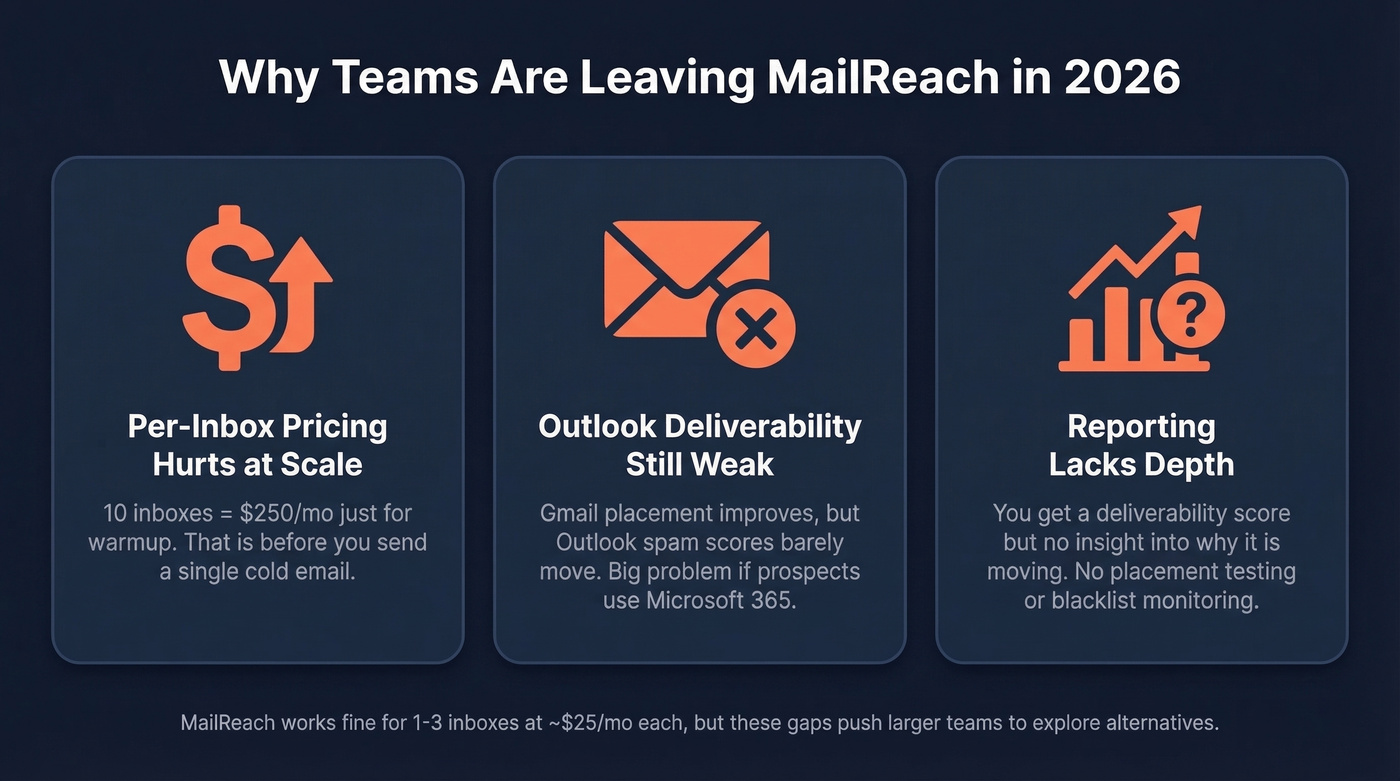
Outlook deliverability remains a sore spot. The most common complaint on r/coldemail is that Gmail placement improves after warmup, but Outlook spam scores barely budge. If your prospects live in Microsoft 365, that's a dealbreaker.
Reporting lacks depth. Compared to tools like Folderly that offer placement testing, blacklist monitoring, and diagnostic dashboards, MailReach's reporting feels surface-level. You get a deliverability score, but not much insight into why it's moving.
One thing worth knowing across the warmup space: tools like MailReach emphasize that they use real business inbox networks for warmup interactions, not disposable accounts. Some cheaper alternatives cut corners here. When evaluating any tool below, ask whether the warmup network is built on real inboxes or throwaways - it matters for how inbox providers score your domain. If you want the bigger picture, start with an email deliverability breakdown.

Every warmup tool on this list is fighting the same battle: repairing sender reputation damaged by bounces. Prospeo's 5-step email verification catches bad addresses before they ever hit your outbox - 98% accuracy, catch-all handling, spam-trap removal. At $0.01/email, one month of verification costs less than one inbox on MailReach.
Stop warming up domains that bad data keeps burning down.
Warmup Tool Comparison
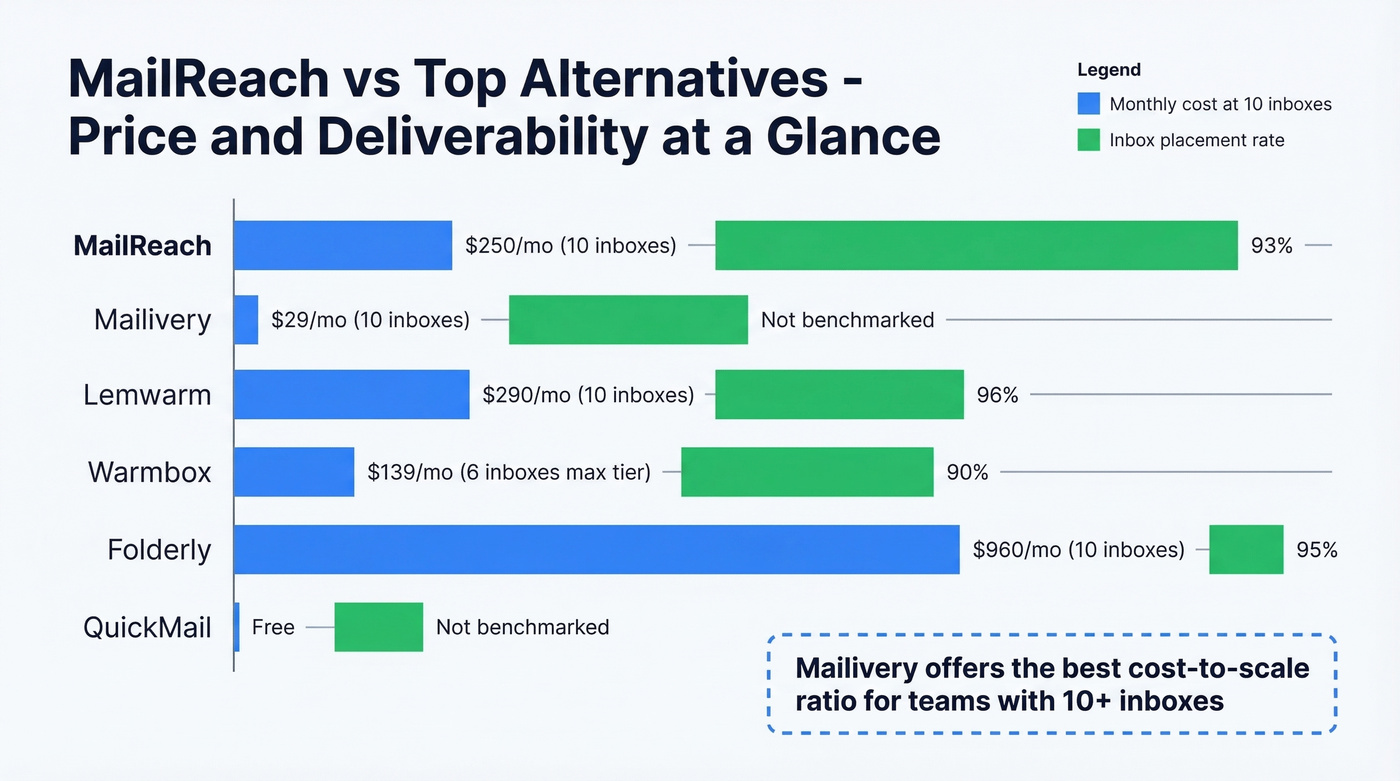
A Skylead benchmark test sent ~200 warmup emails per tool and tracked Inbox/Spam/Promotions placement. It's not a massive study, but it's more data than most guides offer.
| Tool | Starting Price | Model | Free Trial | Inbox Placement | Best For |
|---|---|---|---|---|---|
| MailReach | ~$25/mo | Per-inbox | Not advertised | 93% | Baseline (your current tool) |
| Mailivery | $29/mo | Volume-based | 7-day | Not benchmarked | Agencies running 10+ inboxes |
| Lemwarm | $29/mo/email | Per-inbox | Free w/ Lemlist sub | 96% | Lemlist users, 1-3 inboxes |
| Warmbox | $15/mo | Per-inbox | No | 90% | Solo/bootstrap, 1-3 inboxes |
| Folderly | $96/mo/mailbox | Per-mailbox | No | 95% | Enterprise diagnostics |
| InboxAlly | $149/mo | Seed-based | No | N/A (seed model) | 2K+ emails/day senders |
| QuickMail | Free | Per-inbox | Free forever | Not benchmarked | Maintenance warmup |
| Warmforge | $12/mo/mailbox | Per-mailbox | Yes | Not benchmarked | Budget per-mailbox option |
| Warmy | Quote-based | Volume-based | 7-day | Not benchmarked | Enterprise (quote only) |
The 7 Best MailReach Alternatives
1. Mailivery

Use this if you're an agency or team running 10+ inboxes and you're tired of per-inbox math.
Mailivery flips the pricing model entirely. Instead of charging per mailbox, you pay for a shared daily warmup volume across unlimited inboxes. The Starter plan runs $29/mo for 200 warmup emails/day - spread however you want. Their rule of thumb is roughly a 1:1 ratio between warmup and outreach volume, so if each inbox sends 20 cold emails/day, that Starter plan covers about 10 inboxes. (If you're also thinking about safe sending limits, pair this with an email velocity plan.)
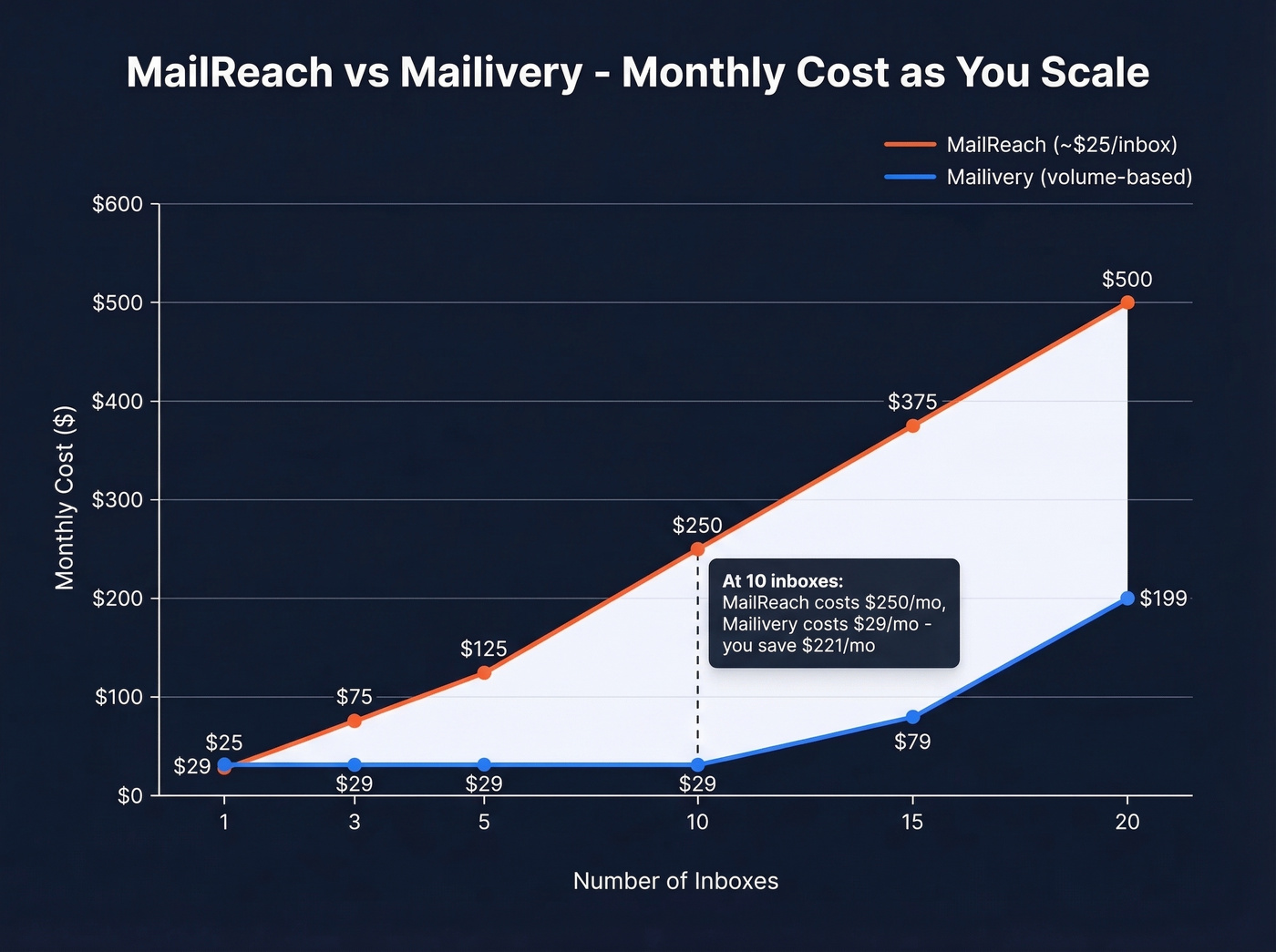
At scale, the math is brutal in Mailivery's favor. Ten inboxes on MailReach: $250/mo. Ten inboxes on Mailivery: still $29/mo. The Professional tier ($79/mo, 800 emails/day) handles larger operations, and the Business tier ($199/mo, 2,500 emails/day) covers even the biggest agencies. They also bundle blacklist monitoring across 70+ lists, plus verification credits - Starter includes 100, Pro includes 500, and Business includes 2,000.
Skip this if you're a solopreneur with one inbox. The volume-based model is overkill - you'd be paying for capacity you'll never use.
2. Lemwarm

Lemwarm scored the highest deliverability in the benchmark at 96% inbox placement. The Essential plan costs $29/mo per email address ($24/mo annually), and the Smart plan at $49/mo adds personalized warmup emails and an industry-tailored network.
Here's the thing: if you're already paying for Lemlist, Lemwarm is free with your subscription. That makes it the obvious choice for Lemlist users. The catch is the scaling rule - one seat equals one email address. Five inboxes means five seats at $29/mo each, which is $145/month. At that point, Mailivery's $29/mo for unlimited mailboxes starts looking very attractive.
Use this if you're a Lemlist user running 1-3 inboxes. Skip this if you're running 5+ inboxes outside the Lemlist ecosystem.
3. Warmbox
At $15/mo for one inbox up to $139/mo for six, Warmbox is one of the cheapest standalone warmup tools on the market. Cheap comes with tradeoffs, though.
In the benchmark test, Warmbox scored 90% deliverability - the lowest of the tools tested. It works for maintenance warmup on healthy domains, but we wouldn't rely on it for reputation recovery. No free trial either, which makes the decision harder. For basic Gmail warmup on a bootstrap budget, it does the job. For Outlook problems, look elsewhere.
4. Folderly
The best deliverability suite on the market - and the most expensive. At $96/mailbox/month, Folderly is enterprise-only, though volume discounts bring it down to $56/mailbox at 25+ seats. This isn't just warmup. It's diagnostics, placement testing, blacklist monitoring, and actionable reporting all in one package.
Third-party testing benchmarked Folderly at 95% inbox placement, and it carries ratings of 4.8 on G2, 4.9 on Capterra, and 5.0 on TrustRadius. If you have the budget and need deep visibility into why emails land in spam, Folderly is unmatched. If you don't have $96/mailbox to spend, keep scrolling.
5. InboxAlly
InboxAlly uses a seed-email model: $149/mo gets you 100 seed emails/day across one sender profile, designed for senders pushing ~2,000 emails/day. If that's not your volume, you're overpaying significantly. The Plus tier jumps to $645/mo for 500 seeds/day. This is a specialist tool for high-volume senders - newsletters, transactional email, or massive outbound operations. Most cold email teams don't need it.
6. QuickMail Auto-Warmer
Free forever. Ten warmup emails/day. Unlimited inboxes.
It's a maintenance dose - it won't rescue a damaged domain or ramp a new one. Best used as a supplement alongside a paid warmup tool, not a replacement. If you're already using QuickMail for outreach, turning this on is a no-brainer. (If you're building sequences too, keep a set of cold email follow-up templates handy.)
7. Warmforge
The newest entrant on this list, Warmforge charges $12/mailbox/month - making it one of the cheapest per-mailbox options after QuickMail's free tier. It also includes 1 free placement test per month. It wasn't benchmarked in the Skylead test, so treat it as an emerging option rather than a proven one. Worth testing if Mailivery's volume model doesn't fit your workflow but you still want something cheaper than MailReach.
Warmup Won't Save You Alone
Let's be honest about something most warmup guides skip entirely: the biggest threat to your sender reputation isn't insufficient warmup. It's bad data.
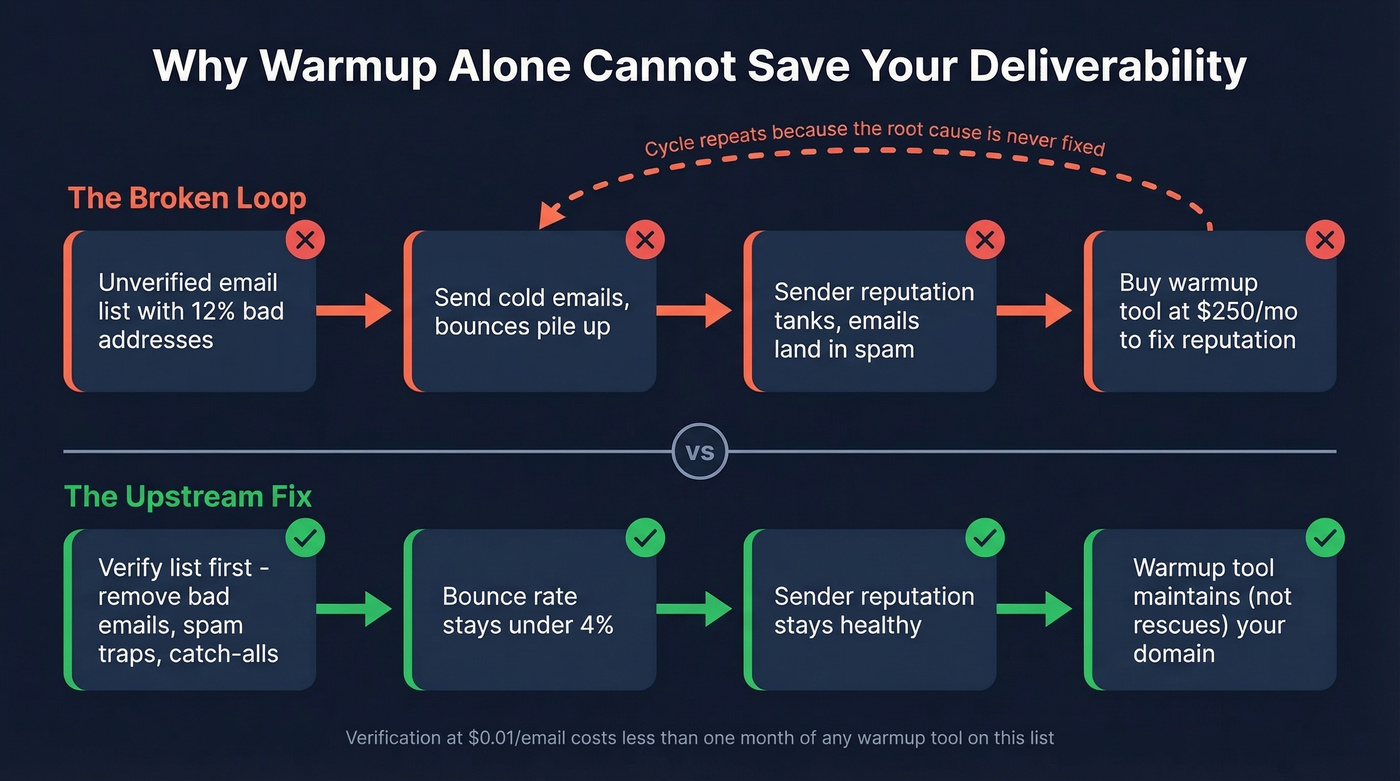
Every bounced email is a signal to inbox providers that you don't know who you're emailing. Stack enough bounces and no amount of warmup will dig you out. We've seen this pattern repeatedly - teams invest $200/month in warmup tools while feeding their sequences unverified lists scraped from who-knows-where. One agency we spoke with was running Mailivery on 15 inboxes and still landing in spam because their bounce rate hovered around 12%. The warmup wasn't the problem. The list was. (If you want bounce targets and diagnostics, see email bounce rate.)

The free tier gives you 75 verified emails/month - enough to test whether your deliverability problem is actually a data problem. If you're comparing verifiers, start with Bouncer alternatives or a broader list of data enrichment services.
You're spending $25-$250/month on warmup because bounces torched your sender reputation. Prospeo's 5-step verification - with honeypot filtering and catch-all detection - keeps bounce rates under 4% before you send a single cold email. That's the upstream fix no warmup tool can replace.
Fix your list first. 75 free email verifications, no credit card required.
FAQ
Is MailReach still worth it in 2026?
Yes, for small teams running 1-3 inboxes. It scores 93% inbox placement in third-party benchmarks and does one thing well. But at ~$25/inbox/month, costs escalate quickly past three mailboxes - making volume-based competitors like Mailivery significantly cheaper at scale.
Do email warmup tools actually work?
Dedicated warmup tools achieved 90-96% inbox placement in benchmark testing across ~200 emails per tool. The catch: warmup can't outrun bad data. If your bounce rate exceeds 5-10%, sender reputation tanks regardless. Verify your list before investing in warmup.