


Mailwarm Review 2026: Pricing, Pros, Cons, and Whether It's Worth It
$79 a month to warm up a single inbox. No free trial. And in an independent test, Outlook emails went 100% undelivered.
That's the short version. The longer version is that Mailwarm occupies a strange spot in the warmup market - it's one of the simplest tools to set up, but also one of the most expensive for what you actually get. We've dug through the pricing tiers, independent test data, and user reviews to give you a clear picture of whether Mailwarm justifies its premium or whether you should look elsewhere.
30-second verdict: Mailwarm works for simple, single-inbox warmup. Setup is dead easy and the 2026 feature updates (live spam scoring, per-provider analytics) are welcome additions. But at $69-$79/mo for one inbox with no trial, it's among the priciest warmup tools available. If you're scaling multiple inboxes or want to test before committing, MailReach at $19.50/mailbox or Warmup Inbox at $19/inbox deliver comparable results at a fraction of the cost, and both Warmup Inbox and Warmy.io include free trials.
Mailwarm Pricing Breakdown
The $69 vs. $79 discrepancy you'll see across review sites comes down to billing cycle. Annual billing gets you $69/mo; monthly is $79/mo.
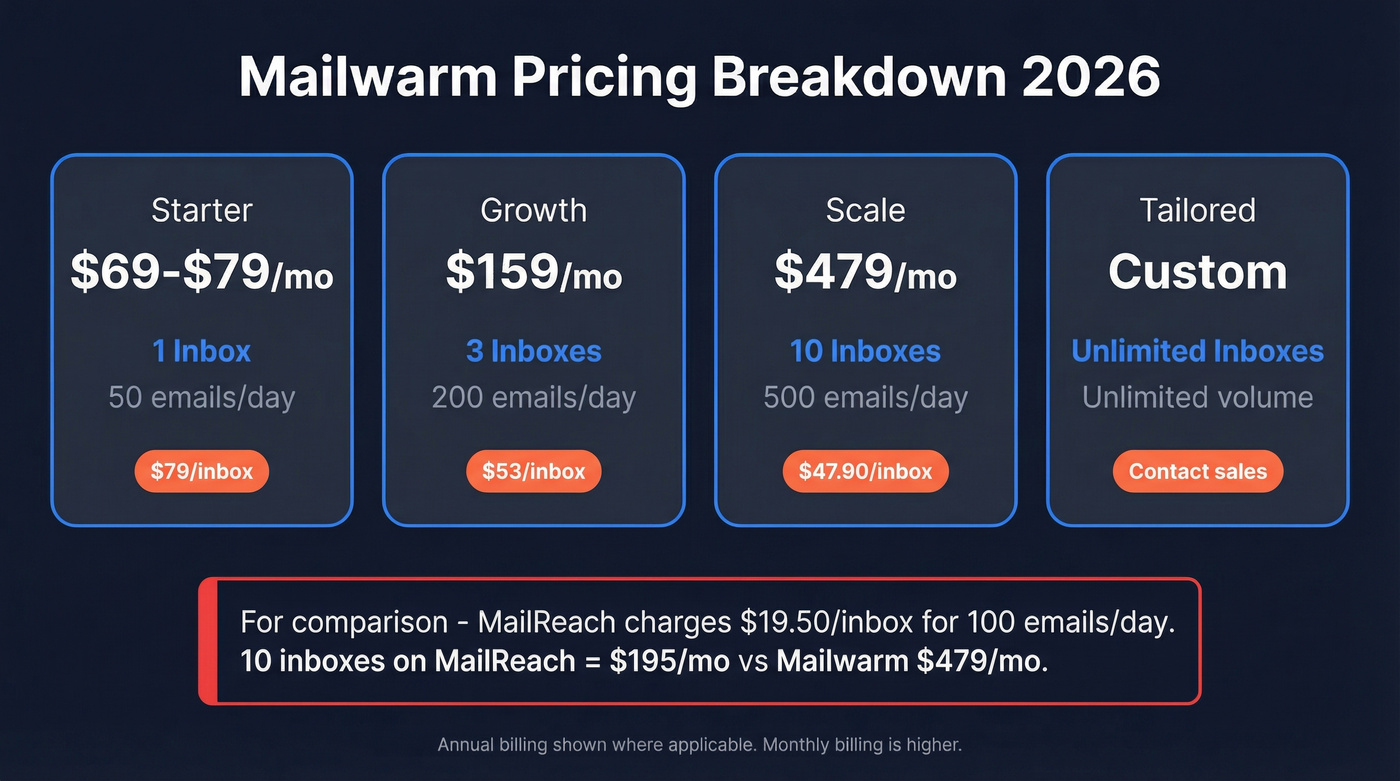
| Plan | Monthly Price | Accounts (SMTPs) | Daily Volume |
|---|---|---|---|
| Starter | $69-$79 | 1 | 50 |
| Growth | $159 | Up to 3 | 200 |
| Scale | $479 | Up to 10 | 500 |
| Tailored | Custom | Unlimited | Unlimited |
The scaling math is where Mailwarm really hurts. Ten accounts on the Scale plan runs $479/mo - nearly $5,750/year just for warmup. That same 10-mailbox setup on MailReach costs $195/mo. And buying inboxes individually without the Scale plan would cost even more. There's no free trial on any tier, so you're committing cash before you see a single result.
Pros and Cons Worth Knowing
What Mailwarm does well:
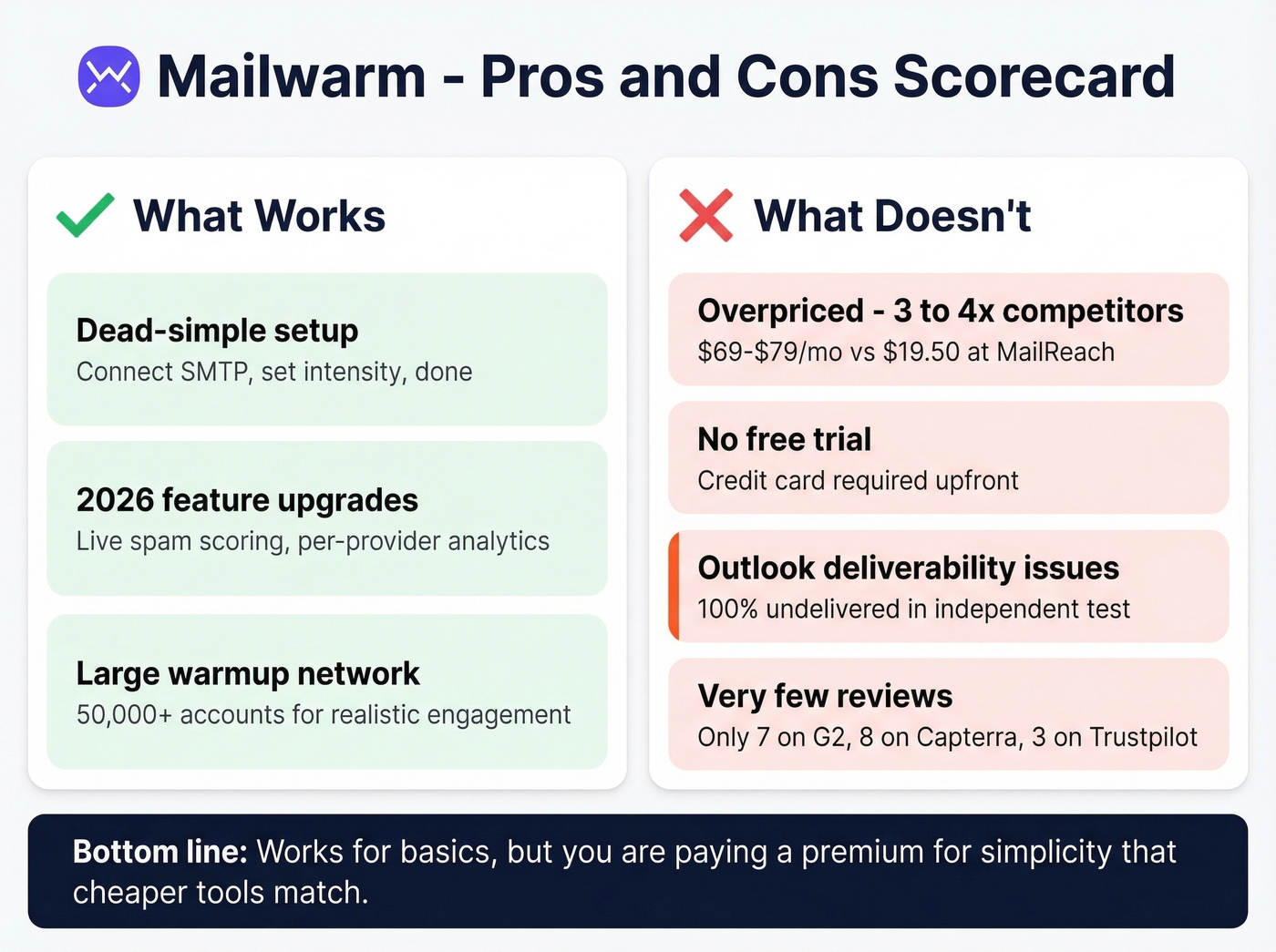
- Dead-simple SMTP setup. Connect your inbox, set intensity, walk away. Trustpilot reviews call it "easy to set up" with responsive support (4.0/5).
- 2026 feature upgrades. Live spam score monitoring and per-provider analytics let you see exactly where Gmail vs. Outlook vs. Yahoo placement stands.
- Large warmup network. Mailwarm operates a 50,000+ account warmup network, which helps simulate realistic engagement patterns.
Where it falls short:
- Overpriced for what you get. At $69-$79/mo for one inbox, it costs 3-4x what MailReach or Warmup Inbox charge for equivalent functionality.
- No free trial. Warmup Inbox and Warmy.io offer 7-day trials. Mailwarm asks for your credit card upfront.
- Outlook performance is a red flag. An independent test of 53 emails showed 100% undelivered on Outlook and 35% spam on Microsoft Business, with overall inbox placement at just 55%. If your prospects live in Microsoft 365, that's a dealbreaker.
- Thin review footprint. G2 shows 7 reviews (4.9/5), Capterra has 8 (4.9/5), and Trustpilot has just 3. One r/coldemail user described Mailwarm as "older, simple, fine for basics" - which sums up the general sentiment pretty well.

Mailwarm costs $79/mo to patch deliverability problems that bad data created. Prospeo's 5-step email verification delivers 98% accuracy - Snyk's bounce rate dropped from 35% to under 5%. At $0.01 per verified email, you spend less than one month of Mailwarm and fix the actual problem.
Skip the band-aid. Start with emails that don't bounce.
Does Email Warmup Still Work in 2026?
Here's the thing: warmup tools are fighting an uphill battle. Cold email practitioners point to stricter filtering from major mailbox providers, plus the fact that those providers are getting better at detecting automated engagement patterns - which is exactly what warmup tools generate.
In our experience, warmup still helps for ramping new or dormant inboxes. Most practitioners recommend at least 14 days before sending real campaigns. But it doesn't guarantee long-term placement once live outreach starts. What matters more is engagement quality, targeting precision, and careful volume scaling. A well-reasoned analysis from Postbox Services found that many teams see no measurable improvement from warmup alone - because the real problem is upstream.

And that upstream problem is data quality. Warmup can't save you if 20% of your list bounces. Every bounce torches your sender reputation faster than warmup can rebuild it. We've seen this pattern repeatedly: teams spending $79/mo on warmup while sending to unverified lists, then wondering why deliverability stays flat. Prospeo's 5-step verification and 98% email accuracy catch bad addresses before they ever hit your sending infrastructure - Snyk's team saw bounce rates drop from 35% to under 5% after switching their data source.
Hot take: Most teams spending $79/mo on Mailwarm would get a bigger deliverability lift by spending that same money on cleaner contact data. Warmup is a band-aid; data quality is the cure.
Mailwarm vs. Alternatives
| Tool | Price/Inbox | Daily Volume | Free Trial | Best For |
|---|---|---|---|---|
| Mailwarm | $69-$79 | 50 | No | Zero-config simplicity |
| MailReach | $19.50 | 100 | No | Best overall value |
| Warmup Inbox | $19 | 75 | Yes (7-day) | Budget multi-inbox |
| Lemwarm | $29 | Not public | No | Lemlist users |
| Warmy.io | Starts at $49 | Varies | Yes (7-day) | Large domain networks |
| Instantly | Starts at $37 | Varies | No | Warmup + sending combined |
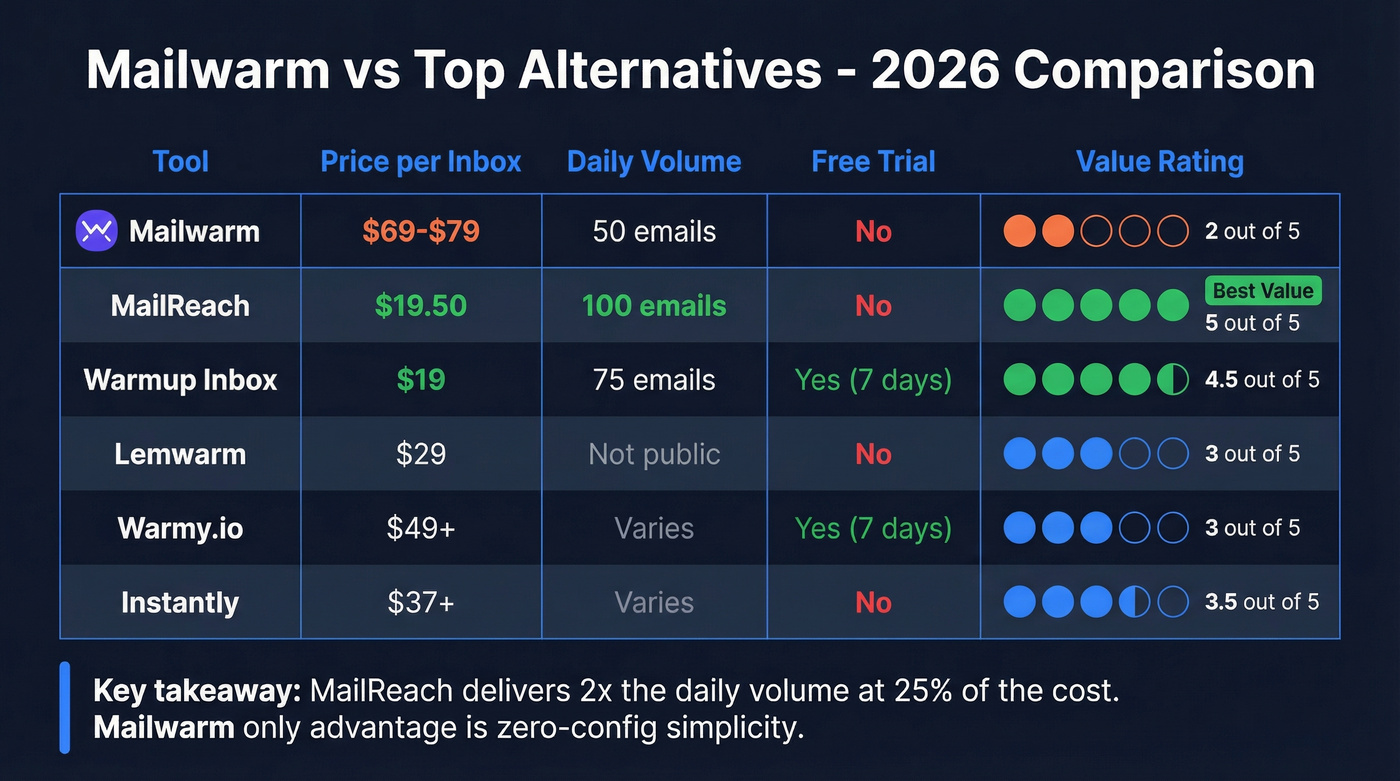
We've compared pricing and test data across these tools, and MailReach at $19.50/mailbox with 100 emails/day and spam test credits included is the best pure-warmup value right now. Mailwarm's only real advantage is zero-config simplicity - you're paying a premium for not having to think about it. Whether that premium is worth 3-4x the price depends entirely on how much you value your setup time.
If you're building a full outbound stack, it also helps to pair warmup with a solid email deliverability guide and a clear view of safe email velocity as you ramp.
Who Should Use Mailwarm
Use Mailwarm if you're a solo founder with one inbox, you want the absolute simplest setup, and you don't mind paying a premium for convenience.
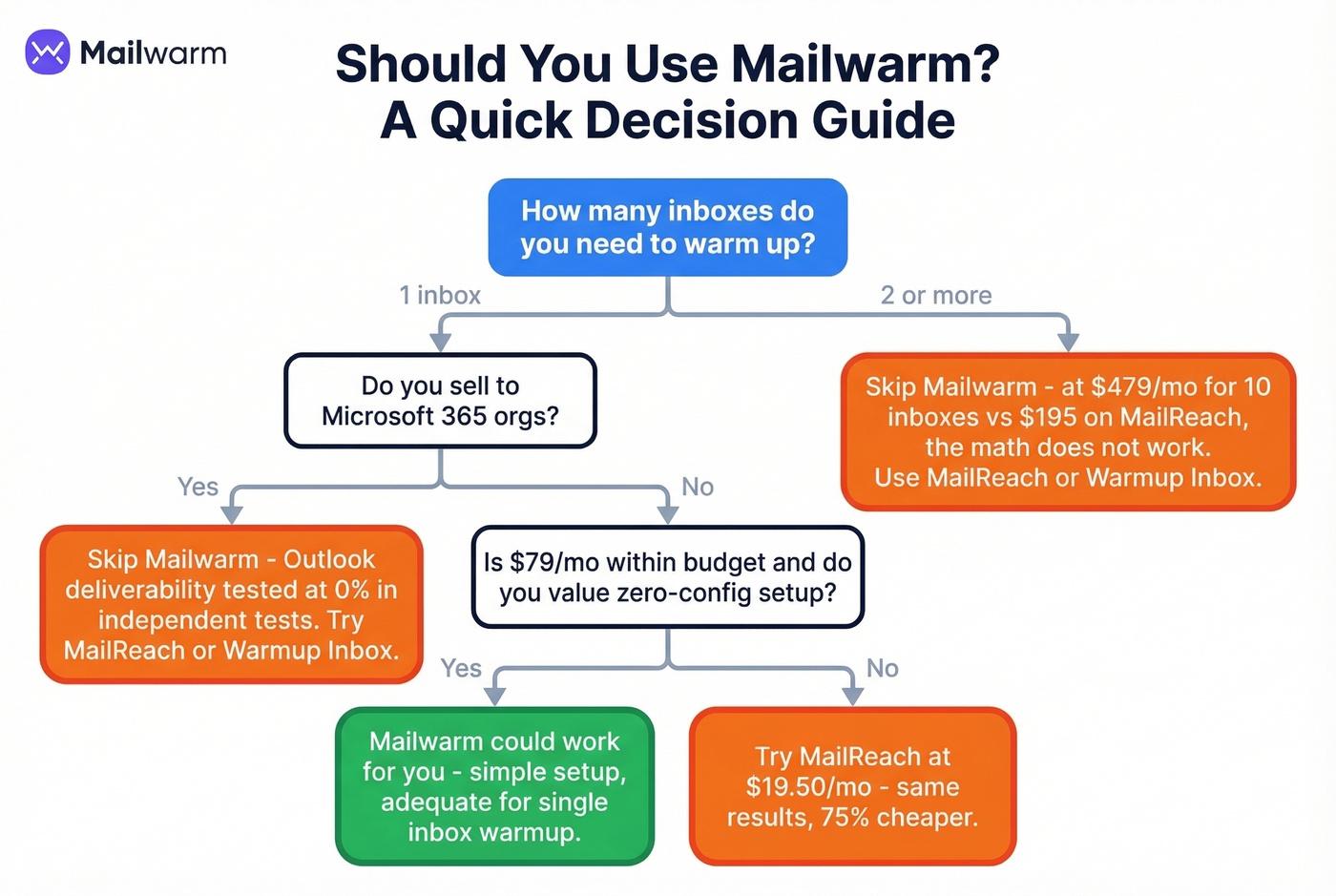
Skip Mailwarm if you're scaling three or more inboxes, you sell primarily to Microsoft 365 organizations, you want to test before committing, or budget matters to you at all. MailReach or Warmup Inbox will get you comparable results at 25% of the cost. For teams running multiple sender accounts, the savings add up fast - we're talking thousands per year that could go toward better contact data or actual outbound lead generation tools instead.
After weighing Mailwarm's pricing, reviews, and the pros and cons covered above, the pattern is clear: the tool works, but you're overpaying for simplicity that cheaper competitors match.
You're evaluating $69-$79/mo warmup tools because your emails aren't landing. But warmup can't save a list with 20%+ bounces. Prospeo gives you 143M+ verified emails refreshed every 7 days - not every 6 weeks. Stack Optimize built a $1M agency on our data with bounce rates under 3% and zero domain flags.
Clean data is the deliverability fix warmup tools can't deliver.
FAQ
Does Mailwarm offer a free trial in 2026?
No. All plans require upfront payment with no trial period. If you want to test before committing, Warmup Inbox and Warmy.io both offer 7-day free trials with comparable warmup functionality.
Is Mailwarm worth $79 per month?
For a single inbox with simple needs, it's adequate but overpriced. MailReach at $19.50/mailbox delivers 100 emails/day (vs. Mailwarm's 50) and includes spam test credits - roughly 75% cheaper for better volume.
What's the cheapest Mailwarm alternative?
Warmup Inbox at $19/inbox/month with 75 emails/day and a 7-day trial. MailReach at $19.50 is arguably the better value with 100 emails/day and spam test credits included.
Can warmup tools fix bad deliverability on their own?
No. Warmup helps ramp new inboxes but can't overcome high bounce rates from bad data. Verified contact data with 98% accuracy eliminates bounces at the source - which has a larger impact on sender reputation than warmup alone.