

Market Intelligence Analysis Tools: What to Buy, What to Skip, and What You'll Actually Pay
Your VP just asked you to "get a market intelligence tool." That's like asking someone to "get a vehicle" - you don't know if they mean a $200/month Similarweb subscription or a $125,000/year AlphaSense contract. Market intelligence analysis tools span everything from competitive battlecards to financial research to contact databases, and the category is a mess.
Sales teams face direct competition in 68% of deals. The gap between having intelligence and acting on it costs mid-market companies $2M-$10M per year in lost revenue. You need the right tool, not just any tool.
Our Picks
| Use Case | Pick | Starting Price |
|---|---|---|
| B2B contact data & action | Prospeo | Free / ~$0.01 per email |
| Competitive intelligence | Crayon | ~$15K/yr |
| Financial & research intel | AlphaSense | ~$18K/yr median |
| Digital market intelligence | Similarweb | $199/mo |
What Category Do You Actually Need?
Before you spend a dollar, figure out which category you're shopping in. These four get conflated constantly - Gartner groups them under "Competitive and Market Intelligence," and we think that conflation is exactly why buyers pick the wrong tool.
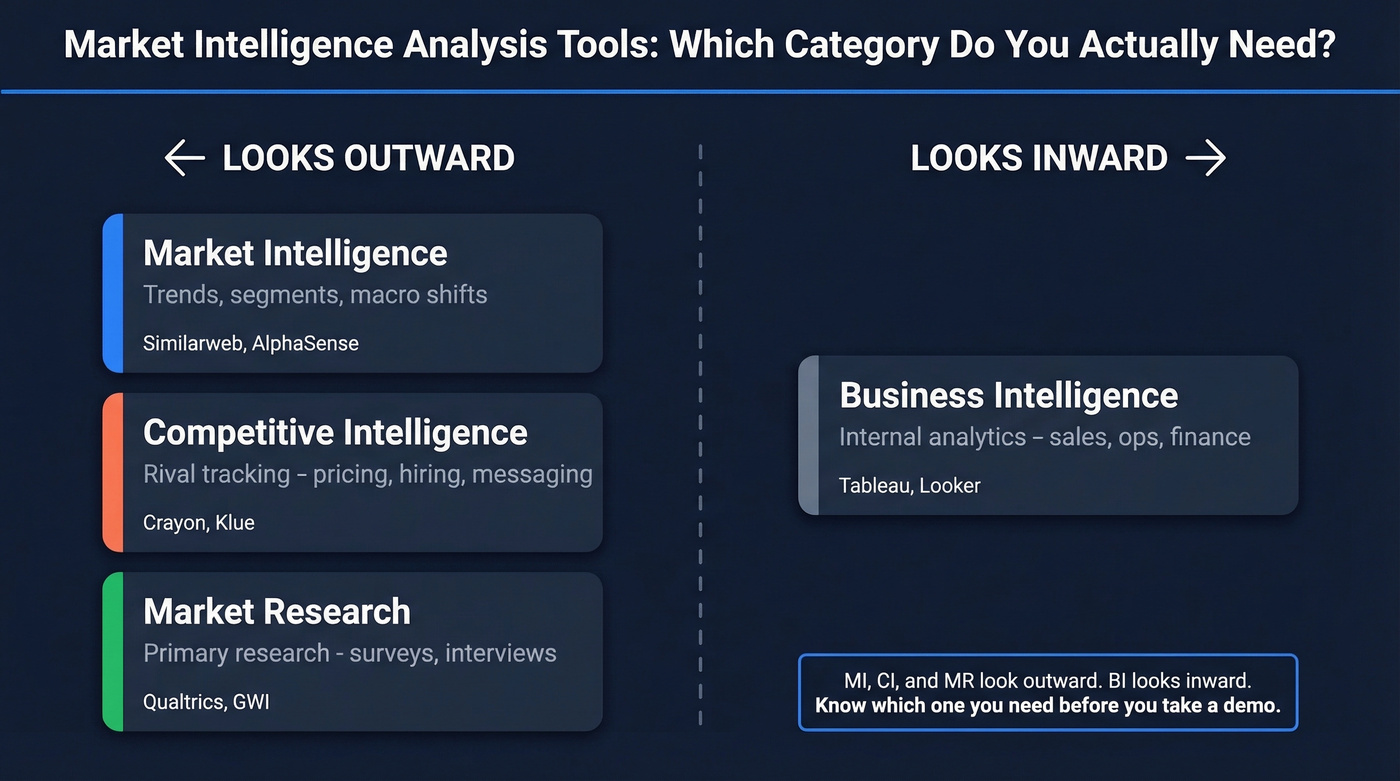
| Category | What It Covers | Direction | Example Tools |
|---|---|---|---|
| Market Intelligence | 360-degree external view: trends, segments, macro shifts | External | Similarweb, AlphaSense |
| Competitive Intelligence | Systematic rival tracking: pricing, hiring, messaging | External | Crayon, Klue |
| Market Research | Primary research for specific questions (surveys, interviews) | External | Qualtrics, GWI |
| Business Intelligence | Internal performance analytics - sales, ops, finance | Internal | Tableau, Looker |
MI, CI, and MR look outward. BI looks inward. Know which one you need before you take a demo.

Market intelligence tools tell you who to target. Prospeo turns that intelligence into action - 300M+ profiles, 98% email accuracy, 30+ filters including buyer intent across 15,000 topics, all refreshed every 7 days. At ~$0.01 per email, you spend less on contact data than a single AlphaSense seat.
Stop analyzing markets you can't reach. Get verified contact data now.
Best Tools by Category
Prospeo - Best for B2B Contact Data
Use this if you've identified target accounts through market intelligence and need verified contact data to actually reach decision-makers.
Skip this if you need competitive battlecards or financial research - that's a different category entirely.
Prospeo isn't a CI platform or a research tool. It's the action layer. Once you know which accounts matter, you get 300M+ professional profiles, 143M+ verified emails with 98% accuracy, and 125M+ verified mobile numbers that hit a 30% pickup rate. The database refreshes every 7 days, compared to the 6-week industry average, so you're not emailing people who changed jobs two months ago.

The 30+ search filters include buyer intent powered by 15,000 Bombora topics, technographics, job changes, headcount growth, funding signals, and revenue filters. Teams book 26% more meetings than ZoomInfo users and 35% more than Apollo users. The free tier gives you 75 verified emails per month plus 100 Chrome extension credits, and paid plans run about $0.01 per email with no annual contracts.
Crayon - Best for Competitive Intelligence
Use this if you need deep, automated monitoring of competitor moves - pricing changes, messaging shifts, product launches, hiring patterns.
Skip this if your team is under 10 people and you can track 3-4 competitors manually. In our experience, small teams rarely get enough value from Crayon to justify the spend.

Crayon crawls competitor websites, job boards, and review sites to surface changes your team would miss. The median buyer pays $28,750/year based on 90 tracked purchases. Small teams can get in around $15K/year on Essentials; enterprise deployments push past $100K. Add-ons for battlecards, integrations, and professional services tack on 15-30%. If you're in a market with fast-moving competitors, the premium is justified.
AlphaSense - Best for Financial Research
Here's the thing most listicles won't tell you: if your average deal size is under $25K and you're not in PE, corporate strategy, or equity research, you almost certainly don't need AlphaSense. It's genuinely excellent - and genuinely expensive for teams that won't use 80% of its capabilities.
The median buyer pays $18,375/year, but that number hides a massive range. SMB customers average $44,754/year, and enterprise contracts average $125,124/year across 160 tracked customers. Enterprise pricing jumped 48% year-over-year. That's not aggressive inflation - that's aggressive monetization of a sticky product. If you're renewing this year, negotiate hard.
What makes AlphaSense stand out is its ability to synthesize earnings transcripts, SEC filings, and expert interviews into structured, searchable intelligence that strategy teams can act on immediately.

Klue - Best for CI + Sales Enablement
Pick Klue over Crayon when your bottleneck is getting intelligence consumed by the sales floor, not collected by the strategy team. Klue scores 4.7/5 on G2 across 443 reviews, and the product earns it. Four tiers (Starter, Essentials, Pro, Plus) with typical contracts running $20K-$40K/year. The Salesforce and Slack integrations mean battlecards show up where reps already work, not buried in some portal nobody checks.
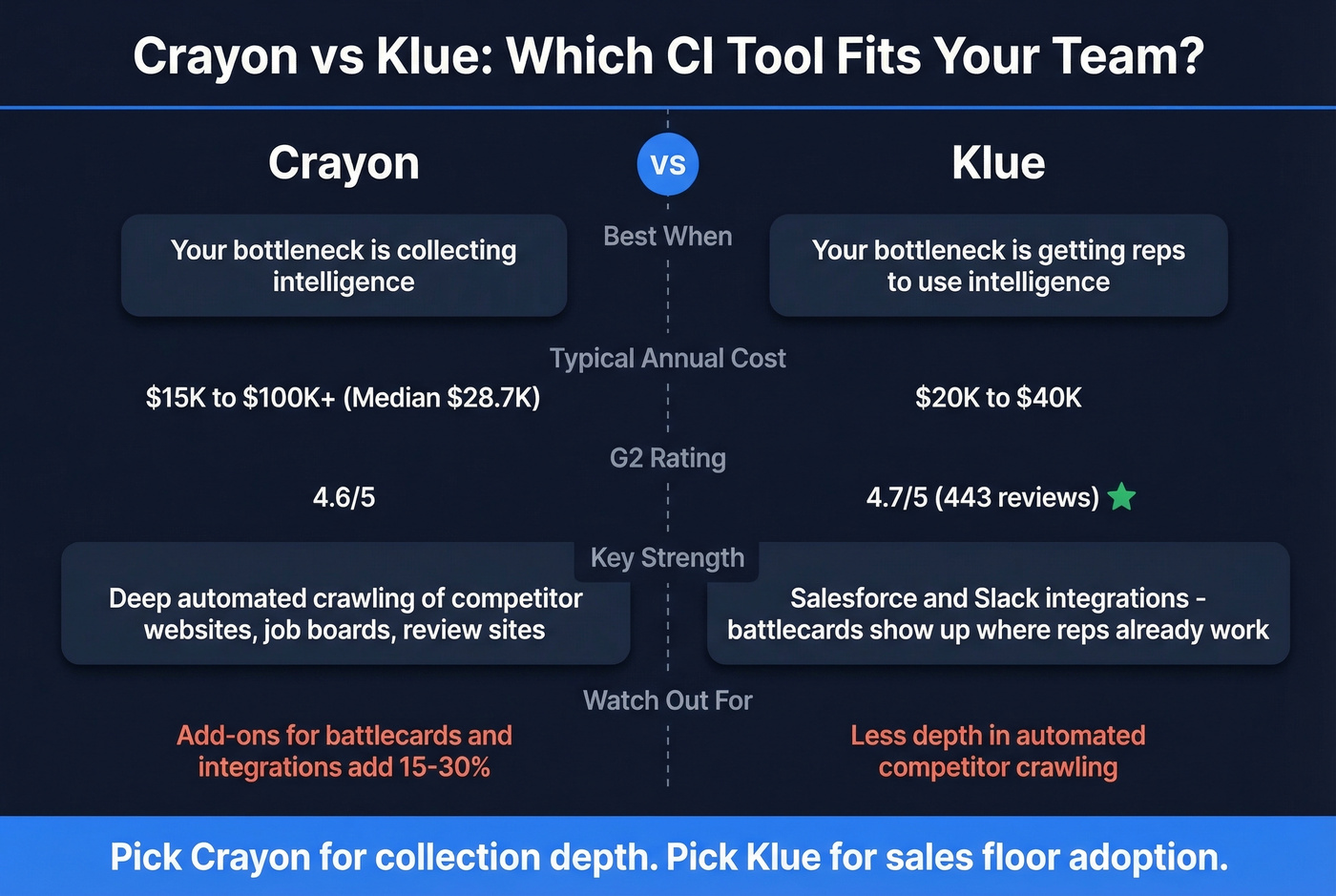
G2 comparison data highlights that Similarweb is more expensive and slower to reach ROI compared to Klue for competitive use cases - worth considering if you're weighing both.
Similarweb - Best for Digital Intelligence
Use this if you're a digital-first company that needs traffic analysis, keyword intelligence, and industry benchmarks for online competitors.
Skip this if your competitors don't have meaningful web presence. Similarweb's value drops fast for offline-heavy industries.
Starter runs $199/month. Web Intelligence - Team plans hit $14,000/year for 5 users, and Web Intelligence - Business jumps to $35,000/year with API access and AI dashboards. A Sales Intelligence tier also exists at $129/month for individual users. There's a 7-day free trial. For understanding competitor traffic sources, audience overlap, and digital market share, nothing else comes close at this price point.
Brandwatch - Social & Sentiment Tracking
Social listening and sentiment analysis across public channels. Typical mid-market contracts run $1K-$3K/month. Best for brands tracking public perception, trending topics, and campaign sentiment in real time - especially useful when you need to spot emerging conversations before competitors do.
Visualping - Website Monitoring
Monitors competitor website changes: pricing pages, product updates, feature launches. Free tier available, business plans around $105/month, enterprise from $900/year. Simple, focused, and surprisingly useful as a lightweight CI layer. We've seen teams pair it with a proper CI tool to catch the small stuff that slips through automated dashboards.
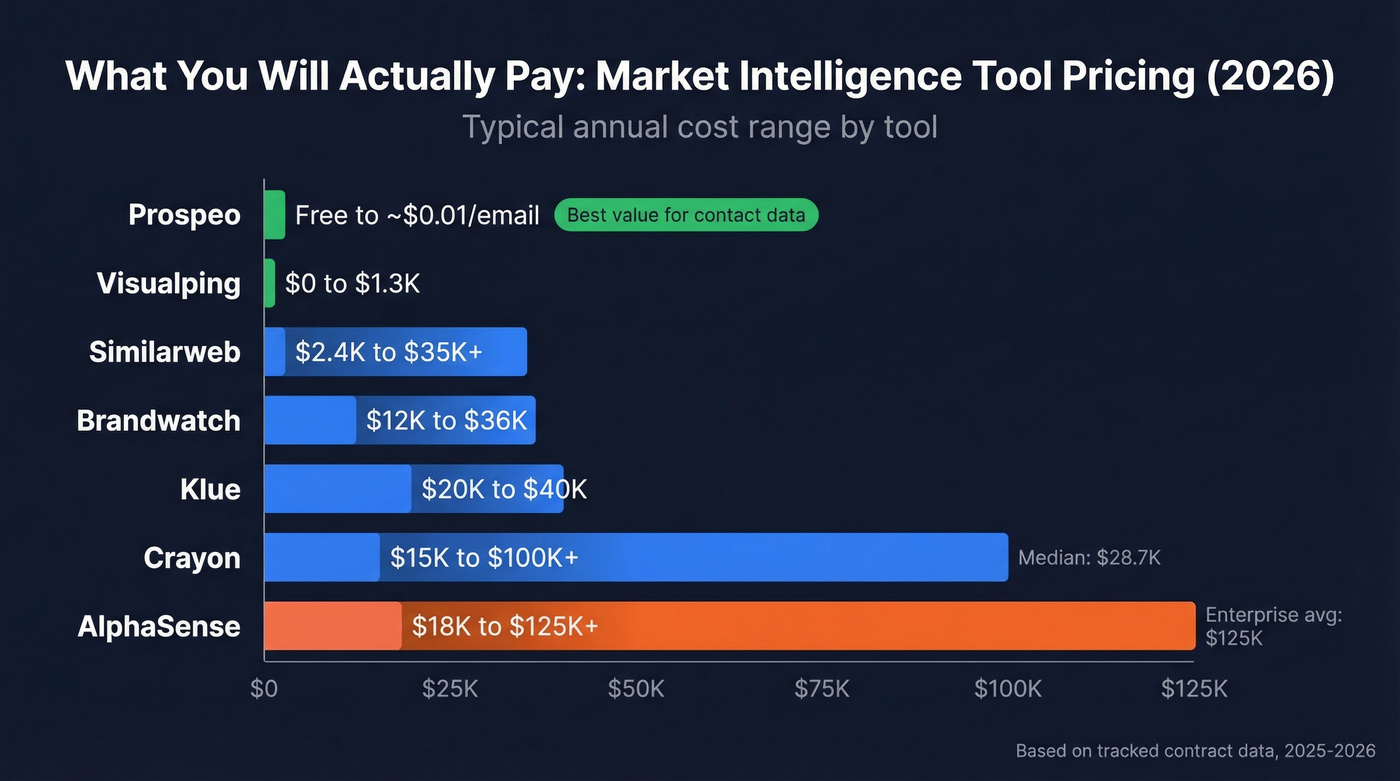
Pricing Comparison
| Tool | Best For | Starting Price | Typical Annual |
|---|---|---|---|
| Prospeo | Contact data & verification | Free | ~$0.01/email |
| Crayon | Competitive intelligence | ~$15K/yr | $28K median |
| AlphaSense | Financial research | ~$18K/yr | $45K-$125K |
| Klue | CI + sales enablement | ~$20K/yr | $20K-$40K |
| Similarweb | Digital intelligence | $199/mo | $2.4K-$35K+ |
| Brandwatch | Social listening | ~$1K/mo | $12K-$36K |
| Visualping | Website monitoring | Free | $0-$1.3K |
Your market intelligence stack identifies the right accounts. But if your contact data is stale, you're emailing ghosts. Prospeo refreshes every 7 days - not every 6 weeks - and teams book 26% more meetings than ZoomInfo users. No contracts, no sales calls, 75 free emails to prove it.
Intelligence without action is just expensive reading. Close the gap.
Mistakes That Waste Your MI Budget
Buying a generalist when you need a specialist. A CI platform won't replace financial research tools, and a social listening tool won't build battlecards. Match the category to the problem.
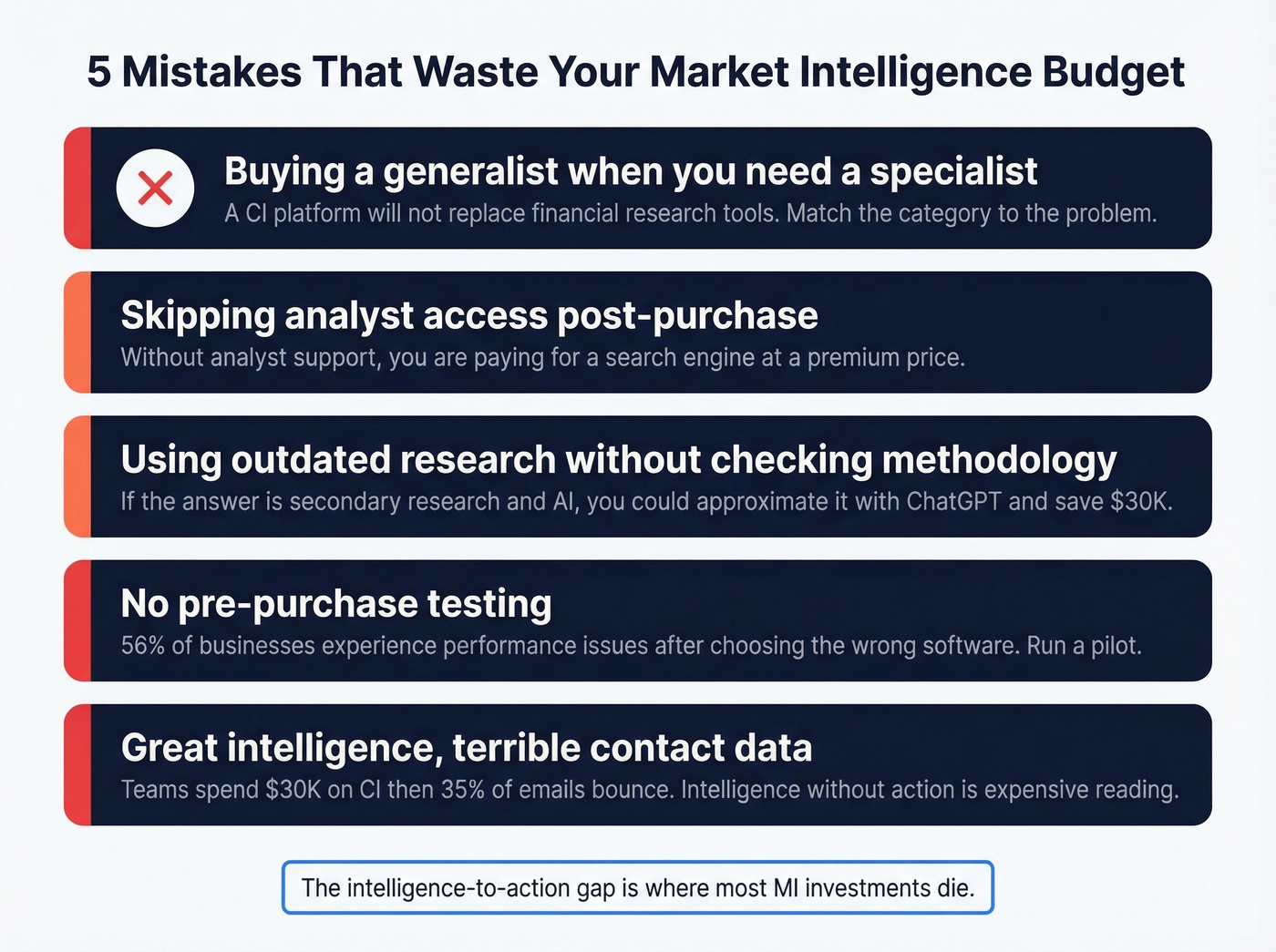
Skipping analyst access post-purchase. The best MI platforms include analyst support. If yours doesn't, you're paying for a search engine with a premium price tag.
Using outdated research without checking methodology. Ask where the data comes from. If the answer is "secondary research and AI," you could approximate that with ChatGPT and save $30K.
No pre-purchase testing. 56% of businesses experience performance issues after choosing the wrong software. Run a pilot - every serious vendor offers one.
Investing in intelligence but neglecting data quality. We see this constantly. Teams spend $30K on CI, then send outreach where 35% of emails bounce. No amount of market intelligence analysis tools fixes your pipeline if the contact data is stale. Let's be honest: the intelligence-to-action gap is where most MI investments die. For deliverability fundamentals, start with email bounce rate and an email deliverability guide.
FAQ
What's the difference between market intelligence and competitive intelligence?
Market intelligence covers the full external picture - trends, customer shifts, regulations, and category dynamics. Competitive intelligence is a subset focused specifically on tracking rivals' products, pricing, hiring, and messaging. The tools and price tags are very different, so clarify which you need before buying.
How much do these tools typically cost?
Ranges from free (Visualping, Prospeo's free tier) to $125,124/year for enterprise AlphaSense contracts. Most mid-market CI platforms land in the $20K-$40K/year band. Digital intelligence tools like Similarweb start at $199/month. Always negotiate - median contract values suggest 15-25% discount room on most platforms.
What's the best free option for getting started?
Visualping offers a free tier for website monitoring. For B2B contact data, Prospeo's free plan includes 75 verified emails per month and 30+ search filters - the strongest option for teams that need to act on intelligence with accurate, verified contacts without committing budget upfront.