

MDR vs SDR: What's the Real Difference?
A RevOps lead posts a job for an "MDR" and gets resumes from people who've only done cold calling. An SDR applies to an "MDR" role and discovers it's 100% inbound qualification. The confusion is real - only about 25% of companies actually split sales development into dedicated inbound and outbound roles. As Gail Behun at Juniper Square put it, most orgs just have "inbound SDRs and outbound SDRs."
Here's the short version: SDR/BDR roles typically lean outbound while MDR (or inbound SDR) roles lean inbound, but nearly half of companies use blended roles handling both. If you're hiring, read the decision framework below before writing the job description.
What Is an SDR?
An SDR - Sales Development Representative - lives at the top of the funnel. The core motion is outbound prospecting: finding people who don't know you yet and getting them interested enough to take a meeting. Bridge Group's 2026 report, surveying 351 B2B companies, shows 60% of sales development groups report to Sales, not Marketing. The typical SDR-to-AE ratio sits at 1:2.4.
Day-to-day, an SDR's work breaks down like this:
- Cold calling around 44 dials/day and sending roughly 41 cold emails
- Researching target accounts and building prospect lists
- Running multi-touch sequences across phone, email, and social
- Booking qualified meetings for AEs and logging everything in the CRM
KPIs are volume-driven: meetings booked, pipeline generated, outreach activity. It's a grind role. Median annual turnover hits 40%, so plan your hiring pipeline accordingly.
What Is an MDR?
An MDR - Marketing Development Representative - sits in the middle of the funnel. Where outbound sales development creates demand from scratch, MDRs take marketing-generated leads from webinars, content downloads, and demo requests, then convert them into sales-qualified opportunities.
Core MDR responsibilities:
- Responding to inbound leads within minutes (speed-to-lead is everything)
- Qualifying MQLs against ICP criteria and scoring frameworks
- Nurturing warm leads that aren't ready to buy, then handing off qualified opportunities to AEs with full context
The impact is measurable. Cognism reported that after introducing dedicated MDRs, their MQL-to-SQL conversion rate jumped from 3% to 10%, and 50% of marketing's pipeline and revenue came from the MQLs those MDRs worked. That's the difference between letting inbound leads rot in a queue and actually working them.
MDR vs SDR Side-by-Side
| Dimension | SDR | MDR |
|---|---|---|
| Lead source | Outbound (self-sourced) | Inbound (marketing-generated) |
| Funnel stage | Top of funnel | Middle of funnel |
| Primary activity | Cold outreach + prospecting | Lead qualification + follow-up |
| Core KPIs | Meetings booked, pipeline created | MQL-to-SQL conversion, speed-to-lead |
| Reports to | Sales (60% of orgs) | Marketing or Sales |
| Daily split | 40% calls / 30% research / 20% email / 10% admin | 40% qualification / 30% follow-up / 20% CRM / 10% meetings |
| Typical OTE | $70k-$100k | Similar to SDR comp |
| Career path | SDR/BDR -> AE or SDR Manager | MDR -> AE or SDR/MDR Manager |
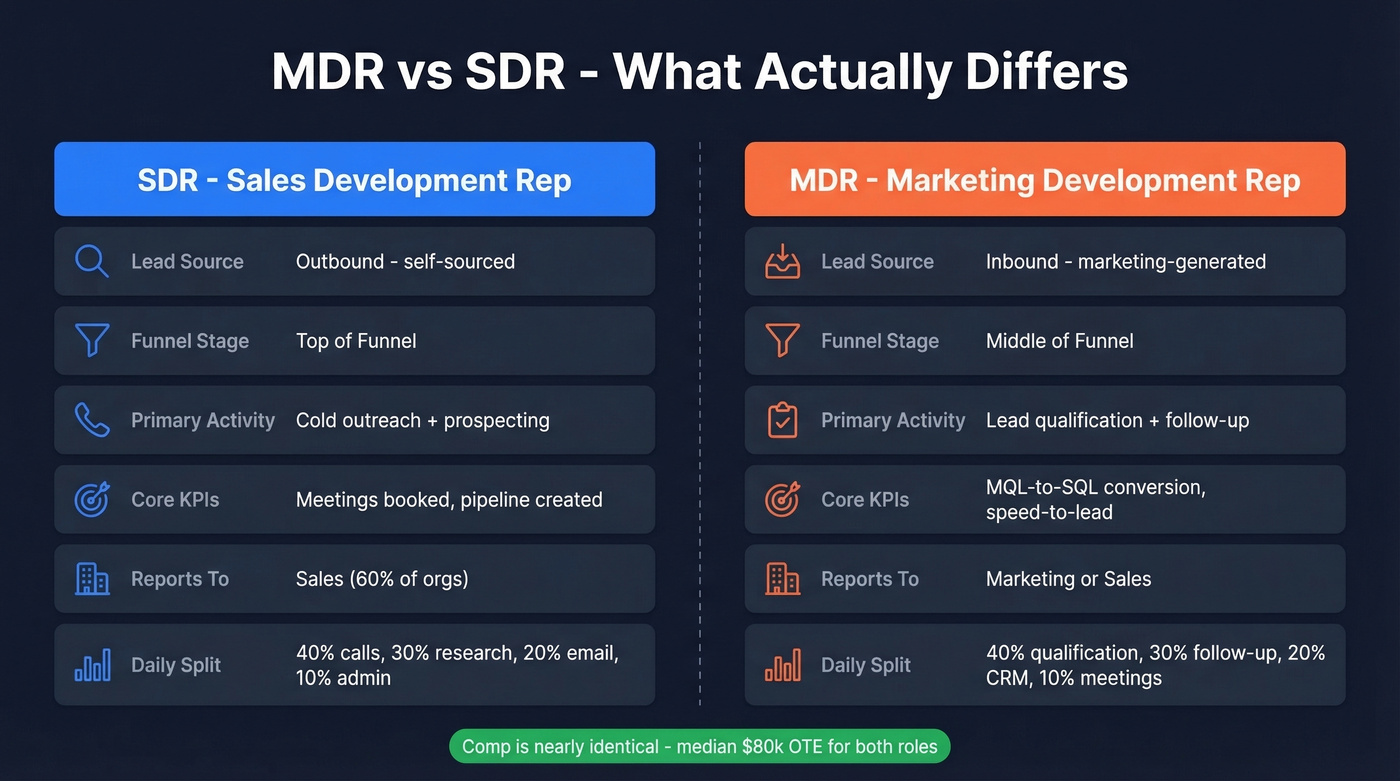
These lines blur constantly. We've seen MDR postings on Glassdoor that list "execute outbound campaigns via email and digital touchpoints" and require Outreach or Salesloft experience - that's an SDR job description with an MDR title slapped on it. Don't get hung up on the label. Look at the actual motion.

SDRs cold-calling 44 dials a day need direct dials that actually connect. MDRs qualifying MQLs need verified emails to follow up fast. Prospeo gives both roles 98% email accuracy, 125M+ verified mobiles, and 30+ filters to nail your ICP - refreshed every 7 days, not 6 weeks.
Arm every rep with data that connects, starting at $0.01 per email.
What MDRs and SDRs Earn
Let's be honest: comp is where people expect a big difference, and there isn't one. Bridge Group data puts the median SDR at $55k base and $80k OTE with a 68:32 base-to-variable split. Betts Recruiting's 2026 ranges show entry-level SDRs at $55k-$70k base and $70k-$100k OTE, with salaries up 5-10% year over year.
If you want to sanity-check your plan, it helps to understand OTE and how teams structure variable comp.
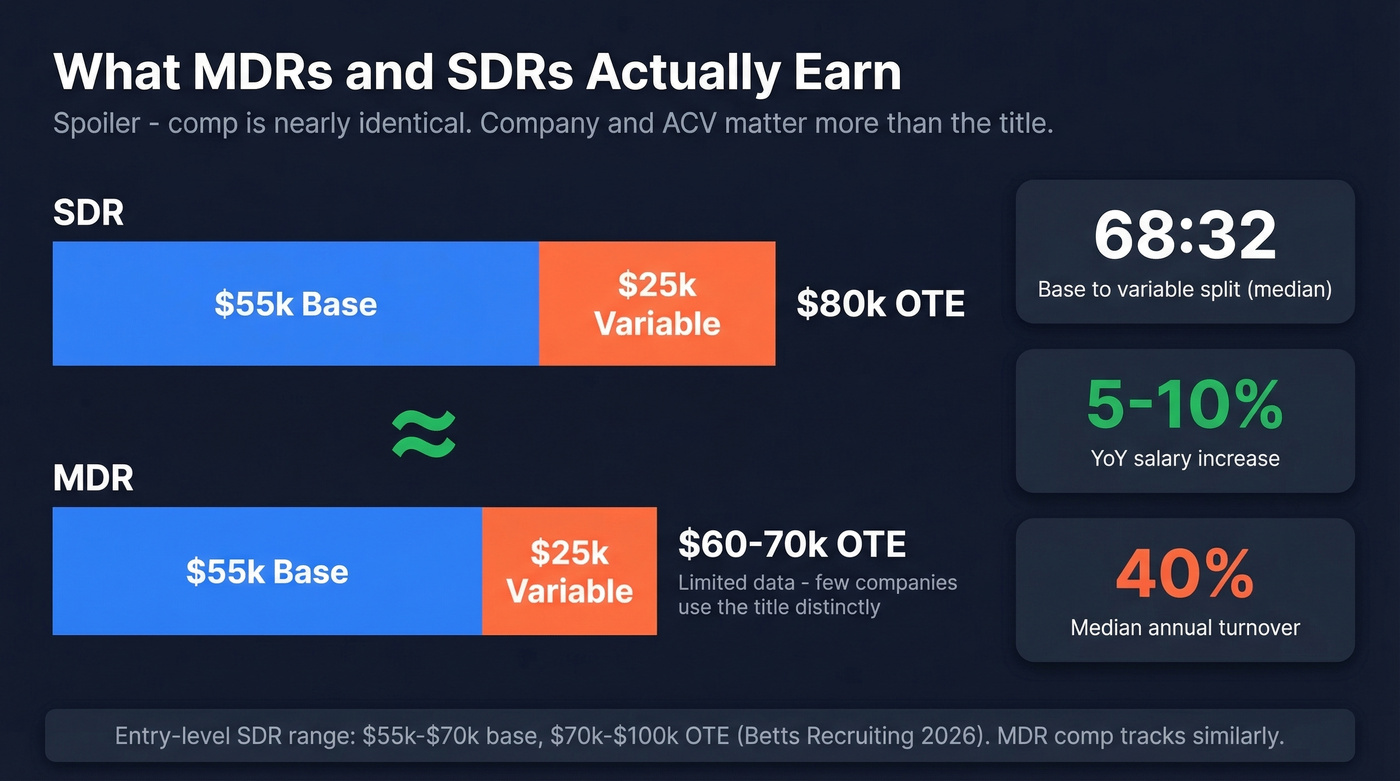
MDR-specific comp data is thin because so few companies use the title distinctly. But the Reddit anecdotes tell the real story: one user on r/sales compared a DocuSign MDR offer at roughly $60-70k OTE against a startup SDR role at $60-65k OTE. Nearly identical. The company, the product's ACV, and the territory matter far more than whether your title says "Market" or "Sales" development.
If your average deal size is under $15k, the distinction between these two roles is a luxury. One person can handle both motions until you're drowning in inbound.
When to Hire Each Role
If you're building a sales development function from zero, here's the framework we recommend:
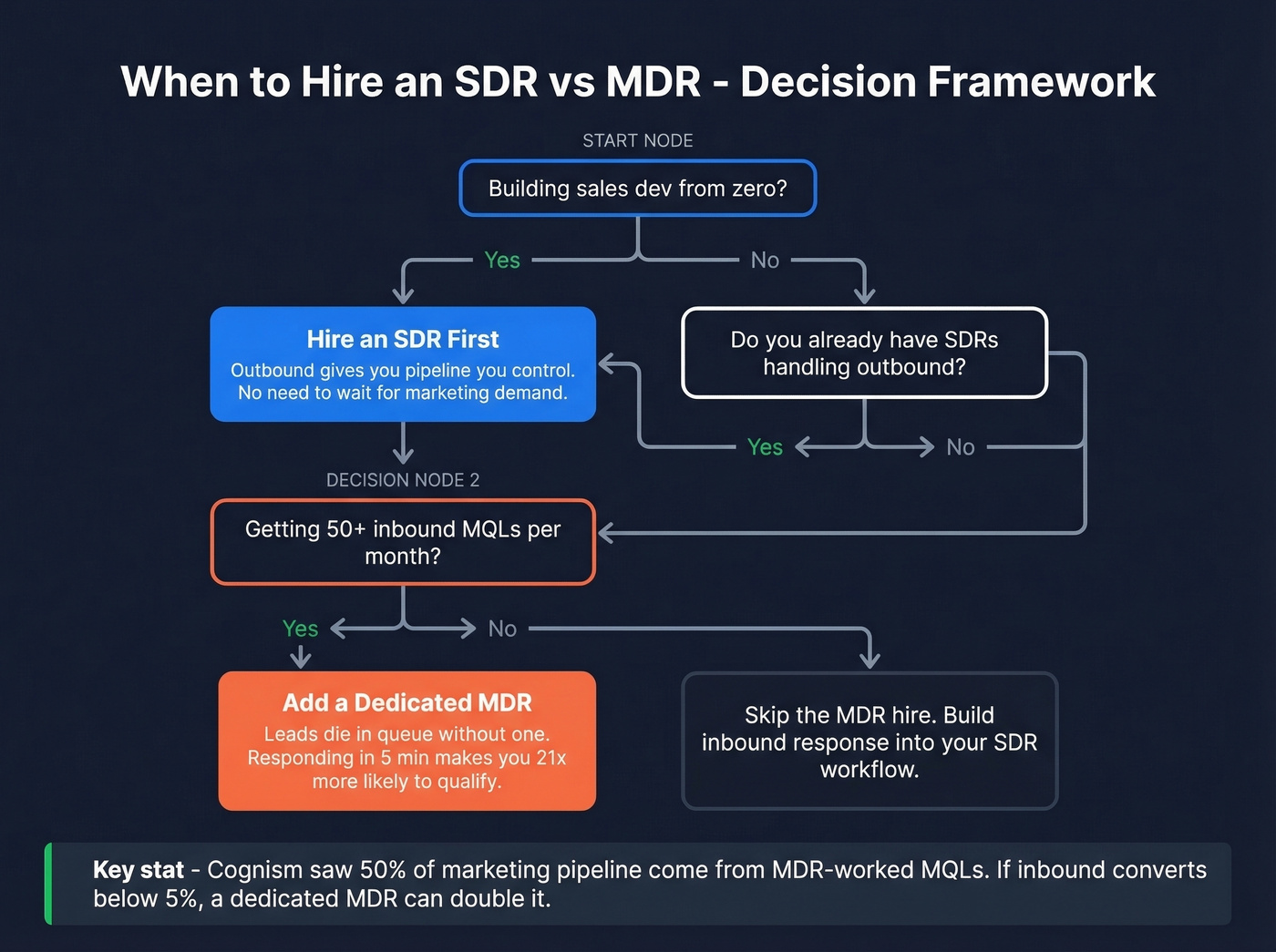
Hire an SDR first. Outbound gives you pipeline you control. You don't need to wait for marketing to generate demand. A popular take in early-stage startup circles echoes this - hire SDRs before marketers, because you need pipeline before you need brand.
Add an MDR when inbound exceeds roughly 50 MQLs per month. Below that threshold, your AEs or SDRs can handle inbound alongside their other work. Above it, leads start dying in the queue. Responding within five minutes makes you 21x more likely to qualify a lead versus waiting 30 minutes.
Measure the MDR impact. Cognism's internal data showed 50% of marketing pipeline and revenue came from MDR-worked MQLs. If your inbound leads convert below 5%, a dedicated MDR can likely double that rate.
Skip the MDR hire entirely if your marketing team generates fewer than 30 inbound leads a month. That volume doesn't justify a full-time salary - just build an inbound response cadence into your existing SDR workflow.
With 40% annual turnover across sales development, you're replacing a huge chunk of your team every year. Build hiring pipelines before you need them.
The Tech Stack Both Roles Need
The tools are nearly identical. Three layers matter.
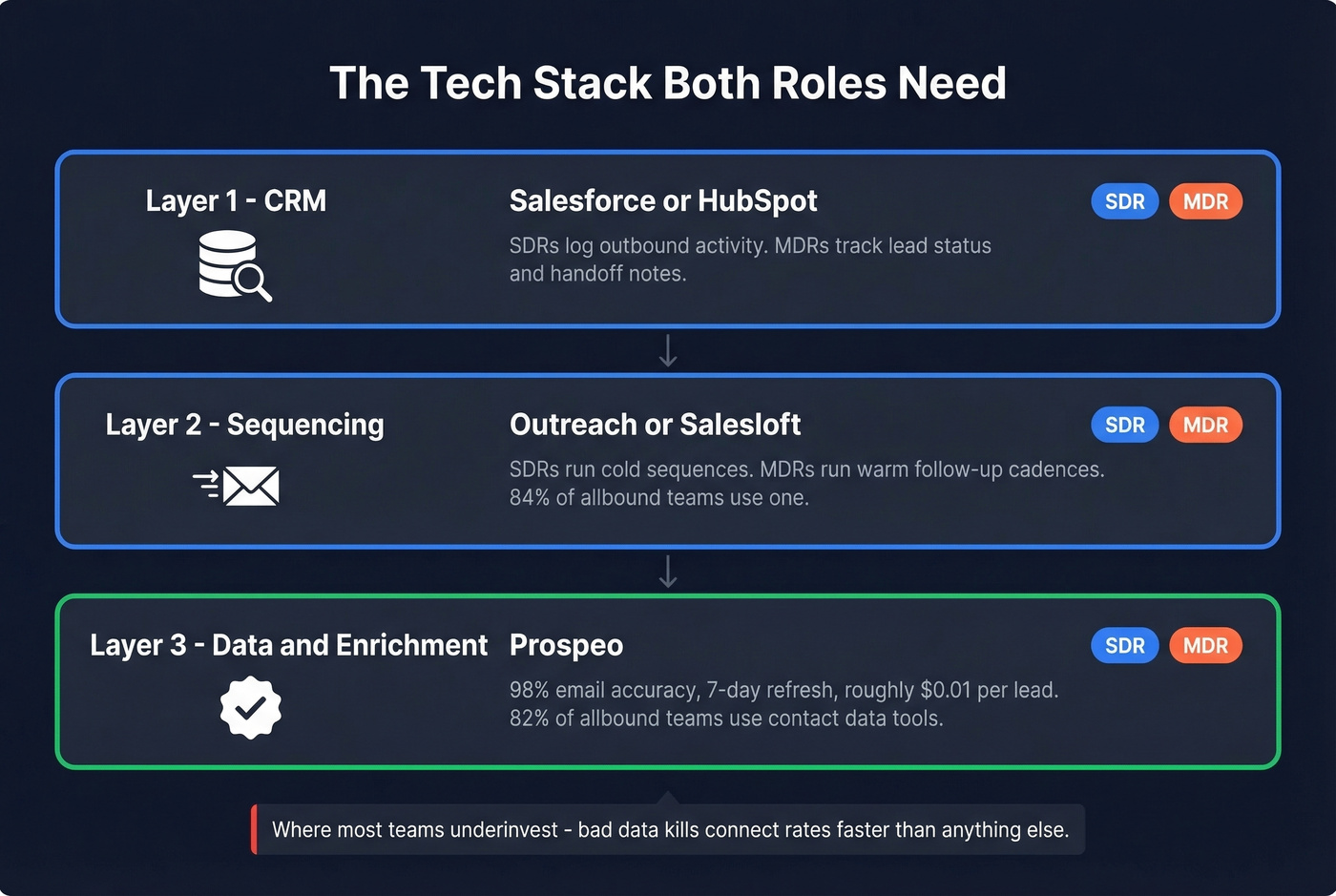
CRM - Salesforce or HubSpot. Non-negotiable for most teams. Both roles live here: SDRs logging outbound activity, MDRs tracking lead status and handoff notes. If you're standardizing your process, start with clear lead status definitions.
Sequencing - Outreach or Salesloft. SDRs run cold sequences; MDRs run warm follow-up cadences. Bridge Group data shows 84% of allbound teams use a sales engagement platform. (If you're evaluating options, see our roundup of SDR tools.)
Data and enrichment - This is where most teams underinvest, and in our experience it's what kills connect rates faster than anything else. 82% of allbound teams use contact data or account intelligence tools, and the ones that don't are leaving pipeline on the table. Prospeo covers this layer with 98% email accuracy and a 7-day data refresh cycle at roughly $0.01 per lead - the easiest layer to get right for both roles. If you're comparing vendors, start with data enrichment services and work backward from your workflow.

With 40% annual SDR turnover, every new hire needs to ramp fast on clean data - not waste weeks scrubbing bad lists. Prospeo's 7-day refresh cycle and 92% API match rate mean your CRM stays current whether it's feeding outbound sequences or inbound qualification workflows.
Cut rep ramp time in half with data that's already verified.
FAQ
Is an MDR more senior than an SDR?
No. Both are entry-level sales development roles with similar ramp times of about three months and comparable comp ranges. The median OTE across sales development is $80k. The difference is lead source and funnel position, not seniority or pay grade.
What's the difference between MDR, SDR, and BDR?
SDRs and BDRs are often used interchangeably, though many teams use BDR for outbound prospecting and SDR as a catch-all. MDR specifically refers to marketing-sourced inbound lead follow-up, turning MQLs into SQLs. In practice, titles vary wildly by company - always read the actual responsibilities in the job description rather than trusting the title.
What tools do MDRs and SDRs use daily?
Both roles rely on a CRM like Salesforce or HubSpot, a sequencing platform like Outreach or Salesloft, and a data enrichment tool for verified emails and direct dials. The tech stack overlap is nearly total; only the lead sources and cadence types differ.