

The MEDDIC Checklist: Questions, Scoring Rubric & CRM Setup
Your forecast says 80% probability. Your gut says the deal's real. Then the "Economic Buyer" you've never actually met kills it in week eleven.
MEDDIC exists to prevent exactly this - but only if you use it as more than a vocabulary list. What follows is a working MEDDIC checklist with discovery questions, a scoring system, and the CRM wiring to make it stick.
Why MEDDIC Still Matters in 2026
73% of SaaS companies selling above $100K ARR use some version of MEDDIC. Organizations that fully adopt the framework report 18% higher win rates and 24% larger deal sizes, with close rates climbing 20-30% compared to traditional sales methods. Between 2021 and 2022, adoption doubled from 11% to 21% among B2B sales orgs.
The framework endures because it forces reps to gather customer evidence instead of relying on vibes. That's also why MEDDICC training has become a standard investment for revenue teams selling into enterprise accounts - the ROI shows up in forecast accuracy, not just win rates.
What Each Letter Means
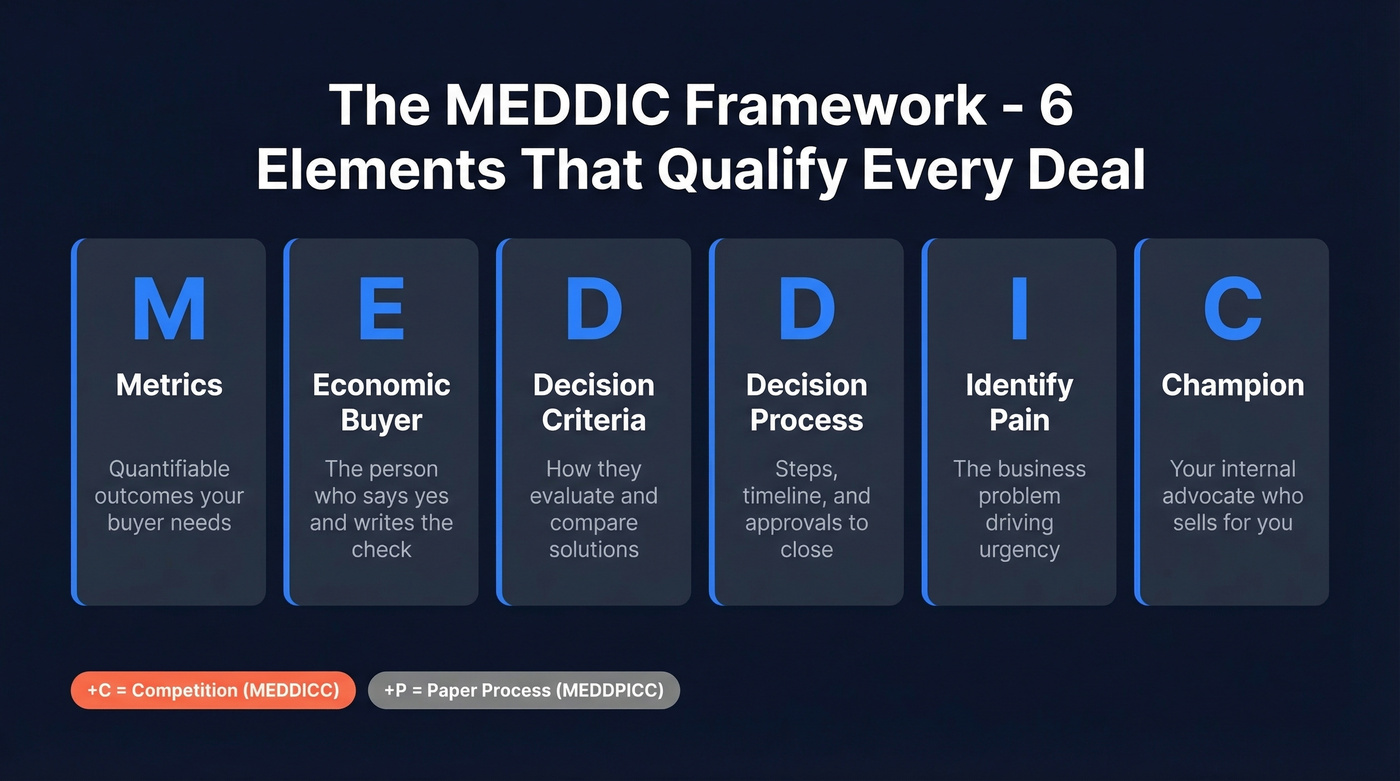
- M - Metrics: The quantifiable outcomes your buyer needs
- E - Economic Buyer: The person who can say yes and write the check
- D - Decision Criteria: How they'll evaluate and compare solutions
- D - Decision Process: The steps, timeline, and approvals to close
- I - Identify Pain: The business problem driving urgency
- C - Champion: Your internal advocate who sells when you're not in the room
MEDDICC adds Competition. MEDDPICC adds both Competition and Paper Process. MEDDPICC adds both Competition and Paper Process - the legal and procurement steps that stall complex enterprise deals. Most teams memorize definitions without building situational depth, skip scoring entirely, and never enforce it in the CRM. Let's fix that.
The Full Qualification Checklist
Metrics
Split metrics into "below the line" (cost savings, FTE reductions, efficiency) and "above the line" (revenue growth, time-to-market, customer satisfaction). The best reps anchor to both.
Ask: "What's your goal for [department] this quarter, and how are you tracking against it?" Then dig into the baseline - total cost of ownership over the past three years, and the financial consequences of missing those targets. If a prospect can't articulate what success looks like in numbers, you don't have a deal yet. You have a conversation.
Economic Buyer
This is the person with budget authority - not your day-to-day contact. If you haven't met the real Economic Buyer or secured their explicit approval, your chance of closing drops below 50%.
Three questions that cut through the ambiguity:
- "Who holds the ultimate budget authority for this purchase?"
- "If you and I reach an agreement, is there anybody else - formally or informally - who'd need to approve?"
- "What metrics does that decision-maker prioritize when evaluating new initiatives?"
Decision Criteria
You need to know how they'll compare you to alternatives - technical requirements, business outcomes, vendor credibility. Here's the thing: if you don't know their criteria, you're guessing at your own pitch.
Questions to ask during criteria discovery:
- "What criteria will your team use to evaluate solutions?"
- "How are those criteria weighted - is price, integration, or time-to-value most important?"
- "Are there any non-negotiable requirements that would eliminate a vendor immediately?"
Decision Process
Map every step between "we like this" and "signed contract." Complex deals commonly involve a technical evaluation, a business case review, and a paper/procurement process. Nail down who owns each.
- "Walk me through the approval process for a purchase like this - technical review, business sign-off, and procurement."
- "What's happened in past evaluations that caused delays?"
- "Is there a procurement or legal review step, and how long does it typically take?"
Identify Pain
Picture this: a VP of Sales tells you their team "could be more efficient." That's not pain - that's a shower thought. Pain is when that VP's team missed quota three quarters running, two reps quit, and the board is asking questions. No quantified business impact, no urgency, no deal.
Go deeper with: "How is this problem affecting revenue or team capacity right now?" and "What happens if you do nothing for the next 12 months?" These discovery questions separate real pipeline from wishful thinking.
Champion
Your Champion isn't just someone who likes you - they need influence and a personal stake in your solution winning. As Brevet Group emphasizes, don't ask "do you have a champion?" Ask: "Have you developed the Product Manager leading the implementation to be your champion?"
Build more than one. If your single advocate changes roles or leaves, the deal dies with them. Ask who on their team has the most to gain from solving this problem, and whether that person has advocated for new tools internally before and won.

A perfect MEDDIC score won't close a deal if your emails bounce. Prospeo gives you 98% verified emails and 125M+ direct dials so you actually reach the Economic Buyer - not their gatekeeper.
Stop qualifying deals you can't even contact. Start with verified data.
MEDDIC Scoring Rubric
A checklist without scoring is just a to-do list. If you want the framework to change forecasting behavior, you need a simple score reps will actually keep updated.
This is also where MEDDIC starts to look a lot like lead scoring: a consistent, evidence-based way to decide what deserves time and forecast weight.
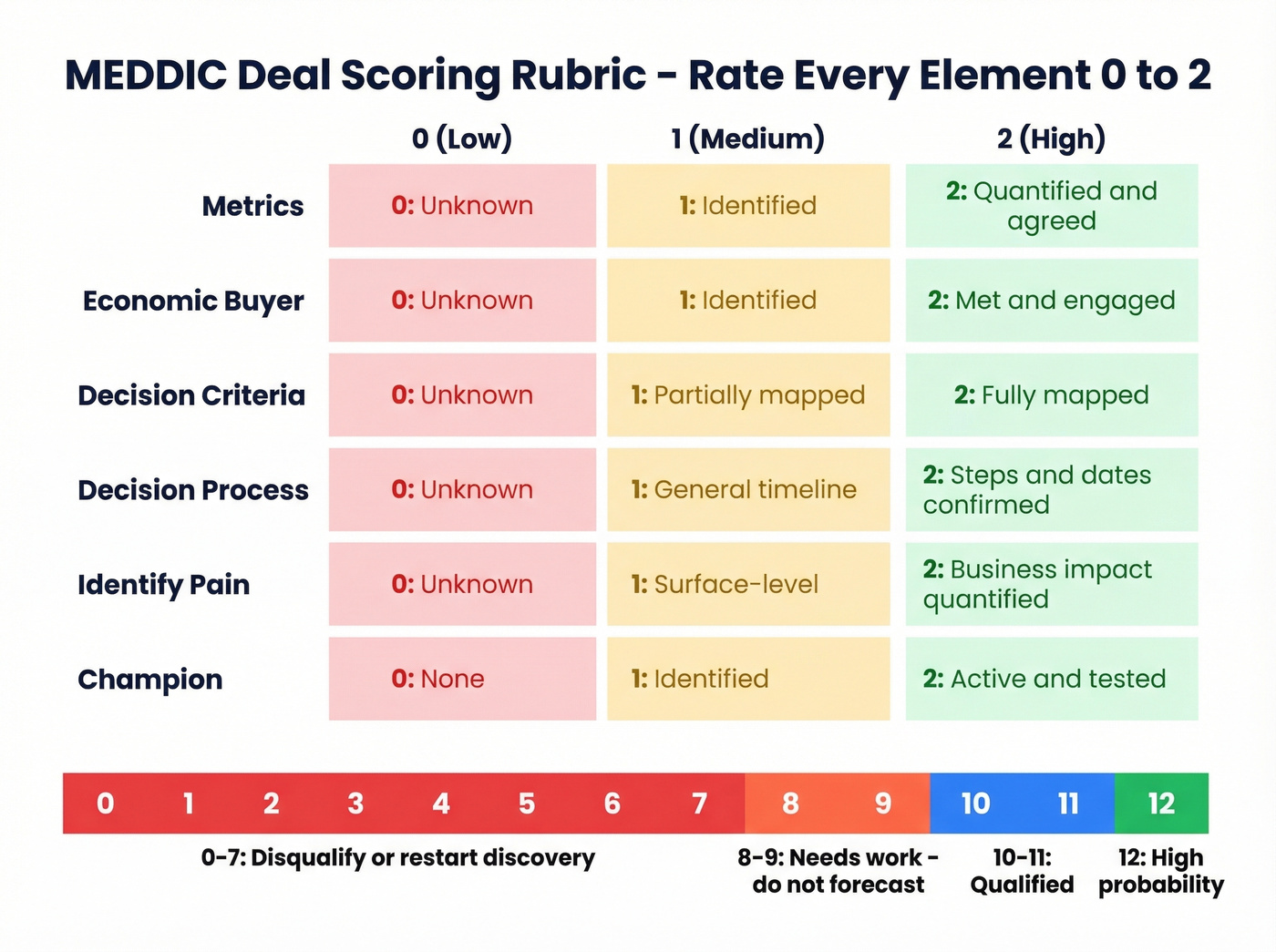
| Element | 0 Points | 1 Point | 2 Points |
|---|---|---|---|
| Metrics | Unknown | Identified | Quantified + agreed |
| Econ. Buyer | Unknown | Identified | Met + engaged |
| Decision Criteria | Unknown | Partially mapped | Fully mapped |
| Decision Process | Unknown | General timeline | Steps + dates confirmed |
| Identify Pain | Unknown | Surface-level | Business impact quantified |
| Champion | None | Identified | Active + tested |
Total: 12 points. Thresholds: 12 = high probability, 10-11 = qualified, 8-9 = needs work (don't forecast it), below 8 = disqualify or restart discovery.
One documented case showed close rates jumping from 35% to 82% after implementing rigorous scoring, with forecast accuracy climbing from 60% to 92% by refusing to forecast deals below threshold.
Here's our strong opinion on this: most teams don't have a "closing" problem. They have a "qualifying" problem. If your pipeline is full of deals scoring 6 and 7, adding more leads won't help. Raising your disqualification bar will.
Running MEDDICC Deal Reviews
A scoring rubric that lives in a spreadsheet dies within a month. The real value shows up when managers use scores to run a structured deal review each week - walking through every opportunity above a certain value and pressure-testing each element with the rep.
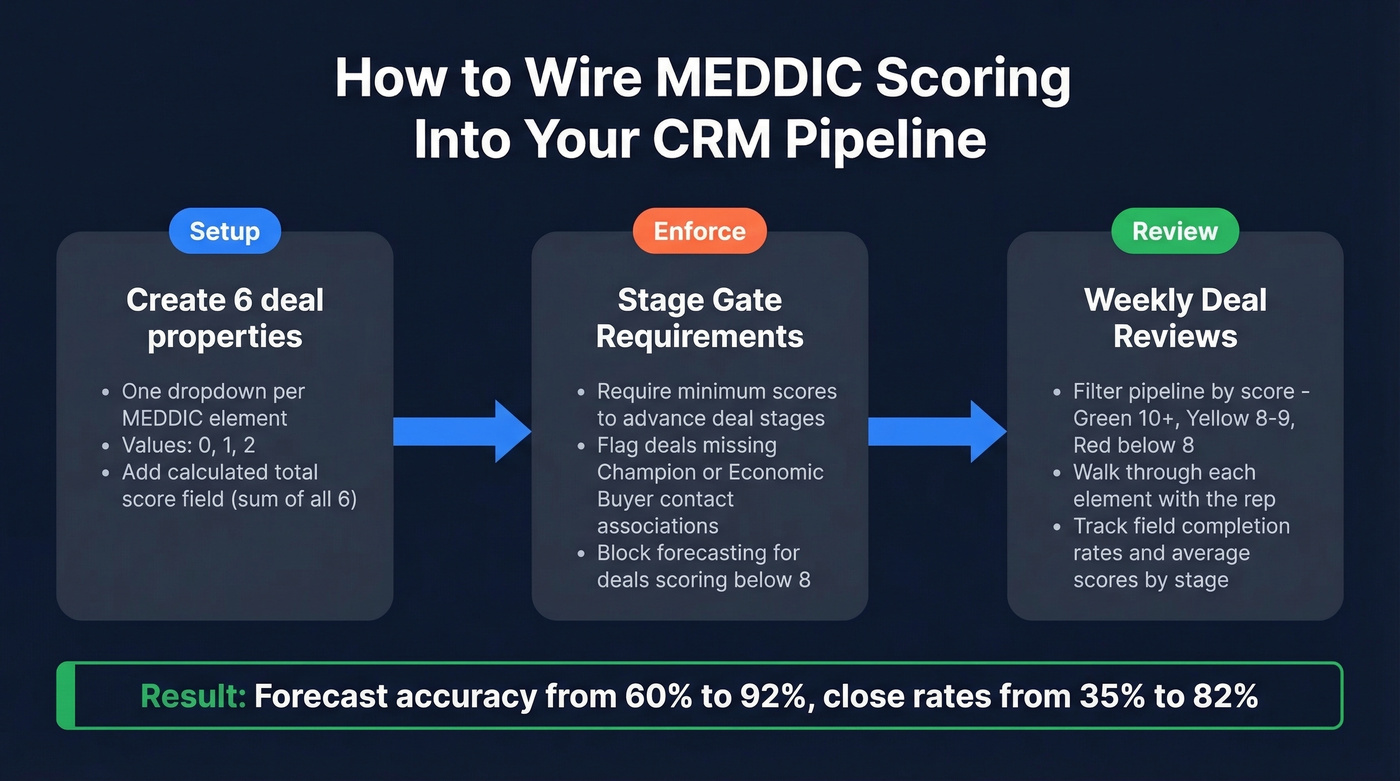
Wire the rubric into your CRM to make these reviews efficient.
In HubSpot: Create a deal property for each element (dropdown: 0, 1, 2). Make them required to advance deal stages. Add a calculated property called "MEDDIC Total Score" that sums all six, then use color-coded pipeline filters: green for 10+, yellow for 8-9, red for below 8. One gotcha worth knowing: Champion and Economic Buyer are really people, not scores. HubSpot can't natively require a specific labeled contact association to move a deal stage. The workaround is a workflow that checks for a correctly labeled associated contact and flags the deal if it's missing.
In Salesforce: Mirror the approach with custom fields per element, required stage gates, and a roll-up formula field for the total score. Use dashboard reports to track adoption metrics - field completion rates, average scores by stage, and the percentage of deals advancing without a minimum threshold. We've seen teams cut their "surprise losses" in half within a single quarter just by enforcing the stage-gate requirement.
Once your MEDDIC checklist surfaces the Economic Buyer and Champion, you need verified contact data to actually reach them. Prospeo's Chrome extension pulls verified emails at 98% accuracy and direct dials from a prospect's company website or professional profile - no tab-switching required.
If you're building this into a broader sales process optimization effort, the CRM enforcement is the part that makes MEDDIC real.
You just built a scoring rubric to disqualify weak pipeline. Now fill it with deals worth scoring. Prospeo's 30+ filters - buyer intent, funding, headcount growth - let you target accounts that already match your MEDDIC criteria before the first call.
Qualify before you even prospect. Filter 300M+ profiles by intent and fit.
Mistakes That Kill Adoption
| Don't Do This | Do This Instead |
|---|---|
| Memorize generic definitions ("Economic Buyer = budget holder") | Build company-specific inspection points: "Baselined their current TCO over three years?" |
| Require reps to document every detail - the #1 complaint on r/sales | Use scores to guide deal coaching conversations, not audit paperwork |
| Forecast based on gut feelings | Refuse to commit any deal below 8 points. Period. |
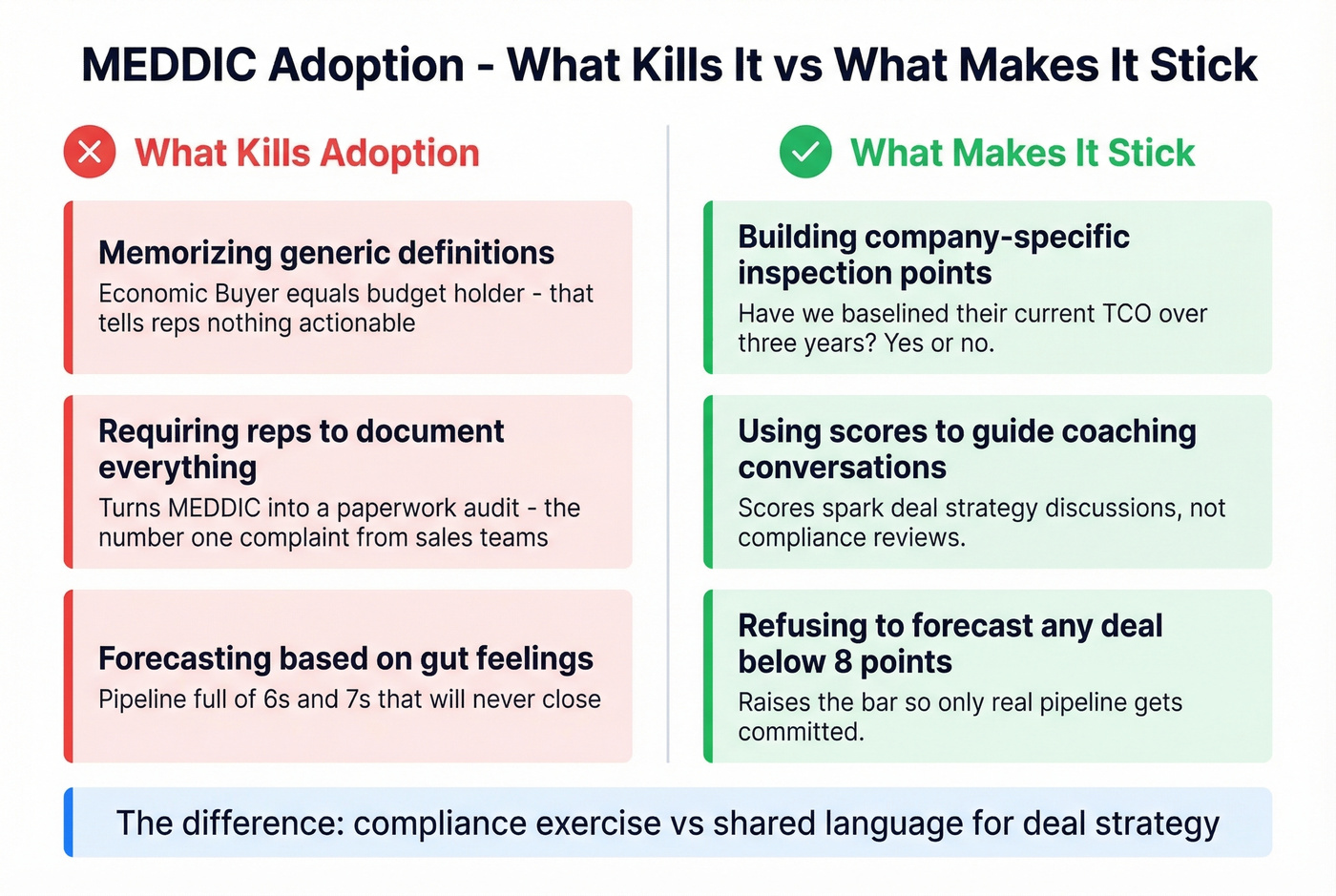
In our experience, the teams that fail treat the framework as a compliance exercise. The ones that succeed treat it as a shared language for deal strategy. Pipeline qualification becomes second nature when reps see that scored deals close faster and more predictably than unscored ones. Skip the framework entirely if you're selling transactional deals under $20K with a single buyer - it'll just slow you down.
If you want a deeper set of prompts for each element, use our MEDDIC Discovery Questions playbook alongside this checklist.
FAQ
What's the difference between MEDDIC, MEDDICC, and MEDDPICC?
MEDDIC covers six qualification elements. MEDDICC adds Competition. MEDDPICC adds both Competition and Paper Process - use it for complex enterprise deals with lengthy procurement and legal approval chains.
When should I use MEDDIC instead of BANT?
Use MEDDIC for complex B2B deals with multiple stakeholders and contract values above $50K. BANT works for transactional sales with short cycles and a single decision-maker. If your average sales cycle exceeds 60 days, MEDDIC delivers materially better forecast accuracy.
How do I find contact info for the Economic Buyer?
Use a verified B2B data platform like Prospeo to pull direct contact details for the decision-makers your qualification process surfaces. At roughly $0.01 per email, it's accessible even for lean teams.
What MEDDIC questions should I ask first?
Start with pain and metrics - they create urgency and a business case. Ask "How is this problem affecting revenue right now?" and "What does success look like in measurable terms?" If you can't quantify the pain in the first two discovery calls, the deal likely isn't real enough to pursue.