

MEDDPICC Questions Mapped to Your Sales Cycle - Not the Acronym
Thursday afternoon pipeline review. Your AE walks through a "Stage 3" deal that's been stuck for nine weeks. You ask about the economic buyer. Silence. You ask about the paper process. More silence. The deal is a ghost - and everyone knows it except the rep who's been "nurturing" it.
The right MEDDPICC questions would've killed this deal two months ago, or saved it.
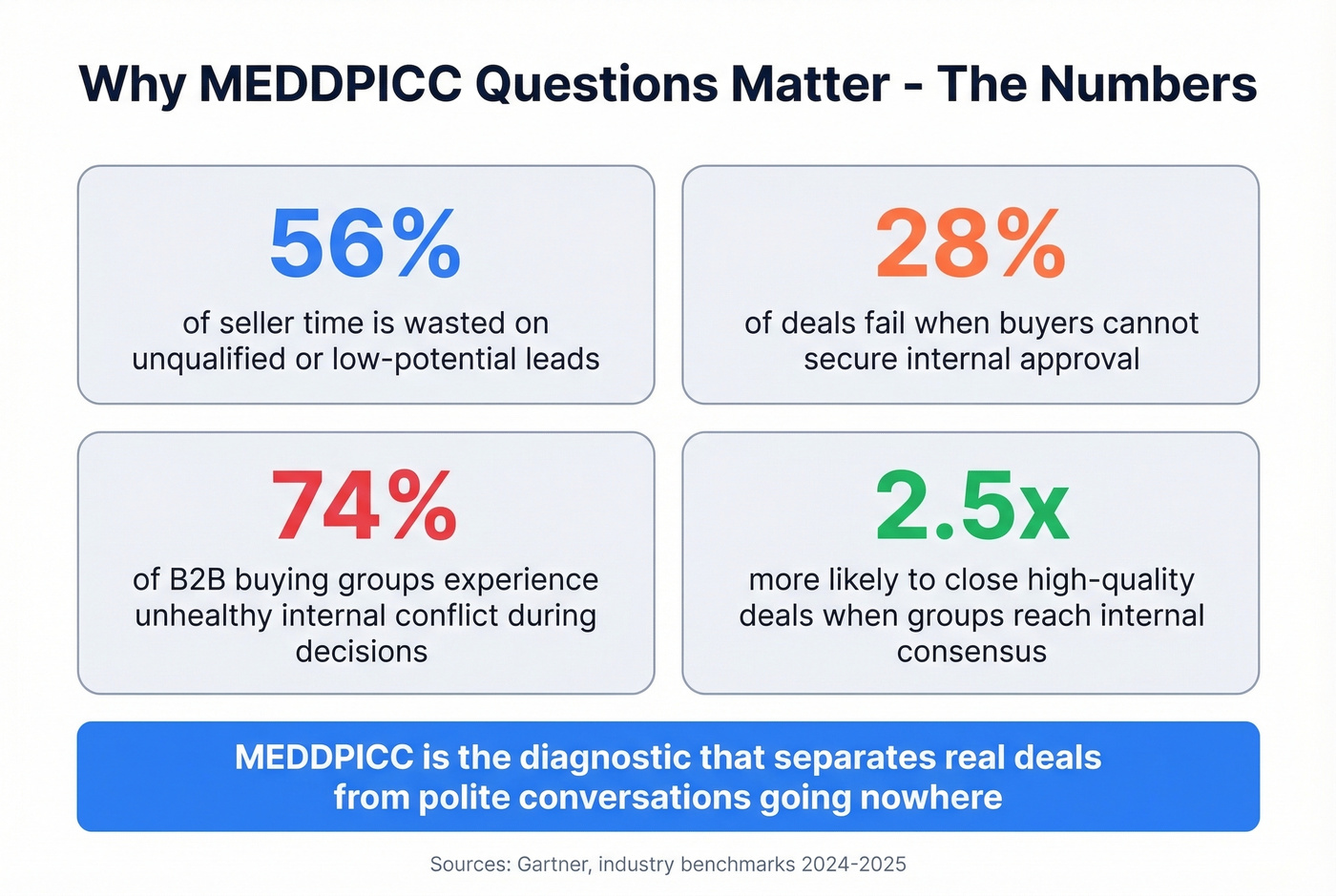
56% of seller time gets wasted on unqualified or low-potential leads. Meanwhile, 74% of B2B buying groups experience what Gartner calls "unhealthy conflict" during their internal decision process, and groups that reach internal consensus are 2.5x more likely to close high-quality deals. Your prospects aren't just evaluating you; they're fighting with each other. MEDDPICC gives you the diagnostic to figure out which deals are real and which ones are polite conversations going nowhere.
Three Rules Before You Start
- Stop following the acronym in order. M-E-D-D-P-I-C-C is a memory device, not a call script. Sequence your questions by sales stage.
- Start with Pain, Champion, and Economic Buyer. These three determine whether the deal is real. Everything else is detail.
- Know what a good answer sounds like before you ask. A question without an expected answer is just conversation filler.
What Is MEDDPICC? (30-Second Refresher)
MEDDPICC is a deal qualification framework - not a sales methodology. It's an X-ray for your pipeline: it reveals what's healthy and what's broken inside a deal, but it doesn't tell you how to sell. That's your methodology's job (Command of the Message, Challenger, SPIN - whatever your org runs).
The original MEDDIC was created in 1996 by Dick Dunkel at PTC, later evangelized by John McMahon and Jack Napoli. Over time, teams added Paper Process and Competition to handle enterprise procurement and competitive evaluations.
| Framework | Elements | Best For |
|---|---|---|
| MEDDIC | M, E, D, D, I, C | Mid-market, moderate complexity |
| MEDDPICC | M, E, D, D, P, I, C, C | Enterprise, regulated industries |
73% of SaaS companies selling above $100K ARR use some version of MEDDIC-style qualification. Adoption roughly doubled between 2021 and 2022 - but adoption doesn't equal execution.
Stop Following the Acronym in Order
A common anxiety new reps have is whether they should follow the letters in sequence during a call. Don't. The consensus on r/sales is that the acronym order "doesn't flow well" in conversation - and they're right.
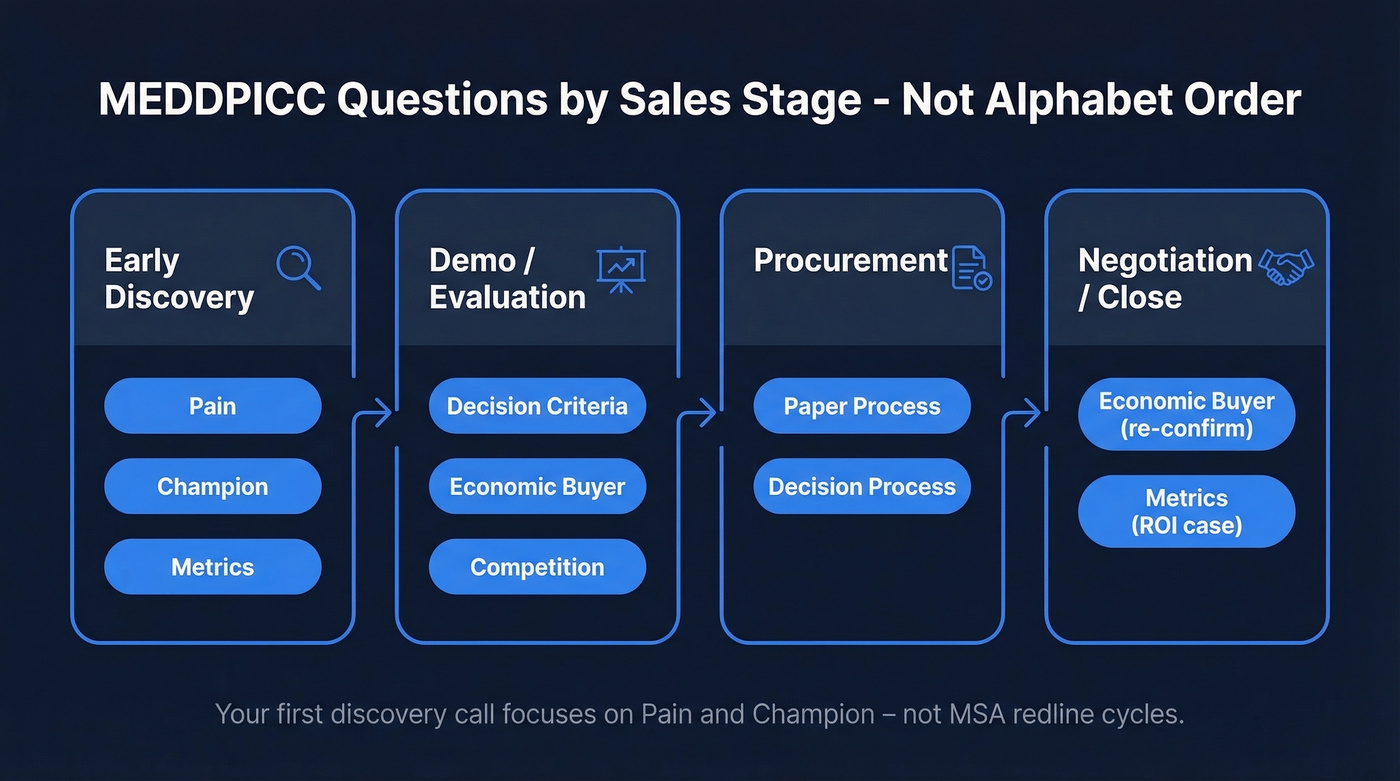
There's a real debate in sales communities about whether the framework makes you sound robotic. It doesn't, if you treat it as an internal diagnostic rather than a prospect-facing checklist. Your buyer should never know you're running it. Here's how to sequence by stage instead:
| Sales Stage | MEDDPICC Elements |
|---|---|
| Early Discovery | Pain, Champion, Metrics |
| Demo / Evaluation | Criteria, EB, Competition |
| Procurement | Paper Process, Decision Process |
| Negotiation / Close | EB (re-confirm), Metrics (ROI case) |
Your first discovery call focuses on Pain and Champion. You're not asking about MSA redline cycles in a 30-minute intro.

Your MEDDPICC discovery is only as good as your ability to reach the right people. When you identify the economic buyer but can't find their direct email, the framework breaks down. Prospeo gives you 98% accurate emails and 125M+ verified mobile numbers so you can actually connect with every stakeholder in your deal map.
Stop qualifying deals you can't even reach. Start with verified data.
60+ MEDDPICC Questions by Component
The subsections below are organized by acronym letter for quick reference, but use them in stage order during live deals. For each component: questions, timing, what a strong answer sounds like, and the red flags that should make you nervous.
Identify Pain
Every deal starts here. If you don't uncover real business pain on the first call, nothing else matters.
- What's not working today?
- How long has this been a problem?
- What have you tried so far to fix it?
- What happens if you don't solve this in the next 6 months?
- Who else in the org feels this pain?
- Can you quantify what this costs you - in dollars, time, or headcount?
- What triggered you to look at this now versus six months ago?
- Is this problem getting worse, or has it plateaued?
Strong answer: Quantified business impact. "We're burning 20 hours a week on manual data entry, and we lost two reps last quarter partly because of it."
Red flag: "It would be nice to have." Nice-to-have projects don't get funded. If the pain isn't urgent, the deal will stall.
Champion
One question separates real champions from false ones: "What happened the last time you bought something like this?"
This is one of the best champion-qualification tools in enterprise sales. If they've bought before, you'll learn who the EB was, what the process looked like, and whether your contact actually drove it. If they haven't, they may not know how to navigate an internal purchase - and that changes your entire strategy.
More champion questions to layer in throughout the deal:
- Would you be willing to present our business case to your leadership?
- If this project doesn't get funded, what happens to your initiative?
- Can you introduce me to the economic buyer this week?
- What objections do you expect internally, and how would you handle them?
- Who internally would try to block this, and why?
- Have you already socialized this with other stakeholders?
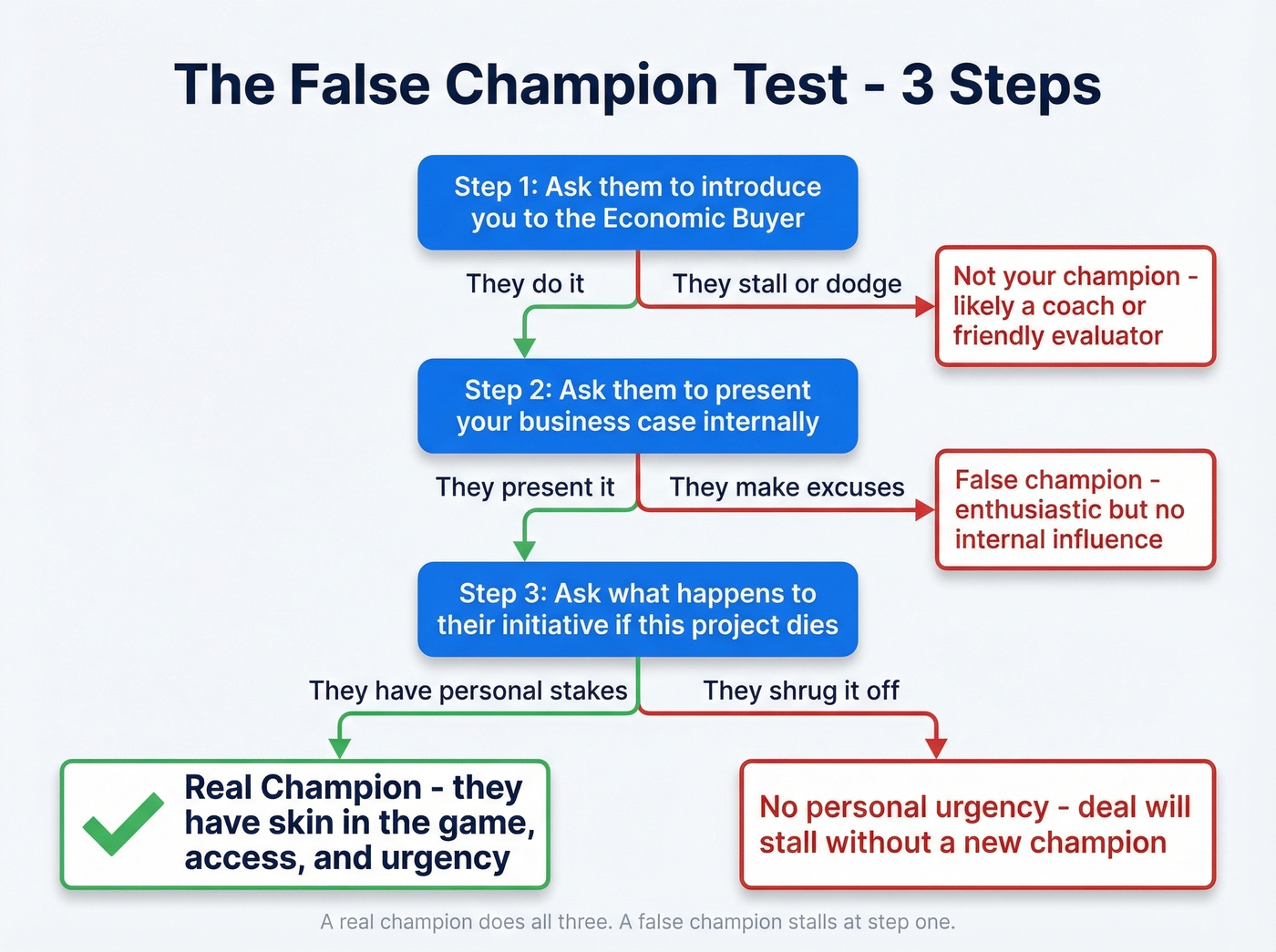
The false champion test is a three-step sequence: (1) Ask them to make an internal introduction to the EB. (2) Ask them to present your business case in an internal meeting. (3) Ask what happens if the project doesn't get funded. A real champion does all three. A false champion stalls at step one.
Here's the thing: if your champion can't or won't get you access to the economic buyer, they're not your champion. They might be a coach, an evaluator, or just someone who enjoys vendor meetings. We've seen reps burn entire quarters on "champions" who never once opened a door internally.
Real champion signals: shares internal org charts unprompted, introduces you to the EB without being asked twice, tells you when things are going sideways, has bought something similar before.
False champion signals: enthusiastic in meetings but never follows through on action items, can't articulate why this matters to leadership, agrees with everything you say. Real champions push back.
Metrics
Ask early in discovery and again during negotiation to build the ROI case.
Start by asking what KPIs the team reports on quarterly, then dig into how they're measuring the cost of the current problem. The question that matters most: "If this project succeeds, what does that mean for you personally?" Business metrics get people to nod. Personal impact - a promotion, a team expansion, looking good in front of the board - gets people to act.
- What would "success" look like 12 months after implementation?
- What's the dollar impact of doing nothing for another quarter?
- How does your leadership define ROI for projects like this?
- What metrics would you use to justify renewal in year two?
- Who owns the dashboard where these numbers live?
Strong answer: Specific numbers. "We're losing $40K/month in manual processing time" or "I need this win to justify the headcount request I made in Q1."
Red flag: Vague aspirations like "we want to improve efficiency." If they can't quantify the pain, the deal lacks urgency.
Economic Buyer
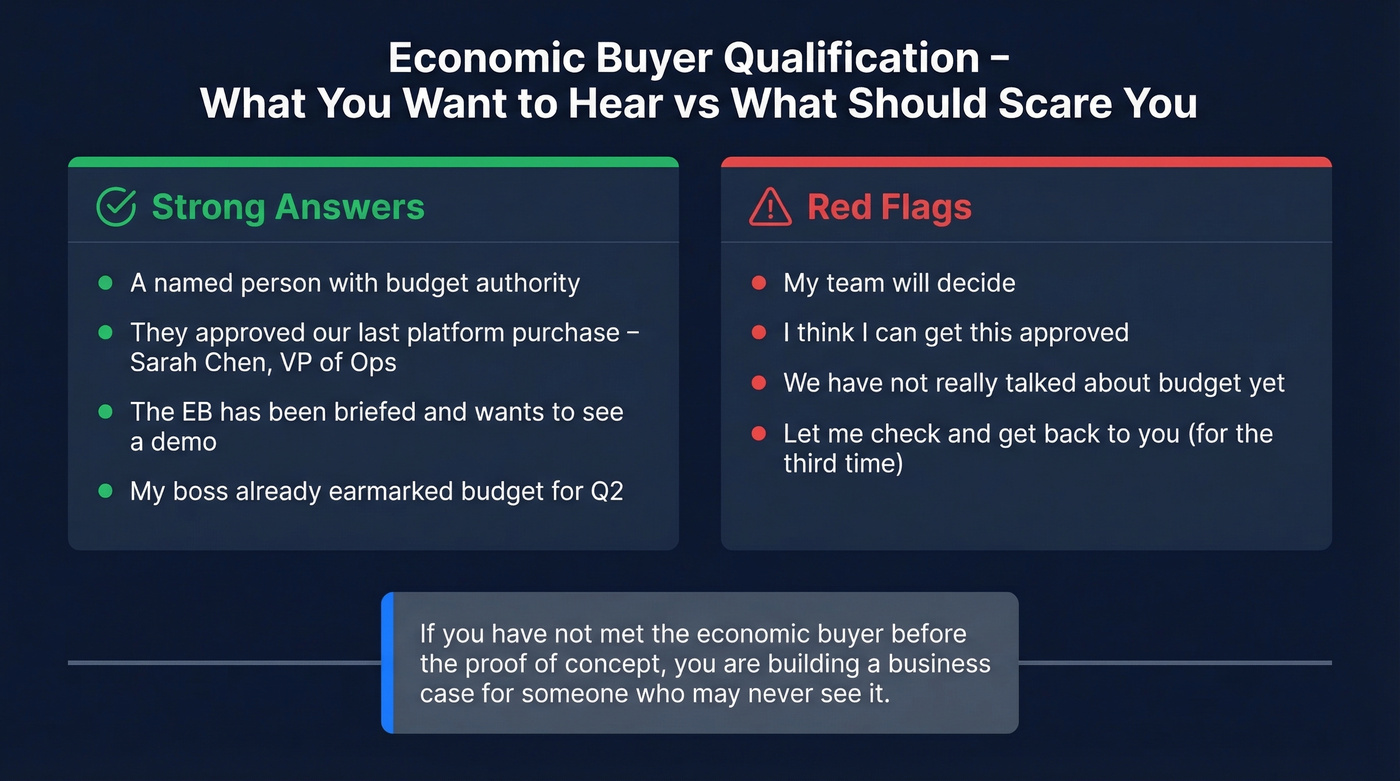
If you haven't met the economic buyer before the proof of concept, you're building a business case for someone who may never see it. This is one of the most predictable failure modes in enterprise deals, and reps repeat it constantly.
- Who signs off on budget for this initiative?
- Have they been briefed on this project yet?
- What's their biggest concern about a purchase like this?
- Have you worked with them on a purchase like this before?
- If we get to a proposal, who needs to see it before a signature?
- Can we include them in the next meeting, even for 15 minutes?
- What does the EB care about that's different from what your team cares about?
Some EBs deliberately avoid early vendor meetings. If you can't get a direct meeting, validate through your champion: confirm the EB's name, their budget authority, and what they care about. Then use a tool like Prospeo to find their verified email before asking your champion to make the intro - having a direct line to the EB changes the dynamic entirely.
Strong answer: A named person with budget authority. "That's our VP of Ops, Sarah Chen. She approved our last platform purchase."
Red flag: "My team will decide" or "I think I can get this approved." No named EB means no real deal.
Decision Criteria
Ask during or right after the first demo. And here's what most reps miss: the best sellers don't just discover criteria - they shape them. If you're early enough in the process, you can educate the buyer on evaluation criteria that favor your solution. That's not manipulation; it's consultative selling.
- What are your must-haves vs nice-to-haves?
- How are you weighting technical requirements against business outcomes?
- Is there a formal scorecard or evaluation matrix?
- Who defined these criteria - your team, procurement, or leadership?
- Are there political criteria we should know about, like an existing vendor relationship?
- What criteria would you add if you could start the evaluation over?
- Has your team evaluated a solution like this before? What did you learn?
Strong answer: A weighted list, ideally documented. "We need SOC 2 compliance, sub-200ms API response, and native Salesforce integration - in that order."
Red flag: "We haven't defined that yet." No criteria means no buying process. You're educating, not selling.
Decision Process
Ask after the demo, before the proposal.
- Walk me through what happens between "we like this" and a signed contract.
- How many stakeholders need to approve?
- What's your target go-live date, and what does the timeline look like working backward?
- Has a deal like this ever stalled internally? What caused it?
- Are there board or committee approval cycles we need to plan around?
- Is there a fiscal year deadline driving the timeline?
- Who has veto power that we haven't talked to yet?
Strong answer: A documented process with dates. "Legal review takes two weeks, then it goes to our procurement committee which meets the first Monday of each month."
Red flag: "I think it's just me and my boss." In enterprise deals, it's never just two people.
Paper Process
28% of deals fail when buyers can't secure internal approval. In regulated industries - healthcare, financial services, government - the paper process alone can add months. We've seen deals die in legal purgatory because the rep never asked about redline cycles until the contract was already submitted. By then it's too late to course-correct.
- Do you use a standard MSA, or will we need to work from ours?
- Is there a security questionnaire or vendor assessment we should start now?
- How long does legal review typically take for new vendors?
- Are there compliance requirements specific to your industry like SOC 2, HIPAA, or FedRAMP?
- How many redline cycles should we expect?
- Who in procurement will own this from your side?
- Has a deal ever been killed in legal review? What happened?
- Can we start the security questionnaire in parallel with the evaluation?
Strong answer: "Here's our standard process - we'll need a security questionnaire completed, then legal review runs about three weeks."
Red flag: "I've never dealt with procurement before." Your champion doesn't have buying experience, and you're about to discover hidden stakeholders the hard way.
Skip this section during early discovery calls. Paper Process questions belong in procurement stage, and asking them too early signals that you're more focused on closing than on solving the buyer's problem.
Competition
"You're the only one we're talking to." In enterprise deals, this is almost always a lie - or it means they're not serious enough to run a real evaluation. Start from that assumption and work backward.
- Who else are you evaluating for this?
- Is "do nothing" a realistic option for your team?
- Are there any internal projects that could solve part of this problem?
- What do you like about the other solutions you've seen?
- How does our approach differ from what you've seen so far?
- What would make you choose the other vendor over us?
- Is there an incumbent with an existing contract?
- What's the switching cost of staying with your current solution?
Strong answer: Honest competitive landscape. "We're also looking at [Vendor X] and considering building something in-house. Here's what we like about each."
Red flag: "We're not looking at anyone else." Probe deeper. They're either not telling you, or the evaluation isn't serious.
Common MEDDPICC Mistakes
Asking all eight letters in one call. Two to three elements per conversation is the ceiling. Beyond that, it's an interrogation.
Following the acronym in order. Pain first, Paper Process later. Always.
Treating CRM fields as a policing tool. If reps see MEDDPICC fields as "stuff my manager checks to yell at me," they'll fill in garbage data. Frame it as deal coaching, not compliance. In our experience, the teams that get this right are the ones where managers use MEDDPICC gaps to ask better coaching questions, not to punish reps for incomplete fields.
Never re-qualifying after discovery. Champions leave companies. Economic buyers change. Decision criteria shift after a reorg. Re-qualify every two weeks on active deals.
Memorizing a 137-question bank without context. Let's be honest - question banks backfire if reps pull questions from memory rather than reading the room. Use these as inspiration, not a script.
Making MEDDPICC Questions Work Long-Term
The framework falls apart when CRM data goes stale. It lives or dies in your CRM, and if reps aren't updating it, you're flying blind.
Create custom MEDDPICC fields in Salesforce or HubSpot - one per element, dropdown or short text, not free-form essay fields nobody reads. Run pipeline reviews against MEDDPICC gaps, not just stage and close date. Re-qualify active deals every two weeks, because champion status, EB access, and paper process timelines change most often. And tie completion to deal stage advancement so reps can't move to Stage 3 without a named EB.
Teams that fully adopt the framework report 18% higher win rates and 24% larger deal sizes. But "fully adopt" is doing a lot of work in that sentence. Most teams train on it once and then let it decay without reinforcement.
Here's a frustration we hear constantly from sales leaders: qualification is worthless if your follow-up emails bounce. You spent 45 minutes on a discovery call, identified the economic buyer, tested your champion - and then your email to the EB comes back undeliverable. Prospeo's 98% email accuracy and 7-day data refresh cycle fixes that. The free tier gives you 75 emails per month to start, no contracts required.
If you're tightening the system end-to-end, pair this with sales follow-up templates and a simple sales meeting follow-up email process so MEDDPICC insights actually turn into next steps.
False champions waste quarters. Real champions get you to the economic buyer. But first, you need verified contact data for every person in the buying committee. Prospeo's 300M+ profiles with 30+ filters - including job title, department, and seniority - let you map the entire decision process before your next call.
Map the full buying committee with verified contacts at $0.01 per email.
FAQ
Should I ask MEDDPICC questions in acronym order?
No. Start with Pain and Champion in discovery, layer in Economic Buyer and Criteria during evaluation, and save Paper Process for procurement. Sequencing by sales stage keeps conversations natural and prevents the interrogation feel that kills rapport.
How many elements should I cover per call?
Two to three per conversation. Covering all eight in one call sounds like an interrogation, and your prospect will disengage. Spread qualification across multiple touchpoints aligned to deal progression.
What's the difference between MEDDIC and MEDDPICC?
MEDDIC has six elements focused on mid-market qualification. MEDDPICC adds Paper Process and Competition - critical for enterprise deals with formal procurement cycles, legal reviews, and multi-vendor evaluations.
How do I avoid sounding scripted when qualifying?
Treat the framework as an internal diagnostic, not a prospect-facing checklist. The questions you ask in any given meeting should be driven by what you still need to learn about the deal, not by a predetermined sequence. Your buyer should feel like they're having a strategic conversation, not filling out a form.
What tools help operationalize MEDDPICC in 2026?
A CRM with custom fields per element for pipeline inspection is table stakes. Beyond that, a verified contact database like Prospeo ensures follow-ups actually reach the stakeholders you've identified - especially economic buyers who dodge early vendor meetings. And conversation intelligence tools like Gong or Chorus can automatically flag which MEDDPICC elements were covered in each call, so reps don't have to manually log everything.