

Mirroring in Sales: Real Scripts, Real Science, Real Results
You're on a discovery call. The prospect says, "We're not really looking to change providers right now." Most reps hear a dead end. But you repeat three words back: "Not looking to change?" Four seconds of silence. Then the prospect fills the gap: "Well, our contract's up in Q3, and honestly, we haven't been thrilled with the renewal terms."
That's mirroring in sales - and it just surfaced information a direct question never would.
Here's the thing: stop obsessing over body language mirroring. Most B2B selling happens on the phone, over video, or in writing. The Chris Voss verbal framework - repeat, silence, label - is the 80/20 of the technique. Master that first, and the rest falls into place.
What Is Sales Mirroring?
Mirroring is the deliberate act of reflecting a prospect's communication patterns back to them to build rapport and surface information. There are three distinct types, and confusing them is where most guides go wrong.
Behavioral mirroring is body language - matching posture, gestures, and physical energy. It's what most people picture, and it's the least useful type for modern B2B sellers who rely on remote channels.
Verbal mirroring is repeating one to three of the prospect's key words back as a question. This is the Chris Voss technique, and it's the highest-leverage form because it works on every channel - phone, video, even email.
Tonal mirroring is matching pace, volume, and vocal energy. A fast-talking prospect gets a fast-talking rep. A deliberate, measured speaker gets someone who doesn't rush. It's the bridge between the other two, and it works everywhere except asynchronous text.
The science behind mirroring is real but overhyped. Mirror neurons exist, but they don't explain rapport the way pop psychology suggests. Perspective-taking - cognitively understanding the other side's frame - is the actual mechanism. Galinsky and colleagues' three studies show it outperforms empathy in negotiation outcomes. We'll get into that research below.
Why It Works - The Real Science
Every article on this topic mentions "mirror neurons" and moves on. Here's what the research actually says, and what it doesn't.
The Chameleon Effect
In 1999, psychologists Tanya Chartrand and John Bargh ran a series of experiments that became the foundation for everything we now call mirroring. Participants had conversations with a researcher who either mimicked their mannerisms or didn't.
The results were specific. Face touching increased 20% and foot waggling increased 50% when participants were exposed to someone doing those behaviors - people unconsciously copied the other person without realizing it. More importantly for sales, participants rated the mimicking researcher as more likeable (6.62 vs 5.91 on a 9-point scale) and rated the interaction as smoother (6.76 vs 6.02). That's a meaningful gap from something the participants didn't even notice was happening.
The Negotiation Numbers
Here's the stat every guide cites without naming the source: 67% deal closure with mirroring vs 12% without. It comes from William Maddux and colleagues, published in the Journal of Experimental Social Psychology.
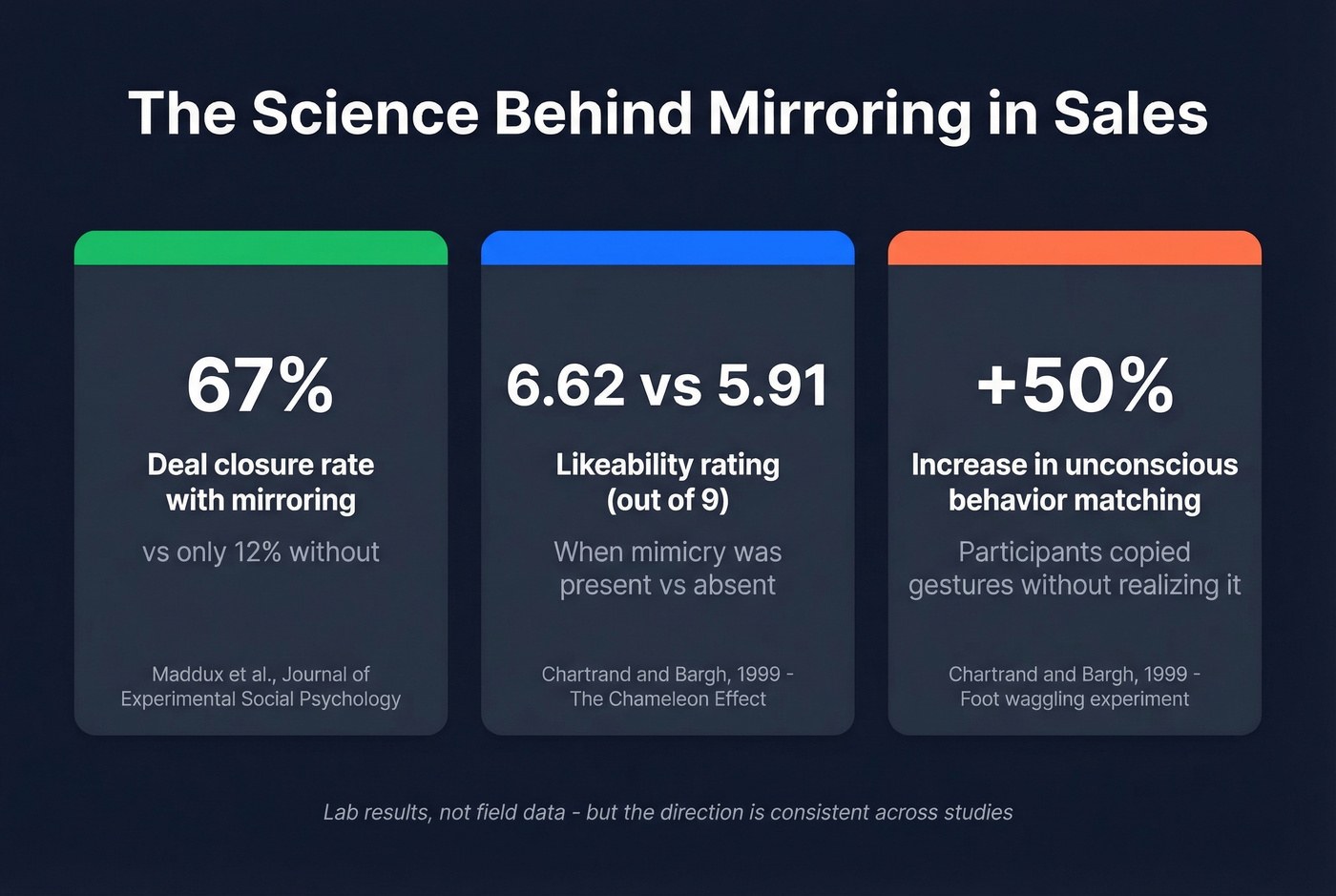
Those numbers come from a controlled lab negotiation, not a real sales floor. But the direction is clear and consistent across studies: mirroring increases agreement rates and improves outcomes for both parties. We've seen this play out anecdotally across our own team's outbound calls - prospects open up faster, and the conversations go deeper.
Mirror Neurons - Real and Overhyped
Mirror neurons were discovered in macaques in the early 1990s. By the mid-2000s, they'd been credited with explaining empathy, language acquisition, and basically everything that makes humans social. Publications with "mirror neuron" in the title peaked around 2013 at roughly 300 per year and fell to fewer than 150 by 2020. The core finding still holds - neurons with mirror properties exist. The grand unified theory of rapport doesn't.
The better framework comes from Galinsky and colleagues, who ran three studies showing that perspective-taking - cognitively understanding the other side's position - increased both deal discovery and resource claiming in negotiations. Empathy, by contrast, wasn't nearly as advantageous and was sometimes actively detrimental. Mirroring works not because of automatic neural magic, but because it forces you to pay attention to the other person's frame. That's a skill, not a trick.
The Chris Voss Verbal Framework
Chris Voss's Never Split the Difference turned FBI hostage negotiation techniques into a sales playbook. His framework is the most practical, field-tested approach available - and it's entirely verbal.
The 5-Step Process
Step 1: Set the tone. Voss calls it the "late-night FM DJ voice." Not monotone - just steady and unhurried. This signals safety and invites the other person to keep talking.
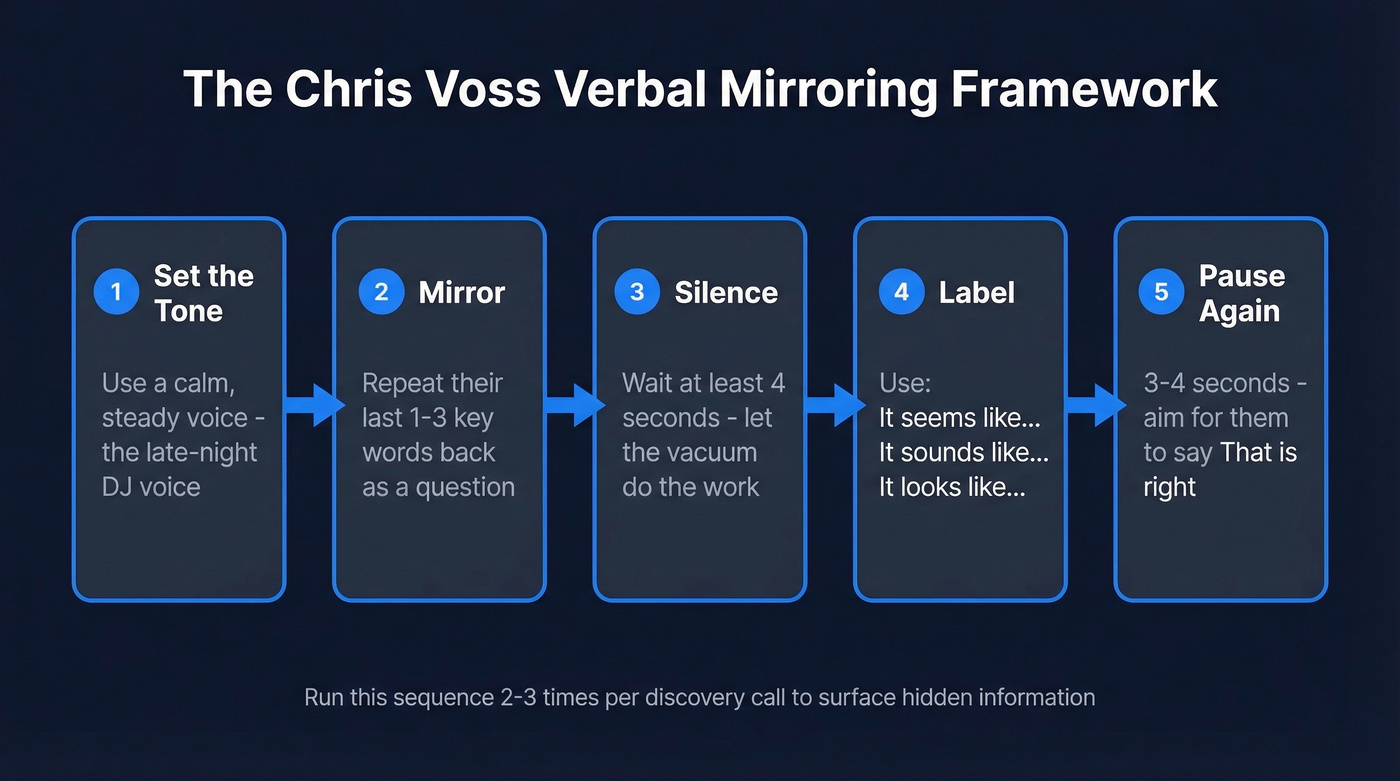
Step 2: Mirror. Repeat the last one to three critical words of what the prospect just said, inflected as a question. No paraphrasing, no adding your interpretation. Just their words, back to them.
Step 3: Silence. At least four seconds. This is where most reps fail - they can't handle the pause. But the silence is the mechanism. It creates a vacuum the prospect fills with information they weren't planning to share.
Step 4: Label. Use one of three stems: "It seems like..." / "It sounds like..." / "It looks like..." These labels show you're tracking their emotional state without claiming to understand it. Never say "I understand" - it triggers defensiveness.
Step 5: Pause again. Three to four seconds after labeling. Let the label land. You're aiming for the prospect to say "That's right" - not "You're right." "That's right" means they feel heard. "You're right" means they want you to stop talking.
The whole sequence takes under a minute. Run it two or three times in a discovery call and you'll surface information that direct questions never would.
Intentional Mislabeling
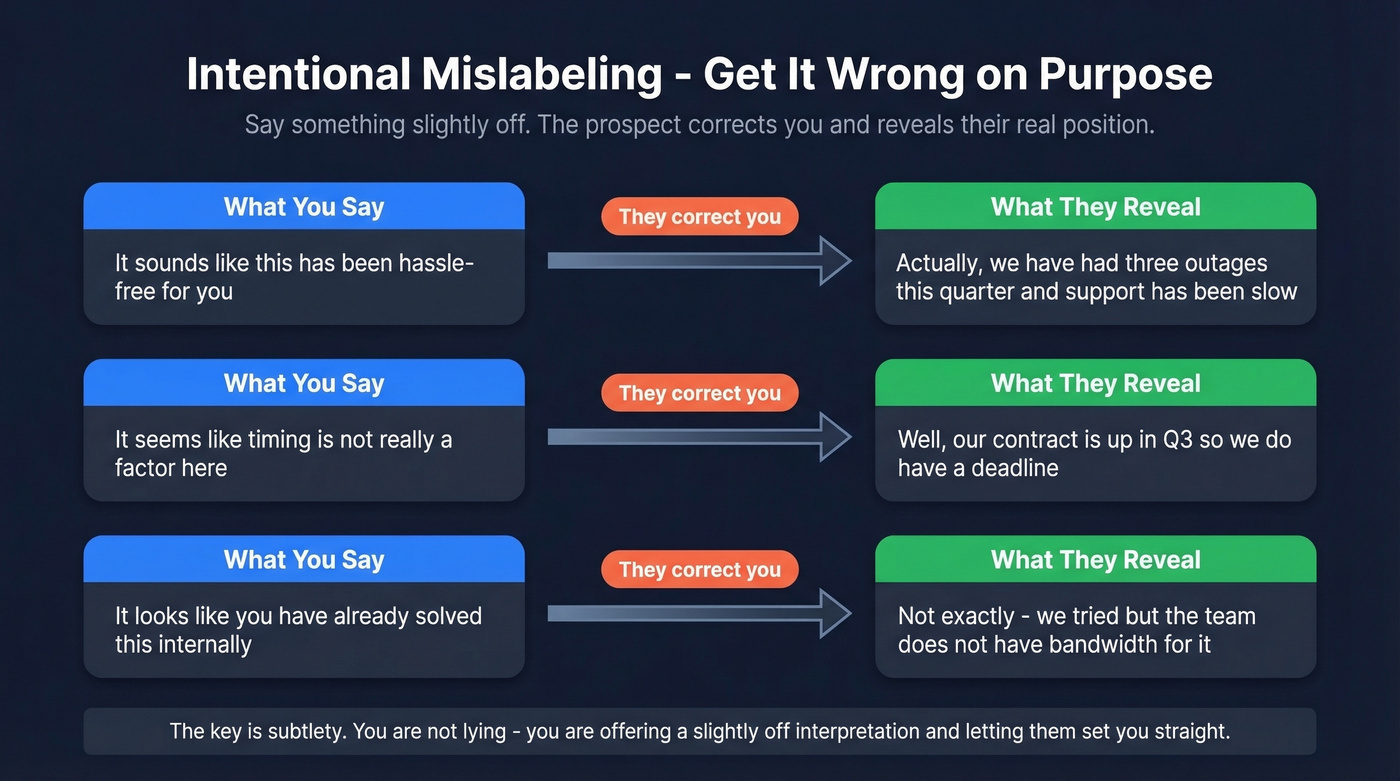
This is the technique experienced practitioners love. You deliberately get it slightly wrong to prompt the prospect to correct you - and in correcting you, they reveal their real position.
One practitioner on r/sales shared this example: "So you're not looking to sell, but if you had an offer that made sense, you would at least consider it." The prospect corrects the framing, and in doing so, reveals their conditional interest and the specific conditions that would move them.
Go-to mislabels that open conversations:
- "It sounds like this has been hassle-free for you" - use when you suspect it hasn't been.
- "It seems like timing isn't really a factor here" - use when you think it is.
- "It looks like you've already solved this internally" - use when you doubt they have.
The key is subtlety. You're not lying - you're offering a slightly off interpretation and letting the prospect set you straight. People love correcting others. Use that.
Techniques by Channel
Two-thirds of B2B buyers now prefer remote or digital interactions. And there's a brutal perception gap: 62% of reps say they listen well, but 83% of buyers who had negative experiences say the rep didn't listen at all. The technique changes depending on the channel, and getting it wrong is worse than not mirroring at all.
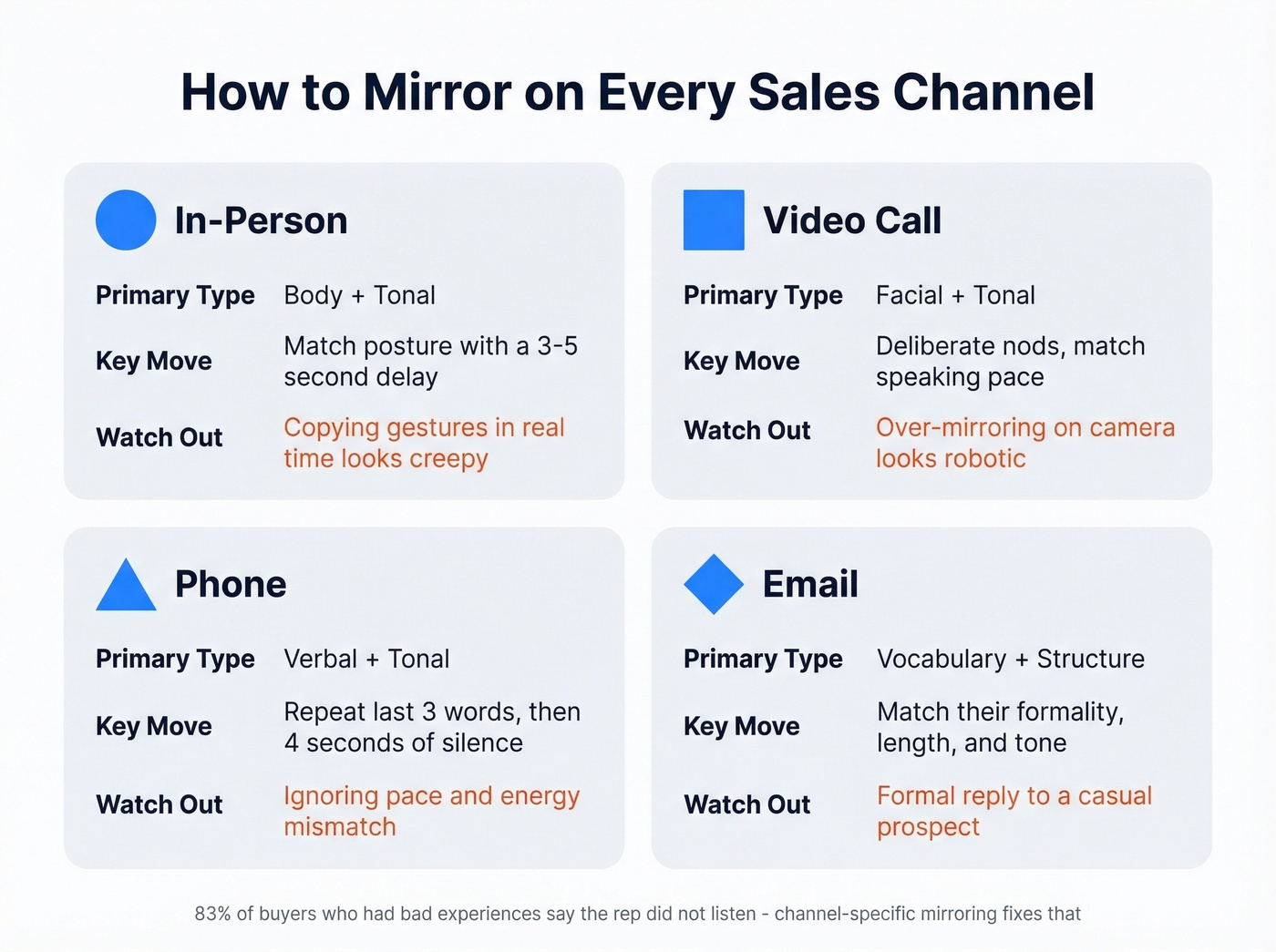
| Channel | Primary Type | Key Technique | Common Mistake |
|---|---|---|---|
| In-person | Body + tonal | Posture match, 3-5s delay | Copying gestures in real time |
| Video call | Facial + tonal | Deliberate nods, match pace | Over-mirroring (looks robotic) |
| Phone | Verbal + tonal | Repeat last 3 words + silence | Ignoring pace/energy mismatch |
| Vocabulary + structure | Match formality and length | Formal reply to casual prospect |
In-Person Body Language
Match posture, gestures, and energy level - but with a three-to-five second delay. If the prospect leans forward, wait a beat, then lean forward. Real-time copying looks bizarre. Delayed matching feels like chemistry.
Mirror their eye contact patterns too - some people hold steady eye contact; others look away while thinking. Match that rhythm instead of forcing your own. Body language is powerful precisely because it operates below conscious awareness, and when done with a natural delay, it builds trust without the prospect ever noticing.
Video Calls
Body language gets compressed to the shoulders-up frame. Mirror upper-body expressiveness and facial energy. Nodding is amplified on video - a small nod on camera reads as strong agreement. Use it deliberately when the prospect shares something important. Match their speaking pace, and keep your camera at eye level. Looking down at a laptop screen breaks the rapport dynamic entirely.
Phone Calls
Body language is invisible. Shift entirely to tonal and verbal techniques. Match pace, volume, and energy. If the prospect speaks quickly and gets to the point, don't slow-roll your responses. If they're deliberate and thoughtful, don't rush.
A practical hack from Hyperbound's phone sales guide: place a physical mirror on your desk during calls. Smiling changes your vocal tone, and the mirror keeps you honest about your own facial expressions and posture. Try it for seven days.
If you're building a repeatable outbound motion, pair this with a cold calling system so reps can practice consistently.
Email and Written Communication
Mirror the prospect's sentence length, formality level, and vocabulary. If they write short, punchy emails, don't reply with a five-paragraph essay. If they use industry jargon, match it. If they're casual - "hey, quick question" - don't respond with "Dear Mr. Johnson, I hope this email finds you well."
Prospect email: "Hey - saw your demo page. What's the pricing look like for a 10-person team?"
Bad reply: "Dear Sarah, Thank you for your interest in our platform. I'd be happy to schedule a call to discuss pricing options that align with your organization's needs."
Good reply: "Hey Sarah - for 10 seats you're looking at $X-Y/mo depending on the modules. Happy to send a breakdown or jump on a quick call. What works?"
Same length. Same tone. Same energy. If you need a fast starting point, borrow from these sales follow-up templates and then mirror the prospect’s style.

Mirroring only works when you're talking to the right person. Prospeo's 300M+ profiles with 30+ filters - including buyer intent and job changes - put you in front of decision-makers worth mirroring. 98% email accuracy means your outreach actually lands.
Stop perfecting your technique on the wrong prospects.
When Mirroring Fails
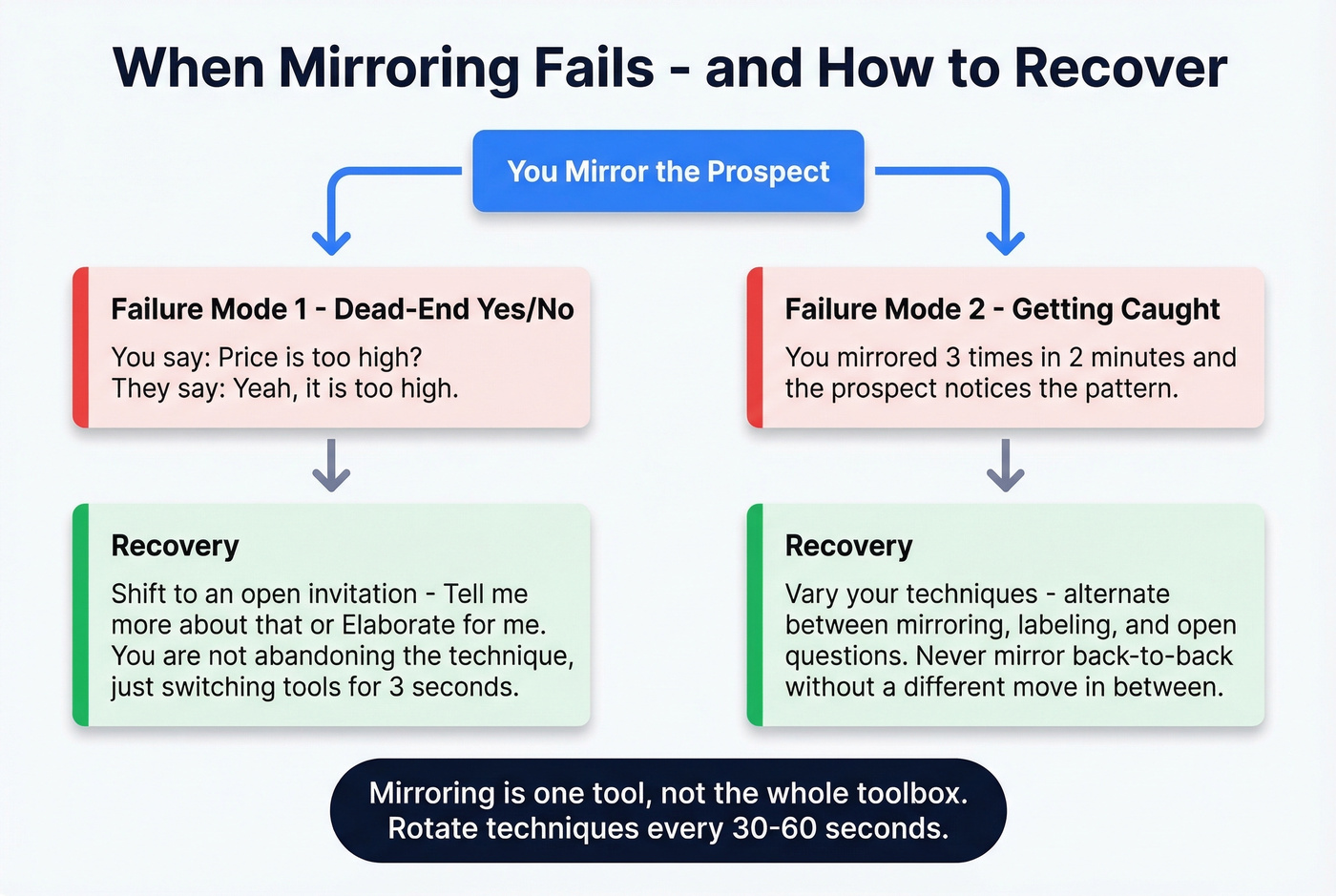
The technique isn't foolproof. Three failure modes kill more discovery calls than anything else.
The Dead-End Yes/No
This is the failure mode practitioners flag most often on r/sales. The prospect says "Price is too high." You mirror: "Price is too high?" They respond: "Yeah, it's too high." Dead end.
The recovery is straightforward: shift from mirroring to an open invitation. "Tell me more about that" or "Elaborate for me" breaks the yes/no loop. You're not abandoning the technique - you're recognizing that this particular mirror didn't create the opening, and you need a different tool for the next three seconds.
If this happens a lot, it’s usually a sign your discovery questions need a tighter structure.
Getting Caught
Sometimes the prospect notices. Maybe you've mirrored three times in two minutes, or your posture matching was too obvious. The dynamic shifts from rapport to suspicion.
Skip this if you're only using verbal mirroring once or twice per call. Getting caught is almost exclusively a body-language problem or an overuse problem. Verbal mirroring at low frequency sounds like active listening, not a technique.
If it does happen, pull back entirely. Switch to a direct question: "I want to make sure I'm understanding you correctly - what's the biggest concern right now?" The worst thing you can do is keep mirroring after someone's noticed.
Never Mirror Hostility
This is the one absolute rule. Never mirror hostile body language, aggressive tone, or negative emotional energy. If a prospect is angry, mirror their words to show you heard them, but not their energy.
Shift to labeling: "It sounds like this has been really frustrating." You're acknowledging the emotion without amplifying it. Matching an angry prospect's volume and intensity escalates a conversation into a confrontation. Mirror the content, not the heat.
Nonverbal Cues Across Cultures
Most mirroring advice assumes a neurotypical, Western-culture baseline. That's a problem when roughly 20% of the workforce is neurodivergent and your prospect pool spans multiple cultures and communication styles.
Eye-contact norms vary dramatically - what signals confidence in one culture is confrontational in another. Neurodivergent sellers or buyers may not make direct eye contact, may prefer plain-spoken questions over social pleasantries, and may skip small talk entirely. None of that means they're disengaged.
Let's also correct a persistent myth: the claim that "93% of communication is nonverbal" is a misreading of Albert Mehrabian's 1967 research, which studied how people interpret feelings and attitudes in specific, constrained conditions - not communication broadly. Citing it in a sales context makes you look like you haven't read the source. The real ratio depends entirely on context, channel, and the relationship between the people involved.
When you're unsure about a prospect's communication preferences, default to verbal mirroring and clarity. Repeat their words, ask direct questions, and don't over-index on body language cues that may not mean what you think they mean. Verbal mirroring works across cultures and neurotypes because it's about content, not performance.
How to Practice Effectively
Mirroring is a skill, not a personality trait. In our experience, most reps crack the verbal technique within two to three weeks of deliberate practice. Here's how to build it.
Daily conversation practice. Pick one low-stakes conversation per day - a colleague, a barista, a friend - and practice repeating their last two to three words as a question. Notice how it changes the conversation's direction. I started doing this at coffee shops and was genuinely surprised how much more people shared.
Call recording review. Listen to your last five sales calls. Identify moments where the prospect said something revealing and you responded with a statement instead of a mirror. Count the missed opportunities. Conversation intelligence tools like Gong or Sybill can speed this up by flagging talk-time ratios and mirrored behaviors.
Role-play the Voss 5-step. Grab a colleague. One person plays a difficult prospect ("We're happy with our current vendor"), the other runs the full sequence: mirror, silence, label, pause. Switch roles. Do this weekly until the silence stops feeling uncomfortable.
The desk mirror exercise. For phone-heavy sellers: place a physical mirror where you can see your face during calls. Monitor your expressions, posture, and energy for seven days straight. It sounds odd, but it works - becoming aware of your own nonverbal signals is the first step to controlling them.
Email audit. Pull up your last ten prospect emails alongside your replies. Check for formality mismatches, length mismatches, and tone mismatches. Adjust your next batch accordingly.
Start with one technique - verbal mirroring on calls - and add channels as it becomes natural. This pairs well with broader sales prospecting techniques so you’re not relying on rapport alone.
Our honest take: if your deal sizes are under $15k, verbal mirroring alone will get you 90% of the benefit. Body language matters most in high-stakes, in-person enterprise deals where the relationship is the product. For everyone else, the Voss 5-step on a phone call is the whole game.
Reach the Right Person First
You've spent 15 minutes building perfect rapport - matching energy, mirroring language, asking great questions. Then the follow-up email bounces. Or the direct dial's been disconnected for months. All that skill, wasted on bad data.
Mirroring is a high-effort skill. Make sure you're reaching the right person before you invest that effort. Prospeo fixes the data problem before you pick up the phone: 98% email accuracy, 125M+ verified mobile numbers with a 30% pickup rate, and a 7-day data refresh cycle versus the six-week industry average. The free tier gives you 75 verified emails per month plus 100 Chrome extension credits, no contract required.
If you’re cleaning up lists before outreach, use a proper data enrichment workflow so you’re not mirroring the wrong contacts.
You just learned how to surface hidden objections on calls. Now imagine doing it with verified direct dials that actually get picked up - 125M+ mobile numbers with a 30% pickup rate. At $0.01 per email, your mirroring skills finally get the volume they deserve.
Get real phone numbers so your mirroring reaches real buyers.
FAQ
Is mirroring manipulative?
No - the chameleon effect research shows people mirror unconsciously in every social interaction. It becomes manipulative only when used to deceive. Perspective-taking, not emotional manipulation, is the mechanism. If your intent is to understand the prospect's frame, it's ethical rapport-building.
Does it work over the phone?
Yes - shift from body language to verbal and tonal techniques. Match pace, volume, and energy. Use the Voss method: repeat the last one to three words as a question, then hold silence for four seconds. Phone selling strips away visual cues, so your voice and word choice carry all the weight.
What's the difference between mirroring and parroting?
Mirroring repeats one to three key words to invite elaboration. Parroting repeats entire sentences verbatim, which feels robotic and breaks rapport. The goal is to signal "I heard you" and create space for the prospect to expand - not to echo everything back at them.
How long does it take to get good?
Most reps see improvement within two to three weeks of deliberate practice. Start with verbal mirroring on calls and add channels as it becomes natural. The Voss 5-step is the fastest path because it gives you a repeatable structure - mirror, silence, label, pause.
Does technique matter if my contact data is wrong?
No rapport-building skill helps if you're calling a disconnected number or emailing a bounced address. Verify your data first - 98% email accuracy and a 7-day refresh cycle mean your effort reaches a real decision-maker, not a dead end.