

Missed Sales Forecast? Here's What to Do Next
You just walked out of the QBR. The number on the slide was 78% of target, and the room got quiet in that specific way where everyone's calculating whose fault it is. The CFO wants answers. Your VP is already rewriting the narrative. And somewhere, a hiring plan is about to get frozen.
A missed sales forecast isn't a "your team" problem - it's a systemic one. 4 in 5 sales and finance leaders missed a quarterly forecast in the past year, and over half missed two or more times.
How Common Are Forecast Misses?
RepVue's Cloud Sales Index tracks quota attainment across 272 companies and 57,000+ ratings from quota-carrying reps. Q4 2025 came in at 43.83%, down from 53% in Q1 2022. That kind of multi-year softness in seller outcomes feeds directly into forecasts that were already shaky.
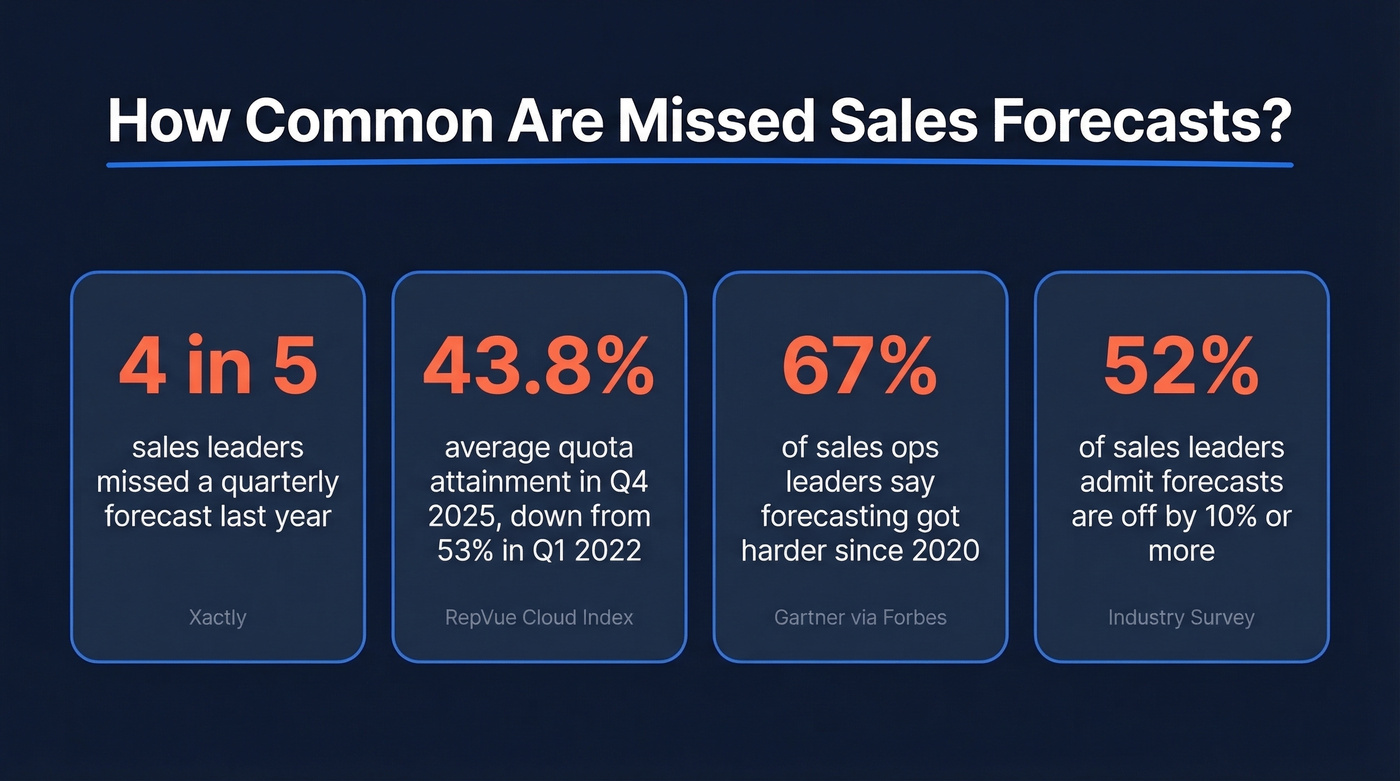
Meanwhile, 67% of sales ops leaders said forecasting was harder in 2023 than in 2020, per Gartner research cited by Forbes. And 52% of sales leaders admit their forecasts are off by 10% or more.
5 Root Causes Behind the Miss
1. Silent deal deaths
Deals quietly die while your CRM still shows green. Emails slow. Meetings get postponed. Decision-makers go silent. But nobody updates the stage.
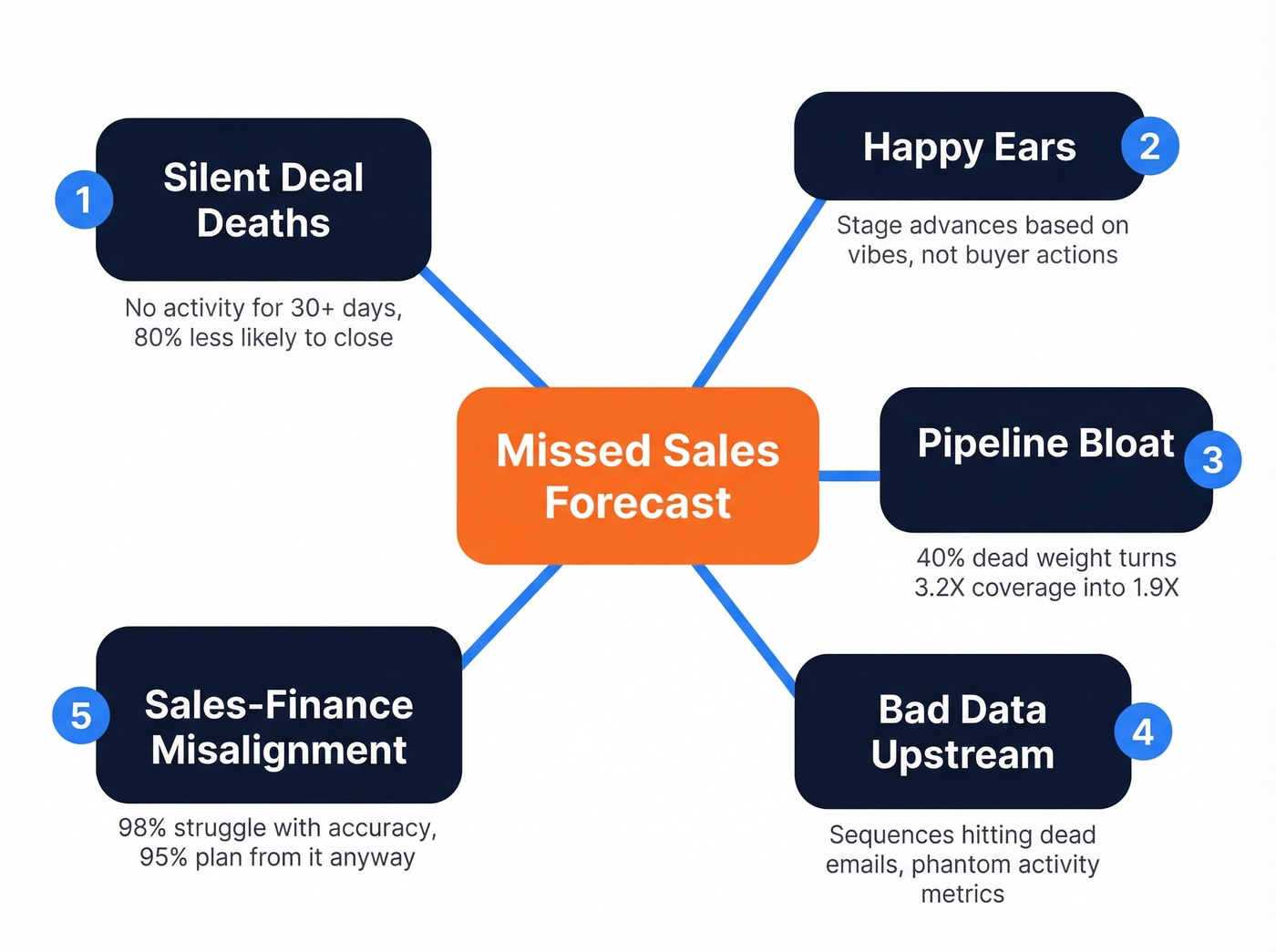
Deals with no activity for 30+ days are 80% less likely to close. Buying committees have grown larger and more risk-averse, making deals stall in ways your CRM can't detect. If your forecast is built on "committed" deals that haven't had a meeting in six weeks, you don't have a forecast - you have a wish list.
2. Happy ears
Reps move deals forward based on vibes, not verifiable buyer actions. "They loved the demo" becomes Stage 3. Without customer-behavior-based criteria - a signed mutual action plan, a technical evaluation kicked off, a procurement contact introduced - you're forecasting on feelings. We've seen this pattern wreck otherwise solid quarters more times than we can count.
3. Pipeline bloat
Everyone loves the 3X coverage rule. But if 40% of your pipeline is dead weight - deals parked in Stage 2 for 90 days, contacts who left the company - then your 3.2X coverage is really 1.9X. Pipeline hygiene isn't glamorous, but it's the difference between a forecast and a fiction.
4. Bad data upstream
Here's the thing: if your reps are running sequences against dead emails, they're generating activity metrics that look healthy while building zero real pipeline. The CRM shows outreach happening. What it doesn't show is how much of that outreach never reached a real buyer.
A proper data audit often makes the pipeline look smaller at first - and that's a good thing, because now the forecast reflects reality. When your contact data is verified and current, the distance between "CRM pipeline" and "real pipeline" shrinks dramatically. Tools like Prospeo, with a 7-day refresh cycle and 98% email accuracy, exist specifically to close that gap.
5. Sales-finance misalignment
98% of leaders admit they struggle to formulate accurate forecasts - yet 95% say they're confident planning from them. Read that again. When 60% of leaders aren't even sure where pipeline data is coming from, the forecast output is guaranteed to be wrong.
How to Measure Forecast Accuracy
A thread on r/SalesOperations put it bluntly: teams obsess over the forecast number but rarely measure how wrong they were last quarter. Most sales orgs forecast every week but never calculate their error rate. That's wild.
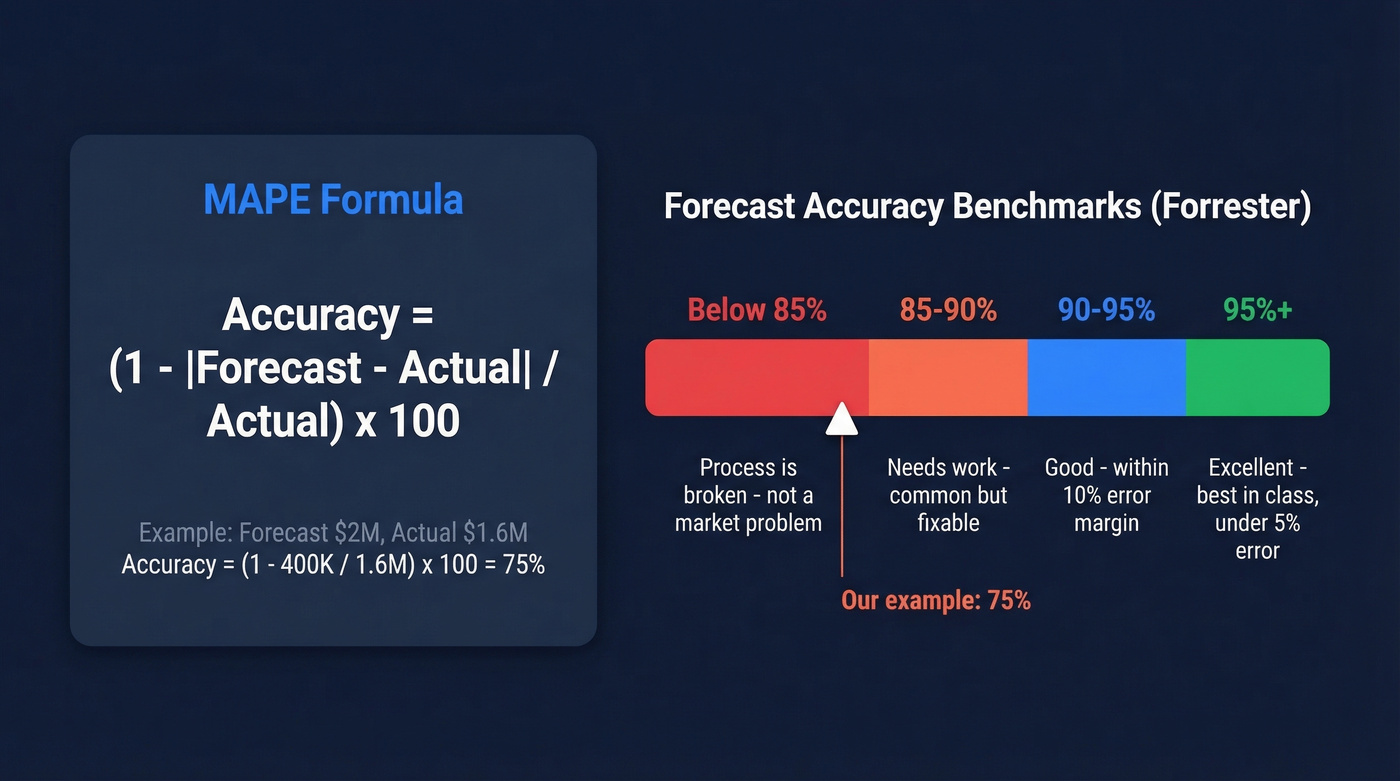
Accuracy (%) = (1 - |Forecast - Actual| / Actual) x 100
Industry benchmarks from Forrester: a 5% margin is excellent, 10% is good, and anything beyond 15% means your process needs serious work. Best-in-class organizations hit 90-95% consistently.
If you're not running this calculation after every quarter, you're guessing about whether you're getting better or worse.

Dead emails create phantom pipeline - reps show activity, but nothing reaches real buyers. That gap between CRM pipeline and real pipeline is where forecasts die. Prospeo's 98% email accuracy and 7-day data refresh cycle ensure every contact in your pipeline is verified, current, and reachable.
Stop forecasting on contacts that don't exist anymore.
The Monday Morning Post-Mortem
Run this the Monday after every quarter close.
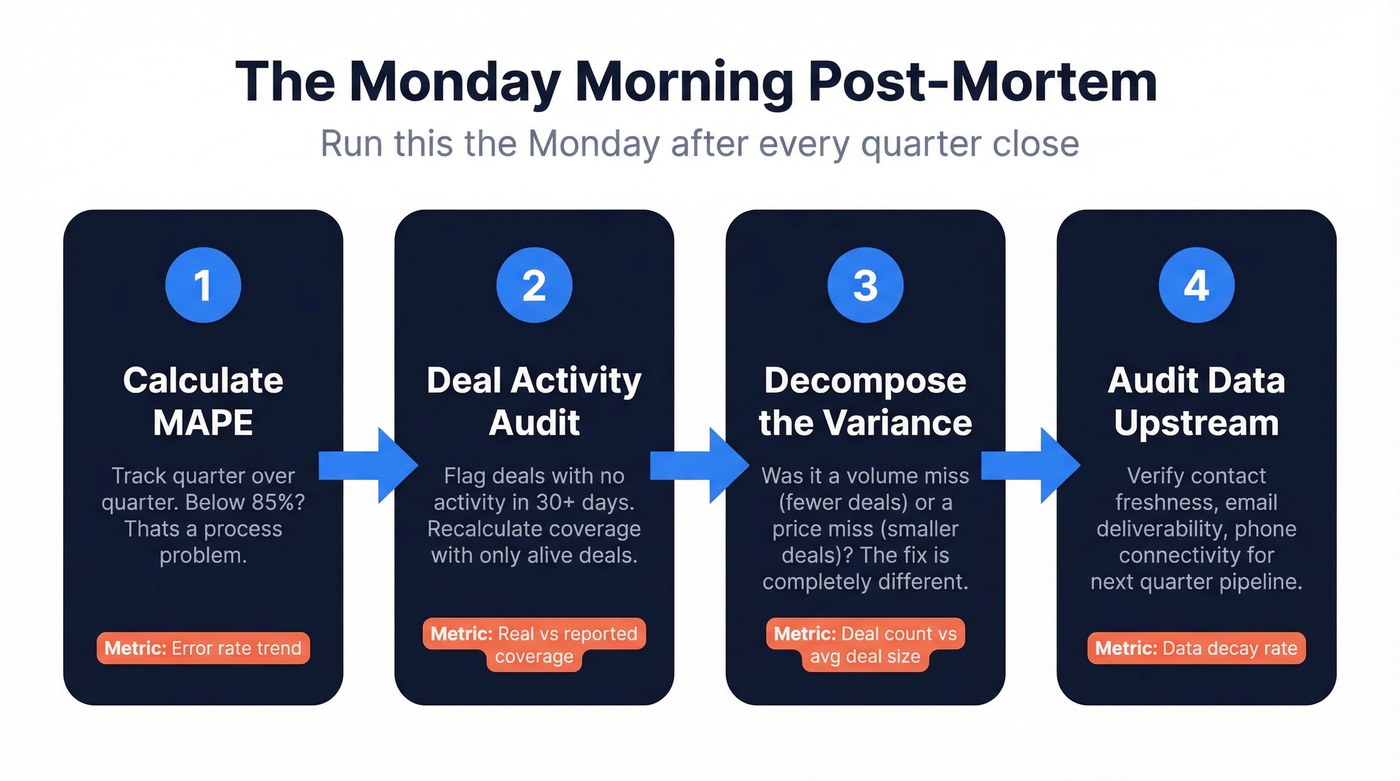
Step 1: Calculate your MAPE. Track it quarter over quarter. Teams that track it consistently get better faster because they can see whether process changes actually worked. Below 85%? That's a process problem, not a market problem.
Step 2: Run a deal activity audit. Pull every deal in your forecast and flag the ones with no activity in 30+ days. Recalculate pipeline coverage with only the "alive" deals. In our experience, real coverage is almost always lower than what the CRM says - sometimes dramatically so.
Step 3: Decompose the variance. Was the miss a volume problem or a price problem? If you forecast $2M and closed $1.6M, figure out whether you closed 80 deals at $20K instead of 100 (volume miss) or 100 deals at $16K instead of $20K (price miss). A volume miss means pipeline generation is broken. A price miss means reps are discounting too aggressively or your ICP is drifting downmarket. ORM Technologies' variance framework breaks this down cleanly.
Step 4: Audit your data upstream. Verify contact data freshness, email deliverability, and phone connectivity for every account in next quarter's pipeline. Poor data quality costs companies 15-25% of revenue annually. That's not a data ops problem - that's a revenue problem wearing a data ops disguise.
Preventing the Next Forecast Miss
Stop relying on rep judgment for stage advancement. Define stages by customer behavior: a discovery call completed, a technical evaluation scheduled, a business case presented to the economic buyer. If the buyer didn't do something, the deal doesn't move.
Run your forecast weekly, not monthly. 41% of leaders already prefer weekly cadence - monthly reviews let bad data compound for 30 days before anyone catches them. Get sales and finance in the same room every week, not every quarter.
Organizations that adopted this rhythm after repeated misses saw accuracy improve by double digits within two quarters. Let's be honest: data quality isn't a one-time cleanup. Treat it as a leading indicator, not a quarterly fire drill.
You just calculated your MAPE. If the miss was a volume problem, your pipeline generation is broken upstream - and bad contact data is the most common culprit. Prospeo gives you 300M+ verified profiles with 30+ filters to build pipeline that actually converts, at $0.01 per email.
Rebuild pipeline coverage with contacts that are actually alive.
Tools That Help
Hot take: most teams don't need a $250/user/month forecasting platform. They need clean data and a disciplined weekly review. If the data feeding the process is bad, you're optimizing garbage.
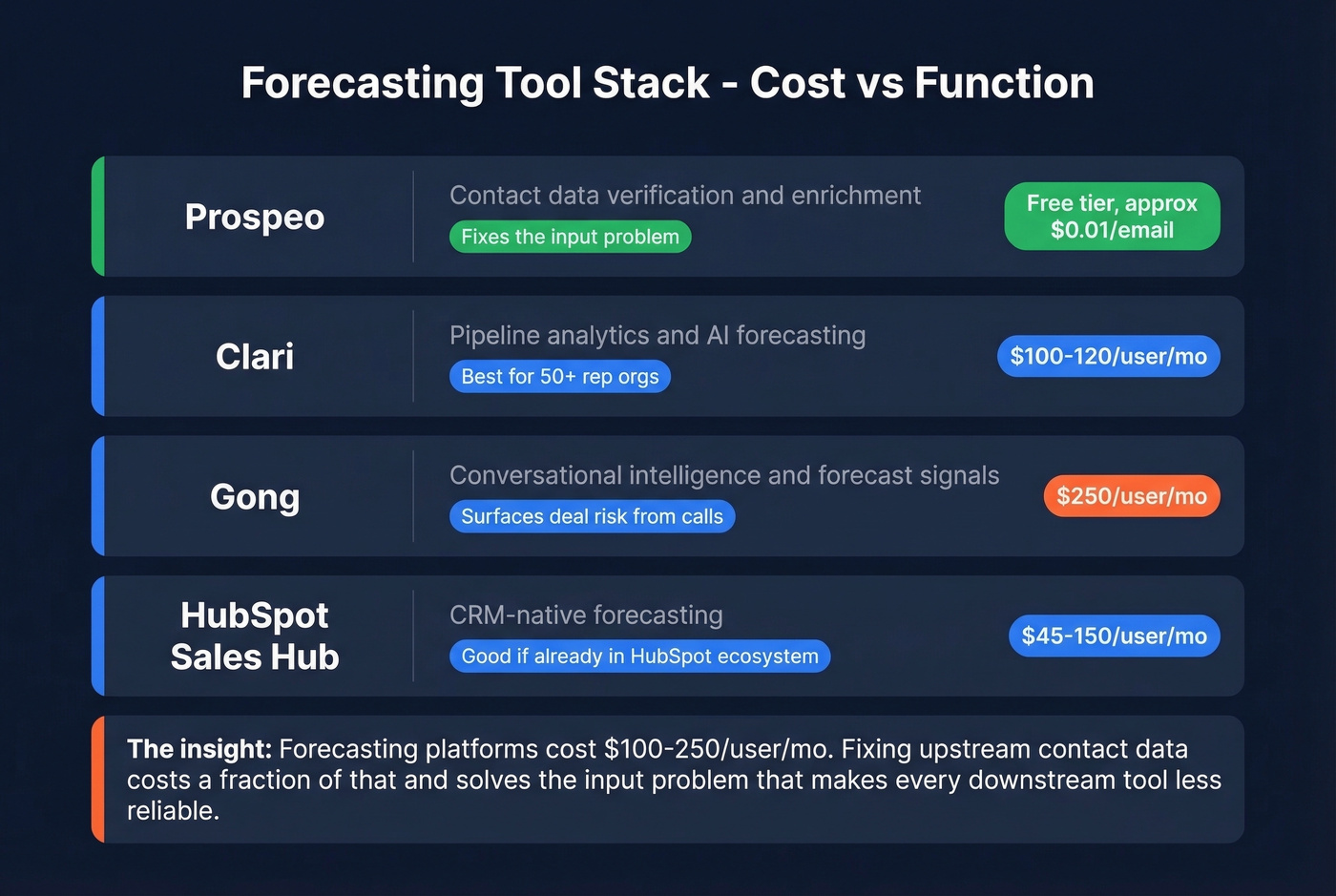
| Tool | Function | Approx. Price |
|---|---|---|
| Prospeo | Contact data verification + enrichment | Free tier; ~$0.01/email |
| Clari | Pipeline analytics + AI forecasting | ~$100-120/user/mo |
| Gong | Conversational intelligence + forecast | ~$250/user/mo |
| HubSpot Sales Hub | CRM-native forecasting | $45-150/user/mo |
Clari and Gong are excellent at surfacing deal risk - if you're running a 50+ person sales org and can justify the spend, they're worth evaluating. HubSpot works well if you're already in their ecosystem. Skip the enterprise forecasting platforms if you're under 20 reps; the ROI math rarely works out.
But notice the price gap. Forecasting platforms run $100-250/user/month. Fixing your upstream contact data costs a fraction of that, and it solves the input problem that makes every downstream tool less reliable. If you do want to compare options, start with a shortlist of sales forecasting solutions and work backward from your inputs.
Stop blaming your reps. Start auditing your data. A missed sales forecast is almost never about effort - it's about the quality of information flowing into the model. Fix the inputs, and the outputs take care of themselves.
FAQ
What's a good forecast accuracy benchmark?
Best-in-class sales organizations maintain 90-95% forecast accuracy, meaning their MAPE stays within a 5-10% error margin. Anything above 15% error signals a broken process, not just a tough quarter. Track MAPE every quarter to spot whether changes are actually improving results.
How do I tell if my miss was a volume or price problem?
Compare the number of deals closed against the average deal size. If you hit your deal count but revenue fell short, reps are discounting or your ICP shifted downmarket - that's a price miss. If deal sizes held but fewer closed, pipeline generation or conversion rates broke down, which is a volume miss. The fix for each is completely different.
Can bad contact data cause a forecast miss?
Absolutely. Poor data quality costs companies 15-25% of revenue annually. Reps sequencing dead emails generate healthy-looking activity metrics while building zero real pipeline. Verified, regularly refreshed contact data eliminates stale contacts before they inflate your forecast.
How often should we review our forecast?
Weekly. Monthly reviews let bad data and stalled deals compound for 30 days before anyone catches them. 41% of sales leaders already prefer weekly cadence, and teams that switch typically see double-digit accuracy improvements within two quarters.