

Monthly Cadence Meaning: What It Is and Why It Matters
Your new VP just dropped "we need a monthly cadence for pipeline reviews" in a Slack message, and you're not entirely sure what that means beyond "let's meet once a month." You're not alone. People use "cadence" differently across teams, so it sounds like jargon until you pin down the pattern it's actually describing. The word is borrowed from poetry, speech, and music - and it carries more weight than most people realize.
So what's the monthly cadence meaning in a business context? It's a recurring activity - meetings, billing cycles, reports, or outreach - scheduled on a once-per-month rhythm. It implies a deliberate, designed pattern rather than ad hoc scheduling: same time, same structure, same participants, repeated every month to create predictability and accountability.
The definition shifts depending on which department is using it. Let's break that down.
What It Means Across Business Contexts
"Cadence" does real work when it describes a deliberate rhythm across multiple activities, not just a single recurring calendar invite.
Meetings
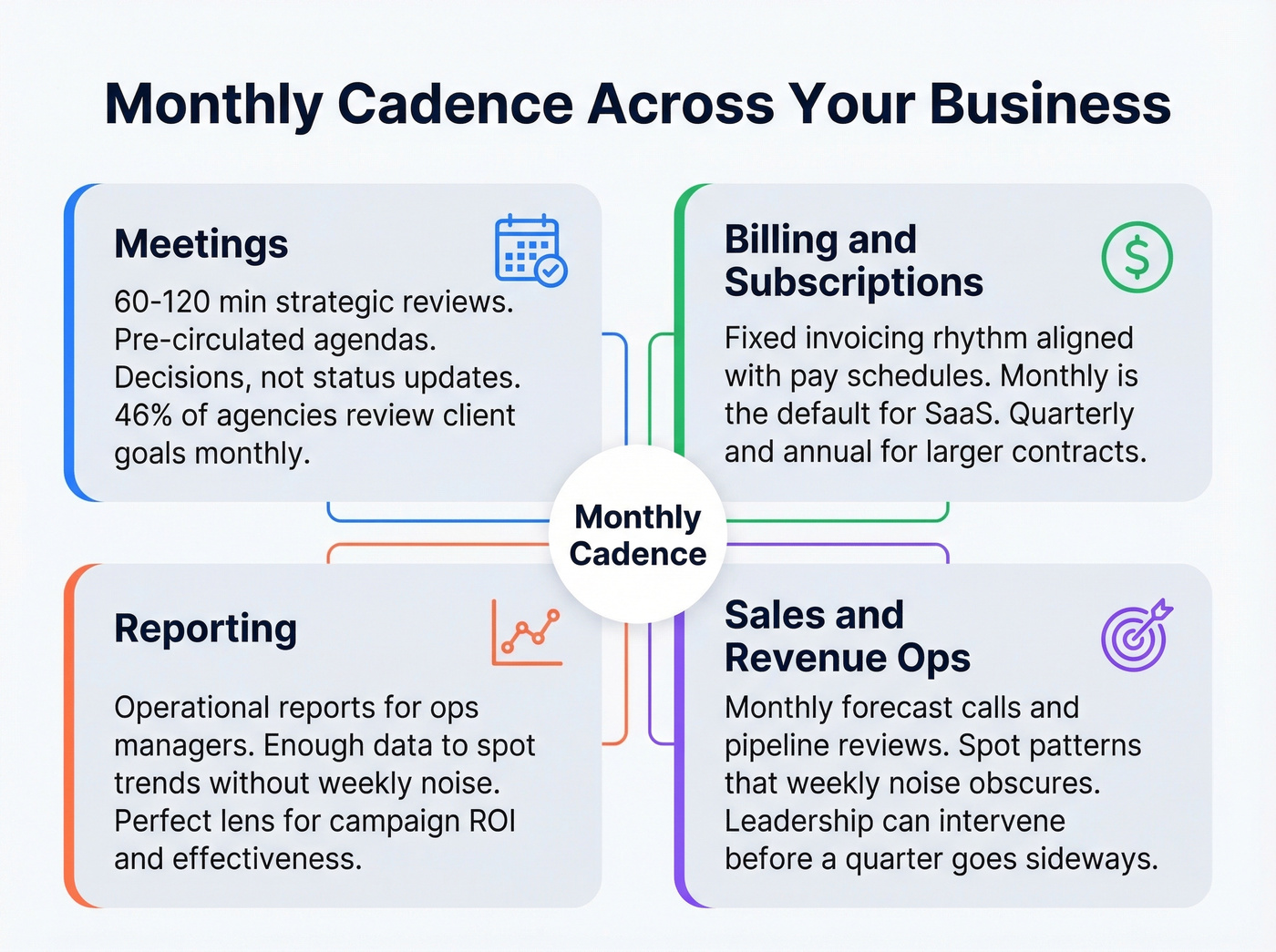
Monthly meetings are the strategic middle ground - too infrequent for tactical execution, but frequent enough to course-correct before a full quarter slips by. Leadership teams use them for performance reviews, strategic initiatives, and growth planning. About 46% of agencies review client goals monthly, which makes sense: it's enough time to see results from last month's decisions without micromanaging weekly fluctuations. These meetings typically run 60-120 minutes, and the best ones have a pre-circulated agenda that keeps the room focused on decisions rather than status updates nobody needed to hear live.
Billing & Subscriptions
In SaaS and finance, a monthly cadence refers to the invoicing rhythm - the fixed schedule and frequency at which a business invoices its customers. Monthly billing is popular because it aligns with most people's pay schedules. Quarterly reduces payment events for larger contracts while staying predictable. Annual minimizes overhead with a "commit and save" discount.
Reporting
Not every stakeholder needs the same frequency. A useful framework maps it out: executives get quarterly high-level KPIs, ops managers get monthly operational reports (ticket trends, project milestones), and department leads get weekly tactical updates. Monthly reporting gives you enough data to identify trends without the noise of weekly fluctuations - exactly the right lens for campaign effectiveness and ROI analysis.
Sales & Revenue Operations
This is where "monthly cadence" gets the most airtime.
Monthly forecast calls are standard in most revenue orgs - the checkpoint where pipeline numbers get real scrutiny. A clean framework comes from a three-layer model: weekly cadence focuses on execution (deal progress, next actions), monthly cadence focuses on trends (conversion rates, deal size, cross-functional alignment), and quarterly cadence focuses on direction (strategic resets). Monthly is where you spot the patterns that weekly noise obscures, and where leadership can actually intervene before a quarter goes sideways.
Monthly vs. Weekly vs. Quarterly
Monthly isn't always the right answer. The right cadence depends on what you're trying to accomplish.
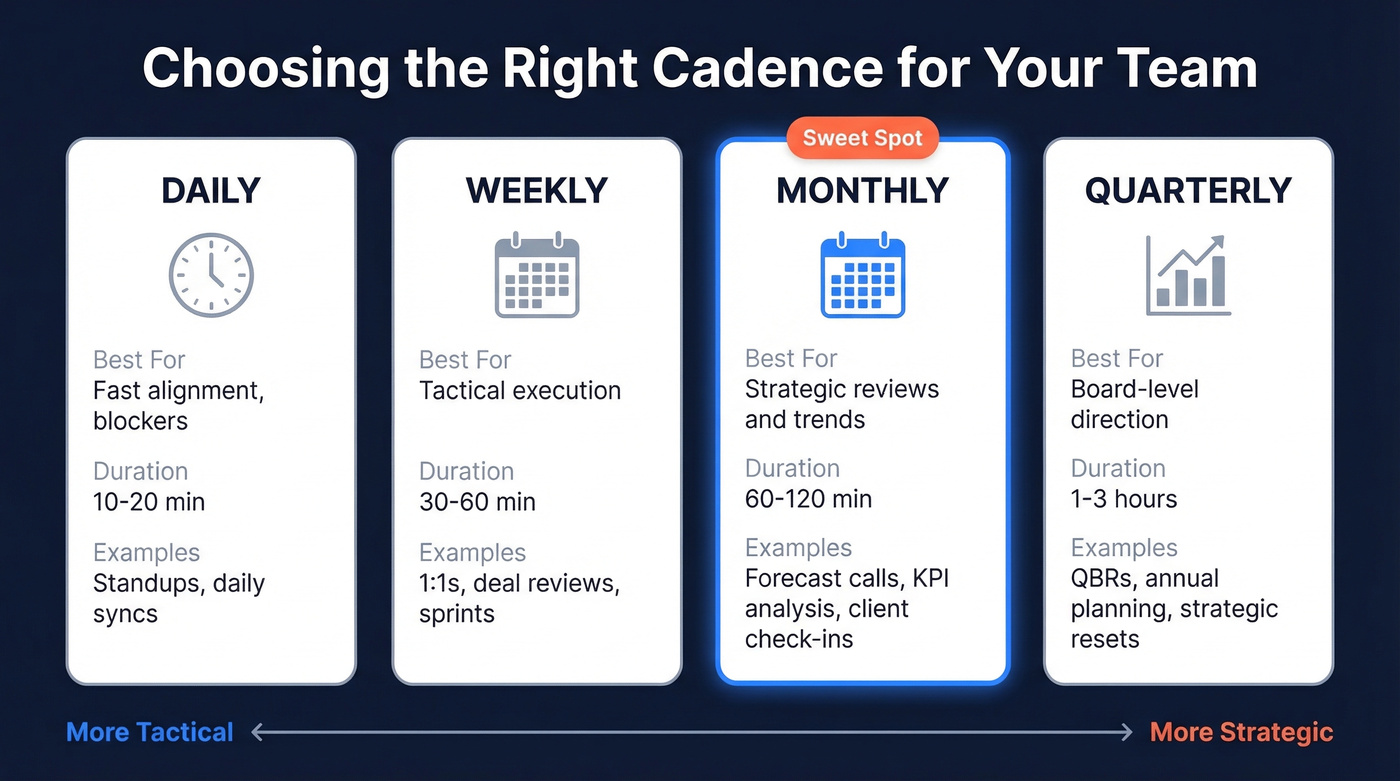
| Frequency | Best For | Typical Duration | Example Activities |
|---|---|---|---|
| Daily | Fast alignment | 10-20 min | Standups, blockers |
| Weekly | Tactical execution | 30-60 min | 1:1s, deal reviews, sprint planning |
| Monthly | Strategic reviews, trends | 60-120 min | Forecast calls, client check-ins, KPI analysis |
| Quarterly | Board-level direction | 1-3 hours | QBRs, annual planning, strategic resets |
Before you default to weekly, ask three questions. Has anything meaningfully changed since last week? Could this update be async? Do you need real-time discussion or just a status read-out? If you answered "no, yes, status" - switch to monthly. You'll reclaim hours and the monthly meeting will actually have substance.
Here's the thing: monthly is the Goldilocks cadence for most strategic activities. Weekly is too granular for strategy, quarterly is too slow for course correction. If you're unsure, start monthly and adjust from there - not the other way around.

A monthly sales cadence falls apart when your contact data is stale. Prospeo's 7-day refresh cycle means every monthly pull starts with current, verified emails - not month-old records that bounce and wreck your sender reputation. 98% accuracy, $0.01 per email.
Stop letting stale data sabotage your monthly outreach rhythm.
Common Mistakes to Avoid
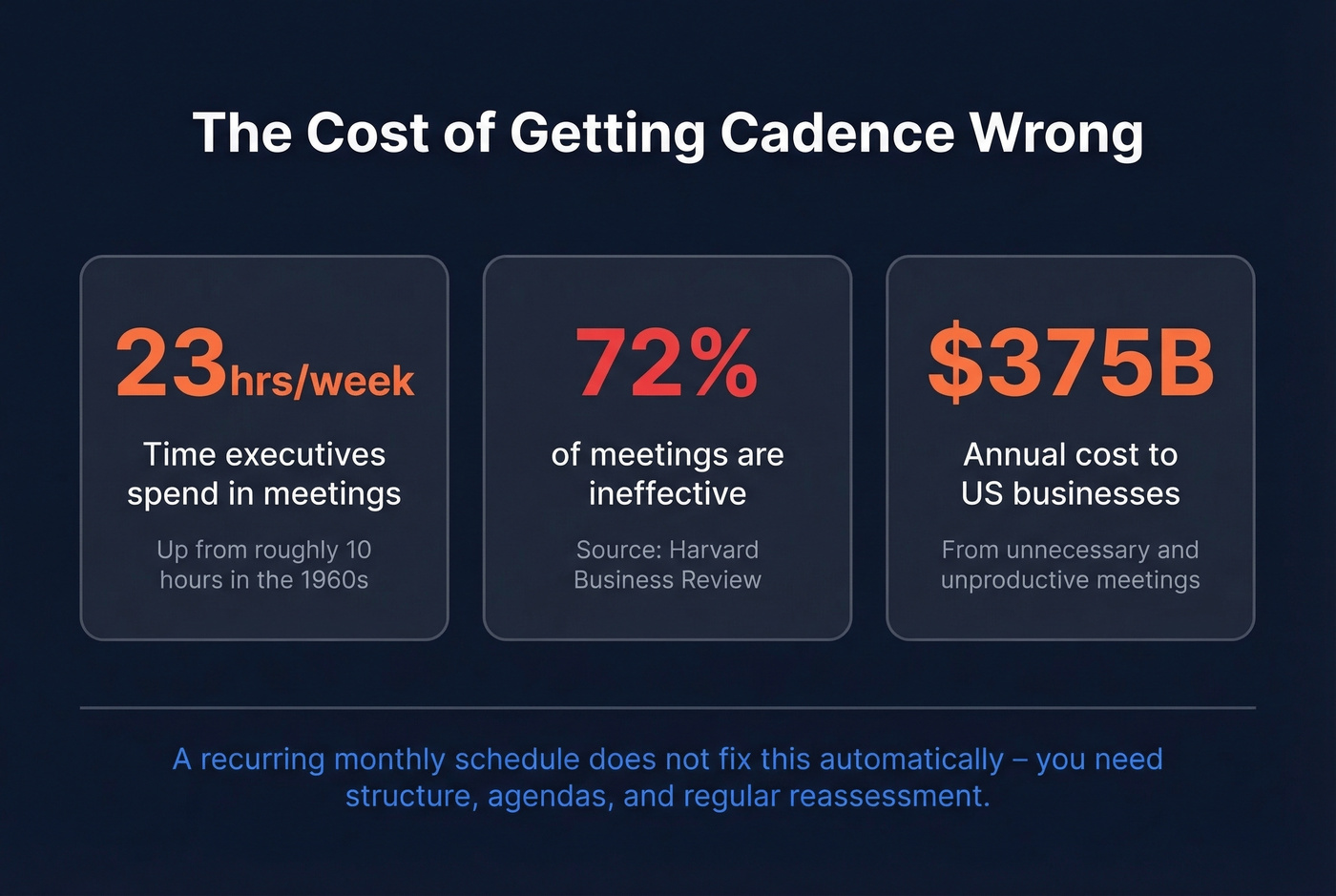
Executives spend almost 23 hours a week in meetings - up from roughly 10 hours in the 1960s. Meetings are ineffective 72% of the time, costing businesses upwards of $375B a year. A recurring monthly schedule doesn't fix this automatically.
Here's what goes wrong:
- "Set it and forget it." You establish a monthly meeting in January and never reassess whether it's still needed by June. Review your cadence quarterly.
- Defaulting to weekly when monthly would suffice. If the update hasn't changed meaningfully in seven days, you're wasting everyone's time. We've seen teams reclaim 4-6 hours per month just by making this switch.
- No agenda, no outcome. A monthly meeting without a pre-circulated agenda is just a group chat with video on. 68% of employees already say they don't have enough uninterrupted focus time - don't make it worse.
- Calling everything a "cadence." If you mean "monthly meeting," say "monthly meeting." The word only earns its keep when you're designing a deliberate rhythm across multiple activities, not renaming a single calendar event.
Making Your Monthly Rhythm Work
Lock in a fixed date and time - "second Wednesday at 1 p.m." beats "sometime this month." In our experience, teams that commit to a fixed slot get dramatically better attendance than those who schedule ad hoc. Send an agenda 48 hours ahead so attendees can prep, and every quarter, ask whether monthly is still the right frequency. Teams evolve. Cadences should too.
If you run a formal quarterly review, keep a bank of QBR questions to ask so the meeting stays decision-focused.
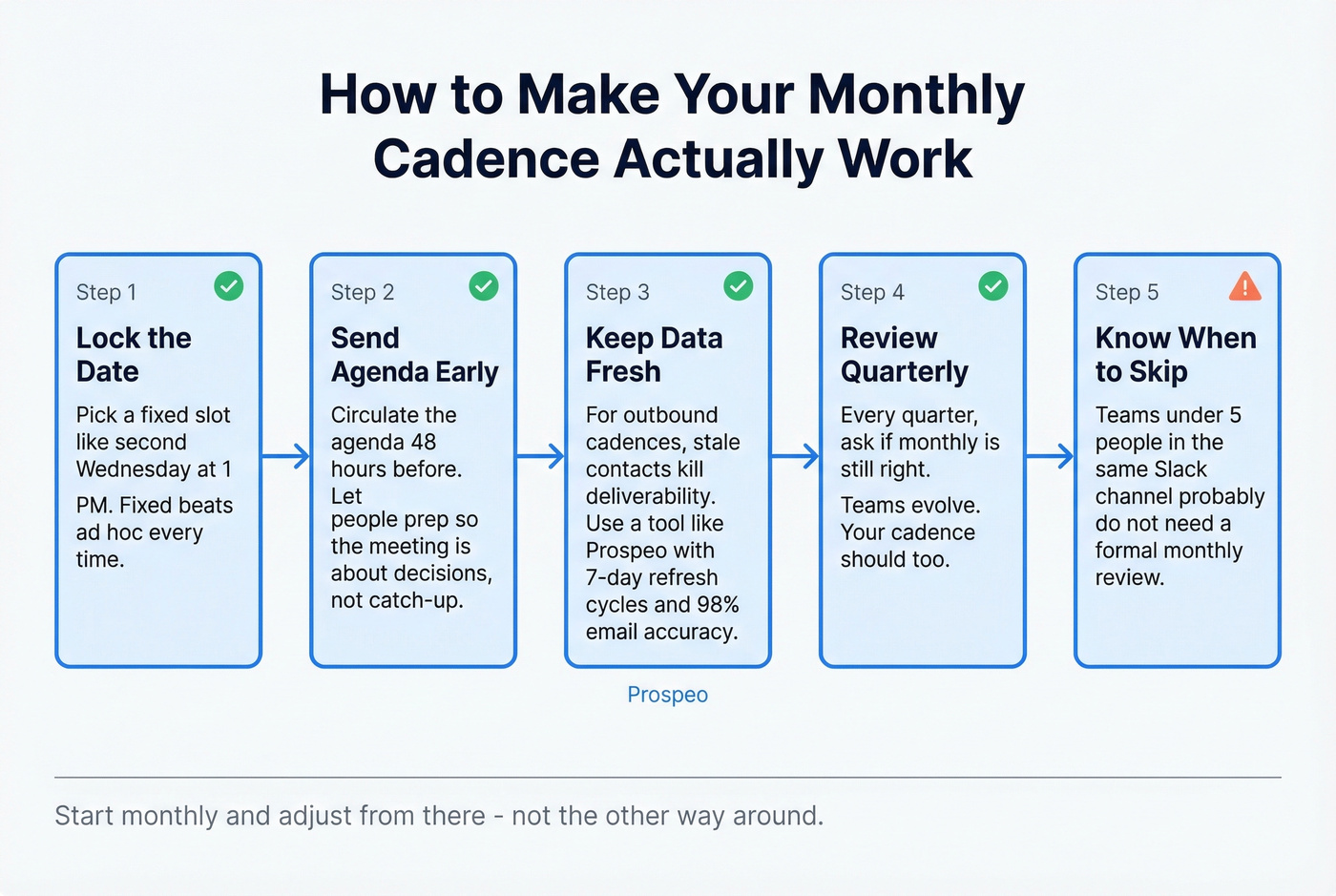
For outbound sales cadences specifically, data freshness matters more than most teams realize. A monthly list pull means your contacts could be up to a month old by the next cycle. Stale emails bounce, and bounces tank your sender reputation. Tools like Prospeo help here - its 7-day data refresh cycle keeps contacts current between monthly pulls, with 98% email accuracy so your sequences actually land instead of hitting dead inboxes.
If you're building sequences, tighten up your sequence management so monthly pulls translate into consistent execution.
Skip the monthly cadence entirely if your team is fewer than five people and everyone sits in the same Slack channel. You don't need a formal monthly review when you're already talking every day. Save the structure for when the team grows and information stops flowing naturally.
Building a monthly outbound cadence? Your first cycle is free. Prospeo gives you 75 verified emails per month - enough to test your monthly rhythm with 98% accurate contacts before spending a dollar.
One monthly cadence, 75 free verified emails, zero bounces.
FAQ
What does "bi-monthly cadence" mean?
"Bi-monthly" can mean twice a month or every other month - the English language never resolved this. Avoid the ambiguity entirely. Say "twice monthly" or "every other month." Your team will thank you.
How is cadence different from frequency?
Functionally, they're close to synonymous in business contexts. "Cadence" implies a deliberate, designed rhythm with structure and purpose. "Frequency" is neutral - just how often something happens. Don't overthink it.
What's the best cadence for sales outreach?
Monthly works for strategic account touches and pipeline reviews. For active prospecting, you'll want daily or weekly touchpoints within a broader monthly campaign cycle. Data quality determines whether outreach actually reaches anyone - bounce rates above 4-5% signal stale data, and that's a problem no send schedule can fix.