

Mozenda vs Octoparse: Which Scraper Is Worth Your Money in 2026?
Most people comparing Mozenda vs Octoparse don't actually need a web scraper. They need contact data for outreach, and they're solving the wrong problem with the wrong tool. But if you genuinely need to extract structured data from websites - competitor pricing, product catalogs, job listings - this comparison will save you from picking the expensive option by default.
30-Second Verdict
- Octoparse wins for most users. Free tier, transparent pricing starting at $39/mo, and a stronger community.
- Mozenda only makes sense if you need managed enterprise extraction and have $500+/month to spend.
What Happened to Mozenda?
Mozenda merged with Dexi.io on July 16, 2020, and the announcement spooked some users into thinking the product was dead. It's not.
Both brands were maintained as distinct products, and Mozenda's release notes show active development with updates posted as recently as February 2026 - webhook capability, AI feature groundwork, and regular Chromium updates. The product has shifted firmly toward enterprise buyers, though, and the self-serve experience feels dated next to Octoparse.
Pricing Compared
The gap here is hard to ignore.
| Mozenda | Octoparse | |
|---|---|---|
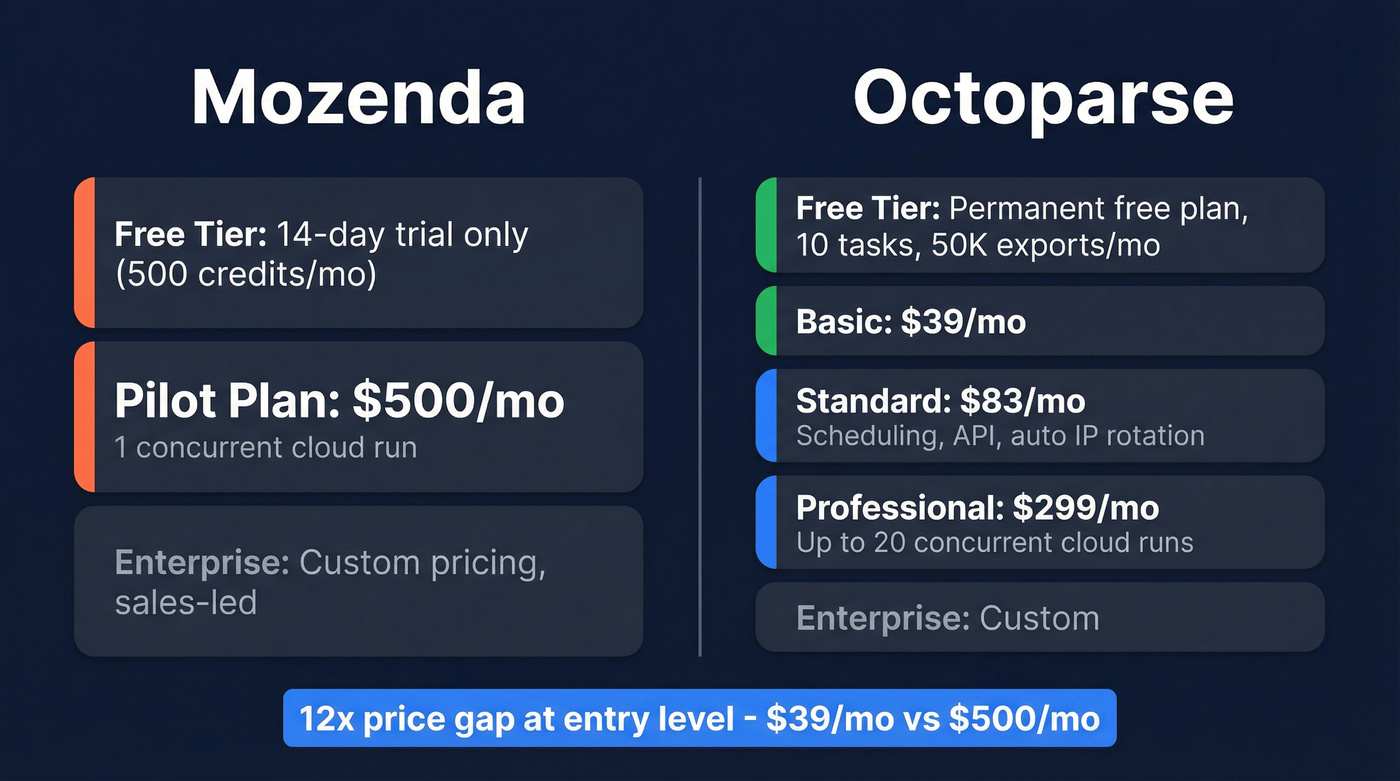
| Free tier | 14-day trial (500 processing credits/month) | Free plan (10 tasks, 50K data export/month) |
| Entry paid | $500/mo (Pilot) | $39/mo (Basic) |
| Mid-tier | - | $83/mo (Standard; some packages show $119) |
| Pro tier | - | $299/mo (Professional) |
| Enterprise | Custom (annual, sales-led) | Custom |
| Hidden costs | Credit burn if agents loop | Proxies $3/GB, CAPTCHA $1-$1.50/1K |
Octoparse's entry point is $39/mo. Mozenda's is $500/mo. That's roughly a 12x difference for tools that handle the same core job. Mozenda's pricing page doesn't even show prices - it's a lead form. If you have to fill out a form to learn what something costs, that tells you who the product is built for.

Watch the add-ons on Octoparse's side, though. Residential proxies at $3/GB, CAPTCHA solving at $1-$1.50 per thousand, and crawler setup services starting at $399 add up at scale. Mozenda bundles more infrastructure into its base price, but you're paying for it whether you use it or not. On pure sticker price, Octoparse Standard runs $83/month while Mozenda Pilot is $500/month - about 6x higher before you even factor in add-ons.
If you're mainly trying to build lists for outbound, you may be better off with free lead generation tools than paying scraper overhead.

You're comparing $39/mo vs $500/mo scrapers - but verified B2B emails cost $0.01 each on Prospeo. No proxies, no CAPTCHA fees, no cleaning raw HTML. 143M+ verified emails at 98% accuracy, ready for outreach.
Skip the scraper tax. Get the contacts directly.
Feature-by-Feature Breakdown
| Feature | Mozenda | Octoparse |
|---|---|---|
| No-code builder | Yes | Yes |
| Cloud extraction | Yes | Yes (paid plans) |
| Scheduling | Yes | Standard+ |
| Auto IP rotation | Yes | Standard+ |
| API access | Yes | Standard+ |
| Free plan | No (trial only) | Yes (permanent) |
| Concurrent cloud runs | 1 (Pilot) | Up to 20 (Professional) |
| Export formats | CSV, Excel | CSV, Excel, JSON |
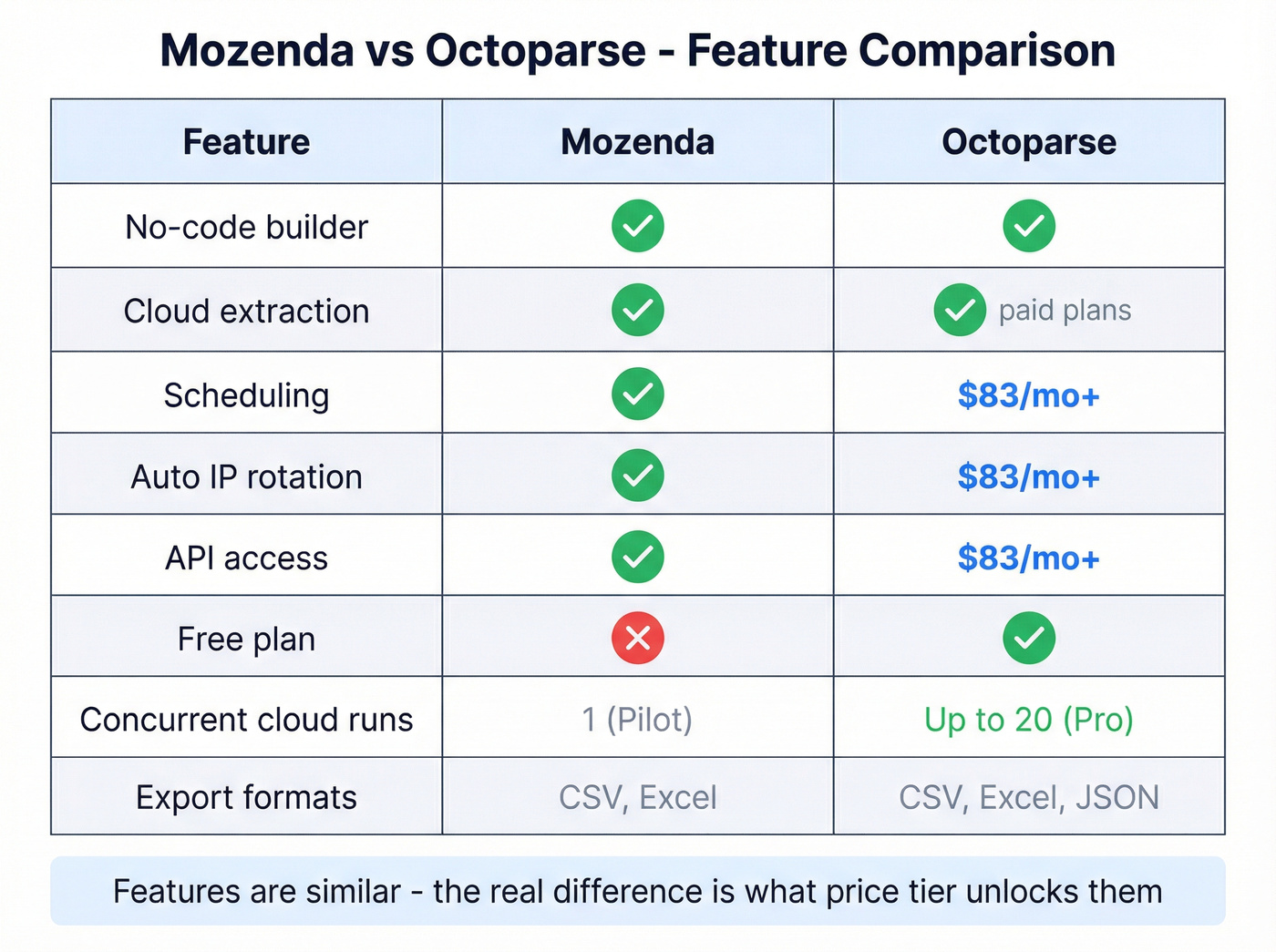
Feature-for-feature, these tools are closer than the pricing suggests. Both handle no-code extraction, cloud runs, and scheduling. The real difference is gating: Octoparse locks scheduling, auto IP rotation, and API access behind the $83/mo Standard plan, while Mozenda includes core capabilities from the Pilot tier - but that tier starts at $500/mo.
Here's where it gets interesting. Octoparse's Professional plan allows up to 20 concurrent cloud extractions. Mozenda's Pilot plan allows one. If you're running high-volume parallel jobs, Octoparse gives you far more headroom per dollar.
If your end goal is outreach, pairing extraction with data enrichment services is usually the missing step.
What Users Actually Say
Octoparse carries a 4.8/5 on G2 across 52 reviews. Users consistently praise the no-code builder and templates. The recurring complaints center on a learning curve for advanced features and occasional cloud extraction reliability issues.
If you're evaluating other scrapers in the same category, see Apify vs Octoparse and ScrapingBee alternatives.
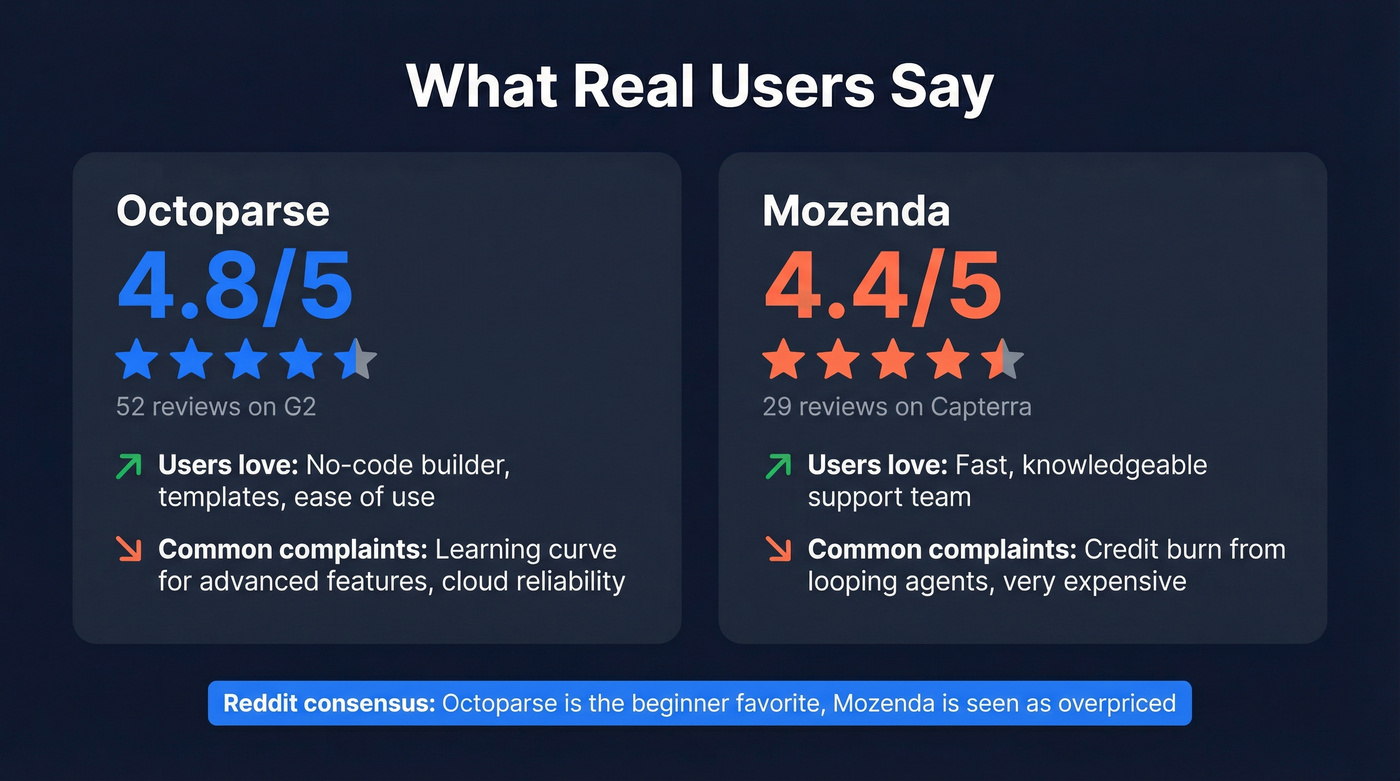
Mozenda sits at 4.4/5 on Capterra from 29 reviews. Support gets genuine praise - "responds quickly and knowledgeably" is a common thread. But the credit-burn problem comes up repeatedly: agents that loop can chew through your monthly allocation without warning. Mozenda's G2 presence is nearly invisible - just 4 reviews, miscategorized under OCR software. The consensus on r/webscraping tracks with this: Octoparse is the favorite for beginners, and Mozenda is "very expensive."
Who Should Pick Which
Pick Octoparse if you're budget-conscious, want a permanent free tier to test with, or need to scale concurrent cloud jobs without negotiating an enterprise contract. It's the obvious choice for solo operators and small teams.
If you're building a repeatable outbound motion, it also helps to standardize your sales prospecting techniques so the data you collect actually turns into meetings.
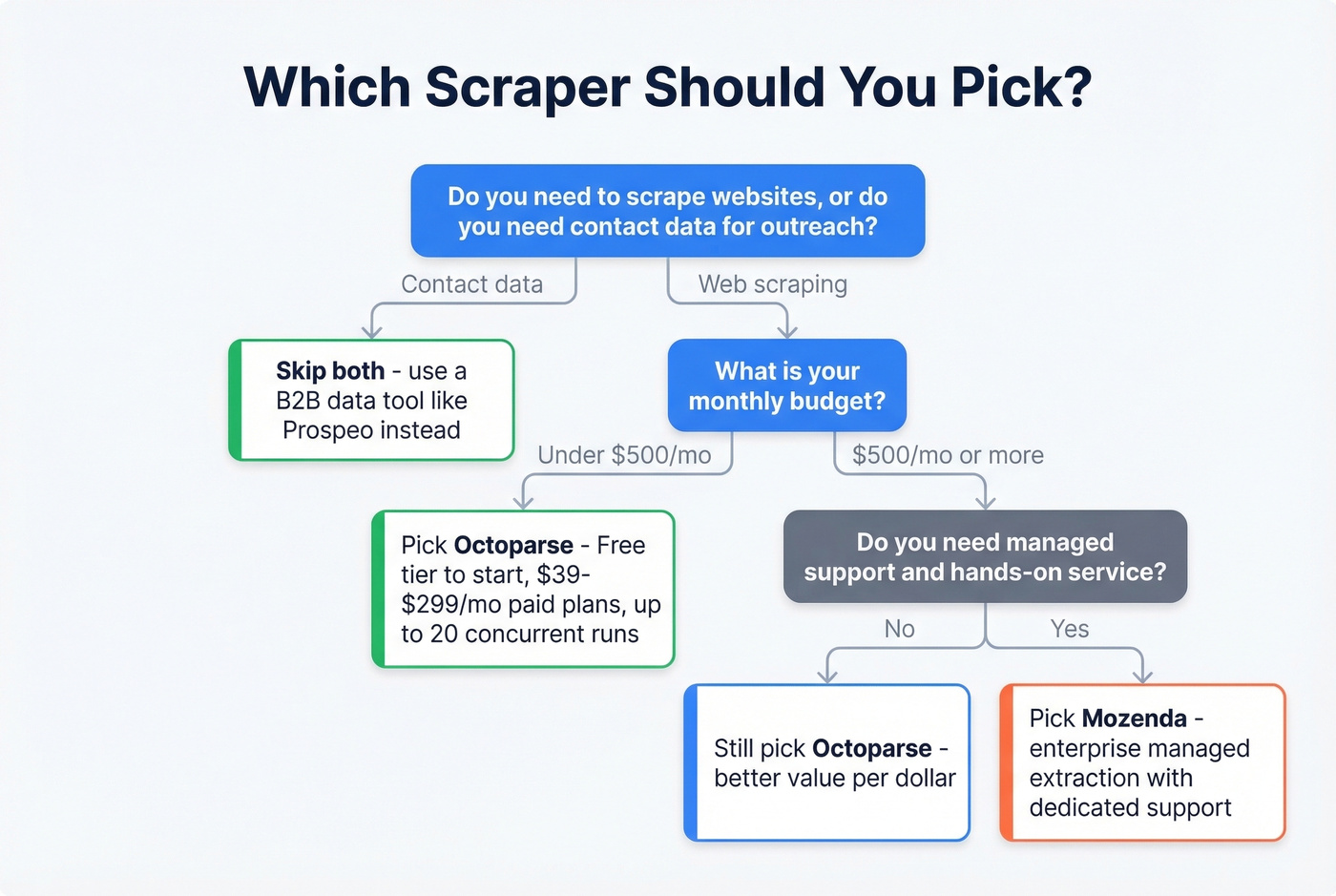
Pick Mozenda if you need a managed extraction service with hands-on support and your budget comfortably clears $500/mo. Enterprise teams with complex, recurring data pipelines are the sweet spot.
Let's be honest: Mozenda's product isn't bad - it's just priced for a market that has moved on. Three years ago, $500/mo for a managed scraper was competitive. Today, Octoparse offers most of the same functionality at a fraction of the cost, and we've seen more teams making that switch in the last year than ever before. Mozenda needs to ship a self-serve tier or keep losing ground.
Do You Actually Need a Scraper?
A huge chunk of people weighing Mozenda vs Octoparse aren't extracting product data or monitoring competitor pricing. They want emails and phone numbers for outreach. A web scraper is the wrong tool for that.
If you're tempted to scrape emails anyway, read web scraping lead generation and compare it to using an email crawler built specifically for contact discovery.

Scraping websites for contact data means hours of cleanup and 25%+ bounce rates. Prospeo delivers verified emails and 125M+ direct dials with a 30% pickup rate - no extraction jobs, no looping credit burns.
75 free verified emails per month. No credit card required.
FAQ
Is Mozenda still active in 2026?
Yes. Mozenda shipped updates as recently as February 2026, including webhook support and AI feature groundwork. The 2020 Dexi.io merger didn't kill the product - both brands continue as distinct offerings with active development.
Does Octoparse have a free plan?
Yes. Octoparse's free tier includes 10 tasks, 2 concurrent local runs, and 50,000 data exports per month. It's a permanent free plan, not a trial - you can use it indefinitely without entering payment details.
Which tool is better for lead generation?
Neither. You can scrape websites for contact data, but you'll spend hours cleaning and verifying results with bounce rates north of 25%. A purpose-built B2B data tool like Prospeo gives you verified emails and phone numbers instantly at 98% accuracy - no scraping, no proxies, no cleanup. The free plan includes 75 emails per month.