

Mutual Action Plans: How to Build One Your Buyer Won't Ignore
You sent the MAP on Tuesday. Your champion opened it once, didn't check off a single task, and went dark for two weeks. Now you're chasing them with a "just circling back" email while the deal quietly dies.
Only 45% of sellers consistently use MAPs, and the ones who do often build them wrong. Here's how to create a mutual action plan that actually moves deals forward - one your buyer will treat as a resource, not an obligation.
What You Need (Quick Version)
A MAP works when it hits four conditions: it's co-created with your champion (not emailed as homework), introduced after a business case exists, used as a centralized hub rather than a to-do list, and backed by accurate contact data for every stakeholder on it. If your champion won't co-edit the MAP, the deal is already dead - you just don't know it yet.
What Is a Mutual Action Plan?
A mutual action plan is a shared roadmap between your sales team and the buyer's team that maps out every milestone, owner, and deadline from evaluation through go-live.
You'll hear it called different things - MAP, joint execution plan (JEP), mutual success plan (MSP), go-live plan, or just "the plan." The name doesn't matter. What matters is that it's shared.
Here's the distinction most reps miss: a close plan is internal - your steps to win the deal. A MAP is co-owned with the buyer. If the buyer didn't help build it, you've got a close plan with a friendlier name.
B2B buying is genuinely complex. The average buying group involves six to ten people, each stakeholder consulting four to five sources during the process. 77% of buyers say the process is "too complex," and 95% of buying groups will pivot at least once during the evaluation. A shared plan cuts through that complexity by giving everyone - your side and theirs - a single source of truth.
Why MAPs Improve Win Rates
Deals where AEs engage buyers with a shared action plan show a 26% higher win rate than deals without one. For context, RAIN Group research puts the average win rate at 47% across 472 sellers and executives. That 47% baseline jumps to roughly 59% with MAP engagement - the difference between a rep who hits quota and one who doesn't.
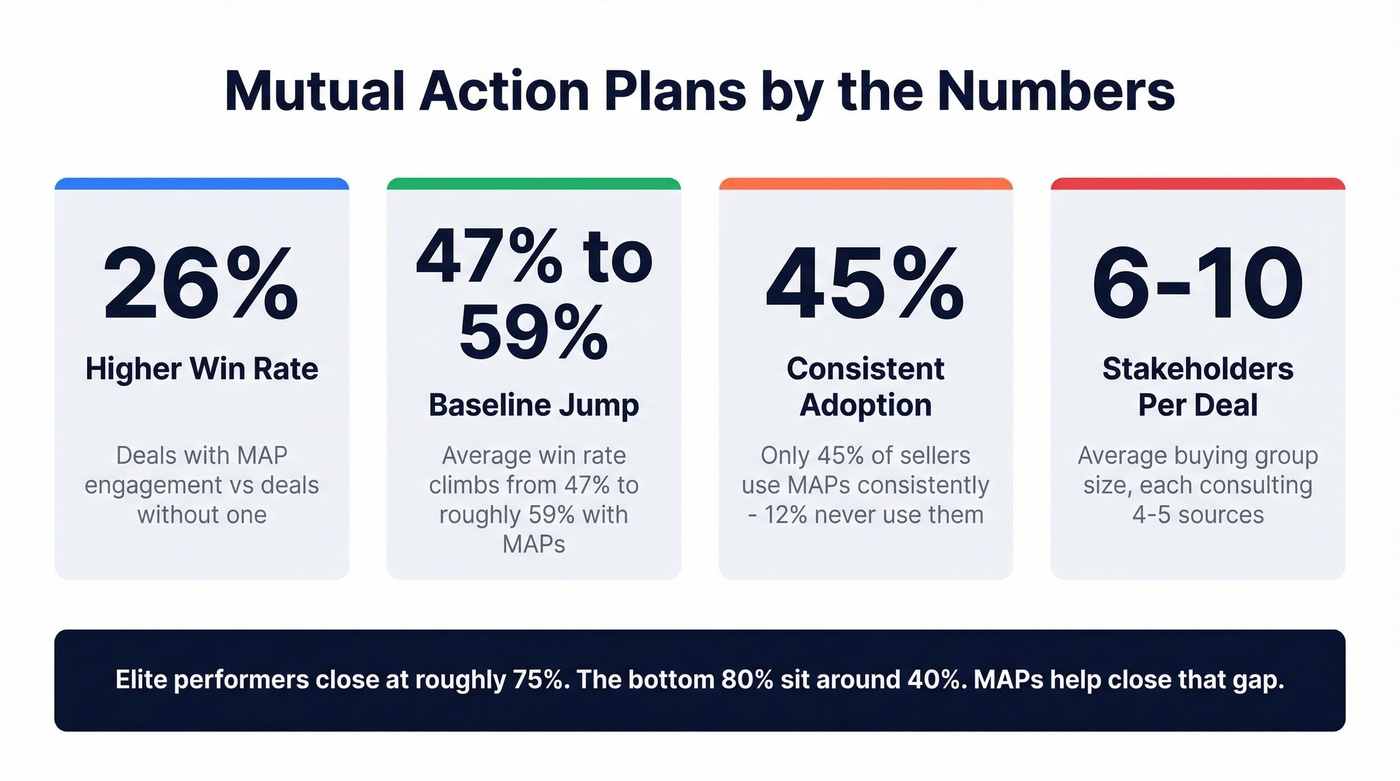
Elite performers already close at ~75%, while the bottom 80% sit around 40%. MAPs help close that gap.
Adoption is all over the place, though. 45% of sellers use MAPs consistently, 43% use them sometimes, and 12% never touch them. The "sometimes" group is the most interesting - they've tried MAPs, seen mixed results, and aren't sure whether the tool or the execution is the problem. In our experience, it's almost always the execution.
Why Most MAPs Get Ignored
Three failure modes kill most plans before they generate any value.
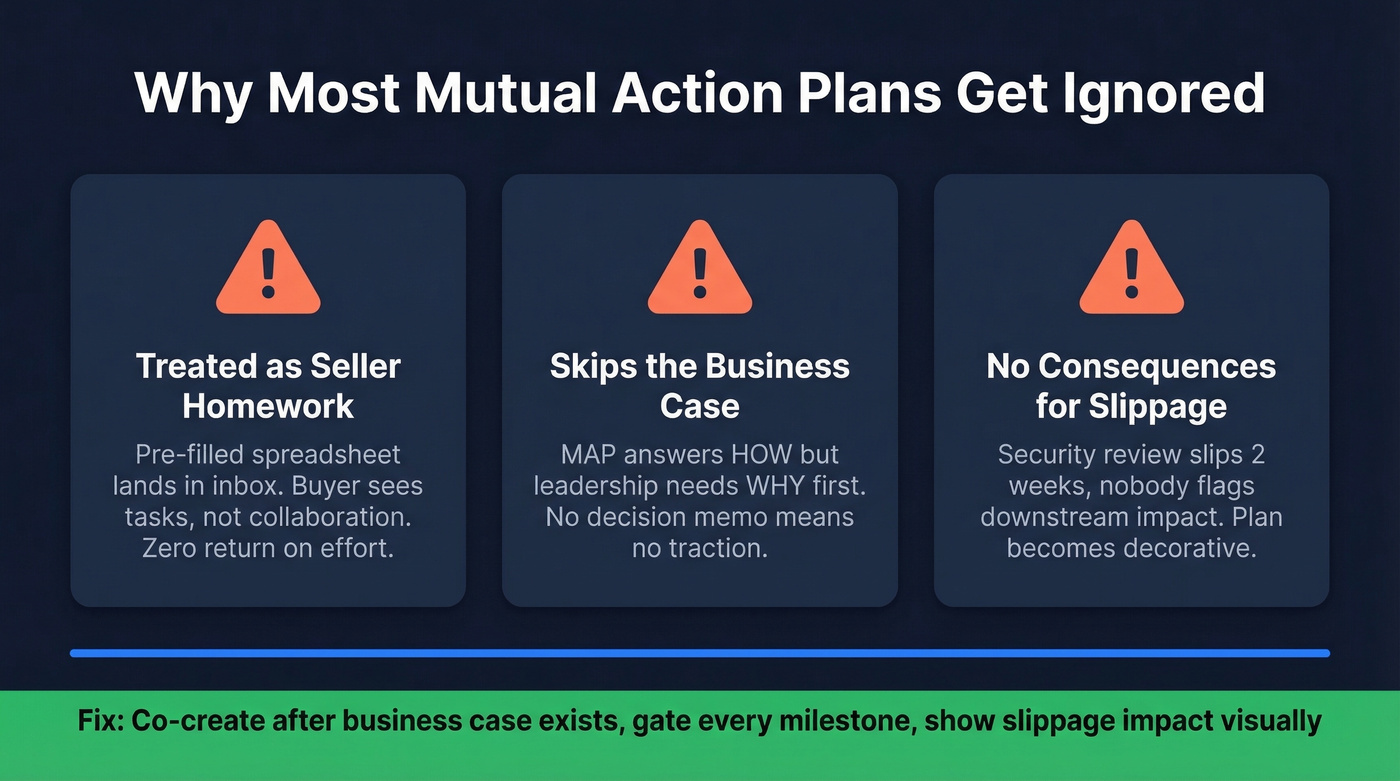
The buyer treats it as seller homework. A practitioner on r/sales put it bluntly: "Most of the time buyers just ignore them." When a MAP lands in a buyer's inbox as a pre-filled spreadsheet, it feels like you're assigning them tasks. That's not mutual - it's a project plan disguised as collaboration. Fluint calls this the "return on effort" problem: if the MAP looks like more work than it saves, buyers won't touch it.
The MAP replaces the business case instead of following it. This is the sequencing error that sinks more enterprise deals than any other MAP mistake. A Senior DevOps Director managing $2M in developer tool spend explained it plainly: they can't take "a bunch of tasks" to a CTO. Leadership needs a decision memo explaining why this matters - tied to strategic priorities and outcomes. The MAP answers how. Skip the why, and the how never gets traction.
There are no consequences for slippage. A to-do list without teeth is just a wish list. When the security review slips two weeks and nobody flags the downstream impact, the MAP becomes decorative. One practitioner framework on Reddit nails this: every milestone should map to a gated validation step, not just a checkbox.

Your mutual action plan lists a security review owner, a legal contact, and an exec sponsor. But do you have verified emails and direct dials for all of them? Prospeo gives you 98% accurate contact data for every stakeholder on your MAP - by company and role - so deals don't stall waiting on your champion to make introductions.
Stop letting missing contact data kill your deal momentum.
How to Build a MAP That Gets Used
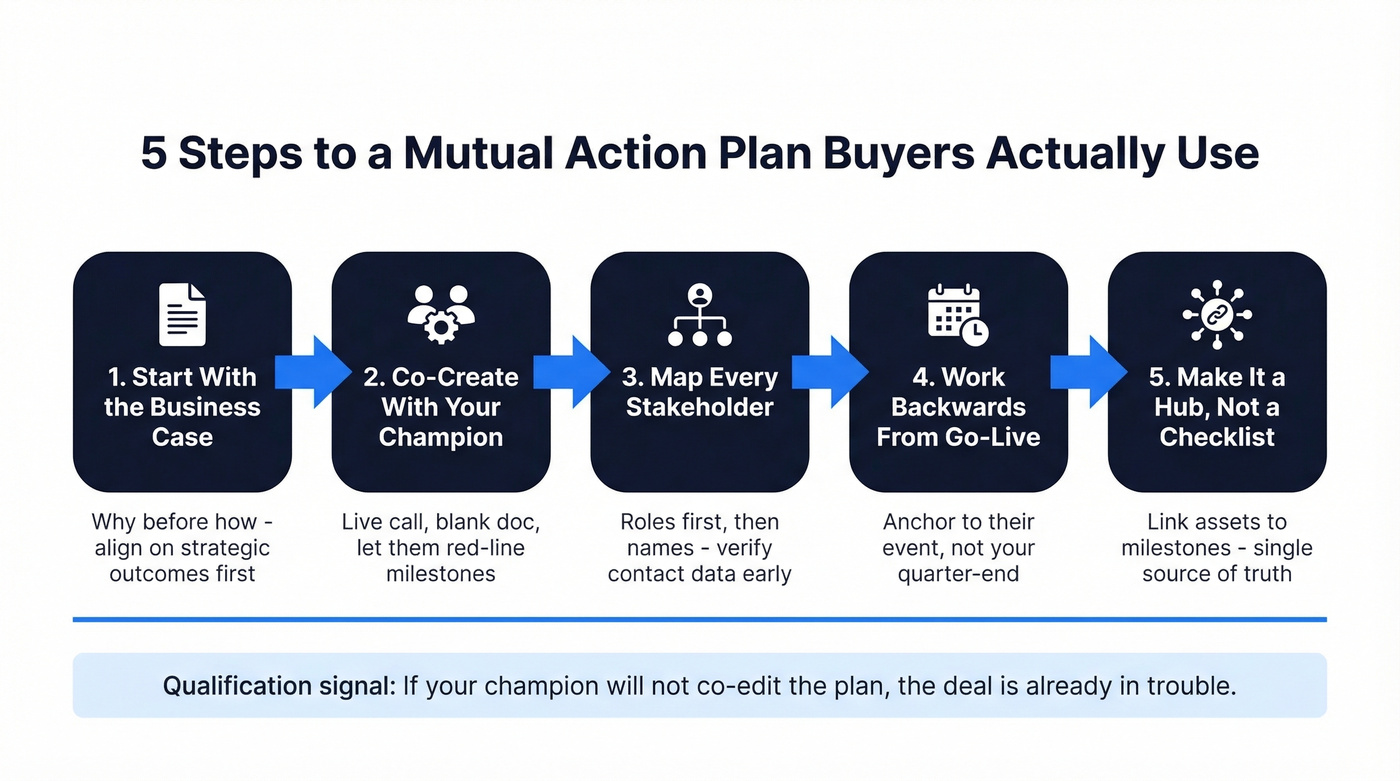
This framework has worked across dozens of mid-market and enterprise deal cycles we've been involved with. Five steps, each one non-negotiable.
Start With the Business Case
The business case ("why") must exist before the MAP ("how"). Executives don't read project plans - they read decision memos. Before you open a shared doc, make sure you and your champion can articulate the strategic outcome this purchase drives. What metric improves? What initiative does it support? What happens if they do nothing?
Align on outcomes first, then build the plan.
Co-Create With Your Champion
Open a blank doc together - on a live call, not async. Let the champion red-line milestones, add their internal deadlines, and flag blockers you'd never know about. Maybe legal is slammed until mid-quarter. Maybe the CFO is on PTO the week you planned the exec briefing. You won't learn any of this from a pre-filled template.
Use the buyer's terminology for milestones - "Vendor Security Assessment" instead of "Security Review" - so the MAP mirrors their internal process, not your sales stages.
The qualification signal most reps ignore: if your champion won't co-edit the plan, they either lack the authority or the motivation to push this deal internally. Either way, you've got a problem that no amount of follow-up emails will solve.
Map Every Stakeholder
Identify roles first, then names. A MAP stalls the moment you hit "Security Review" and realize you don't have a verified email for the CISO. Or "Legal Redline" kicks off and you can't reach the General Counsel directly.
We've watched deals die over something this simple. Your champion says "I'll loop in our VP of Security," and then... nothing. Two weeks pass. The deal stalls. Having direct contact data for every person on the plan - before you need it - is the difference between a MAP that moves and one that waits. A tool like Prospeo can pull verified emails and direct dials by company and role in minutes, so you're not dependent on your champion making introductions on their timeline.
Work Backwards From Go-Live
Anchor to the buyer's compelling event or target launch date - not your quarter-end. Schedule milestones in reverse. Be realistic about timeline blocks: security review typically runs 2-6 weeks, legal and procurement 2-8 weeks, and implementation kickoff happens 1-2 weeks post-signature.
What separates good MAPs from great ones is the final milestone. It isn't signature - it's first ROI. When does the buyer see measurable value? That's where the plan ends. Everything before it is just plumbing. Framing the MAP as a success plan that extends through implementation and first value shifts the conversation from "when do we close?" to "when do we win?"
Make It a Hub, Not a Checklist
Link each milestone to the assets buyers need - security questionnaire responses, ROI calculator, exec summary, implementation timeline. The best practitioner advice from r/sales threads is to use MAP milestones as a navigation layer: "Infosec Review" links to a folder with security docs instead of forcing the buyer to dig through email threads.
When the MAP becomes the single place the buying committee goes for everything - a digital sales room, essentially - it stops being an obligation and starts being a resource.
Mutual Action Plan Template
Adapt the phases and milestones below to your sales cycle. The structure matters more than the specific items.
| Phase | Milestone | Owner | Target Date | Status |
|---|---|---|---|---|
| Evaluation | Platform demo -> Demo recording | AE + Champion | Jan 15 | Done |
| Evaluation | Exec presentation -> Exec summary deck | AE + VP Ops | Jan 22 | Done |
| Evaluation | POC kickoff -> Success criteria doc | SE + DevOps lead | Feb 3 | Done |
| Evaluation | POC results review -> ROI analysis | Champion + CFO | Feb 21 | Done |
| Procurement | Security review -> Security questionnaire | CISO + SE | Mar 3 | In progress |
| Procurement | Legal redline -> MSA + DPA | GC + Legal (seller) | Mar 17 | Not started |
| Procurement | Contract signoff -> Order form | CFO + AE | Mar 28 | Not started |
| Implementation | Kickoff call -> Onboarding checklist | CSM + IT Admin | Apr 7 | Not started |
| Implementation | Admin training -> Training materials | CSM + 3 admins | Apr 14 | Not started |
| Implementation | First-value review -> KPI dashboard | CSM + Champion | May 12 | Not started |
Notice the post-signature milestones. If your MAP ends at "Contract signoff," you've built a close plan. The buyer cares about what happens after they sign - that's where trust compounds.
Gated Validation for Big Deals
For six- and seven-figure deals, a basic MAP isn't enough.
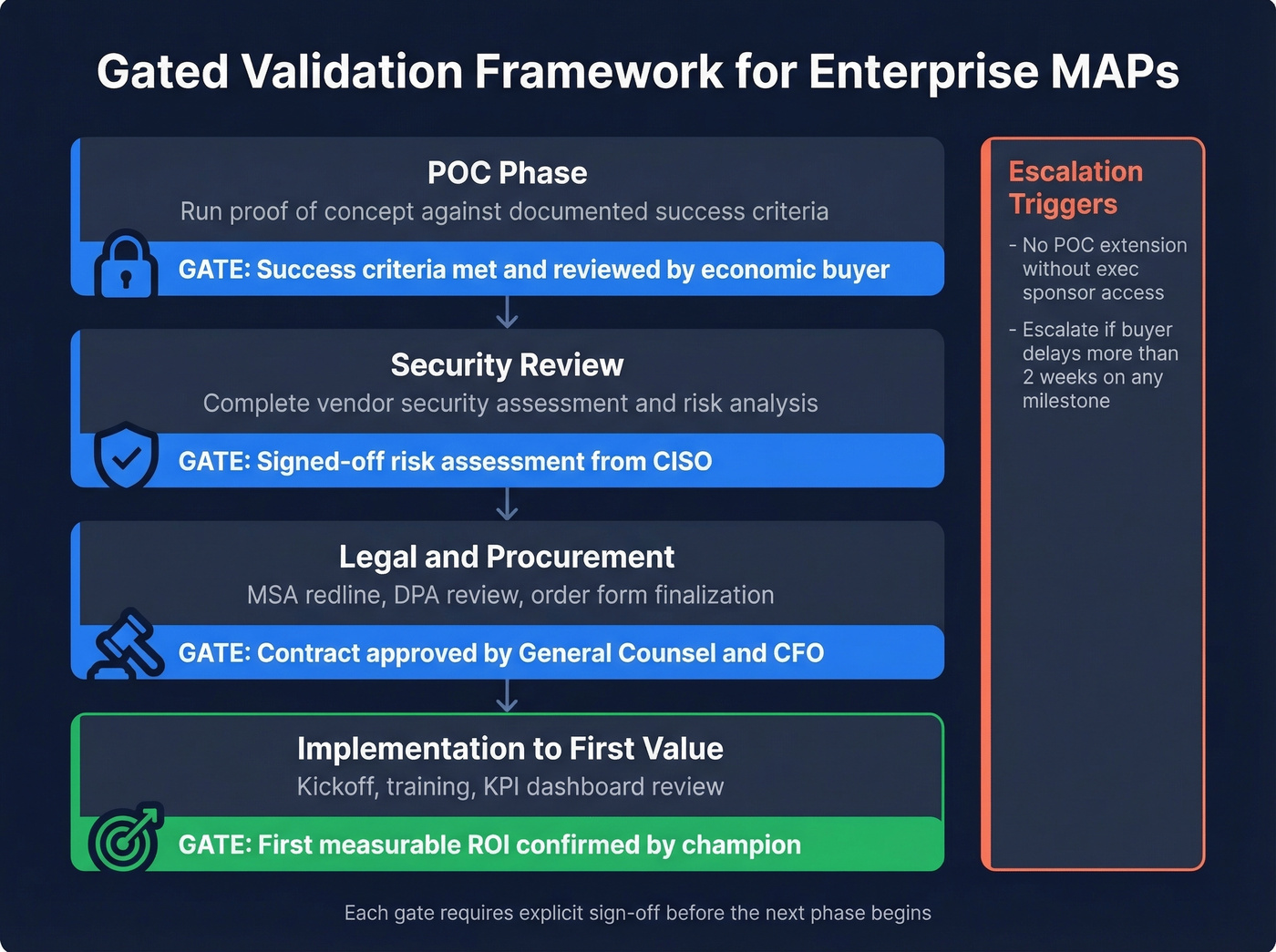
Each milestone maps to a validation gate - not just a task. The POC doesn't just "complete." It completes with documented success criteria met, reviewed by the economic buyer. Security review doesn't just "pass." It passes with a signed-off risk assessment. Every gate requires explicit sign-off before the next phase begins.
Run an internal "mirror plan" alongside the shared MAP. This is your playbook for what happens when things stall. Set escalation triggers in advance: no POC extension without exec sponsor access, and escalate if the buyer delays more than two weeks on any milestone.
These aren't threats - they're guardrails that protect both sides from a deal that drags on indefinitely.
Show slippage impact visually. When security review slips one week, show your champion exactly which downstream milestones shift - and what that means for their target go-live date. Clari's guidance on this is solid: visualize how one missed deadline cascades through the entire plan. Suddenly that "we'll get to it next week" response from the CISO feels a lot more urgent.
Let's be honest about the biggest mistake teams make here. They treat MAPs as a one-off artifact instead of a living process. Define where the plan lives - inside your CRM, a deal room, or a shared workspace - and set a weekly check-in cadence to review progress with your champion. Make MAP creation a required step in your sales process for any deal above a certain ACV threshold. We've seen this single change - making MAPs mandatory, not optional - lift team-wide win rates more than any training program.
MAP Tools Worth Knowing
You don't need expensive software to run a MAP. But the right tool makes collaboration easier.
Dock is the most purpose-built option. It functions as a digital sales room where buyers can interact with your MAP, content, and proposals in one branded workspace - without creating an account. It supports due dates, task assignment, multi-phase plans, reminders, and embedded videos, decks, and notes. Expect SMB MAP tools like this to land around ~$30-$150/user/month, while enterprise platforms run $10k-$50k+/year depending on seats and integrations.
Aligned offers a similar MAP template + deal-room approach with a free template available. Recapped focuses on deal collaboration and shared plans. Outreach Success Plans bake MAPs into the broader sales execution platform.
And honestly? Google Sheets works fine if you're running a small book of business. It's free and everyone knows how to use it.
Here's the thing: most teams don't need MAP software. They need MAP discipline. If your reps aren't co-creating plans with buyers today, buying a $50/seat deal room won't fix that. Start with a shared Google Sheet, prove the process works, then upgrade to a dedicated tool when you need engagement analytics and tighter workflow integration.
Deals with MAPs win 26% more often - but only when every milestone has an owner you can actually reach. Prospeo's 300M+ verified profiles and 125M+ direct dials mean you'll never hit a MAP checkpoint and realize you can't contact the decision-maker. At $0.01 per email, it costs less than one lost deal costs you in pipeline.
Map every stakeholder. Reach every stakeholder. Close the deal.
FAQ
When should you skip a MAP?
Skip the formal plan for transactional deals with one decision-maker and a sub-30-day cycle. MAPs add value when there are three or more stakeholders, multiple approval steps, or a timeline longer than six weeks. For a quick one-call close, a MAP is overhead you don't need.
What's the difference between a MAP and a close plan?
A close plan is internal - your steps to win the deal. A mutual action plan is shared with the buyer and co-owned. If the buyer didn't help build it, it's a close plan with a friendlier name. The co-creation step is what makes it "mutual."
Can you use a MAP for renewals?
Yes. Expansion MAPs are simpler - fewer stakeholders, known process - but still valuable for multi-department rollouts or upsells requiring new budget approval. The procurement and implementation phases usually shrink by 40-60%.
How do you get a buyer to engage with the plan?
Co-create it live during a call - never send a pre-filled spreadsheet async. Let them edit milestones and dates. Link useful assets to each step so the MAP becomes their go-to resource, not another attachment they ignore.
How do you find contact info for stakeholders on the MAP?
Use a B2B data platform to look up verified emails and direct dials by company and role. The key is having current contact data for every person on the plan - especially stakeholders your champion hasn't introduced you to yet. Waiting on warm intros for every committee member is one of the most common reasons MAPs stall.