

Net-New: What It Means, When It Matters, and When It's Just Jargon
Your VP of Sales says "net-new logos." Your CFO says "net new ARR." Your marketing lead says "net-new pipeline." They're all using the same phrase to mean three different things, and nobody's noticed yet. That misalignment is quietly wrecking your targets, your comp plans, and your board reporting.
Quick version: Net-new means something was added, not replaced. In sales, it's a brand-new customer. In SaaS finance, it's new revenue minus what you lost. In contracts and regulations, it means whatever the definitions section says it means.
What Net-New Actually Means
The term draws a line between incremental additions and replacements. An ERP migration from one vendor's legacy system to their cloud product? That's new, but it's not net-new - you're replacing an existing relationship. Moving to a completely different vendor? That's an incremental addition. Something was created that didn't exist before.
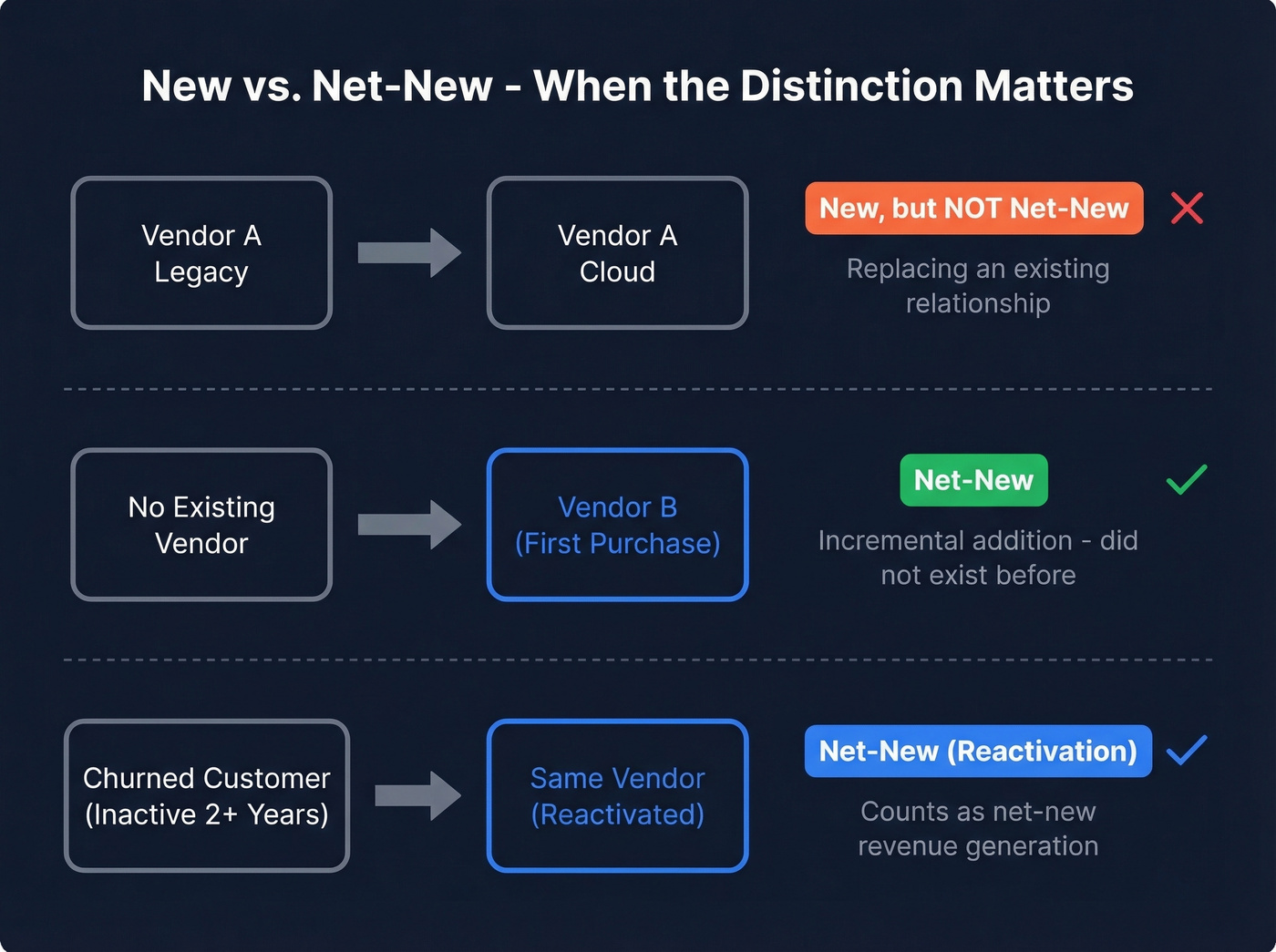
Understanding this distinction precisely is what separates accurate reporting from vanity metrics.
Here's the thing, though: the term is genuinely overused. A popular Glassdoor thread is full of practitioners calling it unnecessary jargon when "new" would work fine. If there's no replacement-vs.-addition ambiguity in your context, just say "new." Save the qualifier for when the distinction actually changes a number on a dashboard.
Net New Sales: The Revenue Lens
In sales, this almost always means "new logo" - a brand-new customer who wasn't in your CRM as an active account. Net new sales specifically measure revenue generated from these first-time buyers:
Net New Business = Revenue from New Customers + Revenue from Reactivated Accounts
Reactivated accounts count because they represent a return to revenue generation. Upsells and cross-sells to active customers don't - that's expansion revenue, a different line item.
The edge cases trip teams up constantly. Does a subsidiary of an existing customer count? What about a company you acquired through a merger? There's no universal answer. Document your policy, get sales and finance to sign off, and stick to it. We've seen teams burn weeks arguing about this mid-quarter when it should've been settled during comp plan design.
Net New ARR - The SaaS Metric
Net New ARR is the single most important metric here because it's the only one that accounts for both gains and losses. The full ARR bridge looks like this:
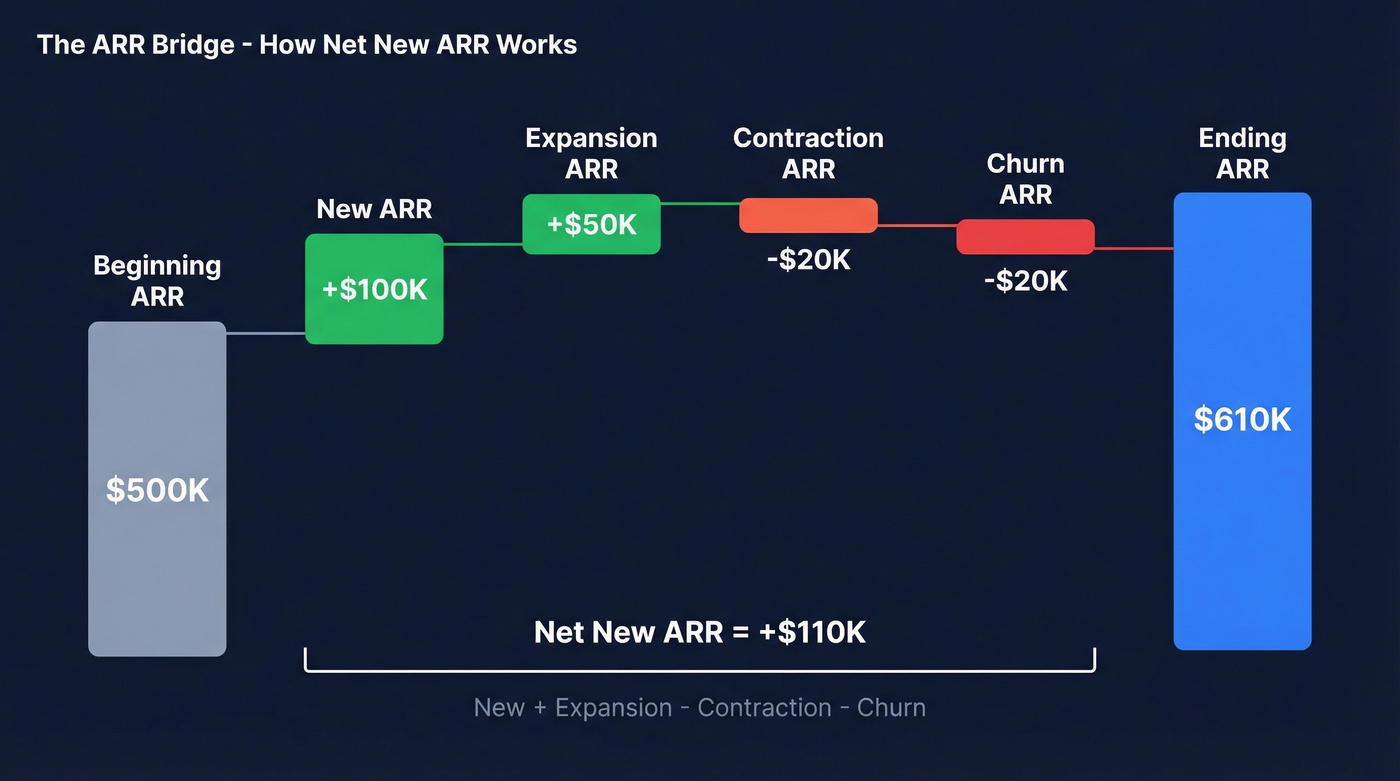
Ending ARR = Beginning ARR + New ARR + Expansion ARR - Contraction ARR - Churn ARR + Restart ARR
New ARR only counts revenue from newly acquired customers. Net New ARR is broader:
Net New ARR = New ARR + Expansion ARR - Contraction ARR - Churn ARR
Let's break this down with a real example. Close $100K in new customer ARR this quarter, but $40K churns and contracts. Your Net New ARR is $60K - that's the number investors fixate on, not the gross bookings figure your sales team celebrates.
Net New ARR feeds directly into capital efficiency metrics. Burn multiple - net burn divided by net new ARR - is how boards gauge spending discipline. In 2026, a sub-1.5x burn multiple signals strong efficiency; above 3x is a red flag.

Net New ARR only grows when your pipeline does. Prospeo's 30+ filters - buyer intent, headcount growth, technographics, funding - let you isolate true net-new accounts in minutes. 98% email accuracy on a 7-day refresh means your sequences hit real inboxes, not bounce logs.
Find net-new accounts with verified data at $0.01 per email.
Incremental Pipeline in Marketing
When marketing says "net-new pipeline," they should mean incremental pipeline - demand that wouldn't have existed without the marketing intervention. The real test isn't "did a lead touch our campaign?" It's "would this opportunity have been created anyway?"
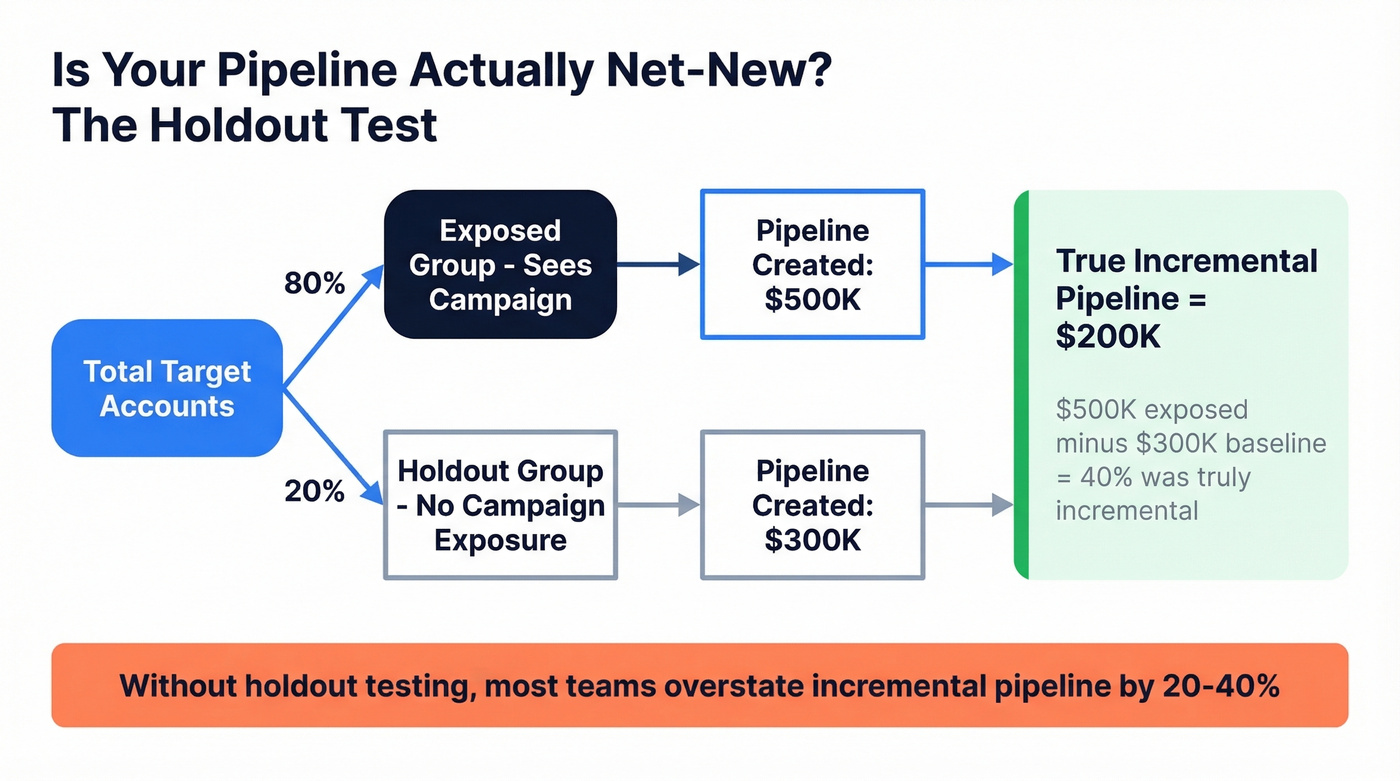
CRM-validated outcomes - opportunities created, pipeline value attributed - are the right measurement. Holdout testing is the gold standard for proving causality. If you're not running holdout tests, you're probably double-counting captured demand as created demand.
In our experience, most marketing teams overstate incremental pipeline by 20-40% once you apply proper incrementality controls. That's not a knock on marketing - it's a measurement problem that almost everyone gets wrong until they invest in the testing infrastructure.
Legal and Contractual Definitions
In contracts and regulations, the term gets hyper-specific. Four common variants:
- Employment positions: Net new permanent employees = total new permanent employees (current tax year) minus total new permanent employees (previous tax year). Washington state offers a $3,000 tax credit per qualified employment position, with anti-gaming rules requiring vacated positions to be backfilled.
- Invoicing/billing: New matters not previously invoiced, excluding renewals or existing subscriptions.
- Revenue formulas: Gross new recurring plus non-recurring sales, less subscription cancellations.
- Dwelling units: Units in excess of previously approved development plans.
Always check the definitions section. The term means exactly what the agreement says it means - nothing more.
Why the Split Changes Your Org
Separating hunters focused on first-time customers from expansion and renewal teams isn't a nice-to-have at scale. It's a structural requirement.
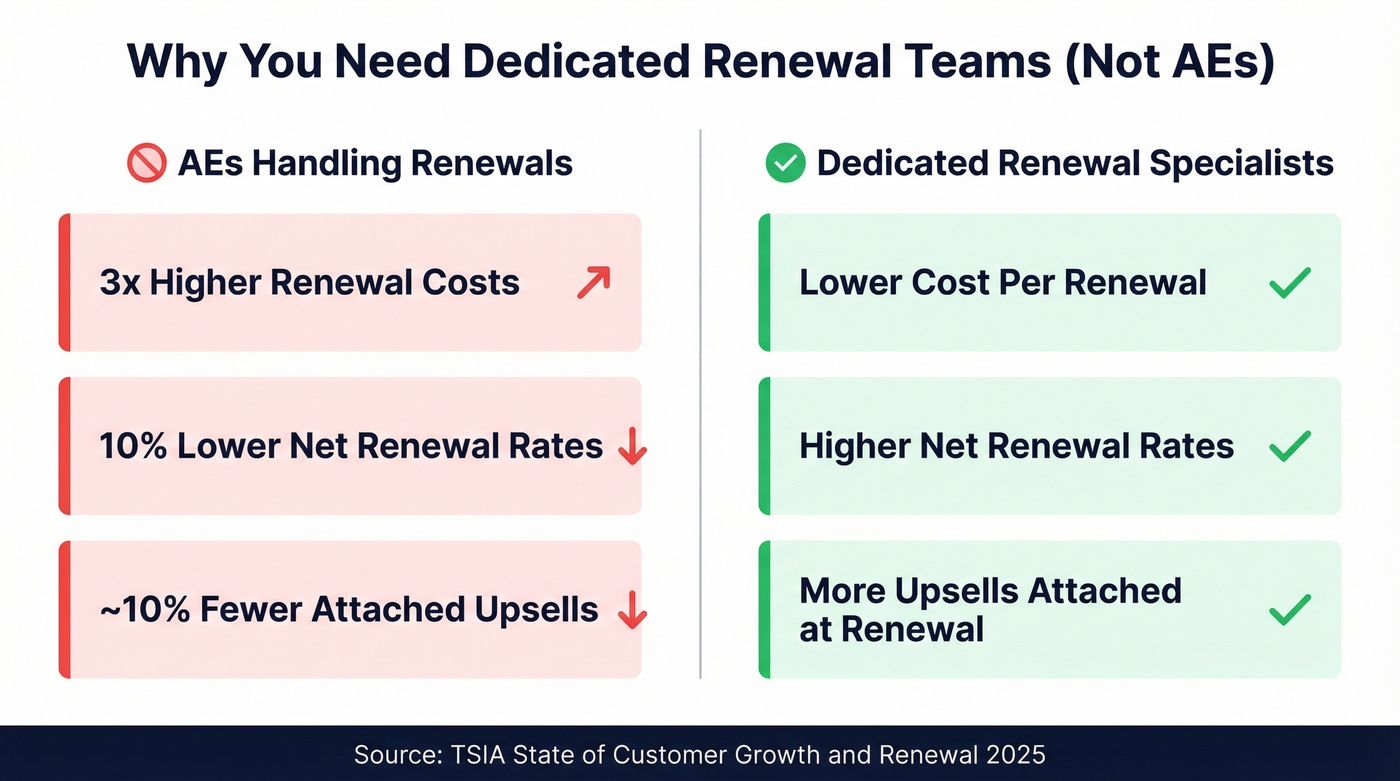
TSIA's research shows that using AEs for medium-complexity renewals results in 3x higher renewal costs, 10% lower net renewal rates, and nearly 10% fewer attached upsells compared to dedicated renewal specialists. That's a staggering gap, and it compounds every quarter you don't address it.
Comp plans reflect this tension. Reddit's r/sales is full of debates about where new-logo responsibilities end and renewal ownership begins - the 6% vs. 1% commission split on new business vs. renewals is a common flashpoint. That gap isn't arbitrary; it reflects fundamentally different skill sets and selling motions. If your org hasn't built a repeatable expansion process with executive alignment across Sales, CS, and Services, your new-logo team is carrying the entire growth burden. Skip this problem at your own risk.
How to Find Net New Accounts
Once you've defined what counts as incremental for your team, the challenge shifts to building the target list. Identifying fresh accounts starts with filtering by company attributes - industry, headcount, funding stage, tech stack, buyer intent - then finding verified contact data for the decision-makers at those accounts.
We've tested a lot of approaches here, and the biggest time sink is always data quality. You build a beautiful list, launch sequences, and half the emails bounce. Prospeo's B2B database covers 300M+ professional profiles with 30+ search filters, including buyer intent signals across 15,000 topics, headcount growth, technographics, and job changes. Emails are 98% accurate on a 7-day refresh cycle, so you're not launching sequences against stale data.
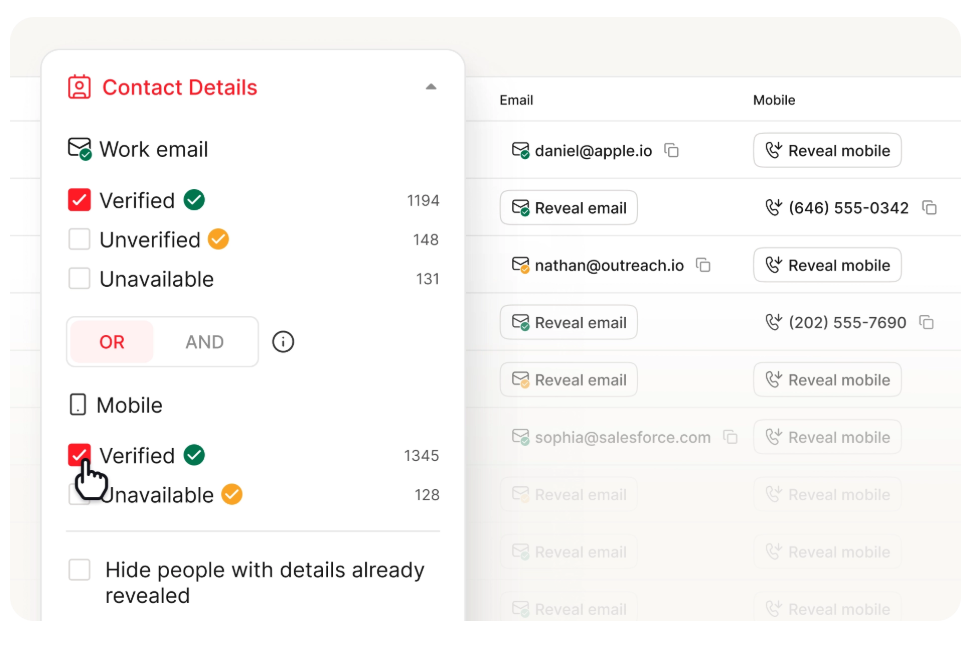
Your hunters shouldn't waste hours cleaning bad lists. Prospeo covers 300M+ profiles with 143M+ verified emails and 125M+ direct dials. Layer intent data across 15,000 topics to target accounts actively researching your category - that's net-new pipeline that actually converts.
Teams using Prospeo book 35% more meetings than Apollo users.
FAQ
Is "net-new" the same as "new"?
Not always. "New" can include replacements - a renewed contract, a migrated account. Net-new specifically means an incremental addition that didn't exist before. The distinction matters when tracking real growth versus churn replacement. If there's no ambiguity in your context, "new" works fine.
What's the difference between New ARR and Net New ARR?
New ARR counts revenue from newly acquired customers only. Net New ARR adds expansion revenue and subtracts churn and contraction, giving you the true change in recurring revenue over a period. Investors care about the latter because it reflects actual business momentum, not just sales activity.
How do I build a net-new target account list?
Define your ICP criteria - industry, headcount, tech stack, funding stage - then use a B2B database to filter matching accounts and pull verified emails and direct dials for decision-makers. Layer in intent data to prioritize accounts actively researching your category, so your outbound hits while the buying window is open.