

Neuro-Linguistic Programming in Sales: What Actually Works
A sales manager drops a YouTube link about neuro-linguistic programming into the team Slack. Half the reps start "mirroring" prospects on their next discovery call. The other half spend the afternoon arguing about pseudoscience. Both sides have a point - and that's the problem with most NLP sales advice online.
Drop "NLP" into any sales subreddit and the same polarized debate plays out on repeat. One r/sales thread asks point-blank: "Does NLP get you numbers?" while noting that VPs and partners proudly list NLP as a skill. Another asks, "Have any of you guys used NLP and did it help at all?" Years later, still no consensus.
Here's what actually matters if you carry a quota: NLP as a unified system is scientifically shaky, but four component techniques - mirroring, reframing, anchoring, and VAK matching - have genuine support in social psychology. Use those. Skip the rest. Below you'll find word-for-word cold call scripts, email templates, and objection reframes with the underlying principle labeled for each.
What Is NLP? (30-Second Version)
Neuro-linguistic programming was developed by Richard Bandler and John Grinder in the 1970s, formalized in The Structure of Magic. The name breaks down simply: Neuro (how we perceive the world through our senses), Linguistic (how language shapes that perception), Programming (the behavioral patterns we can identify and change).
The core idea is modeling - studying how effective communicators think and speak, then replicating those patterns. Quick disambiguation: NLP also stands for natural language processing in the AI world, where one market report pegs NLP in healthcare and life sciences at $7.76 billion in 2025, projected to reach $58.83 billion by 2034. Completely different field. When salespeople say NLP, they mean the Bandler-Grinder version.
Does NLP Actually Work?
The clinical evidence for NLP as a complete system is weak. A review of five randomized controlled trials found only one supportive trial - the other four showed the opposite result. The Canadian Agency for Drugs and Technology in Health found zero clinical evidence supporting NLP's therapeutic claims.
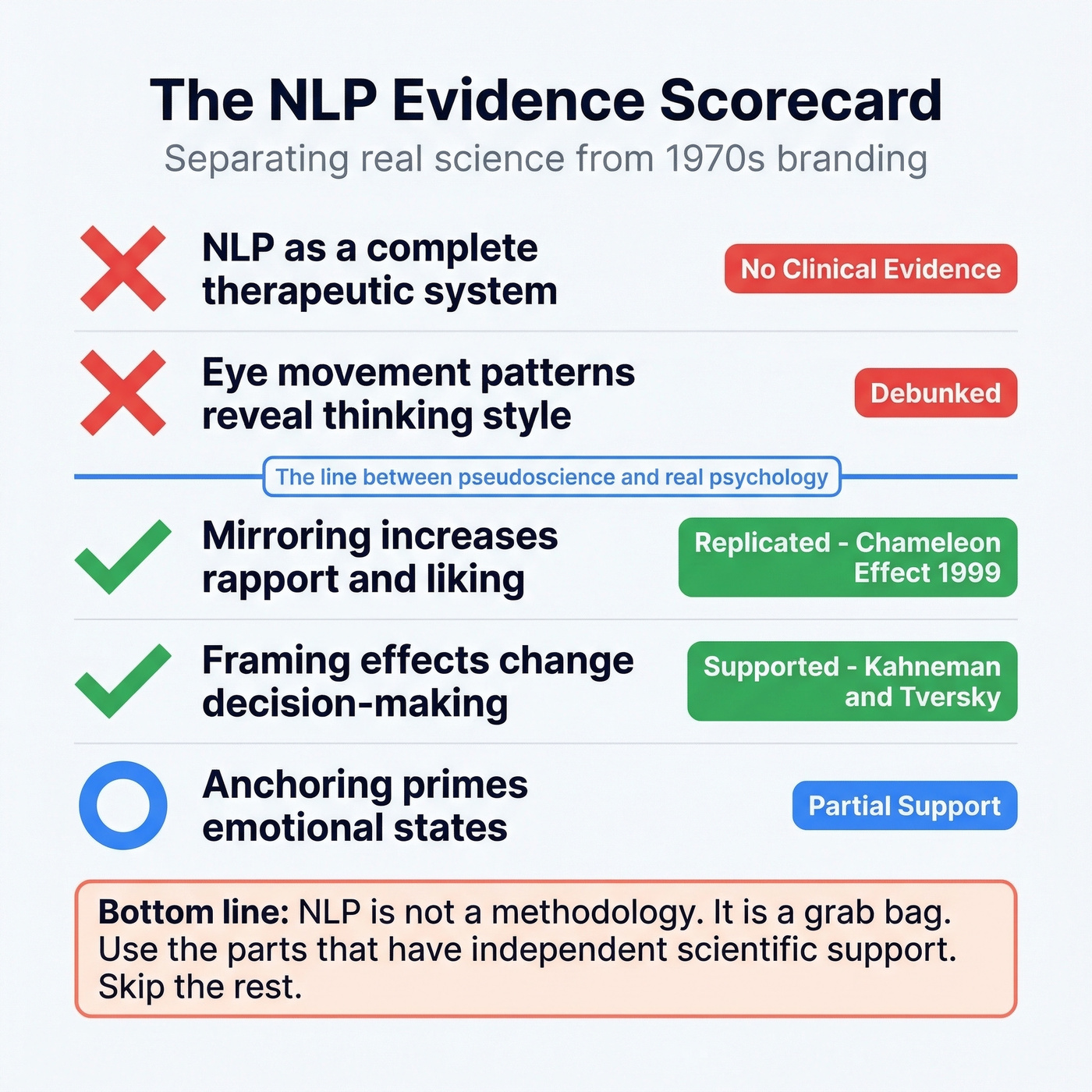
NLP trainers love citing six-figure revenue improvements with zero verifiable data behind them. That should make you skeptical.
But here's the pivot that matters: some component behaviors - mirroring, framing, anchoring - have support in social psychology research entirely separate from NLP's branded framework. The Chameleon Effect, documented by Chartrand and Bargh in 1999, showed that people unconsciously mimic interaction partners and this mimicry increases liking and rapport. That's real science, replicated multiple times.
Let's be honest about what NLP really is: it isn't a sales methodology. It's a grab bag of communication techniques wrapped in 1970s branding. The useful parts are just good communication - and those are absolutely worth learning. If you can only change one thing about your outbound this quarter, match your prospect's speaking pace on calls. It's the highest-ROI communication adjustment we've seen.
6 NLP Techniques That Move the Needle
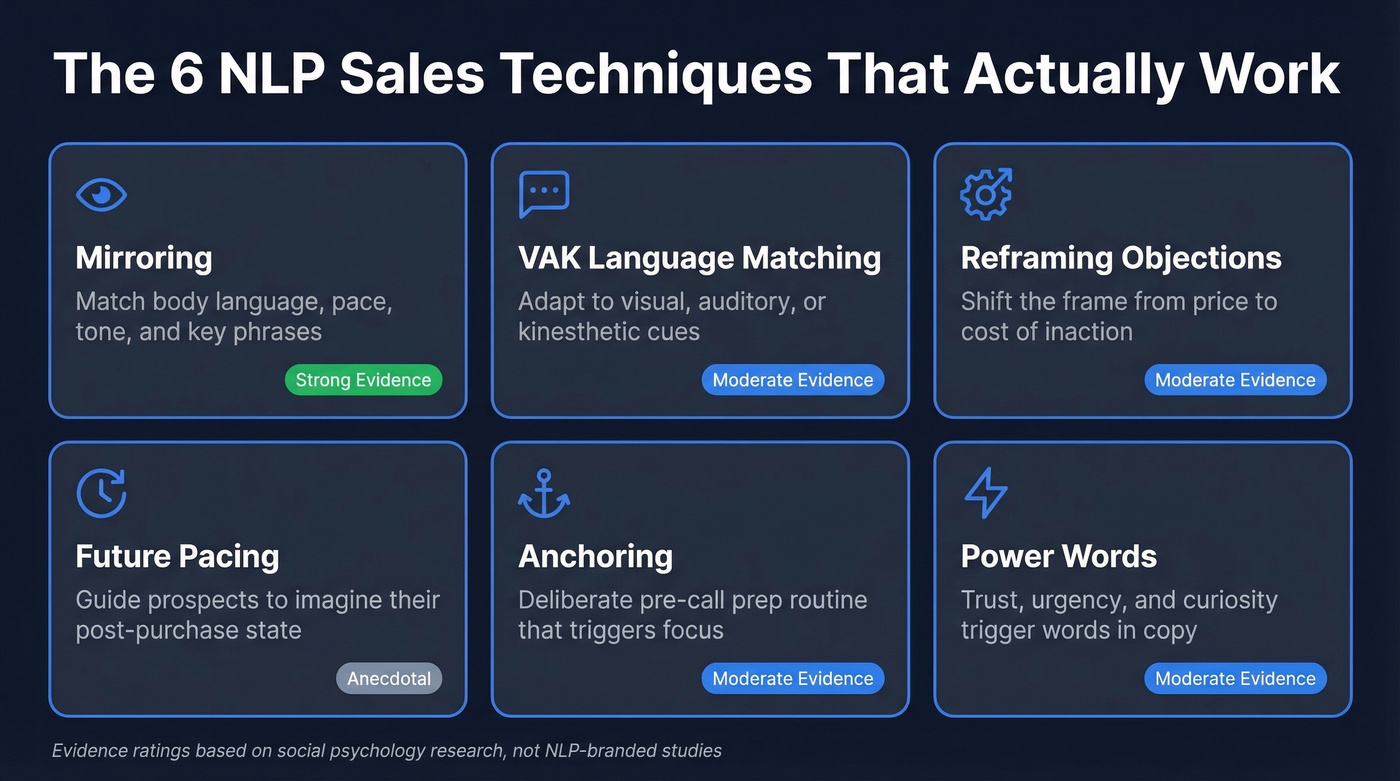
Mirroring
Use this if: You want the single most evidence-backed rapport technique available.
Skip this if: You tend to overdo things. Mirroring that feels forced destroys trust faster than no mirroring at all.
The practical dimensions are body language (posture, gestures), voice (pace, volume, tone), energy level, and phrasing (echoing key words the prospect uses).
Unmirrored: Prospect speaks slowly, measured. You barrel in at double speed: "Hey! Super excited to connect - we've got an incredible platform that's going to transform your outbound!"
Mirrored: You match their pace and tone: "Hi, appreciate you picking up. I'll keep this brief - wanted to share something relevant to how your team's handling outbound right now."
The difference is subtle but the prospect's nervous system registers it. In our experience across hundreds of discovery calls, mirroring is the one technique that consistently moves the needle on rapport - and we've tested plenty of frameworks that didn't. If it feels like you're performing, break the mirror and just be natural. Forced rapport is worse than no rapport.
VAK Language Matching
People process information through dominant sensory channels: Visual, Auditory, or Kinesthetic. Listen for cue phrases, then match your language to their modality.
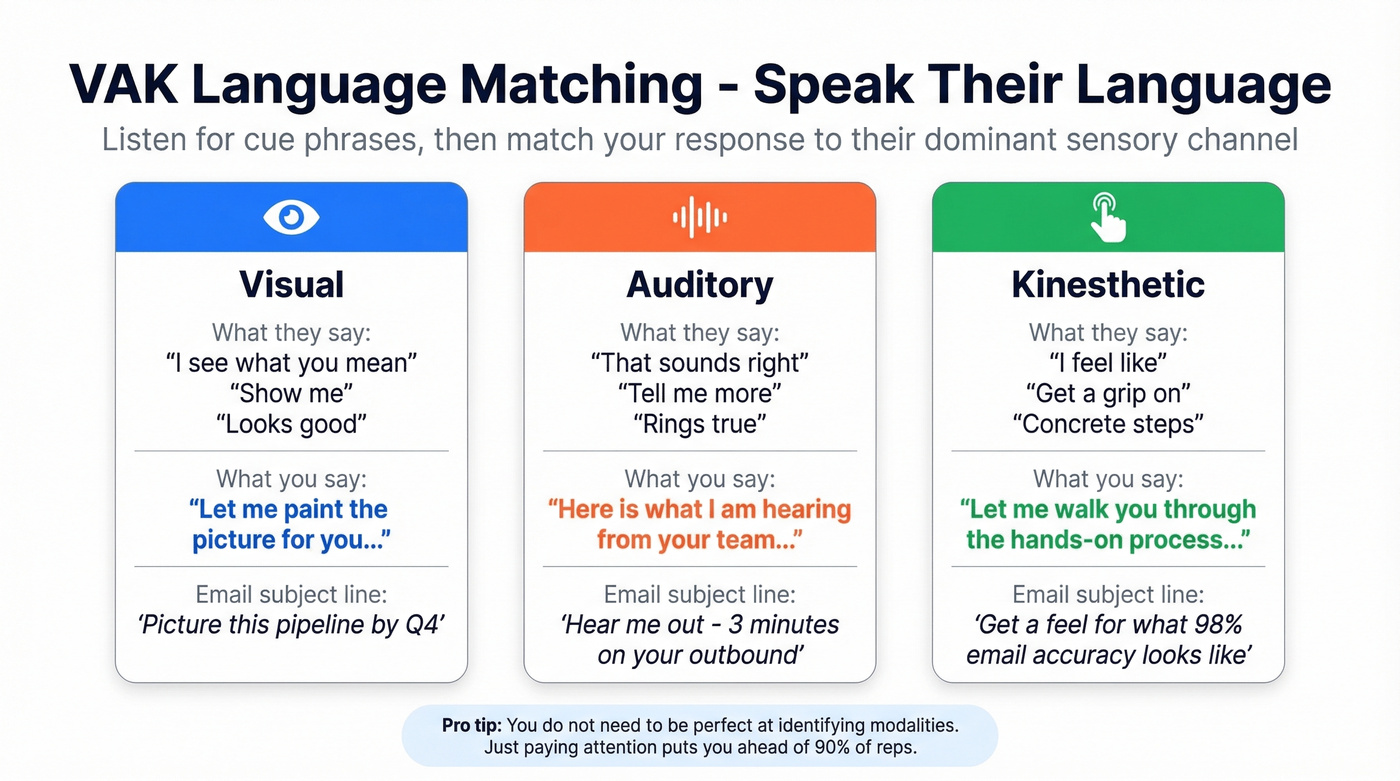
| Modality | Prospect cue phrases | Your adapted response |
|---|---|---|
| Visual | "I see what you mean," "Show me," "Looks good" | "Let me paint the picture for you..." |
| Auditory | "That sounds right," "Tell me more," "Rings true" | "Here's what I'm hearing from your team..." |
| Kinesthetic | "I feel like," "Get a grip on," "Concrete steps" | "Let me walk you through the hands-on process..." |
This translates directly to email subject lines. Visual: "Picture this pipeline by Q4." Auditory: "Hear me out - 3 minutes on your outbound." Kinesthetic: "Get a feel for what 98% email accuracy looks like."
You don't need to be perfect at identifying modalities. Just paying attention to how someone talks - and adjusting accordingly - puts you ahead of 90% of reps who use the same script regardless of who's on the other end.
Reframing Objections
Standard objection handling meets the objection head-on. NLP-style reframing shifts the frame entirely, changing what the prospect evaluates.
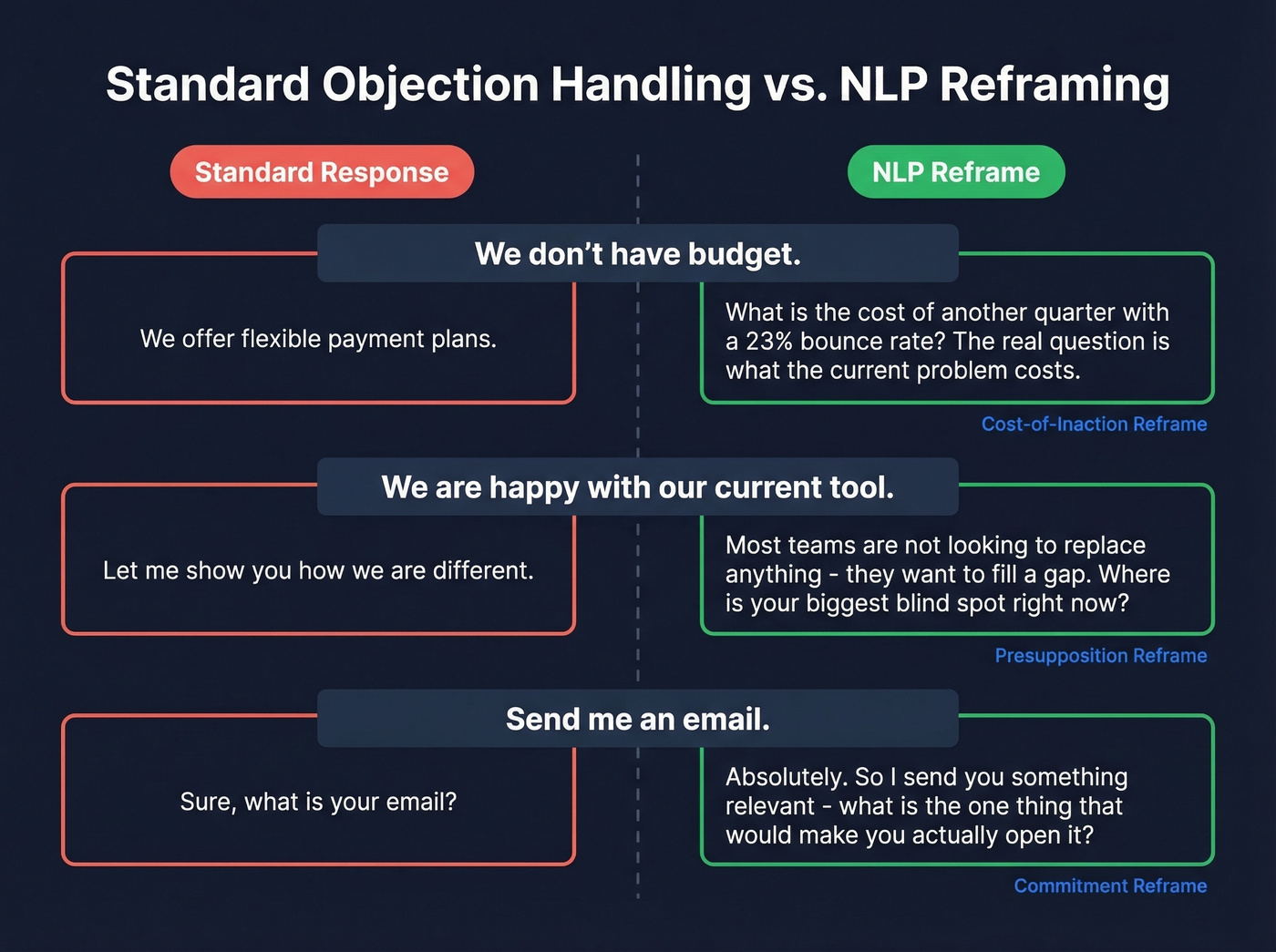
"We don't have budget."
Standard: "We offer flexible payment plans."
Reframed: "What's the cost of your team spending another quarter with a 23% bounce rate on outbound? The budget question isn't what this costs - it's what the current problem costs." This is a cost-of-inaction reframe. You're shifting the evaluation from price to pain.
"We're happy with our current tool."
Standard: "Let me show you how we're different."
Reframed: "That's great - most teams I talk to aren't looking to replace anything. They're looking to fill a gap their current tool doesn't cover. Where's your biggest blind spot right now?" This is a presupposition reframe - it assumes a gap exists and invites the prospect to name it.
"Send me an email."
Standard: "Sure, what's your email?"
Reframed: "Absolutely. So I send you something relevant - what's the one thing that'd make you actually open it?" This is a commitment reframe. You get a micro-agreement before hanging up.
Future Pacing
Future pacing means guiding the prospect to imagine their post-purchase state - the NLP version of "sell the outcome, not the feature," but with specific sensory language.
On a discovery call: "Imagine it's Q4 and your team has already hit 110% of quota. Your reps aren't spending two hours a day finding contacts - they're spending that time in conversations. What would that change about how you plan next year?"
The technique works because it creates an emotional anchor to a positive future state. The warning: if you do this every other sentence, you sound like a hypnosis script. One future pace per call, placed after you've established the problem, is the sweet spot.
Anchoring
In NLP theory, anchoring means associating an emotional state with a sensory trigger so you can recall it on demand. The practical version for sales is simpler than the theory suggests.
Before a high-stakes call, review the prospect's company for 60 seconds, rehearse your opener out loud, take one deep breath. That sequence becomes your anchor - it shifts your brain from "scrolling mode" to "performance mode." Skip the essential oils and power poses. The evidence-backed version is just deliberate preparation that triggers focus.
Power Words
Certain words trigger predictable psychological responses. Group them by goal:
Trust: Guarantee, Proven, No risk, Verified, Backed
Urgency: Now, Limited, Today, Before [date], While
Curiosity: Secret, Discover, Behind-the-scenes, Revealed
Cold email subject line examples: "Proven: how [Company] cut bounce rates by 31%" ... "Limited spots - 15-min pipeline audit this week" ... "The outbound secret your competitors already found."
Power words work because they're specific and emotionally loaded. Generic subject lines like "Quick question" trigger nothing. Pick one angle per message - overloading urgency words makes you sound like a late-night infomercial.
NLP Cold Call Scripts
The PSB (Problem-Solution-Benefit) Framework
Step 1 - Problem statement using a reframe: "Most sales teams I talk to are burning 30-40% of their call block on disconnected numbers. That's not a data problem - that's a pipeline problem."
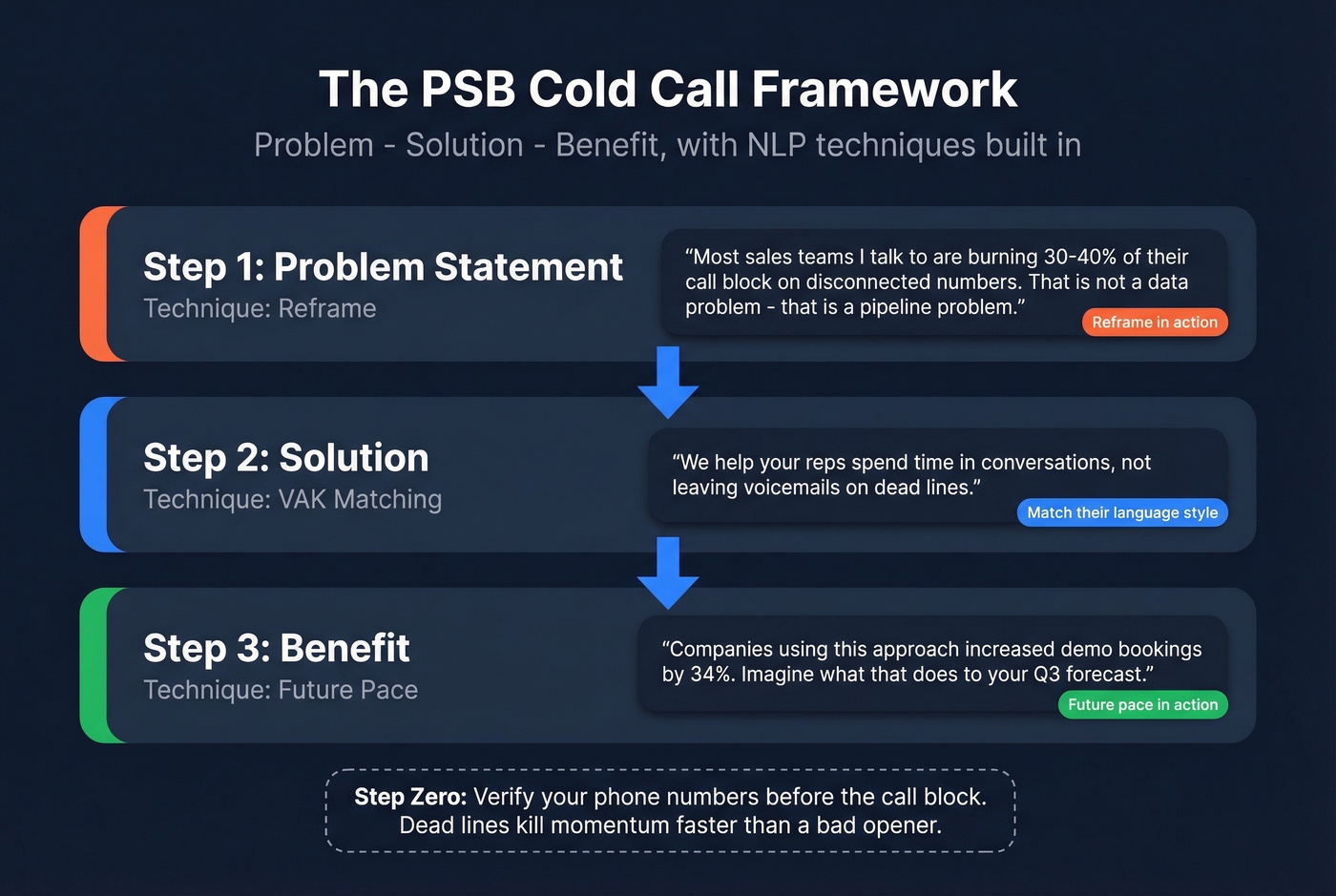
Step 2 - Solution matching their language: "We [describe what you do] so your reps spend time in conversations, not leaving voicemails on dead lines."
Step 3 - Benefit with a future pace: "Companies using PSB-style scripts have increased demo bookings by 34%. Imagine what that does to your Q3 forecast."
The "Before You Hang Up" Pattern Interrupt
When a prospect says "not interested" within the first five seconds:
"Totally fair - and I'm not going to pitch you. Before you hang up: are your reps currently dealing with bounce rates above 10% on outbound? If not, I'll never call again."
The prospect expects you to push harder. Instead, you ask a single diagnostic question that reframes the conversation from "sales call" to "problem identification."
Here's the thing nobody talks about: step zero of any cold call block is verifying your numbers. Dead lines kill momentum faster than a bad opener. We've seen teams obsess over NLP scripts while ignoring the fact that 30% of their phone numbers are disconnected. Prospeo runs real-time mobile verification and delivers a 30% pickup rate, so your reps actually get live conversations to practice these techniques on.

You just learned to reframe 'we don't have budget' - but that objection never happens if your emails bounce. Prospeo's 98% email accuracy and 7-day data refresh mean your NLP techniques land in real inboxes, not spam folders. At $0.01 per email, bad data is the objection you can't reframe.
Master the conversation. Let Prospeo master the contact data.
NLP for Email and Outreach
A lot of NLP sales content over-indexes on in-person mirroring. Modern selling lives in written channels too - and these techniques translate cleanly.
VAK-adapted cold email bodies:
Visual: "Picture your team's dashboard showing 40% more meetings booked this quarter - without adding headcount."
Auditory: "I keep hearing the same thing from VPs of Sales: 'We have the tools, but our data is killing our connect rates.' Sound familiar?"
Kinesthetic: "There's a tangible difference between a team dialing verified numbers and one burning through a stale list. You feel it in the pipeline within two weeks."
Reframed follow-up replacing "just checking in": "Since we last connected, [Company] shipped [specific product update or news]. That changes the math on [problem you discussed]. Worth 10 minutes this week?"
Power word subject lines: "The outbound gap your team hasn't measured" or "Proven framework - 34% more demos in 30 days." These outperform generic openers because they trigger curiosity or trust before the email is even opened.
If you want more plug-and-play messaging, steal from these follow-up templates and adapt them with VAK language.
NLP on Video Calls
Mirroring on Zoom requires different muscles than mirroring in person. Carew's virtual selling research nails the key shifts: vocal pacing carries most of the rapport signal without full body language, so match the prospect's speed and energy first. Mirror nods and facial expressions - a slight nod when they make a point signals active listening through a webcam. Look at the camera when speaking, at the screen when listening, to simulate natural eye contact.
If they're deliberate speakers who pause between thoughts, don't rush to fill silence. That pause is doing work for you.
On a phone call, you mirror voice. On video, you mirror energy. In person, you mirror everything. The principle stays the same - the execution shifts by channel.
The Ethics Question
Look, the critic side is legitimate. NLP lacks scientific validation as a unified system. There's no oversight or regulation - anyone can claim to be an NLP trainer and charge $3,000-$10,000 for certification. The framework has been co-opted by pickup artists and manipulative contexts that have nothing to do with professional selling.
The defender side has a point too. Reputable practitioners stress "do with, not do to" - NLP techniques should create mutual understanding, not coerce. Awareness of communication patterns can actually help people recognize when they're being manipulated by others.
Our stance is simple: use the evidence-backed components transparently. Mirroring someone's communication style to build genuine rapport is ethical. Using "embedded commands" to trick someone into buying something they don't need is not. The line isn't blurry - some NLP trainers just pretend it doesn't exist.
Skip NLP certification entirely. The $3,000-$10,000 is better spent on six months of verified data and actual call practice. Try the free techniques in this guide for 30 days and measure the impact - that'll tell you more than any weekend seminar.
If you want a clearer framework for doing this responsibly, start with a practical guide to ethics in sales.
Before Technique, Fix Your Data
You can master every NLP persuasion technique in this guide, but if half your phone numbers are disconnected and your emails are bouncing, you never get the at-bat. Snyk's 50 AEs were prospecting 4-6 hours per week and watching their bounce rate sit at 35-40%. After switching to Prospeo's verified data, that bounce rate dropped under 5%, and AE-sourced pipeline jumped 180% with 200+ new opportunities per month. Clean data gives your communication techniques a stage to perform on.
If you're seeing bounces, start by benchmarking and fixing your email bounce rate before you rewrite scripts.
Mirroring and future pacing only work when you're actually talking to decision-makers. Prospeo gives you 125M+ verified mobile numbers with a 30% pickup rate - so your reps spend less time hunting contacts and more time using the techniques above.
Stop perfecting scripts for voicemails that never get returned.
How to Measure Results
Companies realize roughly $4.53 for every $1 invested in sales training - a 353% ROI according to a Forbes analysis citing Accenture data. But only 25% of sales orgs directly measure leading-indicator sales behaviors. Most teams adopt a technique, "feel" like it's working, and never validate.
Don't be that team. Track these four KPIs:
- Reply rate - Are NLP-adapted subject lines and body copy getting more responses? (If you need ideas, pull from these email subject line examples.)
- Meeting-booked rate - Are mirroring and reframing converting more conversations to next steps?
- Objection-to-close ratio - Are reframed objections leading to fewer stalled deals?
- Close rate - The ultimate measure. Everything else is a leading indicator.
The A/B testing framework is straightforward: run NLP-influenced messaging on half your call block for two weeks, standard messaging on the other half, compare meeting-booked rates. Keep everything else constant - same time of day, same list quality, same reps.
Honest caveat: you may not be able to isolate NLP from "just paying more attention to how prospects communicate." That's fine. If your meeting-booked rate goes up 15% because you started listening to how people talk, does it matter whether you call it NLP or just "being a better communicator"? (If you want to systematize that, build it into your sales communication standards.)
FAQ
Is NLP pseudoscience?
NLP as a complete system lacks strong clinical evidence - one review of five randomized controlled trials found only one supportive result. Individual techniques like mirroring and reframing are supported by social psychology research, including the Chameleon Effect (Chartrand & Bargh, 1999). The useful parts aren't pseudoscience; the branded packaging is the problem.
Which NLP technique should I try first?
Start with mirroring on your next discovery call - match the prospect's speaking pace and energy level. It's the most evidence-backed technique, the easiest to implement, and the hardest to screw up. You'll notice a difference in conversation quality within a few calls.
Is NLP certification worth it for sales reps?
No. Certifications cost $3,000-$10,000 and aren't required to use mirroring, reframing, or VAK matching. Try the techniques in this guide for 30 days and measure your meeting-booked rate first. The ROI on free practice beats expensive seminars every time.
Can NLP techniques work in cold email?
Yes - VAK language matching, power words, and reframing translate directly to written outreach. Pair sensory language with verified contact data so your carefully crafted messages actually reach inboxes instead of bouncing.
How long before NLP sales techniques show measurable results?
Most reps notice better conversation quality within the first week of consciously mirroring prospects. Measurable improvements in meeting-booked rate typically appear within two to four weeks if you run a disciplined A/B test. Consistency matters - sporadic use won't move the needle.