

NeverBounce vs ZeroBounce: Which Email Verifier Actually Delivers?
The NeverBounce vs ZeroBounce debate usually starts with "which one is more accurate?" and ends with "why are the results so different?" One user on r/coldemail ran 10 emails through 7 different verifiers - NeverBounce, ZeroBounce, Hunter, Debounce, and three others - and got completely different outputs from each one. Ten emails. Not ten thousand.
That's the state of email verification in 2026: tools promising 98-99% accuracy can't even agree on a sample you could count on your fingers.
Both tools work. Neither is as accurate as they claim. And depending on your workflow, you might not need a standalone verifier at all.
30-Second Verdict
Pick ZeroBounce if you want granular result categorization, better support, credits that never expire, and free unknown results. It's the more complete deliverability product.
Pick NeverBounce if you need fast, conservative bulk cleaning and you want a verifier that's part of a ZoomInfo-owned stack. It catches risky emails that ZeroBounce lets through - but it'll also reject more valid ones.
Skip both if your real problem is bad source data. Prospeo finds and verifies emails in a single step with 98% accuracy and 5-step verification, so you spend less time and money on downstream cleaning. Start with better data and the verifier becomes a safety net, not a crutch.
Quick Comparison
Based on G2 comparison data and published pricing pages:
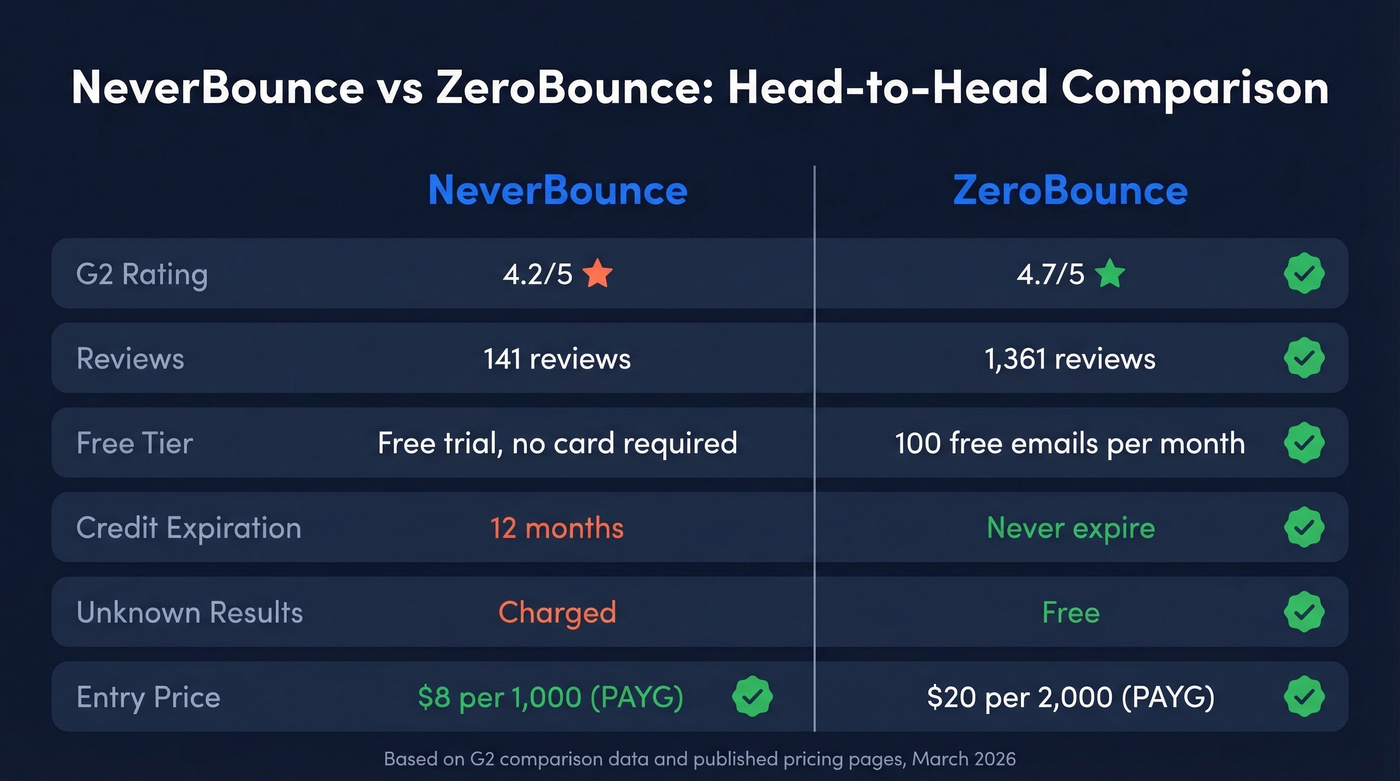
| Category | NeverBounce | ZeroBounce | Edge |
|---|---|---|---|
| Rating (G2) | 4.2/5 (141 reviews) | 4.7/5 (1,361 reviews) | ZeroBounce |
| Founded / Status | Acquired by ZoomInfo, 2019 | Independent | ZeroBounce |
| Free Tier | Free trial (no card) | 100 free/month (business/premium domain) | ZeroBounce |
| Credit Expiration | 12 months | Never | ZeroBounce |
| Lowest Entry Price | $8/1,000 (PAYG) | $20/2,000 (PAYG) | NeverBounce |
ZeroBounce wins most rows. The review gap alone is hard to ignore - nearly 10x the reviews and higher scores on every category: Meets Requirements (9.5 vs 8.4), Quality of Support (9.6 vs 8.2), Product Direction (9.2 vs 7.9). NeverBounce's acquisition by ZoomInfo in 2019 explains some of this. The product is often bundled into a bigger data stack rather than positioned as a standalone indie tool, and that shift shows in the user sentiment.
Here's the thing: ZeroBounce is the better product for most teams. But if your deal sizes are small and you're sending fewer than 5,000 emails a month, you probably don't need either of these - you need cleaner source data.
Accuracy: What the Tests Show
The 563-Email Head-to-Head
A Sparkle.io test ran 563 emails through both tools and found a meaningful split. ZeroBounce marked 61 more emails as safe to send. NeverBounce was more conservative, rejecting those 61 as risky.
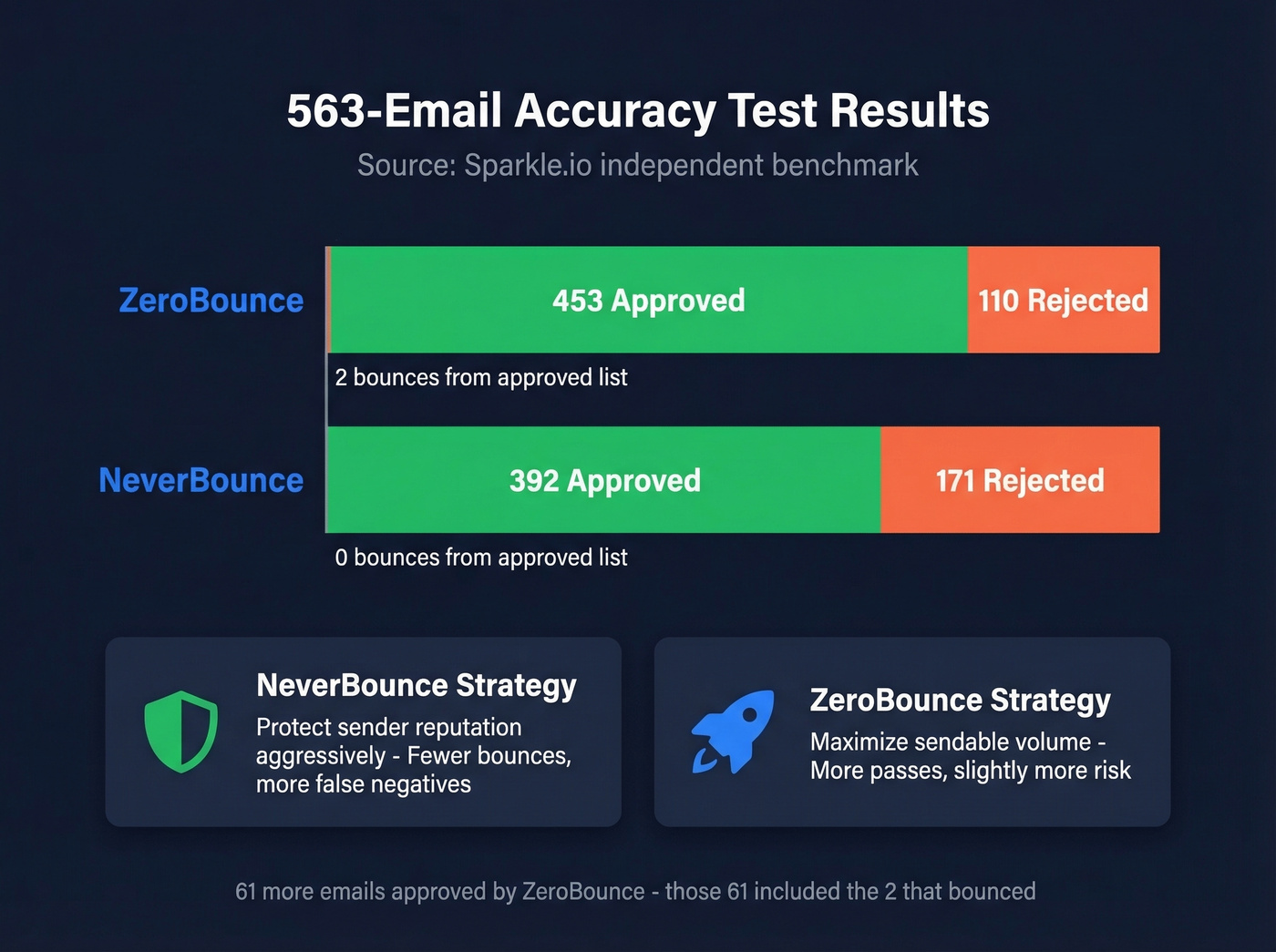
The tester actually sent to both approved lists. ZeroBounce's 453 approved emails produced 2 bounces. NeverBounce had flagged those exact 2 emails as invalid - and its 392 approved emails bounced zero. NeverBounce also finished the entire list in under a minute, while ZeroBounce took noticeably longer.
They optimize for different outcomes:
- NeverBounce: protect sender reputation aggressively (fewer bounces, more false negatives)
- ZeroBounce: maximize sendable volume (more passes, slightly more risk)
Which matters more depends on whether you're more afraid of bounces or missed opportunities.
The Benchmark Nobody Cites
Hunter ran a large-scale benchmark of 15 email verifiers using roughly 3,000 real business emails segmented by company size, executed inside Clay to standardize conditions. The top performers hit 68-70% overall accuracy. Not 98%. Not 99%. Sixty-eight to seventy percent.
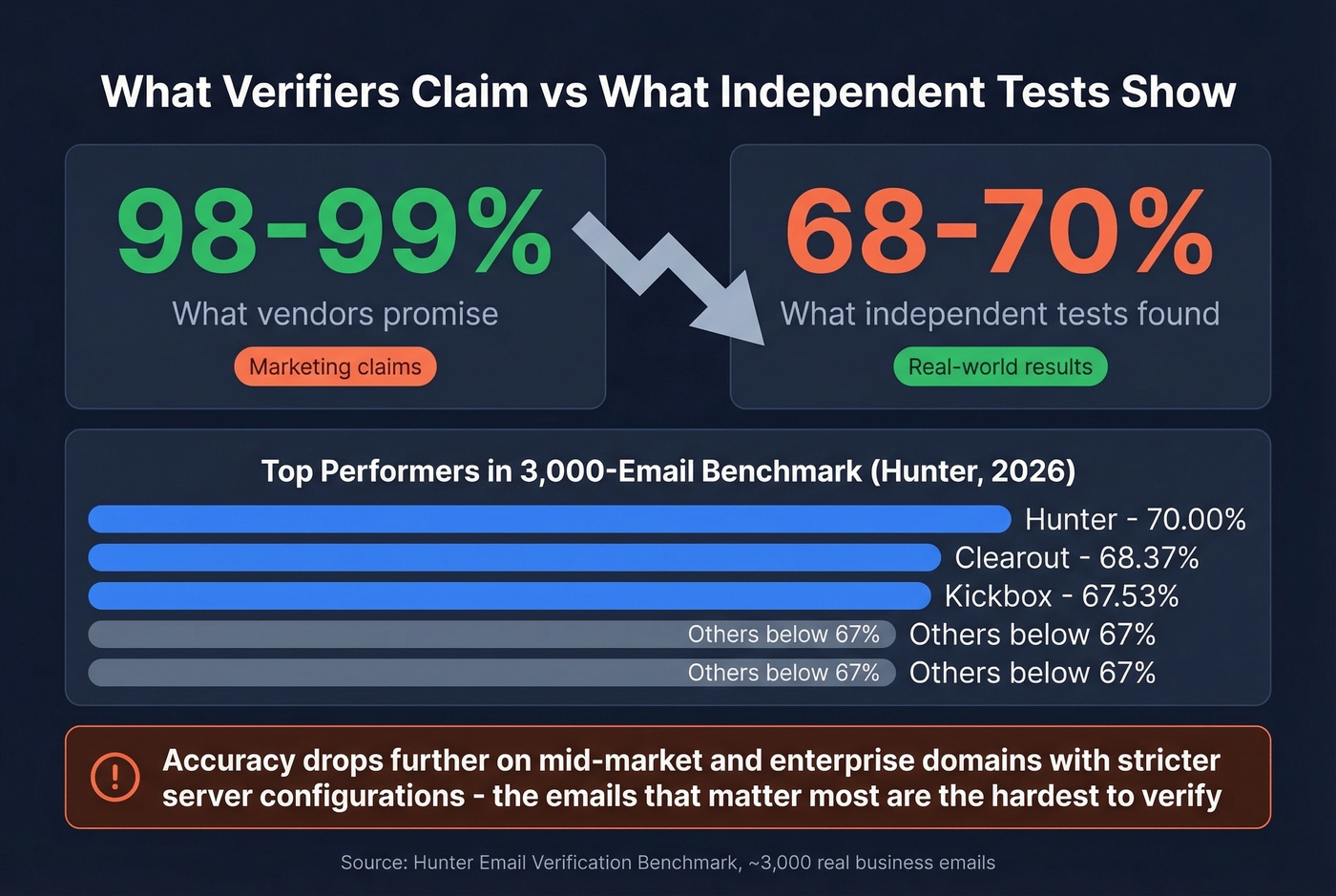
The leaders were Hunter itself (70.00%), Clearout (68.37%), and Kickbox (67.53%). Yes, this is a vendor-authored benchmark, and Hunter acknowledges the dataset bias. But the methodology is the most rigorous publicly available, and the gap between vendor claims and independent results should make you skeptical of any verifier promising near-perfect accuracy.
We've seen this pattern repeatedly: accuracy drops on mid-market and enterprise domains with stricter server configurations. The emails that matter most - decision-makers at real companies - are the hardest to verify correctly.
Catch-All Handling
Catch-all domains are the verification industry's dirty secret. These domains accept all incoming mail - even for inboxes that don't exist - so your verifier gets a false "yes" and marks the email valid.
ZeroBounce provides more granular catch-all status codes, distinguishing between catch-all addresses that show signs of activity and those that don't. NeverBounce tends to be more conservative in what it'll confidently pass.
Practical move: segment catch-all results separately and recheck them every 60-90 days. Catch-all status changes as companies update their email infrastructure, security gateways, and routing rules.

NeverBounce and ZeroBounce top out around 68-70% accuracy in independent tests. That's because verification can only clean what you give it. Prospeo's 5-step verification is built into the email-finding process - 98% accuracy before the email ever hits your list. At $0.01/email, you skip the verifier entirely.
Start with accurate data and stop paying to clean bad data.
Pricing Breakdown
| NeverBounce | ZeroBounce | |
|---|---|---|
| Pay-as-you-go | $8/1,000 credits | $20/2,000 credits |
| Per-email cost (PAYG entry) | $0.008 | $0.010 |
| Subscription | $49/mo (up to 10K) | $99/mo starting tier |
| Credit expiration | 12 months | Never |
| Unknown results | Charged | Free |
NeverBounce looks cheaper per email at first glance, but credit expiration and unknown-result policies change the real cost for teams that don't send consistently or get lots of ambiguous statuses.
True Cost Per Usable Email
Let's break this down with a simple scenario. You upload 10,000 emails. Roughly 15% come back as unknown or catch-all - that's 1,500 emails you can't confidently send to.
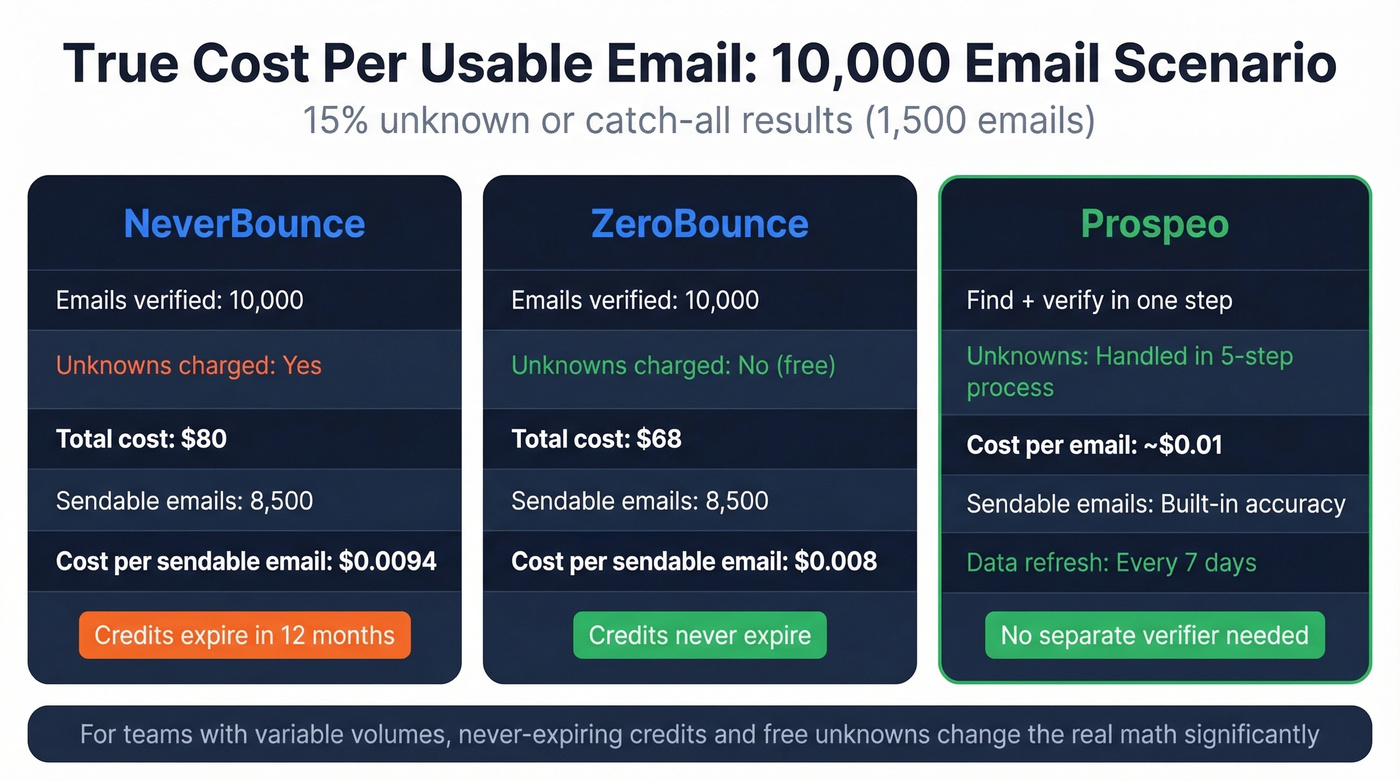
With NeverBounce, you pay $0.008 x 10,000 = $80 to verify the whole file. If you only mail the 8,500 you trust, your effective cost per sendable email is $0.0094. Credits also expire 12 months after purchase, so unused balance vanishes.
With ZeroBounce, unknown results are free, so you're only charged for emails that return a definitive status. If 1,500 come back unknown, you pay for 8,500 checks. At the same $0.008 baseline many teams target at volume, that's $68 for 8,500 billable verifications - $0.008 per sendable email. And your credits never expire.
For teams with variable sending volumes or seasonal campaigns, never-expiring credits are worth the slightly higher sticker price.
What 1,500+ Users Say
NeverBounce: Fast and Simple, Fading Support
NeverBounce scores 4.2/5 across 141 reviews. Users praise the speed and simplicity - it does one thing and does it fast. The UI is straightforward, bulk uploads are painless, and the API is reliable for automated workflows.
Complaints cluster around two themes. First, support: the Quality of Support score sits at 8.2, and Product Direction scores a concerning 7.9. One user on Software Advice reported being automatically charged a full annual fee instead of monthly, then getting ghosted by support when they tried to resolve it. Second, the ZoomInfo factor: since the 2019 acquisition, NeverBounce has drifted toward enterprise procurement patterns. The indie, scrappy product feel is gone, and the roadmap feels like it's serving ZoomInfo's priorities, not standalone verification users.
NeverBounce's reviewer base skews about 49.6% small-business, compared to ZeroBounce's 69.1% - which partly explains the satisfaction gap, since SMBs value responsive support more than enterprise buyers do.
ZeroBounce: Premium Product, Premium Price
ZeroBounce's 4.7/5 across 1,361 reviews tells a different story. Meets Requirements scores 9.5. Quality of Support hits 9.6. Users consistently highlight the detailed validation results - you don't just get "valid" or "invalid," you get granular status codes that help you make smarter decisions about borderline emails.
The main complaint is price. "Expensive at scale" is a recurring theme, and Reddit threads regularly surface users looking for cheaper alternatives with similar accuracy. Million Verifier gets mentioned as a budget option, but users note it misses unregistered domains and invalid TLDs that ZeroBounce flags correctly.
You get what you pay for with ZeroBounce. The 24/7 live support, the never-expiring credits, the free unknowns - those policies cost money to maintain. For teams verifying under 50K emails a month, the premium is often worth the peace of mind.
Fix the Data, Not Just the Verifier
Look - if you're spending $100+ per month on email verification, the problem probably isn't the verifier. It's your source data.
Prospeo takes a different approach: find and verify in one step. Its database covers 300M+ professional profiles with 143M+ verified emails, all running through a 5-step verification process that includes catch-all handling, spam-trap removal, and honeypot filtering. The data refreshes every 7 days, compared to the 6-week industry average, so you're not verifying stale emails for contacts who changed jobs two months ago.
At around $0.01 per email, the cost is comparable to verification alone, but you're getting email discovery and verification bundled together. That eliminates the entire "scrape a list from somewhere, then clean it with a verifier" workflow. In our experience, most teams reduce standalone cleaning significantly once they switch to pre-verified source data, then only re-check edge cases like catch-all segments before a big send.
If you're still cleaning lists, it helps to understand email bounce rate benchmarks and how they impact deliverability.
Catch-all headaches, expiring credits, unknown results you still pay for - standalone verifiers add cost and complexity to a problem that starts upstream. Prospeo's proprietary infrastructure finds, verifies, and delivers 143M+ emails with 98% accuracy and a 7-day refresh cycle. One tool. One step. No cleanup.
Replace your verifier with a source that doesn't need one.
Who Should Choose What?
Choose ZeroBounce when you want richer status codes, stronger support, and credit policies that don't punish inconsistent sending.
If you're pairing verification with outreach, make sure your cold email marketing setup (domains, volume, and sequencing) matches the risk level of your list.
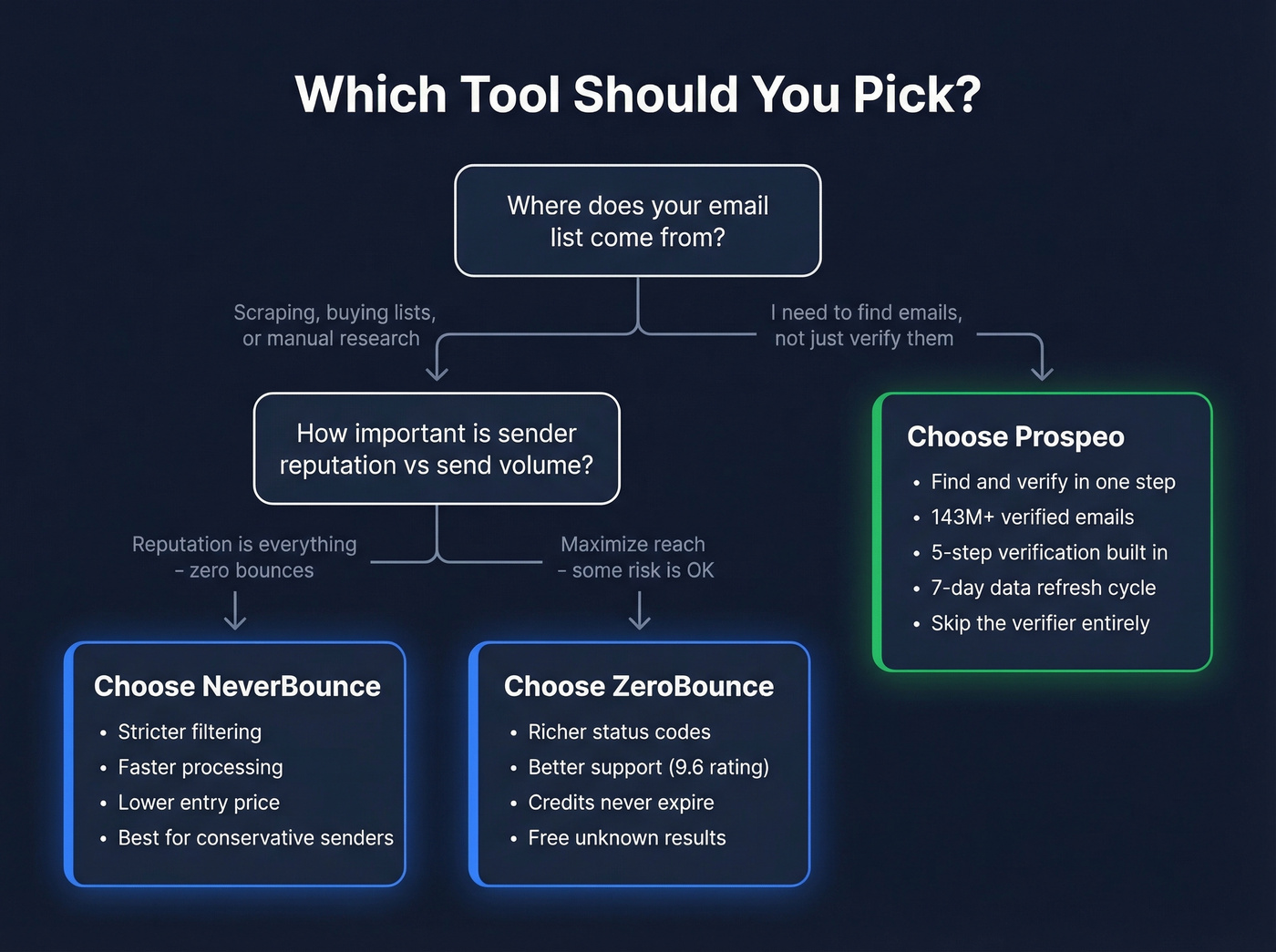
Choose NeverBounce when you want speed and stricter filtering that prioritizes reputation protection over maximum send volume.
If your pipeline starts with shaky lists, fix the upstream data first. In that scenario, the NeverBounce vs ZeroBounce decision matters less than switching to a source that finds and verifies contacts before they ever hit your sequencer.
FAQ
Is ZeroBounce more accurate than NeverBounce?
ZeroBounce typically approves more addresses, while NeverBounce blocks more borderline ones - so "more accurate" depends on your goal. In a 563-email test, 2 emails that bounced from ZeroBounce's approved list were correctly flagged by NeverBounce, but ZeroBounce also allowed 61 additional sends.
Do NeverBounce credits expire?
Yes - NeverBounce credits expire 12 months after purchase, which can raise your effective cost if you verify in bursts. ZeroBounce credits never expire, so it's usually a better fit for seasonal campaigns or inconsistent monthly volume.
Which is faster for bulk verification?
NeverBounce is faster. It processed 563 emails in under a minute and claims roughly 3 minutes for 10,000 emails, while ZeroBounce takes longer but returns more granular status codes for segmentation.
Can I skip standalone verification entirely?
For many outbound teams, yes. Using pre-verified data from a platform like Prospeo reduces the need for a separate cleaner. You'd mainly re-check catch-all segments or older lists before a large send.