

Odoo vs Salesforce: Which CRM Is Worth Your Money in 2026?
The Odoo vs Salesforce debate usually gets framed like a simple CRM shootout. It isn't. Your CFO is questioning the Salesforce renewal, your sales manager is annoyed that Odoo logs activities in unexpected places, and you're stuck choosing what actually deserves budget.
Here's the thing: Odoo is an ERP that includes a CRM. Salesforce is a CRM that built an entire operating system around selling. If you compare them only on "CRM features," you'll pick the wrong one.
30-Second Verdict
Choose Odoo if you need ERP + CRM under one roof, have fewer than 50 users, and want costs you can predict without a consultant decoding your invoice.
Choose Salesforce if your sales team is the engine of your business, you need deep CRM automation and AI, or you're mid-market to enterprise with complex workflows.
Skip both if you just need clean prospecting data and a straightforward outbound workflow. Whichever CRM you pick, it's only as good as the data inside it - and that's where pipeline ROI actually starts.
Side-by-Side Overview
| Dimension | Odoo | Salesforce |
|---|---|---|
| Core identity | ERP-first | CRM-first |
| G2 rating | 4.1/5 (176 reviews) | 4.4/5 (25,482 reviews) |
| Top segment | Small-biz (68.8%) | Mid-market (46%) |
| Deployment | Cloud, self-hosted | Cloud only |
| Ecosystem | 44k+ apps | 7k+ AppExchange apps |
| Ease of use (G2) | 8.2 | 8.2 |
| Support quality (G2) | 7.8 | 8.1 |
| Open source | Yes (Community) | No |
| Scale signal | 12M+ monthly users | 150K+ paying customers |
| AI capabilities | Built-in automation + add-ons | Einstein + Agentforce |
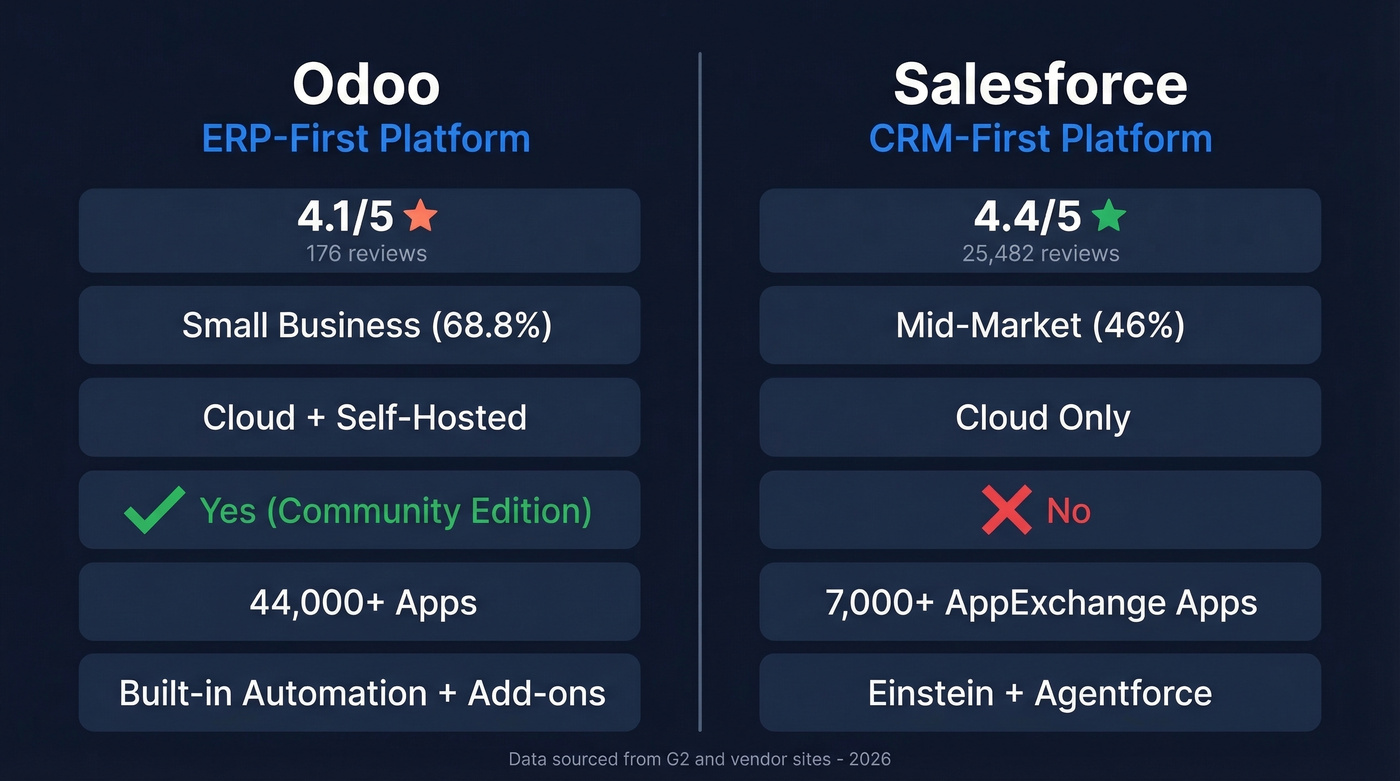
Salesforce's review volume is the real confidence signal here. With 25K+ reviews, its 4.4 rating is far more stable than Odoo's 176-review snapshot. Odoo's reviewer mix also tells you who it fits: it's heavily small-business, which is exactly where "ERP + CRM in one system" is most valuable.
Pricing Breakdown
Salesforce Sales Cloud (2026)
Most comparison pages still cite old pricing tiers. Here's what Salesforce actually charges now:
| Plan | Price/user/mo | Billing | Notable gates |
|---|---|---|---|
| Free Suite | $0 (2 users max) | - | Basic CRM only |
| Starter Suite | $25 | Monthly or annual | AI email sync |
| Pro Suite | $100 | Annual only | Quoting, forecasting |
| Enterprise | $175 | Annual only | Web API, Agentforce |
| Unlimited | $350 | Annual only | Predictive AI, Full Sandbox |
| Agentforce 1 Sales | $550 | Annual only | Full AI agent suite |
In our experience, the Starter to Pro jump is where teams get sticker shock. Forecasting and the broader ecosystem start to matter the moment you're running a real pipeline review cadence - and that's exactly where Salesforce gets expensive.
Odoo Pricing (US Benchmarks)
Capterra's US benchmarks give the cleanest apples-to-apples reference for what teams actually pay:
| Plan | Annual billing | Monthly billing |
|---|---|---|
| One App Free | $0 (unlimited users) | $0 |
| Standard | $31.10/user/mo | $38.90/user/mo |
| Custom | $46.70/user/mo | $58.40/user/mo |
One nuance that genuinely matters: Odoo charges for backend employees, while portal users like customers and suppliers are free. If you have lots of external stakeholders, that pricing model is a quiet advantage.
Cost for Real Teams
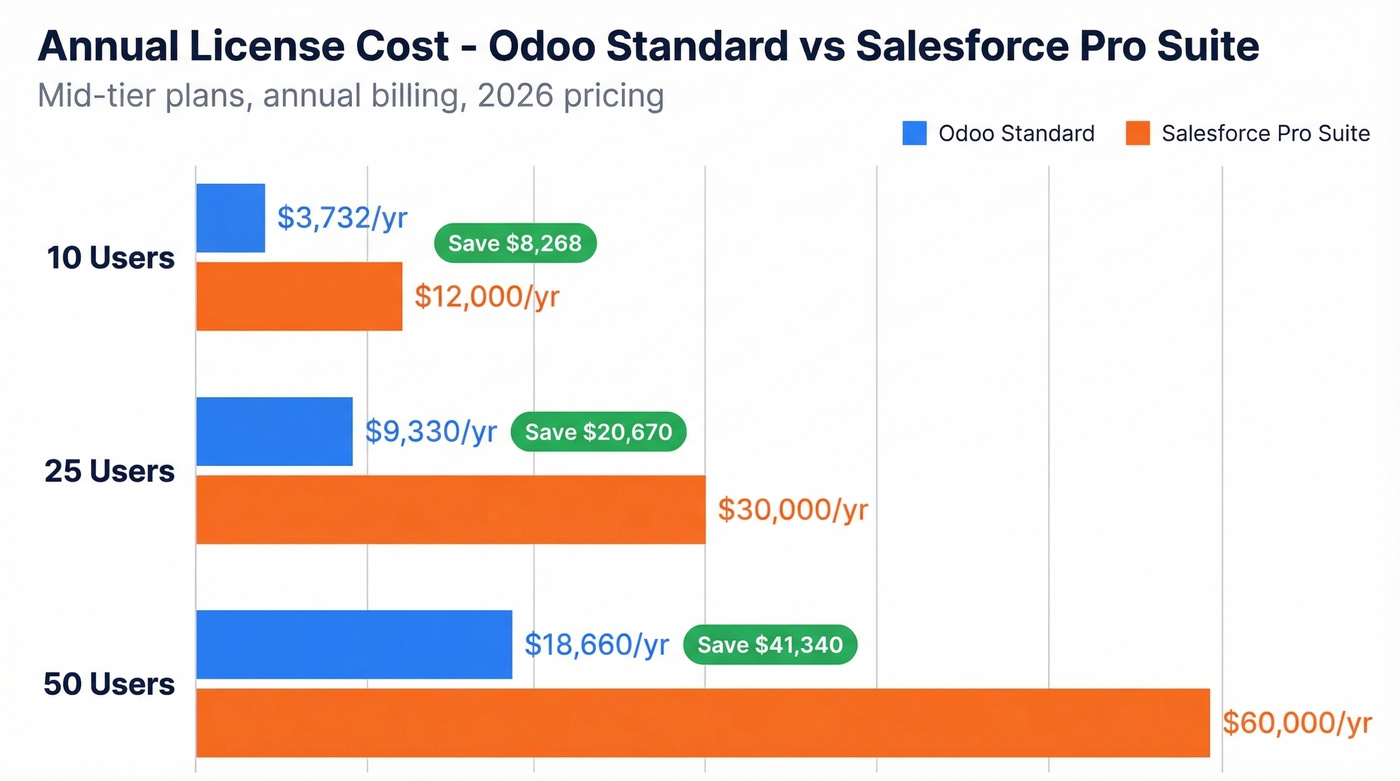
Mid-tier comparison - Salesforce Pro Suite vs Odoo Standard, annual billing:
| Team size | Salesforce Pro | Odoo Standard | Annual gap |
|---|---|---|---|
| 10 users | $12,000/yr | $3,732/yr | $8,268 |
| 25 users | $30,000/yr | $9,330/yr | $20,670 |
| 50 users | $60,000/yr | $18,660/yr | $41,340 |
At 50 users, Odoo wins on license cost by a landslide. The only question is whether you'll give those savings back in implementation and customization.
Total Cost of Ownership
Salesforce Hidden Costs
Salesforce licensing is only part of what you pay for.
Storage overages show up earlier than most teams expect. Salesforce includes limited data and file storage per org, and extra data storage runs about $125/month per 500MB. API limits become a real constraint once you connect your CRM to marketing automation, enrichment, product analytics, and internal systems. When you hit the ceiling, the "fix" is usually a tier upgrade. Premier Support is typically priced as a percentage of license spend, and if Salesforce is mission-critical, most teams end up paying it.
Implementation and training are where budgets get blown up. A professional setup can range from roughly $5,000 to $80,000, and mid-market rollouts climb quickly once you add integrations, data migration, and role-specific training.
A Reddit thread about Salesforce removing long-standing discounts captured the mood perfectly: the user wasn't even angry about paying more - they were angry about paying a consultant thousands just to reshuffle license types.
Odoo Hidden Costs
Odoo's costs are simpler, but they surface in different places.
Hosting for customization is the first one. If you need code-level changes or third-party modules, you're budgeting for Odoo.sh or self-hosting. Implementation services are the big line item - for small businesses, $10,000-$30,000+ is realistic, and for midsize deployments, $50,000+ is common once you're integrating accounting, inventory, manufacturing, and custom workflows.
Success Packs exist for guided implementation, starting around EUR 4,500 depending on scope. In-app purchase credits cover things like SMS and certain automation add-ons. They're not scary, but they're easy to forget until finance asks why the bill keeps changing.
3-Year TCO Model (25 Users)
This is the table we wish more comparison articles would show. It's not perfect - your stack and process maturity matter - but it's directionally accurate for how these tools behave in the real world.
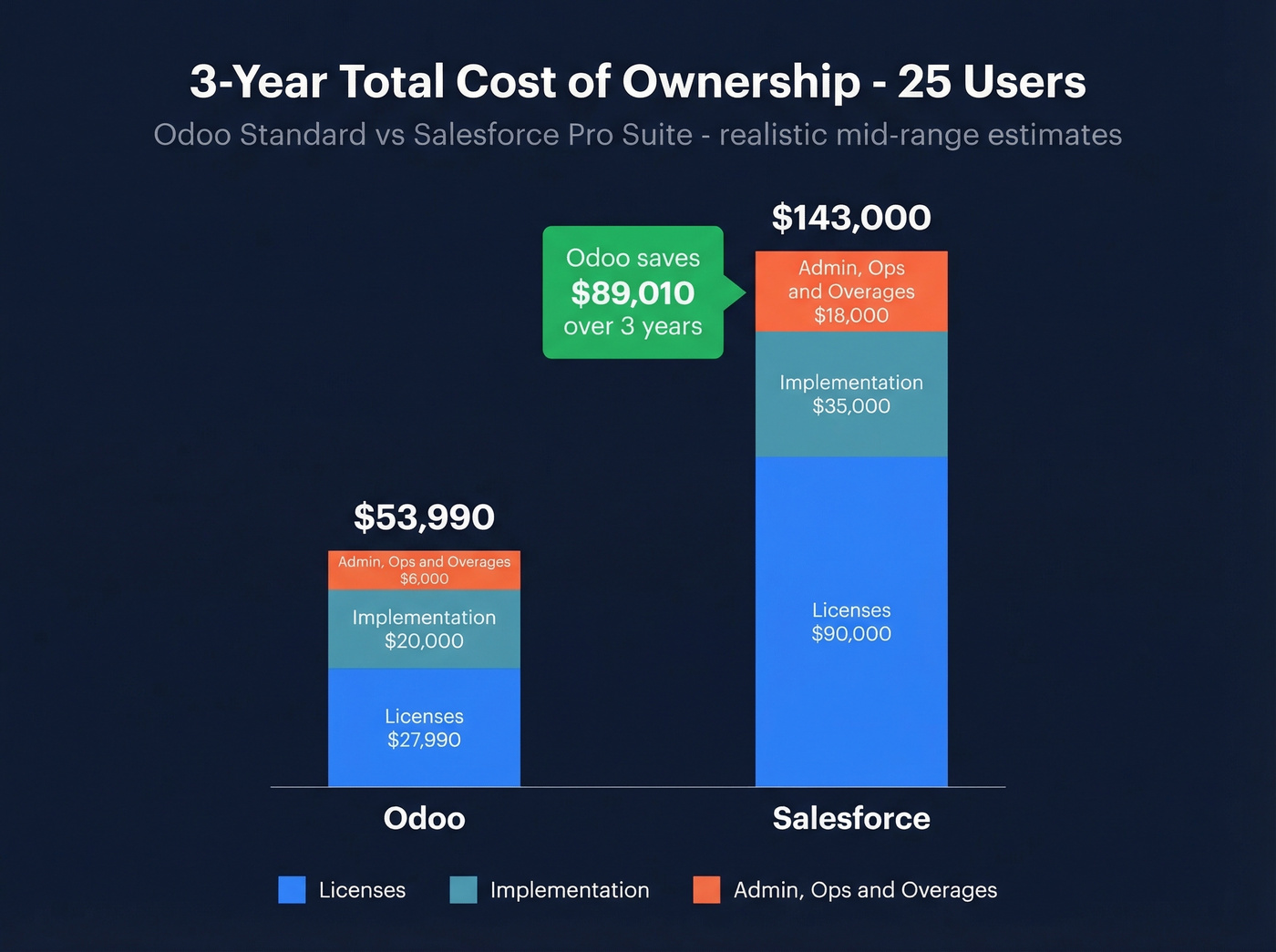
Assumptions: 25 users, Salesforce on Pro Suite ($100/user/mo, annual), Odoo on Standard ($31.10/user/mo, annual), realistic mid-range implementation estimates, and a modest storage/API/ops overage line for Salesforce because most teams add integrations fast.
| Cost component (25 users) | Odoo (Standard) | Salesforce (Pro Suite) | Winner |
|---|---|---|---|
| Licenses (3 years) | $27,990 | $90,000 | Odoo |
| Implementation (one-time) | $20,000 | $35,000 | Odoo |
| Ongoing admin/ops & overages (3 years) | $6,000 | $18,000 | Odoo |
| Estimated 3-year total | $53,990 | $143,000 | Odoo |
If your average deal size is modest and your sales cycle is straightforward, Salesforce is usually overkill. You're paying for power you won't use, then paying again to hire someone to keep that power organized.
For a deeper breakdown of what teams actually pay, see our guide to Salesforce pricing.

You just saw the 3-year TCO gap between Odoo and Salesforce. But here's what no pricing table shows: bad contact data costs more than either CRM. Prospeo enriches your CRM with 98% accurate emails and 125M+ verified mobiles - at $0.01/email. Native integrations with Salesforce and HubSpot mean your pipeline stays clean on a 7-day refresh cycle.
Stop paying for a CRM full of bounced emails and dead numbers.
Feature Comparison

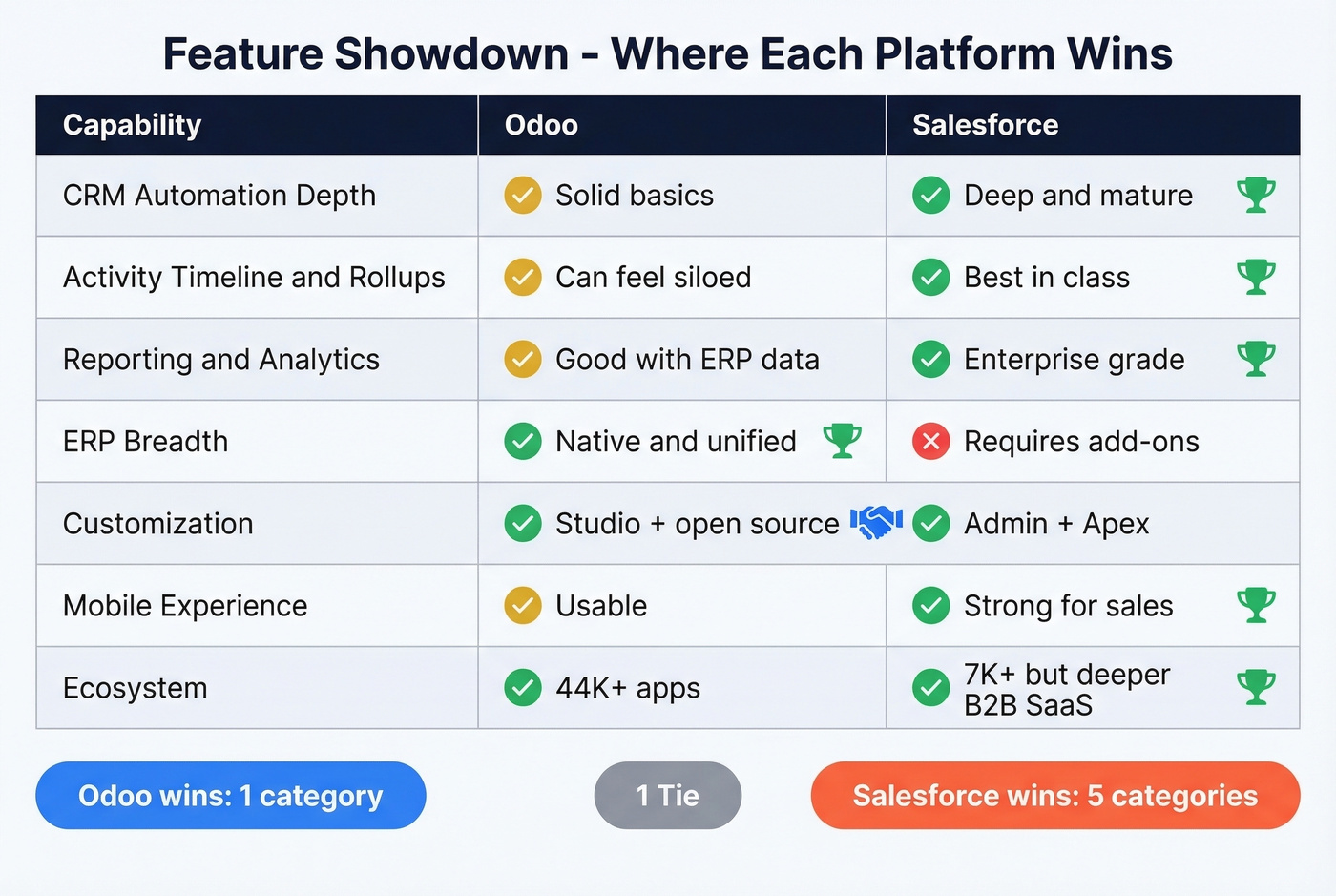
Let's break this down simply: Salesforce wins when "selling" is the product. Odoo wins when "running the business" is the product.
Capabilities That Buyers Argue About
| Capability | Odoo | Salesforce | Winner |
|---|---|---|---|
| CRM automation depth | Solid basics, lighter enterprise workflow tooling | Deep automation, approvals, assignment logic, mature objects | Salesforce |
| Activity timeline & relationship rollups | Works, but can feel siloed by record type | Best-in-class rollups across accounts/contacts/opps | Salesforce |
| Reporting & analytics | Good for ops; strong when paired with ERP data | Excellent; enterprise-grade dashboards and analytics | Salesforce |
| ERP breadth (inventory/accounting/manufacturing) | Native, unified database across apps | Requires add-ons and integrations for ERP-class coverage | Odoo |
| Customization approach | Studio + open-source options | Admin tooling + Apex ecosystem | Tie |
| Mobile experience | Usable, less polished for heavy field selling | Strong mobile for sales orgs | Salesforce |
| Ecosystem | Huge Odoo app library | AppExchange is the default for B2B SaaS connectors | Salesforce |
Where Salesforce Wins
Salesforce's CRM depth is hard to match because it's built for one job: turning activity into revenue. Reps get full interaction history across accounts, contacts, and opportunities without hunting through separate modules. Forecasting and territory management are mature, and the ecosystem is the real moat - there's a connector for almost anything.
If forecasting is a core requirement, compare options in our roundup of sales forecasting tools.
The AI story is real too. Einstein and Agentforce features work when your process is disciplined enough to feed them good data. We've watched teams buy Salesforce "for AI," then never clean their fields, never define stages, and wonder why the outputs look dumb. That's not a Salesforce problem. It's a process problem.
Where Odoo Wins
Odoo's advantage isn't that its CRM beats Salesforce. It doesn't. Odoo wins because inventory, manufacturing, accounting, HR, projects, and e-commerce can live in the same system. That eliminates integration glue and the "why doesn't finance match sales?" arguments that waste weeks every quarter.
For a 20-person manufacturer that needs CRM, inventory, and invoicing in one place, Odoo is the obvious choice. Salesforce would push you into multiple tools and a lot of integration work.
Where Odoo's CRM Frustrates Salesforce Veterans
Odoo's CRM is perfectly workable, but it has workflow quirks that annoy reps trained on Salesforce or HubSpot. A Reddit thread from a Salesforce-to-Odoo migrator called out activity logging behavior where call details live on the Opportunity record rather than rolling up cleanly to the Contact/Company view. That's not a small UX nit - it changes how reps build context before a call.
If your sales org lives and dies by account history, multi-threaded stakeholder tracking, and clean rollups, Salesforce feels like home. Odoo feels like you're adapting your sales motion to the tool.
The "Both" Option
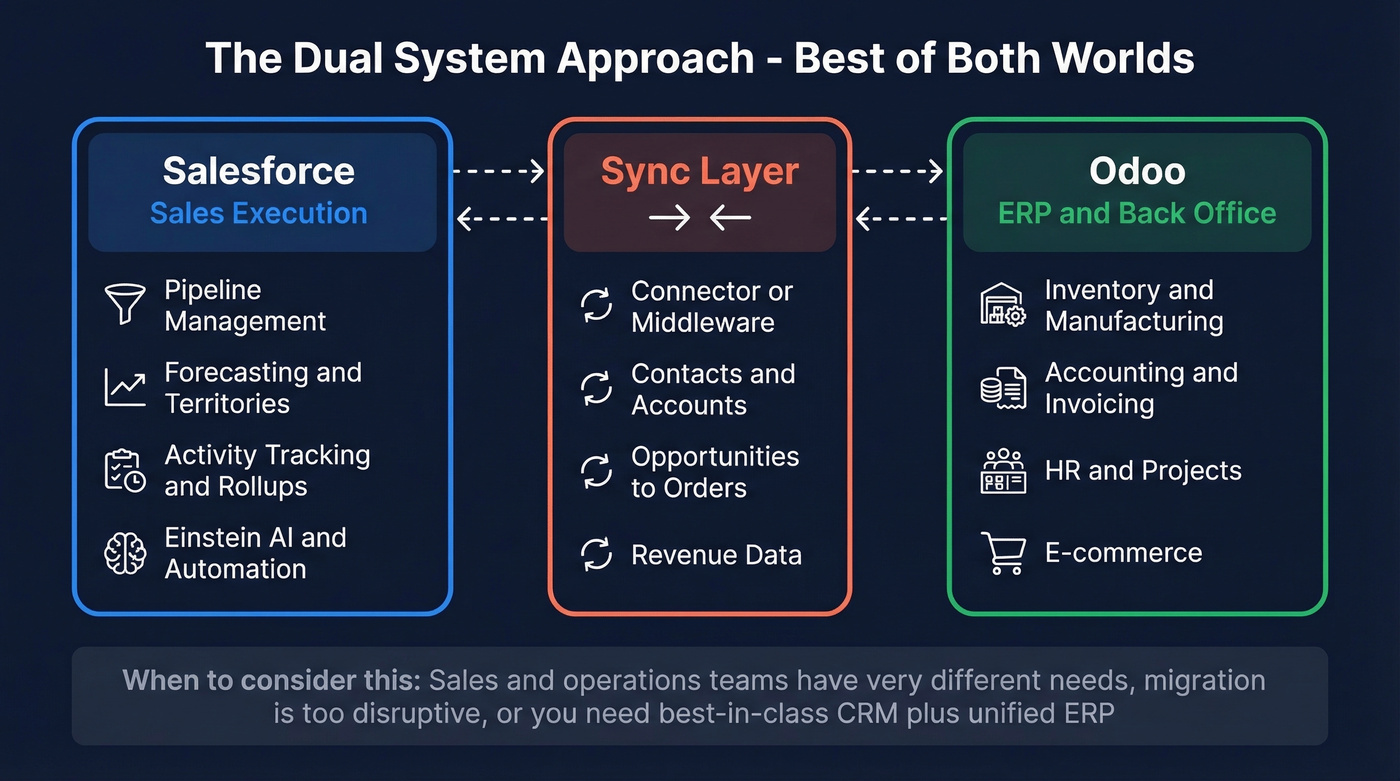
Some companies stop treating this as a cage match and run Salesforce for sales execution while keeping Odoo for ERP/back office, syncing key objects through a connector or middleware. It's not the cheapest route, but it's often the least disruptive when sales and ops have very different needs.
If you're planning a build like this, it helps to map the full lead generation workflow so objects and handoffs stay clean.
What Real Users Say
G2's head-to-head makes the pattern obvious: Salesforce scores higher on "meets requirements" and support, while ease of use is a tie. That tracks with what we see in practice - Salesforce is complex because it's powerful; Odoo is complex because it's broad and its CRM doesn't always behave like a pure-play CRM.
Capterra reviews lean positive on Odoo's value, but implementation is where the "cheap" narrative gets corrected fast.
Community sentiment is blunt. Salesforce users complain about price and licensing games. Odoo users complain about CRM workflow quirks and partner dependency. Pick your poison - or pick the platform that matches what your business actually is.
What Switching Looks Like
Migration between these platforms isn't a weekend project. DD Engineering, a Belgian B2B services firm with 75+ employees, migrated from Salesforce to Odoo starting in October 2023 and rolled out in phases over about five months:
- Phase 1 (Oct 2023): Contacts, CRM, and sales
- Phase 2 (Dec 2023): Recruitment and fleet management
- Phase 2B (Jan 2024): Leave management, eLearning, documents
- Phase 3 (Mar 2024): Projects, timesheets, invoicing, planning
Their rationale was simple: moving to Odoo cost less than optimizing their Salesforce setup, and they got predictable pricing across the apps they needed.
Budget expectations by direction: moving to Salesforce often lands around $10K-$80K depending on complexity, while moving to Odoo often lands around $10K-$30K for SMBs and $50K+ for midsize orgs. Reddit threads on CRM migrations back up the same reality - DIY migrations usually turn into "we rebuilt half the system twice."
Before you import anything, clean the data. Bulk-verifying and enriching contacts before migration means you don't start your new CRM with bounced emails and dead phone numbers. (If you're evaluating vendors, start with this list of data enrichment services.)
Why Data Quality Decides ROI
Both Odoo and Salesforce are containers. Expensive, feature-rich containers - but containers.
Your ROI depends on what you put inside. Neither platform solves data quality for you. Salesforce won't automatically tell you which imported emails will bounce. Odoo won't magically fix outdated phone numbers. That's a separate layer, and it's the layer that decides whether reps book meetings or burn domains.
If you're seeing deliverability issues, start by tracking your email bounce rate and fixing the root causes.
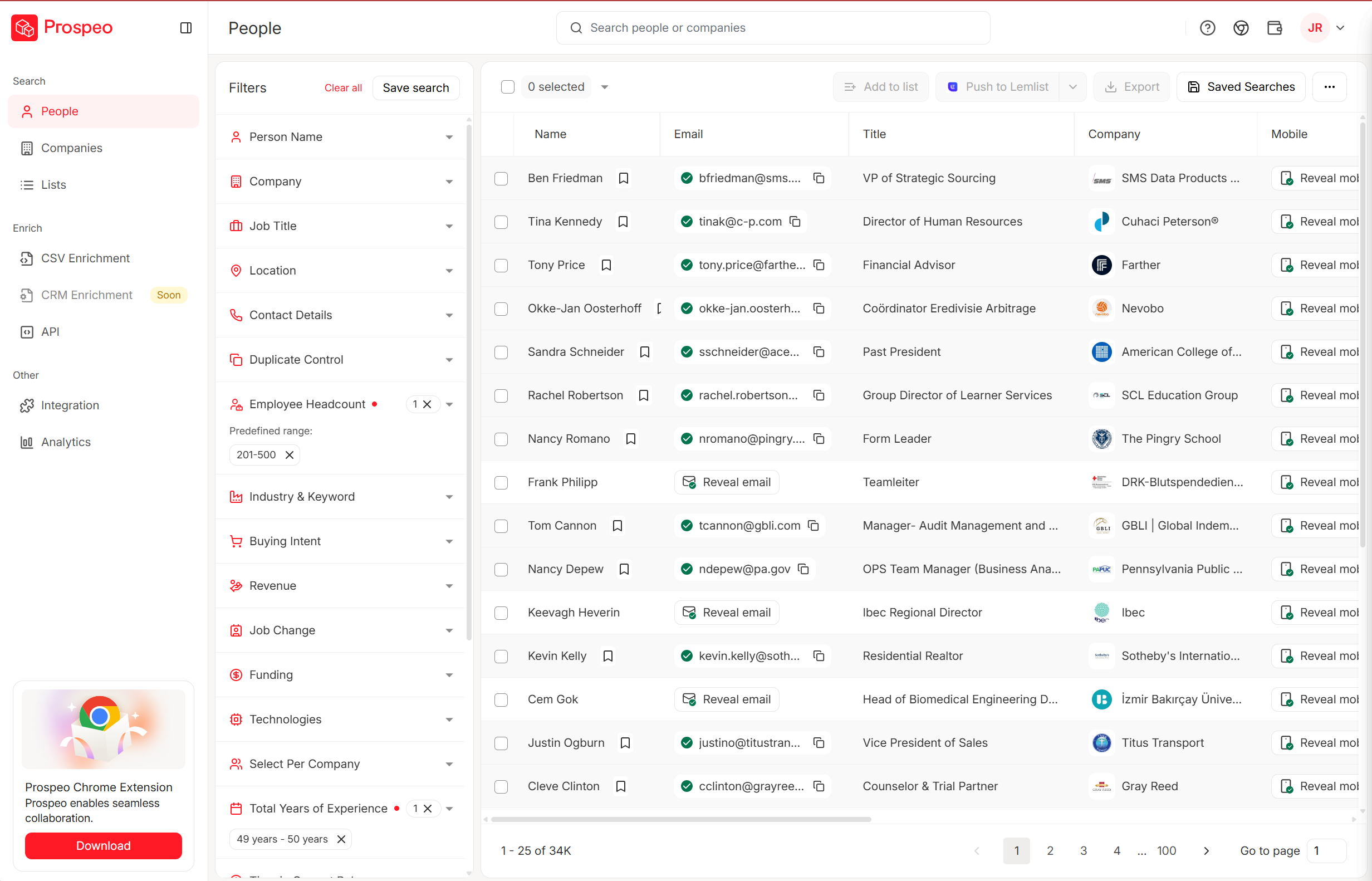
Prospeo has native Salesforce integration and works with any CRM that accepts CSV imports, including Odoo. With 98% email accuracy, a 7-day data refresh cycle, and enrichment returning 50+ data points per contact at an 83% match rate, it's the cleanest self-serve path we've found to keeping CRM data accurate across either platform.
If your outbound motion is still being built, these sales prospecting techniques will help you turn clean data into meetings.
Whether you pick Odoo's affordability or Salesforce's depth, your reps still need real buyer data to hit quota. Teams using Prospeo book 26% more meetings than ZoomInfo users and 35% more than Apollo - because 300M+ profiles verified every 7 days means reps reach actual decision-makers, not outdated records.
Your CRM choice matters less than the data feeding it.
The Verdict
The right Odoo vs Salesforce answer depends on what your business actually is - not which feature checklist looks longer.
Choose Odoo if you're building an operating system for the business. You need ERP and CRM in one platform, your team is under 50 users, cost predictability matters, and you have technical resources or a partner to handle customization. CRM supports the business, but it isn't the business.
Choose Salesforce if you're building an operating system for selling. Sales is your competitive advantage, reps need deep automation, you're mid-market or enterprise with complex workflows, and AI-powered tooling like Einstein and Agentforce is part of your roadmap. You need AppExchange integrations and a mature admin ecosystem.
Choose neither if you're forcing a "platform" decision onto a simple problem. For basic pipeline management, HubSpot's free CRM or Pipedrive will do. And if your real bottleneck is prospect data quality rather than CRM features, solve that first.
If you're still comparing platforms, here are more examples of a CRM with real pricing and best-fit notes.
A $60K/year Salesforce instance full of bounced emails and wrong numbers is worth less than a ~$3,700/year Odoo setup fed with verified contacts. Start with the data layer, then pick the container.
FAQ
Is Odoo really free?
One app is free with unlimited users. The full platform starts around $31.10/user/month on annual billing in the US. Implementation ($10K-$30K for SMBs), hosting for custom code, and add-on credits move the real total cost well above the sticker price.
Can Odoo replace Salesforce for sales teams?
For basic pipeline management, yes. For teams relying on deep activity rollups, mature forecasting, and enterprise-grade automation, Salesforce is the stronger tool. If your reps live in the timeline view all day, Odoo's CRM behavior will frustrate them.
What are Salesforce's biggest hidden costs?
Implementation ($5K-$80K), Premier Support fees, storage overages (~$125/mo per 500MB), and API-limit-driven tier upgrades. The license is the visible line item; operating costs are what turn Salesforce into a serious long-term commitment.
How do I keep CRM data accurate after migration?
Verify and enrich before you import, then refresh on a recurring schedule. Prospeo handles bulk verification at 98% email accuracy and returns 50+ data points per contact, so your new CRM starts clean and stays clean - whether you're on Salesforce or Odoo.