

One-to-Many ABM: What It Actually Costs and How to Run It in 2026
One-to-many ABM separates itself from regular demand gen through three operational commitments: account-list governance, buying-committee coverage, and measuring at the account level instead of counting MQLs. There's a popular take on Reddit that ABM is just "the bare minimum for successful B2B digital marketing" - narrow targeting plus tailored content, repackaged with a buzzword. For one-to-one ABM, that criticism is lazy. For the programmatic tier? It's worth confronting head-on, because without those three commitments, you really are just running demand gen with a fancier name.
What One-to-Many ABM Actually Is
One-to-many ABM - sometimes called programmatic ABM or Tier 3 ABM - targets hundreds to thousands of accounts simultaneously using automation, account-based ads, and dynamic content. It's the high-volume end of account-based marketing: automation-heavy, less personalized, but far more efficient per account.
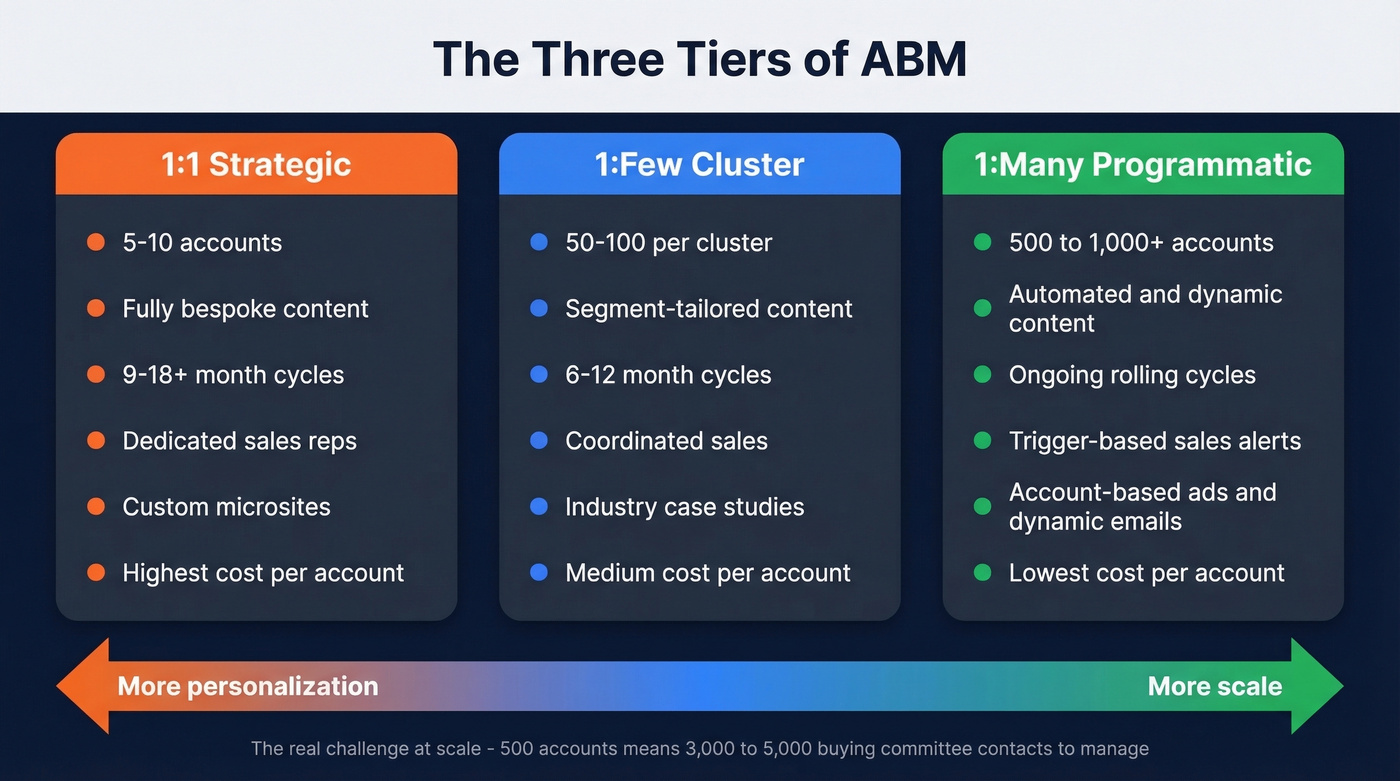
| Dimension | 1:1 (Strategic) | 1:Few (Cluster) | 1:Many (Programmatic) |
|---|---|---|---|
| Accounts | 5-10 | ~50-100 per cluster | Hundreds to 1,000+ |
| Personalization | Fully bespoke | Segment-tailored | Automated/dynamic |
| Timeline | 9-18+ months | 6-12 months | Ongoing cycles |
| Sales involvement | Dedicated | Coordinated | Trigger-based |
| Content | Custom microsites | Industry tracks, segment case studies | Account-based ads, dynamic emails |
Here's the detail most guides skip: the typical B2B buying committee is 6-10 stakeholders. At 500 accounts, that's 3,000-5,000 contacts you need to identify, enrich, and keep current. The real operational challenge isn't the strategy. It's the data plumbing.
ABM Benchmarks in 2026
71% of practitioners now run some form of ABM, and a survey of 771 marketers pegged the average ROI at 137%. Nearly half plan to increase ABM budgets this year, and 78.7% incorporate AI into their programs.
Email dominates at 92% channel usage, followed by in-person events at 72%. The biggest challenge isn't execution - it's proving ROI. 47% of teams struggle with it, followed by sales-marketing alignment (43%) and scaling programs (40%).
How to Execute a 1:Many ABM Program
Define Your ICP and Build the List
Start with the math. If you want 10 closed deals at $100K average and expect a 10% win rate, you need roughly 100 accounts. Scale from there.
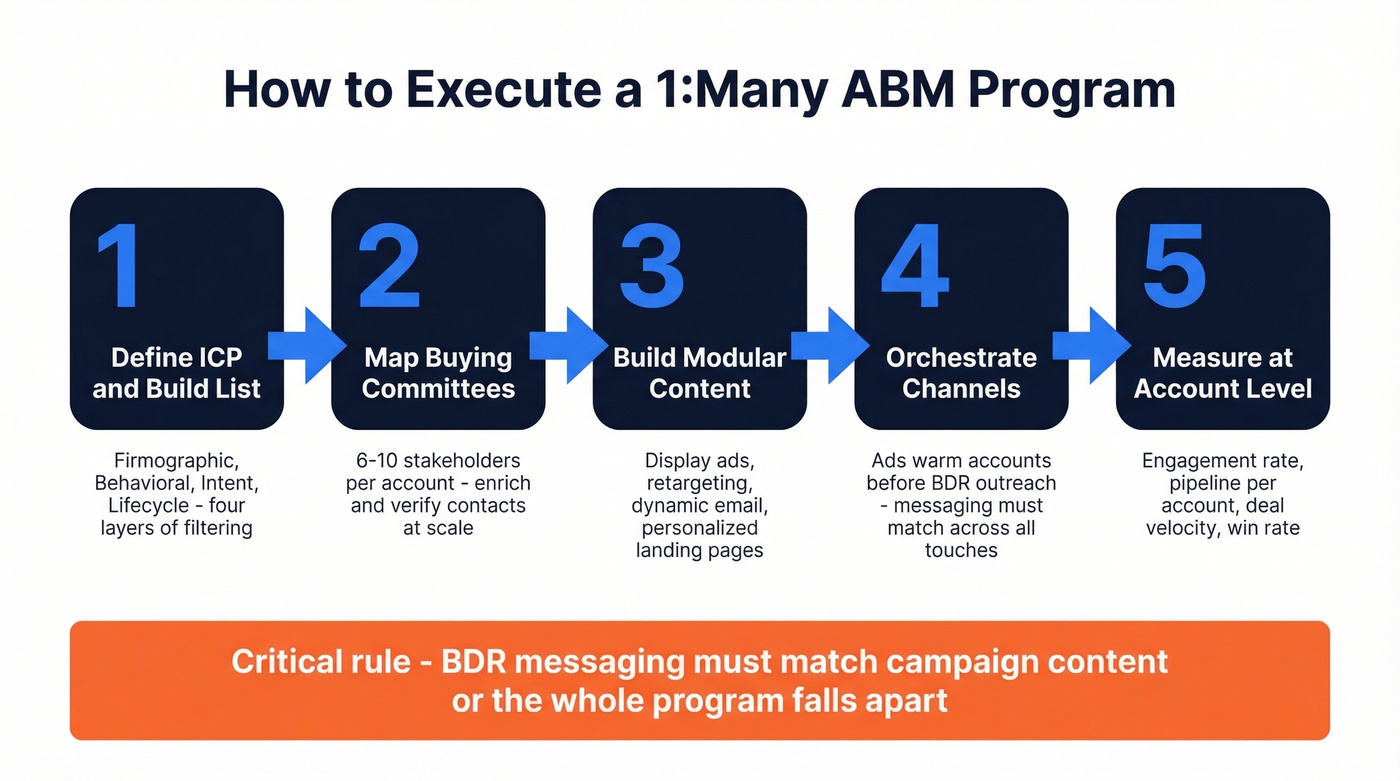
Layer segmentation in four passes:
- Firmographic - industry, headcount, revenue, geography
- Behavioral - site visits, content engagement (remember: 97% of visitors never fill out a form, so don't rely on form fills alone)
- Intent - who's actively researching your category right now
- Lifecycle - new vs. re-engaged vs. closed-lost
Each layer narrows the list and increases relevance. We've found that teams who skip the intent layer end up burning budget on accounts that aren't even in-market - which defeats the whole point of ABM over broad demand gen.
Map Buying Committees at Scale
This is where programmatic ABM either works or collapses.
Build Scalable Content by Segment
The content tier for programmatic ABM has four workhorses: account-based display ads, behavioral retargeting sequences, dynamic email with segment-swapped messaging, and personalized landing pages. You're not writing custom microsites. You're building modular content that assembles differently based on industry, company size, or buying stage.
Let's be honest - most teams over-invest in content production and under-invest in content assembly logic. One strong case study rewritten for three industries beats three mediocre case studies every time.
Orchestrate Across Channels
Email is the backbone, but the real lift comes from layering. Programmatic ads warm accounts before BDR outreach. Direct mail breaks through for high-value segments. The non-negotiable rule: BDR messaging must match campaign content.
When a prospect sees one message in an ad and hears a completely different pitch on a cold call, the outreach feels random - because it is. In our experience, this single disconnect kills more ABM programs than bad targeting or weak content combined.
Measure at the Account Level
If you're still reporting MQLs to your leadership team, you're not running ABM. You're running demand gen with an account list. The metrics that matter:
- Account engagement rate - are target accounts interacting with your content?
- Pipeline per account - how much revenue is each account generating?
- Deal velocity - are ABM-touched deals closing faster?
- Win rate - are you converting at a higher rate than non-ABM deals?
Contact-level attribution creates false negatives because of cookie limitations, ad blockers, and narrow attribution windows. Forrester's ABM research consistently reinforces that account-level measurement is the only reliable approach for multi-touch programs.

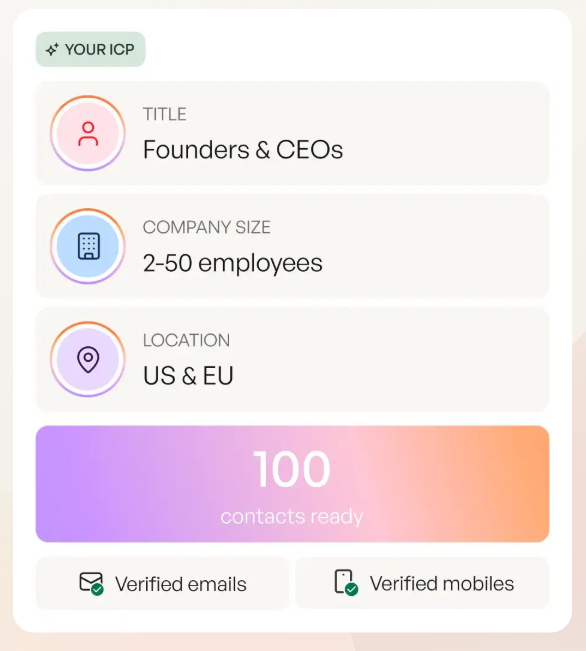
You just read that 500 accounts means 3,000-5,000 buying committee contacts to identify and enrich. Prospeo's 300M+ profiles with 30+ filters - including intent data across 15,000 topics - let you map entire buying committees in minutes, not weeks. 98% email accuracy means your BDR outreach actually lands.
Stop burning ABM budget on bounced emails and stale data.
What It Actually Costs
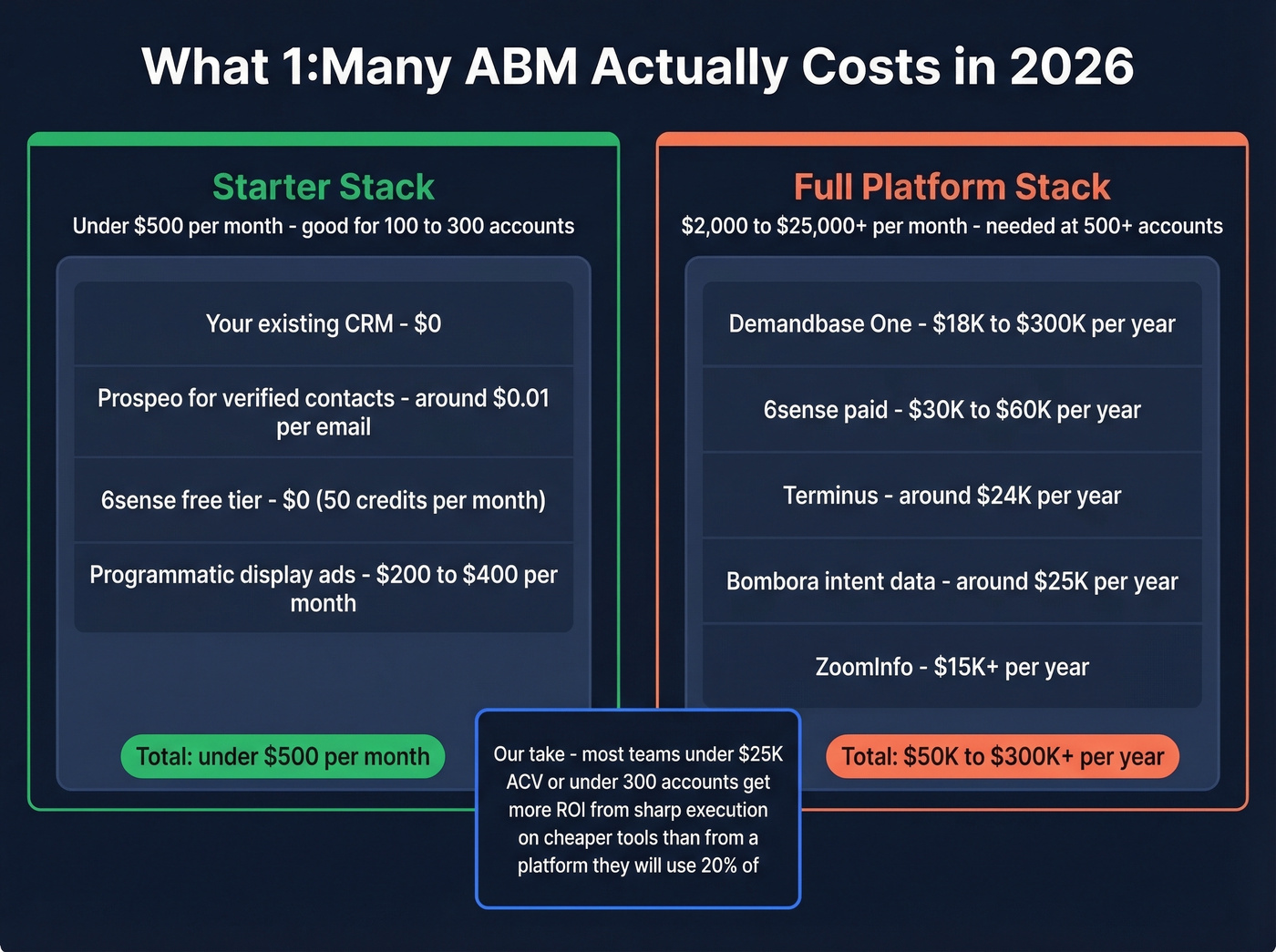
Look - most teams don't need a $50K ABM platform. If your average deal size is under $25K or you're targeting fewer than 300 accounts, you'll get more ROI from sharp execution on cheaper tools than from a platform you'll use 20% of.
| Tool | Category | Est. Annual Cost |
|---|---|---|
| Demandbase One | ABM platform | ~$18K-$300K/yr |
| Prospeo | Contact data + enrichment | Free tier available; ~$0.01/email |
| 6sense | ABM platform | $30K-$60K/yr (free tier: 50 credits/mo) |
| Terminus | Orchestration | ~$24K/yr |
| RollWorks | Orchestration | ~$12K/yr |
| Bombora | Intent data | ~$25K/yr |
| ZoomInfo | Data + intent | ~$15K/yr+ |
| HubSpot Marketing Hub | CRM + ABM features | ~$9,600/yr |
| Apollo | Data + outreach | Free / $49/mo |
The starter stack we'd actually recommend: your existing CRM, Prospeo for verified contact data, 6sense's free tier for basic intent signals, and programmatic display ads. Total cost: under $500/month. That's enough to run a real program against 100-300 accounts. The full platform becomes necessary at 500+ accounts with complex orchestration needs - not at 100.
Mistakes That Kill Programmatic ABM
Setting MQL goals instead of account-stage movement. If your ABM dashboard looks like a demand gen report, you're optimizing for the wrong thing. Full stop.
Over-segmenting into tiny clusters. Splitting 200 accounts into 15 micro-segments means you'll never have enough data to learn what's working. Start with 3-5 segments. You can always split later once you have signal.
Trusting platform attribution blindly. HubSpot's 90-day attribution window and cookie limitations create massive blind spots. 6sense has drawn criticism in practitioner communities for attribution models that over-credit the platform itself for pipeline movement. The consensus on r/sales and r/marketing is blunt: verify with your own account-level data before trusting any vendor's self-reported numbers.
BDR outreach misaligned with campaigns. Your reps need to know what ads and content each account is seeing. We've seen teams invest six figures in ABM platforms and then let BDRs freelance their messaging - it kills the program faster than bad targeting.
Bad contact data. If a big chunk of your emails bounce, BDRs stop trusting the program fast. The bounce-rate spiral is the single fastest way to kill an ABM program before it produces a single pipeline dollar. One of our customers, Snyk, saw bounce rates drop from 35-40% to under 5% after switching their data source - and AE-sourced pipeline jumped 180%.

Real Results from 1:Many ABM
| Company | ABM Approach | Key Result |
|---|---|---|
| StarTree | Staged TOFU-to-BOFU ad journeys with sales alerts at 15 impressions | 3.17x conversion rate vs cold outreach |
| CipherHealth | Contact-level targeting + SDR routing | $122.70 revenue per $1 spent |
| BioCatch | Multi-channel ABM with sales alerts | 6x pipeline, 41% faster deal velocity |
| DocuSign | 6 industry segments, tailored content | 22% pipeline growth, 60% engagement lift |
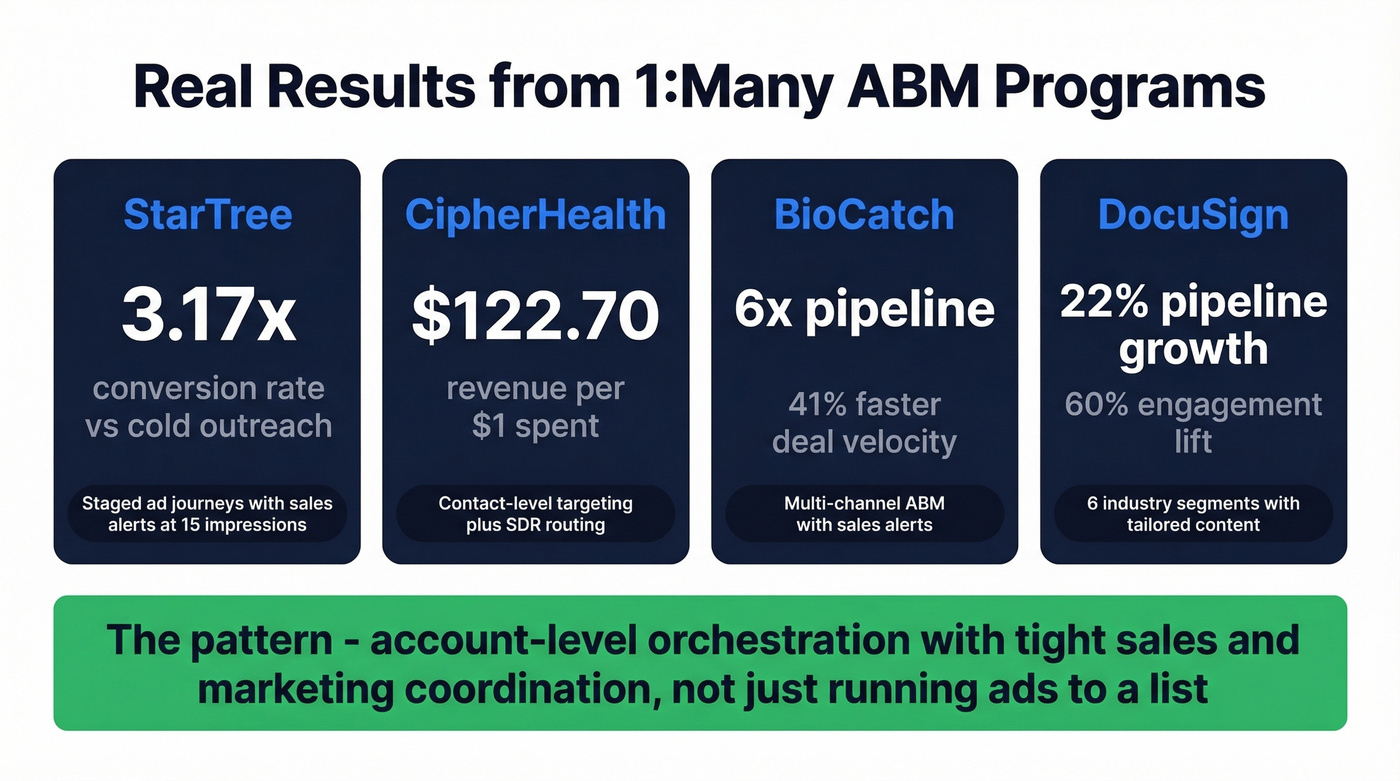
The pattern across all four: account-level orchestration with tight sales-marketing coordination. None of these teams just "ran ads to a list." They built systems where marketing signals triggered specific sales actions, and every touchpoint reinforced the same narrative. That's what separates programmatic ABM from glorified retargeting.
The article recommends a starter ABM stack under $500/month. Prospeo fits that budget at ~$0.01/email with a 7-day data refresh cycle - so your account lists stay current while competitors work with 6-week-old data. CRM enrichment returns 50+ data points per contact at a 92% match rate.
Run real programmatic ABM without the enterprise price tag.
FAQ
What separates one-to-many ABM from demand gen?
Three things: a defined account list, coordinated multi-channel campaigns hitting the same accounts simultaneously, and account-level measurement instead of lead-level MQL counting. Without all three, you're running demand gen with extra steps.
How many accounts should a 1:many program target?
Back into it from your deal targets. If you need 10 closed deals at a 10% win rate, start with 100 accounts minimum. Most mature programs target 300-1,000 accounts, segmented into 3-5 industry or use-case clusters. Skip this if you're selling deals under $15K ACV - the unit economics rarely justify the orchestration overhead at that price point.
How do you keep contact data accurate across hundreds of accounts?
Buying committees shift constantly - job changes, promotions, departures. You need a data source with a short refresh cycle. The industry average sits around 6 weeks, which means by the time you're halfway through a campaign cycle, a meaningful chunk of your contact list is already stale. Weekly refreshes prevent the bounce-rate spiral that kills ABM programs before they produce pipeline.