

ABM Data: What You Need, How to Get It, and What It Actually Costs
Forrester's latest budget survey found that 82% of B2B marketing leaders reported budget increases - but only 35% saw real increases after inflation. You're doing more with less whether you planned to or not. And the biggest waste we see? Teams dropping $50K+ on ABM platforms, then watching double-digit percentages of their outbound emails bounce because the contact data underneath is stale.
Good ABM data starts with verified contacts, not intent dashboards. The intent signals were never the problem. The contact layer was.
The Short Version
ABM data breaks into five layers: firmographic, technographic, contact, intent, and behavioral. Most teams over-invest in intent platforms and under-invest in verified contact data - the layer that actually converts signals into conversations. You don't need a six-figure platform to run data-driven account-based marketing. You need clean data, buying committee coverage, and a process.
What Is ABM Data?
ABM data is account-centric intelligence organized around target companies and their buying committees, layered with intent and behavioral signals that tell you when and how to engage. A contact list gives you names and emails. ABM data gives you a view of which companies match your ICP, what technology they run, who's involved in purchasing decisions, and whether they're actively researching solutions like yours.
The marketing account intelligence software market is projected to grow from $3.4B in 2024 to $10.5B by 2033. That growth reflects a real shift: B2B teams are moving from bulk email blasts toward structured, account-level engagement. But more tools also means more ways to waste budget on data you can't actually use.
The 5 Types of ABM Data
Firmographics Come First
Firmographic data is the B2B equivalent of demographics - organizational attributes that define whether a company fits your ICP. The core variables are industry, company size by headcount, annual revenue, headquarters location, ownership type, and growth signals like hiring velocity and recent funding rounds.
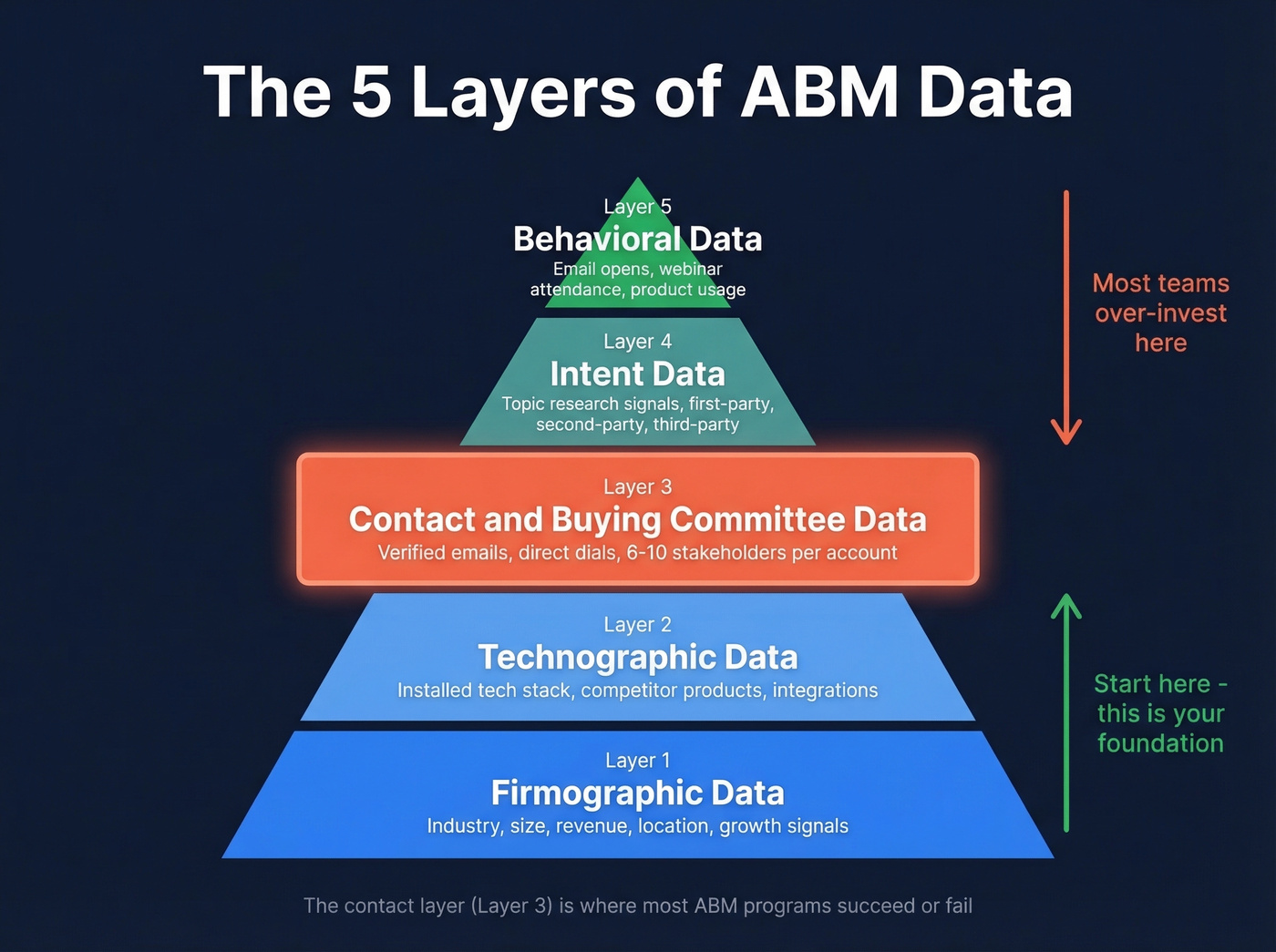
This is your foundation layer. Every account in your ABM program should have clean firmographic data before you spend a dollar on intent signals or ad targeting.
Technographic Data
Technographic data maps a company's installed technology stack. It tells you whether a prospect runs a competitor's product, has no solution in your category, or uses tools that integrate well with yours.
Here's a concrete example: if you sell a data warehouse tool and a target account runs Snowflake, that's a different conversation than if they're still on legacy on-prem infrastructure. Without technographic data, your messaging defaults to generic value props. With it, you can reference their actual stack.
Contact and Buying Committee Data
This is the layer that makes or breaks ABM execution. Gartner's research shows a typical B2B buying group involves 6-10 decision-makers, each independently gathering 4-5 pieces of information before the group converges on a decision. You need verified emails and direct dials for the right people across those roles - not just the one VP who downloaded a whitepaper.
If you're evaluating vendors for this layer, start with a shortlist of data enrichment services and compare accuracy, refresh cadence, and coverage.
Intent Data
Intent data signals that a company is actively researching topics relevant to your product. First-party intent comes from your owned properties: pricing page visits, demo video views, case study downloads. Second-party intent comes from partner data-sharing agreements, like review-site comparison activity. Third-party intent is aggregated web behavior from external publisher networks - Bombora's co-op of 5,000+ B2B publisher sites tracking 12,000+ topics is the leading example.
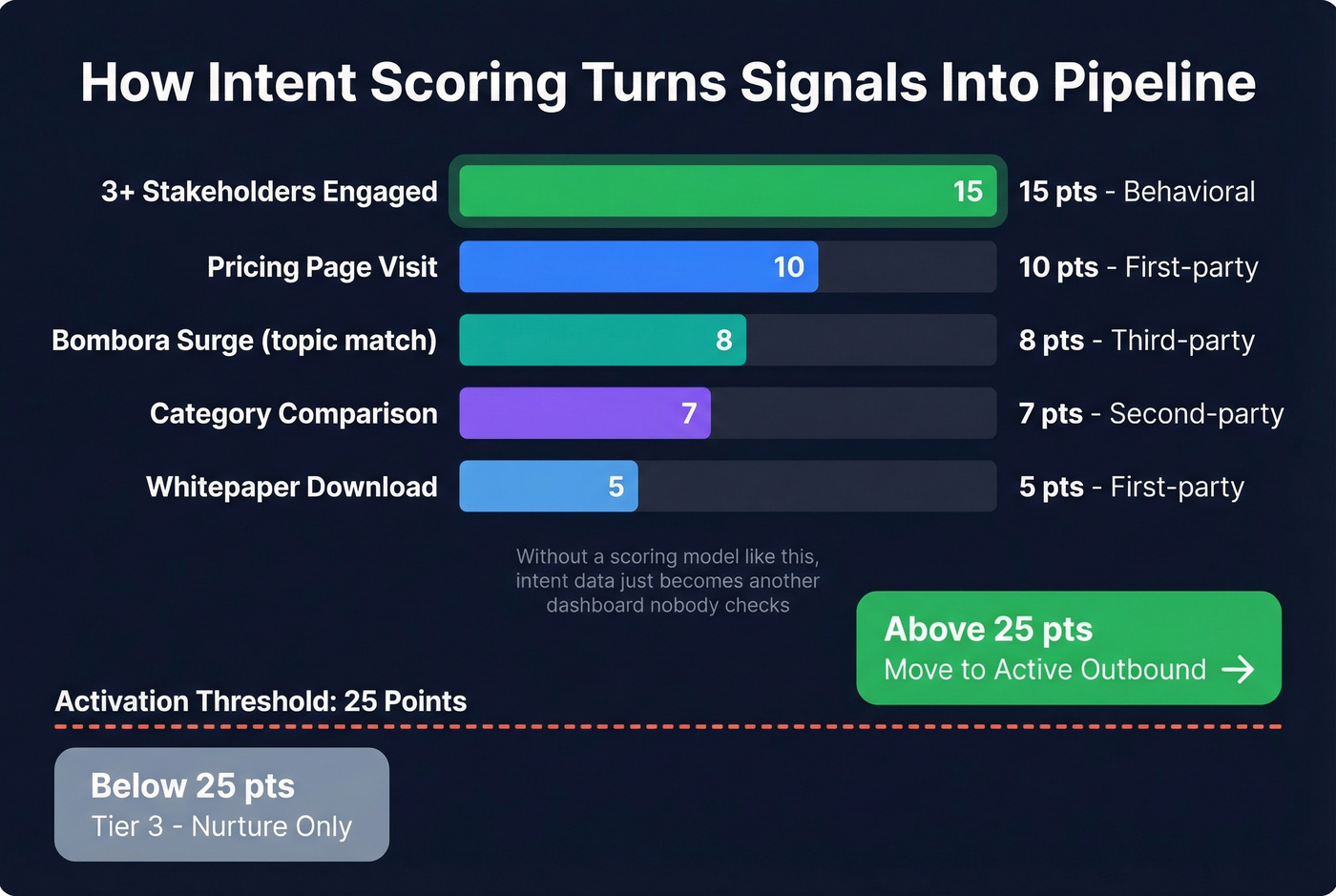
Let's be honest: intent data is the most overpurchased layer in ABM. It's valuable, but only after your contact and firmographic layers are airtight. Buying a $25K intent feed when your email bounce rate is 15% is like putting a turbo on a car with flat tires.
A simple engagement-scoring model keeps intent actionable:
| Signal | Points | Source |
|---|---|---|
| Pricing page visit | 10 | First-party |
| Bombora surge (topic match) | 8 | Third-party |
| Whitepaper download | 5 | First-party |
| Category comparison | 7 | Second-party |
| 3+ stakeholders engaged | 15 | Behavioral |
Accounts crossing a threshold - say, 25 points - move from Tier 3 nurture into active outbound. Without a model like this, intent data just becomes another dashboard nobody checks. If you want a deeper framework, use a dedicated lead scoring model and align it with sales stages.
Behavioral Data
Behavioral data tracks engagement on your owned properties: email opens, content downloads, webinar attendance, product usage patterns. It's often confused with intent data, but the distinction matters. Intent tracks external research signals. Behavioral tracks direct engagement with you.
An account where three stakeholders attended your webinar, two visited pricing, and one requested a case study is further along than an account that triggered a single Bombora surge. The combination of behavioral and intent data separates good ABM programs from expensive ones.
Why Buying Committee Coverage Matters
If you're engaging one contact per account, you're reaching roughly 10-15% of the buying committee. That's not ABM - that's single-threaded outreach with extra steps.
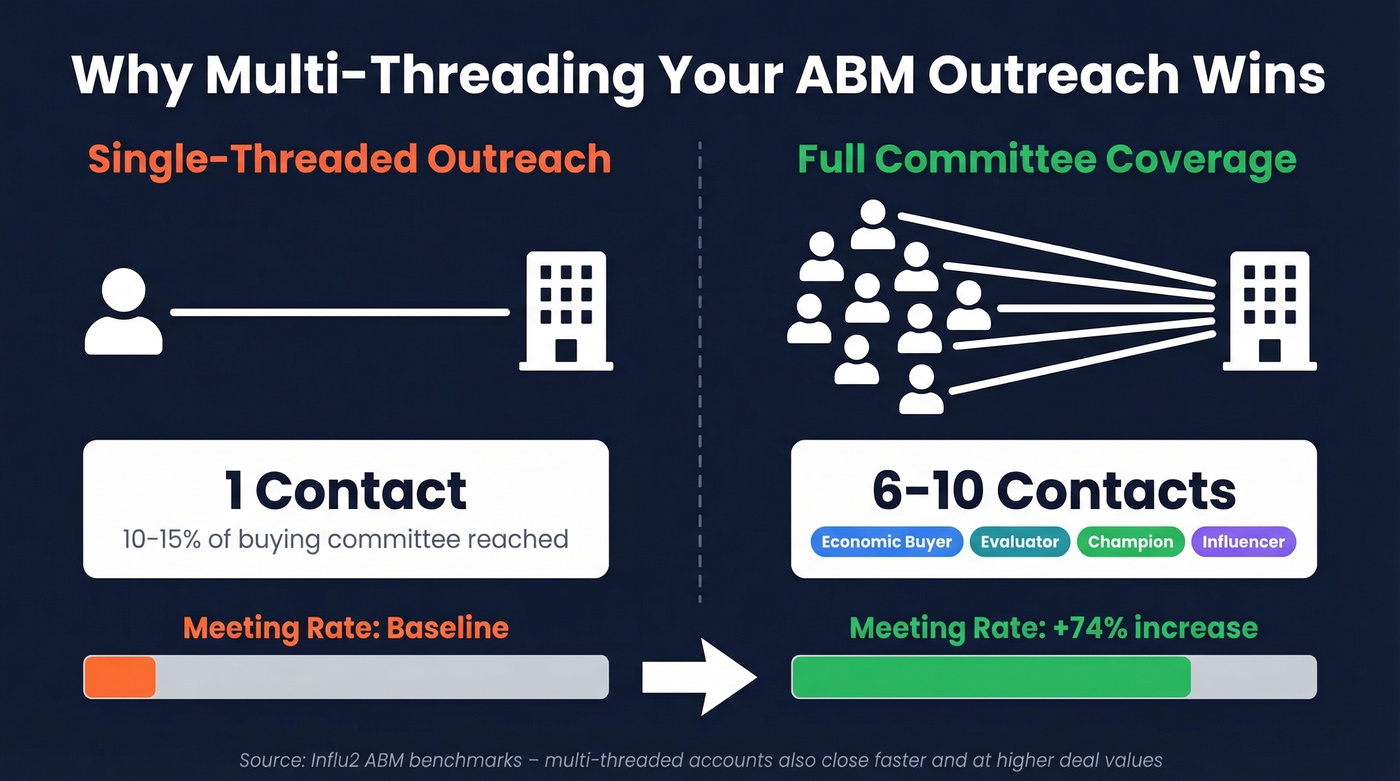
Influ2's ABM benchmarks show a 74% increase in booked meetings when ABM targets contacts across the full buying committee rather than single-threading. We've seen similar patterns in our own outreach: multi-threaded accounts close faster and at higher deal values, every time.
Effective buying committee mapping starts with role clusters, not job titles. You need to identify the economic buyer who controls budget, the evaluator who runs the technical assessment, the champion who advocates internally, and the influencer who shapes requirements. A contact gap analysis then reveals which of those roles you're missing for each target account. (If you want a structured way to define “fit” before you map roles, use an ideal customer profile template.)

You just read that 6-10 decision-makers are involved in every B2B deal. Prospeo gives you verified emails and direct dials across entire buying committees - 300M+ profiles, 125M+ mobiles, 30+ filters including intent data, technographics, and headcount growth. At 98% email accuracy and a 7-day refresh cycle, your contact layer stays clean while competitors decay.
Stop sending ABM campaigns to bounced emails at $0.01 per verified contact.
How to Build Your ABM Data Stack
The most practical framework we've found uses four enrichment layers, built sequentially:
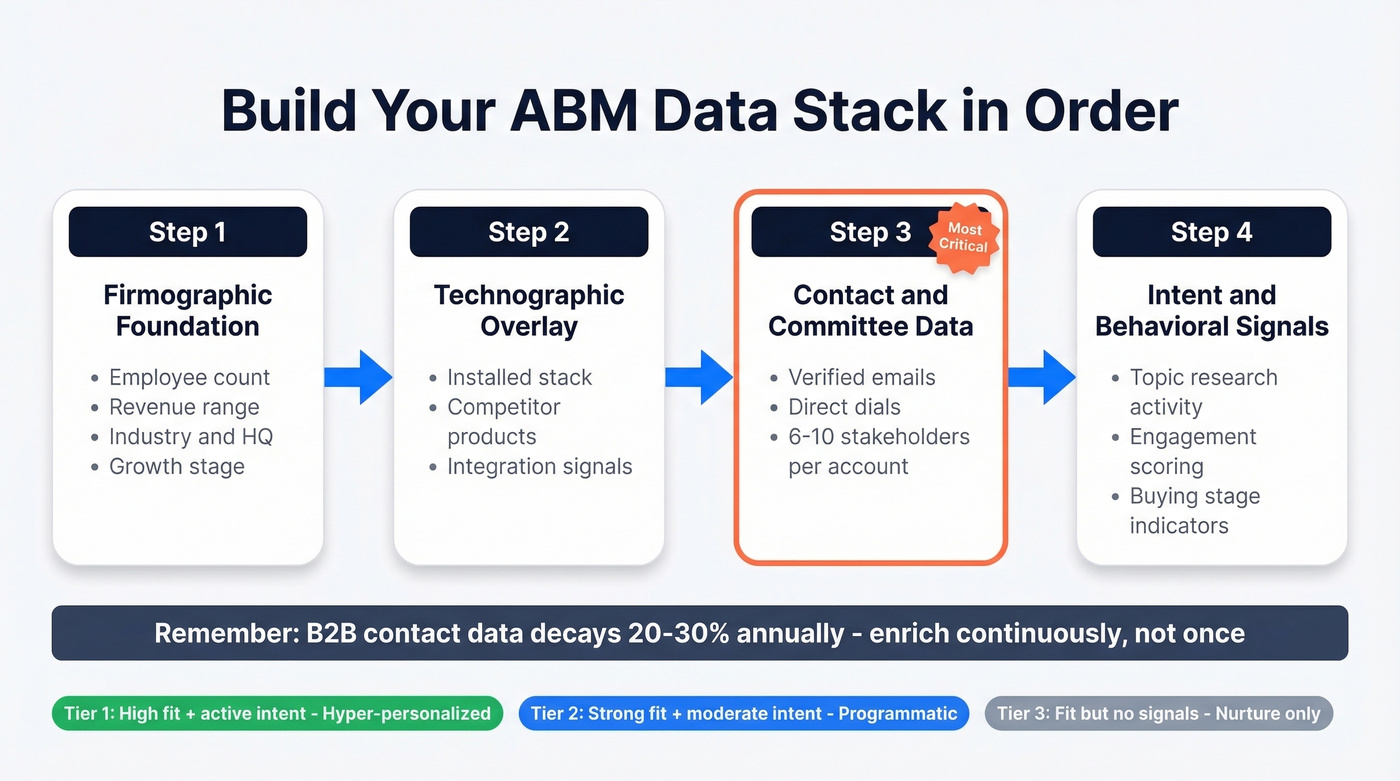
- Firmographic foundation - employee count, revenue range, industry, HQ location, growth stage. This defines your target account list.
- Technographic overlay - installed stack, competitor products, integration signals. This sharpens messaging and prioritization.
- Contact and buying committee data - verified emails, direct dials, seniority, department, job function across 6-10 stakeholders per account.
- Intent and behavioral signals - topic-level research activity, engagement scoring, buying stage indicators.
Once you've built the layers, tier your accounts:
| Tier | Profile | Signal Level | Approach |
|---|---|---|---|
| Tier 1 | High ICP fit | Active intent | Hyper-personalized |
| Tier 2 | Strong fit | Moderate intent | Programmatic |
| Tier 3 | Fit, no signals | None yet | Nurture only |
B2B contact data decays 20-30% annually - job changes, company moves, email deactivations. Your enrichment process isn't a one-time project. It's a recurring workflow. Define data movement rules between your CRM, MAP, and enrichment tools upfront, and audit monthly to prevent duplicates and stale records from compounding. If you need a practical workflow for list building + enrichment, see Clay list building.

ABM Data Tools and Pricing
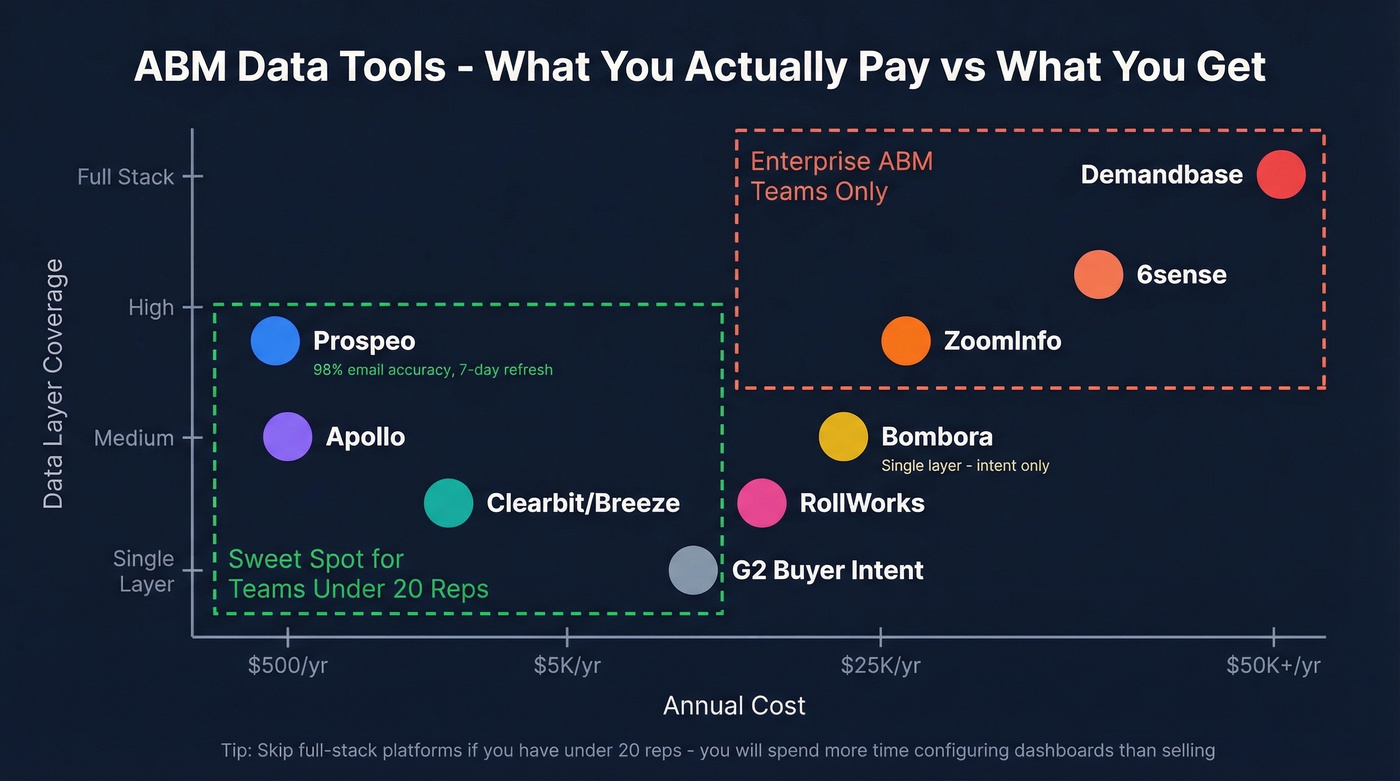
Most teams under 500 employees don't need a six-figure ABM platform. The consensus on r/sales and r/marketing is that tools like 6sense and Demandbase are "expensive reminders to sell to your ICP." That's harsh, but there's truth in it - especially for teams that haven't nailed their contact data layer yet.
| Tool | Category | Best For | ~Annual Cost | Differentiator |
|---|---|---|---|---|
| Prospeo | Contact + intent | Verified contacts + intent | Free tier; paid from ~$39/mo | 98% email accuracy, 7-day refresh |
| Demandbase | Full-stack ABM | Enterprise orchestration | $50K+/yr | Intent + ad targeting |
| 6sense | Full-stack ABM | Predictive buying stage | $35-75K+/yr | AI buying stage detection |
| Bombora | Intent data | Standalone intent signals | ~$25K/yr | 5K+ publisher co-op |
| ZoomInfo | B2B intelligence | Broad database + intent | $15-40K/yr | Multiple bundled modules |
| Apollo | Contact + engagement | Self-serve, budget teams | From ~$49/mo | Built-in sequencing |
| Clearbit / Breeze | Enrichment | HubSpot-native | From ~$30/mo | Credit-based enrichment |
| RollWorks | ABM advertising | Account-based ads | From ~$975/mo | Ad campaign focus |
| G2 Buyer Intent | Bottom-funnel intent | Software buying signals | Custom pricing | Category-specific signals |
Prospeo stands out for teams that need the contact layer locked down before layering on intent. With 300M+ profiles, a 7-day data refresh cycle versus the 6-week industry average, and intent data covering 15,000 Bombora topics, it handles both verified contacts and signal layers without requiring a separate platform.
Demandbase and 6sense make sense for organizations with dedicated ABM teams and the budget to match. 6sense's implementation typically runs 3-6 months, which is worth knowing before you sign. Bombora is the go-to if you already have a contact data provider and just need standalone intent signals. ZoomInfo bundles multiple modules including intent, but you're paying for a lot of functionality you'll never activate. Apollo is the budget play - solid database, built-in sequencing, but email accuracy doesn't match dedicated verification platforms. If deliverability is a priority, start by fixing your email bounce rate and tightening your email deliverability fundamentals.
Skip the full-stack platforms if you're a team of under 20 reps. You'll spend more time configuring dashboards than actually selling.
ABM Data Sources Beyond Paid Platforms
Not every source comes from a paid tool. The best programs blend multiple sources to build a complete picture. Your CRM and marketing automation platform hold first-party behavioral data. Sales Navigator provides real-time job changes and org-chart context. Review sites like G2 and TrustRadius surface bottom-funnel intent. Public filings, job boards, and press releases reveal firmographic shifts like funding rounds and leadership changes.
The key is layering these sources systematically rather than relying on a single vendor for everything. If you want more options for sourcing contacts without a big contract, compare sales prospecting databases and free lead generation tools.
Navigating a Cookieless World
Chrome's third-party cookie deprecation is reshaping how ABM platforms identify and track accounts. Safari and Firefox blocked third-party cookies years ago, but Chrome's 70%+ market share makes this the real inflection point. The industry is shifting toward IP-based account identification, first-party data activation, and alternative identity frameworks.
The practical implication: verified contact data - emails and direct dials - becomes more valuable as cookie-based tracking degrades. You can't retarget an anonymous visitor whose cookies are blocked, but you can reach a verified contact at that account directly. First-party behavioral data from your owned properties also gains importance since it doesn't depend on third-party tracking infrastructure. This shift is pushing teams to prioritize owned data assets over rented audience signals, and it's a trend that won't reverse.
Common ABM Data Mistakes
Five patterns we see repeatedly:
No refresh cadence. Data decays 20-30% per year. If you're running outbound on a list you built six months ago, expect bounces. Automate re-verification monthly.
Single-contact targeting. Engaging one person per account and calling it ABM. With 6-10 stakeholders per buying group, you're missing 85-90% of the committee. Reddit threads on ABM consistently flag this as the #1 execution gap.
Treating intent as qualification. A Bombora surge doesn't mean an account is ready to buy. It means they're researching. Teams that skip qualification and dump intent-flagged accounts straight into sales sequences inflate early-stage pipeline and depress win rates. (If you need a qualification framework that works well with ABM, use MEDDIC sales qualification.)
Over-tooling. Paying $50K+ for a platform when you use 20% of its features. 37% of marketers cite lack of budget and resources as their top ABM challenge - often because the budget went to a platform they didn't need.
No data governance. No clear ownership of who maintains account data, how duplicates are handled, or when records get refreshed. ABM is an 18-24 month commitment of continuous activation. Without governance, data quality erodes faster than you can enrich it.
Look, the highest-leverage move most teams can make is spending budget on clean, verified data rather than another dashboard.
The article recommends building firmographics → technographics → contacts → intent sequentially. Prospeo collapses those layers into one platform: 30+ search filters for firmographic and technographic targeting, 143M+ verified emails for buying committee coverage, and Bombora-powered intent data tracking 15,000 topics. No $50K platform contract required.
Build all four ABM data layers in one workspace - free tier included.
FAQ
What's the difference between ABM data and regular B2B data?
ABM data is account-centric - organized around target companies and buying committees, layered with intent and behavioral signals. Regular B2B data is contact-level lists without account context or committee mapping. Layering firmographic, technographic, and intent data together is what makes account-based programs outperform generic outbound.
How often should ABM data be refreshed?
Monthly at minimum. B2B contact data decays 20-30% per year, so quarterly refreshes still leave gaps. Automate re-verification to keep bounce rates under 4%.
Do I need a platform to run account-based marketing?
No. A CRM, a quality contact data provider, and an intent signal source get you 80% of the results at 20% of the cost. Full-stack platforms like Demandbase or 6sense make sense above ~500 employees with dedicated ABM teams and $35K+ annual budgets.
What's the most important type of ABM data?
Contact and buying committee data. Intent signals tell you which accounts are in-market, but without verified emails and direct dials for 6-10 stakeholders, you can't convert signals into conversations. This layer turns research into revenue.
How much do ABM data tools cost?
Self-serve tools start free or under $50/month. Standalone intent providers like Bombora run ~$25K/year. Full-stack platforms like 6sense and Demandbase typically cost $35-75K+/year with multi-month implementations.