

The B2B Marketing and Sales Alignment Playbook That Actually Works
Marketing delivered 2,400 MQLs last quarter. Sales closed 12 deals. Somewhere between those two numbers, 2,388 leads vanished - and now everyone's in a conference room pointing fingers.
Here's the disconnect: 82% of C-level executives say their teams are aligned, while 65% of the people doing the work say they aren't. That gap isn't a communication problem. It's a structural one, and it's the reason B2B marketing and sales alignment remains the most talked-about, least-solved problem in revenue organizations.
The Three Things That Actually Matter
If you implement three things from this playbook, make it these:
- A shared lead scoring model with point values both teams agree on
- A written SLA with response-time commitments and rejection feedback loops
- Verified contact data on every lead that crosses the handoff line
The rest is context. Those three fix most of the problem.
How Bad Is the Misalignment?
Worse than leadership teams realize. An Influ2 benchmark across 105 companies found that 53% have broken handoffs - sales follows up with fewer than 35% of the prospects marketing engaged. Only 11% showed both effective handoffs and high audience overlap between the two teams.
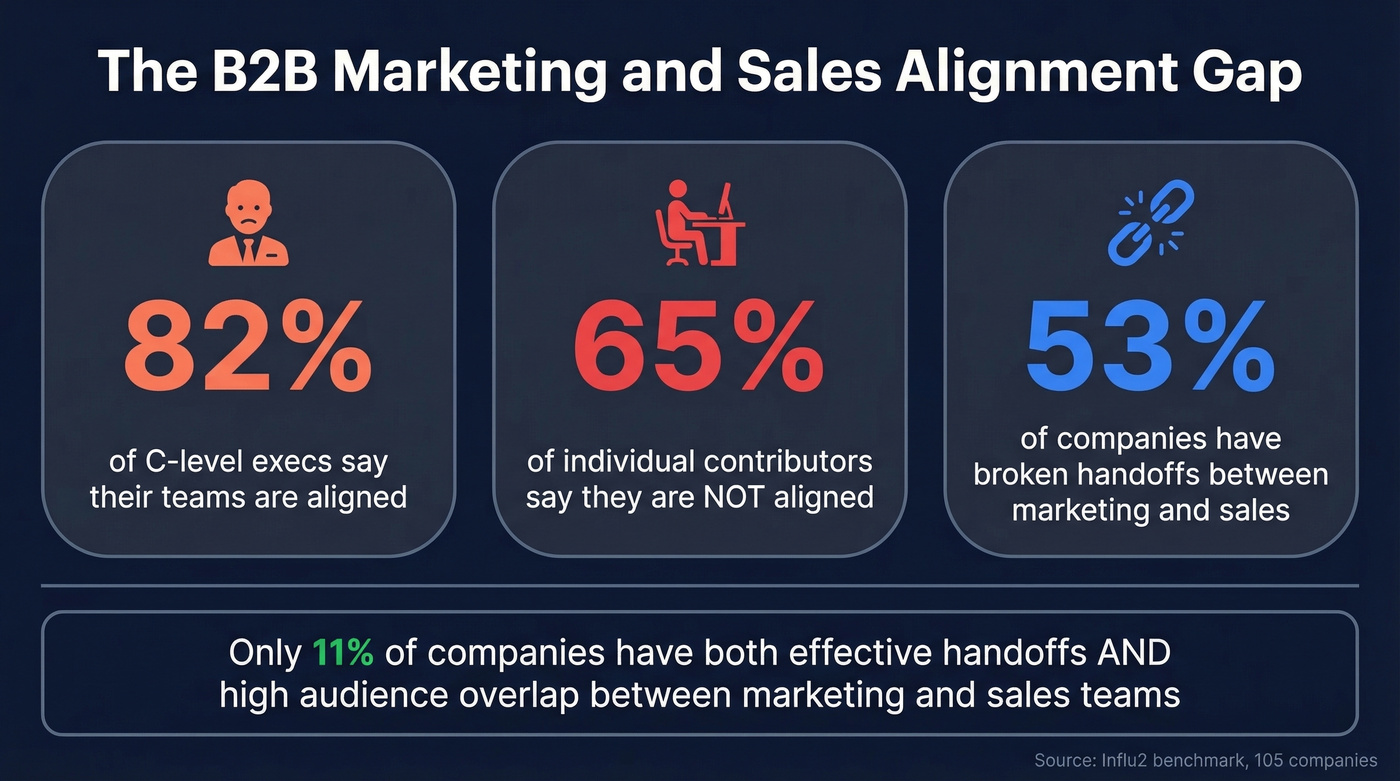
The consensus on r/sales and r/marketing echoes this. One marketing director described a "black hole between MQL and closed-won where nobody knows what happened." The middle of the funnel is where deals go to die, and neither team has visibility into why. That breakdown costs companies millions in wasted pipeline every year.
Why Alignment Initiatives Fail
Most alignment efforts treat the symptom - finger-pointing - instead of the disease: architecture. Misalignment isn't caused by stubborn people. It's caused by vague ICPs, mismatched incentives, and processes that reward the wrong behaviors.
MQL culture as a trust destroyer. When marketing is incentivized on lead volume and sales on revenue, you've built a system that guarantees conflict. A click isn't intent. Downloading a PDF isn't intent. But MQL-driven orgs treat them that way, and sales stops trusting the pipeline. We've watched this pattern play out at company after company - the volume game poisons the relationship between the two teams faster than any personality clash.
Replacing the CMO with a CRO. When marketing reports into a sales-oriented CRO, it gets reduced to a lead gen function. Strategy and demand creation atrophy. The gap between the two teams gets worse, not better.
Bad data as the silent killer. We'll get into this one later. It's more destructive than most teams realize.

Your scoring model and SLA won't matter if sales calls bounce and emails never land. Prospeo delivers 98% verified emails and 125M+ mobile numbers refreshed every 7 days - so every lead that crosses the handoff line is actually reachable.
Stop losing aligned leads to bad contact data.
The Alignment Playbook
Define and Execute a Shared ICP
Let's be honest - most orgs give lip service to their ICP but don't execute against it. Marketing targets one audience, sales prospects a different one, and nobody notices until the quarterly blame meeting.
Build a shared ICP document that includes firmographic criteria like industry, size, revenue, and geography and behavioral signals like pricing page visits, demo requests, and content engagement patterns. Review it quarterly with both teams in the room. Don't let marketing define the ICP in a slide deck that sales never reads. If you need a starting point, use an Ideal Customer Profile Template so both teams are working from the same definitions.
Build a Lead Scoring Model Together
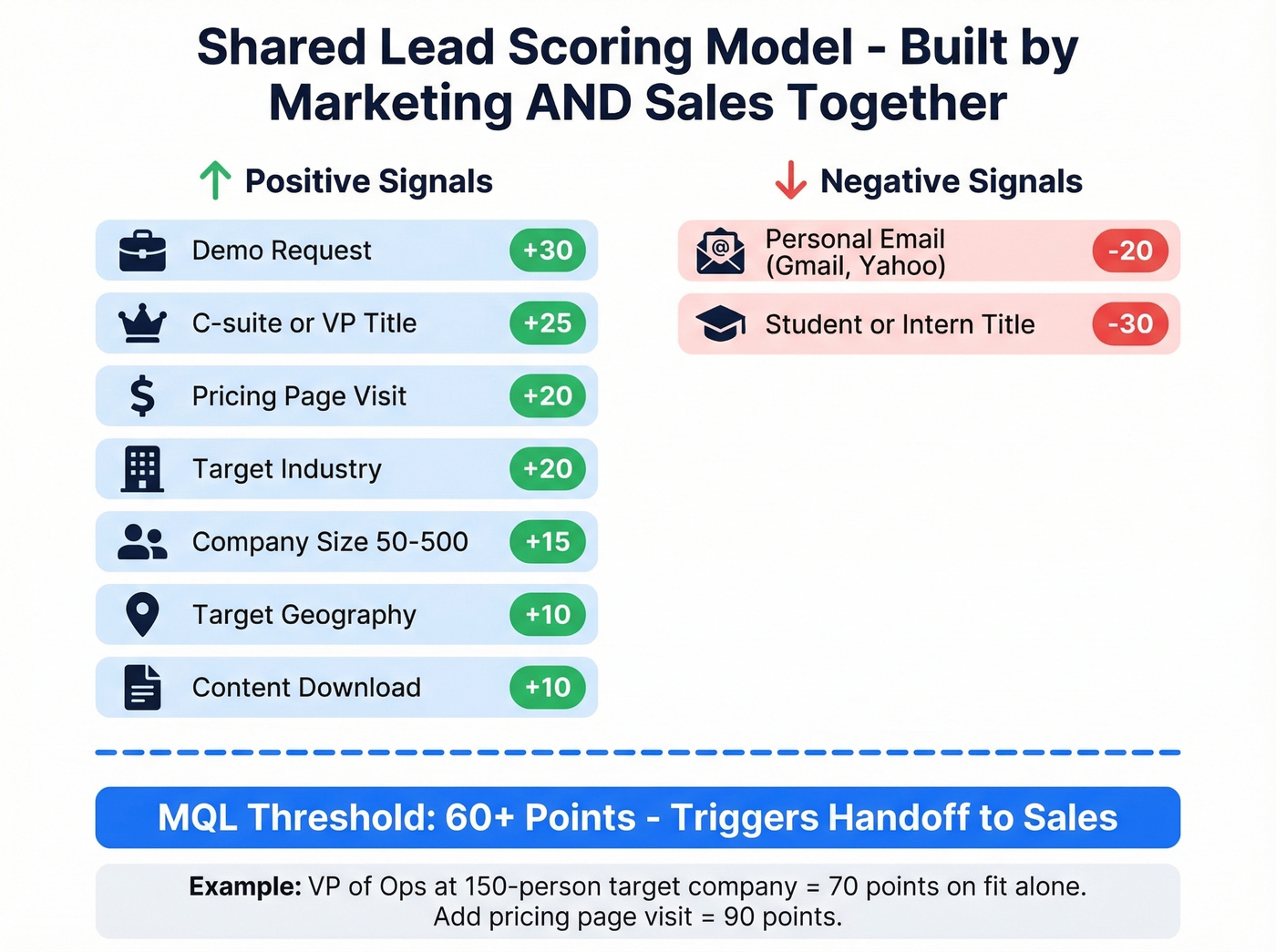
The word "together" is doing heavy lifting here. A scoring model that marketing builds in isolation is just another source of distrust. We've tested this rubric across mid-market B2B teams, and it works:
| Criterion | Condition | Points |
|---|---|---|
| Industry | Target industry | +20 |
| Company size | 50-500 employees | +15 |
| Job title | C-suite / VP | +25 |
| Job title | Director / Manager | +15 |
| Department | Ops, IT, Finance | +10 |
| Geography | Target region | +10 |
| Pricing page visit | Visited pricing page | +20 |
| Demo request | Submitted form | +30 |
| Content download | Whitepaper / case study | +10 |
| Personal email | Gmail / Yahoo / Hotmail | -20 |
| Student / intern | Student, Intern, Trainee | -30 |
MQL threshold: 60+ points triggers handoff to sales.
A VP of Operations at a 150-person manufacturing company in your target region scores 70 points on fit alone - before any behavioral signals. Add a pricing page visit and you're at 90. Negative scoring matters just as much: a student downloading a whitepaper from a personal Gmail should never reach a sales rep. This shared model is the foundation of any real revenue strategy. If you want to go deeper on the mechanics, see our guide to lead scoring.
Write a Sales-Marketing SLA
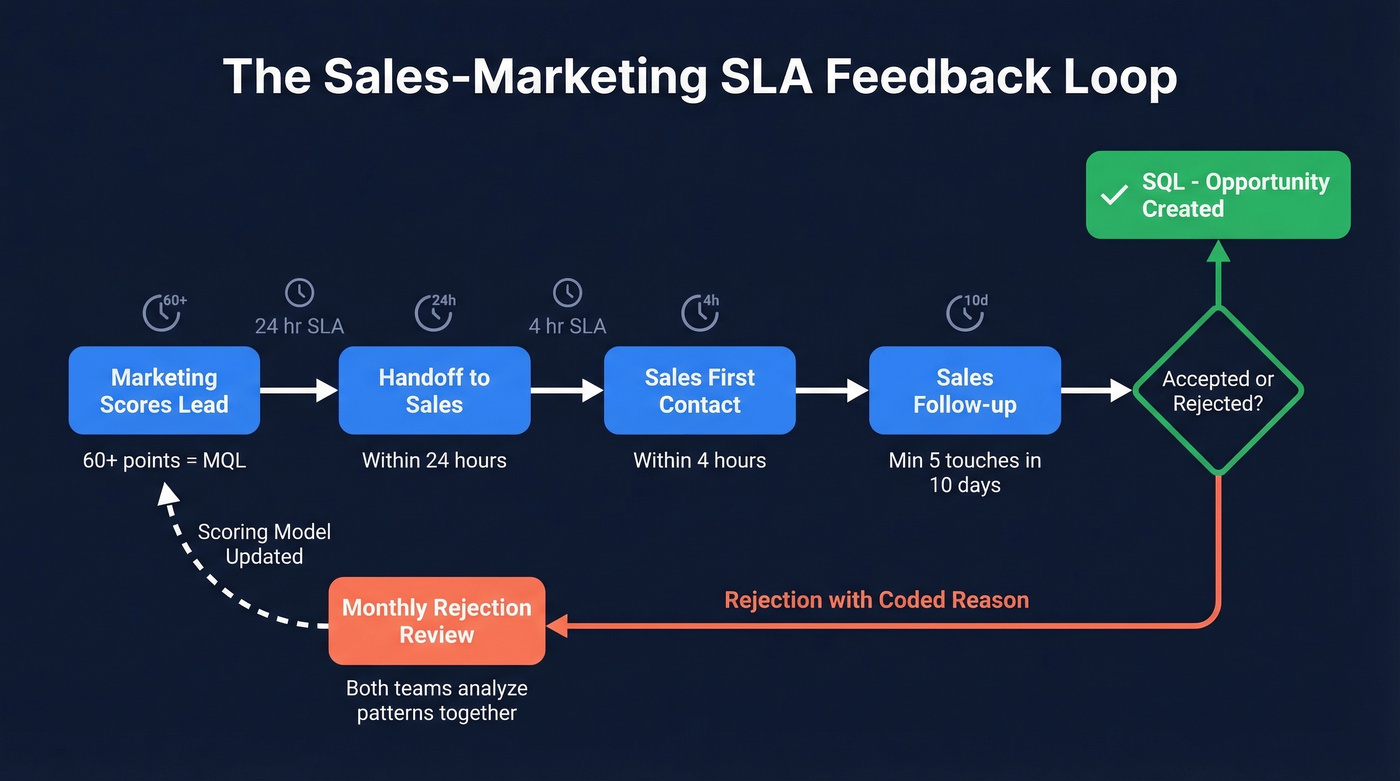
An SLA turns vague alignment goals into measurable commitments:
| Component | Marketing | Sales | Measurement |
|---|---|---|---|
| Lead definitions | Score >=60 = MQL | BANT-qualified = SQL | Quarterly review |
| Handoff timing | Deliver within 24 hrs | First contact within 4 hrs | Avg response time |
| Follow-up | N/A | Min 5 touches / 10 days | Completion rate |
| Rejection feedback | Review rejections monthly | Return with coded reasons | Rejection rate trend |
| Escalation | Flag data issues in 48 hrs | Flag quality issues in 48 hrs | Escalation volume |
In our experience, the rejection feedback loop is where the real alignment breakthroughs happen. When sales has to code rejection reasons and marketing has to review them monthly, both teams develop a shared understanding of what's actually happening in the funnel - collaboration moves from theory to practice. Skip this step and you'll be back in the blame meeting within a quarter.
Fix the Handoff
Influ2's data defines an "effective handoff" as 35%+ of marketing-engaged prospects actually getting contacted by sales. Most companies don't hit that bar.
The fix is mechanical: automated lead routing, speed-to-lead alerts, and SLA enforcement. If your handoff process involves a spreadsheet or a Slack message, you're losing deals right now. Automate the routing from your MAP to your CRM and set alerts that fire immediately. This isn't a nice-to-have - HubSpot's research shows that response time is the single biggest predictor of conversion at the handoff point. If you want a practical starting point for the actual outreach motion, use these sales follow-up templates.
Close the Reporting Loop
Separate dashboards are alignment killers.
You need one shared view tracking leads from first touch through closed-won or closed-lost with a reason code. Not "marketing influenced $2M in pipeline," but "these 47 leads from the webinar converted to 6 opportunities and 2 closed deals worth $180K." Shared dashboards force shared accountability, and they're the only way both teams can diagnose funnel problems together instead of trading blame. This is also where funnel metrics and lead status definitions stop being “ops work” and start being revenue work.
Co-Create Enablement Content
Marketing creates content in isolation. Sales ignores it. This cycle repeats forever unless you break it deliberately.
The fix is co-creation: marketing produces ROI calculators, competitive battle cards, and objection-handling scripts with direct input from sales reps who are on calls every day. Teams are using AI to draft first versions of these assets in hours instead of weeks, but the sales input step isn't optional. A battle card that doesn't address the objections reps actually hear is just a PDF nobody opens. If you want a concrete format to copy, start with sales battle cards.
The Data Problem Nobody Talks About
Here's a scenario we've seen play out dozens of times. A VP of Operations downloads a whitepaper. They score 70+ points. The SLA fires. An SDR picks up the phone within 2 hours - and the number is disconnected. They send an email. It bounces. The lead gets rejected. Marketing never finds out the rejection was a data quality issue, not a lead quality issue.
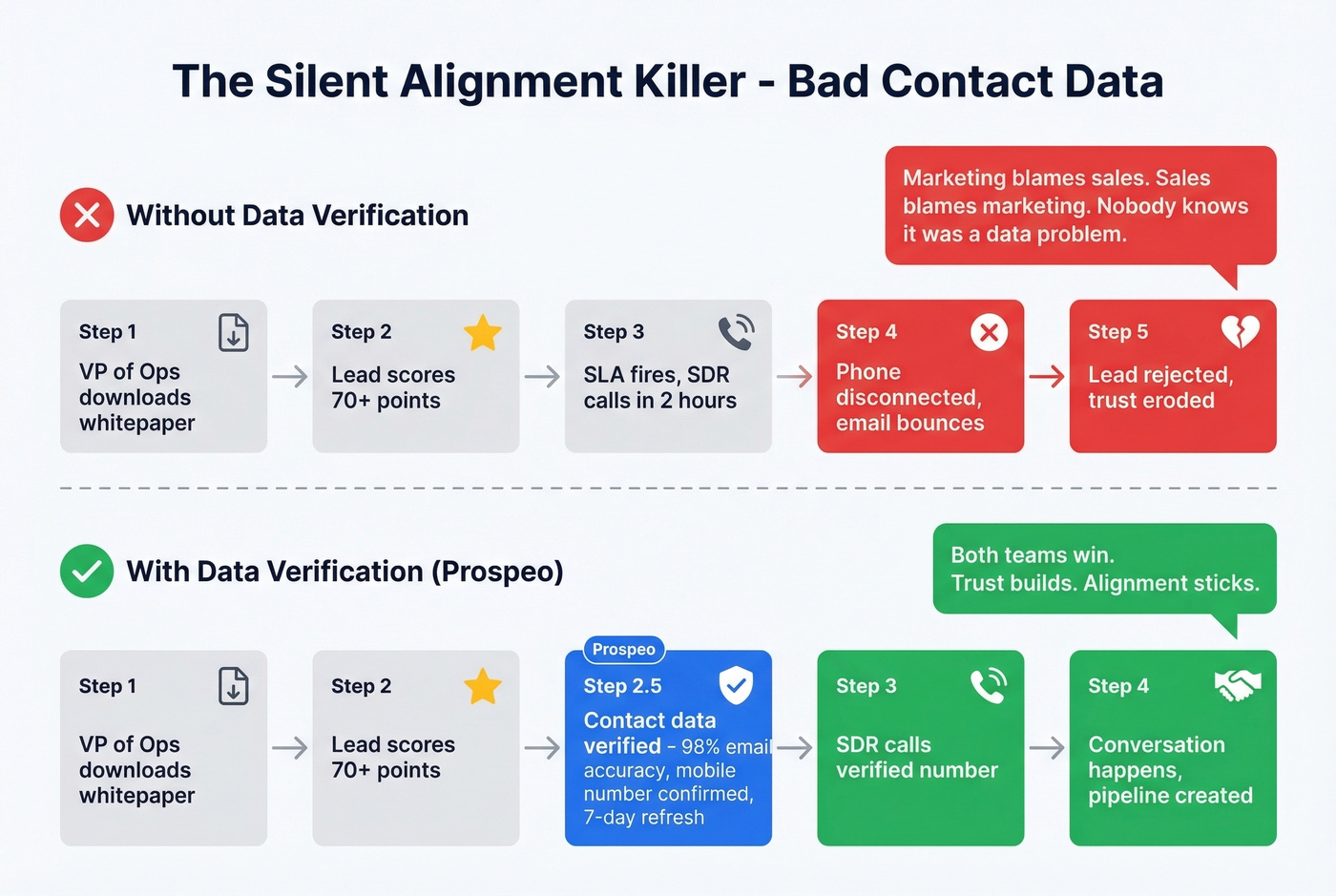
That frustration is real, and it erodes trust between the teams faster than almost anything else.
You can build the perfect scoring model and the tightest SLA in the industry. None of it matters if a meaningful chunk of your contact data is stale. This is where a verification layer like Prospeo fits into the alignment stack - with 98% email accuracy, 125M+ verified mobiles, and a 7-day data refresh cycle, it ensures leads crossing the handoff line actually have working contact information. Native integrations with HubSpot and Salesforce mean enrichment happens inside your existing workflow, no manual steps for reps to skip. If you're evaluating options, compare data enrichment services and make sure verification is part of the stack, not an afterthought.

For teams that don't need an enterprise data platform, the cost difference is significant. Enterprise platforms typically run $15-40K/year. Prospeo starts free with 75 verified emails/month and scales at roughly $0.01 per email - no contracts. If you're troubleshooting the downstream impact, start with your email bounce rate and work backward to the source.
Hot take: Most Series A and B companies don't need a $30K data platform. They need accurate data at the handoff point. Overspending on data infrastructure before you've nailed your scoring model and SLA is like buying a race car before you've learned to drive.
Broken handoffs start with broken data. When 35% of emails bounce, sales stops trusting marketing's pipeline - and alignment dies. Prospeo's 5-step verification and 7-day refresh cycle mean the contacts in your CRM actually connect to real buyers, not dead inboxes.
Rebuild the trust between your teams with data that works.
RevOps as the Structural Fix
If alignment is the goal, Revenue Operations is the structure that makes it stick. RevOps sits across sales, marketing, and customer success with authority over people, processes, data, and technology. If you're building the function, a clear RevOps Manager charter helps prevent “alignment” from becoming a vague catch-all.
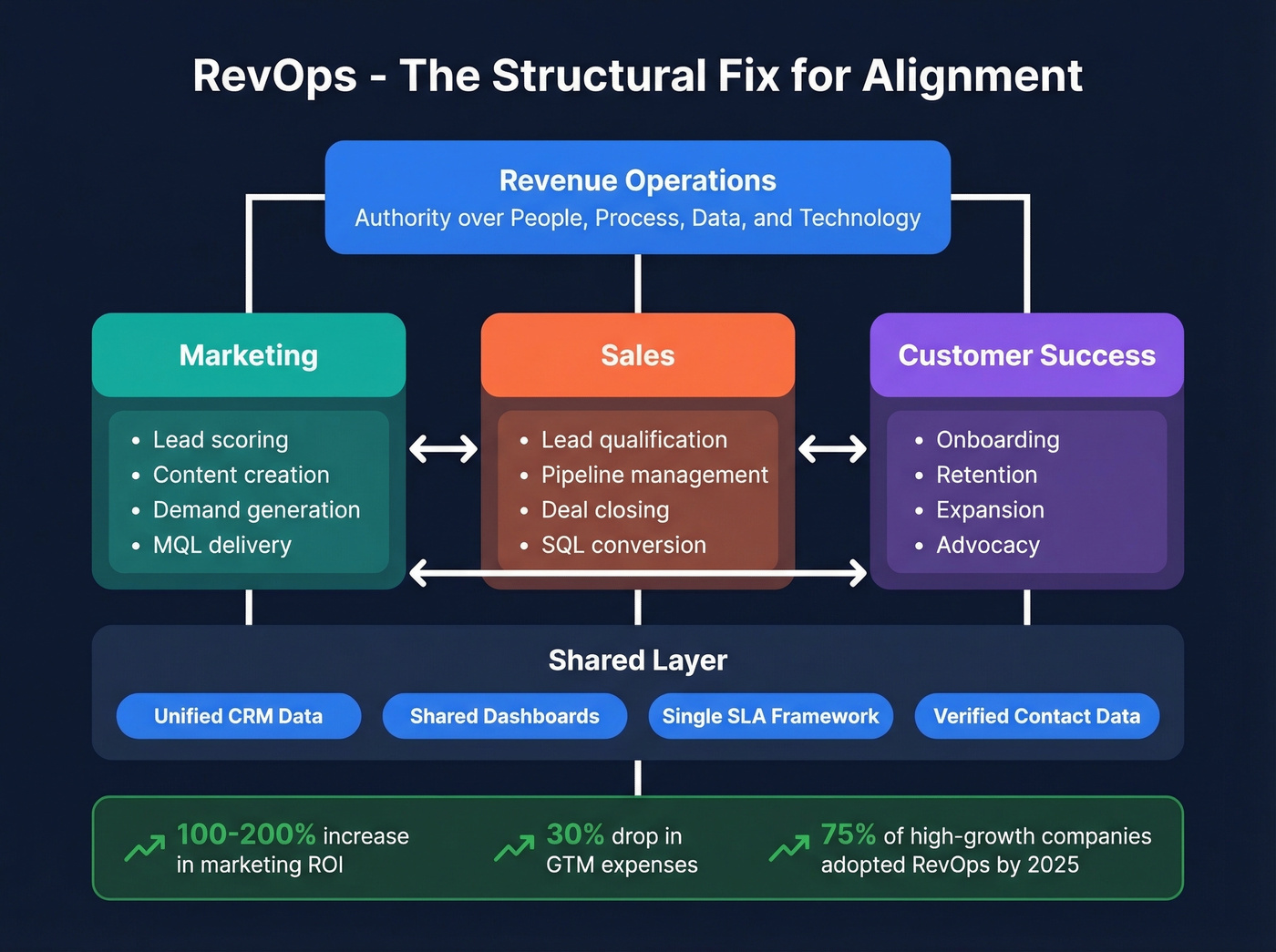
Frameworks from SiriusDecisions, Winning by Design's Bowtie model, and HubSpot's Flywheel all converge on the same idea - revenue is a team sport. A commonly cited RevOps business case is a 100-200% increase in marketing ROI and a 30% drop in GTM expenses for RevOps-aligned organizations. Gartner predicted that 75% of high-growth companies would adopt RevOps by 2025, and by 2026, the data suggests they were right. For companies serious about closing the gap between their go-to-market teams, RevOps provides the governance layer that prevents alignment from sliding back into silos after the initial push.
FAQ
What's the difference between MQL and SQL?
An MQL meets marketing's threshold for engagement and fit - typically a lead score above a set number like 60 points. An SQL has been vetted by sales and confirmed as a real opportunity with budget, authority, need, and timeline. When the two teams define "qualified" differently, every handoff creates friction.
How long does alignment take?
Quick wins like a shared scoring model, a written SLA, and clean contact data can ship in 2-4 weeks. Full organizational alignment - including RevOps restructuring and incentive redesign - is a 3-5 year transformation. The first 90 days of focused effort typically deliver the fastest ROI.
What tools support B2B marketing and sales alignment?
Four categories: a CRM like Salesforce or HubSpot, a marketing automation platform, a data verification tool for contact accuracy at the handoff, and shared dashboards both teams actually look at. Most teams already have the first two. The data layer is where they underinvest.
Why do most alignment efforts stall?
Because they focus on cultural fixes - team lunches, joint meetings, shared Slack channels - without changing the underlying incentive structures and data workflows. Alignment sticks when it's embedded in systems and SLAs, not just relationships.