

Account-Based Marketing Measurement Is Broken - Here's How to Fix It
Your CMO just asked for ABM numbers for the board deck, and you're staring at a CRM full of MQL counts that don't map to any of your target accounts. Roughly 80% of B2B organizations run ABM programs, but only about 30% run mature ones. Vendors sold the dream; nobody shipped the dashboard. And 21% of practitioners say they flat-out can't measure ABM ROI at all.
That gap isn't a tooling problem. It's a metrics problem - teams measuring ABM with demand gen KPIs and wondering why the numbers lie.
What You Actually Need
Stop measuring MQLs for ABM. The unit that matters is the MQA - marketing qualified account - not the individual lead. Track 4-6 metrics tied to your specific ABM motion (net new, expansion, renewal). Start with three essentials:
- Clean account-level data - verified contacts across the buying group, not stale CRM records
- An engagement scoring model - account-level, not contact-level (adapt your existing lead scoring into an account model)
- A shared sales-marketing dashboard - one source of truth, not two slide decks
A dashboard with 13 metrics that nobody checks doesn't prove ROI. It proves you have a dashboard. In our experience, teams that track more than six ABM metrics end up tracking none of them well.
Why Your ABM Metrics Are Lying
The biggest culprit is contact-level attribution applied to an account-level strategy. A buying group of five people engages across seven touchpoints, but your attribution model only sees the one person who clicked a tracked link in Chrome without an ad blocker. That's not measurement. That's a guess.
Here's the thing: cookie-based tracking is increasingly broken. Safari's ITP caps the hubspotutk cookie to 7 days. Ad blockers routinely break tracking scripts and click parameters, including UTMs. LinkedIn attribution has a 90-day window and doesn't track Message Ads, Document Ads, or Thought-Leader Ads at all. If your attribution model breaks every time someone uses Safari, you don't have an attribution model.
Then there's the activity-metrics trap. Teams report impressions, clicks, and email opens as ABM success. Those are activity metrics, not account progression metrics. The question isn't "did they open the email?" It's "did the account move from awareness to opportunity?" (If you need a clean way to define stages, borrow a simple AIDA Sales Funnel structure.)
Data decay is the quieter problem underneath all of this. If your bounce rates are high, your engagement metrics undercount real interest and ROI calculations are wrong before you start. We've seen teams fix this by switching to a verification tool with a 7-day data refresh cycle - Prospeo's 98% email accuracy addresses the database rot that silently deflates every metric downstream. (If you want targets, start with email bounce rate benchmarks.)

The Four Metrics That Actually Matter
These are the metrics that move the conversation with your CFO. Think of them through Forrester's six reporting dimensions - account segments, insights, attraction, behavior, conversion, and impact - which map neatly to the ABM funnel and give you a reporting structure no one on your team will argue with.
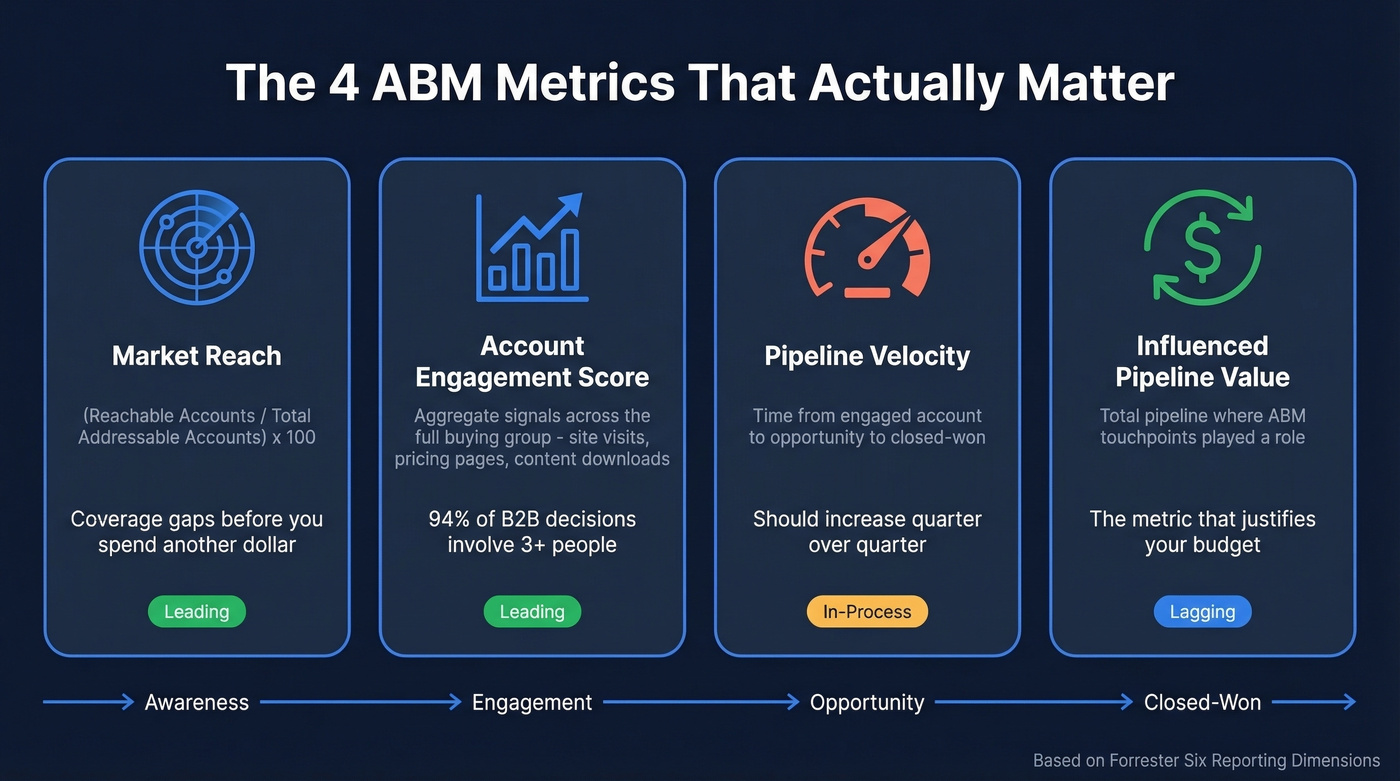
Market Reach tells you how much of your TAM you're actually touching. Formula: (reachable accounts / total addressable accounts) x 100. If you can reach 600 out of 1,000 target accounts, that's 60% - and it tells you exactly where your coverage gaps are before you spend another dollar on ads. (If your TAM math is fuzzy, see Addressable Market.)
Account Engagement Score aggregates signals across the buying group: website visits, pricing page views, repeat sessions, webinar signups, content downloads. This is your leading indicator. It must be account-level because 94% of B2B buying decisions involve three or more people. A single contact's activity tells you almost nothing about whether the account is warming up. (For a broader KPI set, compare against standard funnel metrics.)
Pipeline Velocity measures how fast engaged accounts become opportunities and then closed-won. If ABM is working, velocity increases quarter over quarter. Simple. (If you’re diagnosing slow movement, use a pipeline health checklist.)
Influenced Pipeline Value captures total pipeline where ABM touchpoints played a role - even if they weren't the "first touch." This is the lagging indicator that justifies your budget.

You can't measure ABM engagement across a buying committee if half your contacts bounce. Prospeo's 98% email accuracy and 7-day data refresh cycle eliminate the database rot that silently breaks every attribution model downstream.
Stop measuring ABM with dead data. Start with contacts that actually exist.
Metrics by ABM Program Type
Let's be honest: the worst thing you can do is measure different ABM programs the same way. A net-new motion and a renewal motion have completely different success criteria, whether you're in SaaS, manufacturing, or financial services. Your measurement framework needs to reflect the program it's evaluating. (This is also where account-based selling best practices help align sales + marketing.)
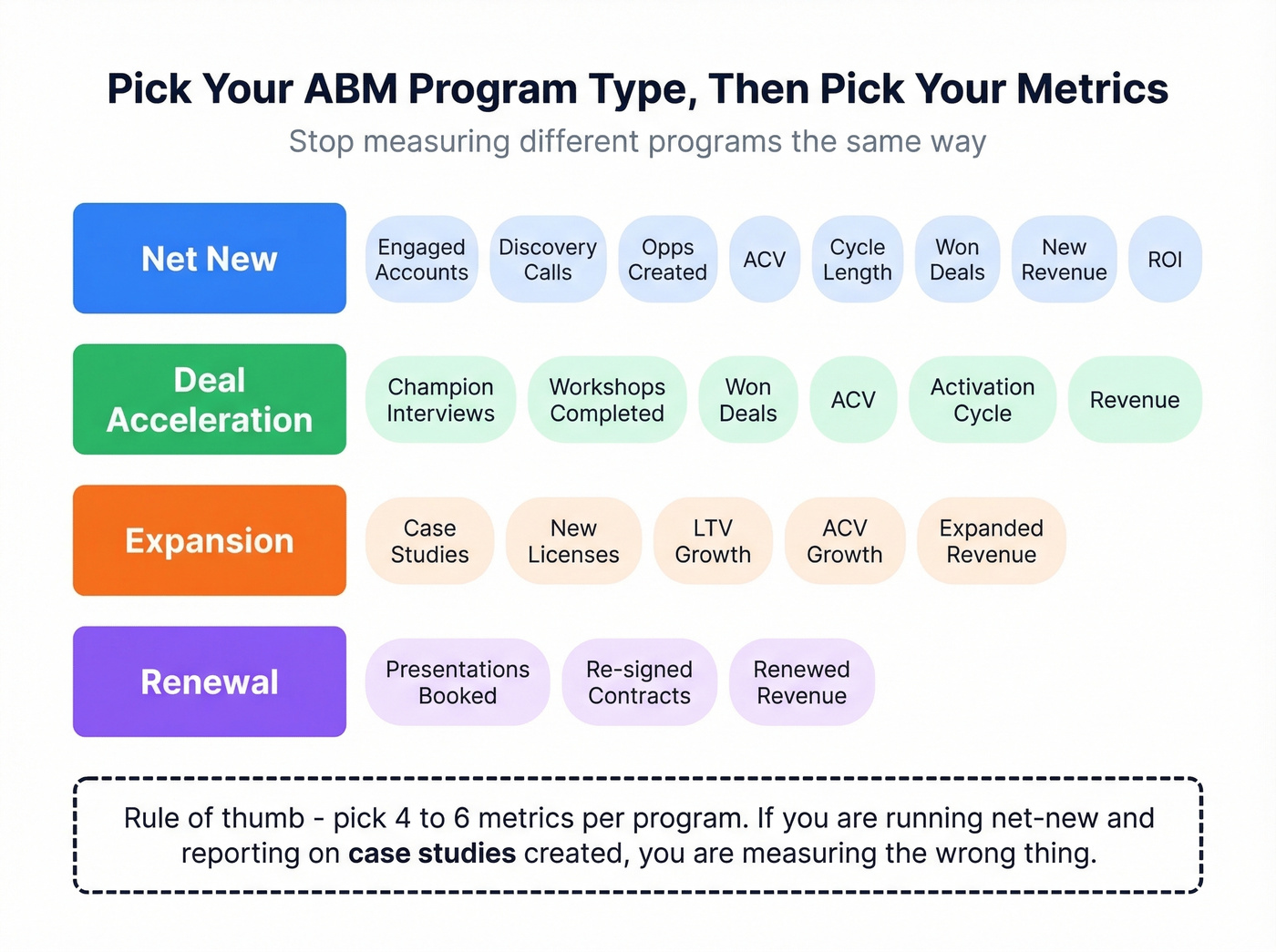
| Program Type | Key Metrics |
|---|---|
| Net New | Engaged accounts, discovery calls, opps created, ACV, cycle length, won deals, new revenue, ROI |
| Deal Acceleration | Champion interviews, workshops completed, won deals, ACV, activation cycle, revenue |
| Expansion | Case studies, new licenses, LTV growth, ACV growth, expanded revenue |
| Renewal | Presentations booked, re-signed contracts, renewed revenue |
Map your programs to these types first, then select 4-6 metrics per program. If you're running a net-new motion and reporting on "case studies created," you're measuring the wrong thing.
How to Attribute Revenue Across a Buying Committee
Single-touch attribution is a lie for ABM. When five stakeholders interact across a dozen touchpoints over six months, giving 100% credit to the last click before the demo is absurd.
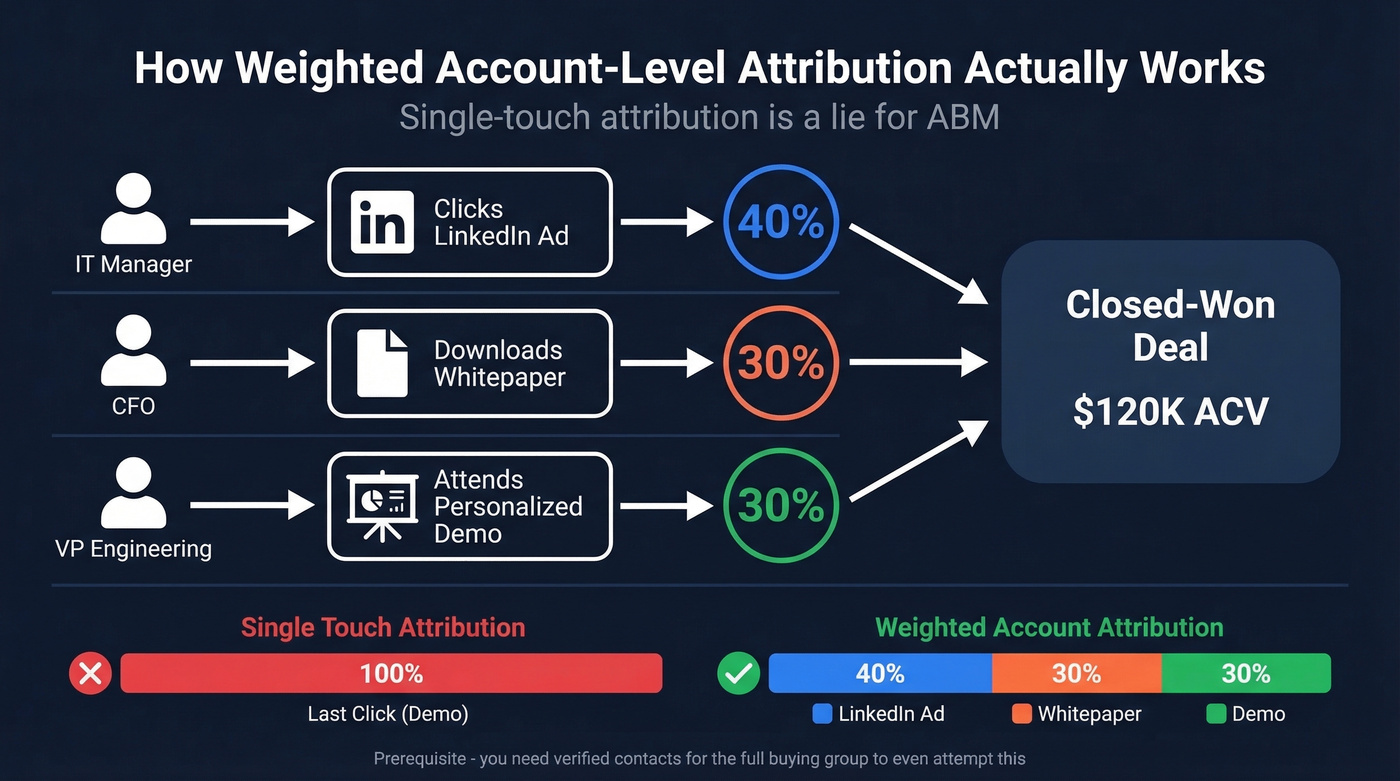
A practical example from HockeyStack's attribution framework: an IT manager clicks a LinkedIn ad (40% credit), the CFO downloads a whitepaper (30%), and a personalized demo seals the deal (30%). That's weighted account-level attribution. A weighted hybrid approach that factors engagement depth, buying stage progression, and account tier is the most practical option for teams that don't have a fully integrated data stack - which is most teams.
The prerequisite that nobody talks about: you need verified contact data for the full buying group to even attempt multi-touch attribution at the account level. If you're only tracking one or two contacts per account, your attribution model has blind spots the size of a freight train, no matter how sophisticated the math. (If you’re building coverage fast, start with how to automate target account lists.)
How to Calculate ABM ROI
ABM ROI = (Revenue attributed to ABM - Total ABM investment) / Total ABM investment x 100.
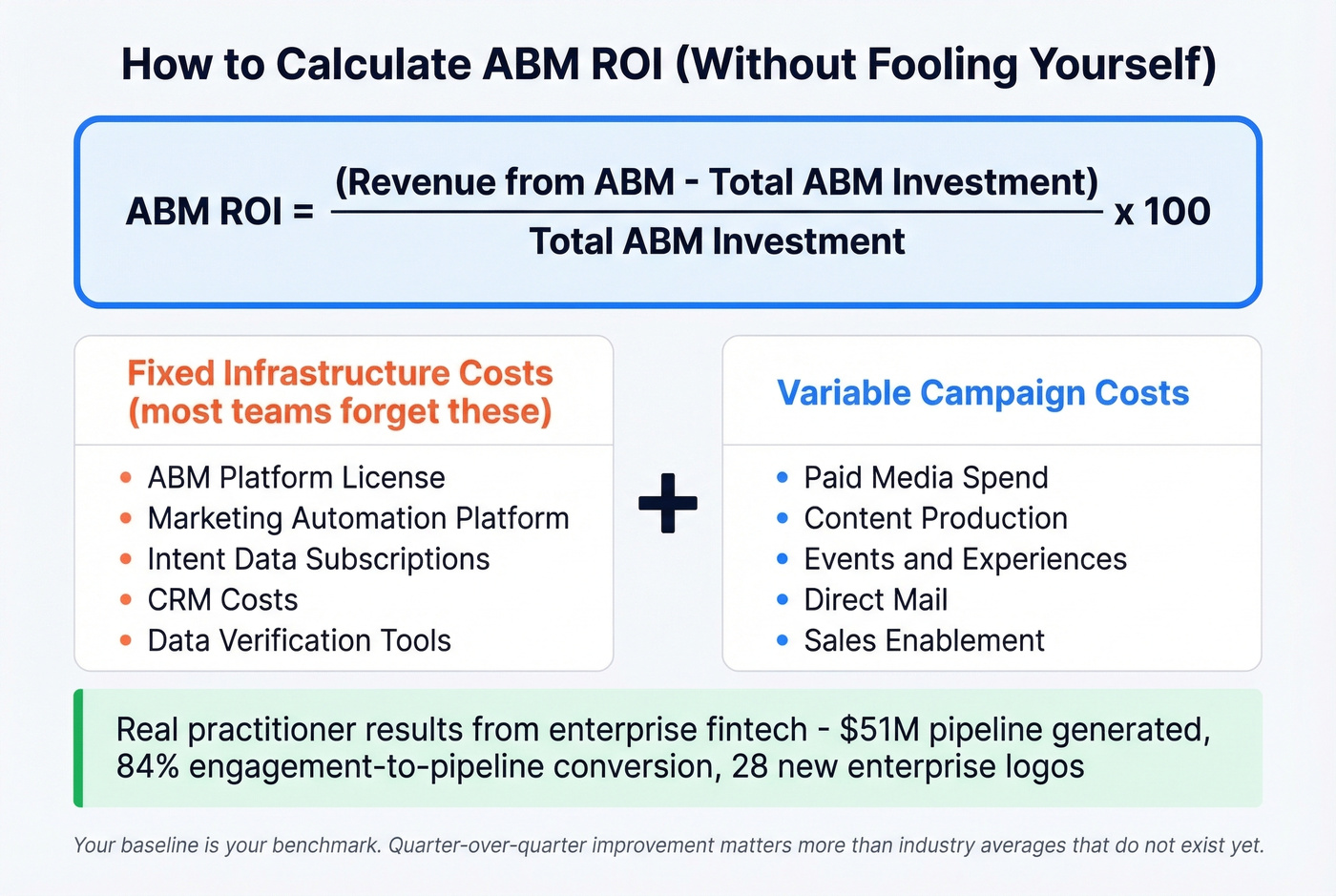
Include both fixed infrastructure costs (ABM platform, MAP, intent data tools) and variable campaign costs (paid media, content, events). Most teams forget the platform fees, which makes ROI look artificially high. (If you want to sanity-check spend efficiency, tie this back to cost to acquire customer.)
One practitioner on r/SaaS shared results from an enterprise fintech ABM program: $51M pipeline generated, 84% engagement-to-pipeline conversion, 28 new enterprise logos. Your numbers will differ, but engagement-to-pipeline conversion is the metric to watch - it's the clearest signal that your targeting and content are working together.
Hot take: ABM benchmarks barely exist. Practitioners are actively searching for them and finding nothing useful. Stop waiting. Your baseline is your benchmark. Quarter-over-quarter improvement matters more than some industry average that doesn't account for your deal size or sales cycle.
Multi-touch attribution requires verified contacts for the full buying group - not one stale email per account. Prospeo gives you 300M+ profiles with 30+ filters including buyer intent, so you can map entire committees and finally measure what matters.
Cover the whole buying group at $0.01 per verified email.
FAQ
What's a good ABM engagement rate?
No universal benchmark exists yet. Use your own first-quarter data as a baseline and track quarter-over-quarter improvement in engagement-to-pipeline conversion. A 5-15% lift per quarter signals a healthy program; flat or declining rates mean your targeting or content needs work.
How long before ABM shows ROI?
Enterprise ABM programs typically need 6-12 months to show closed-won revenue because deal cycles run that long. Set quarterly milestones for leading indicators - engagement scores, account progression, pipeline created - so you can prove momentum while lagging revenue metrics catch up.
What tools do I need to measure ABM?
At minimum: a CRM with clean account data, an engagement scoring model, and a shared dashboard. For the contact data layer, a verification tool with high accuracy and frequent refresh cycles prevents the data decay that silently breaks attribution. Skip this if your team already has bounce rates under 3% and full buying-group coverage - but we haven't met many teams who do.
Can I measure ABM without an ABM platform?
Yes. Many teams start with their existing CRM, a spreadsheet-based engagement model, and manual account tagging. You lose automation and intent signals, but you can still track the four core metrics - market reach, engagement score, pipeline velocity, and influenced pipeline - with disciplined data hygiene and weekly reviews. It's scrappy, but it works until budget opens up.