

Online Sales Coaching: What It Costs, What Works, and What Doesn't
Your VP just approved a coaching budget. You're staring at 15 vendor websites that all say "book a call." Every single one hides pricing behind a discovery meeting, and none of them will tell you upfront whether their online sales coaching program actually moves quota.
Let's fix that.
The Short Version
One-on-one coaching runs $500-$3,500/month depending on the coach's experience and what's included. A PwC global survey found an average ROI of **7x the cost of coaching** - that's the cleanest ROI anchor in the space.
If budget is tight, AI coaching tools are the cheapest way to scale practice and feedback. You can get call analysis, scoring, and role-play reps without paying for 1:1 time. One thing most guides skip: coaching fails when reps have bad contact data. You can perfect a rep's discovery framework, but if a big chunk of their phone numbers are disconnected, that coaching investment evaporates. Fix the data layer first.
What Is Online Sales Coaching?
Online sales coaching is coaching delivered through digital tools - video calls, conversation intelligence platforms, AI role-play software - to improve rep performance. That's the Mindtickle definition, and it's accurate enough.
The distinction that matters is between deal coaching and skill coaching. Deal coaching focuses on active opportunities: how to handle the procurement objection on the Acme deal, whether to multi-thread into the CFO's office, when to bring in an SE. Skill coaching targets long-term behaviors - how a rep runs discovery, how they handle silence, whether they default to pitching features instead of asking questions. Most programs blend both, but the best coaches are explicit about which mode they're in during a given session.
Does Virtual Coaching Actually Work?
The data says yes. But only with the right coach and the right setup.
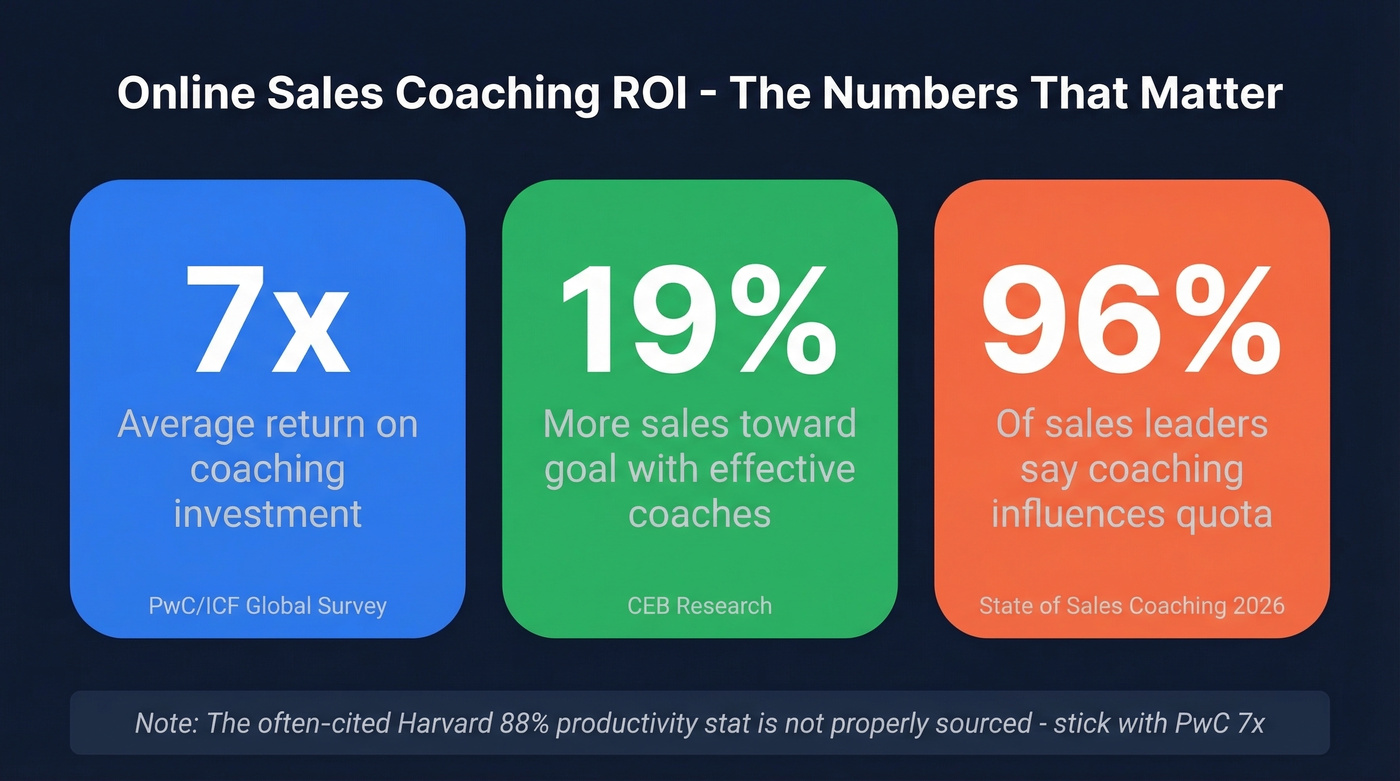
ROI numbers for coaching are genuinely strong - stronger than most sales investments. The PwC/ICF global survey reported an average return of 7x the cost. CEB's research found that sellers with a highly effective coach achieve 19% more sales toward goal. The State of Sales Coaching 2026 survey from My Sales Coach and Aircall showed that 96% of sales leaders say coaching influences quota attainment, with 42% calling the impact significant.
A quick note on a stat you'll see floating around: "Harvard says coaching produces an 88% increase in productivity." It's widely repeated in coaching content, but it isn't properly sourced in any material we've reviewed. Stick with the PwC 7x figure - it's sourced and compelling enough on its own.
Coaching vs. Training
Sandler frames it cleanly: sales training builds skills, sales coaching builds behavior. Training teaches a rep the MEDDIC framework. Coaching makes sure they actually use it on calls three weeks later.
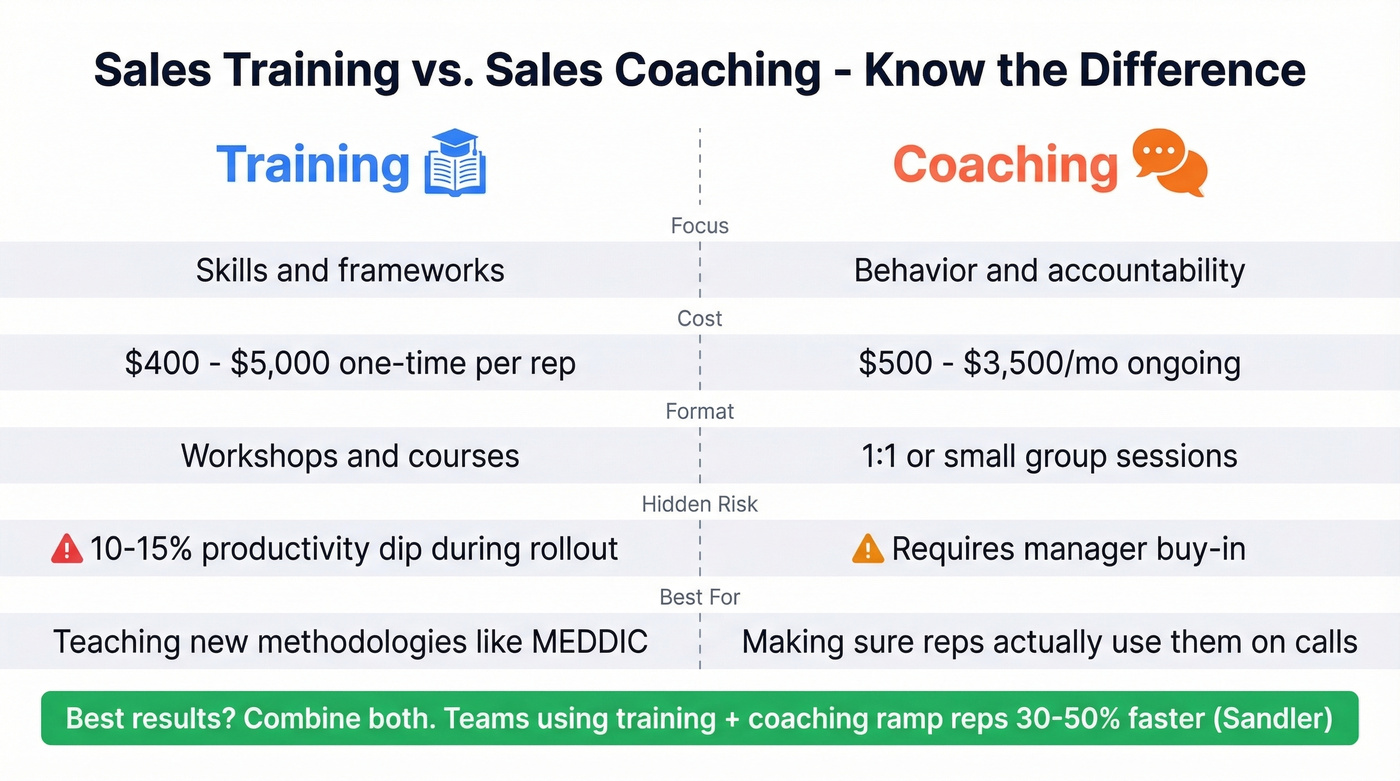
| Training | Coaching | |
|---|---|---|
| Focus | Skills, frameworks | Behavior, accountability |
| Cost per rep | $400-$5,000 (one-time) | $500-$3,500/mo (ongoing) |
| Format | Workshops, courses | 1:1 or small group sessions |
| Risk | 10-15% short-term productivity dip during rollout | Requires manager buy-in |
| Retention | Depends on reinforcement | Reinforced over time |
Here's the hidden cost of training that nobody mentions upfront: expect a 10-15% productivity dip while reps absorb new material. Coaching avoids this because it's applied in the flow of work - reps don't stop selling to learn. They learn while selling.
The best programs invest in both. Sandler specifically argues that teams combining training and coaching can see reps ramp 30-50% faster.

You just read that coaching ROI evaporates when reps have bad contact data. Prospeo delivers 98% email accuracy and 125M+ verified mobile numbers with a 30% pickup rate - so every coached rep actually reaches the buyers they're trained to close.
Stop coaching reps into voicemail. Give them numbers that connect.
What Online Sales Coaching Actually Costs
Every coaching vendor hides pricing behind a discovery call. You shouldn't need a 30-minute meeting to find out if you can afford something.
| Format | Price Range | What's Included |
|---|---|---|
| 1:1 coaching | $500-$3,500/mo | 2-4 calls/mo + async access |
| Per session | ~$250-$500 | Single session, no program |
| Group/cohort | $1,500-$4,000/rep | 8-12 week program |
| Enterprise | $15K-$100K+ | Team coaching + enablement |
Skillway publishes their price - $990/month for two scheduled calls plus unlimited text/email/phone access between sessions. That's a useful anchor point in a market where transparency is rare.
Typical commitments run 6-12 months, and many coaches require a year. This makes sense from a results perspective - behavior change doesn't happen in 30 days - but it also means you're committing real budget before you know if the coach is any good. Push for a 90-day trial period with defined milestones before signing a year-long contract.
The GROW Framework (Sales Edition)
If you're coaching internally or evaluating whether an external coach uses a real methodology, GROW is the framework to know. Co-developed by Sir John Whitmore, Graham Alexander, and Alan Fine in the mid-to-late 1980s and popularized by Whitmore's 1992 book Coaching for Performance, it's the most widely used coaching model in the world - and it adapts to sales beautifully.
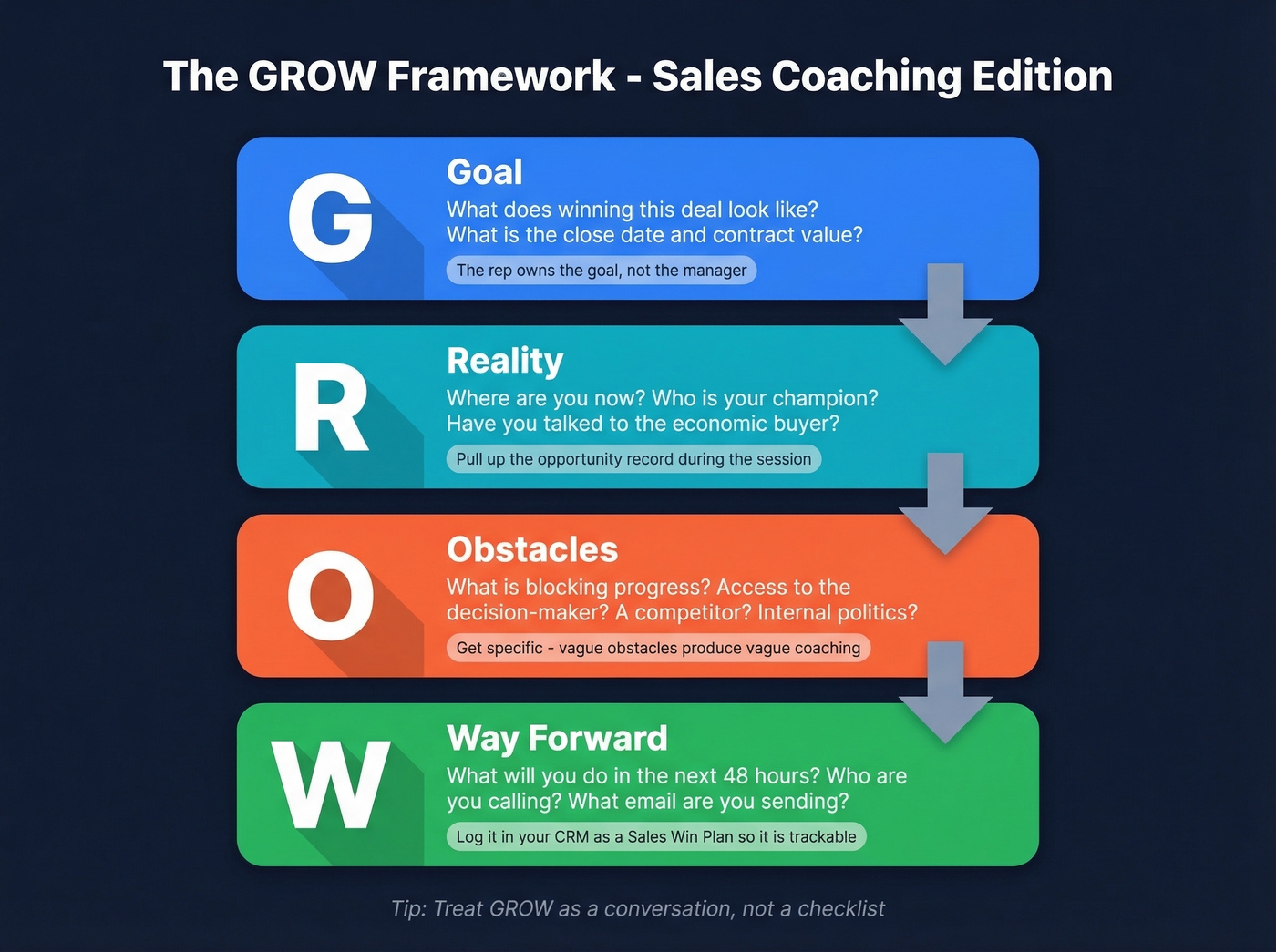
The sales-specific variant uses Goal, Reality, Obstacles, Way Forward:
- Goal: "What does winning this deal look like? What's the close date and contract value you're targeting?" The rep owns the goal, not the manager.
- Reality: "Where are you right now? Who's your champion? Have you spoken to the economic buyer?" Pull up the opportunity record during the session.
- Obstacles: "What's blocking progress? Is it access to the decision-maker? A competitor? Internal politics?" Get specific. Vague obstacles produce vague coaching.
- Way Forward: "What are you going to do in the next 48 hours? Who are you calling? What email are you sending?" Codify this in your CRM as a Sales Win Plan so it's trackable, not just conversational.
The biggest mistake managers make with GROW is treating it as a checklist instead of a conversation. The questions should feel natural, not like an interrogation.
Tools That Support Sales Coaching
Conversation Intelligence and AI Platforms
The AI coaching market has exploded. Here's what the major platforms cost and where they fit:
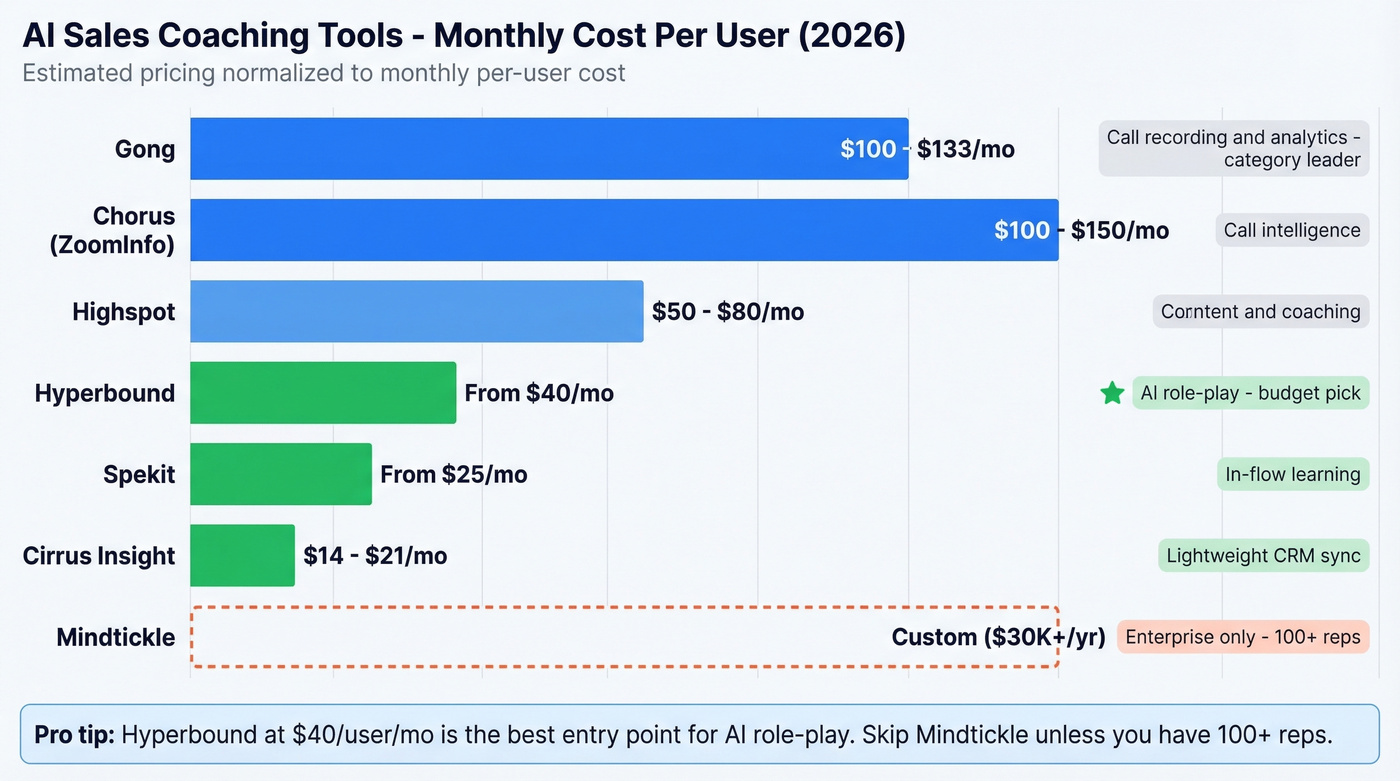
| Tool | Starting Price | Primary Use |
|---|---|---|
| Gong | ~$1,200-$1,600/user/yr | Call recording + analytics |
| Chorus (ZoomInfo) | ~$100-$150/user/mo | Call intelligence |
| Mindtickle | Custom (~$30K+/yr) | Enterprise enablement |
| Hyperbound | From ~$40/user/mo | AI role-play practice |
| Highspot | ~$50-$80/user/mo | Content + coaching |
| Spekit | From ~$25/user/mo | In-flow learning |
| Cirrus Insight | ~$14-$21/user/mo | Lightweight CRM sync |
Gong is the category leader for conversation intelligence - it records calls, surfaces coaching moments, and gives managers data on talk ratios, question frequency, and competitor mentions. At ~$1,200-$1,600/user/year plus a platform fee, it's a serious investment, but for teams running 50+ calls a day, the visibility is worth it.
Hyperbound is the interesting budget play. AI role-play at $40/user/month lets reps practice discovery calls, objection handling, and cold calls against realistic AI personas. Teams commonly use AI coaching tools like these to cut new-hire ramp time by 30-40%.
Skip Mindtickle unless you're running a 100+ person sales org. The platform is powerful, but the implementation overhead and custom pricing make it overkill for smaller teams.
The Data Problem Nobody Talks About
Here's the thing: bad data will destroy more pipeline than bad technique ever will. We've seen this pattern over and over - a rep can nail their discovery framework and still fail if they're dialing disconnected numbers or emailing addresses that bounce.
Before a coached outreach session, reps should be able to verify their contact list in bulk and push clean data to their sequencer. Prospeo handles this with 98% email accuracy, 125M+ verified mobile numbers, and a 7-day data refresh cycle. At roughly $0.01 per lead, it's a fraction of what you're spending on the coaching itself - and it ensures that coaching investment actually translates to live conversations.
If you’re evaluating vendors, start with a quick scan of data enrichment services so you know what “clean” should look like.
Best Practices for Remote Teams
Managers don't actually coach. CSO Insights found that sales leaders spend less than 20% of their time coaching. The rest goes to forecasting, pipeline reviews, and firefighting. If coaching isn't protected time on the calendar, it doesn't happen.
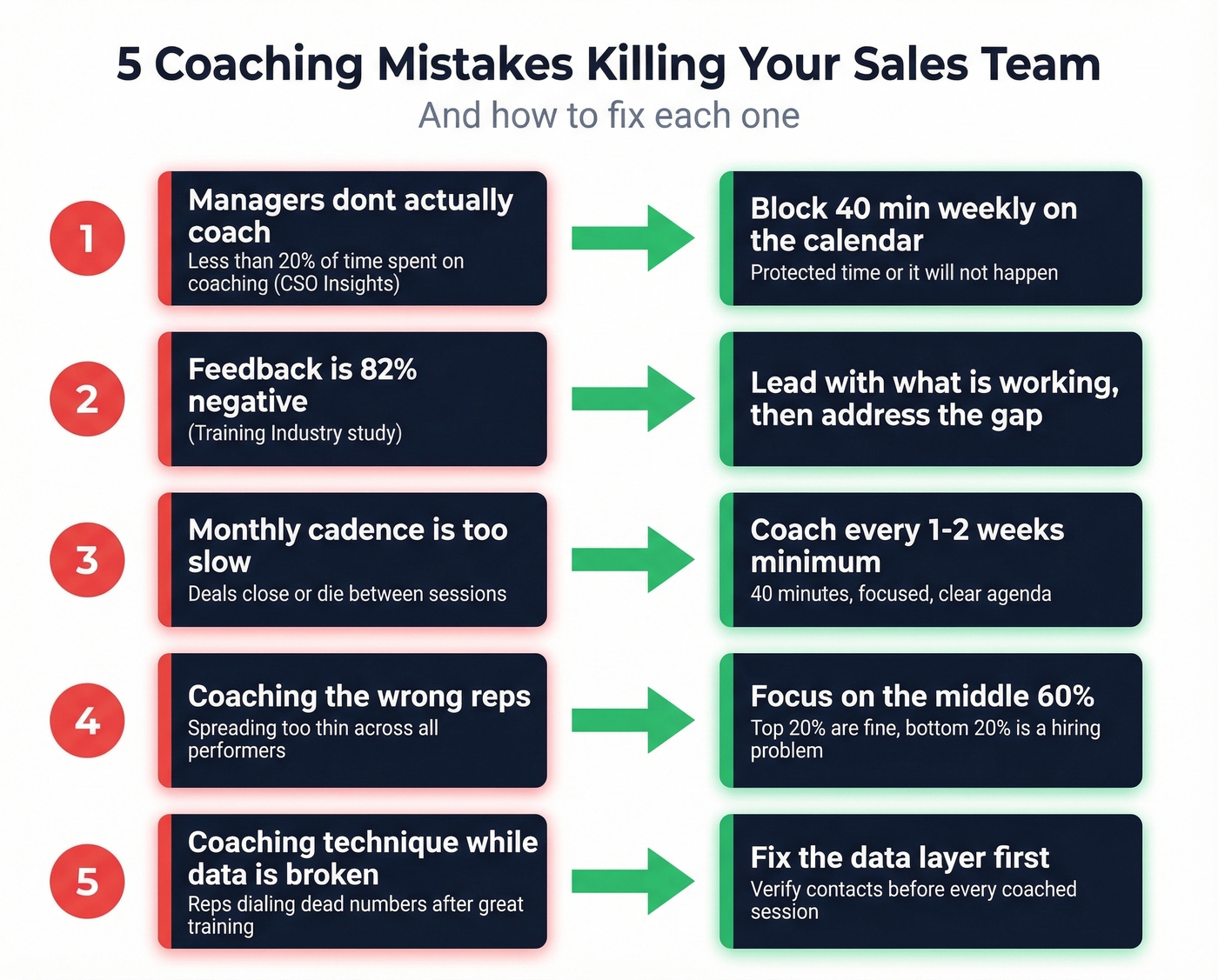
Feedback skews negative. In one study, when managers were asked to comment on rep performance, 82% of their feedback was negative. Coaching that only highlights what's wrong creates avoidance, not improvement. Lead with what's working, then address the gap.
Monthly cadence is too slow. Meeting reps once a month means you're coaching on deals that already closed or died. The recommended cadence is at least every two weeks, ideally weekly. Forty minutes, focused, with a clear agenda.
You're coaching the wrong reps. The most common complaint about coaching programs is coaches who spread themselves too thin. Focus your investment on the middle 60% of performers. Your top 20% already know what they're doing, and your bottom 20% likely have a hiring problem, not a coaching problem.
Technique coaching while the data is broken. This is the mistake we see most often and nobody writes about. You're investing $2,000/month in a coach to improve a rep's cold call opener, but a huge share of the phone numbers in your CRM are dead. That's not a coaching problem - it's a data problem. Bad data is where coaching ROI goes to die.
If your team is fully distributed, tighten up your remote sales meeting rhythm so coaching doesn’t get swallowed by “quick syncs.”
How to Choose a Coach
Not all coaches are worth the investment. We've evaluated dozens of coaching engagements across our customer base, and these five criteria separate the real ones from the resume-padders:
Sales motion match. A coach who specializes in enterprise SaaS cycles won't help a transactional inside sales team. Ask what their typical client's deal size and sales cycle look like.
Session agenda transparency. Good coaches share a sample session plan before you commit. If they can't articulate their methodology, they're winging it.
Defined success metrics. "Better reps" isn't a metric. Agree on specific KPIs upfront - quota attainment lift, win rate improvement, ramp time reduction. (If you need a baseline, start with sales conversion rate benchmarks.)
References from similar companies. Ask for 2-3 references from companies at your stage, selling a similar product, at a similar price point.
Willingness to be fired. The best coaches build in off-ramps. A 90-day checkpoint with clear go/no-go criteria protects both sides.
For distributed orgs, pay special attention to whether the coach has experience with remote teams. Building accountability across time zones and Slack channels is a different animal from coaching a bullpen of SDRs sitting ten feet away.
If you’re building a repeatable outbound motion alongside coaching, keep a short list of sales prospecting techniques to standardize what “good” looks like.
Ramp time drops 30-50% when you combine training with coaching. It drops even faster when reps aren't wasting hours on bounced emails and disconnected phones. Prospeo refreshes every record every 7 days - not the 6-week industry average - so your newly coached reps hit live prospects from day one.
Your coaching budget deserves data that keeps up. Prospeo does, at $0.01 per email.
FAQ
Is online sales coaching worth it for small teams?
Yes - arguably more so than for large teams. Small teams can't absorb a bad hire or a missed quarter the way a 200-person org can. One-on-one coaching at $500-$1,000/month for your top 2-3 reps delivers outsized returns when each rep represents a significant chunk of revenue. Start with the reps closest to quota.
How often should coaching sessions happen?
Weekly or biweekly sessions produce the best results, with 40-minute sessions every two weeks as the standard benchmark. Monthly cadence is the most common setup but also the least effective - by the time you review a deal, it's already won or lost. Protect coaching time on the calendar like you'd protect a customer meeting.
Can AI replace a human sales coach?
Not yet, but it's closing the gap fast. AI tools like Hyperbound and Gong handle repetitive coaching - call scoring, role-play practice, pattern recognition. Humans still win at reading political dynamics in a deal, coaching through career frustration, and adapting to context that doesn't show up in a transcript. The smartest teams use both.
What's the cheapest way to start coaching a sales team?
Combine a free AI tool tier with structured peer coaching using the GROW framework - total cost near zero. Layer in Prospeo's free plan (75 verified emails/month) to make sure reps practice on reachable contacts. Once you see early wins, invest $500-$1,000/month in a 1:1 coach for your highest-potential rep and measure the lift over 90 days.