

Ooma vs Vonage: Which VoIP Actually Deserves Your Money in 2026?
Every Ooma vs Vonage comparison shows you the promo pricing. Nobody shows you what happens in year two when Vonage's 30% discount expires and your per-line cost jumps $6-$12 overnight. That's the comparison that actually matters - what you'll pay over 24 months, not what the landing page says today.
30-Second Verdict
Pick Ooma if you're a small team (under 10 users) that wants transparent, no-contract pricing and a phone system that works out of the box.
Pick Vonage if you're a mid-market team (20+ users) that needs deep CRM integrations and 200-person video meetings - but budget for the post-promo price increase.
Skip both if your team runs outbound and the real bottleneck isn't the phone system - it's whether you're dialing verified numbers. A commodity dialer paired with bad data is just an expensive way to leave voicemails.
Business Pricing Breakdown
Here's the side-by-side that matters - both the promo pricing Vonage advertises and the standard rates you'll actually pay long-term.
| Essentials | Pro | Pro Plus | |
|---|---|---|---|
| Monthly | $19.95/user | $24.95/user | $29.95/user |
| Contract | None | None | None |
| Free toll-free # | Yes | Yes | Yes |
Vonage Business Communications Plans
| Mobile | Premium | Advanced | |
|---|---|---|---|
| Standard | $19.99/line | $29.99/line | $39.99/line |
| Promo (1-yr) | $13.99/line | $20.99/line | $27.99/line |
| Contract | 1-year required | 1-year required | 1-year required |
All prices exclude taxes and fees. Vonage's 30%-off promo required code 30PERCENTOFF and a 1-year commitment - it was listed as valid through January 31, 2026, so confirm availability before signing. Volume discounts apply across Vonage tiers at higher seat counts.
What Ooma Actually Costs
Ooma's pricing is refreshingly straightforward. $19.95, $24.95, or $29.95 per user per month. No contracts. No promo bait-and-switch.
The number you see is the number you pay, and every plan includes a free toll-free number - a perk most competitors gate behind premium tiers. Where it gets slightly more complex: add-ons. An extra local number runs $9.95/month. A toll-free number costs $9.95/month with 500 included minutes (3.4 cents per additional minute). Hardware is a one-time purchase - IP phones start at $59.99, and ATAs range from $69.99 to $119.99. For a 5-person team on the Pro plan, you're looking at roughly $125/month plus whatever hardware you need upfront.
What Vonage Actually Costs
Vonage's pricing page leads with the promo numbers: $13.99, $20.99, $27.99. Those require a 1-year contract. The early termination fee can equal the total remaining contract value - sign up and want out after three months, you're paying for the remaining nine.
Volume discounts do kick in at scale. At 5-19 users, the Mobile plan drops to $17.99/line. At 20-99 users, it's $14.99/line at standard rates. That's where Vonage starts making financial sense. But watch for add-on charges: some features cost extra on lower tiers, and those nickels add up fast.
The Year-Two Math
Nobody talks about this, and it's the single most important pricing consideration.
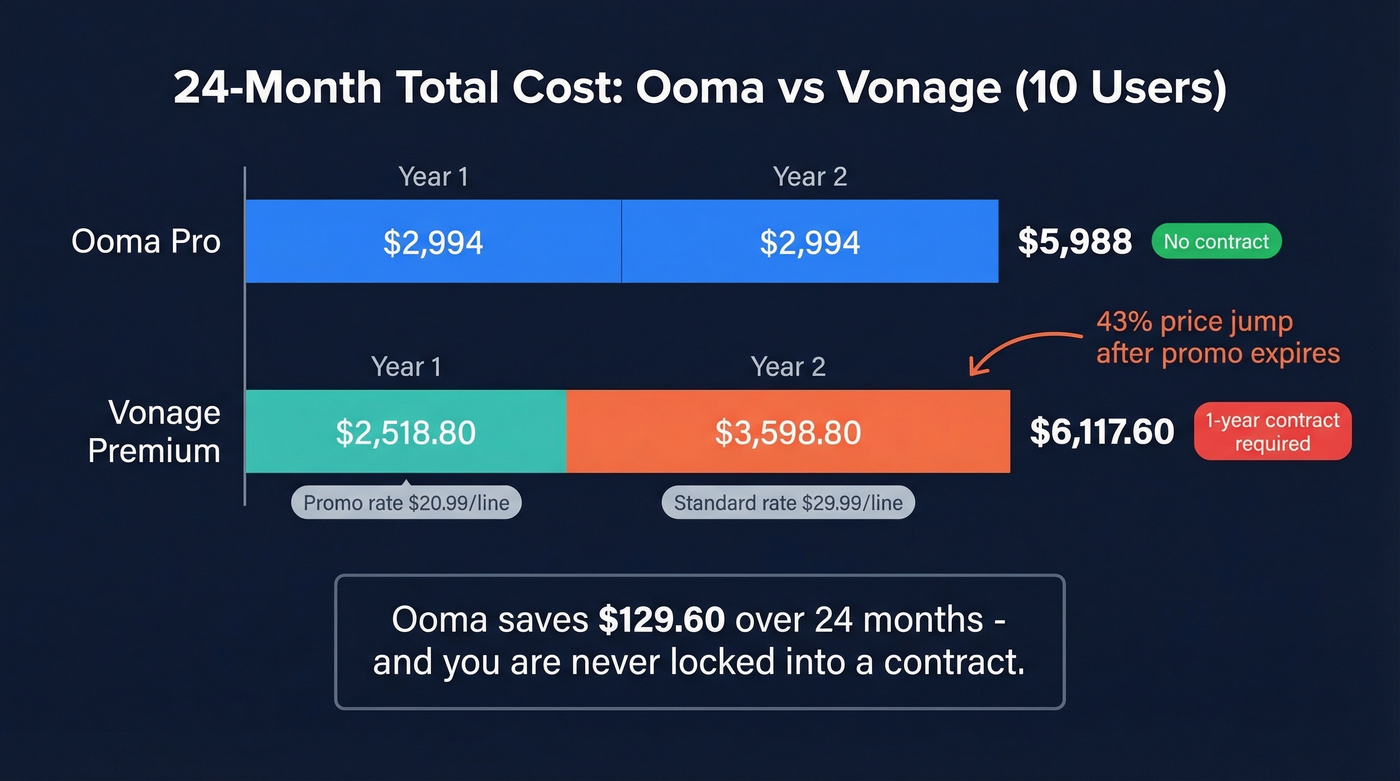
A 10-person team on Vonage Premium pays $209.90/month during the promo year. When the contract renews at standard rates, that jumps to $299.90/month - a 43% increase. Over 24 months, you'll pay $6,117.60 total. The same team on Ooma Pro pays $249.50/month from day one, totaling $5,988 over 24 months. Ooma is actually cheaper over two years, and you're never locked into a contract.
Here's the thing: if your team has fewer than 20 users, Vonage's promo pricing is a trap. It feels cheaper for 12 months, then it isn't. Ooma's boring, predictable pricing is the better financial decision for most small businesses.
Residential Pricing
For home use, the math is even simpler.
| Ooma Telo (Basic) | Ooma Premier | Vonage for Home (North America) | |
|---|---|---|---|
| Monthly | $0 + ~$4-8 taxes | $9.99 + taxes | $9.99 + taxes |
| Upfront | ~$99.99 hardware | ~$99.99 hardware | Vonage Box included |
| All-in estimate | ~$4-8/mo | ~$14-18/mo | ~$15-20/mo |
Ooma's residential play is genuinely hard to beat. You buy the Telo hardware once, and your ongoing cost is just taxes and regulatory fees. Vonage for Home starts at $9.99/month before taxes, which typically pushes the real cost to $15-20/month depending on your state. For home use, Ooma wins on price and it isn't close.
Features Head-to-Head
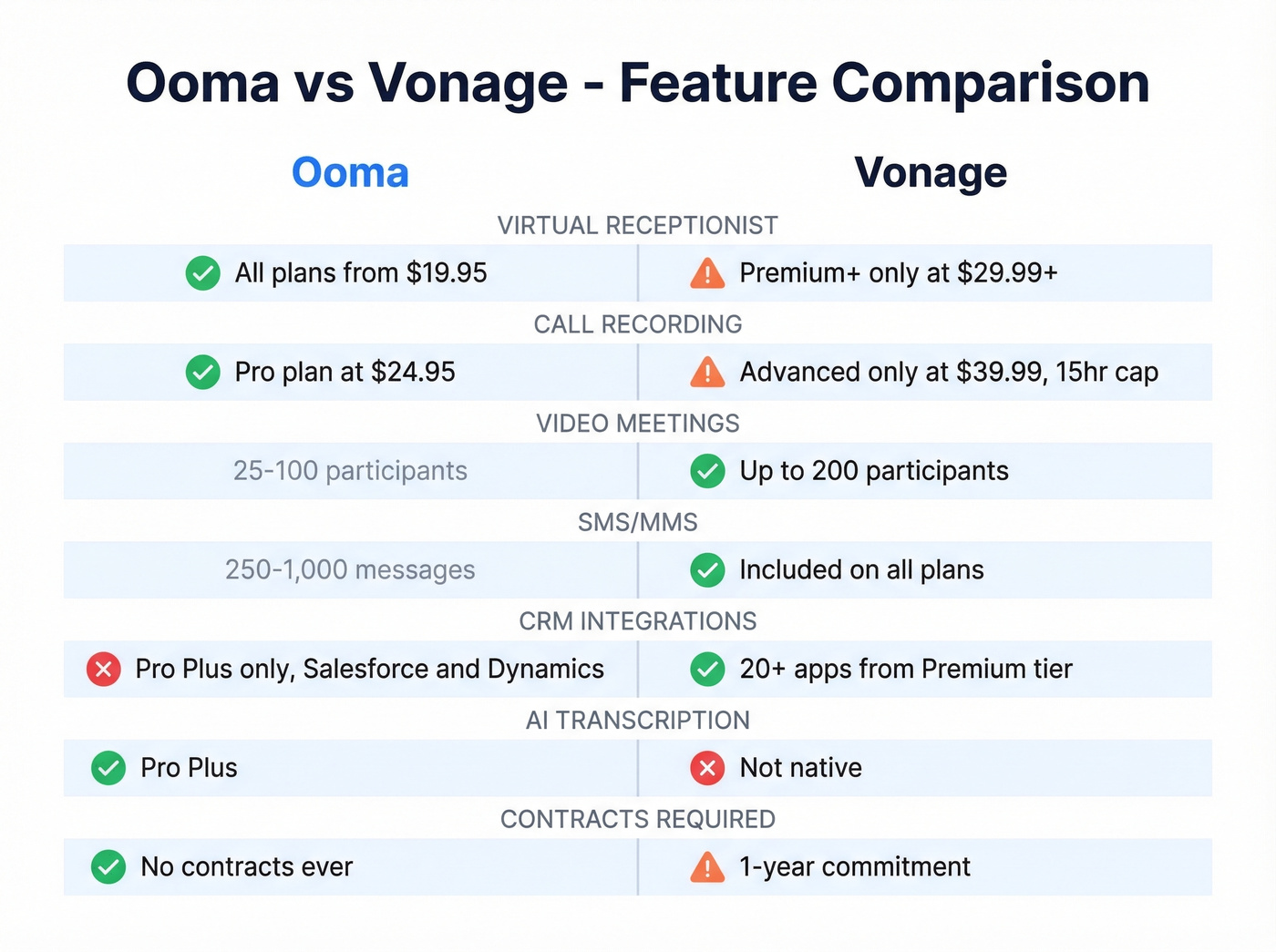
| Feature | Ooma | Vonage | Edge |
|---|---|---|---|
| Virtual receptionist | All plans | Premium/Advanced ($29.99+) | Ooma |
| Call recording | Pro ($24.95) | Advanced only ($39.99, 15hr cap) | Ooma |
| Video meetings | 25-100 participants | Up to 200 participants | Vonage |
| SMS/MMS | 250-1,000 msgs | Included on all plans | Vonage |
| CRM integrations | Pro Plus only (Salesforce, Dynamics) | Premium+ (20+ apps) | Vonage |
| AI transcription | Pro Plus | Not native | Ooma |
| Enhanced 911 | All plans | All plans | Tie |
Where Ooma Wins
Ooma includes a virtual receptionist on every plan, including the $19.95 Essentials tier. That's a feature Vonage gates behind Premium or Advanced. Call recording comes standard on Ooma Pro, while Vonage limits on-demand recording to the Advanced tier at $39.99 - and caps it at 15 hours per month.
Ooma Pro Plus adds AI-powered call transcriptions, which is genuinely useful for sales teams reviewing calls without paying for a separate conversation intelligence tool. The no-contract flexibility also means you can scale up or down monthly without penalty. And Ooma's PureVoice technology is built to prioritize voice quality on real-world internet connections, which matters if your office internet isn't enterprise-grade.
Where Vonage Wins
Vonage Premium supports video meetings with up to 200 participants. Ooma Pro caps at 25, and even Pro Plus only goes to 100. For teams running large all-hands or client presentations over video, Vonage has a clear edge.
Vonage also includes SMS/MMS on the Mobile plan - their cheapest tier. Ooma limits texting to 250 messages on Pro and 1,000 on Pro Plus. For teams that rely on business texting, Vonage's approach is more generous at the entry level. The integration ecosystem is where Vonage really pulls ahead, though - more on that below.
Integrations and CRM
Use Vonage if your workflow depends on CRM connectivity. Vonage's VBC App Center offers 20+ integrations including Salesforce, HubSpot, Microsoft Dynamics, Slack, and Zapier, available starting on the Premium plan.
Ooma's integration story is frustratingly thin for 2026. CRM integration only exists on Pro Plus ($29.95/user/month), and even then it's limited to Salesforce and Dynamics 365. If your reps live in HubSpot, Ooma simply doesn't connect without workarounds. Skip Ooma if integrations are a priority - full stop.
If you're building a stack around data enrichment, the phone system matters less than whether your CRM is clean and current.

You're comparing dialers, but the real cost isn't $19.95 vs $29.99 per line - it's every call that goes to a dead number. Prospeo gives your reps 125M+ verified mobile numbers with a 30% pickup rate, refreshed every 7 days. At $0.10 per mobile, you'll spend less on accurate direct dials than one month of Vonage's Advanced plan.
Stop paying for a premium dialer to call bad numbers.
Support and Reliability
Ooma and Vonage take fundamentally different approaches to support, and the gap is wider than their marketing pages suggest.
Ooma provides 24/7 live chat and phone support on all plans - no paid tiers, no upsells. User reviews consistently praise the responsiveness, and Ooma carries a 4.6/5 rating on G2 across 131 reviews with fewer reliability complaints than most VoIP providers. The one knock: Ooma doesn't publish a formal uptime SLA.
Vonage advertises 99.999% uptime, which sounds impressive on paper. The user review data tells a different story. Vonage sits at 4.3/5 on G2 across 494 reviews - more reviews and a lower score usually means the complaints are consistent, not anecdotal. Reviewers regularly flag call drops and slow support response times. "Support PLUS" costs an extra $9.99/month for priority access. When users report connection issues alongside a five-nines SLA, something doesn't add up.
If uptime is mission-critical, it’s worth understanding churn risk and vendor lock-in before you commit.
What Real Users Say
Vonage's review data reveals a 2-month average implementation timeline and a 17-month ROI timeline. That's a long time to wait for payback on a phone system. We've seen Ooma teams go live in under a day.
The praise patterns diverge predictably. Ooma users love the simplicity and setup speed. Vonage users appreciate the integration ecosystem once everything is running. The complaints diverge too: Vonage users flag support responsiveness and call quality issues, while Ooma users wish for more integrations and occasionally report porting friction when moving numbers from another provider.
For outbound teams, this is also where sales prospecting techniques and list quality start to matter more than the dialer brand.
Vonage's Corporate Future
This is the section most comparison articles skip, and it might be the most important one.
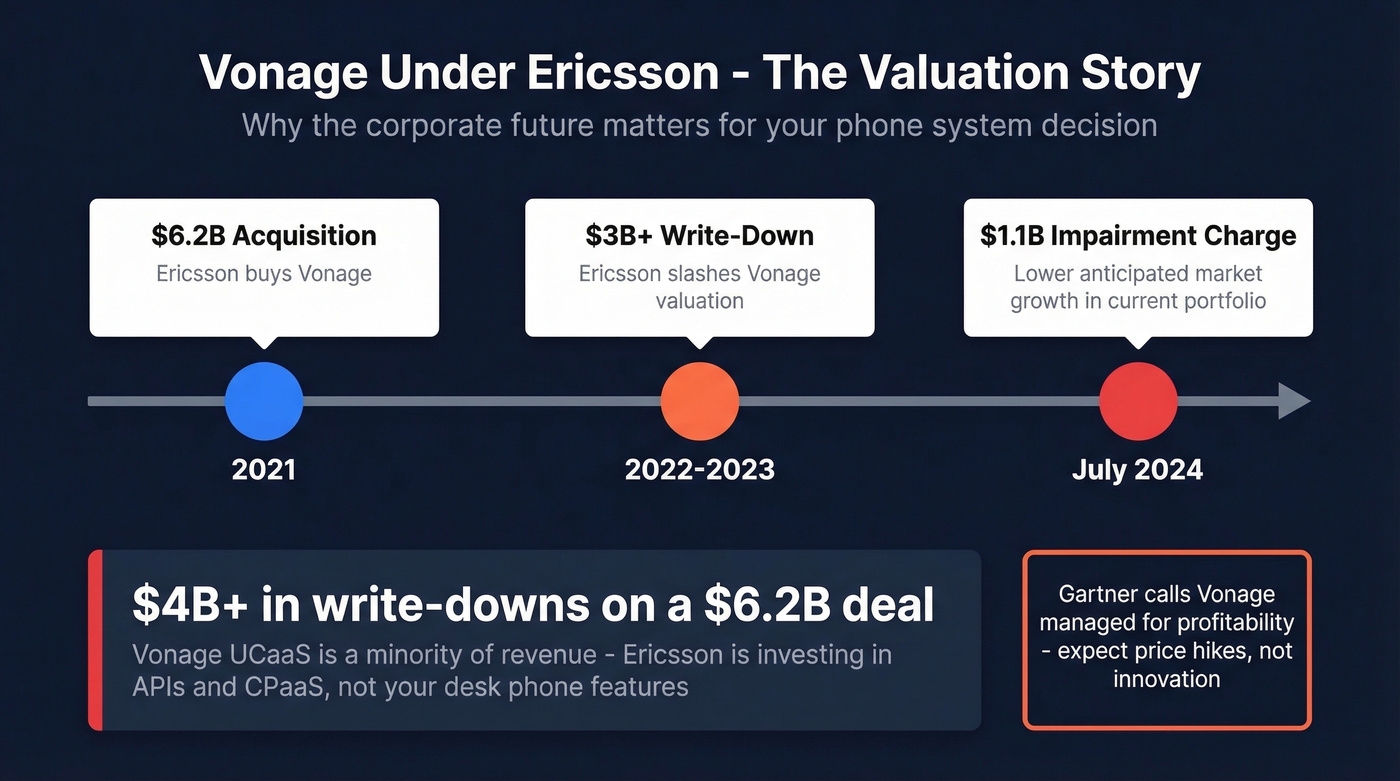
Ericsson acquired Vonage for $6.2 billion. Since then, they've taken a $3 billion valuation slash followed by a nearly $1.1 billion impairment charge in July 2024, tied to "lower anticipated market growth rates in Vonage's current portfolio." That's over $4 billion in write-downs on a $6.2 billion acquisition.
The strategic reality is even more telling. Vonage's API platform accounted for 73%+ of revenue as far back as 2020. The UCaaS product - Vonage Business Communications, the thing you'd actually be buying - is a minority of the business. Vonage's 1.1 million developer community and 200+ carrier connections are the assets Ericsson actually cares about. Gartner forecasts 90% of global enterprises will use CPaaS by 2028, and the network API market is projected to hit $6.7 billion - that's where Ericsson's investment is going, not into your desk phone features.
Gartner has described Vonage as being "managed for profitability," which is analyst-speak for "don't expect aggressive investment." A platform managed for profitability rather than growth tends to raise prices, cut support costs, and slow feature development. We've seen this pattern play out with other acquired-then-deprioritized products, and it rarely ends well for customers. If you're choosing a phone system for the next 3-5 years, this matters more than whether Vonage has 5 more integrations than Ooma.
Who Should Pick What
Pick Ooma if you:
- Have fewer than 10 users
- Want month-to-month flexibility with no contracts
- Need a virtual receptionist without paying for a premium tier
- Value transparent pricing over promo discounts
- Can live with limited CRM integrations
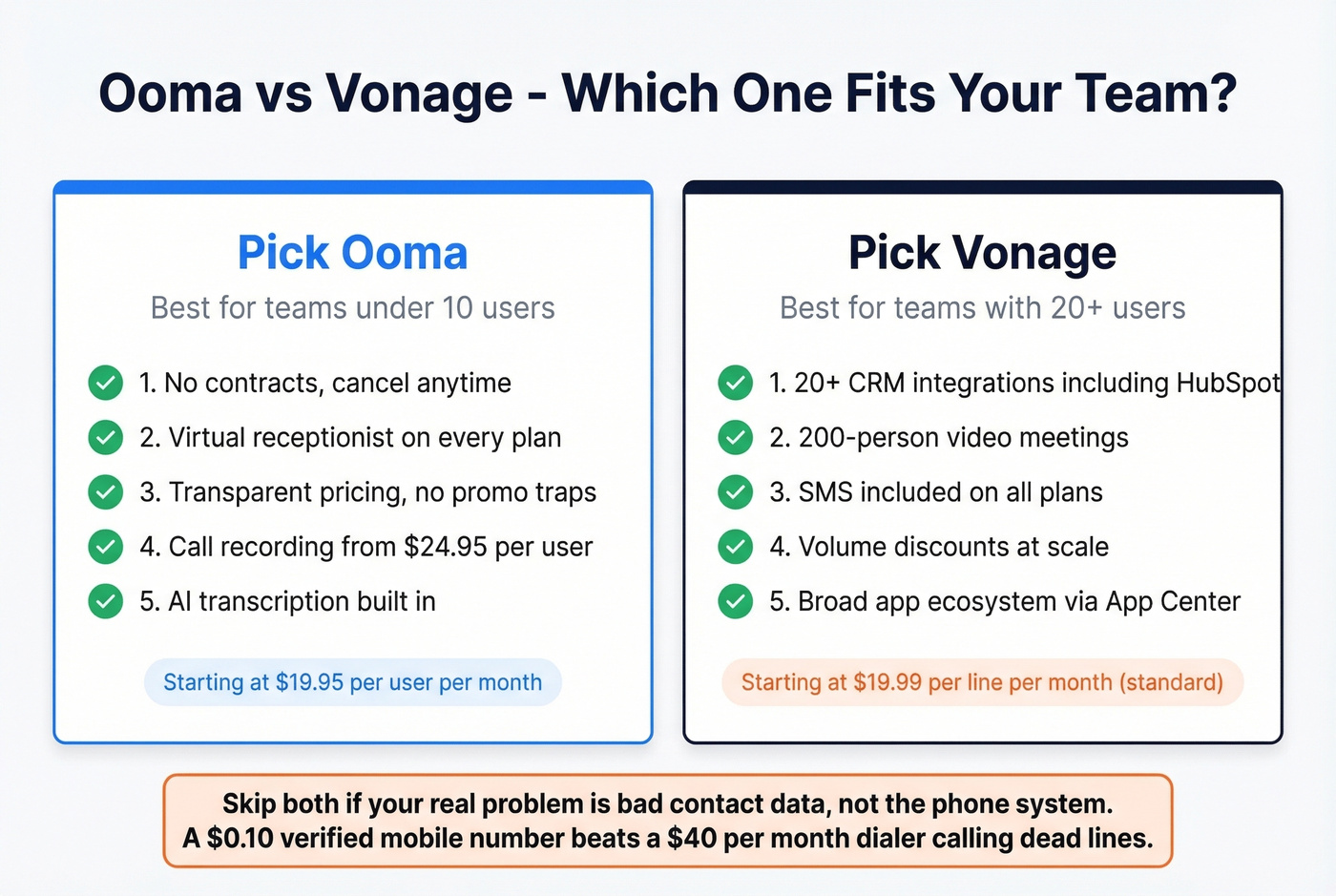
Pick Vonage if you:
- Have 20+ users where volume discounts make it competitive
- Need Salesforce, HubSpot, or Dynamics integrations on day one
- Run large video meetings with 100-200 participants
- Are comfortable with a 1-year contract and post-promo price increases
Consider alternatives if:
- You need AI-native features on a budget - Dialpad starts at $15/user/month with strong transcription and coaching built into every plan
- You want broader integrations - RingCentral (~$20/user/month) covers more ground than either
- Your team runs outbound and the real problem isn't the dialer - it's the data. When reps burn through call blocks hitting voicemail and disconnected numbers, pairing any dialer with Prospeo's 125M+ verified mobiles and a 30% pickup rate solves the problem upstream, before the phone system even matters.
If you’re actively comparing vendors, it can also help to scan Dialpad alternatives to sanity-check pricing and feature claims.
The Dialer Is a Commodity
Let's be honest about something. Your VoIP provider handles the plumbing. The contact data feeding your dialer determines whether reps spend their day talking to prospects or listening to voicemail greetings.
If your outbound team is weighing these two platforms, make sure they're also solving for whether the numbers they're dialing actually connect. In our experience, the teams that see the biggest jump in outbound results aren't the ones who upgraded their phone system - they're the ones who fixed their data. A $20/month dialer with verified numbers outperforms a $40/month dialer with stale lists every single time.
This is also why teams invest in better contact management software before they obsess over VoIP features.
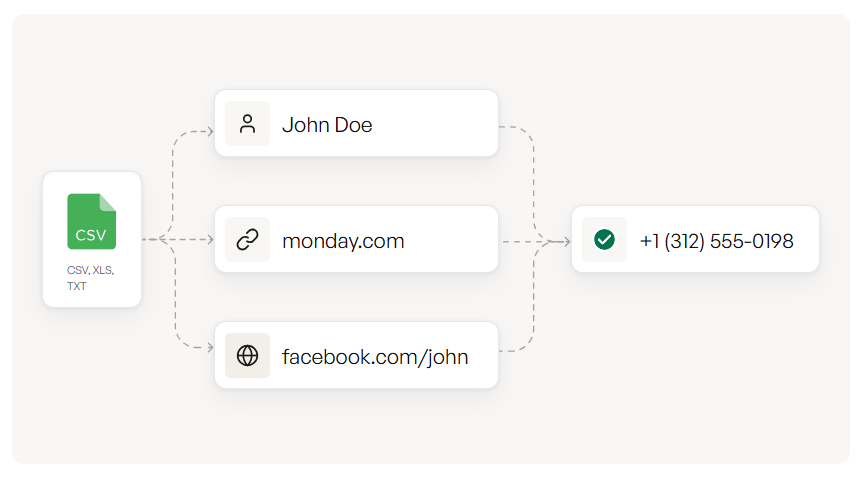
Ooma and Vonage both integrate with Salesforce and HubSpot - but neither fixes the data flowing through your CRM. Prospeo enriches your CRM contacts with 50+ data points at a 92% match rate, so every call your reps make through Ooma or Vonage actually connects to a real decision-maker.
Enrich your CRM first, then pick your dialer.
FAQ
Is Ooma really free?
Ooma Basic residential has no monthly fee, but you'll pay roughly $4-8/month in taxes and regulatory fees plus ~$99.99 upfront for the Telo hardware. Ooma Office business plans start at $19.95/user/month - those aren't free.
Does Vonage require a contract?
Yes. Vonage's advertised 30%-off pricing requires a 1-year contract, and early termination fees can equal the total remaining contract value. Standard month-to-month pricing starts at $19.99/line - significantly higher than the promo rates.
Which has better call quality?
Ooma's PureVoice technology prioritizes voice quality on real-world connections, and users rate it 4.6/5 on G2 with fewer reliability complaints. Vonage advertises 99.999% uptime but scores 4.3/5 on G2, with reviewers consistently flagging call drops and connection issues.
Can I use either platform for outbound sales?
Both work as phone systems, but outbound effectiveness depends on whether reps are dialing verified numbers. The best dialer in the world can't fix a list full of disconnected lines - solving for data quality upstream is what separates high-performing outbound teams from ones burning through call blocks.
What are the best alternatives to both providers?
RingCentral (~$20/user/month) offers broader integrations than either platform. Dialpad starts at $15/user/month with AI transcription and coaching on every plan. For teams prioritizing outbound, pairing any commodity dialer with verified contact data often delivers better ROI than upgrading the phone system itself.