

The Outbound Cold Calling Playbook: Scripts, Benchmarks, and Tools
It's 9:02 AM on a Tuesday. You've got 80 dials queued up, a fresh coffee, and a list your marketing team swears is "clean." By dial fifteen, you've hit six voicemails, four disconnected numbers, two gatekeepers, and one person who hung up before you finished your name. Half the numbers are dead. Your script doesn't matter if nobody picks up.
Outbound cold calling isn't dead - 92% of B2B buyers are open to cold outreach when it's relevant. Lazy dialing is dead. The teams crushing it in 2026 aren't working harder; they're working with better data, tighter frameworks, and a system that doesn't waste 40% of their dials on numbers that never ring. The gap between a rep booking four meetings a week and a rep booking zero is almost never talent. It's infrastructure.
The Short Version
Before we get into benchmarks and scripts, here's what matters most:
Your data matters more than your script. Verified mobile numbers are the single biggest lever for connect rates. A mediocre rep with great numbers will outperform a great rep dialing from a stale list every single time.
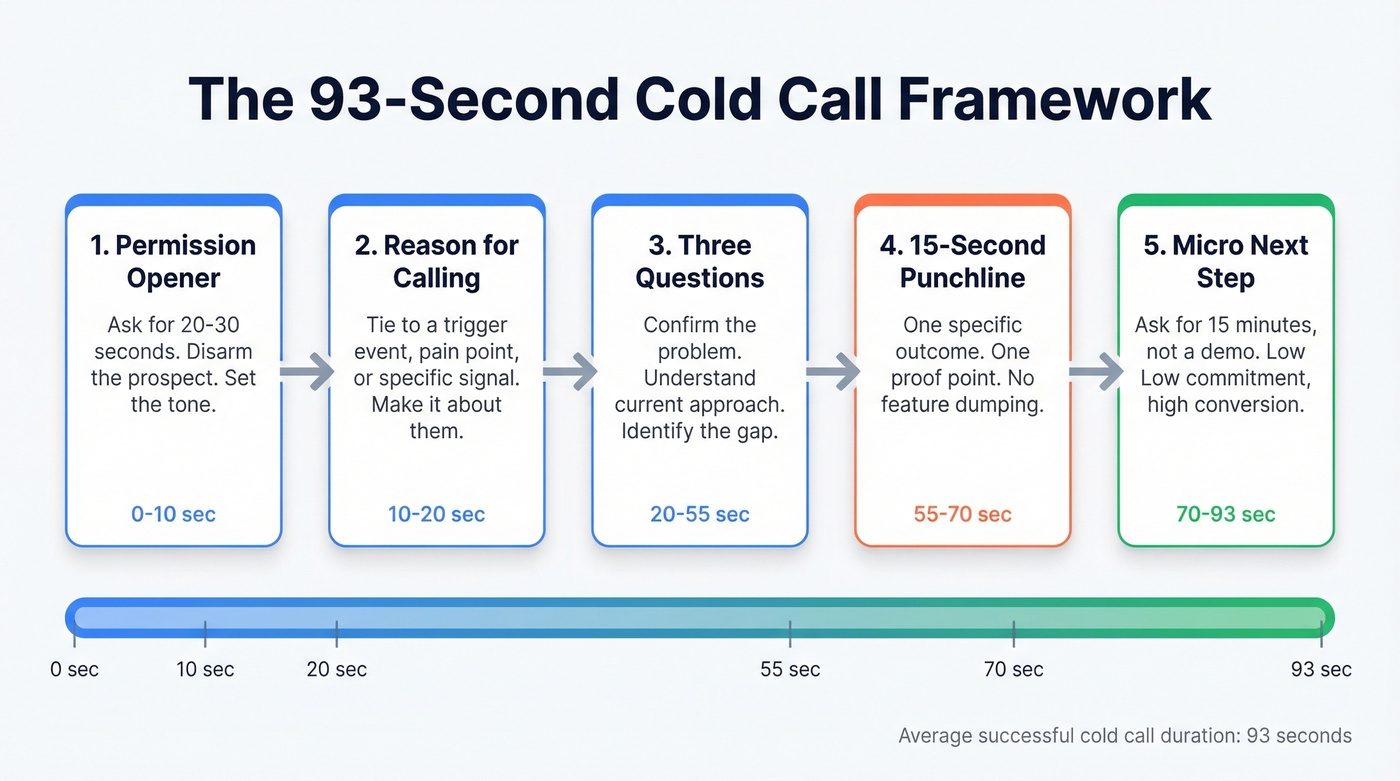
You have 93 seconds. That's the average cold call duration from the Cognism/WHAM cold calling report. Use a permission-based opener, ask three questions, deliver a 15-second punchline, and ask for the next step.
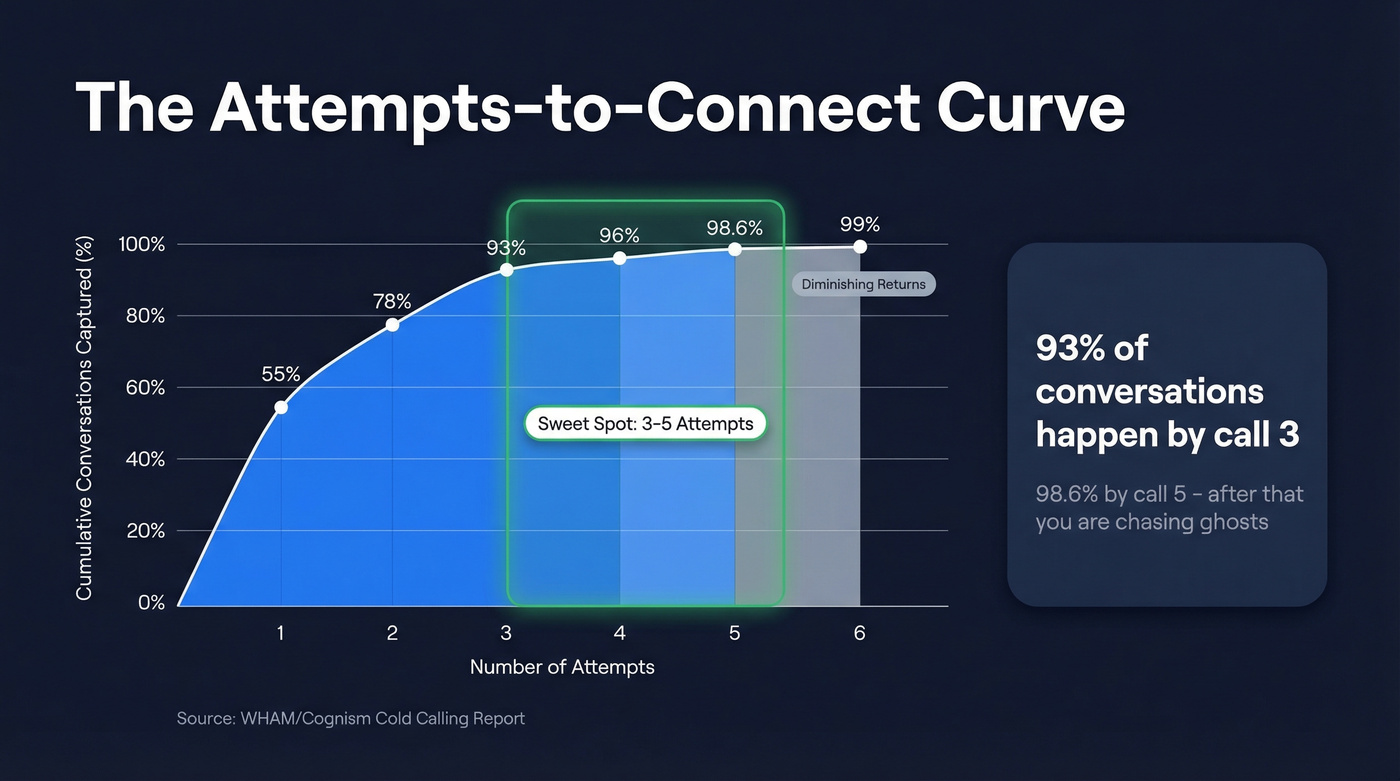
93% of conversations happen by call 3. If you're giving up after one attempt, you're leaving meetings on the table.
Benchmarks That Actually Matter
Let's ground this in real numbers. WHAM (We Have A Meeting) data, analyzed by Cognism, gives us the clearest picture of what's actually happening on the phones.
| Metric | Benchmark |
|---|---|
| Success rate | 4.82% |
| Avg call duration | ~93 seconds |
| Conversations by call 3 | 93% |
| Conversations by call 5 | 98.6% |
| Best days | Tue + Wed |
| Tue + Wed demo share | 44% of demos |
| Monday call-to-demo | 1.19% |
| Worst day | Friday |
The attempts-to-connect curve is steep. You get 93% of your total conversations within three attempts. Push to five and you've captured 98.6%. After that, you're chasing ghosts. Three to five attempts is the sweet spot.
Day-of-week matters more than most reps think. ZoomInfo's analysis of 1.4M+ outbound calls found Tuesday and Wednesday together drive 44% of all demos booked. Monday actually has the highest call-to-demo efficiency at 1.19%, but lower volume. Friday is the worst across every metric - use it for planning, list building, and exec outreach, not high-volume dialing.
Here's the thing: a 4.82% success rate sounds low until you do the math. At 80 dials a day, that's roughly four meetings a week. Consistent, structured outbound cold calling still fills pipeline faster than almost any other channel.
Stop tracking dials per day. It's a vanity metric that rewards busywork. A rep who makes 50 dials against a verified list and books three meetings is outperforming the rep who makes 120 dials against garbage data and books one. Measure qualified conversations and meetings booked. That's the number your pipeline actually cares about.
The Cold Call Script Framework
Scripts aren't monologues. They're structure. The first 30-60 seconds decide whether you get a conversation or a click. Every strong opener has five building blocks:
- A permission-based start
- A reason tied to a real problem
- Light proof - social or data-driven
- An engagement question
- A micro-next step
Here are three openers you can copy and use today:
The Permission Opener "Hey [Name], this is [You] from [Company]. Can I take 20 seconds to tell you why I called, and you can tell me if I'm off base?"
The Trigger Opener "Hey [Name], I noticed [Company] just [trigger event - new hire, funding round, tech change]. We help teams like yours [one-sentence value prop]. Worth a quick conversation?"
The Pattern-Interrupt Opener "Hey [Name], you don't know me - this is a cold call. Can I get 30 seconds before you decide to hang up?"
The pattern-interrupt works because it's honest. Prospects expect a pitch. Acknowledging the call disarms them.
Once you're past the opener, the rest of the call follows a simple structure: three questions, 15-second punchline, small next step. Confirm the problem, understand their current approach, identify the gap, deliver your punchline in 15 seconds or less, then ask for a 15-minute meeting - not a demo, not a commitment.
Here's what a full call sounds like when it works:
Full call example (~80 seconds)
Opener: "Hey Sarah, this is Mike from Acme. Can I take 20 seconds to tell you why I called, and you can tell me if I'm off base?"
Question 1: "How are you sourcing direct dials for your outbound team right now?"
Question 2: "What's your connect rate looking like - are your reps getting through on most dials?"
Question 3: "If you could get 20% more live conversations per day without adding headcount, what would that do to your pipeline?"
Punchline: "We help sales teams cut dead dials by 40% with verified mobile numbers that refresh weekly. Teams using us are booking 26% more meetings than they were before."
Next step: "Would it be worth 15 minutes Thursday to see if the numbers make sense for your team?"
When you know someone's tech stack, recent job change, or company growth signals before you dial, your "reason for calling" actually sounds like a reason - not a guess. Even 30 seconds of pre-call research turns a generic opener into a specific one.

You just read it: your data matters more than your script. Prospeo gives your reps 125M+ verified mobile numbers refreshed every 7 days - not the stale lists that kill connect rates. Teams switching to Prospeo book 26% more meetings because their dials actually ring.
Fix your connect rate before you fix your script.
Handling the Five Objections You'll Hear Most
Not every objection means "no." Blocking objections ("I'm busy," "send me an email") are reflexive - the prospect wants to end the call, not evaluate your offer. Qualifying objections ("we already have a vendor," "no budget") mean they're engaging with what you said. Your response should differ.
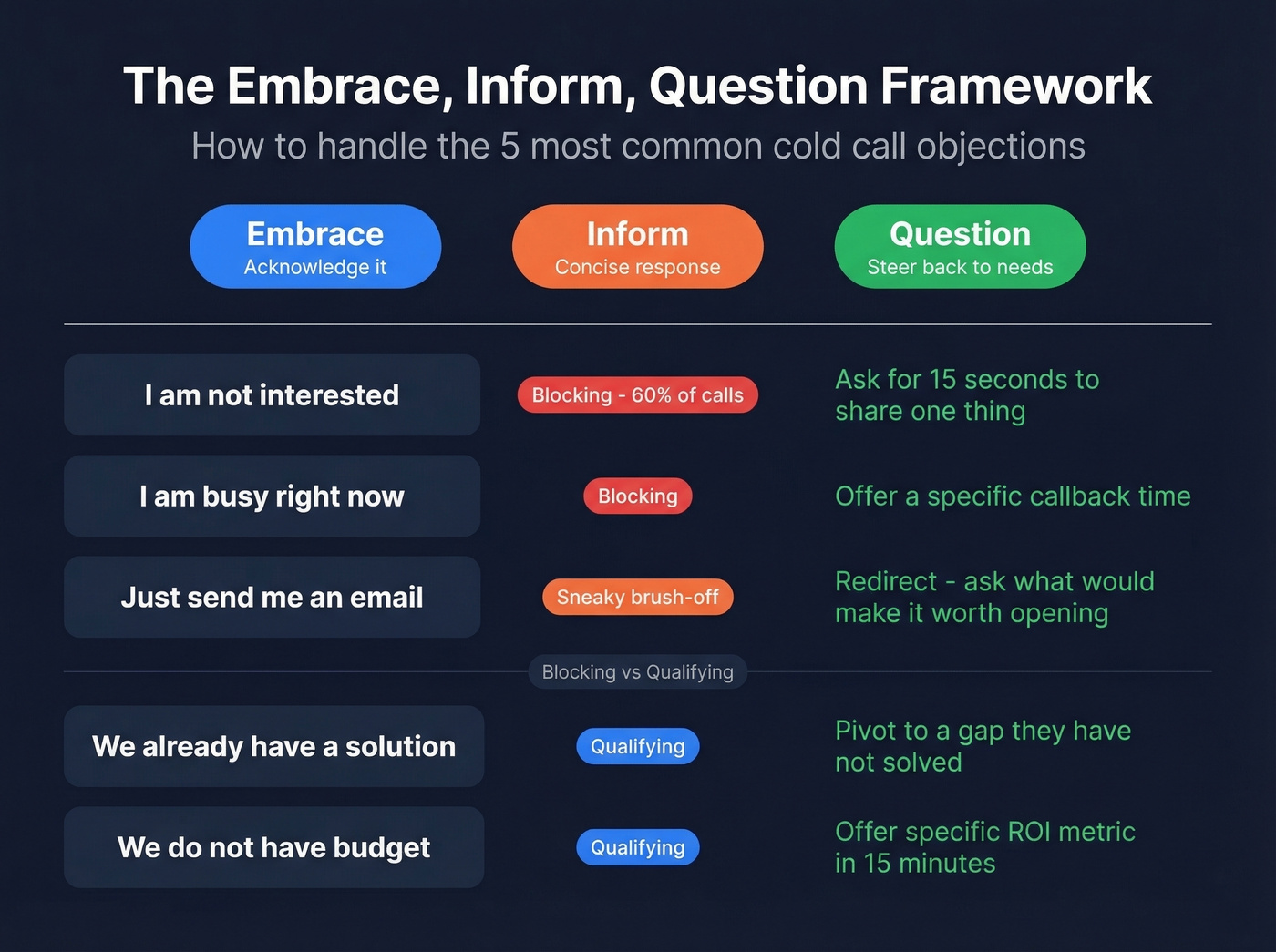
The core framework is Embrace, Inform, Question: acknowledge the objection, provide a concise response, then ask an open-ended question to steer back to their needs.
"I'm not interested"
About 60% of cold calls hit this one. It's almost always reflexive.
"Totally fair - you weren't expecting my call. Most of the [role] I talk to weren't interested either until they heard how we [specific outcome]. Can I share one thing in 15 seconds, and if it's not relevant, I'll hang up?"
"I'm busy right now"
"Completely understand - I'll be quick. Is there a better time this week for a 5-minute call, or should I shoot you a calendar link?"
"Just send me an email"
This one is the sneakiest. It sounds cooperative but it's almost always a brush-off. Don't just comply - redirect:
"Happy to. So I don't send you something generic - what's the one thing that would make it worth opening? [Pause.] Actually, that's exactly what I wanted to discuss. Can I take 20 seconds?"
The redirect forces a micro-engagement that often turns into the conversation you wanted in the first place. We've seen reps convert this objection into a booked meeting about 15% of the time just by not accepting the brush-off at face value.
"We already have a solution"
Don't challenge their current vendor. Pivot to a gap they haven't solved:
"Good - that tells me you take this seriously. Most teams I talk to aren't looking to replace anything. They're looking to [fill specific gap]. Is that something you've run into?"
"We don't have budget"
"Makes sense - most teams don't have budget earmarked for something they haven't evaluated yet. If I could show you [specific ROI metric] in 15 minutes, would it be worth a conversation with whoever owns that budget?"
Why Data Quality Decides Your Connect Rate
Look, we've tested this across hundreds of campaigns and the pattern is always the same: most teams blame their scripts, their reps, or their cadence when connect rates tank. The real culprit is almost always data.
Browse r/sales or r/outbound and you'll see the same frustrations on repeat - reps struggling to enrich quality leads consistently, getting stuck with receptionists instead of reaching direct lines, and losing momentum to inconsistent follow-up because half their dials go nowhere. These aren't script problems. They're data problems.
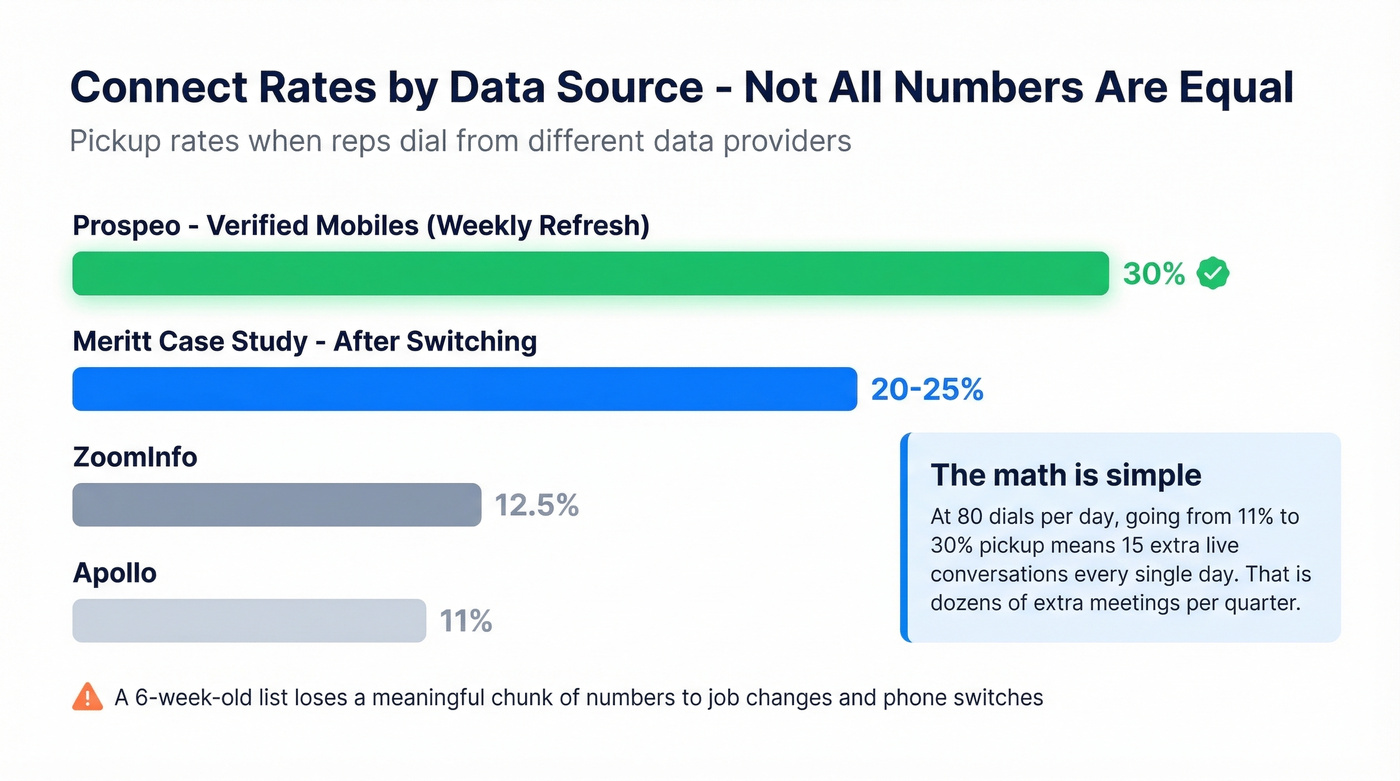
When your list is six weeks old - which is the industry average refresh cycle - a meaningful chunk of those numbers have gone stale. People change jobs, switch phones, leave companies. Every dead dial isn't just a wasted 30 seconds. It's a rep losing momentum, confidence, and eventually motivation. Multiply that across a team of ten reps making 80 dials a day, and you're burning thousands of dials a week on numbers that will never connect.
One team we work with - Meritt - saw their connect rate triple to 20-25% after switching to verified mobiles refreshed on a weekly cycle. That's not incremental improvement. That's a step change in pipeline output. Compare that to the 12.5% pickup rate at ZoomInfo or 11% at Apollo, and the gap is obvious.
The math is simple: if better data gets you even 20% more live conversations per day, that compounds into dozens of extra meetings per quarter. Data quality isn't a nice-to-have. It's the single biggest lever you can pull.
At 80 dials a day, every dead number costs you a conversation. Prospeo's verified mobiles hit a 30% pickup rate - nearly 3x the industry average. Layer in buyer intent signals, job changes, and tech stack filters so your opener sounds like a reason, not a guess.
Turn 80 dials into 4 meetings a week starting at $0.01 per lead.
Tools for Outbound Sales Calls
Two categories matter: dialers and data providers. Everything else - CRM, sequencer, call recording - you probably already have.
Dialers
Quick taxonomy: power dialers call one number at a time and connect you when someone picks up. Predictive dialers call multiple numbers simultaneously and route the first live answer to an available rep. For most B2B teams, a power dialer is the right call - predictive dialers create "telemarketer delay" and carry real compliance risk from abandoned calls. Local presence dialing (displaying a local area code) makes prospects 4x more likely to answer, so make sure whatever you pick supports it.
| Dialer | Starting Price | Type |
|---|---|---|
| MyPhoner | $25/mo | Power |
| CloudTalk | $27/mo | Power |
| Close | $49/mo | Power |
| JustCall | $78/mo | Power |
| Aircall | $120/mo | Power |
| PhoneBurner | $165/mo | Power |
| Orum | Custom | AI parallel |
Our recommendation: CloudTalk or Close for teams under 10 reps. MyPhoner if you're bootstrapping and need the cheapest viable option. Skip Orum unless you're scaling past 20 reps and have the budget for AI-powered parallel dialing.
Data Providers
| Provider | Verified Mobiles | Email Accuracy | Pricing |
|---|---|---|---|
| Prospeo | 125M+ | 98% | Free tier; ~$0.01/lead |
| Cognism | Strong EU coverage | ~95% | ~$1,000-3,000/mo |
| Lusha | Moderate | ~85-90% | Free tier; ~$49/mo |
| ZoomInfo | Large US database | ~87% | $15,000-40,000+/yr |
For cold calling specifically - where every dead number kills momentum - data freshness matters more than database size. Prospeo's 7-day refresh cycle and 30% mobile pickup rate make it the strongest option for teams that live and die by connect rates. Cognism is the pick if you're calling into EMEA and need GDPR- and CCPA-compliant direct dials. ZoomInfo has one of the largest US databases, but the price tag ($15,000+/year minimum) makes it hard to justify unless you're running a 50+ seat sales floor.
For teams whose average deal size sits below five figures, you probably don't need ZoomInfo-level spend. A self-serve data tool paired with a solid power dialer will get you 80% of the results at 10% of the cost.
If you're building a modern outbound stack, start with a short list of SDR tools and a reliable sales prospecting database.
Compliance Checklist
This isn't optional. TCPA class action filings are up 95% year-over-year, and penalties hit hard.
- Calling hours: 8 AM-9 PM in the prospect's local time zone. No exceptions.
- DNC scrubbing: Scrub your lists against the National DNC Registry every 31 days. There are 241M+ numbers on the registry.
- Opt-out SLA: Honor opt-out requests within 10 business days.
- State lists: 11 states maintain their own DNC lists. If you're calling into Indiana, Louisiana, or Pennsylvania, scrub those separately.
- Caller ID: Never spoof your caller ID. It's illegal under TCPA.
- EBR exemptions: You can call existing customers within 18 months of a transaction or 3 months of an inquiry - but document everything.
TCPA violations run $500-$1,500 per call. DNC infractions hit up to $43,792 per call. One bad list, one lazy scrub, and you're looking at six figures in fines. If you're using a predictive dialer for B2B outbound, talk to your legal team. The compliance exposure isn't worth the marginal efficiency gain for most teams.
If you're tightening your outbound process end-to-end, build it like a cold calling system and pair it with repeatable sales prospecting techniques.
FAQ
How many cold call attempts should I make?
At least three. Research shows 93% of conversations happen by the third attempt, and 98.6% by the fifth. Most reps give up after one dial, abandoning the vast majority of potential conversations before they start. Five attempts is the ceiling - beyond that, returns flatline.
What's the best day for B2B cold calls?
Tuesday and Wednesday together drive 44% of all demos booked, making them the highest-volume days. Monday has the best call-to-demo conversion at 1.19%. Avoid Friday for high-volume dialing - reserve it for list building and targeted exec outreach.
How do I avoid TCPA violations?
Scrub against the National DNC Registry every 31 days, call only between 8 AM-9 PM in the prospect's local time zone, honor opt-outs within 10 business days, and never spoof caller ID. DNC penalties reach $43,792 per infraction - one unscrubbed list can cost six figures.
Is outbound cold calling still effective in 2026?
Yes. WHAM data shows a 4.82% success rate, meaning 80 daily dials produce roughly four meetings per week. Combined with 92% of B2B buyers being open to relevant outreach, structured cold calling remains one of the fastest pipeline-generation channels available. The differentiator is data quality, not script perfection.