

Outbound Marketing Definition: What It Really Means (With Numbers)
Most outbound marketing definitions are written by people who've never sent a cold email, dialed a prospect, or watched a $40,000 campaign bounce 30% of its list into the void. You don't need another textbook paragraph. You need the actual numbers - what outbound costs, what it returns, what happens when you get compliance wrong, and why most campaigns underperform.
What Is Outbound Marketing?
Outbound marketing is push marketing - any tactic where you initiate contact with a potential buyer rather than waiting for them to find you. You're interrupting their day with something worth their attention.
The modern outbound toolkit includes cold email, cold calling, paid ads across Google, LinkedIn, and CTV, direct mail, trade shows, and SMS. The traditional side - TV, radio, billboards - still commands serious budgets. Combined US TV and CTV ad spend is on track to hit nearly $100B by 2027, with CTV driving all the growth while linear declines.
This isn't new. The first recorded marketing practices date to roughly 3,000 BC - Mesopotamian clay tablets are among the earliest examples of advertising. The medium changes every decade. The core idea hasn't budged in five millennia: you go to the buyer, not the other way around.
Outbound vs Inbound Marketing
The debate isn't really outbound or inbound. It's about understanding the tradeoffs so you can allocate budget intelligently.
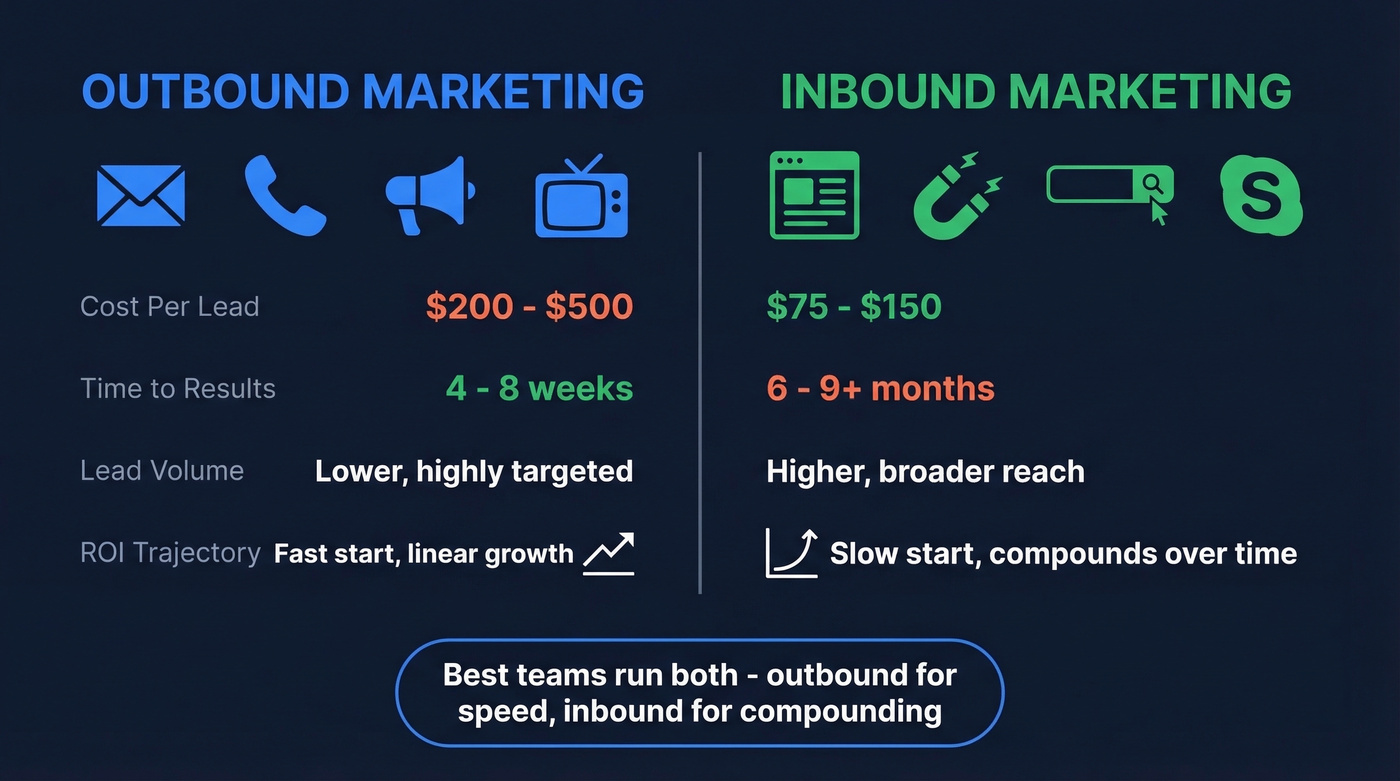
| Factor | Outbound | Inbound |
|---|---|---|
| CPL | $200-$500 | $75-$150 |
| Time to results | 4-8 weeks | 6-9+ months |
| Lead volume | Lower, targeted | Higher, broader |
| ROI trajectory | Fast start, linear | Slow start, compounds |
Inbound generates 54% more leads and costs 62% less per lead than outbound. Over three years, SEO alone can deliver 748% ROI. Email marketing returns $36-$40 per $1 spent.
So why bother with outbound at all? Speed and precision. If you need pipeline in Q2, you can't wait nine months for SEO to compound. Outbound lets you target exact personas at exact companies starting this week. The best teams run both - inbound for long-term compounding, outbound for immediate pipeline control.
What Outbound Actually Costs
Here's where most articles on this topic go vague. We won't.
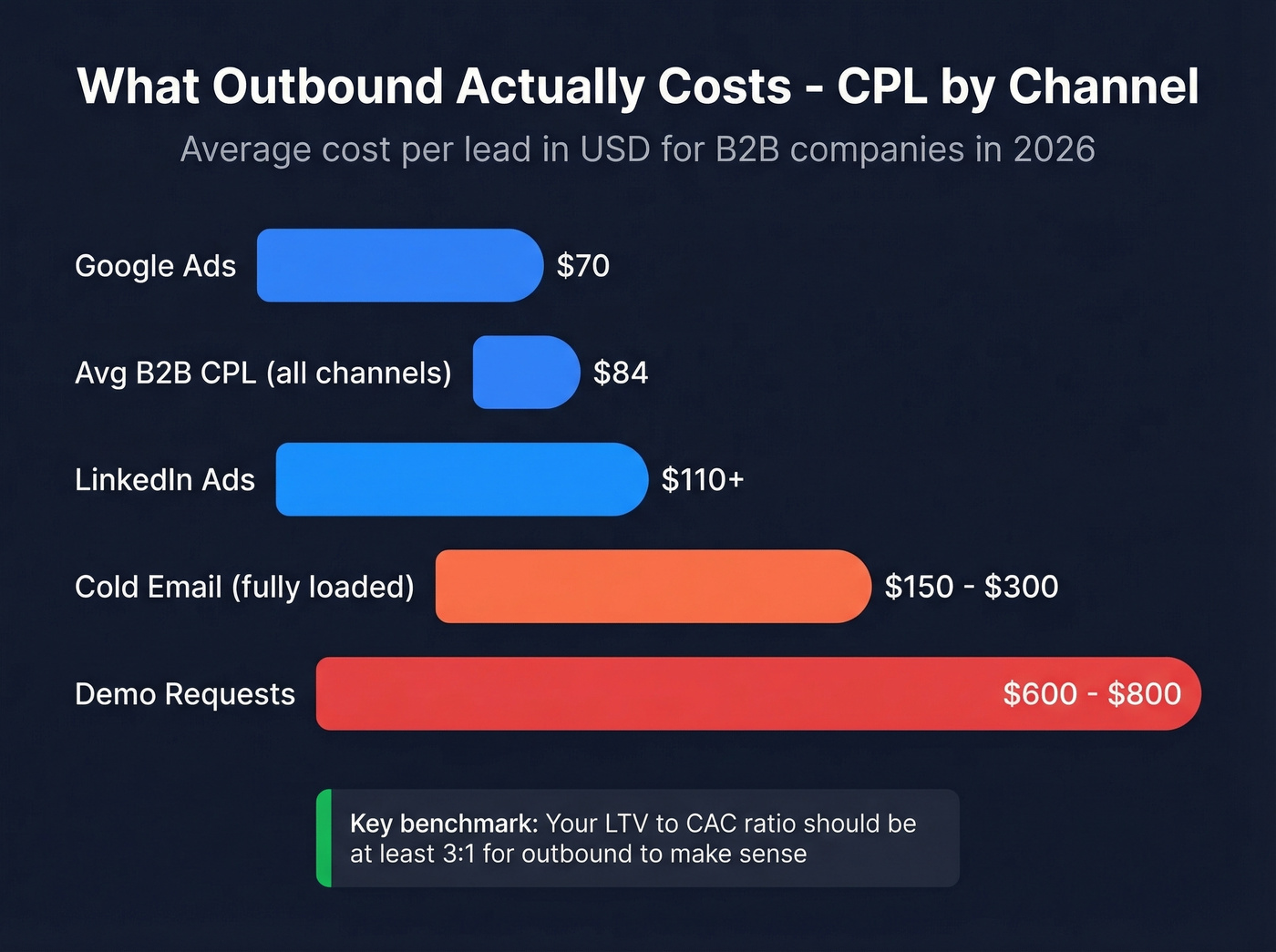
| Channel | Avg CPL |
|---|---|
| Average B2B CPL (all channels) | ~$84 |
| Google Ads | ~$70 |
| LinkedIn Ads | $110+ |
| Cold email (fully loaded) | $150-$300 |
| Demo requests | $600-$800 |
B2B companies typically invest 7.7-8.4% of revenue in marketing. High-growth SaaS can push past 15%. The benchmark that matters most for outbound unit economics: your cost to acquire a customer and LTV:CAC ratio should be at least 3:1. If you're spending $500 to acquire a customer worth $1,200, the math doesn't work - regardless of channel.

You just saw the numbers: cold email CPL runs $150-$300 fully loaded. A 35% bounce rate means you're lighting a third of that budget on fire. Prospeo's 5-step verification delivers 98% email accuracy at ~$0.01 per email - cutting your effective CPL while protecting your domain reputation.
Stop paying to bounce. Start paying to connect.
Outbound Compliance Cheat Sheet
This is the part most outbound guides skip entirely. The penalties are real and they're per-violation.
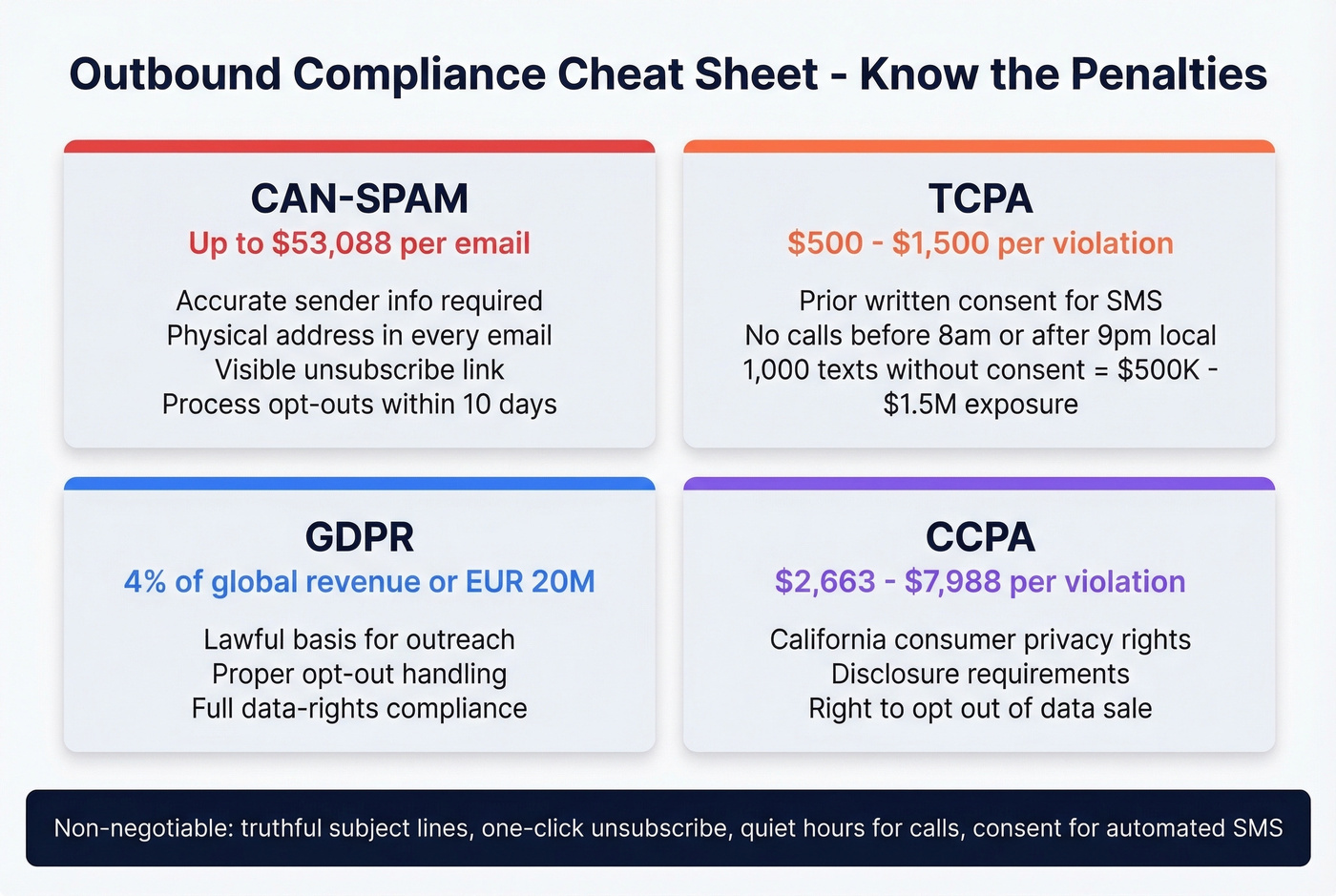
CAN-SPAM carries fines up to $53,088 per email. It requires accurate sender info, a physical address, a visible unsubscribe link, and opt-out processing within 10 business days.
TCPA hits harder: $500-$1,500 per violation. Send 1,000 texts without consent and you're staring at $500K-$1.5M in exposure. No calls before 8 a.m. or after 9 p.m. local time.
GDPR can cost up to 4% of global revenue or EUR20M - whichever is higher. You need a lawful basis for outreach, proper opt-out handling, and data-rights compliance. CCPA penalties range from $2,663 to $7,988 per violation.
The non-negotiable checklist: truthful subject lines, valid physical address in every email, one-click unsubscribe, opt-outs honored within 10 business days, prior written consent for automated SMS, and quiet hours respected for phone outreach. Ignoring these rules doesn't just risk fines - it torches your sender reputation and makes every future campaign worse.
How to Measure Outbound Strategies
73% of B2B sales reps missed quota in 2024. That's often a measurement problem, not a sales problem. Teams that don't track the right KPIs can't diagnose what's broken.
Five outbound metrics actually matter: email reply rate, call connect rate, lead-to-opportunity conversion, pipeline value generated, and cost per lead. Everything else is vanity. We've watched teams obsess over open rates for months while their reply-to-opportunity conversion sat at 2% - unmeasured and unmanaged.
Here's the upside of getting measurement right: 82% of buyers will take a meeting with a salesperson who reaches out with relevant insights. The bar isn't "more emails." It's better targeting and better data.
Why Most Outbound Fails
Let's be honest about this. Two stats tell the whole story: 60% of prospects are lost to poor targeting, and 44% disengage from irrelevant messaging.
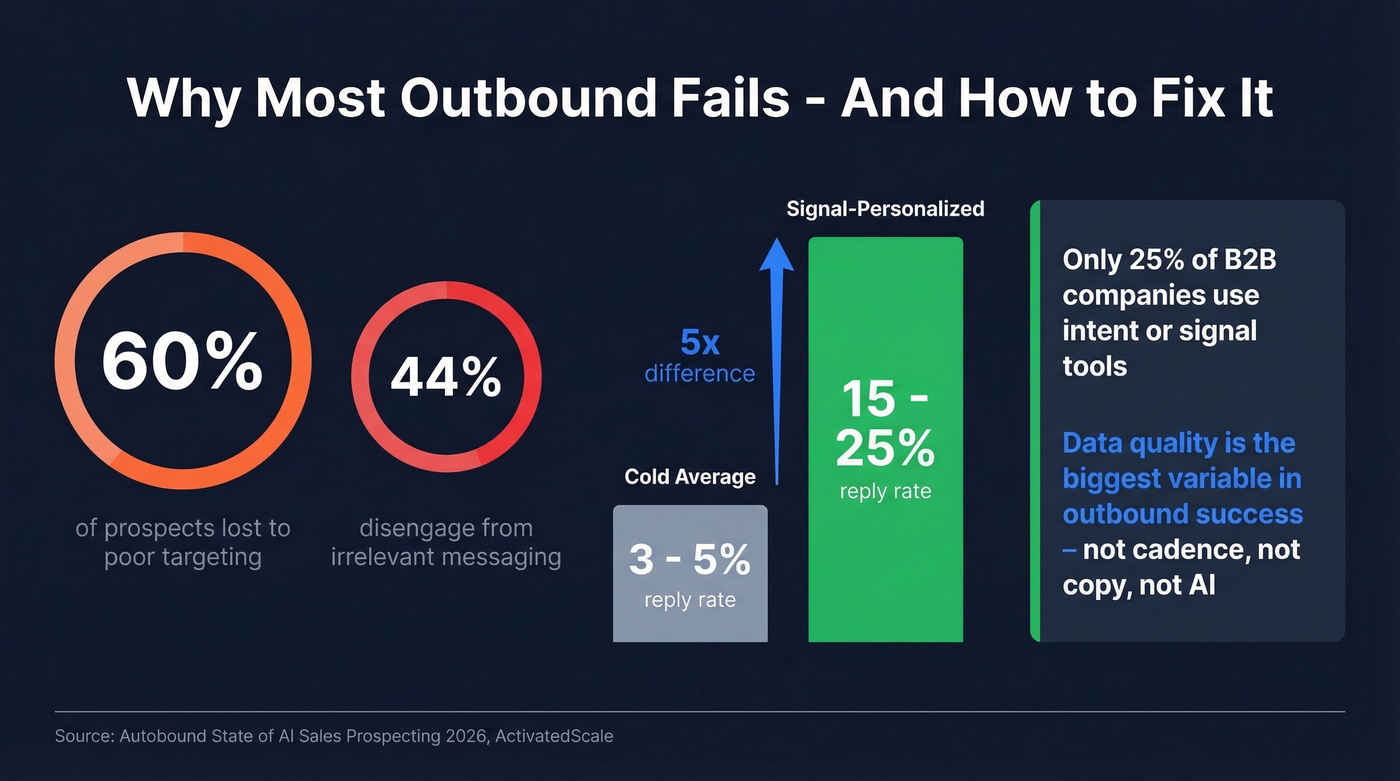
The average cold email pulls a 3-5% reply rate. Signal-personalized outreach - where you reference a trigger event, a tech stack change, or a hiring signal - hits 15-25% reply rates. That's a 5x difference from the same channel, yet only 25% of B2B companies use intent or signal tools. Data quality, not cadence, not copy, not the AI layer on top, is usually the biggest variable in outbound success.
If your average deal size sits below five figures, you probably don't need a $40K/year data platform. But you absolutely need verified emails. A 35% bounce rate torches your domain reputation, tanks deliverability, and makes every subsequent campaign worse. In our experience, teams burn through two or three sending domains before they realize the problem was never their messaging - it was their list.
A platform like Prospeo verifies emails through a 5-step process and refreshes records every 7 days, compared to the 6-week industry average. One customer, Meritt, tripled pipeline from $100K to $300K per week after switching. Bounce rate dropped from 35% to under 4%, and connect rates jumped to 20-25%.
Skip the enterprise data vendors if you're a team under 20 reps. You'll pay 10x more and still end up cleaning the data yourself. The consensus on r/sales backs this up - thread after thread of reps complaining about stale ZoomInfo records and bounced Apollo emails. Start with verified data and build from there.
If you want a deeper stack view, compare outbound lead generation tools and pair them with an email deliverability guide so your list quality and sending setup improve together.
60% of prospects lost to poor targeting. 44% gone from irrelevant messaging. The fix isn't better copy - it's better data. Prospeo's 30+ filters including buyer intent, technographics, and job change signals let you build lists that actually convert. Data refreshed every 7 days, not 6 weeks.
Build signal-driven outbound lists that hit 15-25% reply rates.
FAQ
Is outbound marketing still effective in 2026?
Yes. Outbound generates pipeline in 4-8 weeks, far faster than inbound channels. Signal-personalized outreach hits 15-25% reply rates, roughly 5x the cold average. The key is verified contact data and relevant messaging - volume alone doesn't move the needle anymore.
What's the difference between outbound and inbound marketing?
Outbound pushes your message to prospects through cold email, ads, and calls. Inbound pulls them in through SEO and content. Outbound costs $200-$500 per lead but delivers results in weeks. Most high-performing B2B teams run both simultaneously.
How do I reduce bounce rates on outbound campaigns?
Use a verified data provider that refreshes records weekly and runs multi-step email verification. Meritt cut bounce rates from 35% to under 4% after switching to a provider with a 7-day refresh cycle. Teams moving off stale lists typically see similar drops, protecting domain reputation across every campaign.