

How to Outsource Sales: Costs, Risks, and the Playbook That Actually Works
A RevOps lead we know spent $12,000 over four months with an outsourced SDR agency. The result: three meetings, zero closed deals, and a blacklisted email domain that took six months to rehabilitate. That's not an outlier - it's the most common outcome when you outsource sales without the right foundation.
But consider the flip side: Salesforce research shows 84% of reps missed quota last year, and the ones who still built pipeline often did it through outsourced programs done right. When it works, outsourced sales is one of the fastest ways to generate pipeline without the six-month hiring-and-ramping cycle that kills momentum. Here's how to land on the right side of that equation.
The Short Version
Should you outsource? Only after you've closed at least 10 deals yourself and can clearly articulate your ICP, your offer, and why someone should take a meeting. Outsourcing before that point almost always fails.
What does it cost? Expect $2,500-$15,000/month depending on the model. Cost per meeting in year one typically runs $3,000-$5,000 - that number drops dramatically as targeting and messaging get dialed in, reaching roughly $250/meeting in mature programs.
What's the #1 thing that kills outsourced programs? Bad contact data. Your agency is only as good as the emails and phone numbers they're working from. Bounced emails torch your domain reputation, and once that's gone, no amount of clever copywriting saves the campaign.
What Is Outsourced Sales?
Outsourced sales means handing part or all of your sales process to an external team. That's deliberately broad because the services range from narrow to full-stack. At one end, you've got appointment-setting shops that book meetings for your closers. At the other, full-cycle agencies that own everything from prospecting through close.
The most common flavors:
- SDR-as-a-service - outbound prospecting and appointment setting
- Lead generation - list building, enrichment, and initial outreach
- Full-cycle outsourcing - prospecting through close
- Account management - post-sale retention and expansion
The critical distinction is top-of-funnel versus full-cycle. Outsourcing prospecting and qualification is a well-understood, process-driven motion. Outsourcing closing - where deep product knowledge, objection handling, and relationship nuance matter - is where things fall apart.
Should You Outsource Sales?
89% of business leaders are actively questioning their existing go-to-market models, per Gartner's latest B2B sales research. Outsourcing is one of the most common alternatives they're exploring.
Why It Makes Sense
Outsource when speed matters more than perfection. If you need pipeline in 30-60 days and can't wait six months to hire, ramp, and retain an in-house SDR, an external team compresses that timeline to 2-6 weeks for campaign launch. It also makes sense when you're testing a new market or vertical - you don't want to hire a full-time rep for an experiment that might not pan out.
Budget predictability is another strong signal. An outsourced SDR runs $30,000-$96,000/year versus $125,000-$150,000 fully loaded for an in-house SDR (up to $200K with premium tools and data subscriptions). And you're not eating the attrition risk - SDR turnover runs 35-40% annually, which means you're re-hiring and re-ramping constantly. If your SDR team is a revolving door and your pipeline looks like a heart monitor, that's the signal.
When to Build In-House
Keep sales internal when your product requires deep technical knowledge to sell. If your average deal involves multi-threaded conversations with 6-10 stakeholders - and 10+ in enterprise deals, where some buying committees reach 15-17 people - an external team won't have the context to navigate that. High-ACV enterprise deals, think six figures and up, almost always need internal closers who live and breathe the product.
Long-term, in-house teams also give you something outsourced teams can't: a feedback loop. When your reps hear objections, they feed that back to product, marketing, and leadership. Outsource everything and you lose that signal entirely.
The Hybrid Model (What We Actually Recommend)
Here's the thing: the best outsourced programs aren't fully outsourced. They're hybrid. You hand off top-of-funnel - the prospecting, list building, cold outreach, and initial qualification - and keep closing in-house where product knowledge and relationship depth matter.
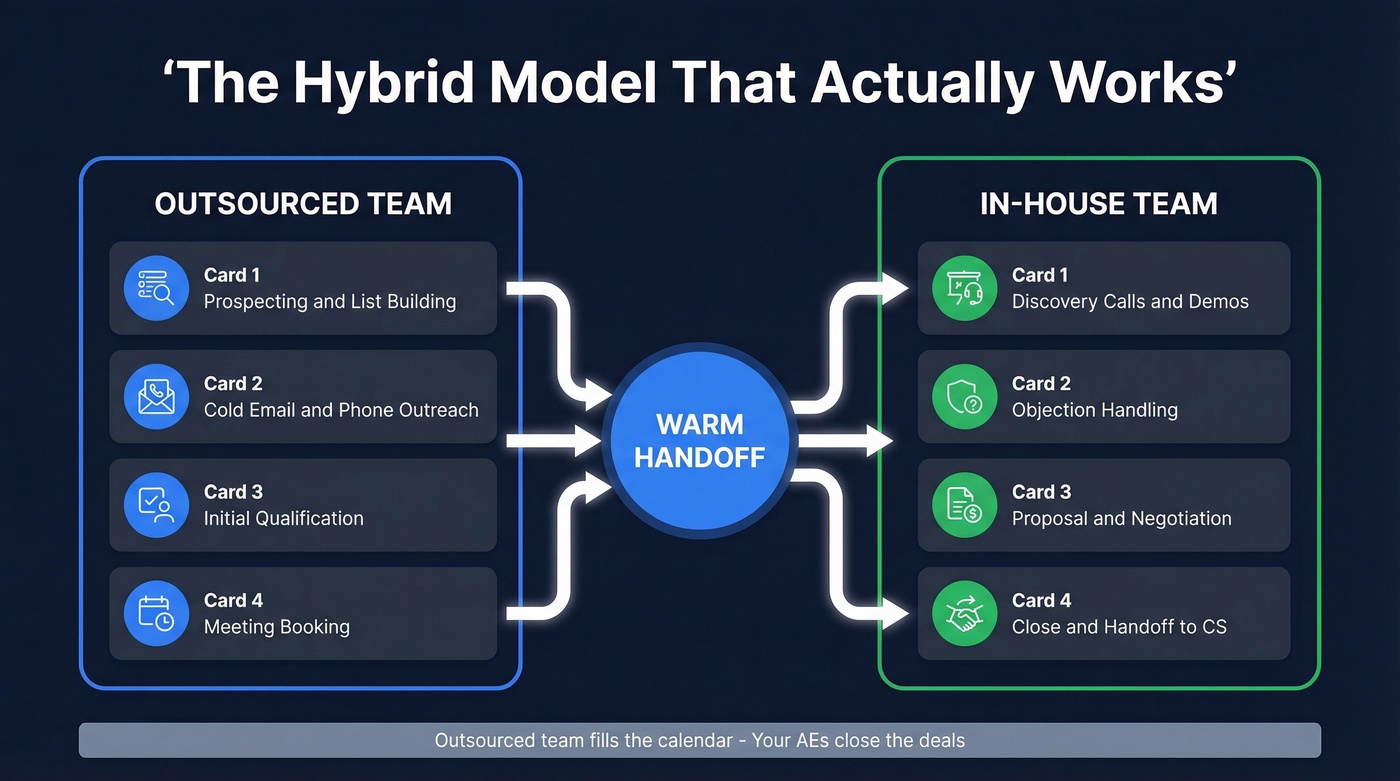
This is the model we've seen work most consistently. The outsourced team fills the calendar. Your AEs take the meetings, run the demos, and close. The outsourced team doesn't need to understand every feature of your product - they need to understand your ICP well enough to book meetings with the right people. Some agencies also offer transition-to-hire models, where you can absorb the outsourced reps into your team after 12 months. Worth asking about if you see this as a bridge to building in-house.
The "close 10 deals first" rule applies here. Before you outsource anything, you need to have personally closed enough deals to know your ICP, your value prop, and the objections that come up. Without that foundation, you're asking an external team to figure out your go-to-market for you. That's not outsourcing - that's abdication.
Outsource Readiness Checklist
Before you sign with any agency, run through this list. If you can't check at least five of seven, you're not ready.
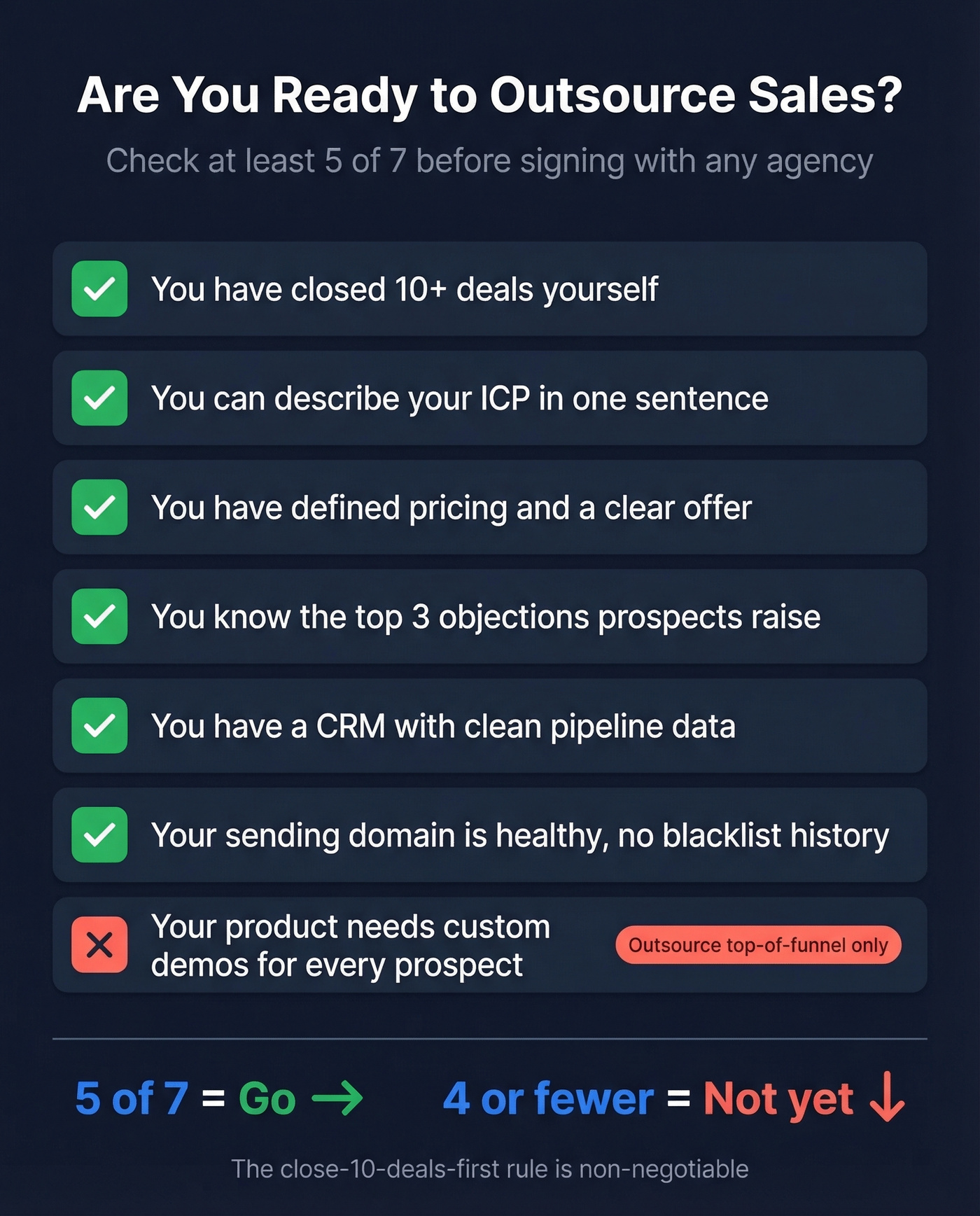
- ✅ You've closed 10+ deals yourself
- ✅ You can articulate your ICP in one sentence
- ✅ You have defined pricing and a clear offer
- ✅ You know the top 3 objections prospects raise
- ✅ You have a CRM with clean pipeline data
- ✅ Your sending domain is healthy with no blacklist history
- ❌ Your product requires custom demos for every single prospect (if yes, outsource top-of-funnel only)
What It Actually Costs
Pricing Models Compared
| Model | Monthly Range | Best For | Watch Out For |
|---|---|---|---|
| Retainer | $3K-$12K/mo | Predictable pipeline | Activity over results |
| Commission | 5-20% of revenue | Aligned incentives | Cherry-picking easy deals |
| Per-meeting | $300-$600/meeting | Pay-for-performance | Junk meetings to hit volume |
| Hybrid | $2.5K-$5K + $150-$300/mtg | Balanced risk | Complexity in tracking |
| Setup fee | $500-$5K one-time | Onboarding/ICP work | Should include deliverables |
| Tech stack | $50-$300/mo | CRM/tools access | Often hidden in retainer |
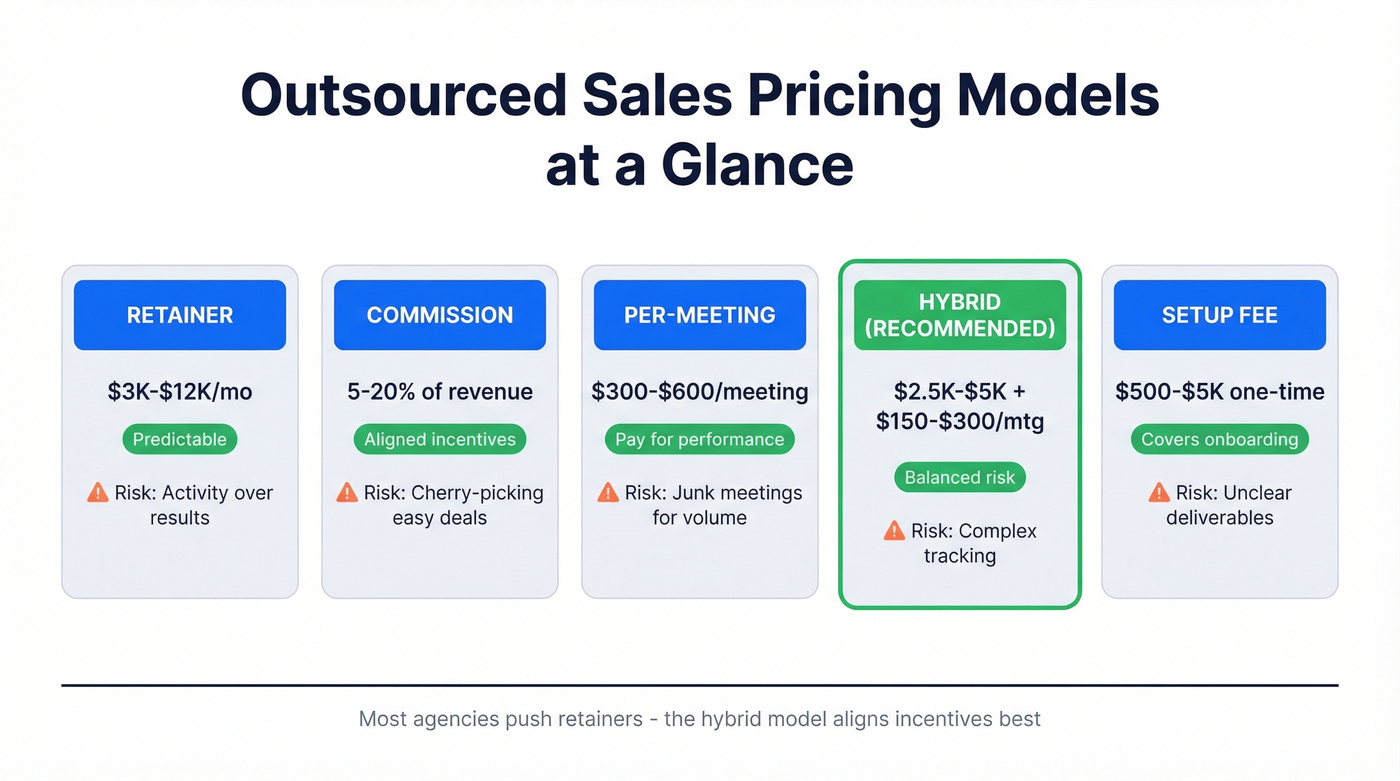
Most agencies push retainer models because it de-risks their business. That's fine - just make sure the retainer includes clear deliverables and activity minimums. Pure commission models sound attractive but create perverse incentives: the agency chases easy wins instead of building your long-term pipeline.
The hybrid model - a modest retainer plus per-meeting or per-opportunity bonuses - aligns incentives best. You're covering the agency's operating costs while tying upside to actual results.
In-House vs. Outsourced: Annual Cost
| Cost Factor | In-House SDR | Outsourced SDR |
|---|---|---|
| Annual cost | $125K-$150K (up to $200K) | $30K-$96K |
| Ramp time | 3-6 months | 2-6 weeks |
| Attrition risk | 35-40%/year | Agency's problem |
| Management overhead | High | Low |
| Tool costs | $200-$900/mo extra | Usually included |
The in-house number includes base salary, commission, benefits, management time, tools, and the hidden cost of re-hiring when your SDR leaves. The outsourced number is the monthly retainer annualized. Neither includes the opportunity cost of ramp time - but that's where outsourcing really wins. Three to six months of an empty seat is pipeline you'll never get back.
The Cost-Per-Meeting Curve
Year-one economics for outsourced sales look brutal. Belkins' data shows $3,000-$5,000 per meeting booked in year one for mid-market and enterprise B2B. That number makes most CFOs flinch.
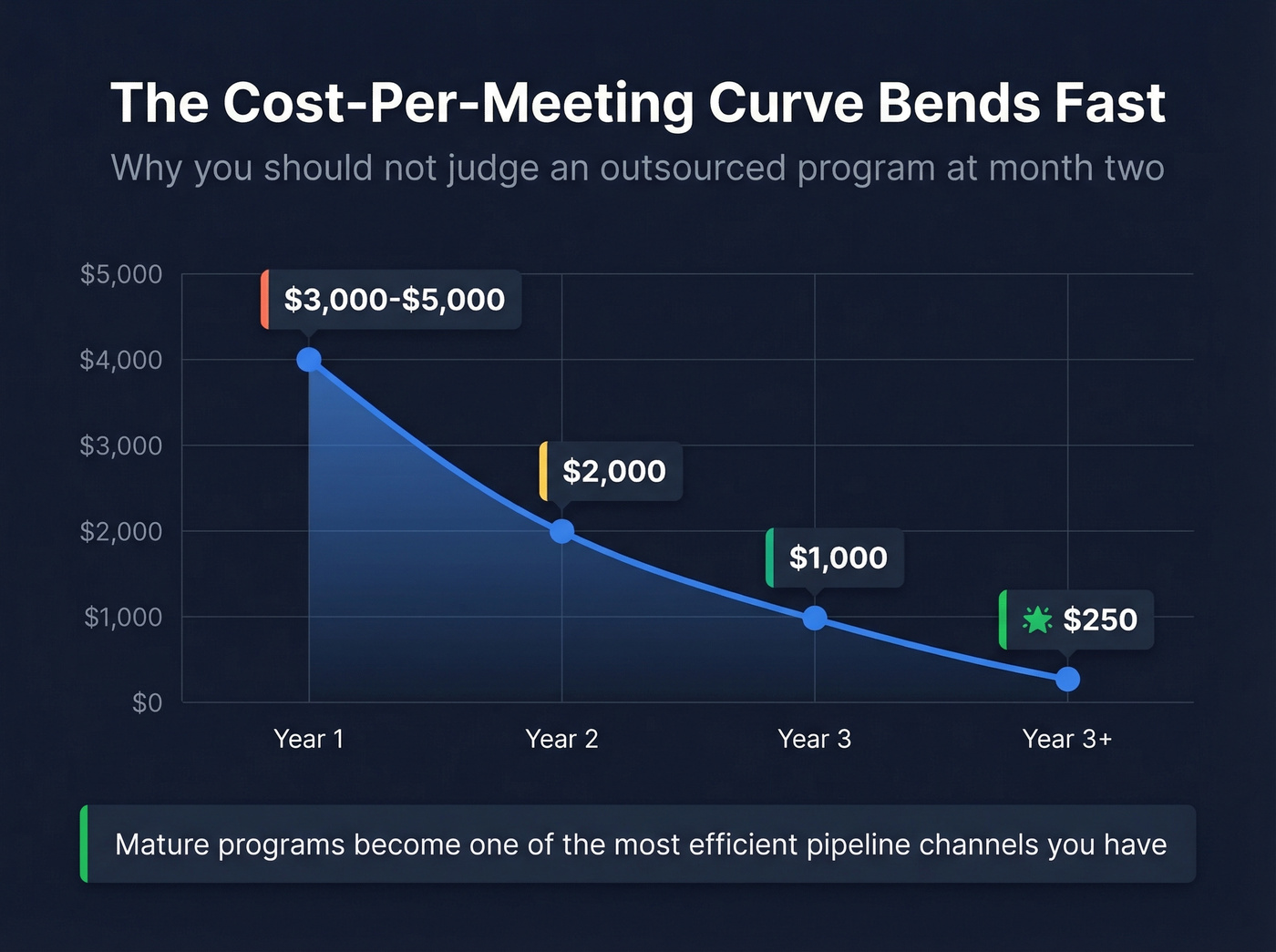
But the curve bends fast. Year two drops to roughly $2,000 per meeting as targeting sharpens and messaging iterates. Year three hits $1,000. Mature programs running 3+ years can get down to $250 per meeting - at which point it becomes one of the most efficient pipeline channels you have. The mistake is judging the program at month two. Even the best internal hires take 3-6 months to ramp. Give an outsourced program the same grace period, and measure the trend line, not the snapshot.
How the Process Works
The modern outsourced sales workflow follows a predictable sequence:
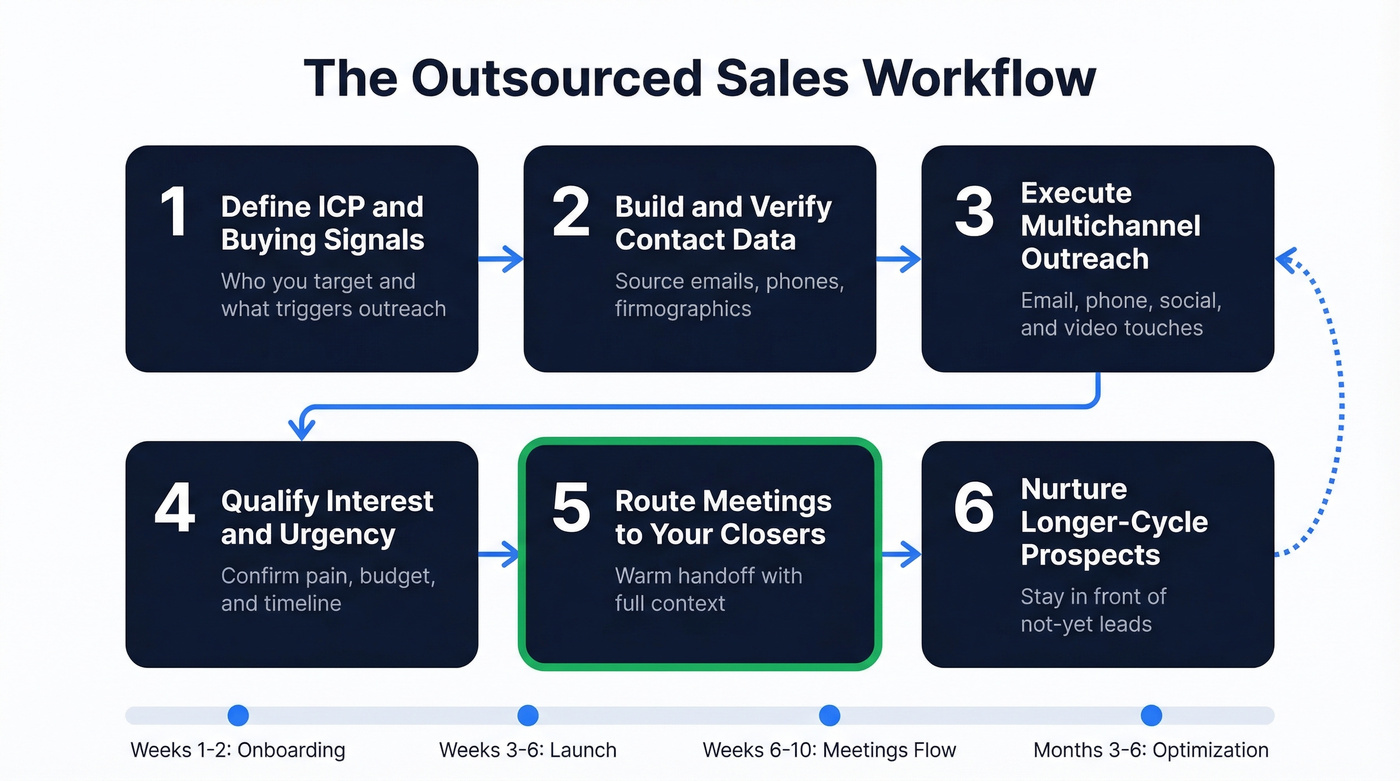
- Define your ICP and buying signals - who you're targeting and what triggers outreach
- Build and verify contact data - sourcing emails, phones, and firmographic details
- Execute multichannel outreach - email, phone, social, and video touches
- Qualify interest and urgency - confirming pain, budget, and timeline
- Route qualified meetings to your closers - warm handoff with context
- Nurture longer-cycle prospects - staying in front of "not yet" leads
Expect first qualified meetings within 30-60 days of launch, with results improving as the team iterates on targeting and messaging.
The best agencies don't rely on a single "unicorn SDR" who does everything. They run pod structures - an SDR focused on conversations, an ops person handling systems and reporting, and a data specialist managing list quality and enrichment. This structure provides redundancy and consistency that a lone-wolf SDR model can't match. When you're evaluating agencies, ask about their team structure. If one person is doing prospecting, sequencing, reporting, and list building, that's a red flag.
For timeline expectations: weeks 1-2 are onboarding (ICP workshops, messaging development, tech setup), weeks 3-6 are campaign launch and initial outreach, weeks 6-10 are where qualified meetings start flowing, and months 3-6 are optimization - refining targeting, A/B testing messaging, and building the feedback loop between your closers and the outsourced team.

Bad data is the #1 killer of outsourced sales programs. Prospeo's 98% email accuracy and 7-day refresh cycle mean your agency works from verified contacts - not stale lists that torch your domain. At $0.01 per email, you spend less on data than a single wasted meeting.
Stop paying agencies to bounce emails. Give them data that actually connects.
Mistakes That Kill Outsourced Programs
1. Set-and-forget management. The most common failure pattern. You sign the contract, do the onboarding call, and disappear. The outsourced team lacks context, sounds like outsiders to your prospects, and results tank. This requires at least weekly touchpoints - more in the first 90 days.
2. Bad incentive alignment. Pay-per-meeting models fill your calendar with garbage. If the agency gets paid $400 per meeting regardless of quality, they'll optimize for volume. Define "qualified meeting" in the contract with specific criteria: right title, right company size, confirmed pain point, agreed next step.
3. Communication decay. It starts weekly, goes monthly, then quarterly, then stops. When communication dies, the outsourced team misses product updates, pricing changes, and competitive intel. Your campaign becomes stale while your market moves.
4. Unrealistic timelines. Judging an outsourced program at week two is like judging a new hire on day three. Give the program 90 days before making a keep-or-kill decision.
5. Siloed CRMs. When the outsourced team works in a separate CRM, you get duplicate outreach, lead handoff delays, and zero visibility into what's actually happening. Insist on shared systems or real-time sync.
6. Undefined success metrics. "More meetings" isn't a KPI. Define what success looks like before you start: meetings per month, meeting-to-opportunity conversion rate, pipeline generated, and revenue influenced. Align on these numbers in the contract.
7. Ignoring data quality. This is the silent killer, and it deserves its own section.
Data Quality: The Hidden Variable
Here's a stat that should keep you up at night: 70% of outsourcing agreements fail to meet expected objectives. Bad data is a primary driver. The chain reaction is simple and devastating: unverified emails bounce, bounce rates spike, email service providers flag your domain, your domain lands on blacklists, and every email you send - outsourced or internal - hits spam. Recovery takes months.
Most outsourced sales agencies don't own their data infrastructure. They're pulling contacts from whatever database they have access to, and the freshness of that data varies wildly. The industry average for data refresh is around six weeks. In B2B, where people change jobs every 2-3 years, six-week-old data is already decaying.
This is where your data layer becomes the make-or-break variable. Prospeo runs a 7-day data refresh cycle across 300M+ professional profiles, with 143M+ verified emails and 125M+ verified mobile numbers. Its 98% email accuracy rate keeps bounce rates under 3% when you verify before sending. Stack Optimize built from $0 to $1M ARR using Prospeo's data, maintaining 94%+ deliverability with zero domain flags across all their clients. Whether you're providing lists to your agency or requiring them to verify before sending, you're protecting the most valuable asset in your outbound stack: your domain reputation.
One practitioner on r/LeadGeneration described spending over $10,000 with an agency that "spammed millions of prospects," produced 3-4 leads, converted none, and left their domain blacklisted. Don't be that person. Verify every contact before your outsourced team touches it.
AI Changes the Equation
The AI sales tools market reached $3B in 2025 and is growing at 13% annually. Sellers who effectively partner with AI are 3.7x more likely to meet quota. 56% of sales pros now use AI daily, up from 24% in 2023.
This doesn't eliminate outsourced sales - it changes what you outsource. AI handles the research, scoring, sequencing, and personalization at scale. Humans handle the conversations, relationship-building, and judgment calls that close deals. The best outsourced agencies are already running this model: AI-powered ops for list building and message optimization, with human SDRs focused purely on conversations.
The buyer side is shifting too. B2B buyers now use roughly 10 channels on average, up from 5 in 2016. 80% of B2B sales interactions happen in digital channels, and 61% of B2B buyers prefer a rep-free buying experience entirely. That means your outsourced team needs to be running multichannel - email, phone, social, video - not just blasting cold emails. Any agency still running single-channel email campaigns in 2026 is leaving pipeline on the table.
Let's be honest about something: AI makes the "build vs. outsource" decision harder, not easier. A small team with the right AI tools can now do what used to require a 5-person SDR team. But if your deal size sits below $10K, you probably don't need a $10K/month outsourced agency either - you need better tooling and one scrappy rep. Sales outsourcing makes the most sense in the $25K-$150K ACV range, where the deal size justifies the cost-per-meeting but the sales cycle isn't so complex that only internal reps can navigate it.
Top Outsourced Sales Companies in 2026
| Provider | Starting Price | Best For | Model |
|---|---|---|---|
| Belkins | ~$3K/mo | SaaS email + social | Retainer |
| SalesRoads | $9,500/mo | US phone-heavy outbound | Retainer |
| Callbox | ~$3K-$5K/mo | Global multichannel | Retainer + nurture |
| MarketStar | ~$10K+/mo | Enterprise/channel | Custom |
| EBQ | ~$3K-$8K/mo | HubSpot-centric RevOps | Retainer |
| memoryBlue | Custom | Multilingual/global | Retainer |
| Martal Group | $3,600-$10K/mo | Tech-focused | Retainer |
| SalesHive | $8,000+/mo | US B2B | Retainer |
Belkins
Belkins is the go-to for SaaS and tech companies that want email and social-heavy outbound. Their published cost-per-meeting data is some of the most transparent in the industry - they openly discuss the $3,000-$5,000 year-one cost curve and how it optimizes over time. Strong appointment-setting discipline with a research-first approach to ICP targeting. If you're a B2B SaaS company selling into North America, start here.
SalesRoads
Use this if: You need US-based phone outbound with trained callers who can handle complex qualification conversations. SalesRoads starts at $9,500/month, which prices out early-stage startups, but the phone-first approach works well for industries where decision-makers don't respond to email - healthcare, manufacturing, financial services.
Skip this if: Your budget is under $10K/month or your ICP is primarily reachable via email and social channels.
Callbox
Callbox runs a true multichannel engine - email, phone, social, chat, and webinar-based outreach - with global reach. What sets them apart is their nurture-focused model: they maintain engagement with longer-cycle prospects, which matters when your sales cycle runs 3+ months.
MarketStar
Enterprise-grade outsourced sales for companies that need global coverage, channel partner programs, or customer success outsourcing. Think $10K+ monthly minimums with dedicated teams. Not the right fit for startups or SMBs.
EBQ
EBQ combines SDR outsourcing with RevOps and CRM support, which makes them particularly strong for HubSpot-centric teams. They'll run your outbound while also cleaning up your CRM, building reports, and optimizing your sales process. For teams where the problem isn't just "we need more meetings" but "our entire sales infrastructure needs work," EBQ handles both.
memoryBlue
memoryBlue stands out for global reach: 650+ sales professionals and outreach in 30+ languages. If you're selling into non-English-speaking markets, they're worth evaluating.
Martal Group
Tech-focused outsourced sales running $3,600-$10,000/month. Good mid-market option for B2B tech companies that want dedicated SDRs without the $10K+ price tags of enterprise providers.
SalesHive
US B2B focused, starting at $8,000/month. Solid for companies that want a straightforward outbound program without the complexity of global multichannel campaigns.
How to Evaluate a Provider
Before you sign anything, get clear answers to these questions. The concerns practitioners raise on Reddit are the same ones that should be in your evaluation checklist.
Transparency: Can you see every email and message sent on your behalf? If the answer is no, walk away.
Infrastructure ownership: Who owns the email accounts, sending domains, and warmed infrastructure? If the agency owns everything and you leave, you start from zero. Insist on client-owned domains and accounts.
Reporting cadence: Weekly reporting is the minimum. Monthly is a red flag. You should see activity metrics (emails sent, calls made, replies received) alongside outcome metrics (meetings booked, meetings held, opportunities created).
"Qualified meeting" definition: Get this in writing. Title, company size, confirmed pain point, agreed next step - all defined before the first email goes out.
Contract terms: Avoid annual commitments until you've seen 90 days of results. Month-to-month or quarterly contracts with 30-day cancellation clauses protect you during the ramp period.
Data portability: What happens to your contact lists, conversation history, and pipeline data if you leave? This should be explicitly addressed in the contract.
| Question | Why It Matters | Red Flag Answer |
|---|---|---|
| Can I see every message sent? | Brand protection | "We handle messaging internally" |
| Who owns the sending domains? | Continuity if you leave | "We use our shared infrastructure" |
| How do you define a qualified meeting? | Prevents junk meetings | "Anyone who agrees to a call" |
| What's your data verification process? | Domain reputation | "We use a purchased list" |
| What are your contract terms? | Flexibility during ramp | "12-month minimum commitment" |
| How do you handle TCPA/DNC? | Legal liability | Blank stare |
If you're worried about deliverability, read our email deliverability guide and keep an eye on email bounce rate benchmarks as you scale.
Running a hybrid model? Your outsourced team needs clean lists fast. Prospeo's 30+ search filters - buyer intent, technographics, headcount growth, funding - let you build laser-targeted prospect lists in minutes, not days. 143M+ verified emails, 125M+ direct dials, all refreshed weekly.
Build your outsourced team's target list in minutes, not weeks.
FAQ
How long before outsourced sales produces results?
Expect first qualified meetings within 30-60 days of campaign launch. Meaningful pipeline optimization takes 3-6 months as targeting, messaging, and qualification criteria get refined through iteration. Programs running 12+ months see dramatically lower cost-per-meeting as the feedback loop compounds.
Is outsourcing sales cheaper than hiring in-house?
In most scenarios, yes. Outsourced SDR programs run $30,000-$96,000/year versus $125,000-$200,000 fully loaded for an in-house SDR. You also eliminate ramp time (2-6 weeks vs. 3-6 months) and attrition risk (35-40% annual turnover). The savings are most dramatic for teams needing 1-3 SDRs.
What's the biggest risk when you outsource sales?
Domain and reputation damage from bad data or spammy execution. A blacklisted sending domain doesn't just kill your outsourced campaign - it tanks deliverability for your entire organization. Verify contact data before every campaign and demand full messaging transparency from day one.
Can I outsource just part of my sales process?
Yes, and you should. The most successful programs outsource top-of-funnel - prospecting, outreach, qualification - and keep closing in-house. Outsourced teams excel at process-driven outreach at scale, while your AEs bring the product knowledge and relationship depth needed to close.
How do I protect my email domain when outsourcing?
Require full transparency on every message sent in your name. Use verified contact data to keep bounce rates under 3%. Insist on dedicated sending infrastructure - separate domains warmed specifically for outbound - so your primary domain stays clean regardless of campaign performance.