

Outsourced SDR Services: The Honest Buyer's Guide for 2026
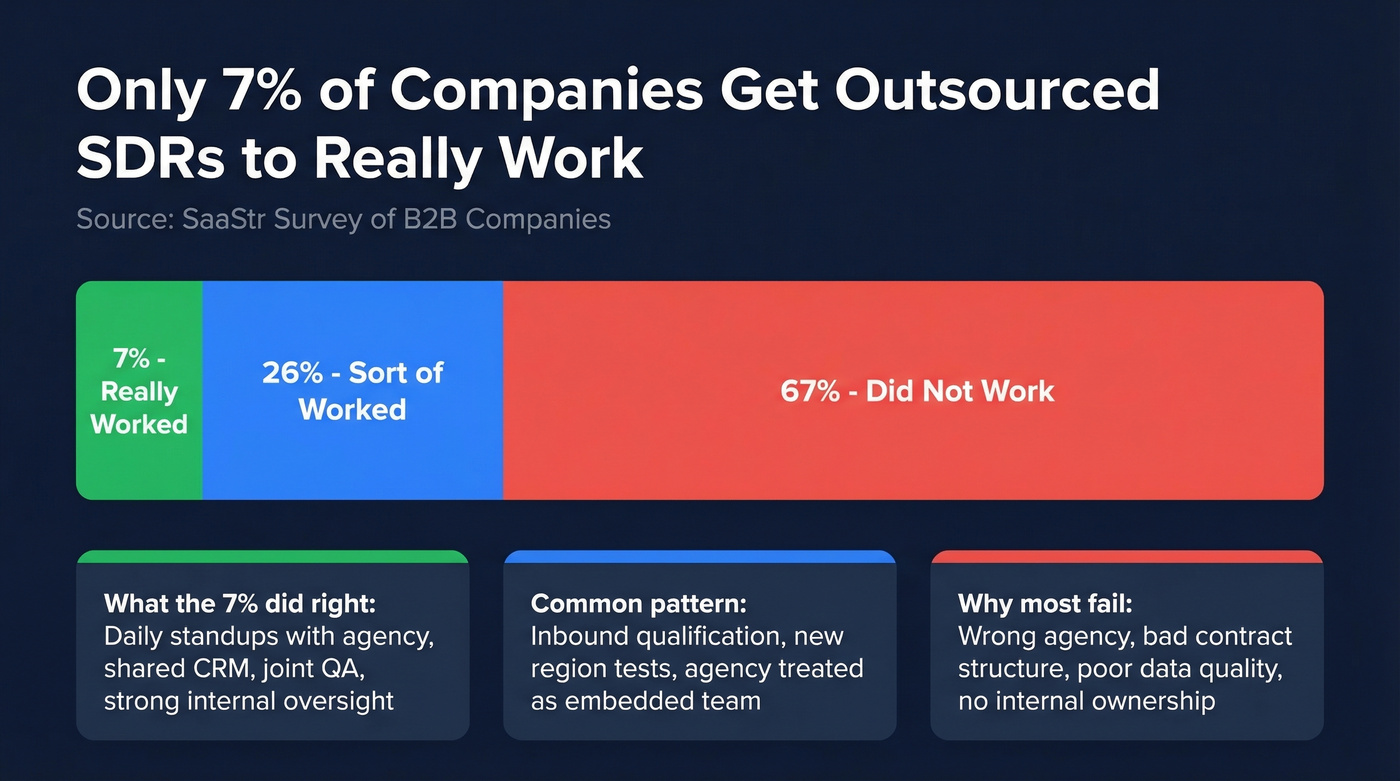
A RevOps lead we know ran the numbers after a year with an outsourced SDR agency. Twelve months, $72,000 spent, pipeline attribution murky at best. The agency booked meetings - half were no-shows, and the ones that held rarely converted past discovery. According to a SaaStr survey, only 7% of companies say outsourced SDRs "really worked." Another 26% said it "sort of worked." The remaining 67%? Didn't work.
Jason Lemkin's take is blunt: you can't outsource something you don't already understand yourself. He's right. But that doesn't mean outsourced SDR services are always a bad bet - it means most buyers pick the wrong agency, accept the wrong contract structure, or ignore the data quality problem that kills campaigns before they start.
Here's the thing: if your average contract value is under $5K, most outsourced SDR companies are mathematically overpriced. You'll spend $3,000-$5,000 per meeting in year one. If your deal closes at $4,800, the math never works. DIY cold email or inbound-first is almost always smarter at that price point.
When outsourcing does work, it tends to follow a pattern: inbound qualification where reps specialize in your market, new region or segment tests with strong internal oversight, or teams that treat the agency like an embedded extension - daily standups, shared CRM, joint QA. SaaStr's own outsourced team added roughly 8% of new revenue, but it required real bandwidth to manage. The 7% who succeed aren't lucky. They're disciplined.
Our Picks (TL;DR)
- Best data infrastructure (use with any agency): Prospeo - 98% email accuracy, 143M+ verified emails, 7-day data refresh, ~$0.01/email. Reduces bounces and protects deliverability, the two failure points behind most failed outsourced SDR programs.
- Best full-service agency: Belkins - 4.8/5 on G2 (93 reviews), omnichannel, starts at $5,500/mo.
- Best for enterprise / US-based: SalesRoads - 4.9/5 on Clutch (65 reviews), dedicated reps, $50K-$200K+ engagements.
- Best for startups on a budget: DIY cold email infrastructure + verified data - under $500/mo total for smaller volumes, ~$1,175/mo at 1,000 emails/day.
What Are Outsourced SDR Services?
Outsourced SDR services are third-party teams that handle top-of-funnel prospecting on your behalf. They identify target accounts, build contact lists, run outreach sequences across email, phone, and social channels, and book qualified meetings for your AEs.
This isn't the same as buying a lead list or deploying an AI chatbot. Outsourced SDRs are real people (or should be) doing the daily grind of cold outreach - researching prospects, writing personalized messages, handling objections, and qualifying interest before it hits your calendar.
The engagement models vary widely:
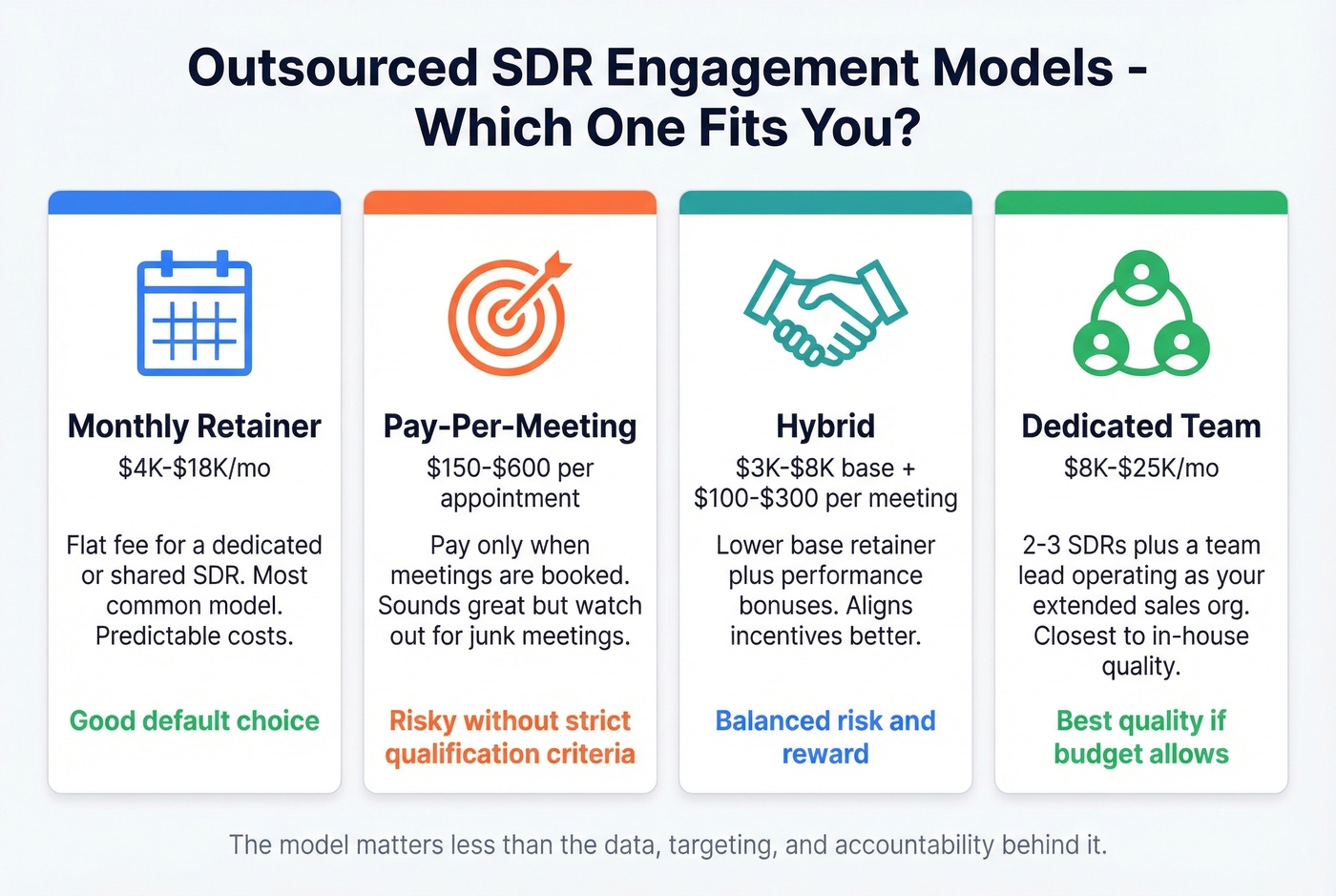
Monthly retainers are the most common - you pay a flat fee for a dedicated or shared SDR. Pay-per-meeting models charge only when appointments land, but avoid these unless qualification criteria are contractually defined and AE acceptance is tracked. Hybrid structures combine a lower base retainer with per-appointment bonuses. Dedicated team engagements give you a full pod - typically 2-3 SDRs plus a team lead - operating as an extension of your sales org, which is the closest you'll get to in-house quality without the overhead.
The model you choose matters less than the data, targeting, and accountability behind it.
SDR Outsourcing Costs in 2026
Here are the four main pricing structures, with ranges reflecting 2026 market rates cross-referenced against baseline benchmarks and current industry analysis:
| Model | Monthly Cost | What You Get |
|---|---|---|
| Retainer | $4K-$18K/mo | Shared or dedicated SDR |
| Pay-per-meeting | $150-$600/appt | Pay only for booked meetings |
| Hybrid | $3K-$8K base + $100-$300/appt | Lower base + performance bonus |
| Dedicated team | $8K-$25K/mo | 2-3 SDRs + team lead |
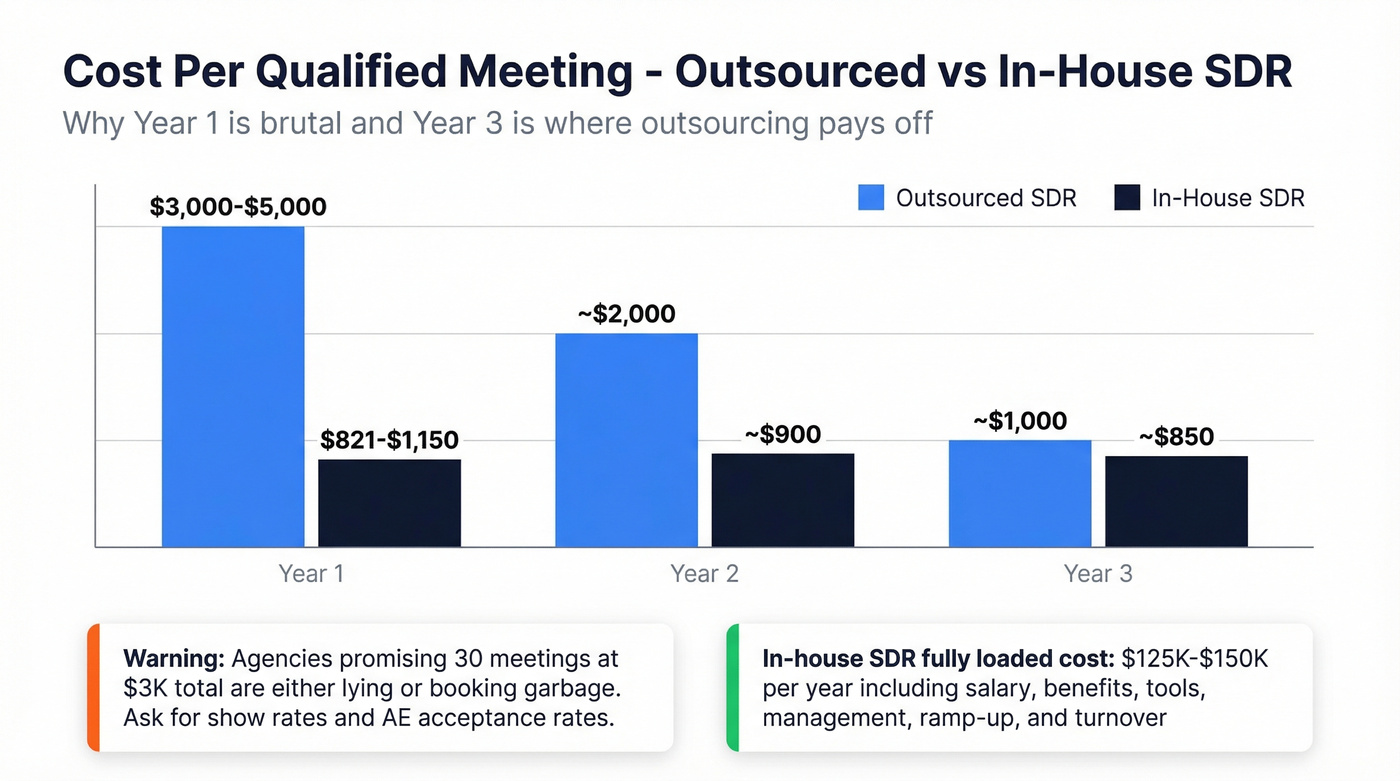
Those numbers look reasonable until you calculate cost per meeting. For mid-market and enterprise B2B, expect $3,000-$5,000 per meeting booked in year one. That drops to ~$2,000 by year two and ~$1,000 by year three as messaging and targeting mature. Year one is brutal.
Compare that to in-house. A fully loaded SDR costs $125,000-$150,000 per year - that's $9,800-$14,200/month when you factor in salary, benefits, tools, management overhead, ramp-up losses, and turnover costs. An outsourced rep runs roughly $42,000-$45,000 annually.
The cost-per-meeting math tells the real story. In-house SDRs producing 10-14 meetings per month at $11,500/mo fully loaded cost $821-$1,150 per qualified meeting. A $5,000/mo outsourced retainer producing the same volume runs $357-$500 per meeting. The outsourced option looks cheaper on paper - but only if the meetings are actually qualified and held.
That "if" is where most programs fall apart.
Reality check: Agencies that promise 30 meetings per month at $3K total are either lying or booking garbage. If the CPM sounds too good to be true, ask for show rates and AE acceptance rates. The honest number for mid-market and enterprise B2B in year one is $3,000-$5,000 per meeting.
Best Outsourced SDR Companies
Pricing ranges below reflect typical retainers for similar scope (1-2 SDRs, campaign management, list building) and publicly visible project bands where available.
| Agency/Tool | Type | Pricing | Review Signal | Channels | Best For |
|---|---|---|---|---|---|
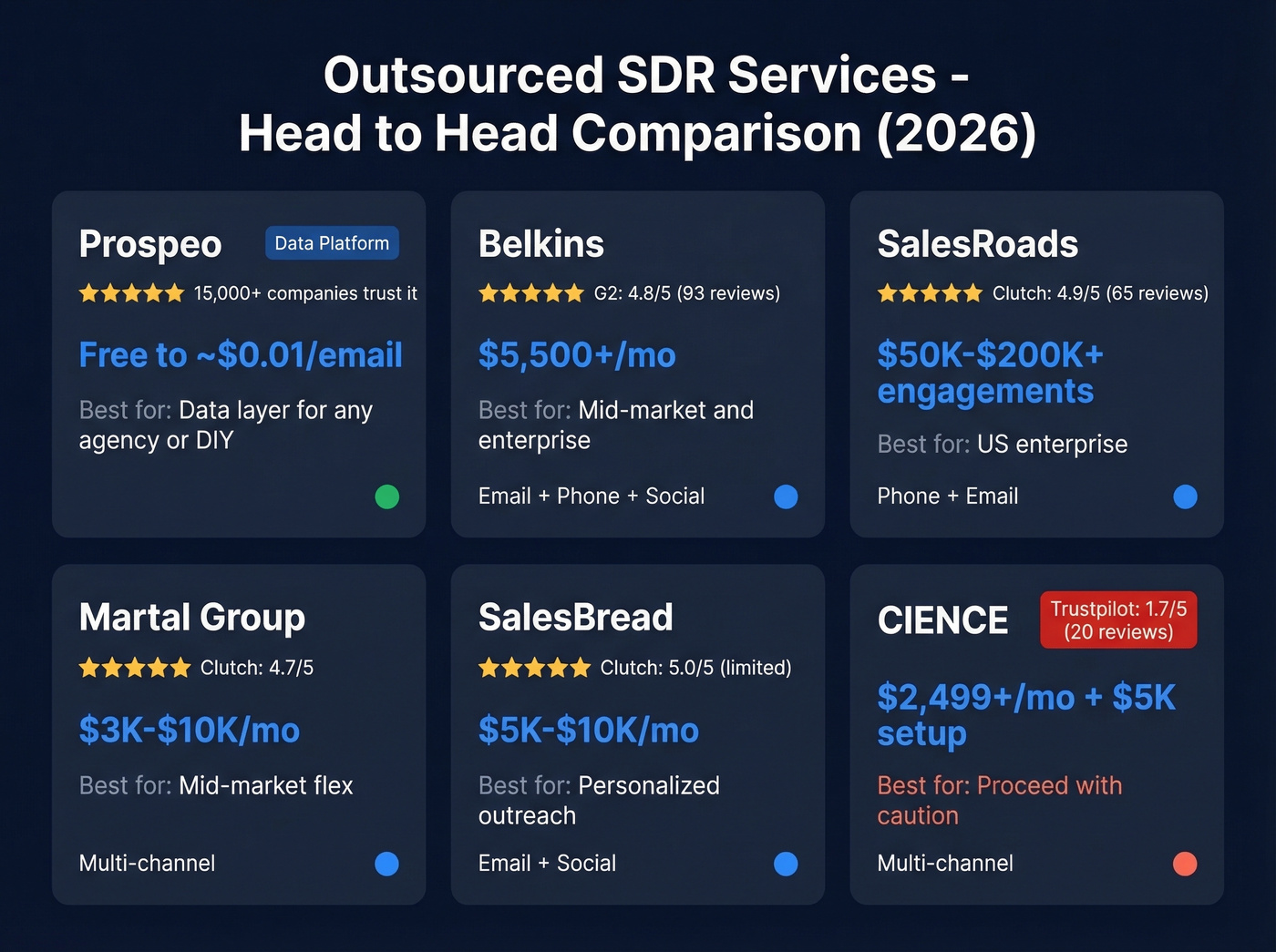
| Prospeo | Data platform | Free-~$0.01/email | 15,000+ companies | Data + verification | Data layer for any agency |
| Belkins | Full-service | From $5,500/mo | G2: 4.8/5 (93) | Email + phone + social | Mid-market/enterprise |
| SalesRoads | Full-service | $50K-$200K+ | Clutch: 4.9/5 (65) | Phone + email | US enterprise |
| Martal Group | Full-service | $3K-$10K/mo | Clutch: 4.7/5 | Multi-channel | Mid-market flex |
| SalesBread | Boutique | $5K-$10K/mo | Clutch: 5.0/5 (limited) | Email + social | Personalized outreach |
| Operatix | Enterprise | $8K-$20K/mo | G2 profile available | Multi-channel | SaaS enterprise (NA + EMEA) |
| MemoryBlue | Enterprise | $8K-$15K/mo | G2: 4.5/5 | Phone + email | Talent pipeline + SDR |
| Callbox | Full-service | $5K-$15K/mo | Clutch: 4.6/5 | Multi-channel + webinar | APAC markets |
| CIENCE | Full-service | $5K setup + $2,499+/mo | Trustpilot: 1.7/5 (20) | Multi-channel | Proceed with caution |
Prospeo (Data Quality Layer)
Use this if: You're working with any outsourced SDR team and want to make sure the contact data won't tank your domain reputation. Or you're building a DIY cold email operation and need verified emails and mobiles at scale.
Best paired with: Any agency on this list, or sending tools like Smartlead and Instantly for DIY outbound. Prospeo handles the data infrastructure; your agency or your team handles execution.
We've seen too many outsourced SDR programs fail not because of bad messaging or lazy reps, but because a quarter of the emails bounced. Prospeo covers 300M+ professional profiles with 143M+ verified emails at 98% accuracy and 125M+ verified mobile numbers. The 7-day data refresh cycle is the differentiator that matters most here - most databases refresh around 6 weeks, and contact data decays 28% within six months. Your agency's outreach sequence means nothing if the emails never land.

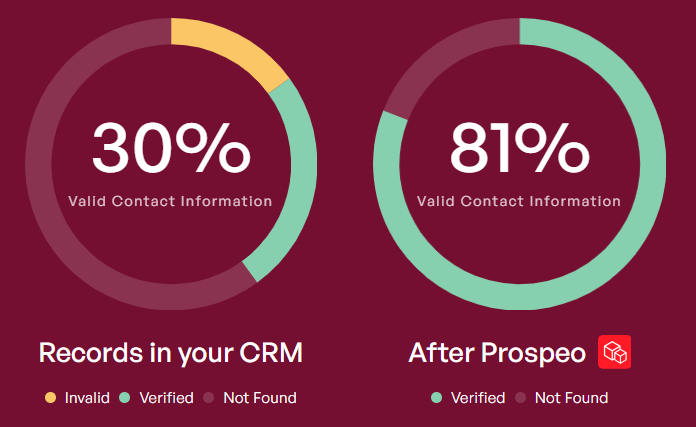
Beyond raw contact data, the platform offers 30+ search filters including buyer intent powered by Bombora across 15,000 topics, technographics, job change signals, and headcount growth - so you're not just finding contacts, you're finding contacts who are actively in-market. The API delivers a 92% match rate with 50+ data points per enrichment, and CRM enrichment returns contact data on 83% of leads. Self-serve, no contracts, GDPR compliant.
Stack Optimize built from $0 to $1M ARR using Prospeo as their data backbone, maintaining 94%+ deliverability and bounce under 3% across all client campaigns. Meritt tripled their pipeline from $100K to $300K per week after switching, cutting bounce rates from 35% to under 4%. At ~$0.01 per email with a free tier of 75 emails/month + 100 Chrome extension credits/month, it's the cheapest insurance policy in your outbound stack.
Belkins
Use this if: You want a proven omnichannel agency with strong review scores and you're selling mid-market or enterprise B2B with deal sizes that justify $5,500+/mo.
Skip this if: You're pre-revenue, selling sub-$5K deals, or need results in under 60 days.
Belkins runs a 4.8/5 on G2 with 93 reviews - the strongest independent signal among outsourced SDR companies. They cover email, cold calling, social selling, and ABM, with dedicated teams rather than shared SDR pools. Belkins reports a 92% AE acceptance rate on booked meetings, which suggests they're optimizing for meeting quality rather than raw volume.
Pricing starts at $5,500/mo. They're upfront that year-one CPM runs $3,000-$5,000 for mid-market and enterprise B2B. That's expensive, but it's honest - and the optimization curve matters. By year three, CPM can drop to ~$1,000 as targeting and messaging compound. They also emphasize TAM burn prevention through suppression lists and domain isolation, which protects your total addressable market from being exhausted by sloppy outreach.
One thing Belkins gets right that many agencies don't: they publish their data ownership policy. You keep the contact lists and campaign data. If you leave, your prospect intelligence leaves with you. Always confirm this with any agency before signing.
SalesRoads
Use this if: You're an enterprise org that needs US-based, dedicated SDRs who can handle complex sales conversations and you have budget for a $50K+ engagement.
Skip this if: You're a startup, need flexible month-to-month terms, or your total outbound budget is under $10K/mo.
SalesRoads carries a 4.9/5 on Clutch from 65 reviews - the highest rating among agencies we evaluated. Project costs range from $10,000 to $200,000+, with the most common engagement falling in the $50K-$199K band.
What separates SalesRoads from cheaper alternatives is the dedicated rep model with operational controls that enterprise buyers care about. Their SDRs are W-2 employees (not contractors), they undergo background checks, and they're trained on your specific product and objection-handling framework before touching a phone. For regulated industries or companies with strict brand protection requirements, this matters more than price per meeting. A single closed enterprise deal at $100K+ justifies the entire annual SDR investment.
Martal Group
Martal Group occupies the flexible middle ground at $3K-$10K/mo, and they're one of the better options for companies testing outsourced SDRs for the first time.
What you're actually buying: Shared SDR capacity with multi-channel execution across email, phone, and social.
Questions to ask before signing: What's the SDR-to-client ratio? Anything above 3:1 means your rep is stretched thin. Do they use dedicated sending domains isolated from other clients? What's their average ramp time for your specific vertical? Expect a standard 4-6 week ramp before campaigns hit stride. Martal carries a 4.7/5 on Clutch, which puts them in solid territory for a mid-market agency.
SalesBread
SalesBread is the anti-volume play. They deliberately cap client volume to maintain outreach quality, and they claim clients can expect 1 qualified sales lead per day on average. Typical range runs $5K-$10K/mo. They carry a 5.0/5 on Clutch, though with a limited review sample.
If your ICP is narrow and your product requires consultative selling, SalesBread's model makes more sense than a high-volume agency blasting 5,000 emails a week. Not the right fit if you need to fill a massive top-of-funnel fast.
Operatix
Best for: SaaS companies selling into enterprise accounts across North America and EMEA.
Not for: Non-SaaS companies, SMB-focused products, or teams that need APAC coverage.
Operatix is a specialist, not a generalist. Typical range runs $8K-$20K/mo depending on scope and geography. Their EMEA coverage is a real differentiator - if you're a US-based SaaS company trying to break into European enterprise accounts, Operatix is built for that motion. They also emphasize GDPR-aware prospecting workflows, which matters when you're selling into EU-regulated industries.
MemoryBlue
MemoryBlue runs a model no other agency on this list offers: SDR outsourcing with a built-in talent pipeline. Many of their SDRs eventually transition to client companies as full-time hires, which means you're essentially running a paid audition. Enterprise-focused at $8K-$15K/mo, with a 4.5/5 on G2.
This is worth considering if you're planning to build an in-house SDR team within 12-18 months. Start with MemoryBlue to validate your playbook and identify top performers, then convert the best reps to your payroll. You skip the recruiting cycle, eliminate ramp time, and the rep already knows your product. The economics only work if you're genuinely planning to hire - otherwise, you're overpaying for a standard outsourced engagement.
Callbox
Callbox is a strong option for APAC-focused outbound, with multi-channel capabilities across email, phone, social, and webinars. Typical range runs $5K-$15K/mo with a 4.6/5 on Clutch.
For teams targeting Southeast Asia, Australia, or Japan, Callbox has the regional infrastructure most US-based agencies lack - local phone numbers, native-language reps, and timezone-aligned outreach. They also offer account-based marketing programs that combine outbound prospecting with webinar promotion and content syndication.
CIENCE (Cautionary Pick)
CIENCE still appears on "best outsourced SDR" listicles across the web, which is baffling given their 1.7/5 Trustpilot rating from 20 reviews. Recurring complaints cite bogus leads, poor targeting, undertrained reps, and revolving account managers. Pricing runs $5,000 for GTM setup plus $2,499+/mo for campaign management, with SDR add-ons pushing $1,500-$5,500 per rep per month.
Let's be honest: the fact that many comparison articles still rank them highly tells you more about affiliate commissions than service quality. We can't recommend them.

Most outsourced SDR programs don't fail because of bad reps - they fail because 25-35% of emails bounce and torch your domain. Prospeo's 98% email accuracy and 7-day data refresh keep bounce rates under 4%, whether you're running DIY outbound or feeding lists to an agency.
Stop paying $5,000 per meeting on data that bounces.
Building a DIY cold email stack at ~$1,175/mo beats most outsourced SDR retainers - but only if the data connects. Prospeo gives you 143M+ verified emails at ~$0.01 each, 125M+ direct dials, and native integrations with Smartlead, Instantly, and Lemlist.
Replace your agency's data layer for a fraction of the cost.
Why Most SDR Outsourcing Fails
That 7% success rate isn't random. The same five failure modes show up over and over.
1. Bad data and poor targeting. This is the root cause more often than anyone admits. Contact data decays 28% within six months. Single-source lists routinely come back incomplete - missing phones, current titles, or verified emails for 40-60% of prospects. Your agency sends 5,000 emails, 800 bounce, your domain reputation craters, and suddenly even the good emails land in spam. The fix is straightforward: run every prospect list through a real-time verification layer before any campaign launches. A 3% bounce rate and a 15% bounce rate produce completely different outcomes from the same outreach copy.
2. Volume-over-quality compensation models. When agencies pay SDRs per meeting booked rather than per qualified opportunity, you get calendar spam. Reps book anyone who'll take a call, regardless of fit. Always ask about AE acceptance rates and show rates - not just meetings booked. If an agency won't share these numbers, walk away.
3. Email over-reliance as deliverability declines. Gmail and Yahoo's sender rules now require one-click unsubscribe within two days and spam rates well under 0.3% per Google's sender guidelines. Agencies that rely solely on email are fighting a losing battle. Multichannel outreach boosts engagement by 287% versus single-channel. Any agency pitching email-only in 2026 is behind the curve.
4. SDR churn. Average SDR tenure is 14 months. At agencies, it's often 6-9 months. Every time your rep turns over, you lose institutional knowledge about your product, your ICP, and your objection-handling playbook. The ramp starts over. Ask agencies about their rep retention rate and what happens when your SDR leaves.
5. Black-box operations. If you can't see the outreach copy, the contact lists, or the deliverability metrics in real time, you're flying blind. Agencies that resist transparency are usually hiding underperformance. If an agency won't share lists and copy pre-launch, that's a dealbreaker.
Compliance, TAM Burn, and Brand Protection
Most buyer's guides skip this section entirely. Don't.
Compliance (GDPR / CCPA / TCPA). If your agency is prospecting into the EU, California, or making cold calls in the US, compliance isn't optional. Ask specifically: Do they maintain opt-out lists? How do they handle data processing agreements? Do they get consent for call recording? Are they using GDPR-compliant data sources? An agency that can't answer these questions clearly is a liability, not a partner.
TAM burn and suppression lists. Every bad email your agency sends burns a prospect from your total addressable market. If they blast your entire ICP with poorly targeted messaging in month one, you can't re-approach those contacts cleanly. Demand suppression lists for prospects already contacted by other clients, seed lists to monitor inbox placement, and domain isolation so your campaigns run on dedicated sending infrastructure rather than shared domains that other clients have already damaged.
Data ownership. Get this in writing before signing. When the engagement ends, do you keep the contact lists, the campaign data, and the prospect intelligence? Or does it stay locked in the agency's system? If you're paying $5,500+/mo, you own the data. Period.
Operational assurances. For enterprise buyers: Are the SDRs W-2 employees or offshore contractors? Do they undergo background checks? What's the QA process for outreach quality? What training do reps receive on your product before going live? These details separate professional agencies from meeting factories.
How to Vet an Agency
Before you sign anything, ask these eight questions. The answers will tell you whether you're dealing with a serious partner or a meeting factory.
- What data sources do you use, and how often is data refreshed? If the answer is "we use one database" and nothing else, that's a single point of failure. Common database refresh cycles run around 6 weeks - ask if they verify data in real time before sending.
- Do you use dedicated or shared SDR pools? Shared pools mean your rep is context-switching between your product and three others.
- How do you define "qualified meeting"? Get this in writing. If they can't articulate qualification criteria that match your sales process, walk away.
- What's your deliverability monitoring setup? They should be tracking inbox placement, bounce rates, and spam complaints per domain - not just "emails sent." (If you need a baseline, start with an email deliverability checklist.)
- Will you integrate with our CRM in real time? If meeting notes and prospect data live in their system and not yours, you lose visibility and data ownership.
- What's the minimum contract and exit clause? Avoid 12-month commitments without a 90-day performance review and exit option.
- Can we see outreach copy and contact lists before launch? Any agency that says no is hiding something.
- What's your AE acceptance rate and show rate? Meetings booked is a vanity metric. Meetings held and accepted by your AEs is what matters.
AI SDRs vs Human Agencies
One Reddit user spent $7,500 on an AI SDR tool and got exactly one demo. The vendor had promised 12-15 meetings per month after ramp, blasting 6,000 contacts monthly. What actually happened: the AI hallucinated company names, misspelled prospect names, referenced the wrong industry, and produced almost zero positive replies.
AI SDRs can work for high-volume, low-ACV, commodity products where personalization barely matters. If you're selling a $29/mo SaaS tool to SMBs, an AI sending thousands of templated emails might generate enough volume to be worthwhile.
For complex B2B - high ACV, multi-stakeholder buying committees, long sales cycles - AI SDRs don't deliver. They can't handle objections, can't read context, and can't build the kind of trust that gets a VP to take a 30-minute discovery call. We've seen teams waste entire quarters trying to make AI outbound work for enterprise deals. The technology will improve, but in 2026, human SDRs still win for anything above commodity sales.
In-House vs Outsourced vs DIY
| Factor | In-House | Outsourced Agency | DIY Cold Email |
|---|---|---|---|
| Annual cost | $125K-$150K/rep | ~$42K-$45K/rep | ~$14K/yr |
| Ramp time | 3-6 months | 4-6 weeks | Immediate (if skilled) |
| Control | Full | Limited | Full |
| Data ownership | Yes | Varies (get it in writing) | Yes |
| Best for | Complex products, high ACV | Speed, new markets | Bootstrapped teams |
In-house gives you full control and deep product knowledge but takes months to ramp and costs three times as much. Outsourcing gets you to market fast and costs less per rep, but you sacrifice control and face the quality risks covered above.
The DIY option is increasingly viable. A Reddit breakdown of founder math puts the infrastructure cost for 1,000 emails/day at roughly $1,175/month - 50 inboxes across 17 domains, plus sending tools. Pair a sending tool like Instantly or Smartlead with verified contact data and your total infrastructure cost stays under $500/month for smaller volumes. You'll need to write your own sequences and manage deliverability (including email velocity and bounce control), but for founders and small teams with outbound experience, this is the highest-ROI path.
Many companies start with an outsourced SDR agency to validate messaging and ICP, then bring it in-house once they've found what works. That's a legitimate strategy - just make sure your contract allows it and that you retain full data ownership when you transition. Using an agency as a stepping stone to an in-house motion is one of the smarter plays in the playbook, provided you negotiate data portability upfront.
FAQ
How long until an outsourced SDR program produces results?
Most agencies need 4-6 weeks to ramp, with meaningful pipeline data emerging by month 2-3. Year-one cost per meeting runs $3,000-$5,000 for mid-market B2B, dropping to ~$1,000 by year three as messaging and targeting mature. Set clear 90-day benchmarks with specific AE acceptance rate targets.
What's a realistic number of meetings per month?
Top-performing outsourced SDRs book 8-15 meetings per month on entry-tier retainers ($2.5K-$4K/mo). Enterprise engagements ($7.5K-$15K/mo) target 20-35+. Always ask for show rates and AE acceptance rates - meetings booked and meetings held are very different numbers.
Should I outsource or build in-house?
Outsource if you need speed (4-6 weeks vs 3-6 months to ramp) or you're testing a new market segment. Build in-house if deal sizes exceed $50K, your product is complex, or you need deep cross-functional alignment. Many companies start outsourced, then bring it in-house once they've validated the playbook.
How do I make sure my agency uses quality data?
Ask what databases they use and how often data is refreshed - contact data decays 28% within six months. Run their prospect lists through a real-time verification tool before any campaign launches. You want 98%+ email accuracy and bounce rates under 3%. If an agency resists letting you audit their contact lists, that's a red flag.
What's the biggest red flag when evaluating agencies?
Guaranteed meeting volumes with no definition of "qualified." If an agency promises 30 meetings per month but can't share their show rate, AE acceptance rate, or qualification criteria, they're optimizing for their invoice, not your pipeline. Get qualification definitions in writing before signing.