

Stop Memorizing Persuasion Tricks - Start Diagnosing Buyer Resistance
The consensus on r/sales is blunt: the harder you try to persuade, the more buyers resist. That tracks with the numbers. 84% of reps missed quota last year, and the average B2B close rate sits around 29%. If persuasive sales techniques actually worked the way most articles describe them - memorize six tricks, close more deals - those numbers would look very different.
The problem isn't that persuasion psychology is wrong. Cialdini's principles are backed by decades of research. The problem is that most reps use them like a hammer looking for a nail, spraying influence tactics without first diagnosing what's actually blocking the deal.
The Short Version
If you only take three things from this article: diagnose the buyer's resistance before choosing a technique, cap your pitch at three claims, and multi-thread every deal over $25K. The rest is execution.
Why Sales Persuasion Matters More in 2026
80% of B2B interactions are now digital. Buyers use 10 channels on average - up from 5 in 2016. The buying committee has ballooned to roughly 13 people. And buyers spend about 17% of their total buying time with suppliers, so if they're evaluating three vendors, you get roughly 5-6% of their calendar.
You don't get a dozen chances to build trust. You get two or three moments where your persuasion skills actually matter - a discovery call, a demo, a pricing conversation. Waste those moments with generic tactics and the deal dies quietly in committee.
"Just be persuasive" isn't useful advice. You need the right technique, applied to the right person, at the right moment in the deal cycle.
Cialdini's 7 Principles (and the One Everyone Misses)
Robert Cialdini's Influence has sold 7 million copies in 44 languages. The framework has held up for over 40 years, partly because Cialdini didn't just run lab experiments - he spent three years undercover in real persuasion-heavy organizations: used car dealerships, telemarketing firms, fundraising operations. The principles came from watching what actually works on real people making real decisions.
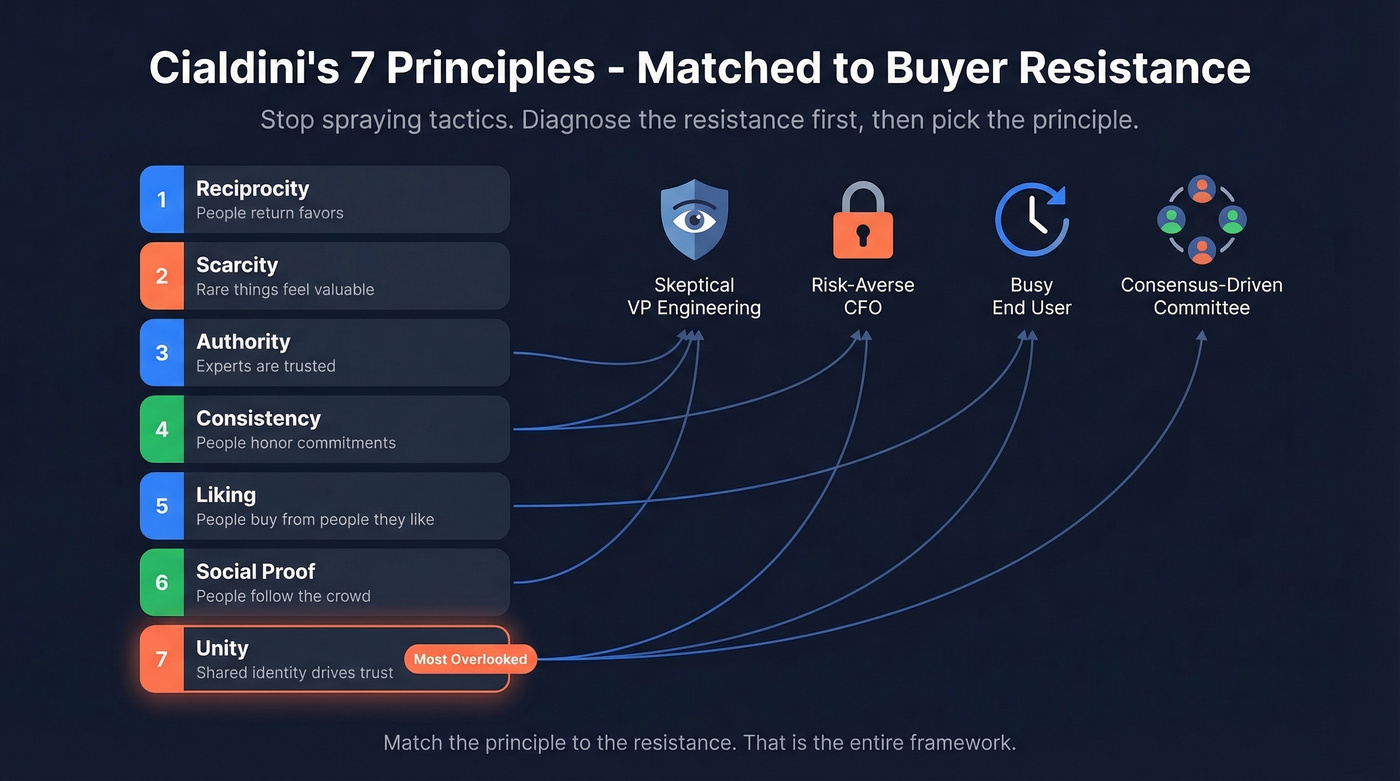
Most sales articles list six principles. There are seven. The seventh - Unity - is the one that changes how you sell to committees.
| Principle | What It Means | Sales Example |
|---|---|---|
| Reciprocity | People return favors | Share a custom ROI model before asking for the meeting |
| Scarcity | Rare things feel valuable | "We onboard 3 new clients/quarter in your vertical" |
| Authority | Experts are trusted | Lead with industry-specific data, not generic claims |
| Consistency | People honor commitments | Get verbal micro-yeses before the proposal |
| Liking | People buy from people they like | Mirror the buyer's communication style |
| Social Proof | People follow the crowd | "Here's how [similar company] solved this" |
| Unity | Shared identity drives trust | "We're both operators - here's what I'd do in your seat" |
Unity is the one most sales articles skip. Cialdini introduced it in Pre-Suasion (2016), and it's arguably the most useful principle for reps working complex B2B deals. It's not about being likable - it's about establishing shared identity. When a buyer feels you're part of their in-group (same industry, same role, same problem set), resistance drops dramatically.
The Diagnostic Step Most Reps Skip
Here's the thing: knowing all seven principles doesn't help if you apply them randomly. The SUE Behavioural Design team nails this critique - people use Cialdini's framework badly because the principles explain how to influence, not when or why. Without diagnosis, you get spray-and-pray influence. And 73% of buyers actively avoid vendors with irrelevant outreach, which is exactly what happens when you spray tactics without diagnosing what the buyer actually needs.
The fix is simple but rarely practiced. Before choosing a technique, identify the buyer's dominant anxiety. A skeptical VP of Engineering who's been burned by vendor promises needs Authority and Social Proof - show them the data, show them the case study, let them talk to a reference. A risk-averse CFO worried about implementation disruption needs Consistency and Unity - get small commitments early, and frame yourself as someone who's navigated this exact transition before.
Match the principle to the resistance. That's the entire framework.

You just learned to diagnose buyer resistance before choosing a technique. But the best technique in the world fails if you're pitching the wrong person. Prospeo gives you 30+ filters - buyer intent, job changes, department headcount - so you reach the actual decision-maker. 98% email accuracy means your three claims land in a real inbox, not a bounce log.
Stop perfecting your pitch for contacts that don't exist.
Data-Backed Techniques That Close Deals
The Rule of Three
Shu & Carlson's 2014 study in the Journal of Marketing (78(1), 127-139) found that persuasion peaks at exactly three claims. At four or more, buyers become skeptical - but only when they perceive persuasive intent. That's the critical moderator. If the buyer sees you as an objective advisor, more claims actually help. The moment they clock you as selling, the fourth claim triggers an alarm.
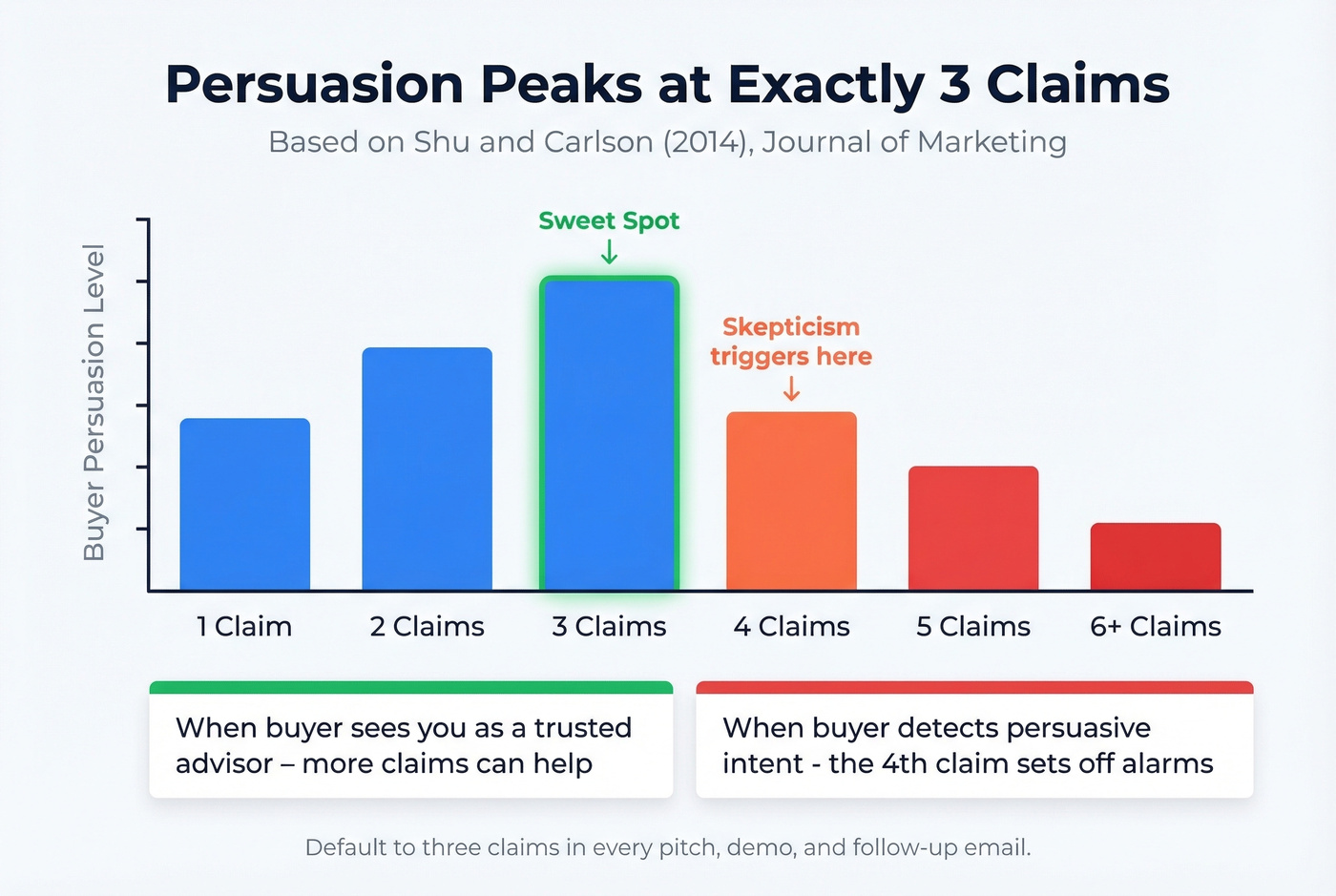
When to use it: Every pitch, every demo, every follow-up email. Three claims is your default. Skip the rule only when you've genuinely earned trusted-advisor status and the buyer is asking for more detail.
Script example (SaaS demo opening):
"There are three reasons teams like yours switch to us. First, your reps are spending 6+ hours a week on manual prospecting - we cut that to under one. Second, your bounce rates are killing domain reputation - we verify in real time. Third, your pipeline coverage is 2x, but conversion is flat - we fix the data quality underneath. Let me show you each one."
Three claims. No more. Let the demo do the rest.
The Talk-Listen Ratio
Gong Labs' analysis across millions of sales calls established the optimal ratio: 43% talking, 57% listening. But the real insight isn't the ratio itself - it's consistency. Low performers swing their talk time by 10 full points: 54% talk on won deals, 64% on lost deals. Top performers hold steady regardless of outcome.
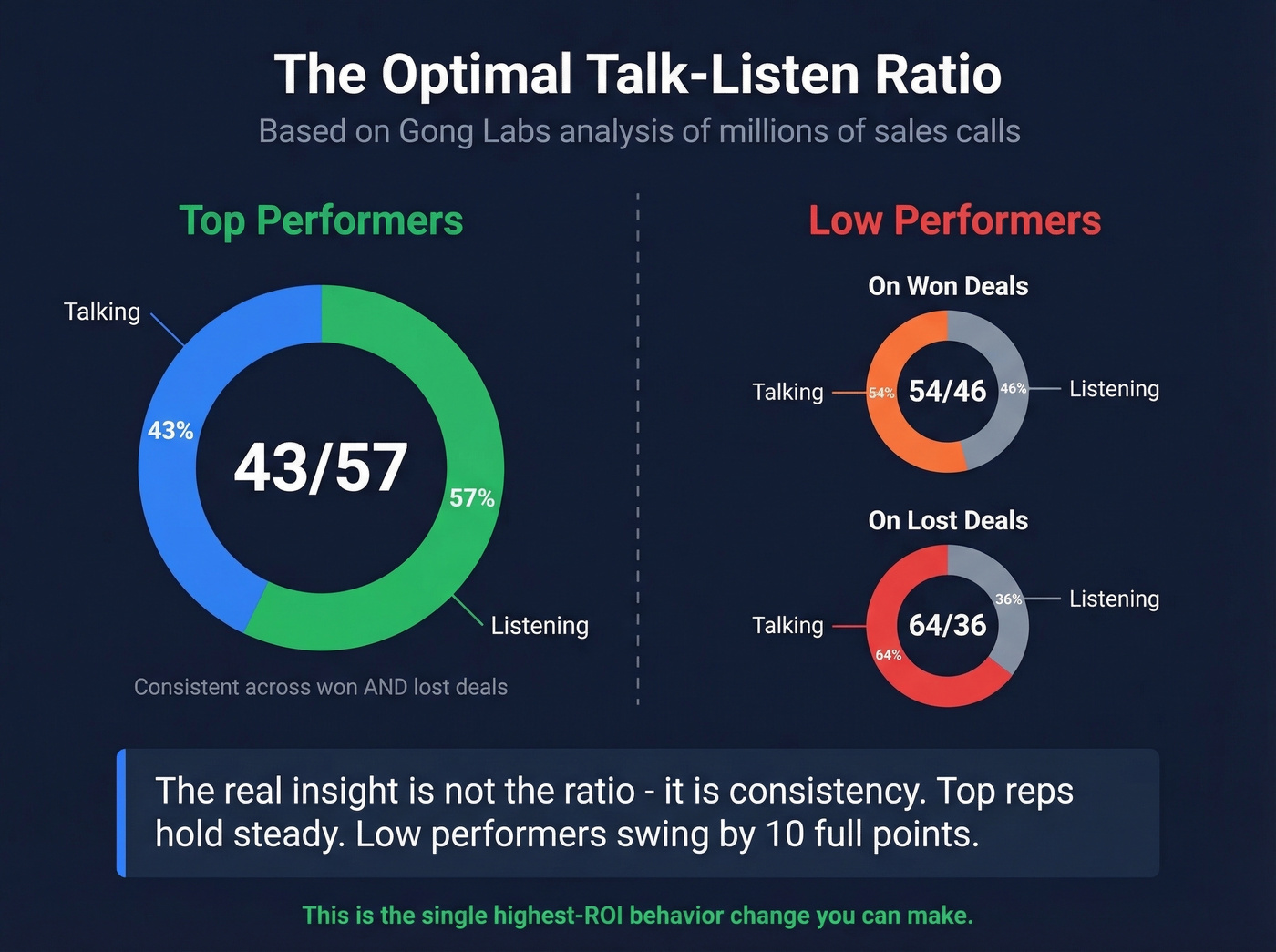
In our experience, the reps who struggle most with this aren't the ones who talk too much. They're the ones who fill silence with filler instead of letting the buyer think. Mastering this ratio is one of the most reliable persuasion methods because it lets the prospect sell themselves on the solution.
When to use it: Every discovery call and every deal review. When to skip it: Never. This is the single highest-ROI behavior change you can make.
Script example (discovery sequence that keeps you at 43%):
"Walk me through how your team handles [process] today." [Listen. Don't interrupt.] "What breaks first when volume spikes?" [Listen. Take notes visibly.] "If you could fix one thing about that workflow by next quarter, what would it be?" [Listen. Then summarize what you heard before pitching anything.]
Three open-ended questions, each designed to get the buyer talking for 2-3 minutes. You'll naturally land near that 43% mark.
The Ambivert Advantage
Adam Grant's 2013 study in Psychological Science tracked 340 outbound sales reps and found a curvilinear relationship between extraversion and sales performance. Ambiverts - people who score near the middle of the introvert-extrovert spectrum - outperformed both extremes.
The mechanism is intuitive once you see it. Extreme extroverts talk too much and miss buying signals. Extreme introverts don't assert enough to move deals forward. Ambiverts naturally balance talking and listening, which maps directly to that 43/57 ratio.
You don't need to be the loudest person in the room to sell effectively. If you're naturally quiet, lean into it - ask better questions and listen harder. The data says that's a competitive advantage, not a weakness.
For deals under $20K with a sales cycle under 30 days, the ambivert advantage matters more than any Cialdini principle. Short cycles reward reps who read the room fast and adapt, not reps who deploy elaborate influence frameworks.
Persuading Committees, Not Individuals
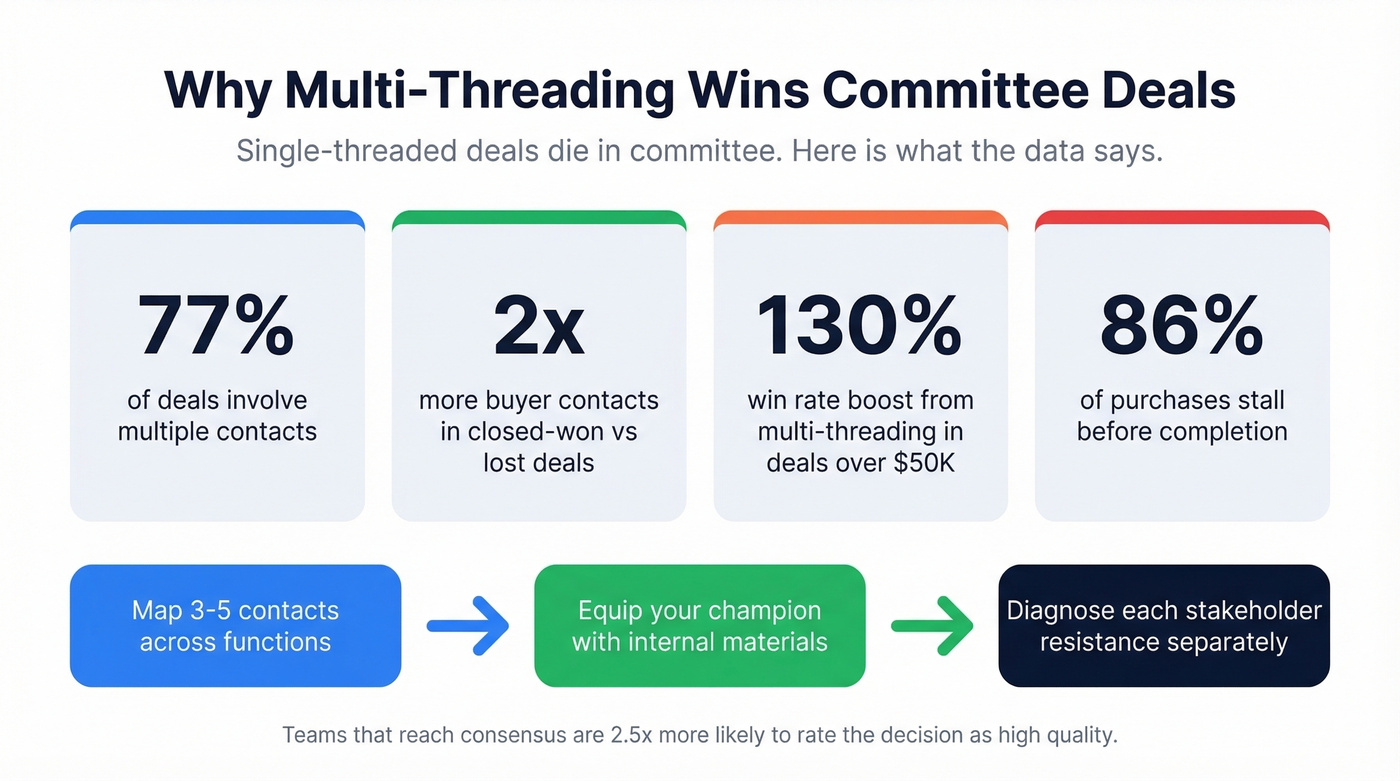
Most persuasion advice assumes you're convincing one person. In B2B, you're almost never convincing one person. An analysis of 1.8 million opportunities found that 77% of deals involve multiple contacts, and closed-won deals have 2x as many buyer contacts as lost deals. In strategic enterprise deals, the average is 17 contacts. Multi-threading boosts win rates by 130% in deals over $50K.
Here's the complication: 74% of buying teams experience unhealthy conflict during the decision process, and 86% of purchases stall before completion. When teams do reach consensus, they're 2.5x more likely to rate the decision as high-quality. Your job isn't just to convince a prospect to buy - it's to help the committee align so they can move forward with confidence.
We've watched deals over $100K die because the champion went on vacation and nobody else in the org knew the rep's name. Don't let that be you.
Committee persuasion checklist:
- Multi-thread from day one. Build relationships with 3-5 contacts across different functions. Don't wait until the deal stalls to find the CFO's email. Prospeo's 30+ search filters let you map an entire buying committee by department, seniority, and job function - so you're reaching the right stakeholders instead of guessing at email formats.
- Equip your champion. Create internal-facing materials - one-pagers, ROI calculators, competitive comparisons - that your champion can forward without editing.
- Map the resistance. Each stakeholder has a different anxiety. The CTO worries about integration. The CFO worries about ROI timeline. End users worry about workflow disruption. Diagnose each one separately.
- Bring your team. Team selling isn't a sign of weakness. Closed-won selling teams are 67% larger than those on lost deals, and bringing a sales engineer lifts win rates up to 30% in enterprise contexts.
Persuasion Mistakes That Kill Deals
Fake urgency and manufactured scarcity. "This pricing expires Friday" when it doesn't. Buyers see through it. One practitioner replaced urgency-based CTAs with data-backed proposals and tailored value maps - and saw a 20% win rate increase over two quarters. Real urgency exists (budget cycles, competitive timing). Fake urgency destroys trust.
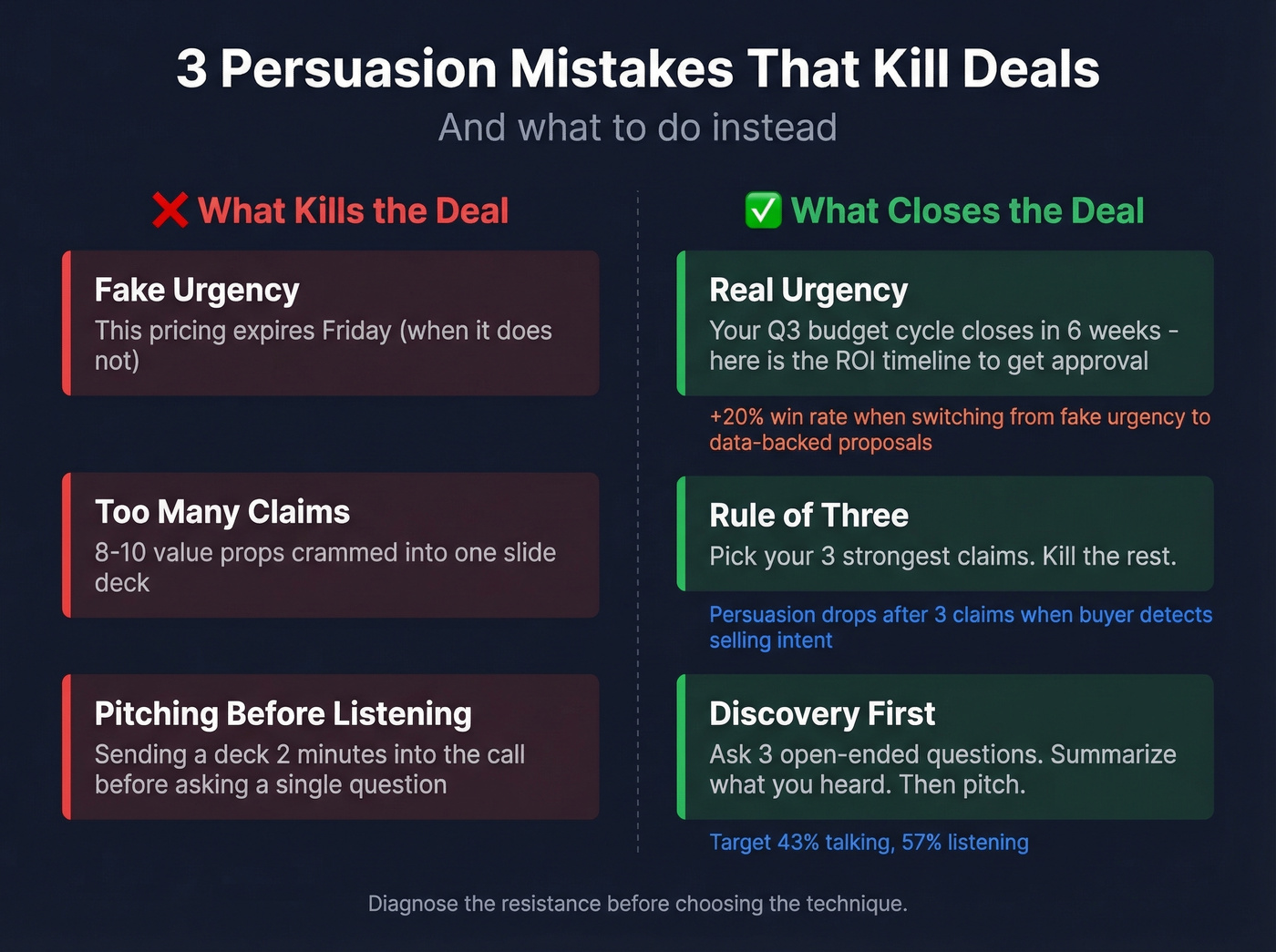
Too many claims. Remember Shu & Carlson: four or more claims trigger skepticism when the buyer knows you're selling. We've seen reps load 8-10 value props into a single slide deck and wonder why the deal stalled. Pick three. Kill the rest.
Pitching before listening. Sending a deck two minutes into a call, before you've asked a single question. The buyer hasn't told you what they care about, so you're guessing - and guessing wrong. Discovery first. Always.
Single-threading the wrong person. Relying on one champion to carry the deal through a 13-person committee is how you lose in week six. But single-threading isn't just about quantity - it's about reaching the right stakeholders. Pitching the technical champion when the CFO holds the budget is a different failure mode, and it's just as deadly.
Bad contact data. The most persuasive email in the world doesn't work if it bounces. Teams running outbound with unverified lists see 35%+ bounce rates, which tanks domain reputation and kills deliverability for every subsequent campaign. Fix the data before you fix the messaging.
Digital Persuasion: Email, Phone, and AI
The channel has changed, but the psychology hasn't. Gong's research shows that "camouflaged" subject lines - short, lowercase, internal-looking - increase open rates. Think "re: quick question" instead of "Exclusive Offer Inside!" The mechanism is simple: it feels more like a real 1:1 note and less like a marketing blast.
If you want more options beyond "re: quick question," steal from proven email subject lines and test them against your ICP.
On the phone side, automation creates a real persuasion problem. Auto-dialers and parallel dialers introduce dead-air delays after the prospect says hello, which immediately signals "sales call" and triggers hangups. Reps enter conversations rushed and underprepared. More dials doesn't mean more influence if every conversation starts with friction. (If you're rebuilding your calling stack, start with a modern cold calling system.)
The AI angle is more promising. Analysis of 7.1 million opportunities found that frequent AI users generate 77% more revenue than non-AI users. But AI amplifies existing skills - it doesn't replace them. A rep who can't diagnose buyer resistance won't suddenly close deals because GPT wrote their follow-up email. If you're operationalizing this, use AI sales follow-up workflows that keep the human diagnosis step intact.
There's also a lesser-known technique worth stealing for email and phone: the "But You Are Free" method. A large meta-analysis found that explicitly acknowledging the prospect's freedom to say no - "totally your call, no pressure either way" - can double the chances of someone saying yes. It works because it disarms the reactance that kicks in when buyers feel cornered. Try it in your next follow-up email and watch what happens.
Let's be honest about one more thing: none of these digital techniques matter if your emails are bouncing or your phone numbers are wrong. We've seen teams spend weeks perfecting their cold email copy only to discover their list was 40% invalid. The persuasion stack starts with accurate data, not clever words. If you're seeing deliverability issues, start by fixing your email bounce rate and then work through a full email deliverability guide.
With 13 people on the average buying committee, multi-threading isn't optional - it's survival. Prospeo maps entire org charts with verified emails and 125M+ direct dials so you can apply Unity, Authority, and Social Proof to every stakeholder who matters. At $0.01 per email, threading a 13-person committee costs you thirteen cents.
Multi-thread every deal for the price of a coffee sip.
FAQ
What's the most effective persuasive sales technique for B2B?
Fix your talk-listen ratio first. The 43% talking / 57% listening split from Gong's research is the single highest-ROI behavior change most reps can make, and it compounds across every conversation in the deal cycle. Pair it with diagnosing each buyer's specific resistance before choosing a Cialdini principle.
Is persuasion in sales manipulative?
Persuasion is structured influence backed by psychology; manipulation is deception for one-sided gain. The line is simple: does the buyer benefit from the outcome? Ethical influence guides a buyer toward a decision that genuinely solves their problem. Fake urgency, exaggerated social proof, and manufactured scarcity cross the line.
How many selling points should I include in a pitch?
Three. Shu & Carlson (2014) found persuasion peaks at three claims, then declines at four or more - specifically when the audience recognizes persuasive intent. Pick the three value props that matter most to this buyer and save the rest for follow-up conversations.
How do I close a deal with a 10+ person buying committee?
Multi-thread from day one. Deals with 2x more buyer contacts close at dramatically higher rates - 130% higher for deals over $50K. Build relationships with 3-5 contacts across functions, equip your champion with internal-facing materials, and map the committee by department and seniority so you're reaching budget holders, not just technical evaluators.