

The Pod Sales Model: Build and Scale Revenue Pods in 2026
Your CRO Wants Pods. Now What?
Your CRO came back from SaaStr, a podcast binge, or a LinkedIn rabbit hole and dropped the word "pods" in the all-hands. Now you're reorganizing your entire sales floor around a concept that sounds great in theory but has a dozen ways to go sideways in practice.
Quick disambiguation: this isn't about vape cartridges or print-on-demand merch. In B2B sales, a pod refers to a small, cross-functional revenue team aligned to a specific audience - not a product you ship.
The model isn't new, but the reasons to adopt it are sharper than ever. Buyers expect continuity. Handoffs kill deals. And the assembly-line structure that worked when you were scaling from 5 to 50 reps starts cracking once deal complexity goes up. Here's how revenue pods actually work, when they're worth the disruption, and how to build one without torching your pipeline.
What Is a Sales Pod?
A sales pod is a small, cross-functional team - typically an SDR, an AE, and a CSM - aligned to a shared segment, territory, or account tier. Instead of passing leads down a linear assembly line where each role handles one stage and throws it over the wall, pods wrap sales (and often customer success, sometimes marketing) around one audience so the team coordinates tightly across the entire buyer journey.
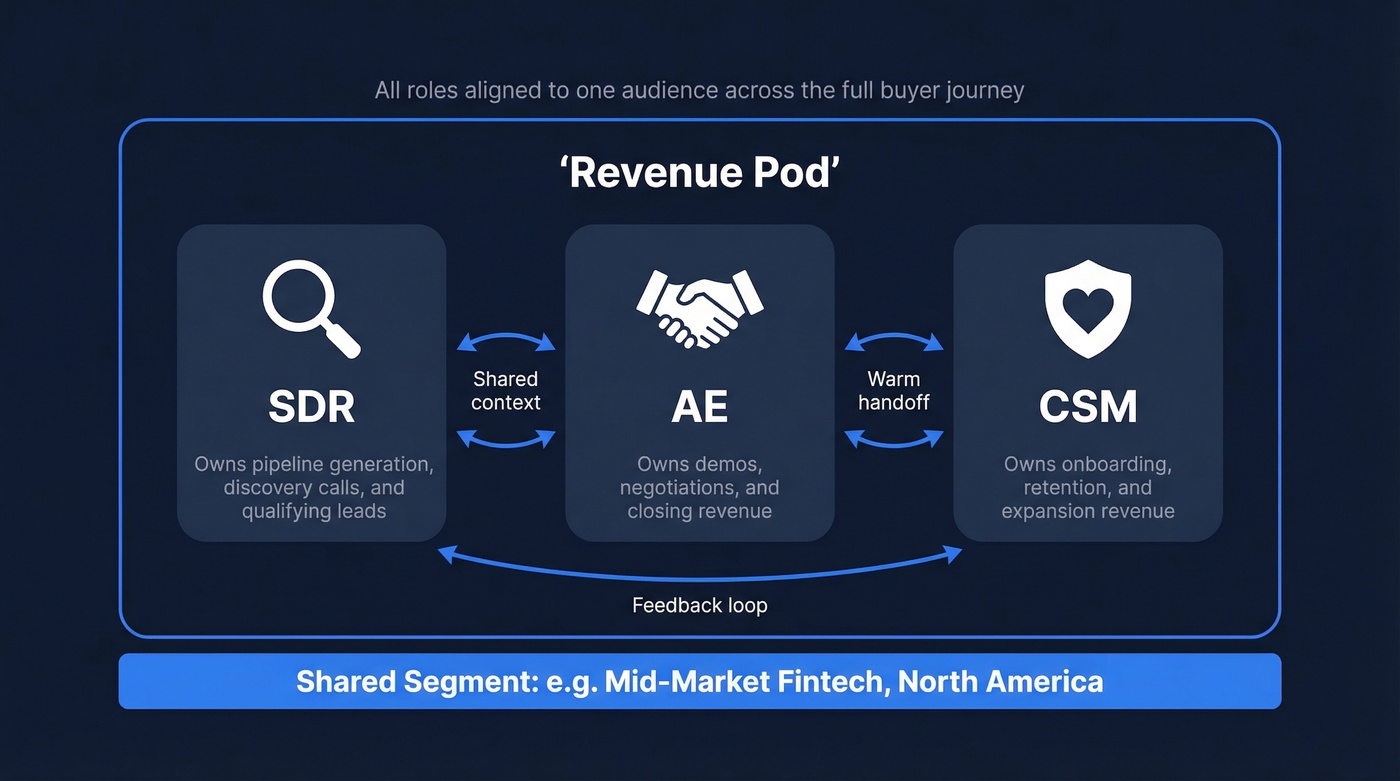
A pod keeps context inside a small group. What the SDR learned, what the AE promised, what the customer actually cares about, what risks are emerging - all of it stays in one conversation instead of getting lost in CRM notes nobody reads.
Is the Pod Model Right for You?
Not every team should run pods. Here's the honest filter.
Pods work when deal complexity is high (multi-stakeholder, multi-touch), deal sizes justify the coordination cost, sales cycles stretch past a few weeks, and retention and expansion revenue matter to your model. You also need enough reps to form at least two pods.
Skip pods if you're selling a transactional, self-serve product, you don't have enough headcount to staff multiple pods, or your sales cycle is extremely short. The coordination overhead will eat any efficiency gains.
Here's the thing: pods add real time cost. Weekly standups, shared pipeline reviews, attribution discussions - it adds up. If your deals close in a week with one decision-maker, that overhead isn't justified. The model pays off when the cost of context loss exceeds the cost of coordination, and for most complex B2B motions with ACVs above $15K, it does.

Pods fail when the SDR prospects with bad data and the AE inherits dead leads. Prospeo gives your entire pod 98% verified emails, 125M+ direct dials, and 30+ filters to nail your segment - so every role works from the same accurate pipeline instead of cleaning up each other's messes.
Arm your pod with data that actually connects to real buyers.
Pod vs. Assembly Line vs. Island
Three models dominate B2B sales org design. Each fits a different stage and selling motion.
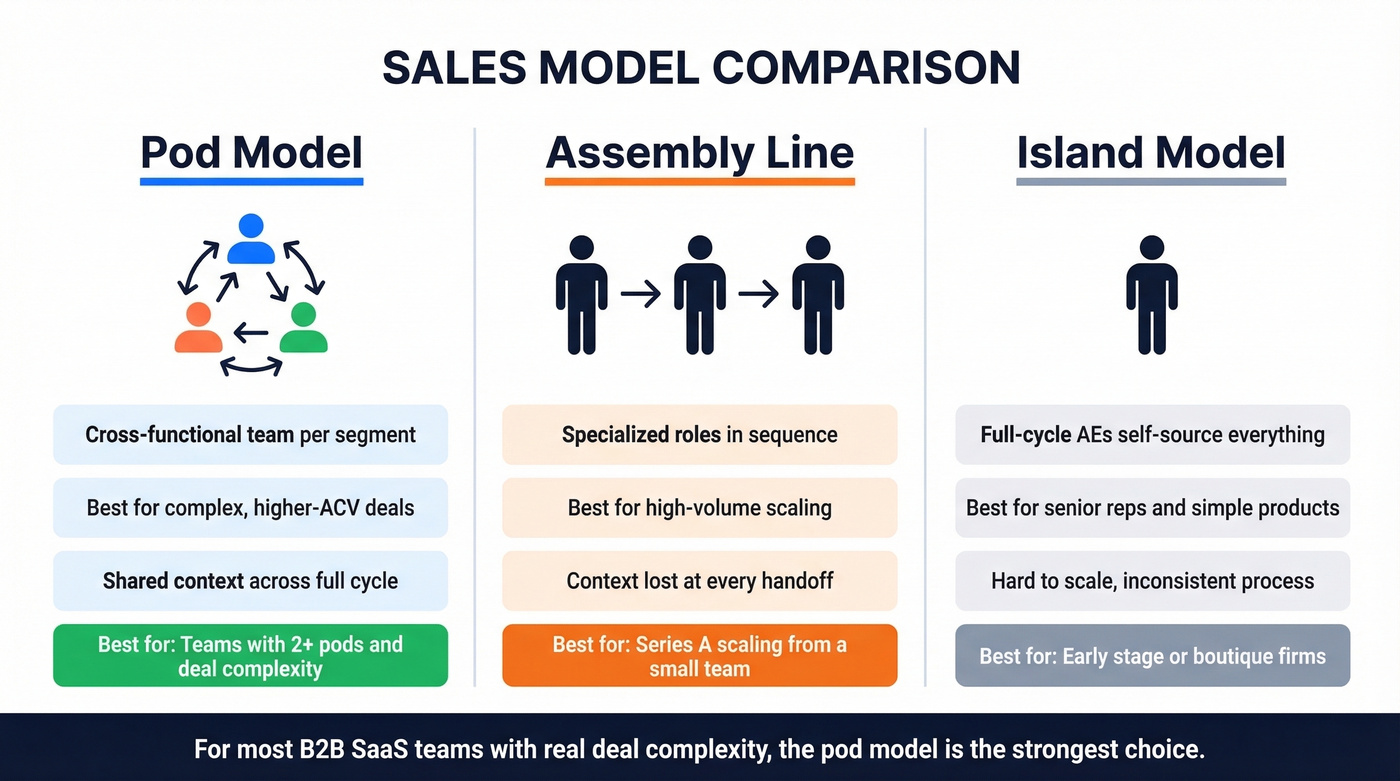
| Pod Model | Assembly Line | Island Model | |
|---|---|---|---|
| Structure | Cross-functional team per segment | Specialized roles in sequence | Full-cycle AEs self-source |
| Best for | Complex, higher-ACV deals | High-volume scaling | Senior reps, simple products |
| Pros | Shared context, faster cycles | Clear specialization, easy to hire | Low overhead, rep autonomy |
| Cons | Coordination cost, harder to staff | Context loss at every handoff | Inconsistent process, hard to scale |
| Ideal stage | Teams with enough headcount for 2+ pods | Series A-style scaling from a small team | Early stage or boutique firms |
For most B2B SaaS teams with real deal complexity and enough headcount, the pod model is the strongest choice. The assembly line is a stepping stone, not a destination. And the island model only works if you have senior reps who genuinely enjoy prospecting - a rarer breed than most hiring managers admit.
The assembly line made sense when the priority was scaling headcount fast. You could hire junior SDRs, train them on one skill, and feed a growing AE team. But once deal complexity rises, that model breaks because every handoff is a miniature trust reset where the buyer has to re-explain their situation to someone new. Pods preserve specialization while eliminating those gaps, which is why the approach has gained so much traction in SaaS over the past few years.
How to Build a Sales Pod
Define Your Segment
Don't roll out pods across the entire org on day one. Start with one pod assigned to your highest-value segment - whether that's enterprise accounts, a specific vertical, or a geographic territory.
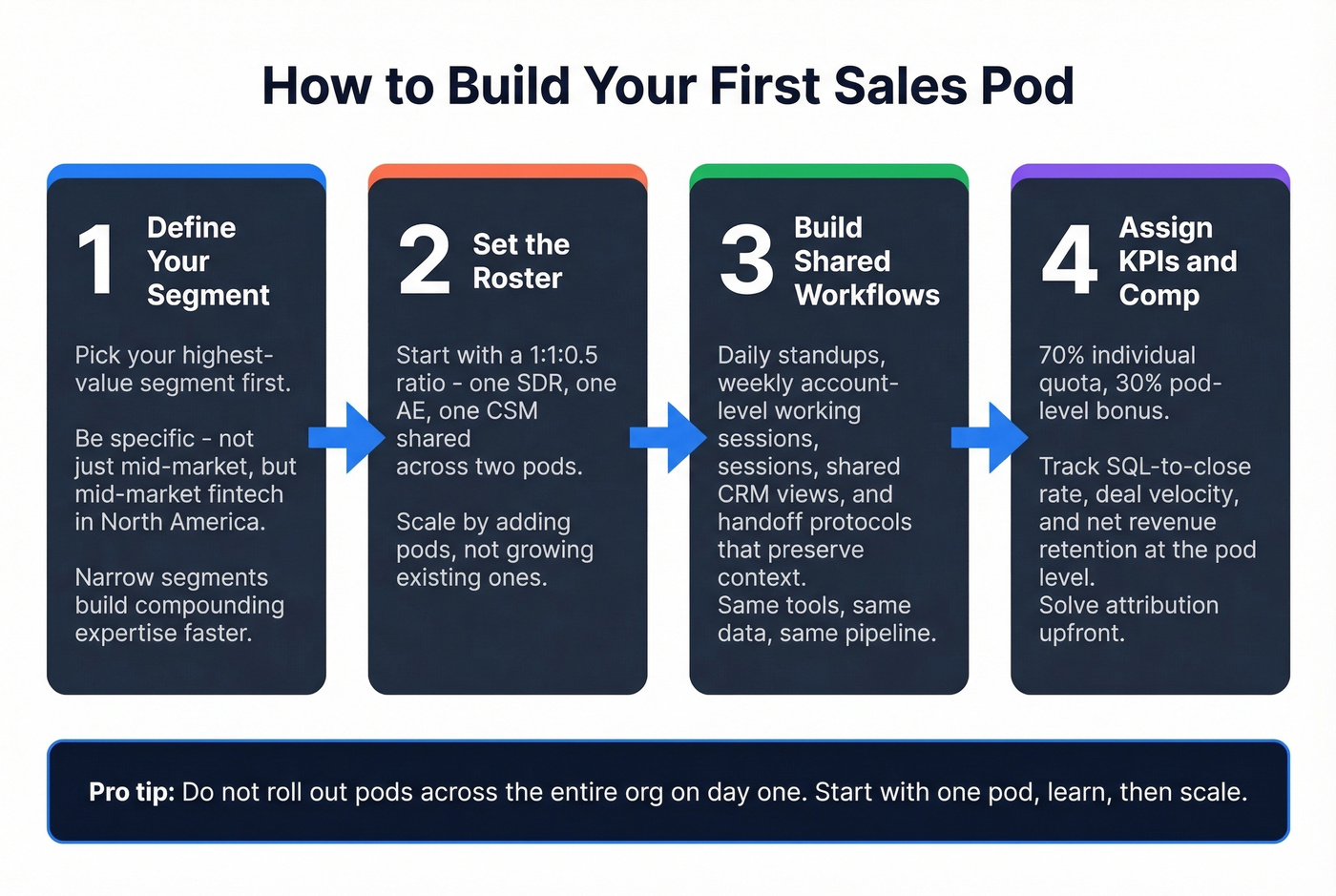
Segment assignment matters more than most teams realize. A pod aligned to "mid-market fintech in North America" will develop sharper messaging and tighter playbooks than one assigned to "all accounts $50K-$200K." The more specific the segment, the faster the pod builds compounding expertise. We've seen teams cut ramp time nearly in half just by narrowing the segment definition.
Set the Roster
Start with a 1:1:0.5 ratio - one SDR, one AE, and a CSM shared across two pods. For high-volume segments, scale to 2:2:1. Resist the urge to build five-person pods. Scale by adding pods, not growing existing ones.
The AE owns the revenue number. The SDR owns the pipeline number. The CSM owns retention and expansion. But the pod shares a collective target - more on that in the comp section below. Getting the structure right from the start prevents the role confusion that derails most early implementations, and it's much harder to fix once habits have calcified.
Build Shared Workflows
This is where most implementations quietly fail.
You can't just redraw the org chart and call it a pod. The team needs shared pipeline visibility, a joint account planning cadence, and handoff protocols that actually preserve context. Run daily standups and a weekly pod meeting - not a forecast call, but an account-level working session. Which deals are moving? What did the SDR learn in discovery that the AE needs before the demo? Where's the CSM seeing early churn signals?
If your SDR lives in one tool and your AE lives in another, you don't have a pod. You have two people sitting near each other. Shared workflows require shared systems: same CRM views, same pipeline stages, same data.
Assign KPIs and Comp
The thing that kills pod momentum fastest is leaving the old comp plan in place. We've watched it happen multiple times - leadership announces the pod structure, everyone's excited for a week, and then the SDR realizes they're still comped purely on meetings booked regardless of quality, so nothing actually changes.
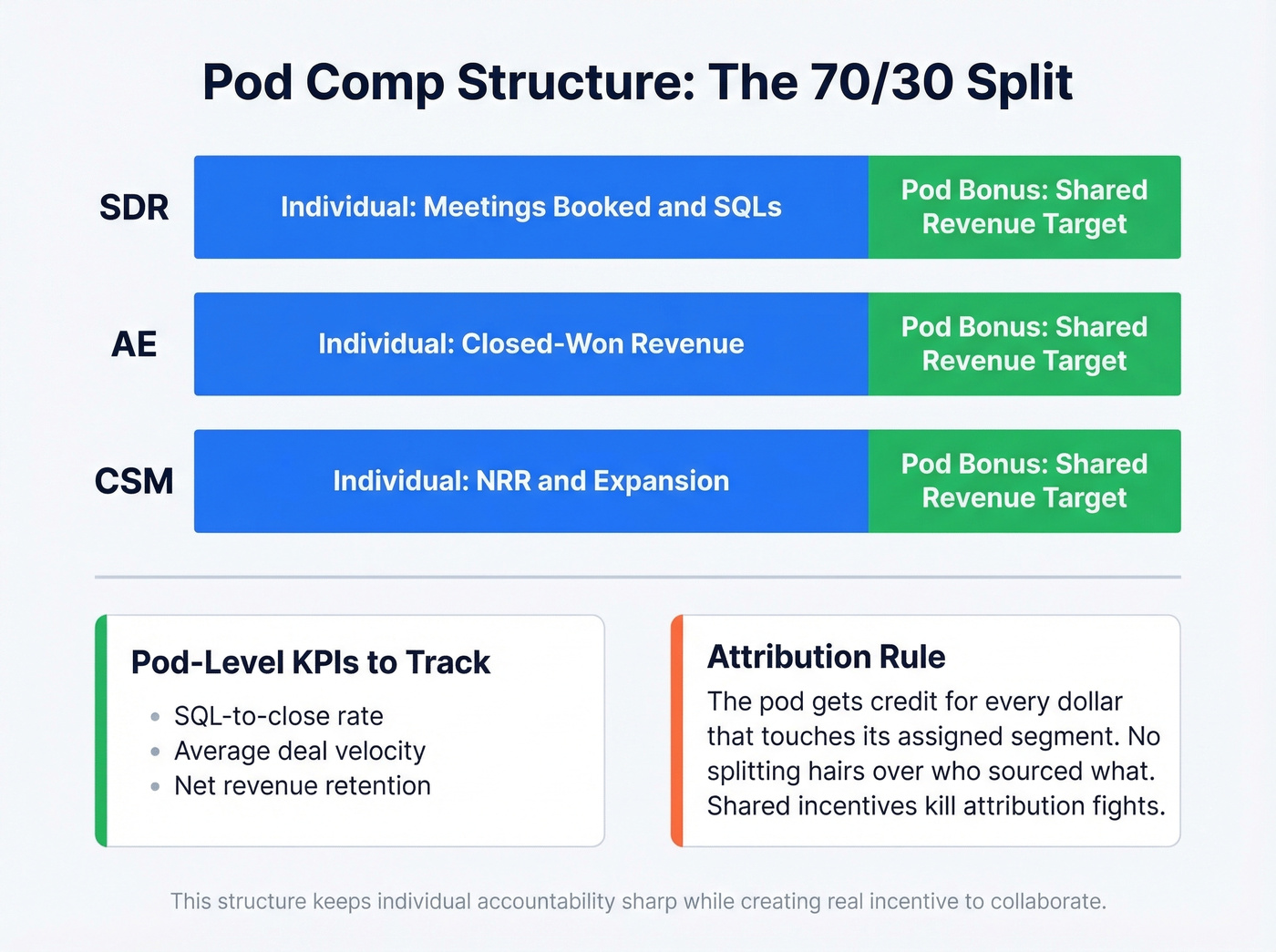
Pod-level KPIs should sit alongside individual metrics, not replace them. Track SQL-to-close rate, average deal velocity, and net revenue retention at the pod level. For comp, a 70/30 split works well: 70% tied to individual quota, 30% tied to a pod-level bonus. This keeps individual accountability sharp while creating real incentive to collaborate.
Attribution fights will destroy a pod. Solve this upfront with a simple rule: the pod gets credit for every dollar that touches its assigned segment. No splitting hairs over who sourced what.
The Tech Stack for Pods
Most pod failures trace back to fragmented tools, not bad people. When three roles share a pipeline, every tool gap gets amplified.
CRM: Salesforce or HubSpot - pick whichever your team already uses. The key is configuring shared views so every pod member sees the same pipeline, the same account history, and the same activity timeline. Don't overthink this. Just make sure everyone's looking at the same screen. If you need a quick gut-check on what counts as a CRM, see CRM.
Data and enrichment: This is where a pod-based team lives or dies. In a traditional org, stale data hurts one rep. In a pod, it poisons the shared pipeline - the SDR pulls a contact, the AE follows up two days later, and the email bounces. Now you've wasted two people's time instead of one. Prospeo's 7-day data refresh cycle keeps the contacts your SDR pulls on Monday accurate when the AE reaches out Thursday, and the 30+ search filters (buyer intent, technographics, job changes) let each pod build targeted lists for its assigned segment without stepping on another pod's territory. If you're comparing vendors, start with data enrichment.

Conversation intelligence: Gong or a similar tool. Pods need shared call context. When the AE can listen to the SDR's discovery call before the demo, the handoff preserves context instead of resetting trust. For a tighter discovery motion, use a consistent set of discovery questions.
Communication: A dedicated Slack channel per pod. Not optional. This is where the micro-coordination happens - "heads up, the VP at Acme just opened our pricing page" or "the CSM flagged a churn risk, let's multi-thread before renewal." The consensus on r/sales is that pod communication breaks down without a dedicated channel, and our experience backs that up.
You just read that pods need shared systems and shared data. Prospeo's CRM enrichment fills 50+ data points per contact at a 92% match rate - refreshed every 7 days, not 6 weeks. Layer in buyer intent across 15,000 topics so your pod targets accounts that are actually in-market for your segment.
Stop splitting hairs over attribution. Start splitting quota attainment records.
Common Pod Failures and Fixes
Role ambiguity is the most common early failure. Nobody knows who sends the confirmation email after the SDR books a meeting. Nobody knows who introduces the CSM after the AE closes. Write a simple RACI document for every handoff point. It takes an hour and saves months of finger-pointing.
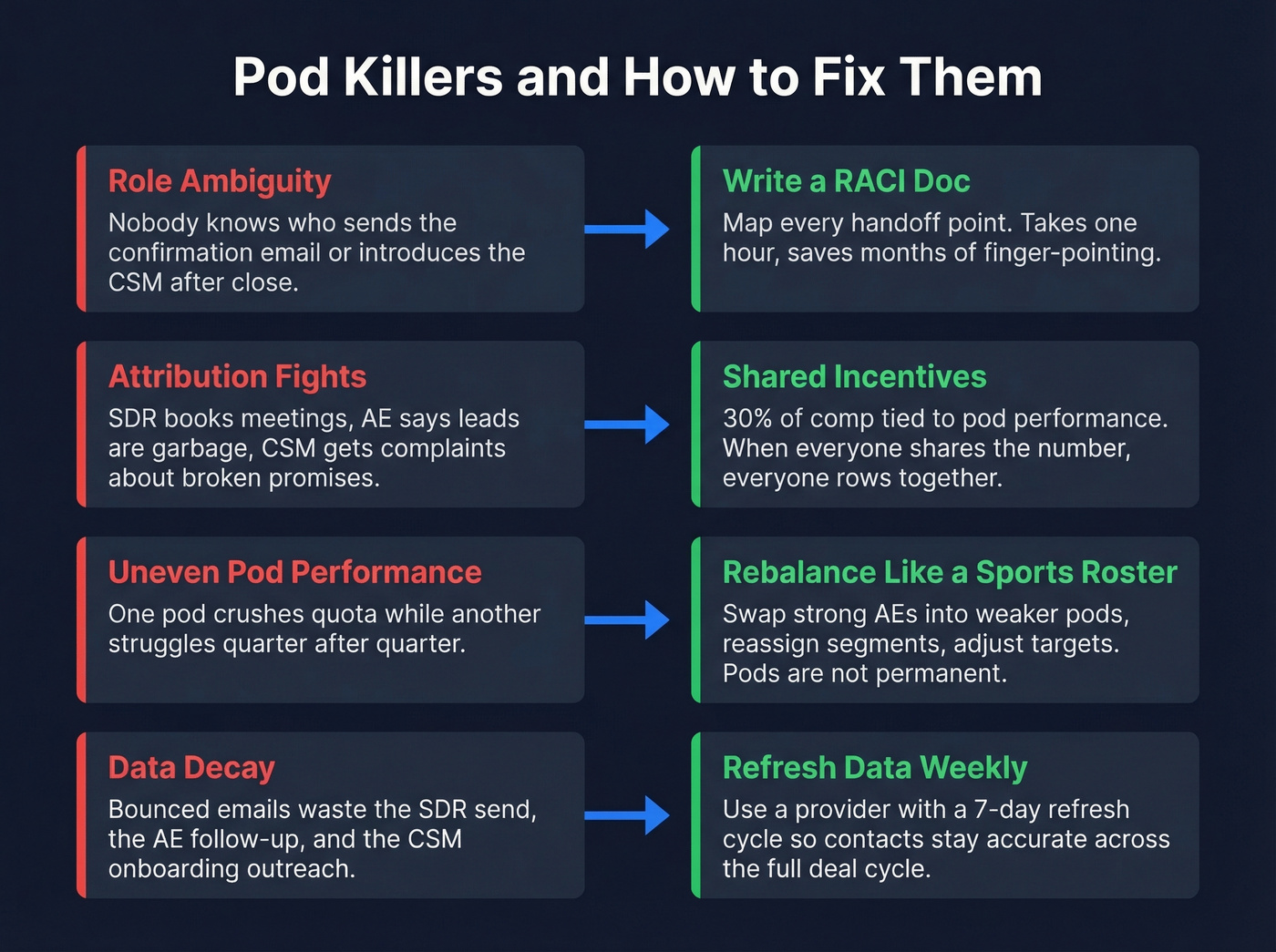
Attribution fights will destroy a pod faster than bad leads. We've watched it play out repeatedly: SDR books meetings, AE says the leads are garbage, CSM gets complaints about promises made during the sales cycle. The fix isn't better tracking - it's shared incentives. When a meaningful chunk of comp ties to pod performance, everyone rows in the same direction.
Uneven pod performance is inevitable. Some pods will outperform others - that's fine in Q1. By Q3, if one pod is crushing quota and another is struggling, rebalance. Swap a strong AE into the weaker pod, reassign segments, or adjust targets. Treat pods like sports rosters, not permanent assignments.
Let's be honest about something: if your average contract value is under $15K and your sales cycle is short, you probably don't need pods at all. Pods are a complex-deal weapon. Using them for transactional sales is like bringing a sniper rifle to a paintball match.
Data decay is the silent pod killer. When three people depend on the same contact records, a bounced email wastes the SDR's send, the AE's follow-up, and the CSM's onboarding outreach. If your data provider refreshes on a 4-6 week cycle, your pod is working with contacts going stale before the first deal closes. If you're trying to diagnose the root cause, start with email bounce rate and then work backward into your list hygiene and enrichment.
FAQ
How many people should be in a sales pod?
Three to four is the sweet spot - one SDR, one to two AEs, and one CSM. When you need more capacity, add a second pod rather than expanding the first one. Five-plus person pods tend to revert to assembly-line dynamics with extra meetings.
Can small teams use the pod model?
Yes, but you need at least six reps to form two pods. One pod isn't a model - it's just a team with a new name. Two pods let you compare performance, iterate on what's working, and avoid survivorship bias in your results.
How long before pods show results?
Expect one to two quarters of adjustment before the numbers improve. Pod velocity typically picks up after the first full sales cycle, when the SDR learns what the AE actually needs and the AE learns what the CSM will inherit. Don't panic if Q1 looks flat.
What's the biggest mistake when switching to pods?
Changing the org chart without changing the comp plan or tech stack. If reps are still comped purely on individual metrics and using disconnected tools, you've just renamed your teams. Cognism documented their own pod experiment and found the same thing - structure without shared incentives is just rebranding.
What data tools work best for pod-based selling?
Look for platforms with frequent data refresh and built-in verification. The key metric to watch is bounce rate: if your pod's shared contact list bounces above 5%, your data layer is the bottleneck, and no amount of org design will fix it.