


Postal Pricing, Reviews, Pros & Cons (2026)
You're trying to figure out what Postal costs, and the pricing page says "Talk to Sales." The G2 pricing page literally reads "pricing information not provided." For a platform in a $312B U.S. corporate gifting market, that's maddening. Here's what companies actually pay, what 407 reviewers think, and whether Postal is worth it for your team.
Postal Pricing Breakdown
Postal has two tiers, but only one shows a price. The Economy plan is free - one user, unlimited U.S. sending, and you only pay for gifts recipients actually accept. Free forever, no time limit, no credit card.
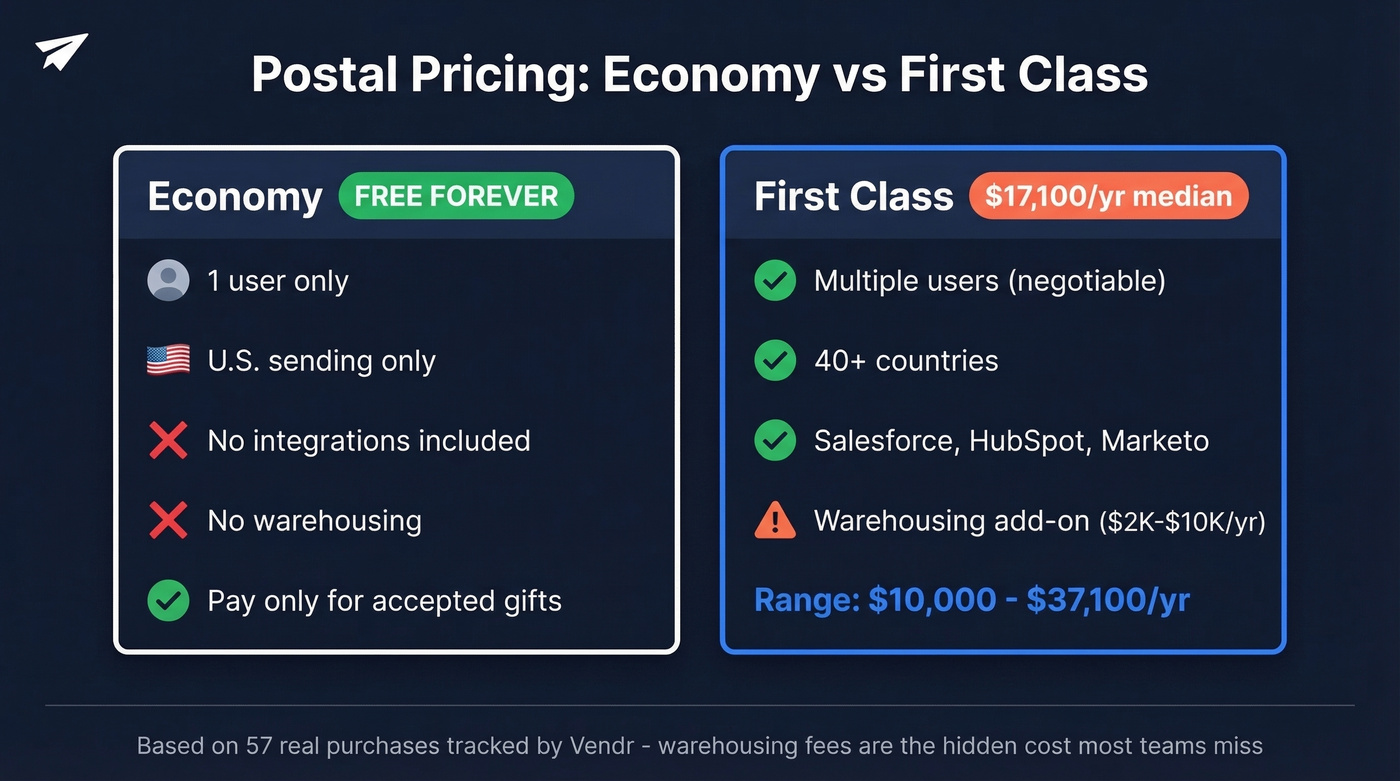
The First Class plan? "Talk to Sales." That's where the real spend lives.
Based on 57 real purchases tracked by Vendr, here's what the two tiers look like side by side:
| Economy | First Class | |
|---|---|---|
| Price | Free | ~$17,100/yr median |
| Range | $0 | $10,000-$37,100/yr |
| Users | 1 | Multiple (negotiable) |
| Integrations | Not included | Salesforce, HubSpot, etc. |
| International | U.S. sending only | 40+ countries |
| Warehousing | No | Add-on (typically ~$2K-$10K/yr) |
That $17,100/year median is your benchmark. Where you land in the $10K-$37K range depends on user count, warehousing needs, and how well you negotiate. A Reddit thread in r/sales calls out that Postal and Sendoso "only have annual plan," which matches how these tools are commonly sold despite G2's "no minimum commitment" language.
Warehousing is the hidden cost that catches teams off guard. Storing branded swag can add $2,000-$10,000/year on top of your platform fee, and most reps don't mention it until you're deep in the sales cycle.
How to Negotiate Your Contract
Postal's sales team has more flexibility than you'd think:
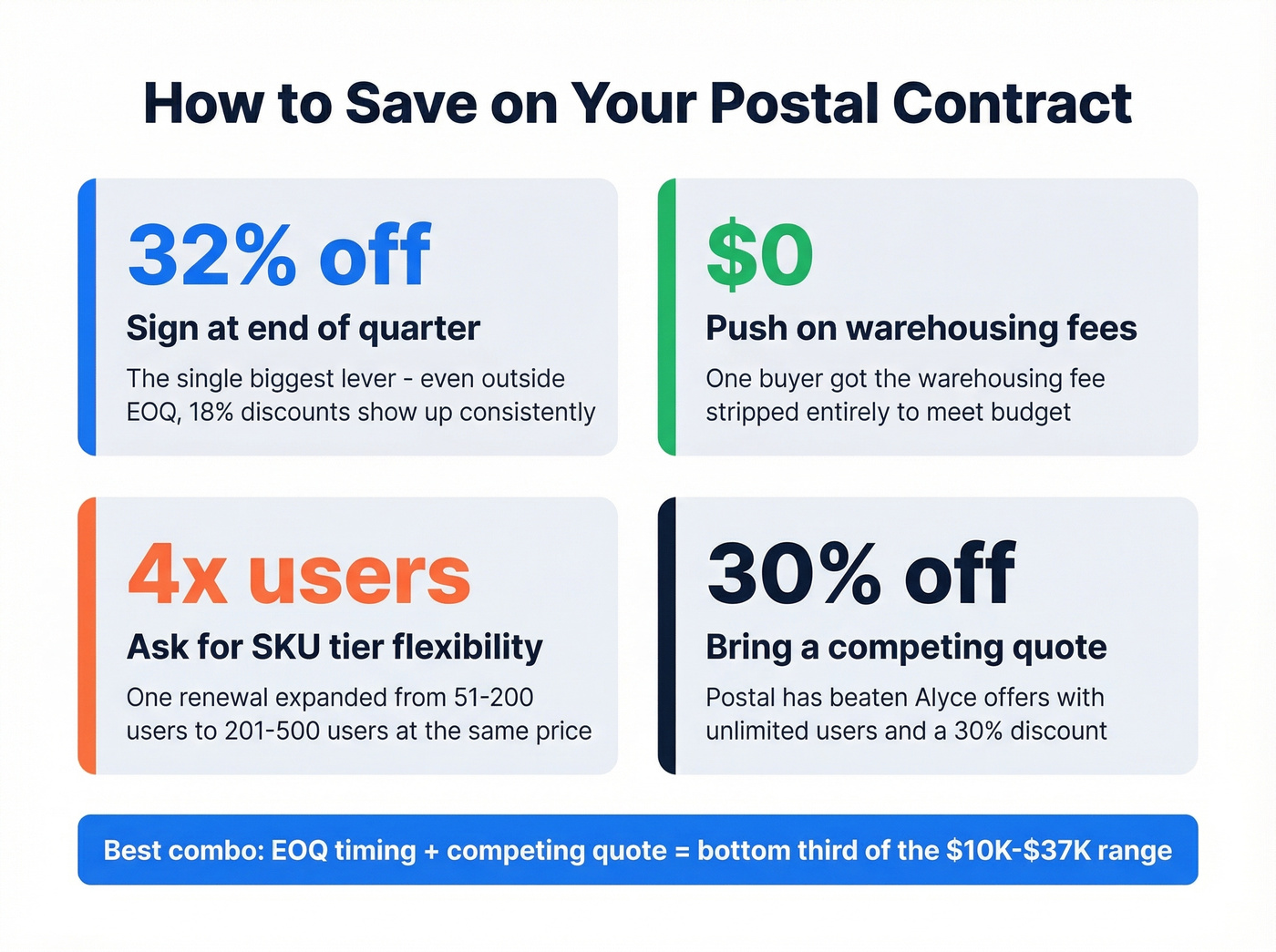
- Sign at end of quarter. Vendr data shows a 32% discount on new 12-month deals closed at EOQ - the single biggest lever. Even outside EOQ, 18% discounts show up consistently.
- Push on warehousing fees. One buyer got the warehousing fee stripped entirely to meet budget.
- Ask for SKU tier flexibility. One renewal got the "medium" tier expanded from 51-200 users to 201-500 users at the same price.
- Bring a competing quote. Postal has beaten Alyce offers with unlimited users and a 30% discount. Competitive pressure works.
The pattern is clear: negotiating at EOQ with a competing quote in hand is how teams consistently land in the bottom third of that $10K-$37K range. We've seen this play out across dozens of SaaS negotiations - timing and leverage matter more than the sticker price. (If you want a framework, start with an anchor and define your walk away point before the call.)
What 407 G2 Reviewers Say
Postal holds a 4.5/5 on G2 from 407 reviews - 77% five-star, 17% four-star. Implementation averages about one month, which is reasonable for this category.
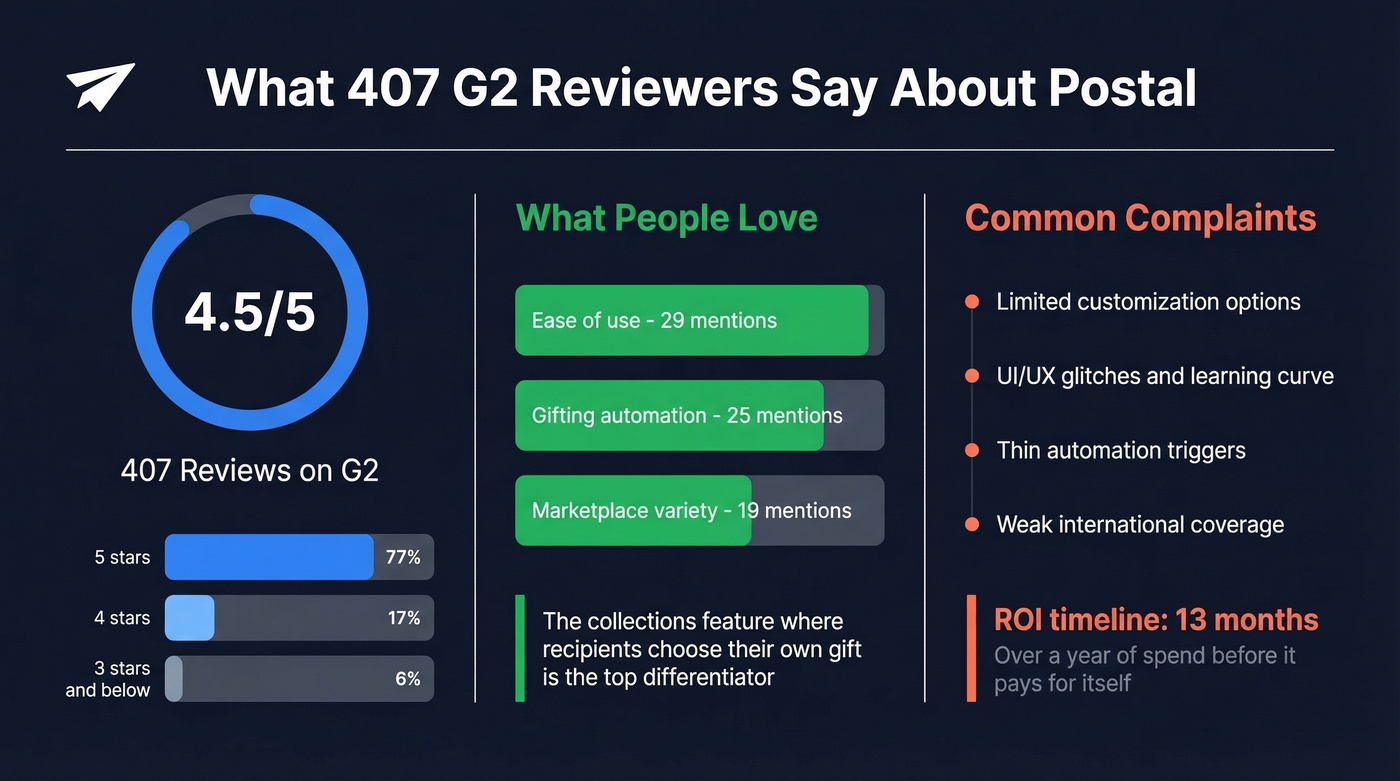
The ROI timeline is the harder pill. 13 months before users report seeing returns. That's over a year of spend before the platform pays for itself, and for budget-conscious teams running quarterly reviews, that's a tough sell internally.
Top praise centers on ease of use (29 mentions), gifting automation (25 mentions), and marketplace variety (19 mentions). The "collections" feature - where recipients choose their own gift - gets called out repeatedly as a genuine differentiator that recipients actually enjoy. On the complaint side, users flag limited customization options, UI/UX glitches, thin automation triggers, and weak international coverage. One reviewer put it bluntly: "Many items are costly, and the pricing structure is confusing."

Postal's 13-month ROI timeline gets worse when gifts land at outdated addresses. Prospeo's 7-day data refresh and 98% email accuracy ensure every contact in your gifting platform is current - so your $17K/year actually reaches real buyers.
Stop wasting gifting budget on contacts who changed jobs six months ago.
Pros and Cons at a Glance
Pros:
- Genuine free tier with no time limit
- Pay-as-you-go - you're only charged for accepted gifts
- 12 integrations including Salesforce, HubSpot, Marketo, and Salesloft
- Broad marketplace with diverse, small-business vendors
- Collections feature that recipients genuinely like
Cons:
- No published pricing - you're negotiating blind without benchmarks
- Annual contracts are standard despite "no minimum commitment" messaging
- 13-month average ROI ramp is slow
- UI/UX has a learning curve and occasional glitches
- International coverage is a recurring complaint
Postal vs Competitors
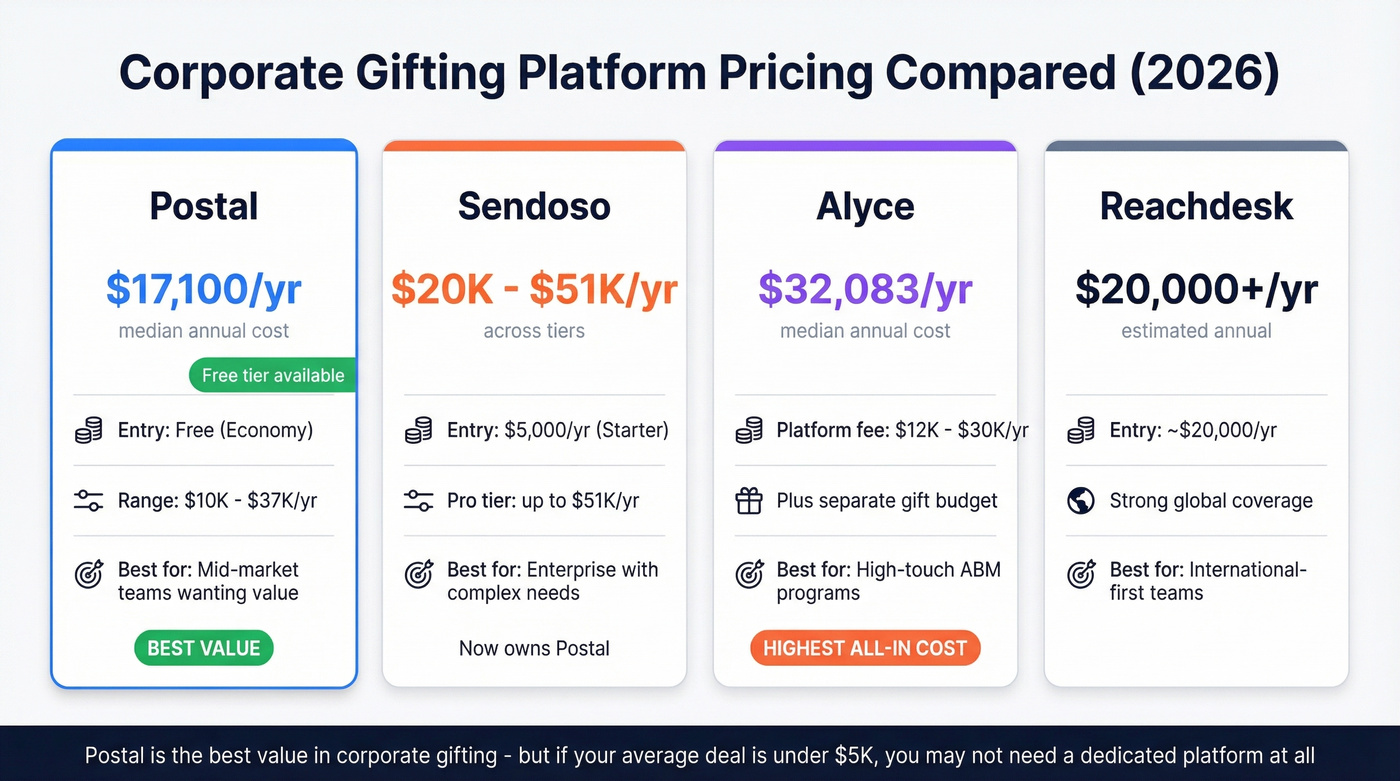
Sendoso now owns Postal, which complicates the comparison. Here's how pricing stacks up across the category:
| Platform | Entry Price | Typical Annual | Best For |
|---|---|---|---|
| Postal | Free (Economy) | $17,100/yr median | Mid-market teams wanting value |
| Sendoso | $5,000/yr (Starter) | $20K-$51K | Enterprise with complex needs |
| Alyce | ~$22,500/yr | $32,083/yr median | High-touch ABM programs |
| Reachdesk | ~$20,000/yr | $20K+ | International-first teams |
Sendoso's tiers break down further: Essential runs ~$19,947 for 8 users, Plus ~$37,880 for 15 users, and Pro ~$50,956 for 10 users. 68% of Pro customers and 45% of Plus customers negotiate sender fees down to zero, so always push on that line item.
Alyce charges a platform fee ($12,000-$30,000/year for small teams of 5-15 senders) plus a separate gift budget, making the all-in cost significantly higher than Postal for comparable usage.
Here's the thing: Postal is the best value in corporate gifting right now. But if your average deal size is under $5K, you probably don't need a dedicated gifting platform at all. A handwritten note and a $25 gift card sent manually will outperform an automated campaign every time. (If you're building a broader outbound motion, pair gifting with sales prospecting techniques and tighter sales activities.)
Who Should Use Postal (and Who Shouldn't)
Use Postal if you're a mid-market team running gifting as part of your sales or CS motion and want the best value-to-feature ratio. Start with the free Economy plan to test the channel before committing budget.
Skip Postal if you need deep international coverage or a heavy enterprise rollout with complex approval workflows. In that case, look at Alyce or Sendoso's higher tiers and expect to pay more.
One thing we've learned from watching teams run gifting campaigns: they only work when gifts reach the right people at the right address. Before loading contacts into any gifting platform, verify your list first. We've seen teams waste thousands in gifting budget on contacts who'd already changed roles - bad data turns a $50 gift into a $50 loss. Running your list through Prospeo's email verification (98% accuracy, 7-day data refresh cycle, free tier with no contracts) can shorten that painful 13-month ROI timeline considerably by eliminating waste from day one. (If you need more than verification, look at data enrichment services and lead enrichment to keep records current.)

Teams waste thousands loading unverified contacts into Postal and Sendoso. Prospeo verifies emails at $0.01 each with 98% accuracy - no annual contracts, no sales calls. One clean list can cut your gifting waste to near zero from day one.
Verify your entire gifting list before you spend another dollar on swag.
FAQ
Does Postal have a free plan?
Yes. The Economy plan is free forever for one user with unlimited U.S. sending. You only pay per accepted gift - no credit card required upfront. It's a genuine free tier, not a time-limited trial.
How long does Postal take to set up?
Implementation averages about one month based on G2 reviewer data. ROI typically follows at around 13 months, so budget for a full year of spend before the platform pays for itself.
Is Postal cheaper than Sendoso?
Generally, yes. Postal's median cost runs $17,100/year versus Sendoso's mid-tier plans at $20K-$51K. Sendoso acquired Postal, so pricing dynamics between the two can shift - ask your rep about bundling options.
How can I make sure gifting contacts are accurate?
Verify your contact list before uploading it to any gifting platform. Stale data means wasted gifts. Tools with high verification accuracy and frequent data refresh cycles help you avoid sending expensive packages to people who left the company six months ago.