


Postmastery Pricing, Reviews, Pros and Cons (2026)
One in six emails never reaches the inbox - global inbox placement sits around 84%. But that average hides brutal gaps: Gmail inboxes 87.2% of email while Microsoft only manages 75.6%. If you're researching Postmastery before committing to a sales call, you've probably already hit the wall. No pricing page. No ballpark. Just "contact us."
We dug into real estimates, actual review data, and an honest look at whether it's worth the conversation.
What Postmastery Costs in 2026
Postmastery doesn't publish pricing. Every tier - Small, Medium, Large, Enterprise - requires a custom quote. That's frustrating for anyone trying to build a business case before getting on a call, and it's a pattern we see too often with enterprise deliverability tools.
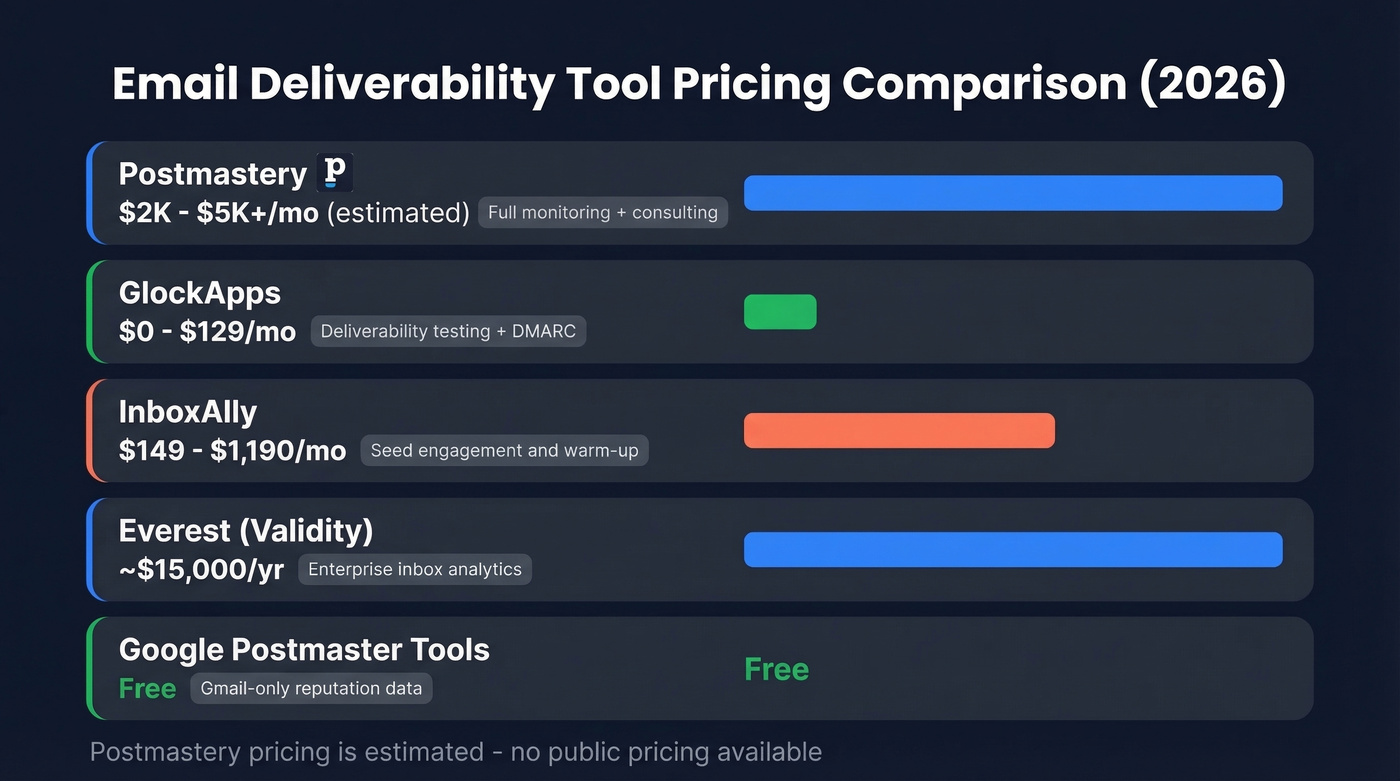
We estimate $2,000-$5,000/month for a mid-market ESP deployment, based on Postmastery's enterprise positioning, its consulting-heavy delivery model, and comparable tools in the space. Larger senders with managed consulting relationships will push into five figures monthly. There's a 14-day free trial for Delivery Analytics, which at least lets you evaluate the Console before committing.
Here's how Postmastery stacks up against alternatives on price:
| Tool | Price Range | What You Get |
|---|---|---|
| Postmastery | ~$2K-$5K+/mo (est.) | Full monitoring + consulting |
| GlockApps | $0-$129/mo | Deliverability testing + DMARC |
| InboxAlly | $149-$1,190/mo | Seed engagement / warm-up |
| Everest (Validity) | ~$15,000/yr | Enterprise inbox analytics |
| Google Postmaster Tools | Free | Gmail-only reputation data |
Here's the thing: many deliverability problems trace back to bad data - bounces, spam traps, stale addresses. Monitoring tools catch the symptoms, but if your list quality is the root cause, you need to fix that upstream with email verification before monitoring even enters the picture. (If you want the full framework, start with our email deliverability guide.)
What Postmastery Does
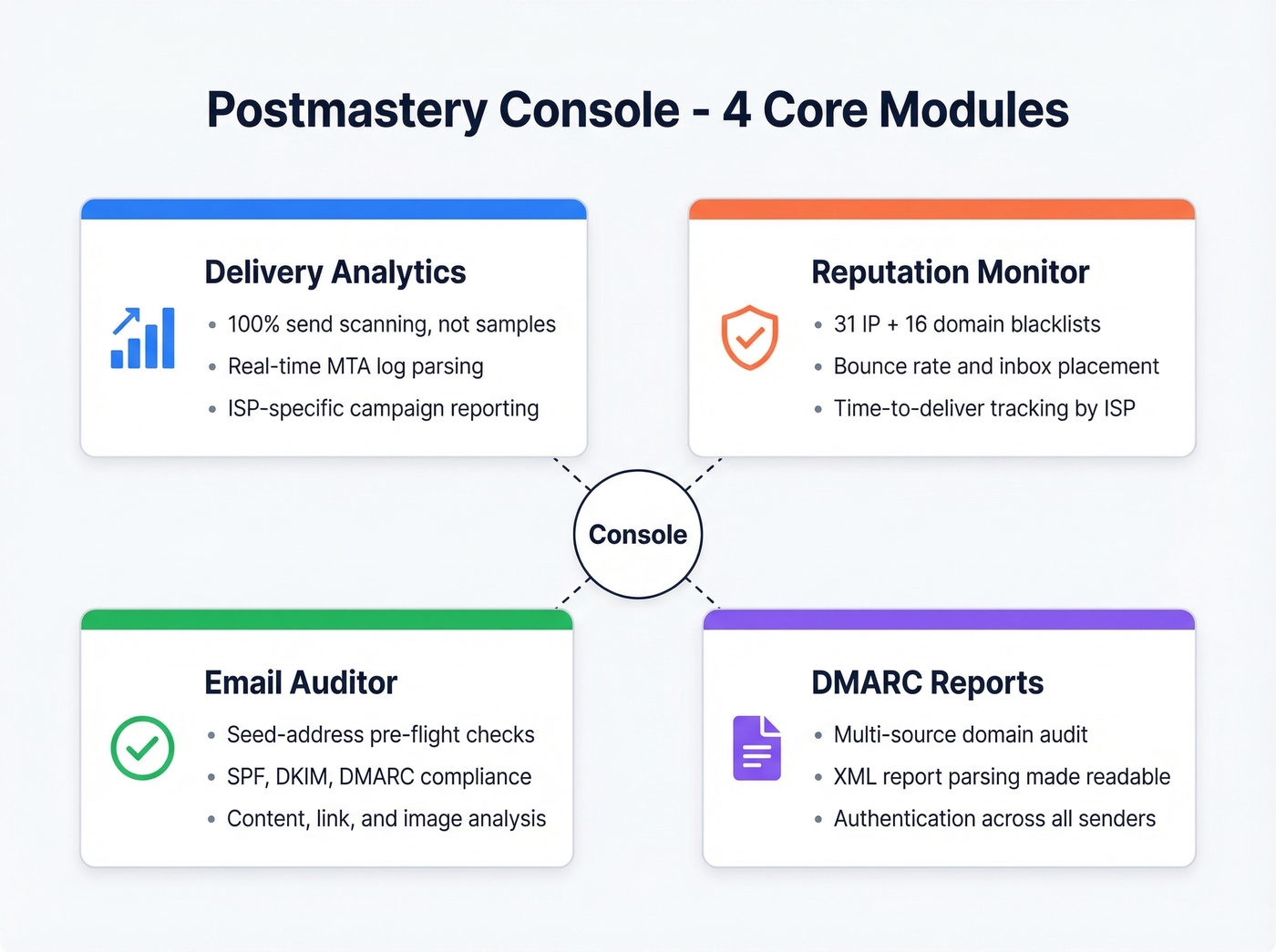
Postmastery's core product is the Console - an all-in-one monitoring dashboard built for senders who need SMTP-level visibility. It breaks into four modules.
Delivery Analytics
This is the flagship. It scans 100% of sends, parsing real-time MTA logs and ESP event data rather than relying on statistical samples. You can filter by campaign, IP, domain, or ISP with critical event alerts for anomalies. Feedback loop integration handles spam complaint monitoring and content scoring. ISP-specific reporting is where it gets genuinely useful - Moosend uses it to separate Outlook from Office 365 addresses and catch errors like Gmail's "421 4.7.30 DKIM authentication didn't pass" before they snowball into reputation damage. (If you're troubleshooting bounces, our email bounce rate guide breaks down codes and fixes.)
Reputation Monitor
Checks 31 IP blacklists and 16 domain blacklists multiple times daily. Tracks bounce rates, inbox placement, and time-to-deliver across providers. Given that Microsoft inboxes only 75.6% of email vs. Gmail's 87.2%, ISP-level granularity isn't a nice-to-have - it's essential. (For a broader view of tooling, see our roundup of email reputation tools.)
Email Auditor
Seed-address-based pre-flight checks. Add a seed address and get a full report covering SPF/DKIM/DMARC compliance, content analysis, link health, and image issues. Think of it as a pre-send sanity check. (If you need a deeper DMARC concept refresher, read our DMARC alignment explainer.)
DMARC Reports
Identifies every source sending on behalf of your domain and parses raw XML DMARC reports into readable output. If you've got multiple sending systems and need to audit authentication across all of them, this saves hours of manual XML parsing. (Related: how to verify DKIM is working.)

What Users Say in Reviews
The public review corpus is thin. Under 20 public reviews show up across major platforms. Trustpilot shows 4.3/5 from 9 reviews. Sprout24 gives it an 8.1/10, with 4 customer reviews and a #5 ranking in the SMTP & Email Deliverability category. We searched Reddit and deliverability forums - virtually no discussion, which tells you how niche this market really is.
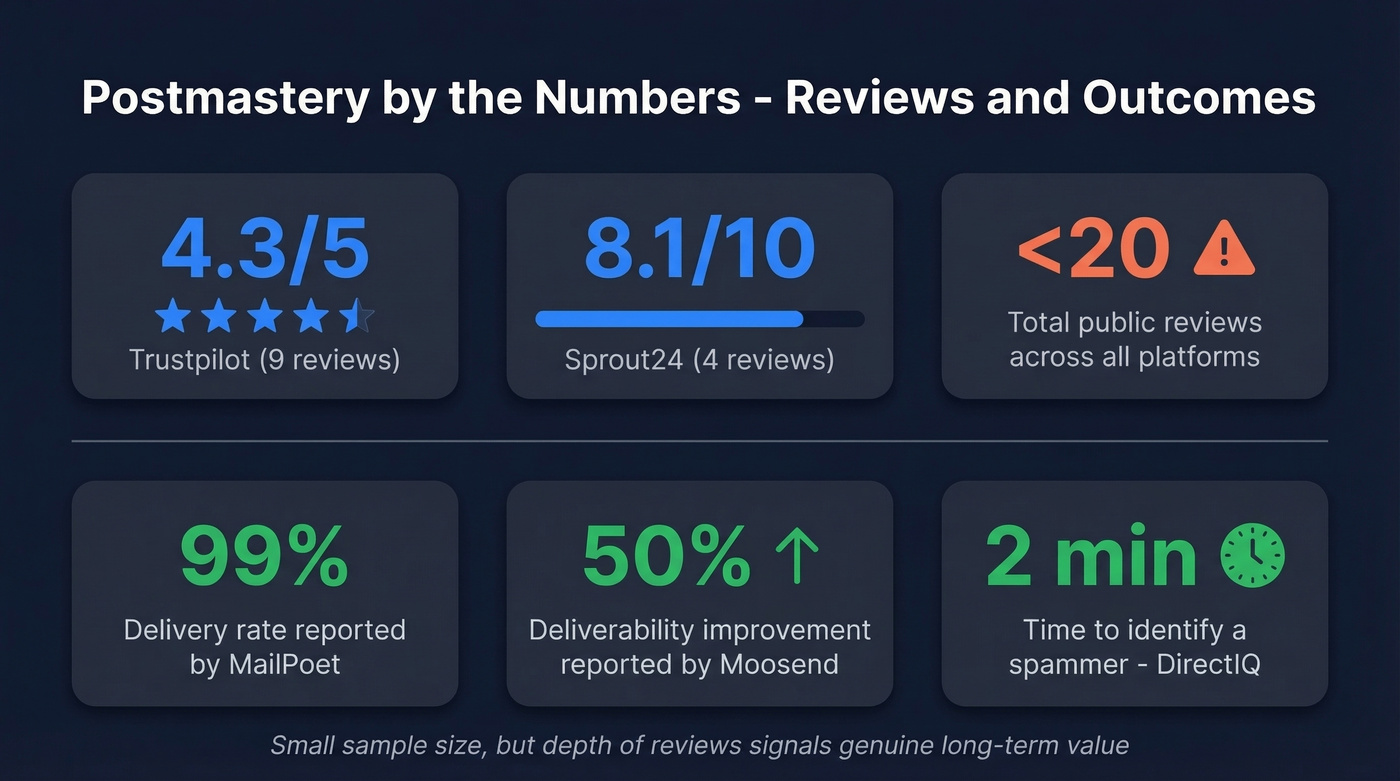
What stands out isn't the scores. It's the consistency. Reviewers repeatedly name specific team members - Yves-Marie, Willem, Olivier - and describe multi-year relationships stretching 7+ years. That kind of loyalty is rare for any SaaS vendor.
The outcome data backs it up. MailPoet credits Postmastery with a 99% delivery rate, well above the 85-95% industry benchmark. Moosend reports a 50% improvement in deliverability. DirectIQ says they identified a spammer in two minutes using Delivery Analytics. You're working with a small sample, but the depth of those reviews signals genuine value rather than surface-level satisfaction.
Pros and Cons Breakdown
| Pros | Cons |
|---|---|
| Deep SMTP-level visibility - goes beyond open/click metrics to MTA log data | No public pricing - must contact sales for every tier |
| Scans 100% of sends, not statistical samples | Steep learning curve without deliverability expertise |
| Expert consulting team praised by name across multi-year reviews | Consulting dependency adds cost on top of the software license |
| Real-time alerting catches reputation damage before it escalates | Limited self-serve options - no sign-up-and-go workflow |
| Multi-year customer retention signals genuine, sustained value | Thin public review corpus makes independent evaluation harder |

Most deliverability problems start with bad data - bounces, spam traps, and stale addresses that tank your sender reputation before any monitoring tool can help. Prospeo's 5-step email verification with spam-trap removal and catch-all handling delivers 98% accuracy at $0.01/email. Fix the root cause instead of paying $2K-$5K/month to watch the symptoms.
Stop monitoring bad data. Start sending to verified contacts.
Who Should (and Shouldn't) Use It
Use Postmastery if you're:
- An ESP or high-volume sender pushing 1M+ emails/month
- A team with dedicated deliverability staff who'll actually use the Console daily
- Looking for a managed consulting relationship, not just software
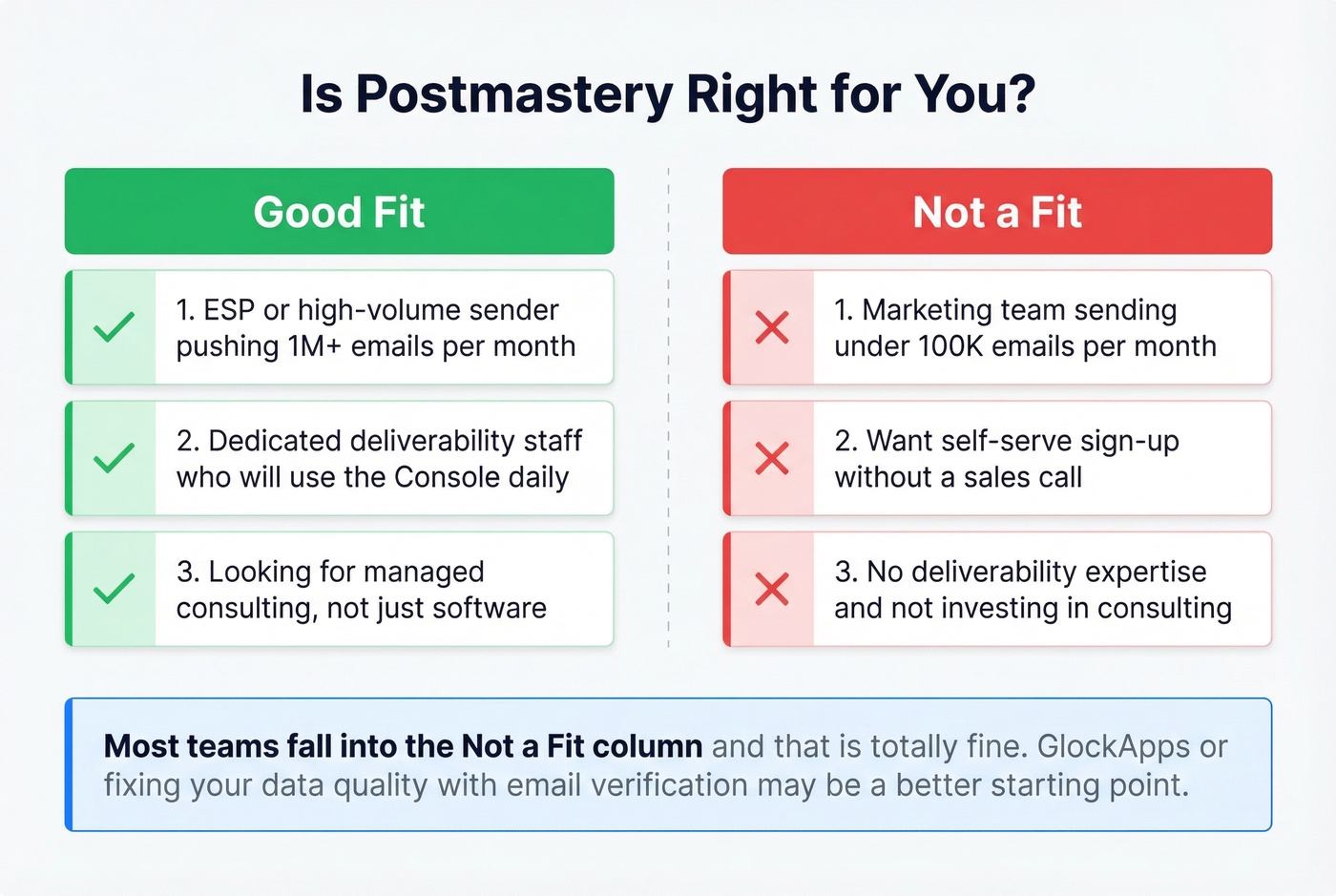
Skip Postmastery if you're:
- A marketing team sending under 100K/month - it's overkill in both cost and complexity
- Someone who wants self-serve sign-up-and-go without a sales call
- A team without deliverability expertise that won't invest in consulting
Let's be honest: most teams fall into the second group. And that's fine - there are better-fit options below.
Alternatives Worth Considering
GlockApps is the obvious pick for mid-market senders who need monitoring without enterprise overhead. At $59-$129/month with a free tier for basic testing, you get inbox placement tests, DMARC analytics, and blacklist monitoring. It won't give you the SMTP-level log analysis that Postmastery's Console provides, but you'll be operational in 10 minutes with no sales call. We've seen teams get 80% of the monitoring value at roughly 5% of the cost.
Google Postmaster Tools is free, essential, and blind to everything outside Gmail. Microsoft, Yahoo, Apple Mail - all invisible. Every sender should use it as a baseline, but it's a supplement, not a solution.
Everest by Validity offers enterprise inbox placement analytics starting at ~$15,000/year. Its main advantage over Postmastery: published pricing. Its main disadvantage: it's still expensive.
On data quality specifically: in our experience, most deliverability problems aren't infrastructure problems - they're data problems. If your bounce rate is climbing because you're hitting spam traps and dead addresses, no amount of monitoring will save you. Prospeo's email verification runs a 5-step verification process at 98% accuracy, with spam-trap removal and honeypot filtering included. A 7-day data refresh cycle means your lists don't go stale between campaigns. Free tier starts at 75 emails/month, or scale at roughly $0.01/email. Fix the data before you monitor the symptoms. (If spam traps are part of the issue, use our spam trap removal playbook.)

If you're spending $2,000-$5,000/month on Postmastery to fix deliverability, ask what's causing the damage. Prospeo refreshes 300M+ profiles every 7 days - not every 6 weeks - so your lists never go stale. Teams using Prospeo see bounce rates under 4% without a consulting retainer.
Clean data costs $0.01/email. Deliverability consulting costs thousands.
Verdict
If you're an enterprise ESP pushing millions of emails monthly, Postmastery is worth the conversation. The Console's depth and the consulting team's expertise are genuinely hard to replicate - those multi-year client relationships exist for a reason.
For mid-market senders who want monitoring without the enterprise commitment, GlockApps gets you most of the way at a fraction of the cost. And if your root problem is data quality - bounces, spam traps, dead addresses tanking your sender reputation - fix that upstream before monitoring even enters the picture. (If you're trying to improve reputation specifically, see how to improve sender reputation.)
Postmastery FAQ
Does Postmastery offer a free trial?
Yes. Postmastery offers a 14-day free trial for Delivery Analytics. You get access to the Console's core monitoring features - enough to evaluate reporting depth and ISP-level granularity before committing to a custom quote.
How many public reviews does Postmastery have?
Under 20 across major platforms in 2026. Trustpilot shows 9 reviews at 4.3/5; Sprout24 shows 4 reviews with an 8.1/10 score. Reddit and deliverability forums have virtually no discussion threads. That's typical for niche B2B tools, but it means you're evaluating on a small independent sample.