

Pre-Call Research: The Practitioner's Playbook for 2026
96% of prospects have already researched you before the call. So when a rep opens with "So, tell me about your business," the prospect mentally checks out. We've heard it on recorded calls dozens of times - the energy drops, answers get shorter, and the meeting ends five minutes early. Pre-call research is what closes that gap.
Why Preparation Matters More Than Ever
Preparation doesn't just improve outcomes - it kills the anxiety that makes reps sound scripted. New reps are often shocked by how much context experienced sellers gather before a single dial: old blog posts, podcast appearances, Crunchbase funding history, career moves. That depth is what separates a forgettable call from one that earns a second meeting.
The goal isn't exhaustive knowledge. It's preparation specific enough to signal homework, without burning an hour per call. In B2B sales, buyers expect you to arrive with a point of view - not a list of generic discovery questions pulled from a template.
What to Actually Research
The old 3x3 framework - three facts in three minutes - gets spotted as shallow personalization instantly. Here's the thing: five pillars actually move calls forward.
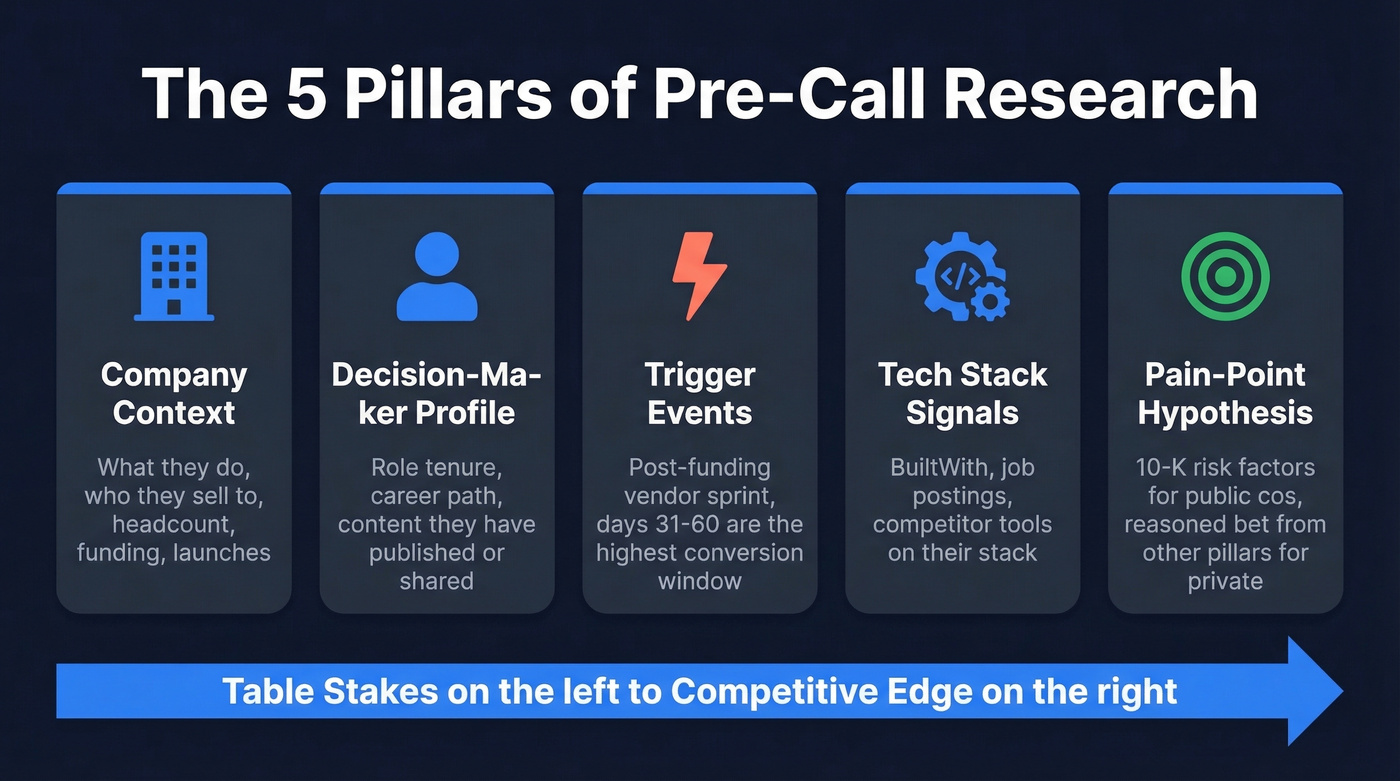
Company context. What they do, who they sell to, headcount trajectory, recent funding or launches. This is table stakes.
Decision-maker profile. Role tenure, career path, content they've published. Referencing something specific a prospect posted is the single biggest unlock for first-to-second-call conversion, according to the consensus on r/sales.
Trigger events. Post-funding companies enter a 90-120 day vendor sprint to evaluate vendors and deploy capital. Days 31-60 are the highest-conversion window, and most reps miss it entirely because they're reacting to the press release instead of tracking the timeline.
Tech stack signals. BuiltWith, job postings, and enrichment data reveal what tools they run. A competitor's logo on their stack is your wedge into the conversation.
Pain-point hypothesis. For public companies, mine 10-K Risk Factors for stated challenges. For private ones, build a reasoned bet from the four items above.
How Long to Spend on Sales Call Research
Not every call deserves the same prep. Match depth to deal size.
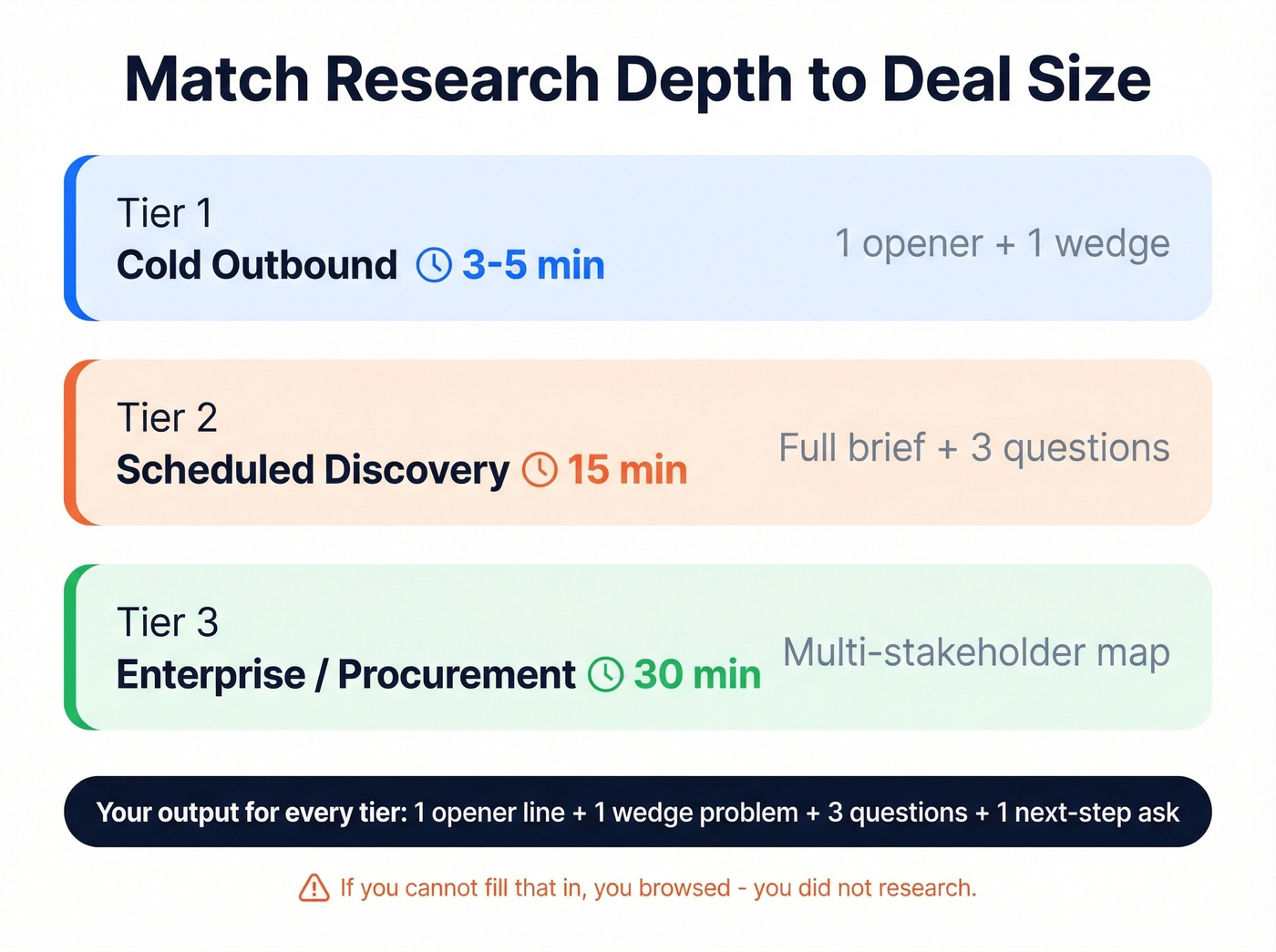
| Call Type | Time Budget | What You're Building |
|---|---|---|
| Cold outbound | 3-5 min | 1 opener + 1 wedge |
| Scheduled discovery | 15 min | Full brief + 3 questions |
| Enterprise / procurement | 30 min | Multi-stakeholder map |
Your output for any tier: 1 opener line + 1 wedge problem + 3 questions + 1 next-step ask. If you can't fill that in, you browsed - you didn't research.
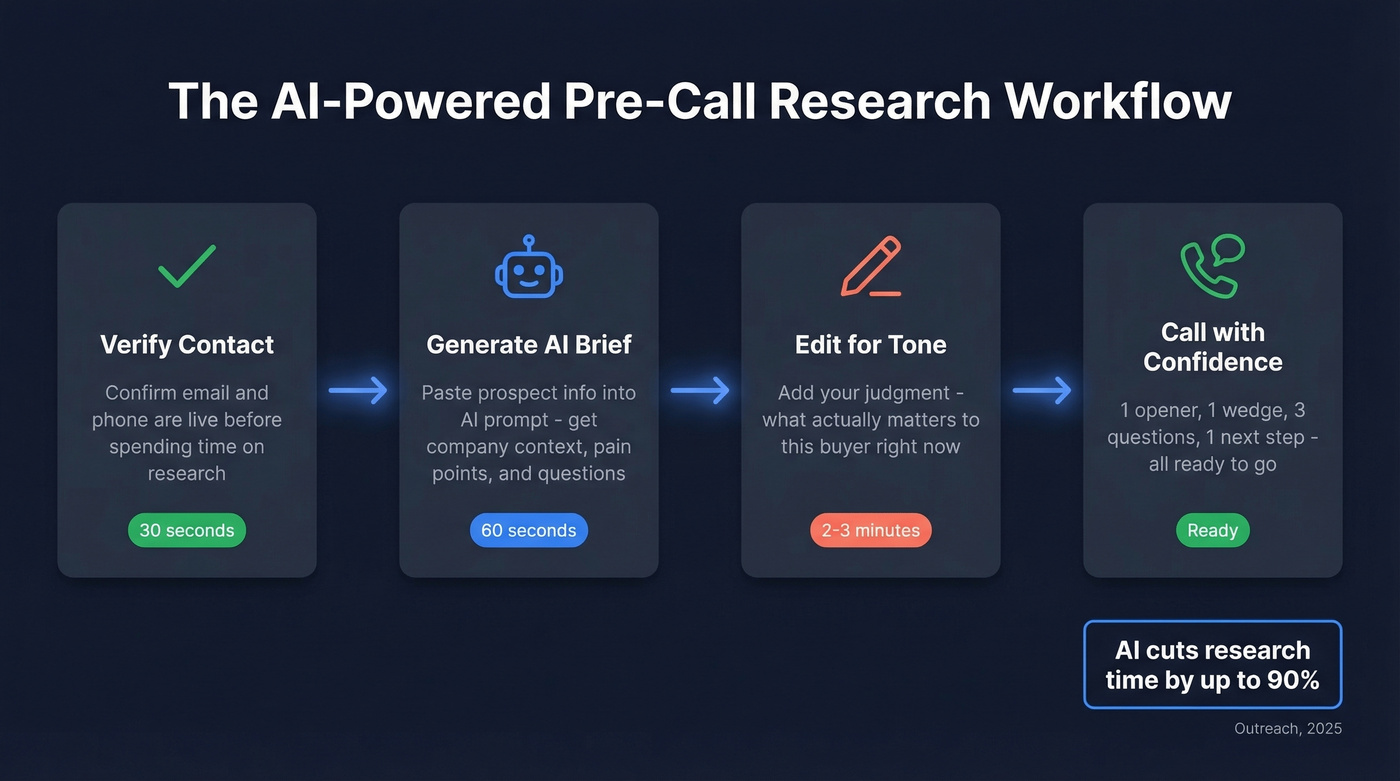
Before building the brief, confirm you can actually reach the person. Prospeo checks emails and phone numbers in real time with 98% email accuracy on a 7-day refresh cycle, so your 15 minutes of prep doesn't end at a disconnected number.


Pre-call research only pays off when you actually reach the prospect. Prospeo verifies emails and direct dials on a 7-day refresh cycle - so your 15-minute brief doesn't end at a bounced inbox or dead number.
Stop prepping calls you'll never connect. Verify first.
AI Prompts You Can Copy Right Now
Outreach reports sellers using AI tools cut research time by up to 90%. Here are three prompts that build a usable brief in under 60 seconds. Quick tip: Claude tends to produce better strategic questions, while ChatGPT pulls more current company news.
Prompt 1 - Pre-call brief:
I'm calling [Name] who is [Title] at [Company] in [Industry].

Summarize: (1) company background and recent news,
(2) likely challenges for someone in their role,
(3) strategic questions I should ask on a discovery call.
Prompt 2 - Pain-point discovery:
Based on this prospect info [paste CRM notes, profile, or company page],
what pain points might they have that [your product/solution] addresses?
What questions will uncover if these are real priorities?
Prompt 3 - Competitive prep:
Prospect is currently using [competitor product].
What are the most common reasons companies switch from [competitor]?
What questions would surface dissatisfaction without sounding aggressive?
Reps with 5-6 meetings daily are building automated workflows that pull meeting participants and generate these briefs overnight. Paste the output into your call notes, edit for tone, and move on. That's where research workflows become scalable instead of manual - and it's the single biggest time-saver we've seen teams adopt this year.
Pre-Call Research Tools That Speed This Up
You don't need ten tools. You need five, used in order.
Start with your CRM - check past conversations, deal history, and marketing touches in Salesforce or HubSpot. Half the time, the intel you need is already sitting there, untouched. I've watched reps spend 20 minutes building a brief from scratch when the SDR who booked the meeting had already logged the prospect's biggest pain point.
For contact verification, Prospeo covers 143M+ verified emails and 125M+ verified mobiles with a free tier of 75 emails/month. Verify before you research, not after. If you're at an enterprise org already paying for ZoomInfo, use what you have - but most teams under $15K average deal size are overpaying for data they don't touch.
Let's be honest: a six-figure data contract is usually overkill for mid-market teams. A $20/month AI tool plus accurate contact data will outperform a bloated platform your reps barely log into.
Run tech stack lookups through BuiltWith (free for basic searches), and set up Google News alerts for trigger events - funding rounds, exec hires, product launches. Apollo paid plans start around ~$49/month per user if you want an all-in-one prospecting platform on a budget. Skip it if you already have solid contact data and just need the research layer.
If you're building a repeatable outbound motion, pair this with sales prospecting techniques and a lightweight lead scoring model so reps know which accounts deserve the 15-minute tier.
Common Mistakes That Waste Your Prep
Over-researching every call equally. A cold outbound dial doesn't need 30 minutes. Use the tiered framework above and move on.
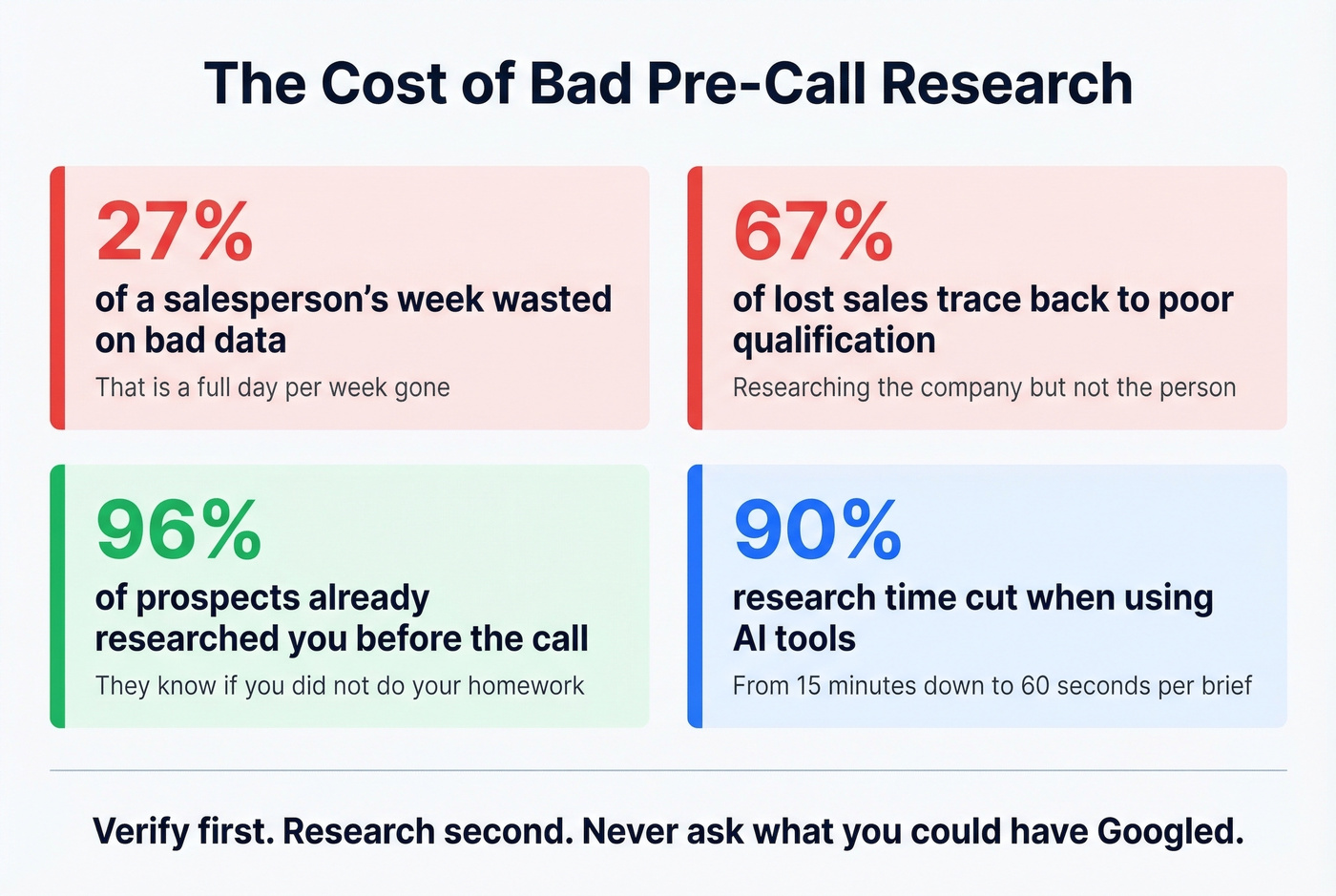
Skipping contact verification. Poor-quality data wastes over 27% of a salesperson's time. That's a full day per week gone - not to research, not to selling, just to chasing bad numbers and bounced emails.
Asking questions you could've Googled. "So what does your company do?" is the fastest way to lose credibility. If the prospect's homepage answers it, you shouldn't be asking it.
Researching the company but not the person. 67% of lost sales trace back to poor qualification. Understanding the individual matters more than memorizing the About page. We've seen reps build a perfect company brief only to discover the contact left that role six months ago.
This is also where a tighter discovery questions framework helps: you stop asking basics and start testing your hypothesis.
FAQ
How long should pre-call research take?
Budget 3-5 minutes for cold outbound, 15 for scheduled discovery, and up to 30 for enterprise meetings. Spending 30 minutes prepping a cold dial to an SDR is a misallocation - match depth to deal value.
Can AI replace manual research?
AI handles 80-90% of the gathering: company news, role challenges, competitive context. You still need to form the hypothesis and craft the questions that drive the conversation. The best workflows combine AI-generated briefs with a rep's judgment on what actually matters to the buyer.
What's the most common pre-call planning mistake?
Researching the company but never verifying the contact data. You can nail your opener and prepare killer questions, then discover the phone number's disconnected. Verify first, research second - it sounds backwards, but it'll save you hours every week.