

CRM Predictive Analytics: What It Costs, What Works, and What Fails
A RevOps lead we know turned on Salesforce Einstein with 18 months of messy pipeline data. The model scored a churned account as their highest-priority lead within the first week. That's the promise and the problem with predictive analytics in CRM - the technology works, but only if the inputs don't lie to it.
Why CRM Predictive Analytics Is Exploding
The CRM analytics market is projected at $12.11B in 2026, on track to reach $20.65B by 2031 at an 11.26% CAGR. The broader predictive analytics market is even more aggressive - $18.89B in 2024, forecast to hit $82.35B by 2030 at a 28.3% CAGR. North America accounts for 36.75% of CRM analytics revenue, and cloud deployment held 63.84% market share as of 2026.
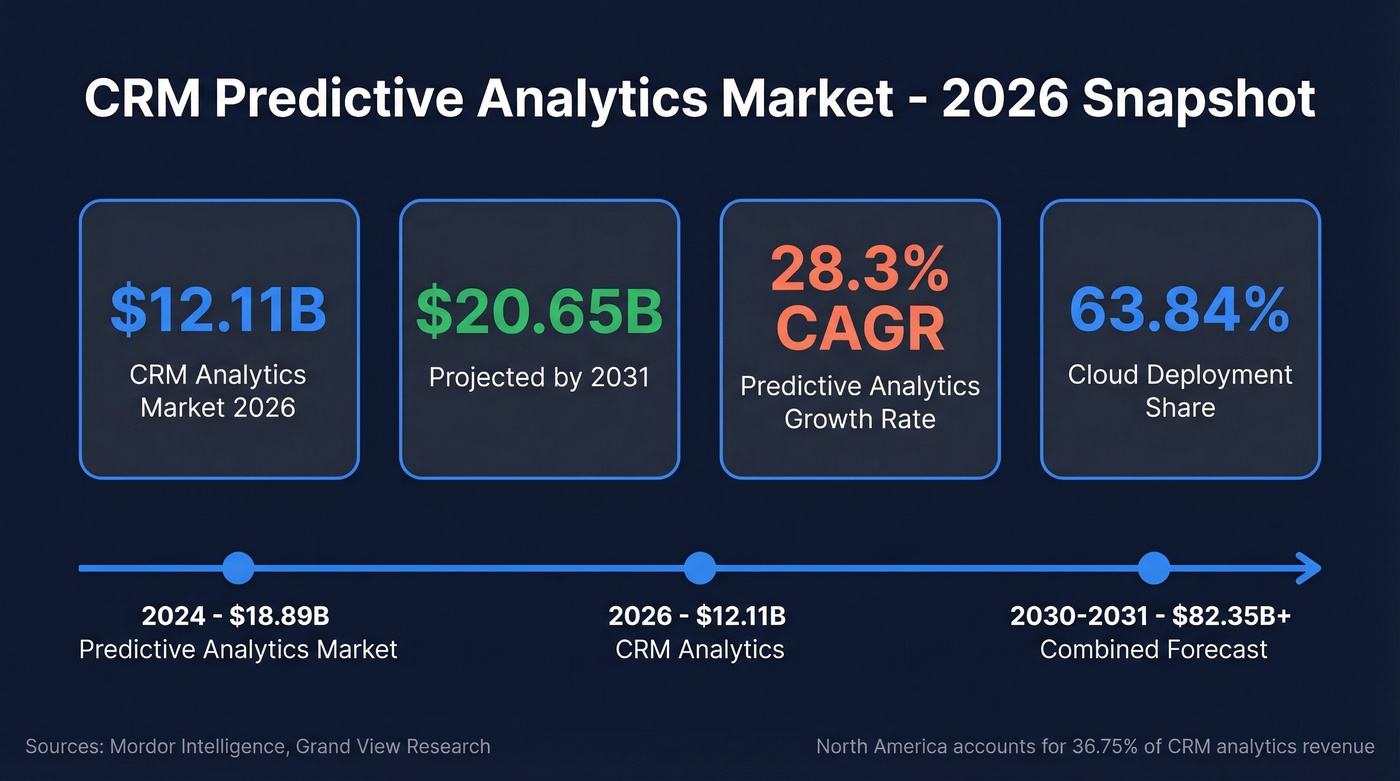
Every CRM vendor needs an AI story, and predictive scoring is the most tangible one. It turns historical deal data into a number that tells reps where to focus. SMEs are adopting faster than enterprises at a 12.12% CAGR - this isn't just an enterprise play anymore. Mid-market CRMs are shipping predictive features that would've required a data science team five years ago.
What You Need (Quick Version)
Three paths, depending on where you are right now:
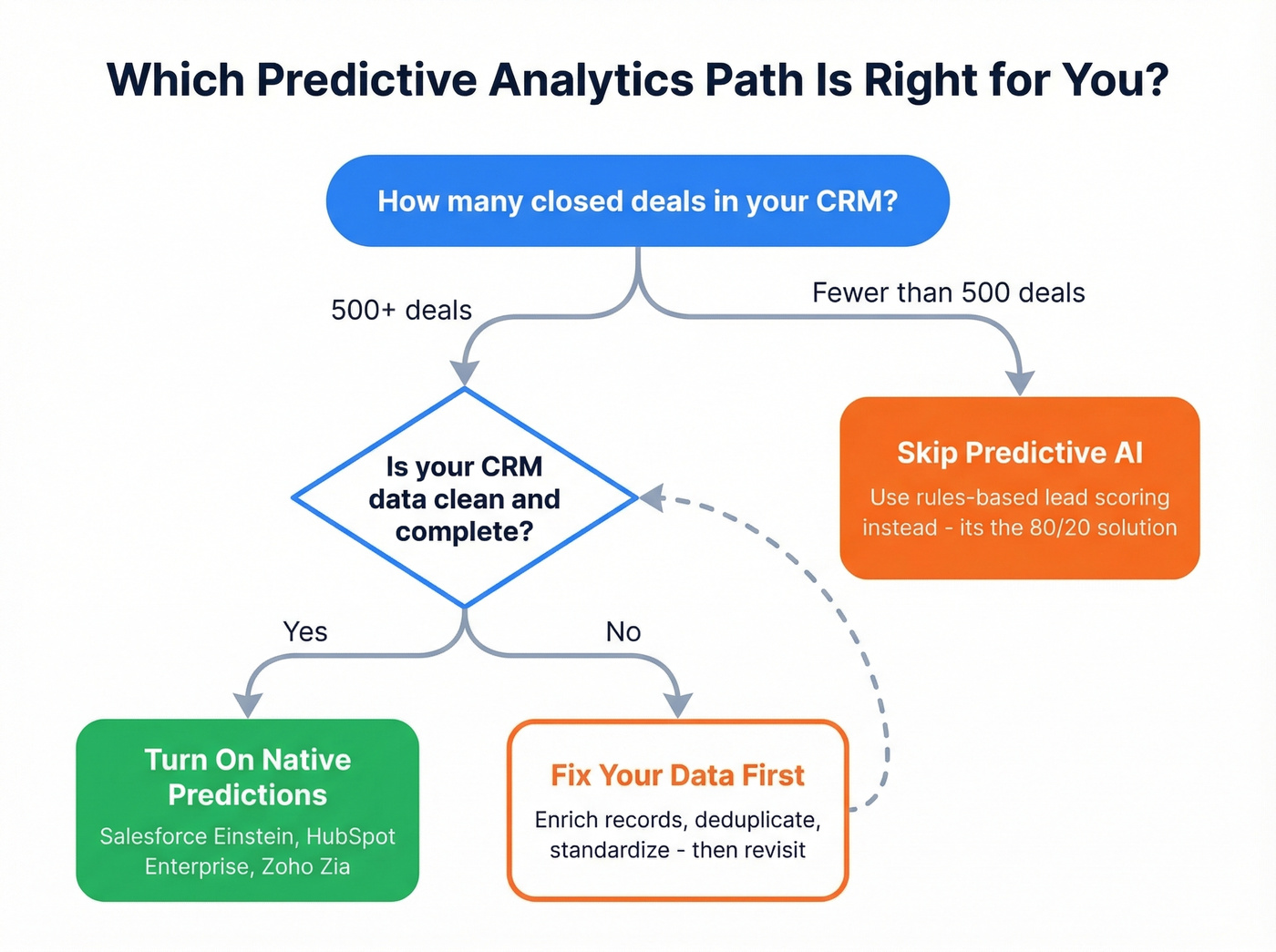
- 500+ closed deals and clean CRM data - Turn on native predictions (Salesforce Einstein, HubSpot Enterprise, Zoho Zia). You've got enough signal for the models to learn from.
- Incomplete or stale CRM data - Fix that first. Enrich your records so predictive models have something real to score against.
- Fewer than 500 deals - Skip predictive analytics entirely. Use rules-based lead scoring. It's the 80/20 solution that doesn't require a data scientist or six figures in CRM licensing.
How Predictive Scoring Works Inside a CRM
At its core, predictive analytics in CRM takes historical patterns - which deals closed, which churned, what behaviors preceded each outcome - and applies statistical models to score future likelihood. The output is deceptively simple: a number. Salesforce Einstein assigns lead scores from 1-99. HubSpot outputs a 0-100 likelihood-to-close percentage plus priority tiers. Both train on closed-won and closed-lost deals alongside behavioral, firmographic, and engagement data.
Scoring is just the starting point. Churn prediction flags accounts showing disengagement signals before they cancel. Lifetime value forecasting helps teams prioritize expansion plays. Next-best-action recommendations suggest whether a rep should call, email, or send a proposal based on what's worked for similar deals. The direction is toward prescriptive models - ones that don't just predict outcomes but recommend specific actions in real time.
None of this matters if only sales sees the predictions. Marketing needs scoring data to align campaigns. Support needs churn signals to trigger retention plays. These are cross-functional tools, and teams that silo them to one department waste most of their value. When implemented well and kept current, teams typically target 5-15% churn reduction alongside measurable improvements in rep prioritization accuracy.
Which CRMs Have Predictive Features
Here's the lineup as of 2026, sorted by depth of capability:
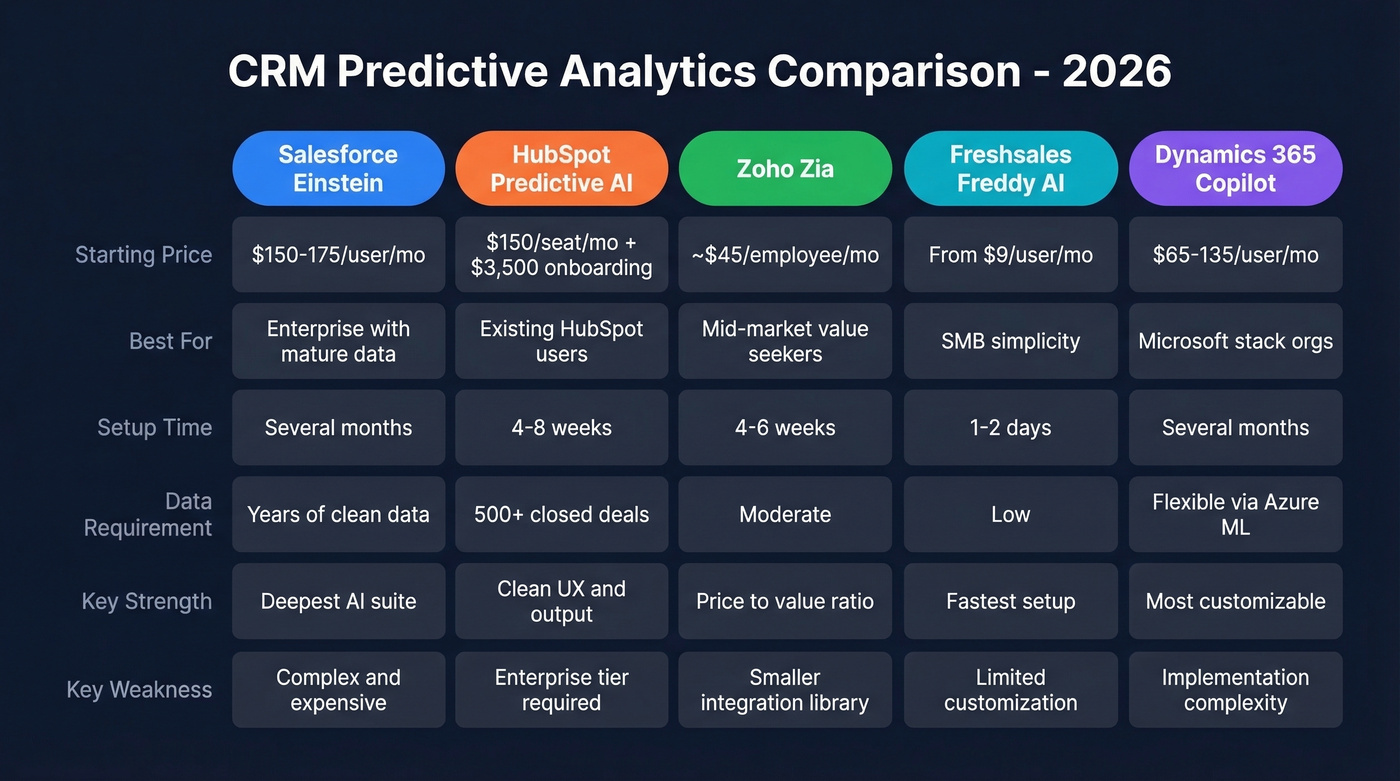
| CRM | AI Brand | Key Predictive Features | Min. Tier | Price (/user/mo) | Best For |
|---|---|---|---|---|---|
| Salesforce | Einstein | Lead/opp scoring, forecasting | Sales Cloud Enterprise | $150-175 | Enterprise with mature data |
| HubSpot | Predictive AI | Lead scoring, priority tiers | Sales Hub Enterprise | $150 | Existing HubSpot users |
| Zoho | Zia | Scoring, forecasts, anomalies | Zoho One | ~$45/employee/mo | Mid-market value |
| Freshsales | Freddy AI | Scoring, deal insights, NBA | Freshsales paid plans | From $9 | SMB simplicity |
| Dynamics 365 | Copilot + Azure ML | Scoring, forecasting | Paid Dynamics 365 Sales editions | $65-135 | Microsoft stack orgs |
Salesforce Einstein
Einstein is the deepest predictive suite in any CRM, and also the most demanding. Lead scoring runs 1-99, opportunity scoring predicts close probability, and Einstein Forecasting layers predictive models on top of your pipeline. The Enterprise tier runs $150-175/user/month, with Unlimited at $330+/user/month for broader Einstein capabilities.
Einstein needs years of clean, consistent historical data to produce reliable scores. Implementation typically takes several months and often requires consultants. The most common complaint from teams who've deployed it: the scores looked great in demos but fell apart on their actual data. For a 20-seat team, you're looking at $36,000-42,000/year in licensing alone - before implementation costs. It's the right choice for organizations with deep Salesforce investment and mature data practices. For everyone else, it's overkill.
HubSpot Predictive Scoring
HubSpot gates predictive scoring behind its Enterprise plan at $150/seat/month, plus a mandatory $3,500 onboarding fee. Professional at $90/seat/month gets you manual rules-based scoring only - no machine learning.
The predictive output is clean: a 0-100 likelihood-to-close percentage and a priority tier. If you're already on HubSpot Enterprise, turning it on is a no-brainer. Upgrading just for predictive scoring? That's harder to justify unless you're also getting value from the other Enterprise features.
Zoho Zia
Zoho's AI assistant Zia handles scoring, forecasts, anomaly alerts, and call summaries across the Zoho ecosystem. The value play is Zoho One at roughly $45/employee/month billed annually, which bundles CRM with 40+ other apps. For mid-market teams already in the Zoho ecosystem, Zia covers the core predictive use cases at a fraction of Salesforce-style enterprise pricing. The tradeoff is ecosystem lock-in and a smaller third-party integration library.
Freshsales Freddy AI
Use this if you're an SMB that wants predictive scoring without enterprise complexity. Freshsales starts from $9/user/month, and Freddy AI features - predictive scoring, deal insights, next-best-action recommendations - are available on higher tiers. Setup is one of the simplest on this list. Many SMB teams can be running in a day.
Skip this if you need deep customization or enterprise-grade forecasting. Freddy is practical, not powerful.
Microsoft Dynamics 365
Dynamics 365 can layer custom predictive models using Azure Machine Learning, making it the most flexible option for teams with data engineering resources. It's the right choice for organizations already deep in the Microsoft stack. For everyone else, the implementation complexity rivals Salesforce without the same ecosystem of consultants and documentation to lean on.

Predictive scoring fails when your CRM is full of stale contacts and missing emails. Prospeo enriches your records with 50+ data points per contact at a 92% match rate - on a 7-day refresh cycle. Feed your Einstein or HubSpot models clean, current data so the scores actually mean something.
Fix your CRM data before you ask AI to score it.
The Data Quality Problem
Here's where most predictive CRM projects actually fail - and it isn't the algorithm.
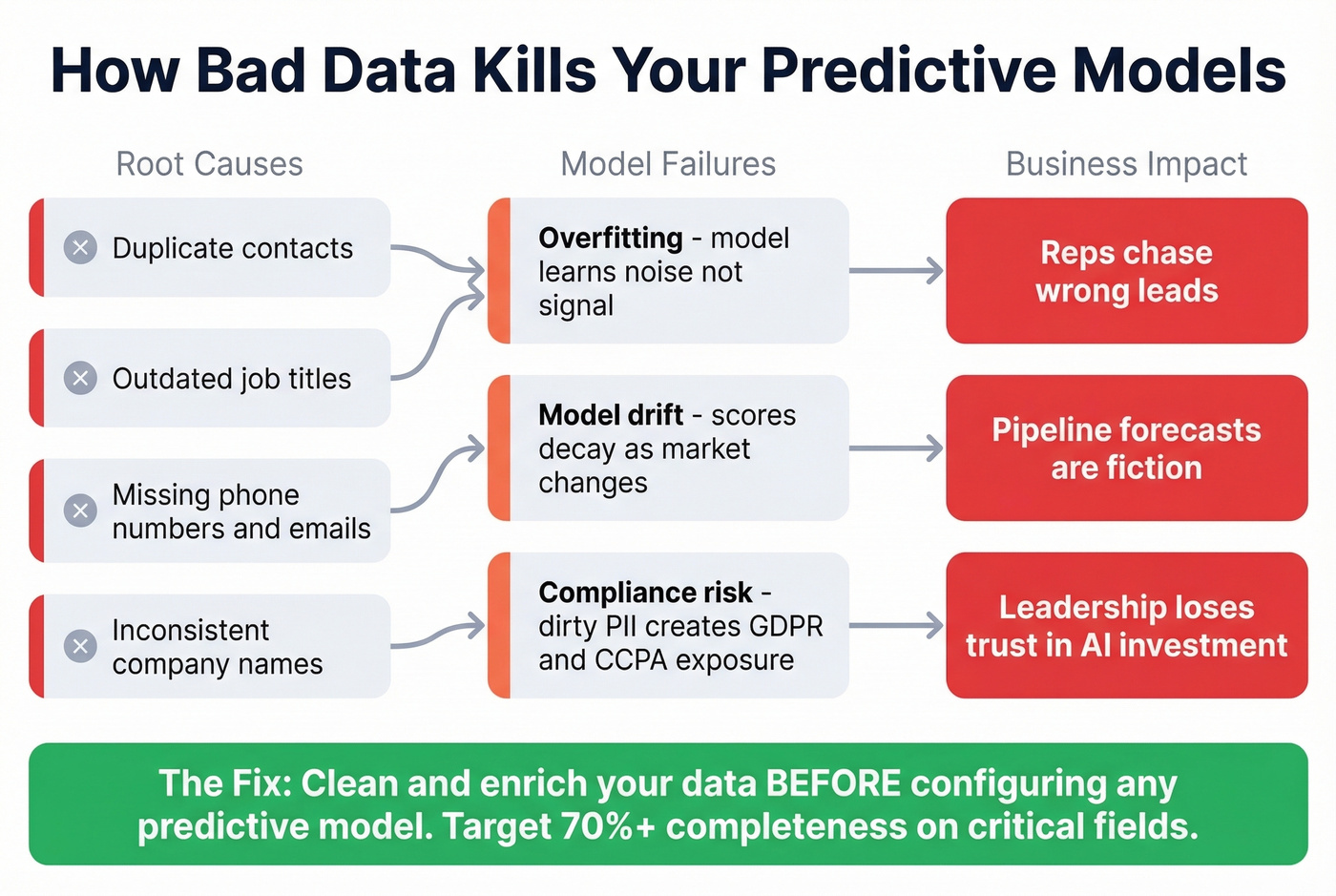
The two biggest blockers are almost always data quality and change management. Duplicated contacts, outdated job titles, missing phone numbers, inconsistent company name formatting - all of these degrade model accuracy. A predictive model trained on stale, inconsistent CRM records will produce scores that look confident but mean nothing. And that's worse than having no scores at all, because your reps start trusting a number that's lying to them.
The failure modes cascade quickly. Poor data leads to overfitting, where the model learns noise instead of signal. Without monitoring and retraining, model drift sets in as your market evolves. And if you're handling PII, data integration challenges multiply with GDPR and CCPA compliance requirements.
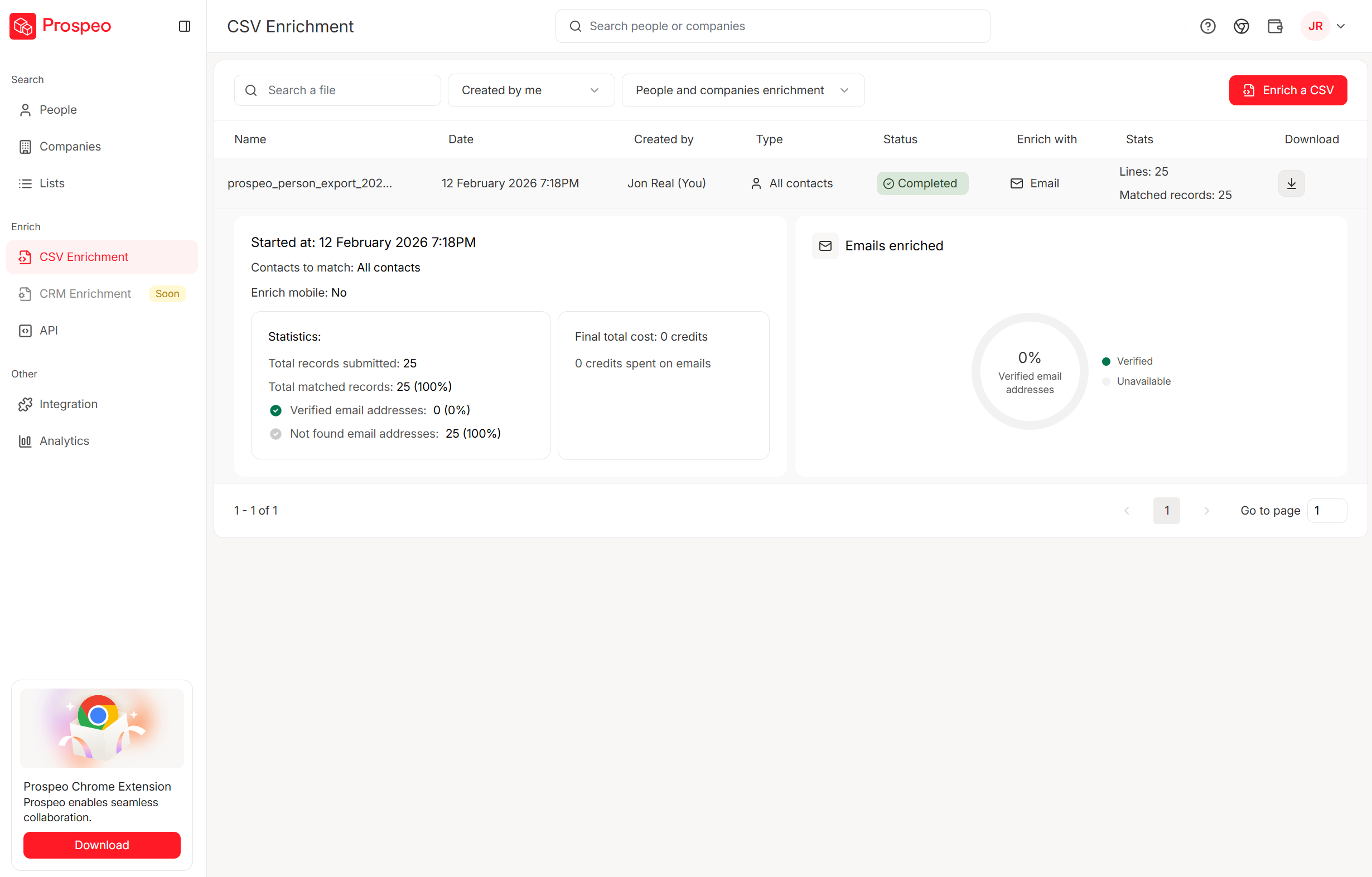
The fix is upstream. Before you configure any predictive model, your CRM data needs to be complete, current, and consistent. Prospeo's enrichment returns 50+ data points per contact with a 98% email accuracy rate and a 7-day refresh cycle - compared to the 6-week industry average that lets data rot between updates. It integrates natively with Salesforce and HubSpot, so enriched records flow directly into the same CRM your scoring models train on.
Let's be honest: most teams don't have an AI problem. They have a data hygiene problem wearing an AI costume. We've seen teams spend months tuning Einstein parameters when the actual issue was 40% of their contact records missing phone numbers and job titles. Fix the data first. The predictions follow.
You don't need a $150/seat CRM to prioritize the right leads. Prospeo gives you 30+ search filters - buyer intent, technographics, job changes, funding signals - so you can build targeted lists without waiting for a predictive model to catch up. At $0.01 per email, it's 90% cheaper than enterprise CRM data add-ons.
Better inputs beat better algorithms. Start with real data.
How to Implement Predictions Step by Step
- Audit your CRM data. Check completeness rates across key fields - email, phone, job title, company size, industry. Below 70% completeness on critical fields? Stop and fix it before proceeding.
- Clean and enrich. Deduplicate records, standardize formatting, and run contacts through an enrichment tool to fill missing data. This step alone takes 2-4 weeks for a mid-market CRM.
- Start with lead scoring. It's the highest-ROI first step. Don't try to launch scoring, forecasting, and churn prediction simultaneously.
- Configure and train. Map data fields to model inputs. Most CRMs need at least 500 closed deals for reliable training.
- Test on a segment. Run predictions against a known cohort. Compare model scores against actual outcomes from last quarter.
- Monitor and retrain quarterly. Models drift. Set a review cadence to check accuracy as your market evolves.
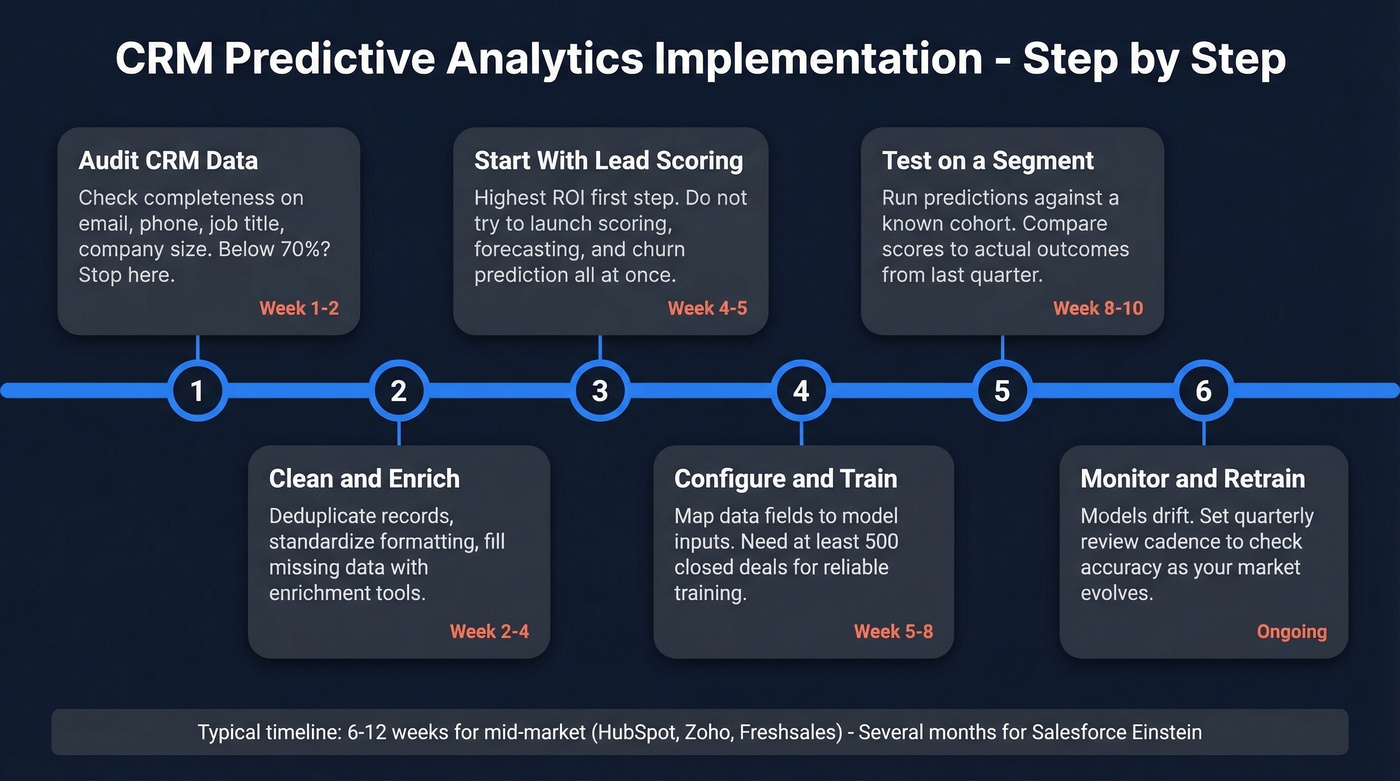
Plan for 6-12 weeks on a mid-market implementation with HubSpot, Zoho, or Freshsales. Salesforce Einstein routinely stretches to several months when custom objects and complex sales processes are involved.
When Predictive Scoring Is Overkill
Not every team needs this. A Freshworks survey found businesses using CRM are 86% more likely to exceed sales targets and report 21-30% revenue increases - but that's CRM adoption broadly, not predictive AI specifically.
Skip predictive analytics if you have fewer than 500 closed deals. The models don't have enough signal. Skip it if your CRM data completeness is below 70% - you'll get confident-looking scores built on incomplete information, which actively misleads your reps. And skip it if your sales cycle is simple enough that reps already know which deals are real. A five-step enterprise sale benefits from scoring. A two-call SMB close probably doesn't.
The alternative is rules-based scoring: define 5-10 criteria that correlate with closed deals and assign point values manually. Less sophisticated, but transparent and immediately actionable. Graduate to predictive models once your data and deal volume justify it.
Common Questions
What's the cheapest CRM with predictive scoring?
Freshsales starts at $9/user/month, with Freddy AI scoring on higher tiers. Zoho Zia is accessible through Zoho One at roughly $45/employee/month billed annually. Both deliver core predictive capabilities without enterprise pricing - ideal for teams under 50 reps.
How much historical data do predictions need?
Most models need at least 500 closed-won and closed-lost deals to produce reliable scores. Salesforce Einstein explicitly requires years of clean, consistent data. Below that threshold, rules-based scoring is more practical and won't give you false confidence from undertrained models.
How do I fix CRM data before turning on predictions?
Start with enrichment to fill missing emails, phone numbers, and firmographic data across your records. Then deduplicate, standardize formatting - especially company names and industries - and establish an ongoing hygiene process. Prospeo's enrichment API handles this at scale with a 92% match rate, returning 50+ data points per contact on a 7-day refresh cycle.
Can small teams use predictive analytics without Salesforce?
Yes. Freshsales Freddy AI and Zoho Zia both offer predictive lead scoring at a fraction of Einstein's cost. For teams with fewer than 20 reps and deal sizes under $25K, these mid-market options cover the core use cases - scoring, deal insights, basic forecasting - without six-figure licensing or dedicated consultants.