

Predictive Intent Data: Which Signals Actually Predict Purchases?
Finance approved the $25K intent data contract. Six months later, pipeline hasn't moved. The predictive intent data was real - accounts were researching your category. The problem? Your team was emailing generic info@ addresses because nobody verified the contacts.
The B2B intent data market hit $4.49B in 2026, and 91% of marketers now use some form of buyer intent signals. Yet only 24% report exceptional ROI. That's not a data problem - it's an activation problem.
Here's the short version: predictive intent modeling uses ML to forecast which accounts will buy. Most teams fail because they get account-level alerts without verified contacts to act on. Skip the $40K+ full-stack ABM platforms. Pair Bombora-powered intent signals with verified contact data and a 48-hour outreach SLA, and you'll outperform most enterprise deployments we've seen.
What Is Predictive Intent Data?
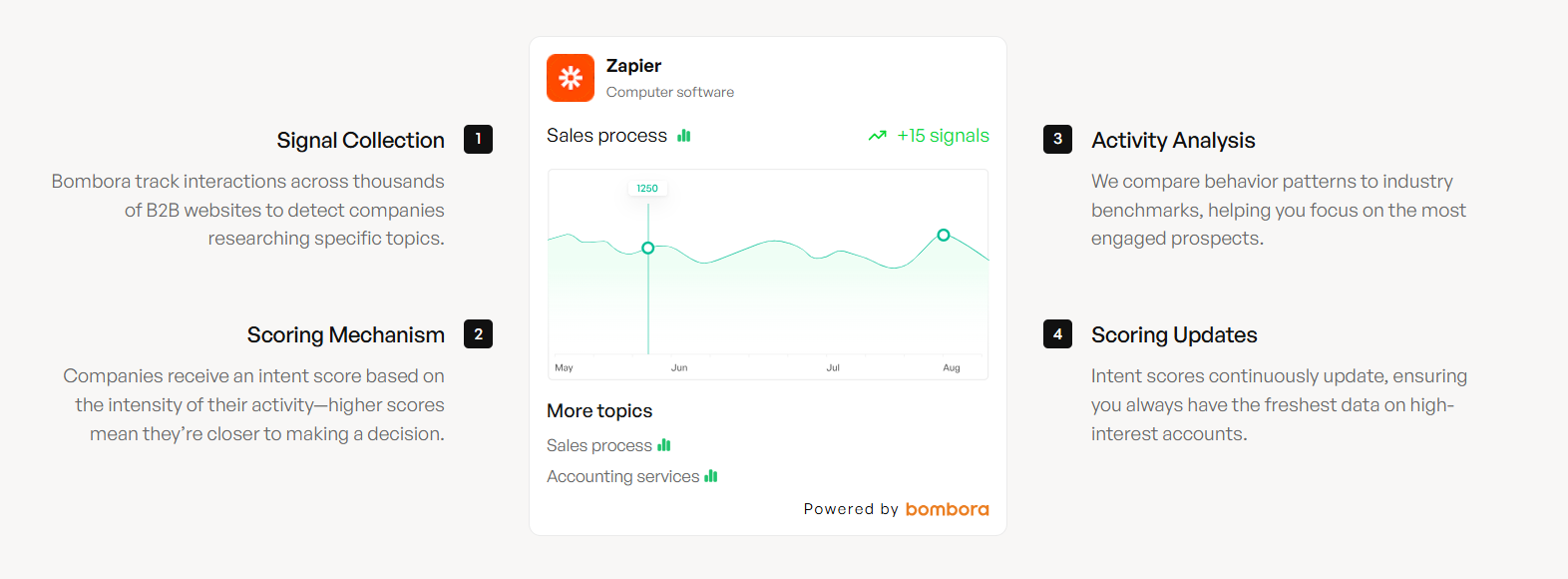
Deterministic signals capture observed, verified events - someone at Acme Corp requested a demo. Predictive intent data uses machine learning to weight those signals against historical closed-won patterns and forecast which accounts are likely to buy next. It's probabilistic modeling, not event logging.
The workflow runs in four steps: data ingestion from first-party, second-party, and third-party sources; pattern recognition against your win/loss history; signal weighting (a pricing page visit by a VP matters more than a blog click from an intern); and forecasting that outputs ranked accounts by purchase likelihood. These models aren't limited to acquisition, either - the same approach powers churn detection and expansion signals, any scenario where behavioral patterns precede a decision.
Which Buyer Intent Signals Matter?
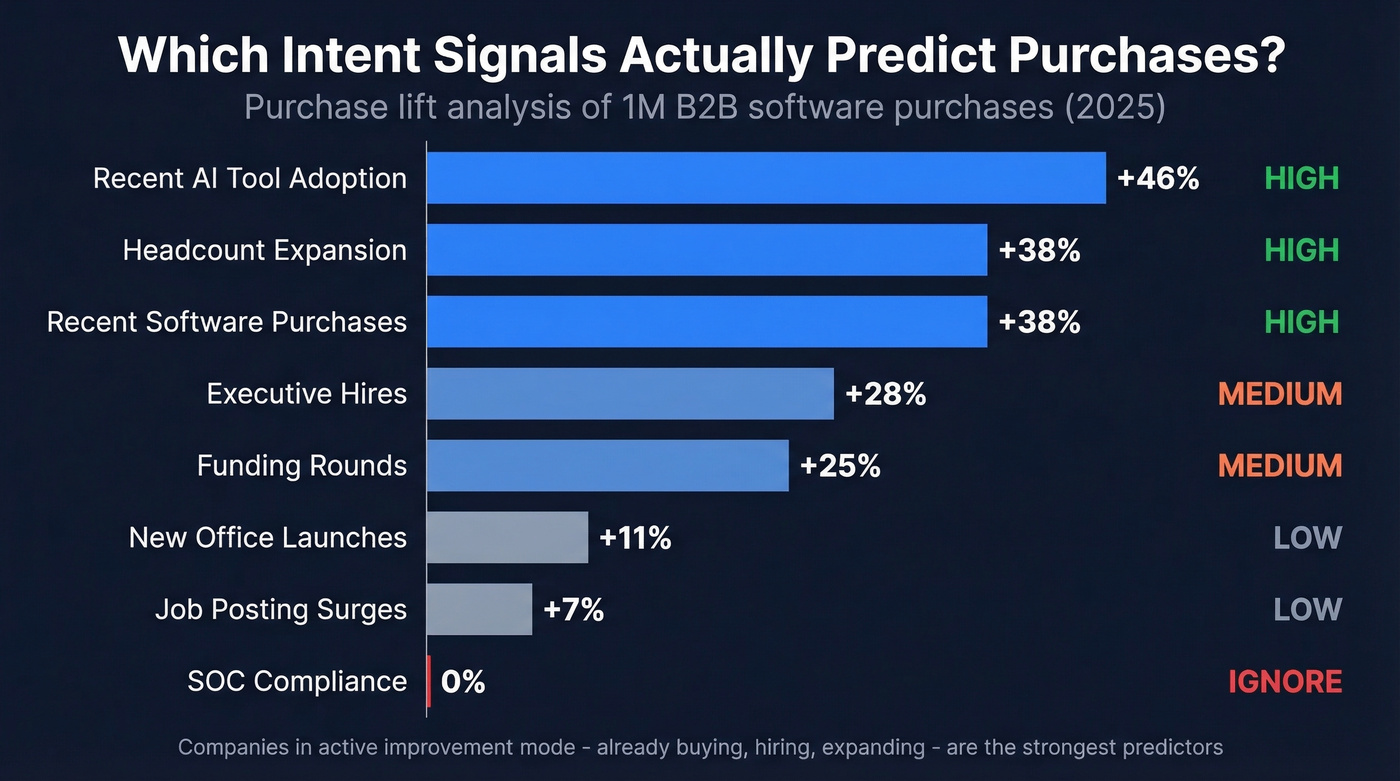
An analysis of 1 million B2B software purchases (March-September 2025, companies with 200-1,000 employees) produced the most specific signal-to-purchase correlation data we've found anywhere:
| Signal | Purchase Lift | Priority |
|---|---|---|
| Recent AI tool adoption | +46% | High |
| Headcount expansion | +38% | High |
| Recent software purchases | +38% | High |
| Executive hires | +28% | Medium |
| Funding rounds | +25% | Medium |
| New office launches | +11% | Low |
| Job posting surges | +7% | Low |
| SOC compliance | 0% | Ignore |
The strongest signals reflect companies in "active improvement mode" - already buying, hiring, and expanding.
Job posting surges are a garbage intent signal at +7%. Stop building playbooks around them. We've seen teams weight job postings heavily because they're easy to track, and it wastes scoring capacity every time. If your average deal size is under $15K, you probably don't need a $40K intent platform at all. The signal correlation data above is free. Pair it with headcount and technographic filters in a self-serve tool and you'll beat most enterprise intent deployments on pure pipeline impact.

You don't need a $40K intent platform. Prospeo tracks 15,000 intent topics via Bombora and pairs them with 30+ filters - headcount growth, technographics, funding - so you can act on the signals that actually predict purchases. All with verified contacts attached, not account-level guesses.
Turn intent signals into verified emails for ~$0.01 each.
How to Act on Intent Signals
Most implementations fail at the operational layer. Forrester's analysis calls out three killers: treating all sources the same, ignoring data decay, and undervaluing first-party intent.
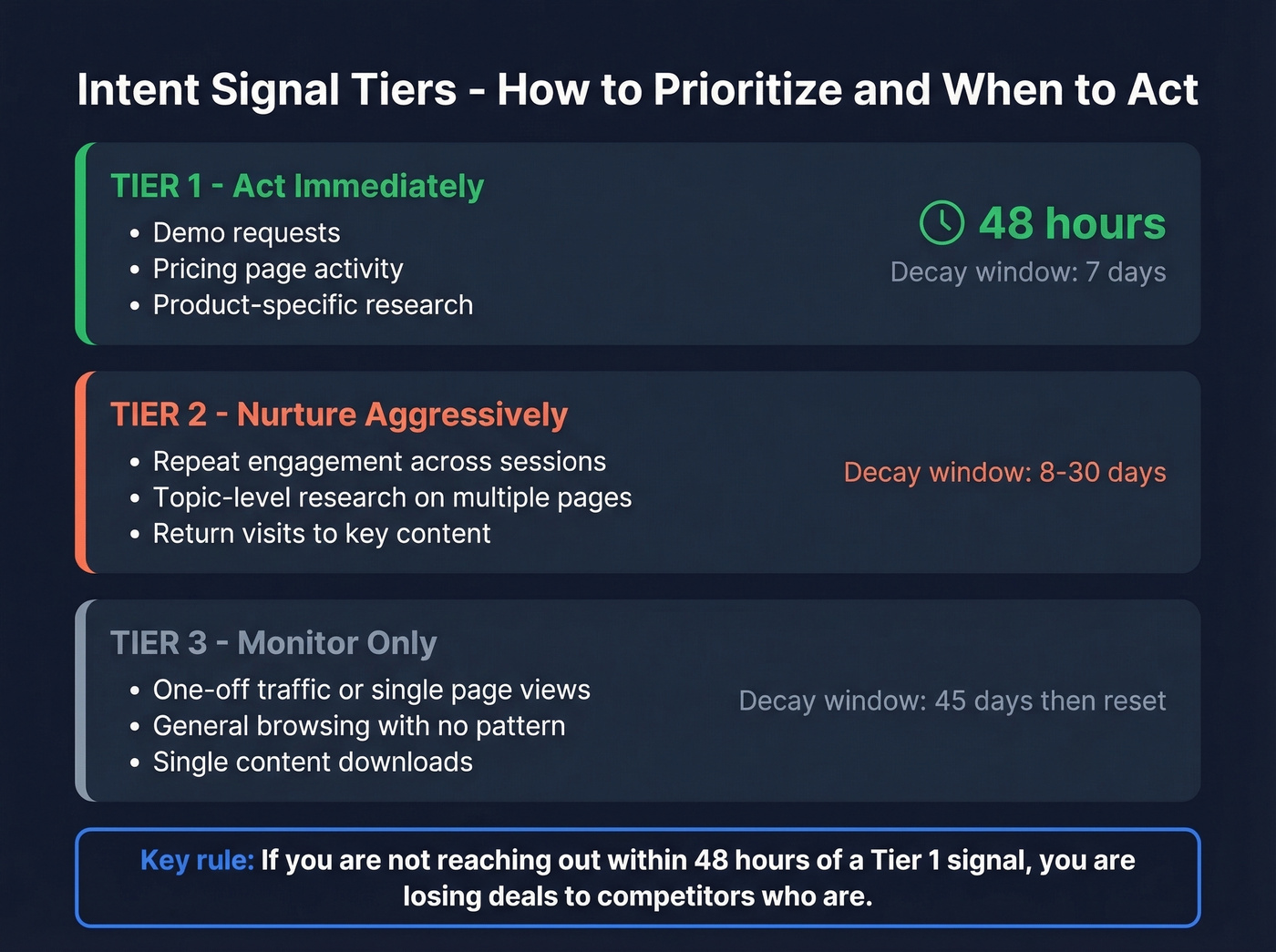
Let's break this down by tier:
Tier 1 - act immediately: Demo requests, pricing page activity, product-specific research. These are bottom-funnel signals with the highest conversion correlation. Tier 2 - nurture aggressively: Repeat engagement, topic-level research across multiple sessions. The account is educating itself. Tier 3 - monitor only: One-off traffic, general browsing, single content downloads. Don't waste outbound capacity here.
Without decay windows, every company in your TAM eventually "shows intent" and the data becomes meaningless. High-priority signals expire in 7 days. Moderate signals hold for 8-30 days. Anything past 45 days should reset the score entirely.
If you're not reaching out within 48 hours of a Tier 1 signal, you're losing deals to competitors who are. 67% of the buyer's journey happens digitally before a prospect talks to sales. By the time a signal decays past the first week, they've shortlisted vendors without you. And choose providers that reveal their data sources and maintain GDPR/CCPA compliance - opaque sourcing is a liability, not a feature.
Closing the Activation Gap
Knowing "someone at Acme Corp is researching your category" is useless without a verified email for the right person. Account-level signals without contact-level activation are a five-figure hunch.
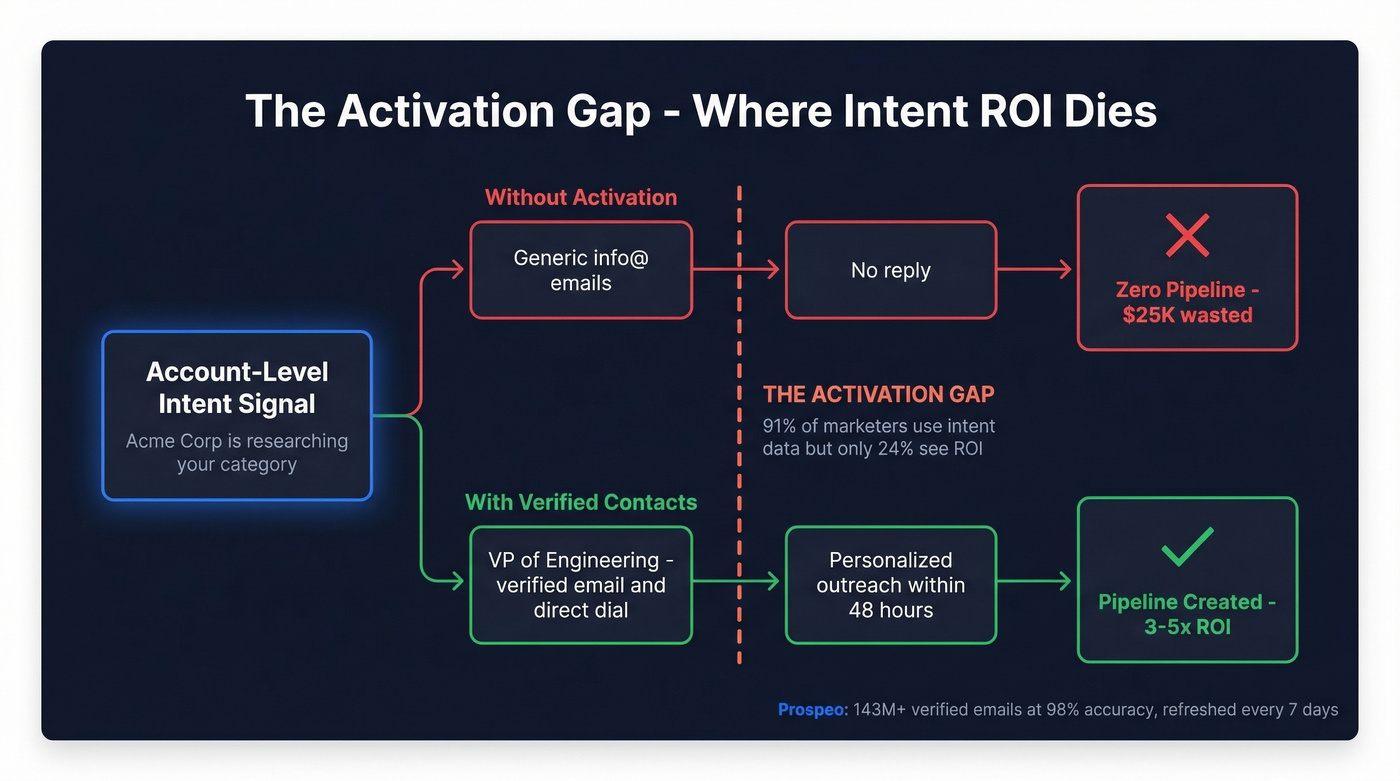
The Reddit consensus on intent tools is brutal: they're "strong at signals but weak at identity, context, and activation," producing alerts no one trusts. The fix isn't better signals - it's bridging the gap between "account is in-market" and "here's the verified VP email."
There's another layer most teams miss entirely: deliverability. Gmail now requires SPF/DKIM/DMARC authentication for high-volume senders, meaning stale or unverified contacts don't just waste time - they actively damage your sender reputation. Fresh, verified data isn't optional anymore. (If you need the technical checklist, start with DMARC alignment and SPF record examples.)
Prospeo closes this gap by tracking 15,000 intent topics via Bombora and pairing them with 143M+ verified emails (98% accuracy) and 125M+ verified mobile numbers, all refreshed every 7 days. You go from "this account is surging" to "here's the VP of Engineering's verified email and direct dial" without switching tools. Self-serve, no contracts, free tier to start.
The activation gap kills intent ROI. Prospeo closes it: 143M+ verified emails at 98% accuracy and 125M+ direct dials, refreshed every 7 days. Go from 'account is surging' to 'here's the VP's verified email' in seconds - no tool-switching, no stale data torching your sender reputation.
Hit your 48-hour outreach SLA with contacts you can actually reach.
What It Actually Costs
Intent data pricing ranges from free to $300K+/year. Most teams land in the $7,000 to $150,000+ range depending on seats, topics, and whether they're buying a full ABM platform. Budget 15-25% above license cost for implementation, topic configuration, and CRM integration.
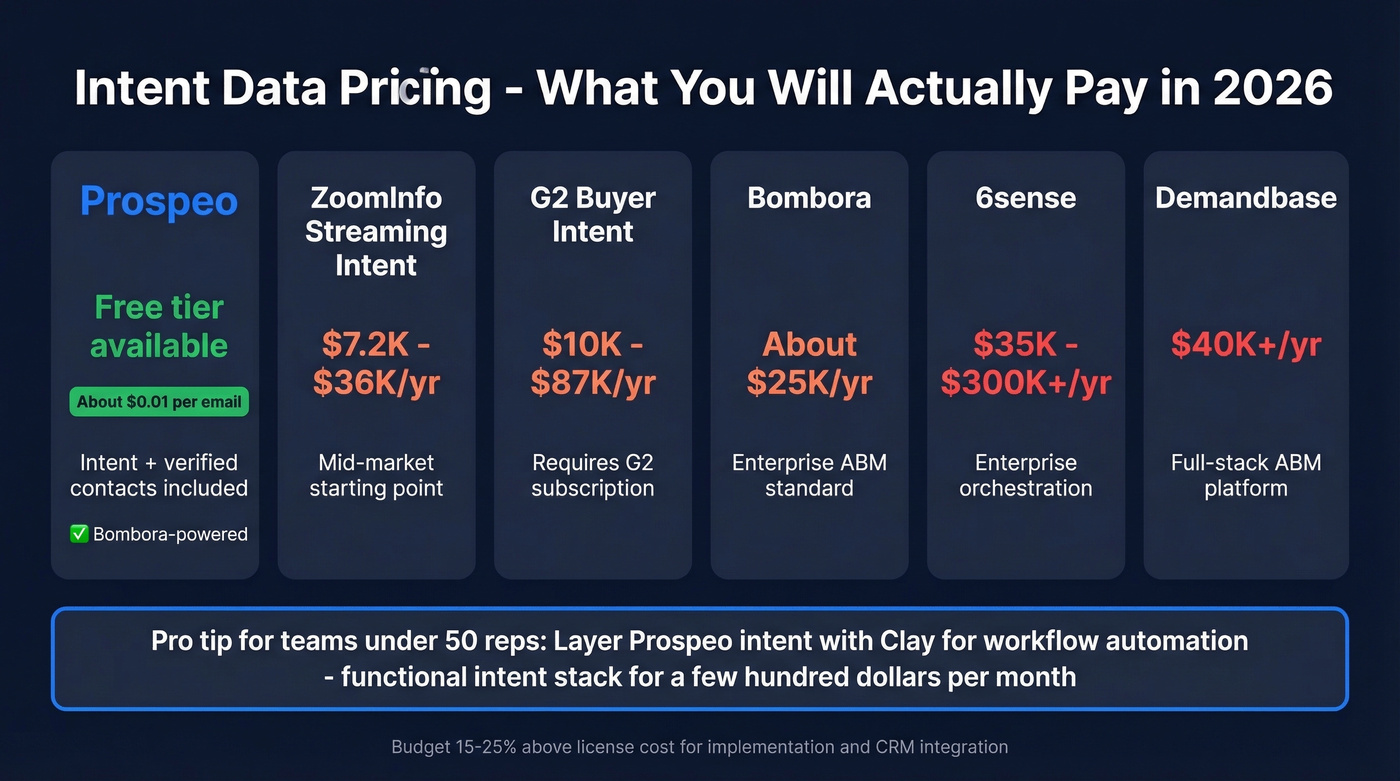
| Platform | Annual Cost | Notes |
|---|---|---|
| Prospeo | Free tier available | Intent + contacts, ~$0.01/email |
| ZoomInfo Streaming Intent | $7.2K-$36K | Mid-market starting point |
| G2 Buyer Intent | $10K-$87K | Add-on to G2 subscription |
| Bombora | ~$25K | Enterprise ABM standard |
| 6sense | $35K-$300K+ | Enterprise orchestration |
| Demandbase | ~$40K+ | Full-stack ABM platform |
For teams under 50 reps, skip the enterprise platforms. Layer Prospeo's Bombora-powered intent with Clay for workflow automation - that's a functional intent stack for a few hundred dollars a month that includes verified contacts most standalone intent tools lack. If you're formalizing scoring, use a lightweight lead scoring model so reps know what to do with each alert.
FAQ
Does predictive intent data actually work?
Yes, but only with proper activation. High-correlation signals like AI adoption (+46%) and headcount growth (+38%) reliably predict purchases when you enforce decay windows and act within 48 hours. Without verified contacts to reach, even perfect signals produce zero pipeline.
How is it different from regular intent data?
Regular intent data logs events - page visits, content downloads. Predictive intent modeling uses ML to weight those signals against closed-won patterns and forecast which accounts will buy next, turning raw behavioral data into ranked purchase probabilities.
What's the cheapest way to start?
Skip enterprise platforms. Pair Prospeo's Bombora-powered intent with Clay for workflow automation - you'll get a functional intent stack for a few hundred dollars a month that includes verified contacts most standalone intent tools don't offer.
Do I need fit and intent modeling together?
Absolutely. Fit and intent modeling combines firmographic and technographic filters (does this account match your ICP?) with behavioral signals (is this account actively researching?). Running intent without a fit layer floods your pipeline with in-market accounts that were never going to buy from you. In our experience, fit filtering alone cuts noise by 60-70% before a single intent signal fires.