

How to Prepare a Sales Presentation That Actually Wins the Deal
96% of prospects research your company before they ever talk to a rep. Your deck isn't an introduction - it's a closing argument. A truly prepared sales presentation respects that reality: Gong data shows winning presentations average just 9.1 minutes, which means every single slide has to earn its spot or get cut.
Here's the short version: qualify the buyer before you build a single slide, follow the 7-step structure below, and verify your prospect's contact data so your follow-up actually lands.
Qualify Before You Build
Don't build a deck for someone who isn't ready to buy. Run every prospect through three gates:
- Specific, quantifiable problem. Vague pain doesn't close deals.
- Willingness to change. Awareness without urgency is a dead end.
- Understanding of inaction cost. They need to feel what staying put costs them.
6-10 stakeholders are involved in a typical B2B buying decision. If you're presenting to one person, you're really presenting to a committee. Know who else influences the decision - even if they're not on the call.
7 Steps to a Winning Sales Presentation
This framework scales from a 10-minute SMB demo to a 45-minute enterprise pitch. We've used it across hundreds of deals, and the sequence matters more than most reps think.
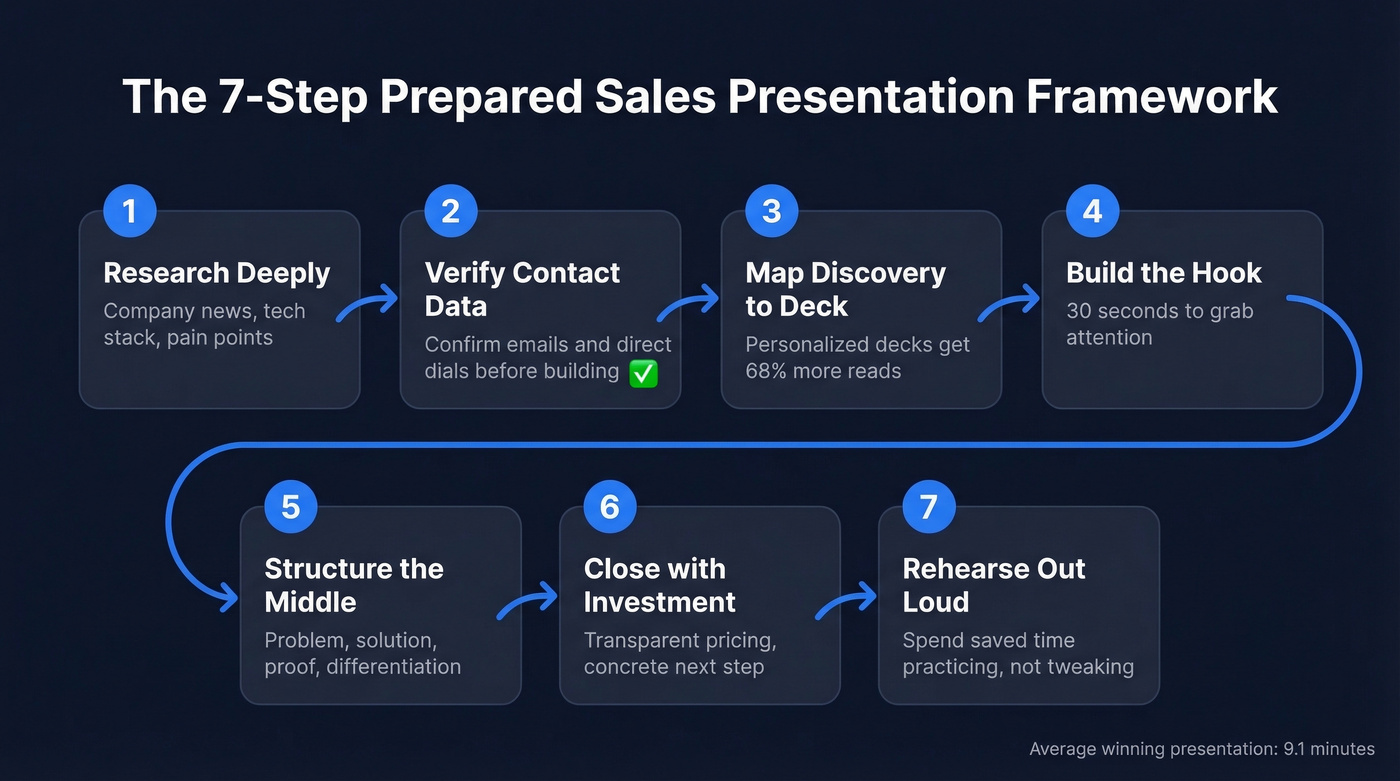
1. Research your prospect deeply. Pull company news, recent hires, tech stack, and competitive landscape. Map every finding to a pain point your product solves. Go back to your discovery-call recording and pull the exact phrases the buyer used to describe their problem - those phrases belong on your slides, word for word.
2. Verify your prospect's data. Before you touch a slide, confirm you have the right contact's verified email and direct dial. A great presentation means nothing if your follow-up bounces. Prospeo handles this with 98% email accuracy across 300M+ profiles, and there's a free tier to get started.

3. Map discovery to deck. Personalized decks get 68% more complete reads and are shared internally 2.3x more often. Generic decks get politely ignored.
4. Build the hook. You have 30 seconds. Open with a provocative stat, a pain-point question, or a bold claim about their market. Never open with your company history - nobody cares about your founding story until they care about your solution.
5. Structure the middle. Problem, then solution, then proof, then differentiation. Two to three slides per section. Sell the transformation, not the feature list. If your demo runs longer than your problem framing, you've lost the thread.
6. Close with investment + next steps. Be transparent on pricing - then pause. Give the number room to breathe before you speak again. End with a concrete next step and a date, not "let us know."
7. Rehearse out loud. Reps spend 31% of working hours searching for and creating sales content. Use AI tools like Gamma (starting at $8/mo) or Beautiful.ai (starting at $12/mo) to cut pitch creation from roughly four hours to about 30 minutes - then spend the saved time actually rehearsing. That's where deals are won.

Step 2 of your prep playbook says verify before you build. Prospeo gives you 98% accurate emails and direct dials across 300M+ profiles - so your follow-up deck lands in the right inbox, not a bounce folder.
A perfect presentation means nothing if your follow-up bounces.
Slide-by-Slide Blueprint
Here's a 12-slide structure where each slide has one job. Build it so a champion can walk their CFO through the logic without you in the room - because those 6-10 stakeholders won't all be on the call.
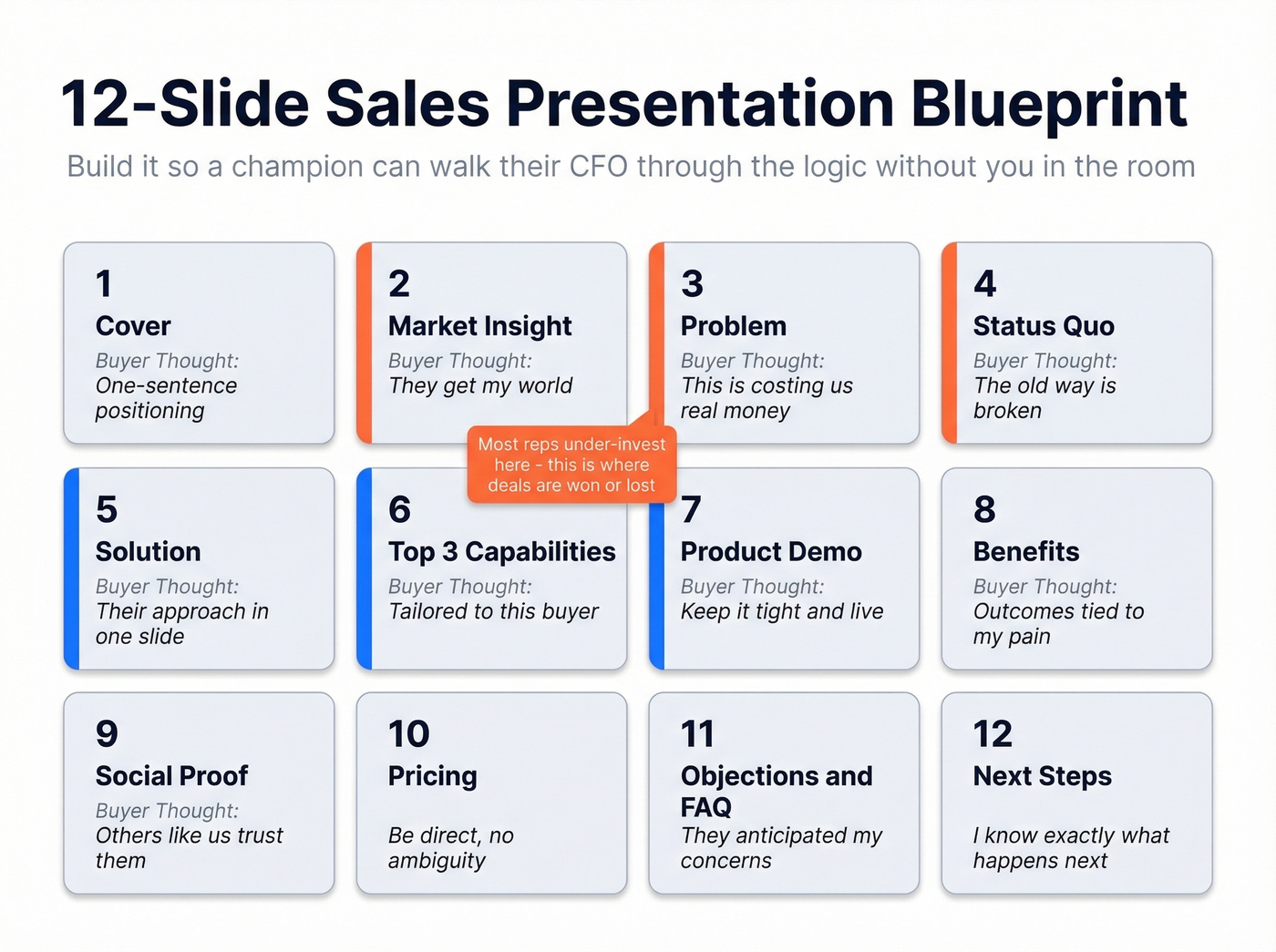
- Cover - One-sentence positioning.
- Market insight - A macro trend that makes your solution timely. The buyer thinks: "They get my world."
- Problem - Quantify the cost of the status quo. "This is costing us real money."
- Status quo - Show why the old way is broken.
- Solution - Your approach in one slide. No feature dump.
- Top 3 capabilities - The three things that matter most to this buyer.
- Product demo - Switch to live product. Keep it tight (use this product demo checklist to stay on track).
- Benefits - Three to four outcomes tied to their specific pain.
- Social proof - Logos, a case study that mirrors their situation. "Others like us trust them."
- Pricing - Be direct. Ambiguity breeds distrust.
- Objections/FAQ - Address the top two concerns preemptively.
- Next steps - A clear CTA with a timeline. "I know exactly what happens next."
Let's be honest: most reps over-invest in slides 5-7 and under-invest in slides 2-3. If the buyer doesn't feel the problem in their gut by slide 4, no amount of product polish saves the deal. We've watched this pattern kill pipeline over and over.
Five Prep Mistakes That Kill Deals
The worst part about these mistakes is that they're invisible. The meeting feels fine. The deal just quietly dies afterward.
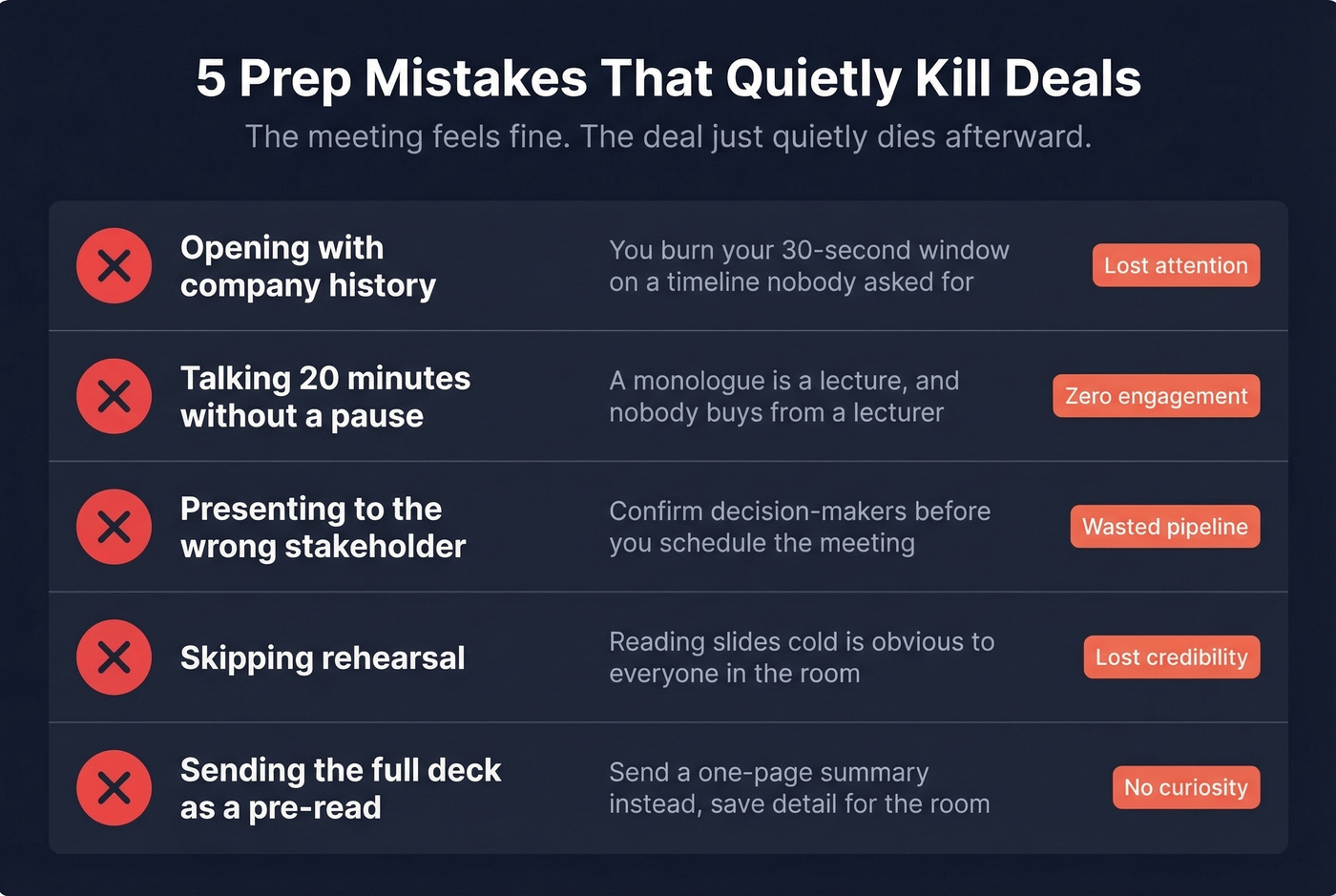
Opening with company history is the most common offender - you burn your 30-second window on a timeline nobody asked for. Almost as damaging is talking for 20 minutes straight without a pause. Ask questions. Use tag-on questions, replay what the buyer said, or ask clarifying follow-ups. Let the buyer shape the conversation, because a monologue isn't a presentation - it's a lecture, and nobody buys from a lecturer.
Presenting to the wrong stakeholder wastes everyone's time. Confirm decision-makers before you schedule.
Skipping rehearsal is obvious to everyone in the room. Reading slides cold shows. And finally, don't send the full deck as a pre-read. Send a one-page summary with the three key points you'll cover. Save the detail for the room.
Virtual Presentation Checklist
Only 15-25% of B2B buyers want to interact with reps in person. Most of your prepared sales presentations will happen over video. Don't let tech issues undermine hours of prep.
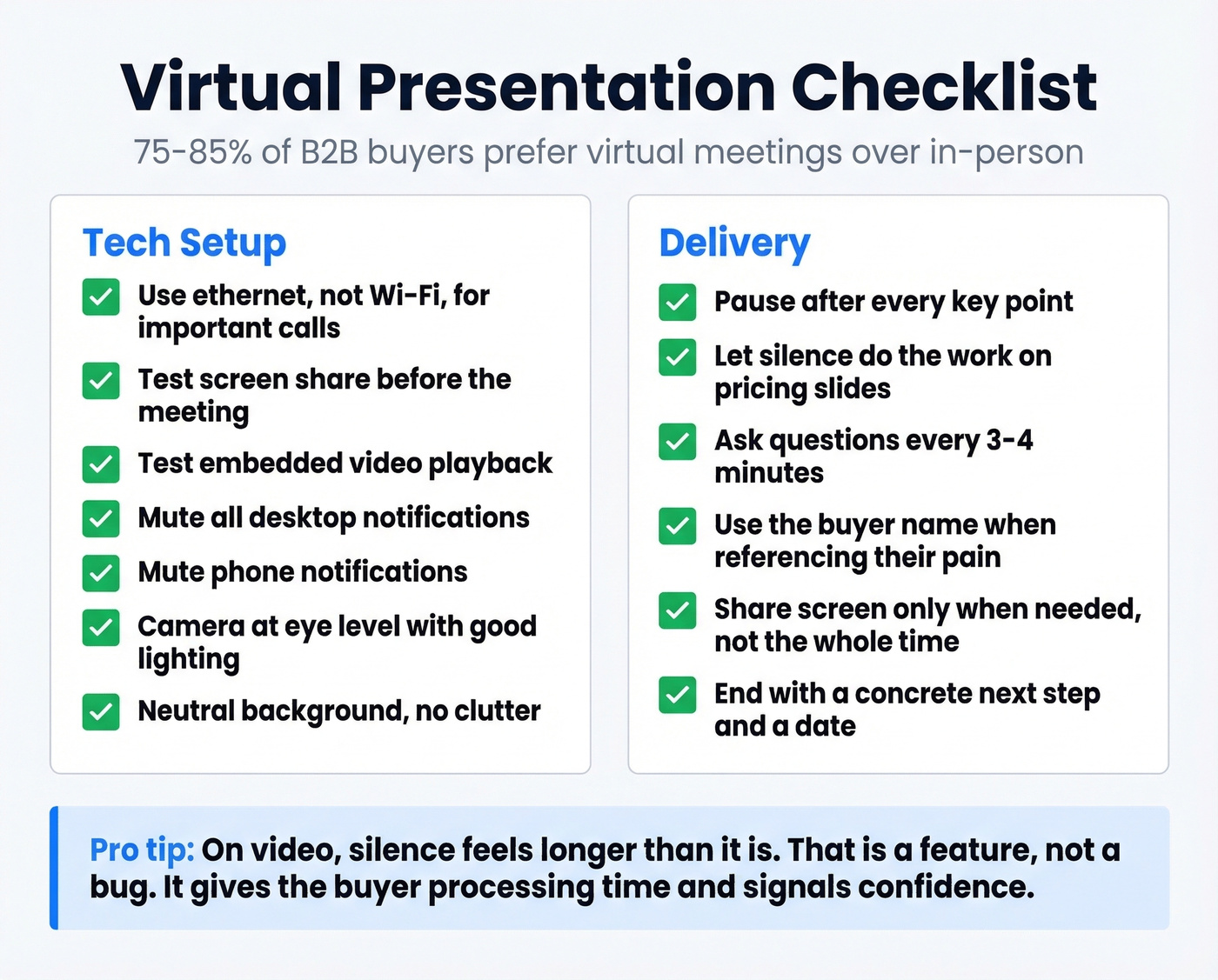
Use ethernet over Wi-Fi - no exceptions for important calls. Test screen share and embedded video playback before the meeting. Mute every notification on desktop and phone. Set your camera at eye level with good lighting and a neutral background.
Most importantly, pause after key points. On video, silence feels longer than it is, and that's a feature - it gives the buyer processing time and signals confidence. I've seen reps rush through pricing on Zoom because the silence felt awkward, and it cost them the deal every time.
If you're presenting remotely, borrow a few virtual sales presentation tips to tighten delivery.
You just mapped 6-10 stakeholders in the buying committee. Now find every decision-maker's verified email and direct dial in one search. Prospeo refreshes data every 7 days - not 6 weeks - so you're never pitching with stale contacts.
Reach the full buying committee, not just the one person on the call.
FAQ
How long should a sales presentation be?
Winning presentations average 9.1 minutes according to Gong's analysis of thousands of closed-won deals. Aim for 9-15 minutes across 10-12 slides. If you're going longer, you're feature-dumping instead of selling outcomes.
How many hours should I spend preparing?
Two to four hours for SMB deals, 6-15+ hours for enterprise including stakeholder mapping and rehearsal. AI deck tools cut pitch creation from roughly four hours to about 30 minutes - spend the saved time on research and practice, not tweaking font sizes.
What's the most overlooked step in presentation prep?
Verifying your prospect's contact data before you ever open your slide editor. You nail the pitch, send the recap, and it bounces - the deal goes cold. In our experience, this is where most follow-up sequences break down, and it's entirely preventable.
What separates a prepared sales presentation from an improvised pitch?
A prepared presentation is built around a specific buyer's pain, stakeholders, and decision timeline - every slide maps back to discovery. An improvised pitch relies on generic talking points and hopes something resonates. Reps who tailor decks to the buying committee close at significantly higher rates than those reusing the same slides across accounts. Skip the "one deck fits all" approach entirely if you're serious about your close rate.