

Probing Questions: 50+ Examples & Frameworks
You're fifteen minutes into a discovery call. The prospect just said, "Yeah, we're looking at a few options." You nod, ask "Can you tell me more about that?" - and get back a polite nothing. The conversation stalls. You pitch too early. The deal dies in committee three weeks later.
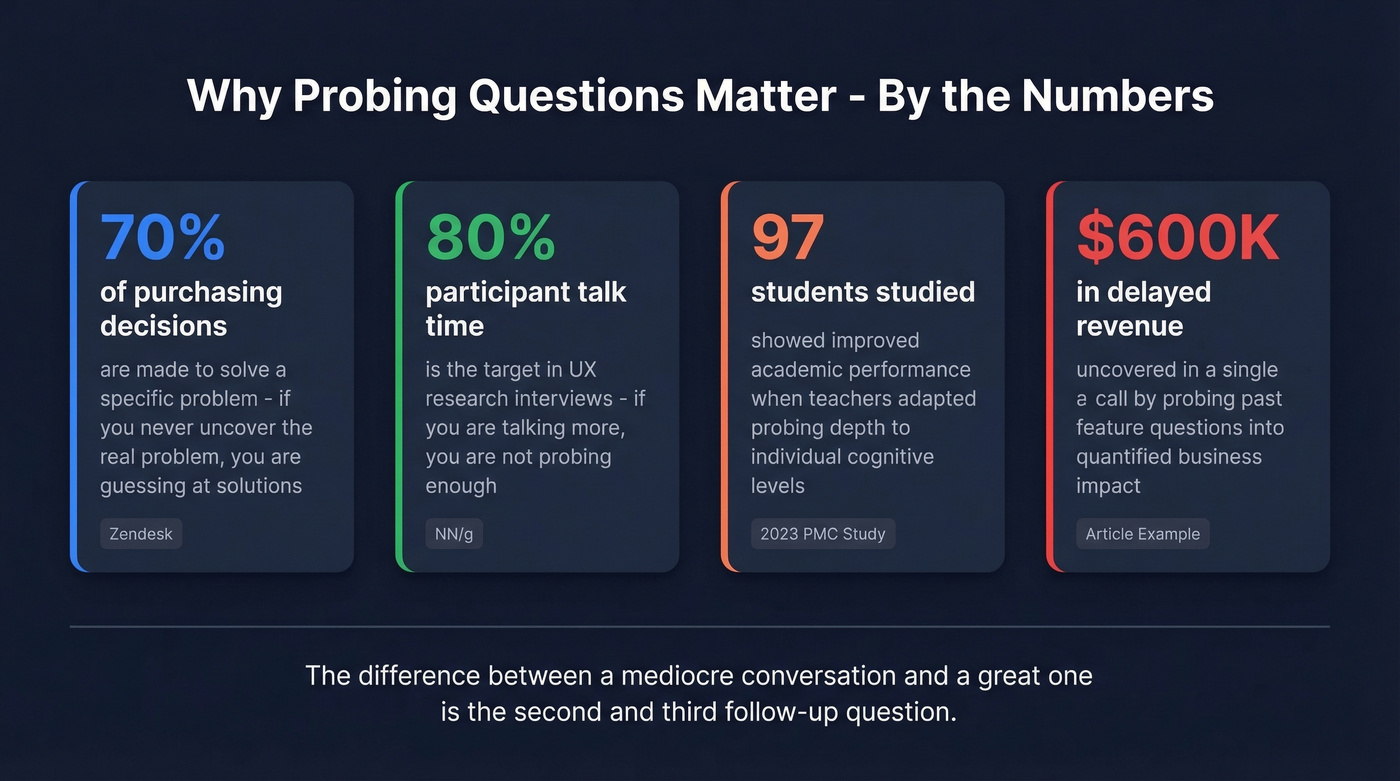
That's not a closing problem. It's a probing questions problem. 70% of purchasing decisions are made to solve a specific problem - but if you never uncover the real problem, you're just guessing at solutions. Guessing doesn't close deals, resolve support tickets, or hire the right candidate.
Here's the thing: most guides on this topic are generic lists written for no one in particular. We've spent enough time auditing discovery calls to know that context matters. A probe that works in a sales call falls flat in a therapy session. So we organized this one by your actual job, not by abstract theory.
What Are Probing Questions?
A probing question digs beneath the surface answer to uncover motivations, impact, context, or information the other person hasn't yet shared. It's the follow-up that turns a shallow conversation into a useful one.
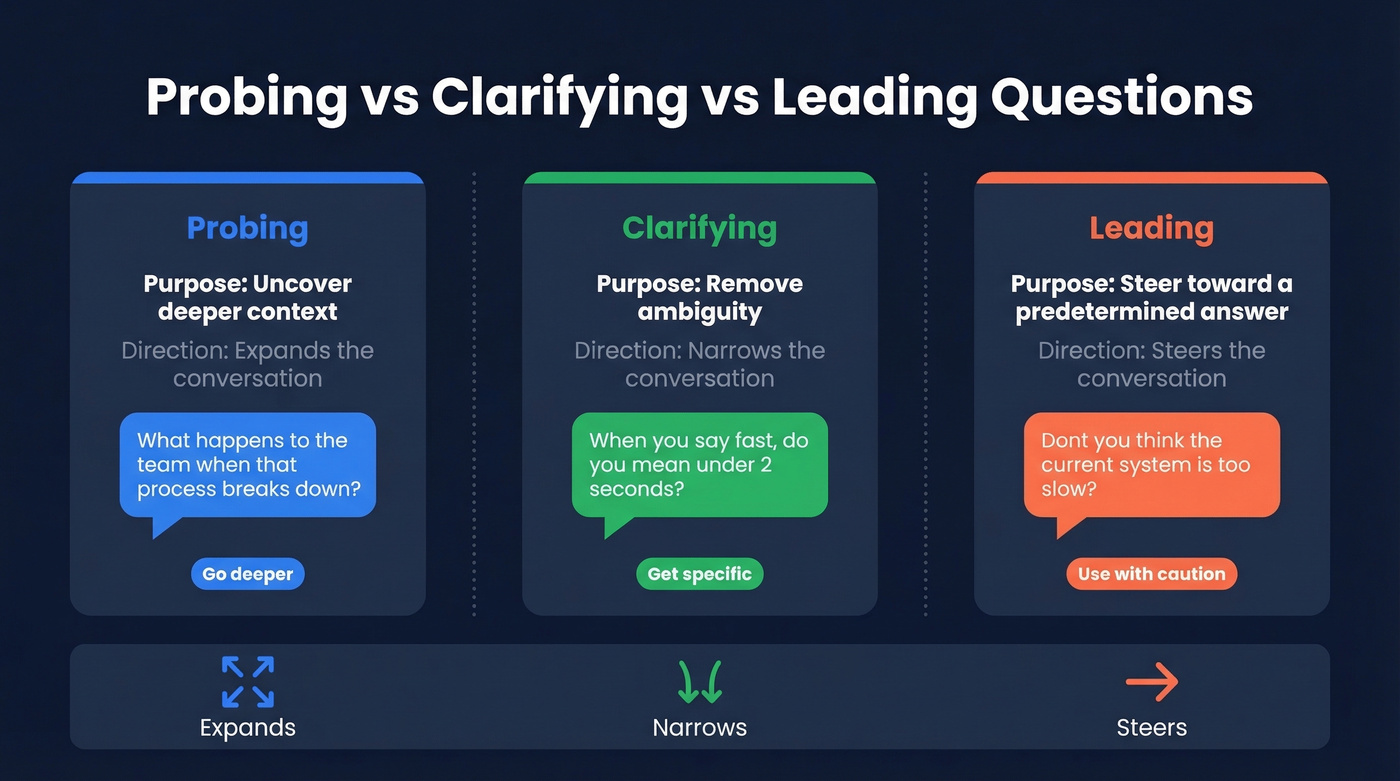
That sounds simple. The confusion starts when people lump probing together with clarifying and leading questions - three fundamentally different tools.
| Type | Purpose | Example |
|---|---|---|
| Probing | Uncover deeper context or motivation | "What happens to the team when that process breaks down?" |
| Clarifying | Remove ambiguity about something already said | "When you say 'fast,' do you mean under 2 seconds?" |
| Leading | Steer toward a predetermined answer | "Don't you think the current system is too slow?" |
Clarifying narrows. Probing expands. Leading steers.
In practice, probes can be open-ended or closed-ended. Open probes ("What impact does that have on your quarter?") invite expansive answers. Closed probes ("Has this happened more than once this month?") confirm specifics. Both have a place, but open probes do the heavy lifting in most professional contexts.
The roots go deep. Socratic questioning - systematic, disciplined, focused on fundamentals - is essentially probing formalized 2,400 years ago. What's changed isn't the concept. It's the contexts where it matters: sales floors, support queues, hiring panels, classrooms, therapy rooms, research labs.
Types of Probing Questions
Not all probes do the same work. Here's the full taxonomy, with guidance on when each type earns its place.
| Type | When to Use | Example |
|---|---|---|
| Clarifying | Something was vague or ambiguous | "What do you mean by 'loads quickly' - under 1 second?" |
| Exploratory / Funneling | You need to go broad then narrow | "What contributes to that? And which factor matters most?" |
| Elevating | You need to zoom out to broader context | "How does this connect to the company's goals for the year?" |
| Adjoining | An adjacent area hasn't been explored | "Who else on the team is affected by this?" |
| Confirmation | You need to validate understanding | "So the core issue is missed deadlines, not budget - right?" |
| Reflective | You want the person to process their own thinking | "What does that tell you about how the team operates?" |
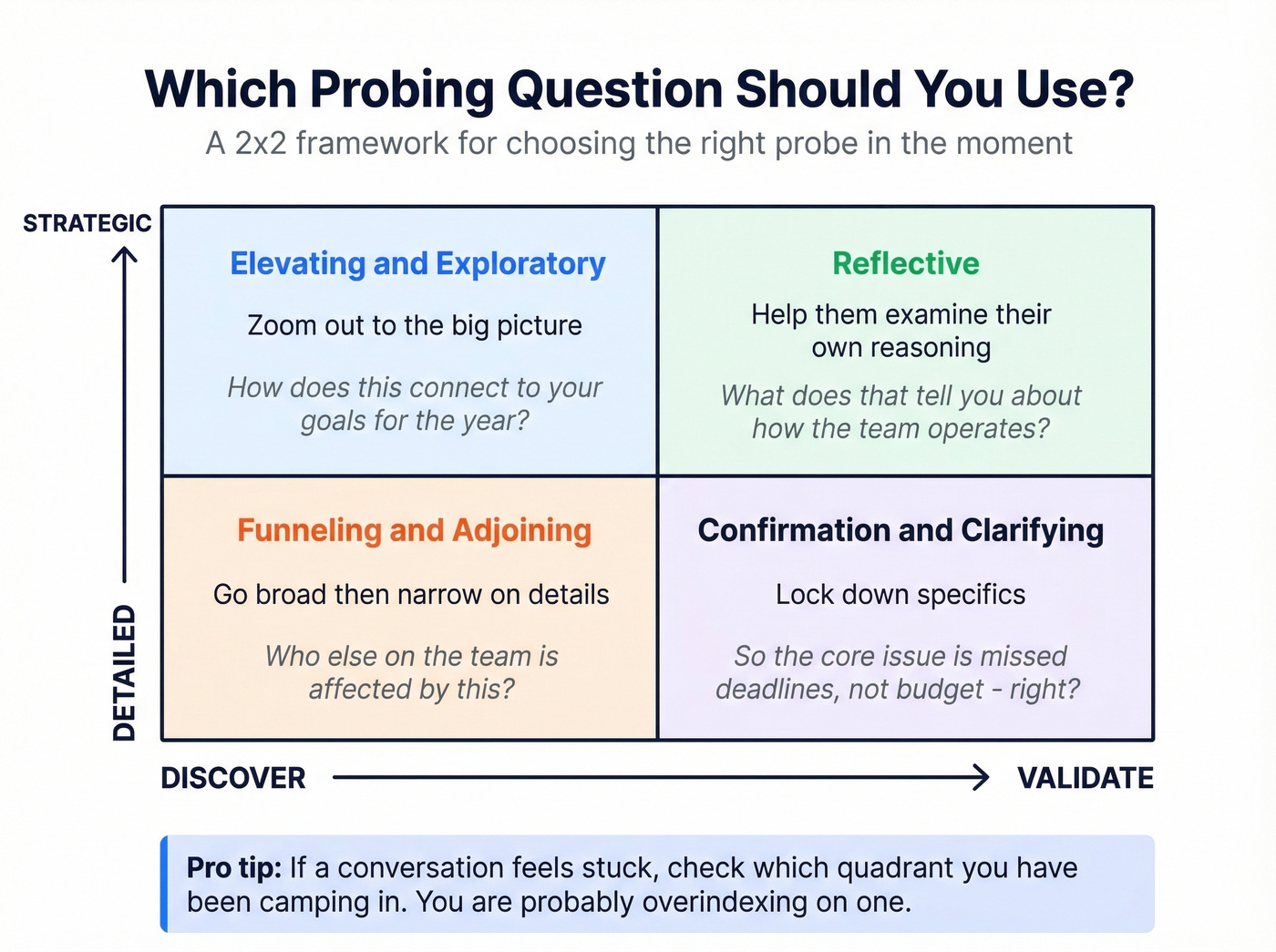
The real skill isn't memorizing types - it's knowing which one to reach for in the moment. A useful mental model is the 2x2 framework: plot your question along two axes. Are you trying to discover something new or validate something you suspect? And are you operating at the strategic level or the detailed level?
Trying to discover something strategic? Reach for elevating or exploratory questions. Need to discover details? Funneling and adjoining. Validating? Lean on confirmation and clarifying questions for specifics, reflective questions to help someone examine their own reasoning.
When a conversation feels stuck, check which quadrant you've been camping in. You're probably overindexing on one.
50+ Examples by Context
Sales Discovery
Great discovery calls follow a natural arc: rapport, pain, impact and urgency, buying process. Here are examples mapped to each stage.
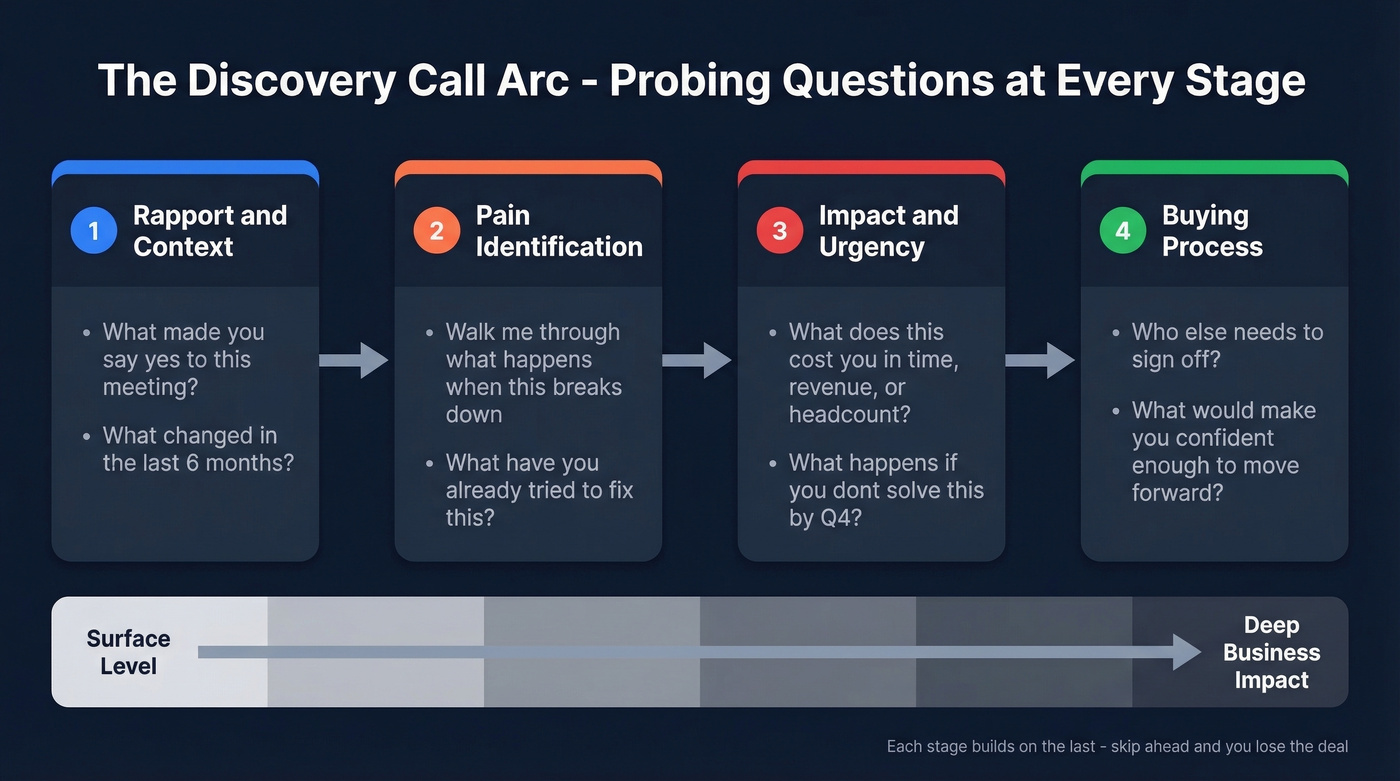
Rapport and context:
- "What made you say yes to this meeting?"
- "What's changed in the last 6 months that put this on your radar?"
- "How are you currently measuring success for [area]?"
Pain identification:
- "When specifically is this a problem - daily, weekly, quarterly?"
- "Walk me through what happens when [process] breaks down."
- "What have you already tried to fix this?"
- "If you could change one thing about how this works today, what would it be?"
Impact and urgency:
- "Who else on your team is affected by this?"
- "What does this cost you - in time, revenue, or headcount?"
- "What happens if you don't solve this by [quarter/date]?"
- "How many deals slipped last quarter because of this?"
Buying process:
- "Besides yourself, who needs to sign off on a decision like this?"
- "What's your timeline for having something in place?"
- "What would make you confident enough to move forward?"
The difference between a mediocre discovery call and a great one comes down to the second and third follow-up. Watch how a single feature question transforms with deeper probing:
Weak: "Do you need Salesforce integration?"
Better: "You mentioned deals slipping into next quarter. How many deals are we talking about, and what's your average deal size? ... So if 15 deals at $40K each slip because your tools don't sync - that's $600K in delayed revenue. Is that the kind of number that gets your CFO's attention?"
That's a probe converting a feature checkbox into quantified business impact. The prospect didn't walk in knowing the number. You helped them find it.
If you want a tighter structure for this part of the call, pair these with a dedicated set of discovery questions.
Customer Service
Probing in support isn't about selling - it's about resolving. Good probes improve First Contact Resolution rates because you're responding to the actual need, not your assumption of it. Teams that probe effectively also see lower escalation rates and higher CSAT scores, because the first agent actually solves the problem.
Billing and account issues:
- "What do you want to get out of this call today?"
- "When did you first notice the discrepancy?"
- "Has this happened before, or is this the first time?"
- "What were you expecting to see on the invoice?"
Technical problems:
- "Walk me through exactly what happens when you try to [action]."
- "When did this begin - was there a change or update recently?"
- "What impact has this had on your workflow so far?"
- "Have you tried any workarounds? What happened?"
Retention and escalation:
- "What would need to change for this to work for you going forward?"
- "If we could fix [specific issue], would that resolve your concern?"
- "What's the most frustrating part of this experience?"
One timing note: emotionally direct probes like "How did that make you feel?" only work after you've built rapport. Ask that in the first 30 seconds and you'll get a wall. Ask it after you've demonstrated you're listening, and you'll get the real answer.
Job Interviews
Hiring managers who ask surface-level questions get surface-level candidates. Follow-up probes separate a rehearsed answer from genuine competency evidence.
Decision-making:
- "Walk me through a decision you made with incomplete data. How did you know you had enough information to move?"
- "What was the biggest trade-off you had to make in that situation?"
Leadership and delegation:
- "How do you decide what to delegate versus handle yourself?"
- "Tell me about a time your delegation didn't work. What did you change?"
Conflict resolution:
- "Describe a disagreement with a peer where you were wrong. How did you realize it?"
- "What's your approach when two team members have fundamentally different views on a project direction?"
Follow-up probes to use after any initial answer:
- "What would you do differently if you faced that situation again?"
- "How did the outcome affect the team's approach going forward?"
- "What did that experience teach you about [leadership/prioritization/communication]?"
These come from competency-based interview frameworks - they push candidates past the polished story into the messy reality of how they actually think.
Coaching and Therapy
A therapy client once posted on Reddit that their therapist kept saying "Tell me more about that" - and it wasn't helping. What they wanted was a more specific probe, something that would "open emotional doors." When the therapist finally asked a targeted question about how others had understood them growing up, it sparked a whole new direction.
Specificity beats generic probing every time.
- "What was the best part of your week?"
- "What were you feeling right before that happened?"
- "When you imagine the ideal outcome, what does it look like?"
- "What would you tell a friend in the same situation?"
- "What's the story you're telling yourself about why this keeps happening?"
- "What strengths did you use to get through that?"
A word of caution from counseling practitioners: questions can also judge, tear down, silence, and isolate. "What's wrong with you?" is technically a question. It's also destructive. The intent behind the probe matters as much as the phrasing.
Education and Classroom
Most teachers default to lower-order questions - recall, comprehension, basic application. Higher-order questions aligned to Bloom's taxonomy drive deeper critical thinking.
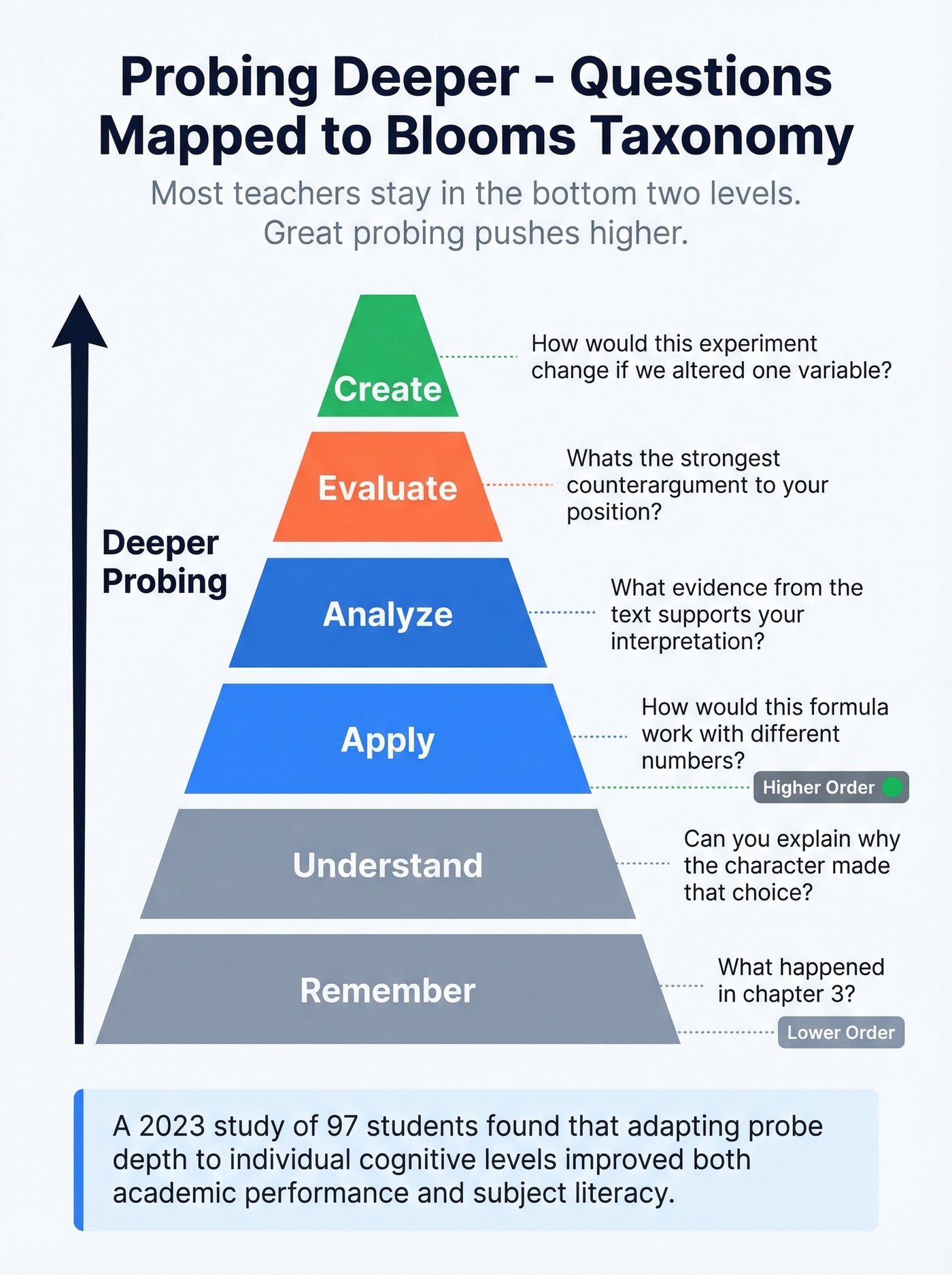
- "Why do you think the author chose that ending instead of [alternative]?"
- "How would this experiment change if we altered [one variable]?"
- "What evidence from the text supports your interpretation?"
- "What's the strongest counterargument to your position?"
A 2023 study of 97 students found that personalized questioning strategies - adapting probe depth to individual cognitive levels - improved both academic performance and subject literacy. One-size-fits-all probing underperforms in classrooms just like it does on sales calls.
UX Research
The NN/g heuristic is simple: aim for the participant to speak roughly 80% of the interview time. If you're talking more, you're not probing enough.
- "You hesitated there - what were you thinking?"
- "What did you expect to happen when you clicked that?"
- "How does this compare to how you'd normally do this task?"
- "What would make this easier for you?"
Build a probe bank - a personal list of go-to follow-ups organized by research phase. It keeps you from defaulting to "Can you tell me more?" on autopilot.

Your probing questions only matter if you're asking the right people. Prospeo gives you 300M+ verified contacts with 30+ filters - buyer intent, job changes, tech stack - so every discovery call starts with a qualified prospect, not a cold guess.
Stop wasting great questions on the wrong prospects.
The SPIN Framework for Sales
If you learn one probing framework, make it SPIN. Neil Rackham developed it from analysis of more than 35,000 real sales calls, and it remains the most research-backed questioning model in B2B sales. SPIN isn't the only game - MEDDIC and the Challenger Sale both emphasize depth - but SPIN gives you the clearest question-by-question structure.
If you're running MEDDIC in your org, keep a separate list of MEDDIC Discovery Questions so reps don’t default to generic follow-ups.
Situation questions establish context. They're necessary but low-value - ask too many and you sound unprepared. "How many reps are on your outbound team?" "What CRM are you using today?"
Problem questions identify pain. This is where most reps stop, and it's a mistake. "What's the biggest challenge with your current prospecting workflow?" "Where does the process break down?"
Implication questions are where SPIN earns its reputation. They expand the problem's perceived cost. "When leads go stale because data's outdated, how does that affect your reps' confidence in the pipeline?" "What happens to your quarterly forecast when 20% of contacts bounce?"
Need-Payoff questions get the buyer to articulate the value of solving the problem in their own words. "If your team could cut research time from 20 minutes to 2 minutes per prospect, what would they do with that time?" "How would accurate contact data change your outbound conversion rate?"
The framework maps cleanly to sales call stages: opening (Situation), investigating (Problem + Implication), demonstrating capability (Need-Payoff), and obtaining commitment. SPIN's core idea is simple - don't camp on long strings of Situation questions. Spend more of the conversation on Implication and Need-Payoff, where the business case gets built.
We've run discovery call audits where reps asked 8-10 Situation questions and zero Implication questions. The calls felt thorough. The deals went nowhere. SPIN gives you a diagnostic for why.
One counterintuitive tactic: "no-oriented" questions like "Is now a bad time to talk?" can actually open conversations faster than positive framing - a technique popularized by former FBI negotiators. It works because saying "no" feels safe, which lowers the prospect's guard before you start probing.
7 Common Mistakes (and Fixes)
1. Asking "why" when "what" works better. "Why did you choose that vendor?" puts people on the defensive. "What led you to that decision?" gets the same information without the accusatory tone. Replace "why" with "what" as your default, and you'll notice people open up faster.
2. Rapid-fire questioning. Three questions in a row without pausing for answers isn't probing - it's interrogation. Ask one question. Wait. Let the silence do its work.
3. Answering your own question. "What's your biggest challenge with outbound? Is it data quality? Or maybe deliverability?" You just gave them two easy outs instead of making them think. Ask the question and stop talking.
4. Generic probing on repeat. "Tell me more" is fine once. Said four times in a row, it's lazy. The therapy client who wanted their therapist to ask something more specific wasn't being difficult - they were asking for better probing. Swap "Tell me more" for a specific follow-up tied to what they just said.
5. Not allowing silence after asking. Most people need a few seconds to formulate a thoughtful answer. If you jump in too fast, you'll only ever get surface responses. The discomfort you feel in that pause is productive - sit with it.
6. Leading questions that bias answers. "Don't you think your current tool is too expensive?" isn't probing. It's projecting. "How do you feel about what you're paying for your current tool?" lets the prospect arrive at their own conclusion, which is far more powerful in a sales context.
7. Jumping to solutions too early. The moment a prospect mentions a pain point, the instinct is to pitch. Resist it. One more follow-up - "What impact does that have on your team's numbers?" - turns a surface complaint into a quantified business case. Value dumping before you've fully diagnosed the problem is the fastest way to lose a deal.
Let's be honest: most reps think they have a closing problem when they actually have a questioning problem. If your average deal size is north of $20K and you're losing deals in committee, it's usually not because your demo was bad. It's because you never uncovered the business case that would survive a CFO's scrutiny. One more Implication question can save the deal.
If you’re losing deals late, map your probes to the 7 steps to close a sale so the business case survives internal review.
How to Improve Your Probing Skills
Probing isn't a talent. It's a practice.
Build a personal probe bank. Organize your best questions by situation and stage. Sales reps should have probes mapped to rapport, pain, impact, and buying process. Support agents should have probes for billing, technical, and retention scenarios. Review and update the bank monthly - the questions that worked six months ago might not fit your current market.
Practice active listening. When someone gives a complex answer, repeat the key point back before asking your next probe. "So the core issue is that stale data is killing rep confidence - and that's showing up in pipeline accuracy. What does that cost you per quarter?" Repeating back proves you heard them and sets up a sharper follow-up.
Follow the 80% rule. If you're talking more than 20% of the time in a discovery call, interview, or research session, you're not probing enough. Record a call and measure. The number is usually worse than you think.
Sequence broad to specific. Start with exploratory probes that open the conversation, then funnel down to detailed confirmation questions. Going specific too early narrows the conversation before you've explored the full scope.
Prepare before the conversation. This is the unsung hero of great probing. You can't ask sharp questions about a prospect's tech stack challenges if you don't know their tech stack. You can't probe about headcount growth pain if you don't know they've doubled in 18 months. Pre-call research with tools like Prospeo's database - pulling company size, recent funding, department headcount, and tech stack - turns that prep into a 2-minute task.
If you’re building a repeatable outbound motion, combine this with modern sales prospecting techniques so your first question is specific from the start.
The difference between "So, tell me about your company" and "I noticed you've added 40 reps since your Series B - how's that scaling going?" is the difference between a generic call and a conversation that earns trust in the first 30 seconds.
You just learned how to quantify pain on a discovery call. Now imagine walking into every call already knowing the prospect's tech stack, recent funding, and headcount growth. Prospeo's intent data tracks 15,000 topics so your probing questions land with precision.
Arm your discovery calls with data that makes every probe hit harder.
FAQ
What's the difference between probing and clarifying questions?
Clarifying questions remove ambiguity about something already said ("When you say 'fast,' do you mean under 2 seconds?"). Probing questions dig deeper to uncover motivations, impact, or context not yet shared. Clarifying narrows; probing expands. Use clarifying to confirm details, probing to discover new information.
How many probes should I ask per conversation?
In a 30-minute sales discovery call, expect 8-12 meaningful follow-ups across rapport, pain, impact, and process stages. The 80% rule matters more than a fixed count: if you're talking over 20% of the time, you're not probing enough. Record a call and measure - most people overestimate how much they listen.
Can probing questions backfire?
Yes - "why" questions feel accusatory, rapid-fire probing feels like interrogation, and generic "tell me more" on repeat feels lazy. Fix it by asking one question at a time, replacing "why" with "what," and waiting 3-5 seconds after you ask. Silence is where thoughtful answers form.
What's the best framework for sales discovery?
SPIN Selling - Situation, Problem, Implication, Need-Payoff - based on 35,000+ real sales calls. Spend less time on Situation questions and more on Implication and Need-Payoff, where the business case gets built. Pair it with pre-call research so your Situation questions are already half-answered before you dial.
How do I prepare to ask better probing questions?
Research your audience before the conversation - know the prospect's role, company size, tech stack, and recent changes. Reps who walk in informed skip generic openers and jump straight to high-value probes. The goal is to make your first question specific, not a time-wasting warm-up.