

Probing vs Clarifying Questions: When to Use Each
Your direct report says "I'm frustrated with the project." You nod. You ask a question. But which kind?
The wrong one gets you a shrug. The right one gets you the actual problem - and a path forward. Understanding the difference between probing and clarifying questions is simpler than most people make it. If the person has to think before answering, it's probing. If they can answer immediately with a fact, it's clarifying. Stop treating them as separate skills. Clarify first, then probe. Every good conversation follows this funnel.
What Are Clarifying Questions?
Clarifying questions are questions of fact. They fill in missing details - often using the who, what, when, where, why, and how framework - so everyone's working from the same picture.
Your manager says "Prepare for the client presentation next week." Before you do anything, you clarify: who's attending, what materials they expect, the exact date and time. Without those answers, you're guessing.
Common clarifying stems: "Which version are you referring to?", "When exactly is the deadline?", "Can you walk me through what you mean by...?", and "Is the report due by Friday or Monday?" These aren't deep questions. They're precision tools that eliminate ambiguity before you go deeper.
What Are Probing Questions?
Probing questions require thought. The person can't just retrieve a fact - they have to reflect, analyze, or examine their own reasoning before responding.
Where clarifying narrows the picture, probing expands it. You're pushing past surface statements to uncover motivations, implications, and root causes. Strong probing stems: "What made you say yes to this meeting?", "Is the problem getting worse over time?", "How are you currently measuring success for that?" Some taxonomies treat clarifying as a subtype of probing, but in practice the distinction matters because the two serve different purposes at different moments in a conversation.
Key Differences at a Glance
| Dimension | Clarifying | Probing |
|---|---|---|
| Purpose | Confirm facts | Uncover depth |
| Depth | Surface-level | Analytical |
| Timing | Early in conversation | After facts are set |
| Example | "Which client?" | "Why that client?" |
| Best for | Removing ambiguity | Driving insight |
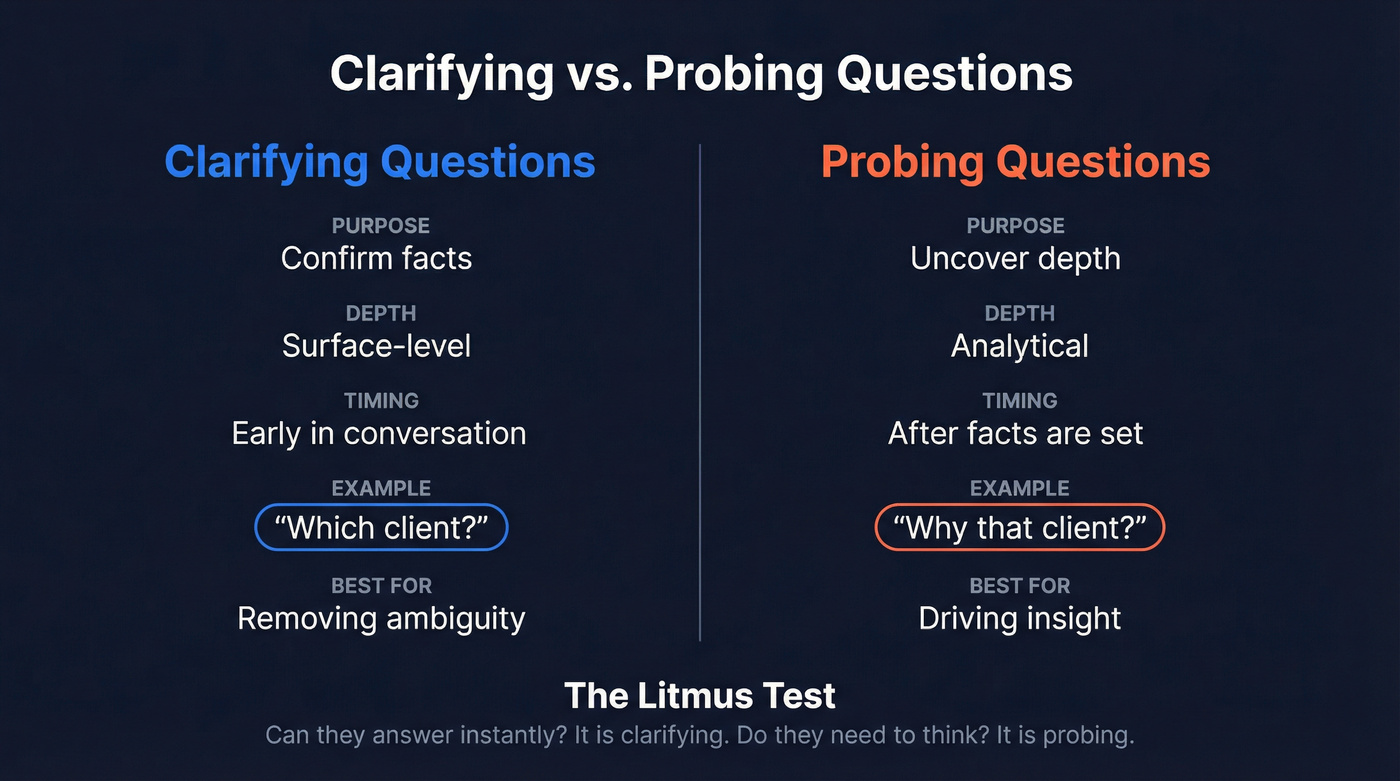
The litmus test still governs: can they answer instantly, or do they need to think? That single check tells you which type you just asked - and which type you should ask next.

Your best probing questions mean nothing if you're asking the wrong person. Prospeo gives you verified emails (98% accuracy) and direct dials for actual decision-makers - so every discovery call starts with someone who can say yes.
Stop running discovery with people who can't sign the deal.
When to Clarify, When to Probe
Here's the thing most guides miss: these aren't separate skills. They're a sequence. Clarify first to establish shared understanding, then probe to go deeper. Trying to probe before you've clarified is like diagnosing a patient before taking their temperature.
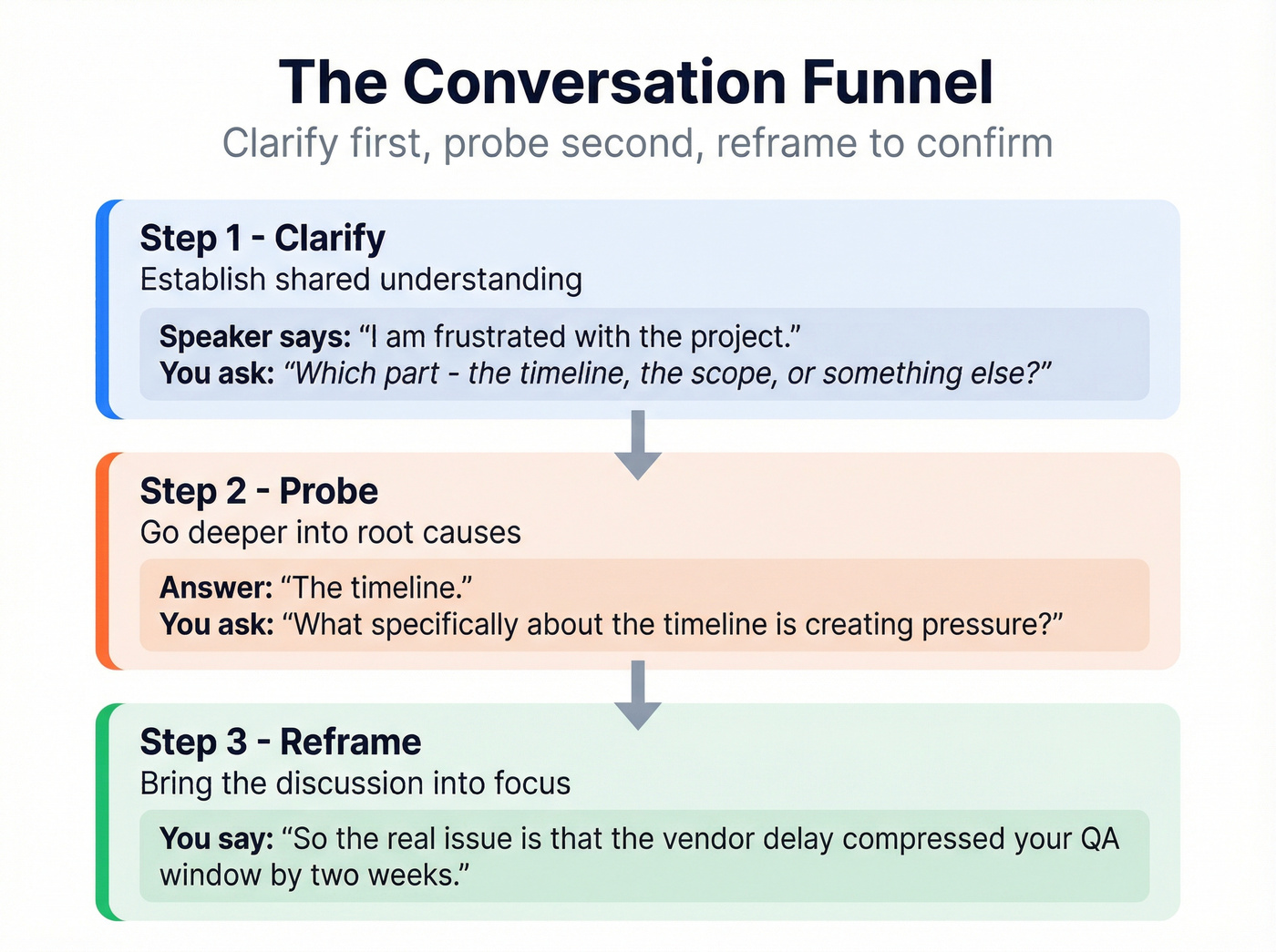
Take "I'm frustrated with the project." First, clarify: "Which part - the timeline, the scope, or something else?" Once you know it's the timeline, probe: "What specifically about the timeline is creating pressure?" Then reframe the problem back to bring the discussion into focus: "So the real issue is that the vendor delay compressed your QA window by two weeks." That third move - reframing - is what separates a good conversation from a great one.
One timing note worth remembering: hold your questions until the other person finishes speaking. Jumping in with clarifiers mid-sentence signals you're not actually listening, and it kills whatever momentum the speaker had building toward their real point.
Examples by Domain
Sales Discovery Calls
A prospect says "We need better reporting." A rookie rep demos the reporting module. A skilled rep clarifies first: "Better in what way - more granular data, faster access, or different metrics?" Then probes: "Why is reporting an issue now?"
If you want a deeper set of prompts, start with a proven list of discovery questions and adapt them to your deal cycle.
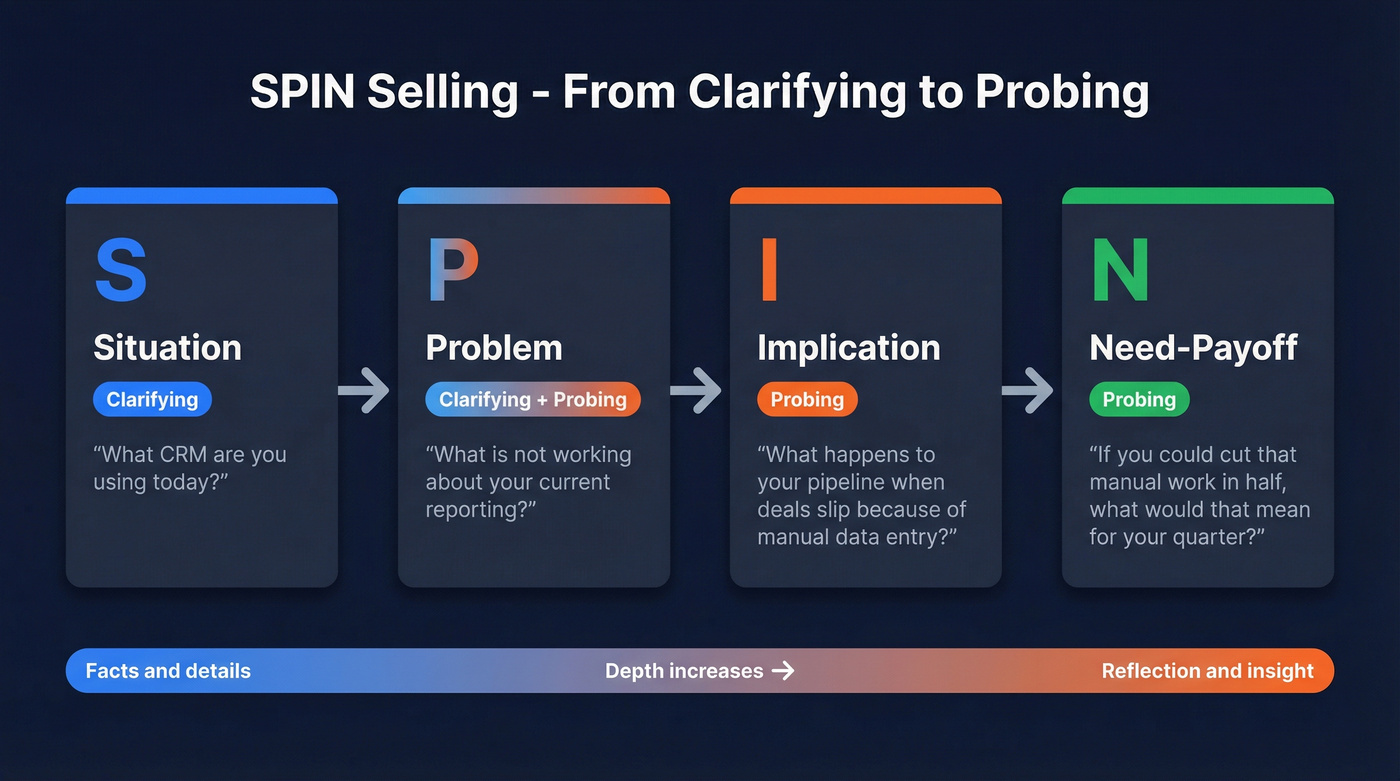
SPIN Selling - Situation, Problem, Implication, Need-payoff - is one of the clearest probing structures for sales. The Aircover team documented a sharp example: a prospect asks "Does your product support a Salesforce integration?" Instead of just saying yes, the rep probes: "Why are you looking for a Salesforce integration?" That single follow-up uncovered deals slipping quarters because of manual data entry. Reps who clarify before probing in discovery run better calls because they're solving the actual problem, not the stated one.
Of course, great discovery questions only matter if you're talking to the right person. We've watched reps burn entire weeks running discovery with contacts who couldn't actually sign off on anything. Tools like Prospeo help you find verified emails and direct dials for decision-makers so your discovery calls happen with someone who can say yes.
If you’re building a repeatable outbound motion, pair this with modern sales prospecting techniques so you’re not just asking better questions - you’re asking them in the right accounts.
UX Research Interviews
The NN/g team flags a specific pitfall: clarifying questions that introduce an interpretation become leading questions. "Did you choose that meal because it was easy?" isn't clarifying - it's suggesting a reason. Better: "What made you decide on that meal?" The fix is semi-structured interviews where you follow the participant's lead and narrow with clarifiers only after open-ended prompts.
Coaching and 1-on-1s
Socratic questioning is the go-to framework for probing in coaching contexts. It spans six types - from clarification and assumption-challenging to exploring implications and questioning the question itself. This framework is backed by controlled trials in CBT and translates directly to management 1-on-1s.
Instead of "Why did you miss the deadline?" try "What got in the way of finishing on time?" Same information, completely different emotional register.
Workplace Meetings
Paraphrasing is an underrated clarifying technique. Restate what you heard - "So you're saying the vendor timeline is the bottleneck, right?" - and wait for confirmation before probing. This catches misunderstandings before they compound.
Once facts are clear, try an elevating question: "Are we even addressing the right problem here?" Adjoining questions explore related areas: "Where else could we apply this solution?" or "Who else is affected?" We've seen teams spend entire meetings debating solutions to the wrong problem because nobody paused to ask.
Common Mistakes
Turning clarifying into leading questions. "Don't you think the deadline is too aggressive?" isn't clarifying - it's lobbying. Keep clarifiers neutral.
This is especially important in sales communication, where a “clarifier” can accidentally become a persuasion attempt.
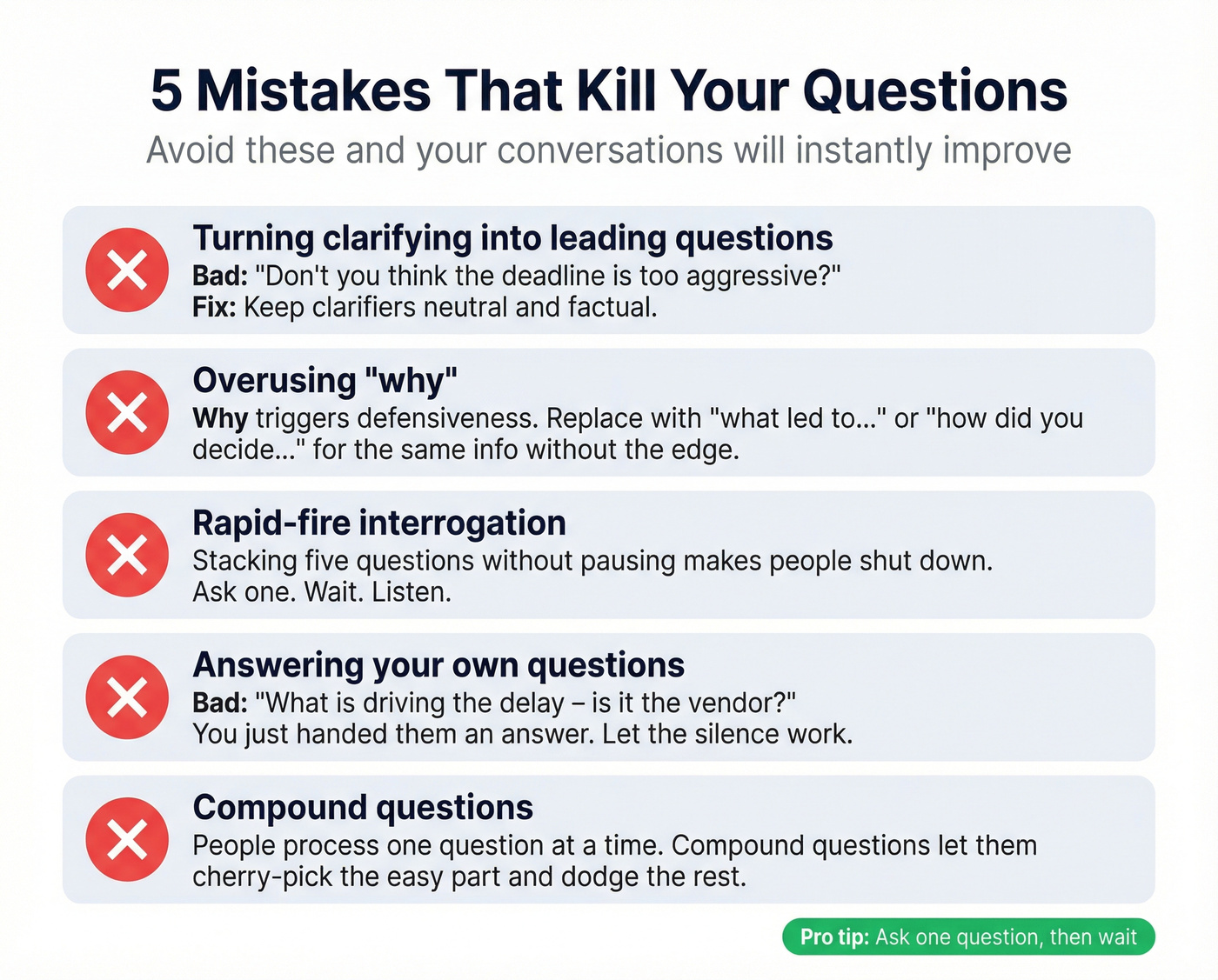
Overusing "why." Real talk: "why" is overrated in professional settings. It triggers defensiveness because it sounds like you're questioning someone's judgment. Replace with "what led to..." or "how did you decide..." for the same information without the edge.
Rapid-fire interrogation. Stacking five probing questions without pausing makes people shut down. Ask one. Wait. Listen.
If your team struggles with this in calls, a simple discovery call script can enforce better pacing.
Answering your own questions. "What's driving the delay - is it the vendor?" You just handed them an answer instead of letting them think. Let the silence do its work.
Compound questions. "What's the timeline and who's responsible and what's the budget?" Pick one. People process one question at a time, and compound questions let them cherry-pick the easiest part to answer while dodging the rest.
This is one reason structured qualification frameworks like MEDDIC stay useful: they force one dimension at a time.
Reps who clarify before probing run better calls. Reps who prospect with Prospeo run them with the right people. 300M+ profiles, 30+ filters including job title and seniority - so your SPIN questions land with buyers, not gatekeepers.
Nail the who before you nail the why. Start free today.
FAQ
What's the easiest way to tell probing and clarifying questions apart?
If the person can answer immediately with a fact, it's clarifying. If they need to reflect or analyze before responding, it's probing. "Which report?" is clarifying. "What would happen if we stopped producing that report?" is probing. The distinction is cognitive effort required, not the phrasing of the question itself.
Can a clarifying question also be a probing question?
Technically yes - some frameworks treat clarifying as a subtype of probing. The practical difference is intent. "Which version?" checks a fact. "What do you mean when you say it's not working?" pushes someone to examine their reasoning, even though the phrasing looks similar. Let's be honest - the labels matter less than knowing when to use each.
What's the best framework for asking better probing questions?
Socratic questioning is the most validated framework, proven in therapy, education, and coaching across six question types. For sales specifically, SPIN Selling gives the clearest structure for moving from surface-level situation questions to high-impact implication questions. Skip Socratic if you're in a fast-paced sales environment where you need a repeatable playbook - SPIN will serve you better there. Always clarify facts before you probe for depth.