

Problem Questions in Sales: The Complete SPIN Playbook
You're 10 minutes into a discovery call. The prospect is giving polite but vague answers, and you can feel the deal drifting toward "we'll circle back." The problem isn't your product - it's your questions.
Mastering problem questions is what separates reps who uncover real pain from those who get ghosted after demo. Rackham's SPIN research, built on over 35,000 sales calls, found that developing explicit needs before pitching solutions cuts objections per selling hour by 55%. Most reps never get there because they treat the problem-question stage as a checkbox instead of a skill.
Here's the thing: every rep knows SPIN exists. Almost nobody executes the problem-question stage well enough for it to matter - and that's exactly where deals are won or lost.
What Are SPIN Problem Questions?
Problem questions uncover pain or dissatisfaction with the prospect's current state. In SPIN, they come after situation questions and before implication and need-payoff questions. Where situation questions ask "what's happening," problem questions ask "what's broken."
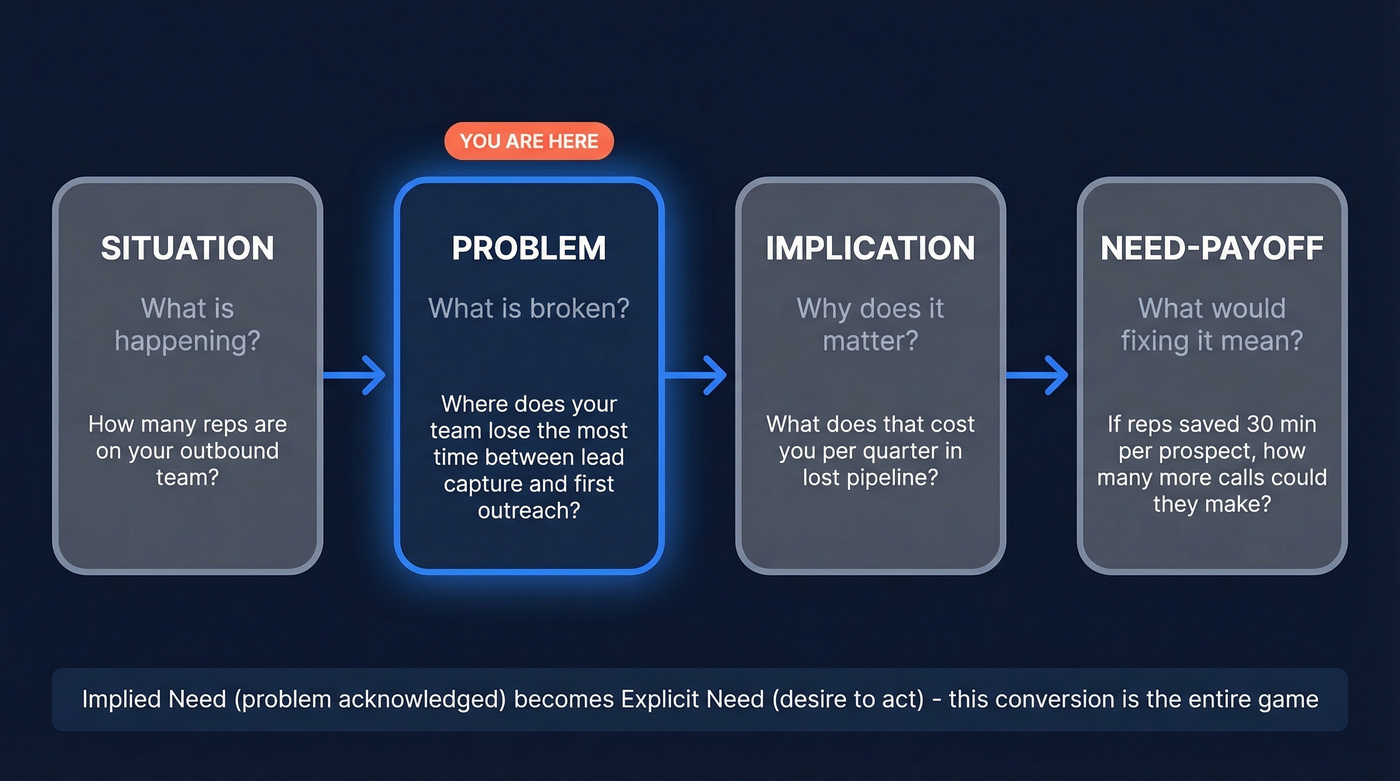
The distinction matters because situation questions build your map, but problem questions find the cracks in it. Implication questions then make those cracks feel urgent.
One nuance most SPIN summaries gloss over: Huthwaite's research distinguishes between implied needs (a problem or dissatisfaction) and explicit needs (a stated want or desire). Strong investigating turns implied needs into explicit ones before you propose a solution. That conversion is the entire game.
Why Discovery Questions Drive Revenue
Salespeople who sharpen their investigating skills see 20%+ revenue lifts. Top performers ask far more discovery questions than average reps and 4x more implication questions - but they only reach implications by surfacing real problems first. You can't expand a consequence the prospect hasn't acknowledged yet.
The uncomfortable part: 60-70% of SPIN implementations fail. Behavioral relapse, shallow follow-ups, reps reverting to pitch mode after one problem surfaces. The framework works. Execution is where it falls apart.
A counter-perspective worth noting: RAIN Group argues that purely pain-focused discovery misses half the picture - prospects also buy toward aspirations, not just away from problems. We think both are true, but in our experience, you earn the right to discuss aspirations only after you've proven you understand the pain. Pain point questions come first.
20 Examples by Industry
Generic questions get generic answers. These target specific, actionable pain.
SaaS / Technology
- "What happens when a new rep needs to get up to speed on your current tool?"
- "Where does your team lose the most time between lead capture and first outreach?"
- "How confident are you that your current data is accurate enough to run outbound at scale?"
- "What breaks first when your team tries to scale from 50 to 200 outbound touches per day?"
Professional Services
- "How do you currently track utilization, and where does it fall short?"
- "What's your biggest bottleneck between winning a project and kicking it off?"
- "How often do scope changes catch you off guard mid-engagement?"
Field Sales / Equipment / Operations
A seller on r/sales described struggling to move past situation questions when selling office tech. The trick is anchoring to specific operational risks:
- "What happens to your schedule when a key supplier misses a delivery window?"
- "How do you handle parts availability for equipment over five years old?"
- "Where do quality issues surface, and how far downstream before someone catches them?"
Cross-Industry
The best cross-industry questions force the prospect to confront normalized pain - the stuff they've stopped noticing.
"What's the most frustrating part of your current process that you've just learned to live with?" works because it gives permission to complain. "Which decisions are you making today based on incomplete or outdated data?" works because the answer is always "more than I'd like." And "If you could eliminate one recurring bottleneck this quarter, what would it be?" forces prioritization, which is where real buying intent lives.

That prospect who said finding accurate contact info is "a mess"? That's the exact problem question your buyers will answer about you if your data is bad. Prospeo's 98% email accuracy and 7-day refresh cycle mean your reps stop researching and start selling.
Stop surfacing pain you're also causing. Get data that actually connects.
The Follow-Up Probe Ladder
The initial question is just the door. Most reps hear a problem and immediately start solving it. Top performers hear a problem and ask five more questions about it. This is the single most underused technique in problem-focused sales conversations.
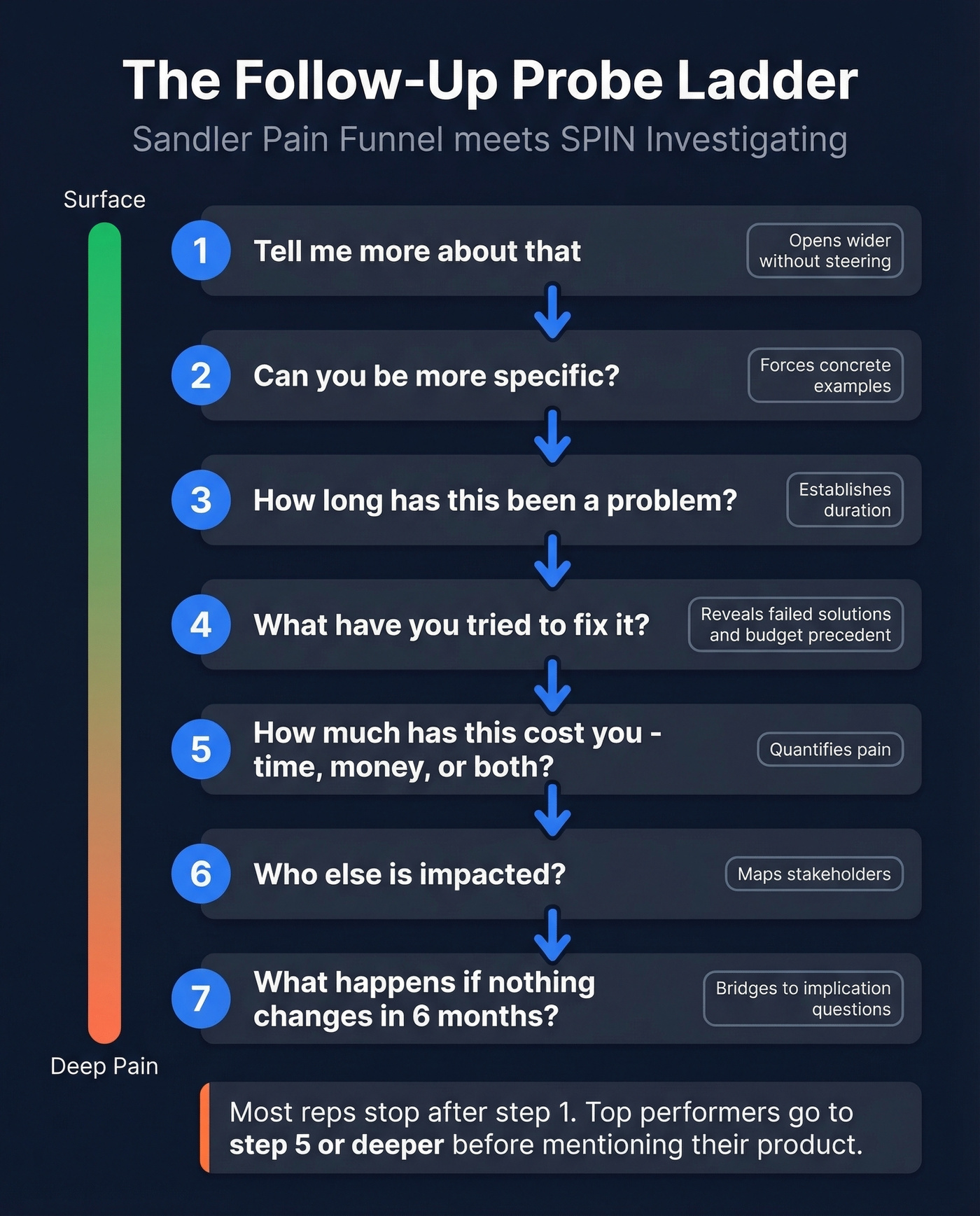
This 7-step sequence blends Sandler's Pain Funnel with SPIN's investigating philosophy:
- "Tell me more about that." - Opens wider without steering.
- "Can you be more specific?" - Forces concrete examples.
- "How long has this been a problem?" - Establishes duration.
- "What have you tried to fix it?" - Reveals failed solutions and budget precedent.
- "How much has this cost you - time, money, or both?" - Quantifies pain.
- "Who else is impacted?" - Maps stakeholders.
- "What happens if nothing changes in 6 months?" - Bridges to implication questions.
The Ladder in Action
Here's what this sounds like in a real conversation:
Rep: "Where does your team lose the most time between lead capture and first outreach?"
Prospect: "Honestly, just getting accurate contact info. It's a mess."
Rep: "Can you be more specific - what does 'a mess' look like day to day?"
Prospect: "Reps spend maybe 30 minutes per prospect just finding a direct email that doesn't bounce."
Rep: "How long has that been the case?"
Prospect: "Since we switched providers last year. Accuracy tanked."
Rep: "Across a team of 12 reps, about how many prospects does each rep research in a typical week?"
Four questions deep. No pitching. The prospect is now doing the math with you. That's when you've earned the right to talk solutions.
When Prospects Can't Name the Problem
A SaaS seller on r/sales asked a prospect how confident they were in finding all available tender opportunities. The response: "you don't know what you don't know."
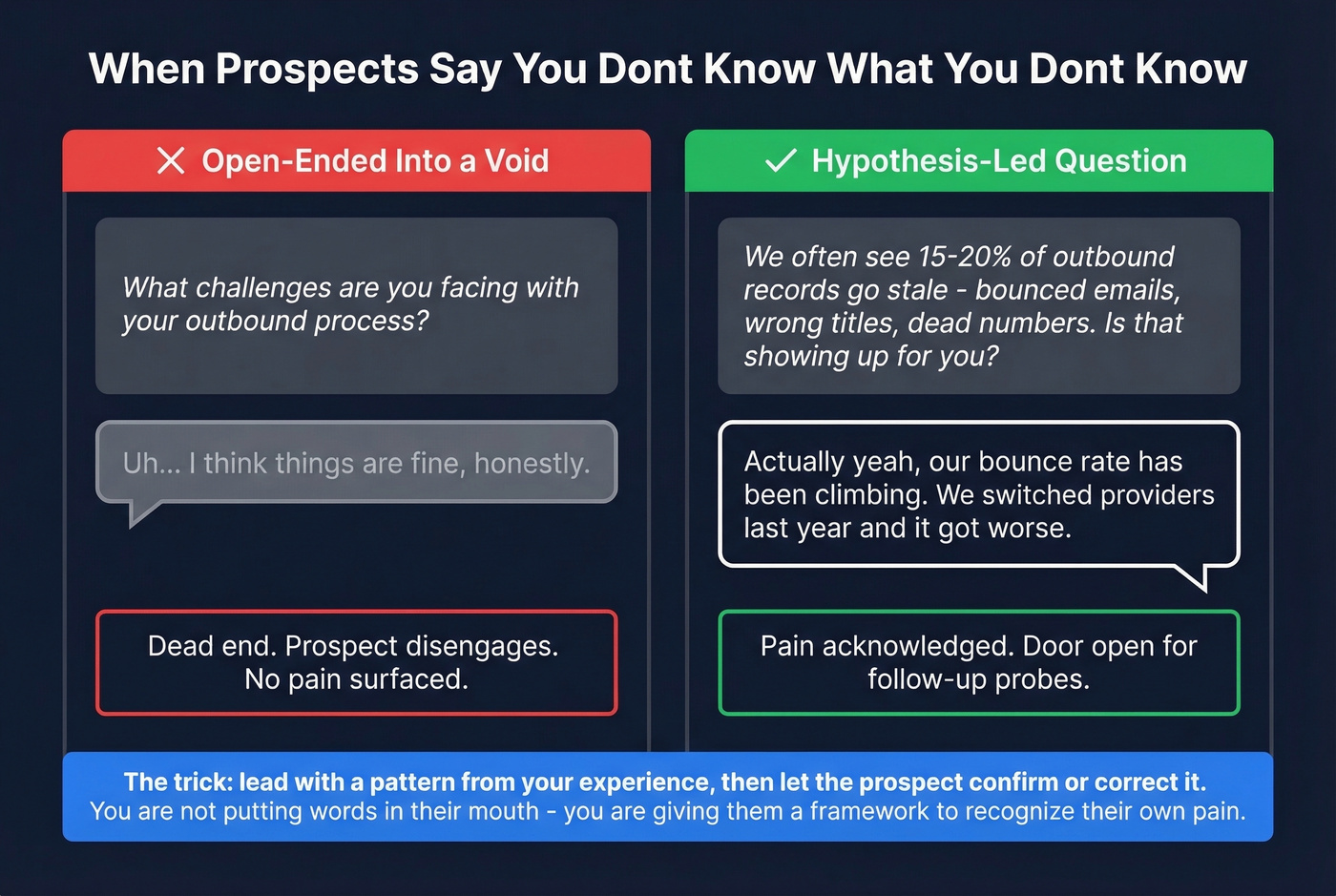
This is where hypothesis-led questions come in. Instead of asking open-ended questions into a void, lead with a pattern:
"We often see 15-20% of outbound records go stale - bounced emails, wrong titles, dead numbers. Is that showing up for you?"
You're not putting words in their mouth. You're giving them a framework to recognize their own pain.
Common Mistakes
Asking "What keeps you up at night?" signals zero preparation. It's the sales equivalent of "tell me about yourself" in a job interview. Problem-centric questions need specificity to earn honest answers.
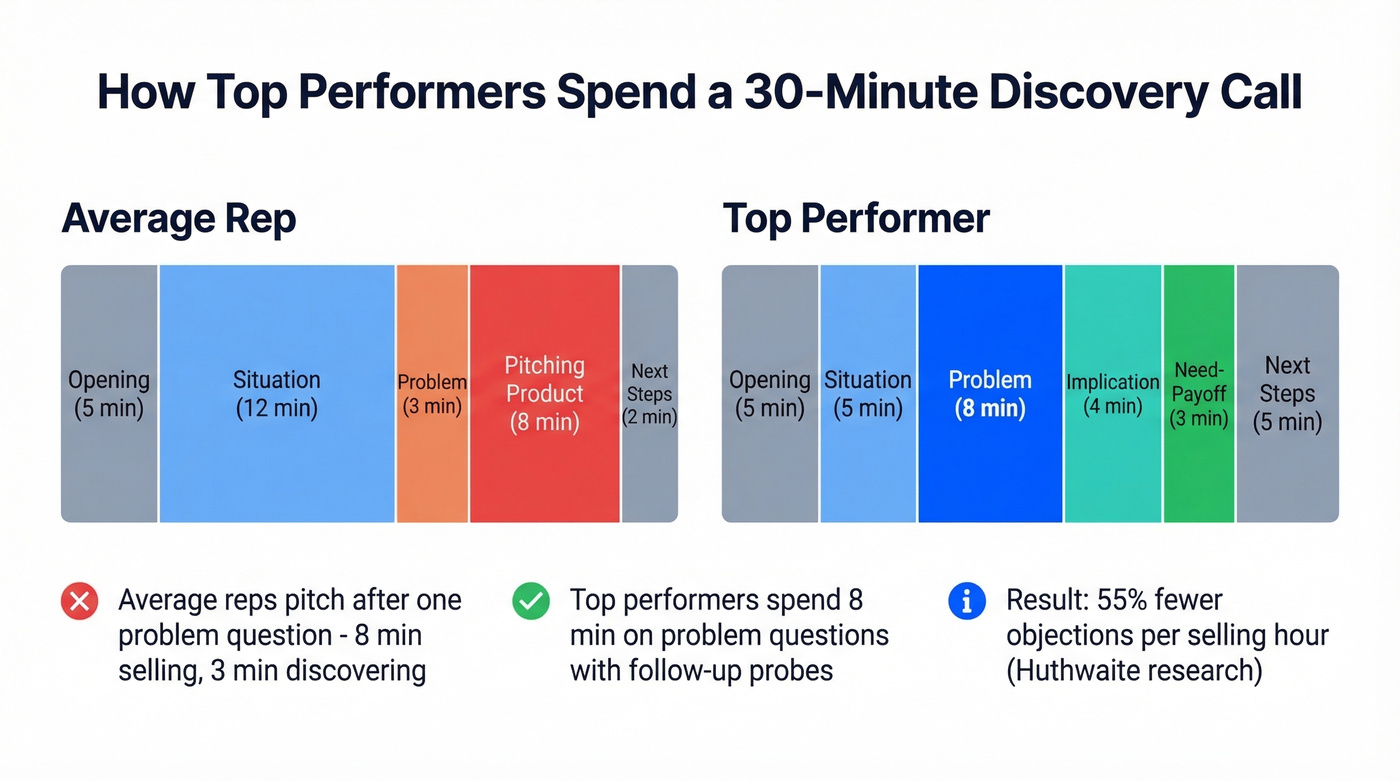
Jumping to solution mode after one question is the most common failure we see. You found a pain point - now ask four more questions about it before you mention your product. In a 30-minute discovery call, budget roughly 8 minutes for problem questions: Opening 5 min, Situation 5, Problem 8, Implication 4, Need-payoff 3, Next steps 5.
Talking to the wrong person entirely. Even perfect problem questions fail if you're calling someone who can't act on the pain. We use Prospeo to verify emails and direct dials before discovery calls - 98% email accuracy and a 30% mobile pickup rate mean your prep work reaches decision-makers, not gatekeepers.
If you're consistently getting stuck with non-buyers, tighten your lead scoring and align on the ideal customer profile before you book the meeting.
Future-Problem Questions
Rackham himself updated his guidance: the greatest value now comes from helping prospects anticipate problems they haven't experienced yet. This separates senior AEs from SDRs running a script.
- "As you scale from 100 to 500 customers, where do you expect your current onboarding process to break?"
- "If your industry sees the regulatory changes everyone's predicting, how prepared is your compliance workflow?"
These questions position you as a strategic advisor. You're not just uncovering today's pain - you're diagnosing problems before they cost money. The best discovery conversations shift from reactive to proactive, and future-problem questions are how you get there.
If you want a broader system for booking and qualifying meetings, pair this with modern sales prospecting techniques and a repeatable cold calling system.
Great problem questions are worthless if your reps waste 30 minutes per prospect hunting for a valid email. Prospeo gives your team 300M+ verified contacts at $0.01/email - so they spend discovery calls asking probe-ladder questions, not Googling phone numbers.
Give your reps the data to stay in discovery mode, not research mode.
FAQ
How Many Problem Questions Per Call?
Three to five with follow-ups beat ten surface-level ones. Top performers go deeper on each pain point instead of bouncing from topic to topic - aim for 2-3 follow-up probes per problem uncovered.
What's the Difference Between Problem and Implication Questions?
Problem questions surface the pain ("What's broken?"). Implication questions expand its consequences - cost, risk, ripple effects across teams. You can't expand a consequence the prospect hasn't acknowledged yet, so problem questions always come first in the SPIN sequence.
Do Problem Questions Work in Short Sales Cycles?
Yes, but you'll compress the ladder. For deals that close in one or two calls, pick your strongest problem question, run two or three follow-up probes to quantify the pain, then move directly to need-payoff. Skip the broad survey approach entirely - you don't have time for it, and the prospect doesn't have patience for it either.