

Product Knowledge in Sales: What Top Reps Do Differently
Your new AE just bombed a demo. The prospect asked how your pricing compares to a competitor, and the rep froze. Three weeks of onboarding, two product walkthroughs, a 90-page deck - and the rep couldn't answer the one question that mattered.
This isn't a hiring problem. It's a product knowledge problem. 77% of B2B buyers say their most recent purchase was "very complex or difficult." When buyers are navigating that complexity, they've got zero patience for a rep still figuring out the product. And when that rep churns six months later, the replacement cost runs $100K-$500K once you factor in lost pipeline, recruiting, and ramp time.
What Is Product Knowledge?
Product knowledge isn't memorizing a feature list. It's the ability to pattern-match a buyer's problem to your product's solution in real time - during a call, in an email, on a demo. It's knowing not just what the product does, but why it matters to this specific buyer.
Most companies treat it as a training event: a week of onboarding, a certification quiz, done. That's product training. True product fluency is the ongoing skill that compounds over months of customer conversations, competitive research, and hands-on use. The reps who genuinely learn your product through live sales conversations - not just in a classroom - are the ones who build real expertise.
Your buyers already know a lot. 96% of prospects research before engaging a rep, and 71% prefer doing that research independently. The bar for what reps need to know has never been higher.
Why It Matters More in 2026
The economics are brutal. Average SaaS ramp time is 5.7 months, and for enterprise sellers it stretches to 9-12 months. During that ramp, 20% of new hires leave within 90 days - often because they feel unsupported and underprepared.
Meanwhile, reps spend 60% of their time on non-selling tasks. When they finally get in front of a buyer, every minute counts. Organizations with mature enablement programs see a 49% win rate on forecasted deals versus 42.5% without - a 6.5-point lift from simply equipping reps with the right knowledge at the right time.
Most sales teams still onboard reps with a PDF and a prayer. The gap between companies that invest in structured training and those that don't is widening every quarter.
The 7 Types That Close Deals
Not all product knowledge is created equal. The reps who consistently outperform know seven distinct categories, and most teams only train on the first two.
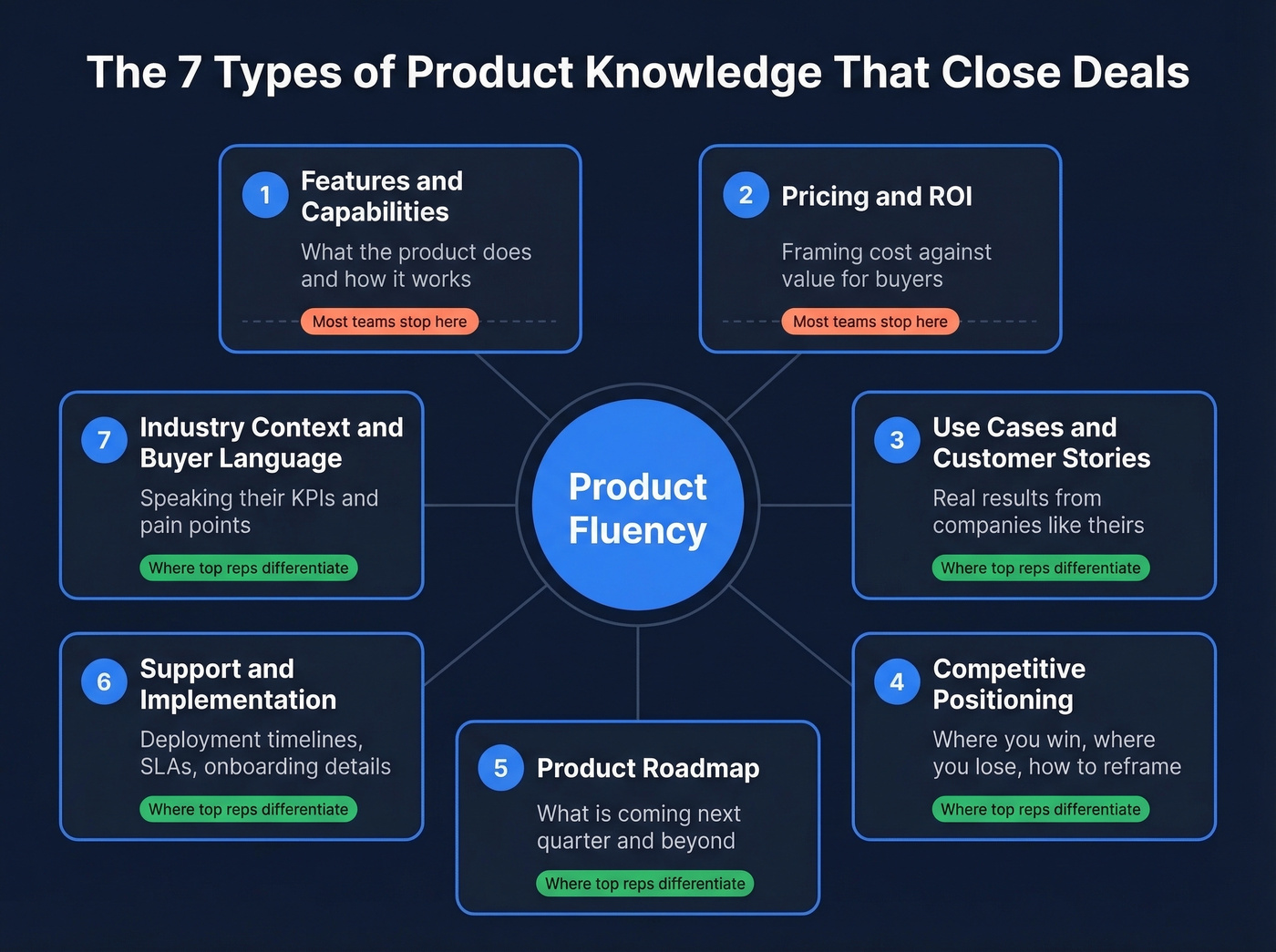
Features & capabilities. The baseline. What the product does, how it works, what's new. Necessary but insufficient on its own.
Pricing & ROI. Not just knowing the price sheet - understanding how to frame cost against value, build business cases, and handle "that's too expensive" without flinching.
Use cases & customer stories. The most persuasive knowledge a rep can carry. "A company like yours used this to solve X and saw Y result" beats any feature walkthrough. One strong case study has closed more deals than a hundred product slides.
Competitive positioning. Knowing where you win, where you lose, and how to reframe the conversation when a prospect brings up a competitor. This is the most overlooked type - and in our experience, the one that separates quota-crushers from quota-missers. Teams that track competitive win/loss data give their reps an unfair advantage.
Product roadmap. What's coming next quarter. Enterprise buyers especially care about trajectory - they're buying a partnership, not just a point solution.
Support & implementation. How long does deployment take? What does onboarding look like? What are the SLAs, warranties, and refund policies? Reps who can cite these specifics close faster because they eliminate uncertainty.
Industry context & buyer language. Speaking the buyer's language - their KPIs, their pain points, the acronyms they use internally. A rep selling into healthcare who says "patient throughput" instead of "efficiency" earns instant credibility.
The Biggest Mistake: Feature Dumping
Your rep knows the product inside and out. Great. Now they're spending 40 minutes walking through every feature on a demo while the prospect checks their phone.
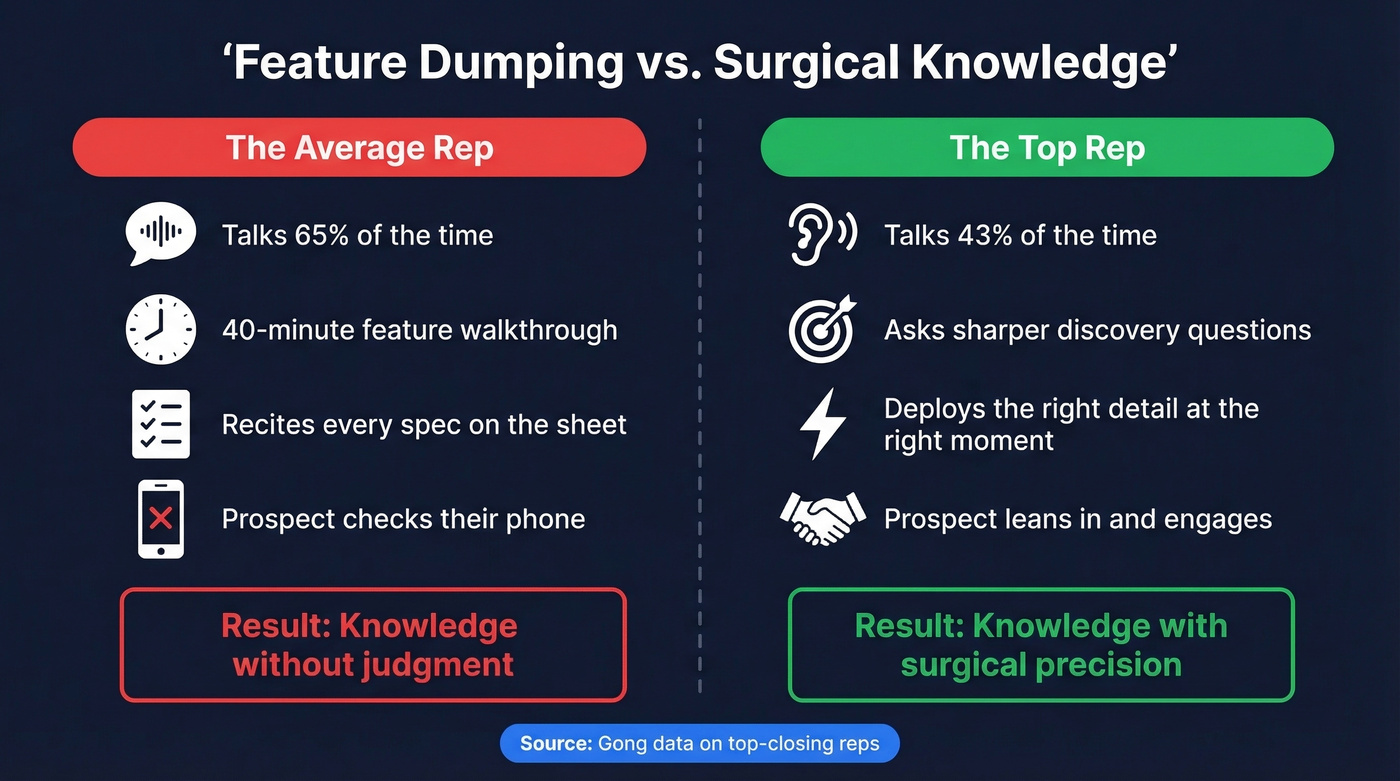
Deep expertise doesn't mean longer pitches. It means better pitches. Gong's data shows top-closing reps speak 43% of the time versus 65% for average reps. The best product-knowledgeable reps talk less, not more. They ask sharper questions, listen for the real problem, and deploy exactly the right piece of knowledge at exactly the right moment.
Highspot warns about the same trap from the enablement side: overwhelming reps with technical specs produces reps who regurgitate specs. A feature dump is knowledge without judgment. A great discovery call is knowledge with surgical precision.

Product knowledge gets your reps saying the right things. But it doesn't matter if those emails bounce. Prospeo delivers 98% email accuracy with a 7-day refresh cycle, so every perfectly crafted message lands in a real buyer's inbox - not a dead end.
Stop perfecting pitches that bounce. Start reaching real buyers.
Signs Your Team Is Falling Short
If any of these sound familiar, you've got a gap:
- Reps can't answer basic competitive questions without pulling up a document
- New hires describe onboarding as "figure it out" - they get a demo environment and zero structured guidance
- Prospects ask about pricing or implementation and reps say "let me get back to you" more than once per deal
- Novice reps make calls without knowing company history or product specs, and informed buyers smell it immediately
- Win rates crater when reps face buyers who've done their homework
The consensus on r/sales is pretty clear: companies that leave product knowledge to self-study are setting reps up to fail. And reps know it.
How to Build Real Product Fluency
Most training programs are built for the company's convenience, not the rep's workflow. Here's what actually moves the needle, ranked by impact.
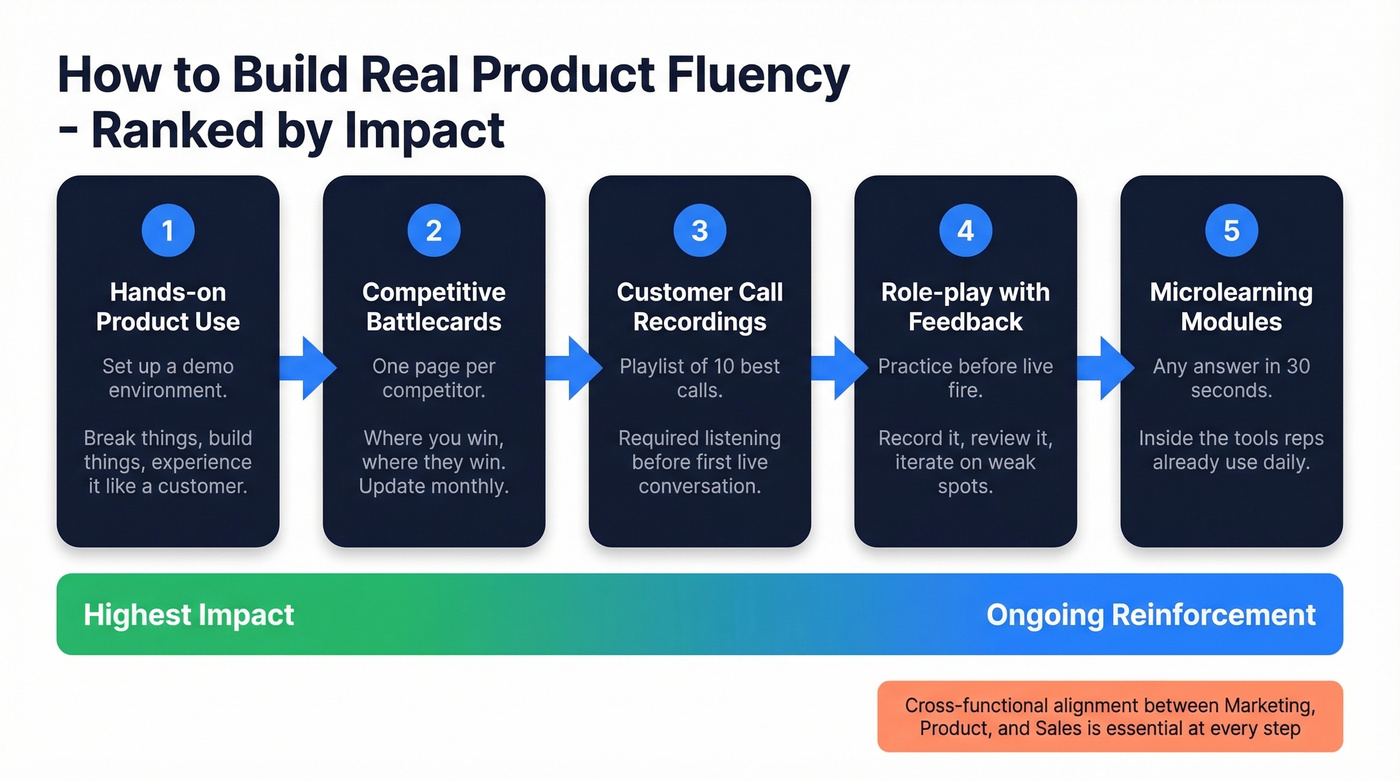
Hands-on product use comes first. Nothing replaces actually using the product. Every rep should set up a demo environment, break things, build things, and experience the product the way a customer does. One medical device rep on Reddit described making flashcards and watching product videos to survive a 200-slide onboarding deck - that's the right instinct, but it shouldn't be self-directed. Build it into the program.
Competitive battlecards are the fastest path to differentiation. A one-page doc per competitor covering where you win, where they win, and how to reframe objections. Update these monthly. Stale battlecards are worse than no battlecards. (If you need a starting point, use sales battle cards as the template.)
Customer call recordings are free training material most companies ignore. Reps hear how buyers actually talk about the product, what objections surface, and how top performers handle them. Make a playlist of the ten best calls and require every new hire to listen before their first live conversation.
Role-play with feedback bridges the gap between knowing and doing. Practice before live fire. Record it, review it, iterate.
Microlearning modules handle ongoing reinforcement. Spekit's research recommends a 30-second search-to-answer standard - reps should find any product answer within 30 seconds, inside the tools they already use. If your enablement content lives in a separate portal nobody visits, it doesn't exist.
The cross-functional piece matters too. Marketing, Product, and Sales need to be aligned on messaging, positioning, and what's changing. We've seen teams where Product ships a major feature and Sales doesn't hear about it for three weeks. That's organizational malpractice.
Measuring Training ROI
If you can't measure it, you can't justify the investment. Here's a framework adapted from Training Industry's methodology, mapped to product knowledge specifically.
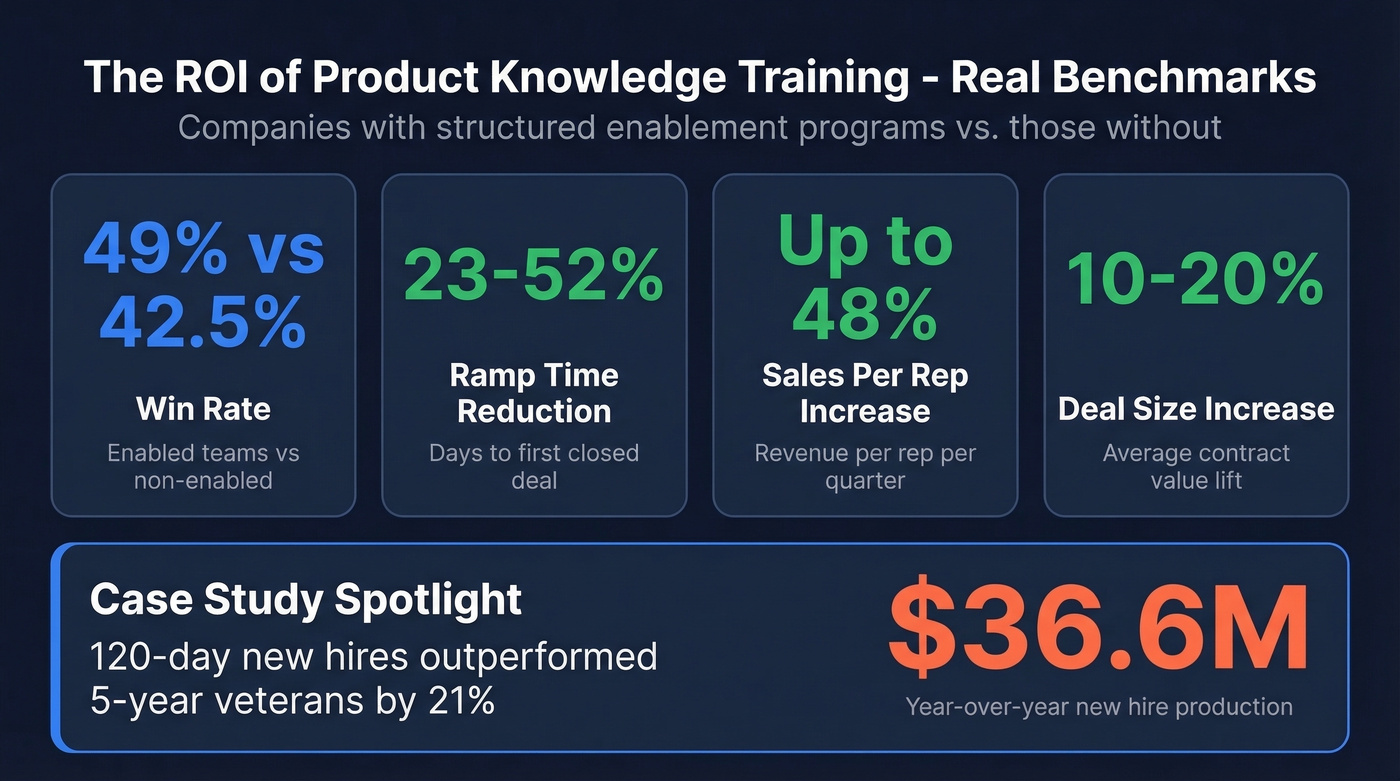
| KPI | What to Measure | Benchmark |
|---|---|---|
| Win rate | Forecasted deal close % | 49% (enabled) vs 42.5% |
| Ramp time | Days to first closed deal | 23-52% reduction |
| Sales per rep | Revenue per rep/quarter | Up to 48% increase |
| Deal size | Average contract value | 10-20% increase |
| Quota attainment | % of reps hitting quota | Enabled vs non-enabled |
| Knowledge scores | Pre/post assessments | 80%+ passing threshold |
These aren't theoretical. One distribution company that implemented structured onboarding with deep product knowledge components saw ramp times cut by 23-52%, win rates climb 16%, and sales per rep jump 48% - driving $36.6M in YoY new-hire production. Their 120-day new hires outperformed a control group of five-year veterans by 21%.
Let's be honest about something most enablement leaders won't say out loud: if your average deal size is under $15K, you probably don't need a six-month ramp program. A two-week sprint with battlecards, five recorded calls, and hands-on product time will get an SMB rep to 80% effectiveness. Save the elaborate programs for enterprise cycles where a single blown demo costs you a six-figure deal.
From Product Knowledge to Pipeline
Product knowledge is the ammunition. Accurate prospect data is the rifle.
73% of B2B buyers avoid sellers who send irrelevant outreach - and nothing screams "irrelevant" like a rep who doesn't understand their own product. But even reps who do know the product hit a wall when half their emails bounce because the contact data is stale. All that knowledge goes to waste when it never reaches a decision-maker.

This is where data quality becomes a force multiplier. Prospeo covers 300M+ professional profiles with 98% email accuracy and a 7-day refresh cycle, so the contacts your reps pull today are still valid next week. The free tier gives you 75 verified emails per month plus 100 Chrome extension credits to test the workflow, and credit-based pricing runs around $0.01 per email with no contracts required. Pair strong product fluency with verified contact data, and reps actually convert what they've learned into booked meetings.
If you're tightening the outbound engine too, pair this with proven sales prospecting techniques and a clean lead generation workflow so reps spend time selling, not hunting.
Top reps don't just know the product - they reach the right people. Prospeo gives your team 300M+ verified profiles with 30+ filters including buyer intent and job changes, so reps spend less time searching and more time selling with the knowledge they've built.
Give your trained reps the data to actually use what they know.
FAQ
What are the main types of product knowledge for sales reps?
Seven types: features & capabilities, pricing & ROI, use cases & customer stories, competitive positioning, product roadmap, support & implementation, and industry context with buyer language. Competitive positioning and buyer language are the most overlooked - and the highest-leverage for win rates.
How long does it take to ramp on a new product?
SMB SaaS reps typically ramp in 1-3 months, mid-market in 4-6, and enterprise in 9-12. Structured programs with battlecards, call recordings, and hands-on product use cut these timelines by 23-52%.
How do you measure product knowledge in a sales team?
Track win rate, ramp time, average deal size, and quota attainment across enabled vs. non-enabled cohorts over 90-day windows. Conversation intelligence tools flag behavioral shifts like talk/listen ratio improvements. Aim for 80%+ on post-training assessments.
What tools help reps access product information faster?
Enablement platforms like Highspot or Seismic, knowledge bases like Notion or Confluence, and CRM-embedded tools that surface answers in the flow of work. For prospect data - so reps can apply their expertise on the right buyers - tools like Prospeo provide verified emails and direct dials with a 7-day refresh cycle.