

How to Build a Product Sales Funnel That Actually Converts
You launched your product, ran ads for a month, got 500 clicks, and closed 2 deals. Is that good? Terrible? You have no idea because nobody gave you the actual numbers to compare against.
Most product sales funnel guides recite "Awareness -> Interest -> Decision -> Action" like that's a blueprint. It's not. It's a poster on a conference room wall.
Here's what actually matters: your funnel probably isn't broken because of your messaging - it's broken because you don't know your stage-by-stage conversion rates. There's no universal funnel either. SaaS, ecommerce, and digital products each need different architectures. And the highest-leverage move? Narrowing the top. Disqualify early, make sure the data feeding your funnel is clean, and stop wasting cycles on leads that were never going to close.
What Is a Product Sales Funnel?
A product sales funnel is two things. First, it's the journey someone takes from discovering your product to buying it - the classic acquisition funnel. Second, it's a product-led funnel where the product itself drives conversion through free trials, freemium tiers, and in-app upgrades.
Most modern funnels blend both. And buyers don't move through stages in a straight line. They loop, revisit, skip stages, and research across devices and channels before they ever talk to sales. Think of it less as a waterslide and more as a flywheel with multiple entry points. Build accordingly.
The 5 Stages With Real Benchmarks
Most funnel content stops at naming stages. Here are actual numbers so you can diagnose where yours is leaking.
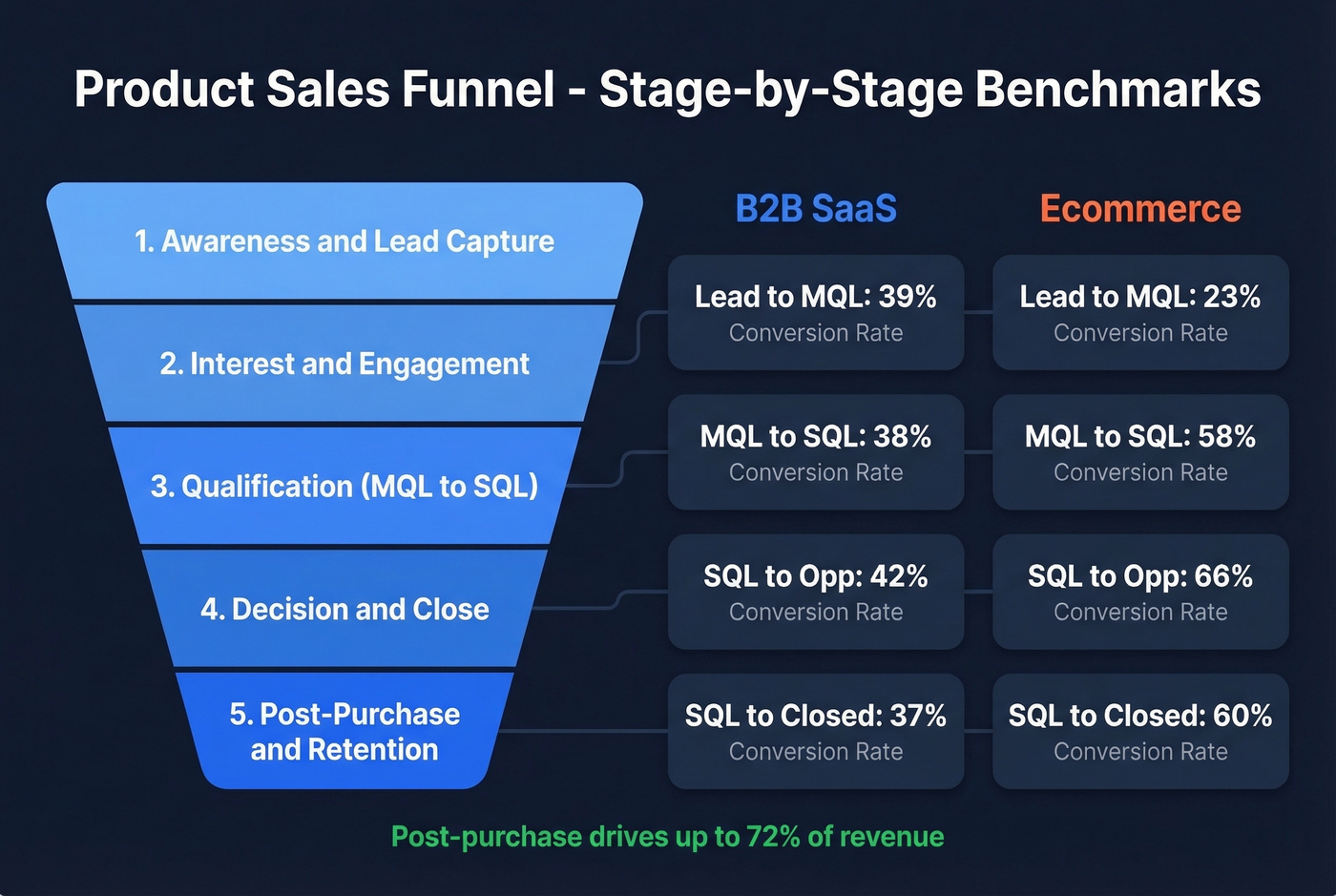
Awareness & Lead Capture
This is where prospects first encounter your product. Visitor-to-lead conversion averages 1.5-2.5% for B2B SaaS, with the top 10% hitting 8-15%. Below ~0.7%? You're in the bottom quartile. Fix your landing pages or ad targeting before you touch anything else.
Interest & Engagement
The gap between "I've heard of you" and "I'm paying attention." This is where content, retargeting, and product-led experiences earn the right to ask for contact info. We've watched teams obsess over bottom-of-funnel tactics while ignoring this stage entirely - then wonder why their pipeline is thin. Time from first visit to lead capture typically runs 1-3 days. Shorten it with strong calls to action and genuinely useful lead magnets, not gated PDFs that nobody reads.
Qualification (MQL to SQL)
Here's where most funnels bleed out. B2B SaaS converts Lead-to-MQL at 39% and MQL-to-SQL at 38%. Ecommerce looks different: only 23% Lead-to-MQL, but a much stronger 58% MQL-to-SQL. The qualification window runs 8-15 days on average - that's your nurture window. AI-driven lead scoring tools can compress this by surfacing high-intent prospects automatically, but they only work if the underlying data is accurate.
Decision & Close
SQL-to-Closed rates vary by industry. B2B SaaS runs about 37%, while ecommerce hits 60%. Enterprise deals take roughly 120 days from opportunity to close; SMB deals close in 30-45 days. If your close rate is strong but pipeline is thin, the problem is upstream. Teams running a high-ticket funnel - enterprise software, premium consulting - should expect longer cycles but significantly higher deal values, making each stage conversion even more critical.
Post-Purchase & Retention
If your funnel ends at purchase, you're ignoring up to 72% of your revenue. Retention, expansion, and referral are where compounding growth lives. This stage is the most neglected and the most profitable.
| Stage | B2B SaaS | Ecommerce |
|---|---|---|
| Lead to MQL | 39% | 23% |
| MQL to SQL | 38% | 58% |
| SQL to Opp | 42% | 66% |
| SQL to Closed | 37% | 60% |
Funnel Math Most Guides Skip
Say you need 10 closed deals. If each stage converts at 50%, you need 160 prospects at the top (10 x 2^4). Manageable. But if your stage-to-stage rate drops to 33%, you need 810 prospects (10 x 3^4). That's a 5x difference from a modest conversion drop, and as one SaaS founder described on r/GrowthHacking, it's exactly what kills most early-stage pipelines.
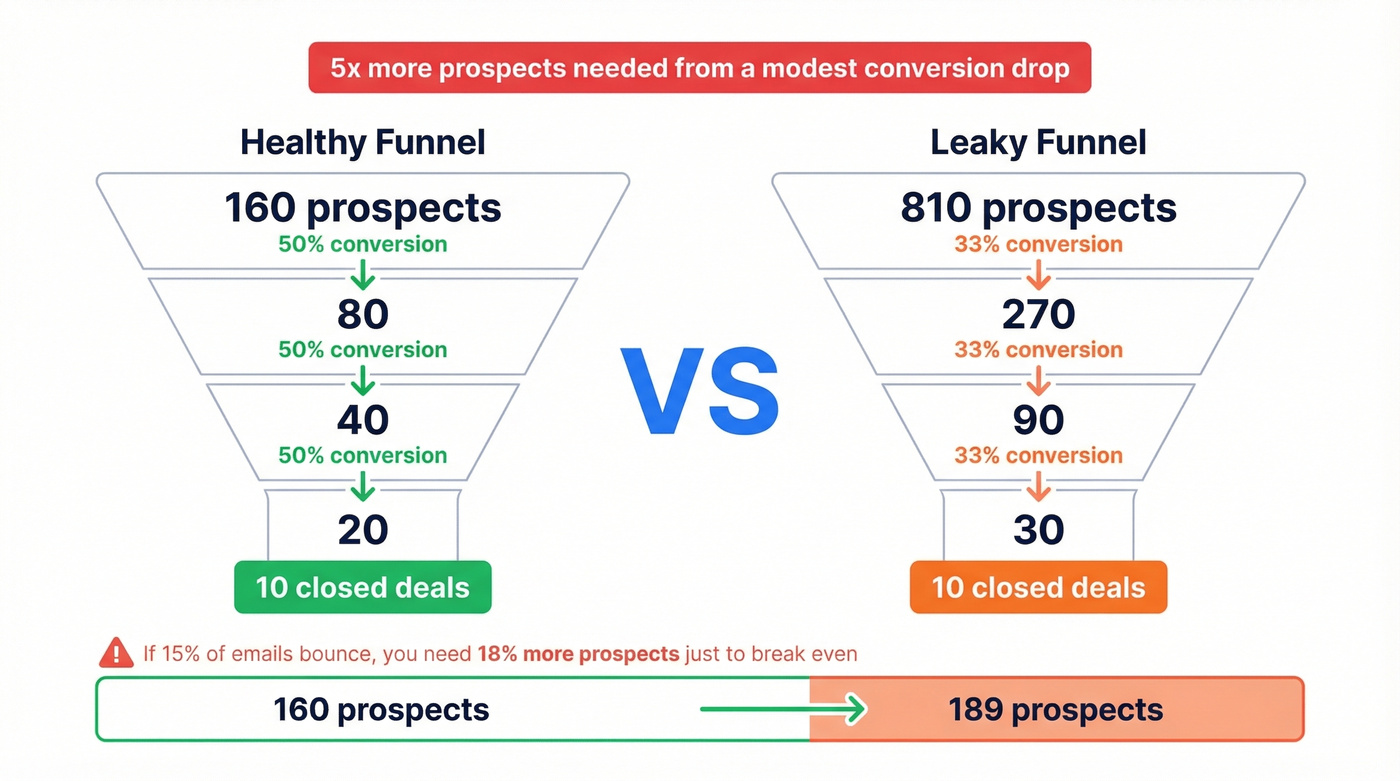
Let's be honest about where most teams waste their time. They optimize the middle of the funnel - tweaking email copy, adjusting lead scores - when the highest-leverage move is narrowing the top. Disqualify bad-fit prospects early so your team isn't burning cycles on leads that were never going to close. If 15% of your emails bounce, you need nearly 18% more prospects just to break even on the same pipeline target. We've seen teams cut their prospect requirements in half just by cleaning up email data before the first outreach, using tools like Prospeo that verify emails in real time at 98% accuracy so the funnel starts clean instead of leaking from the first touch.

The article shows it clearly: a modest drop in stage-to-stage conversion 5x's the prospects you need. If 15% of your emails bounce, you're burning budget before the funnel even starts. Prospeo's 98% email accuracy and 7-day data refresh mean your top-of-funnel stays clean - so every downstream stage converts at its real potential.
Stop feeding bad data into a good funnel. Start with verified contacts.
3 Blueprints for Different Products
SaaS: Lead With the Free Experience
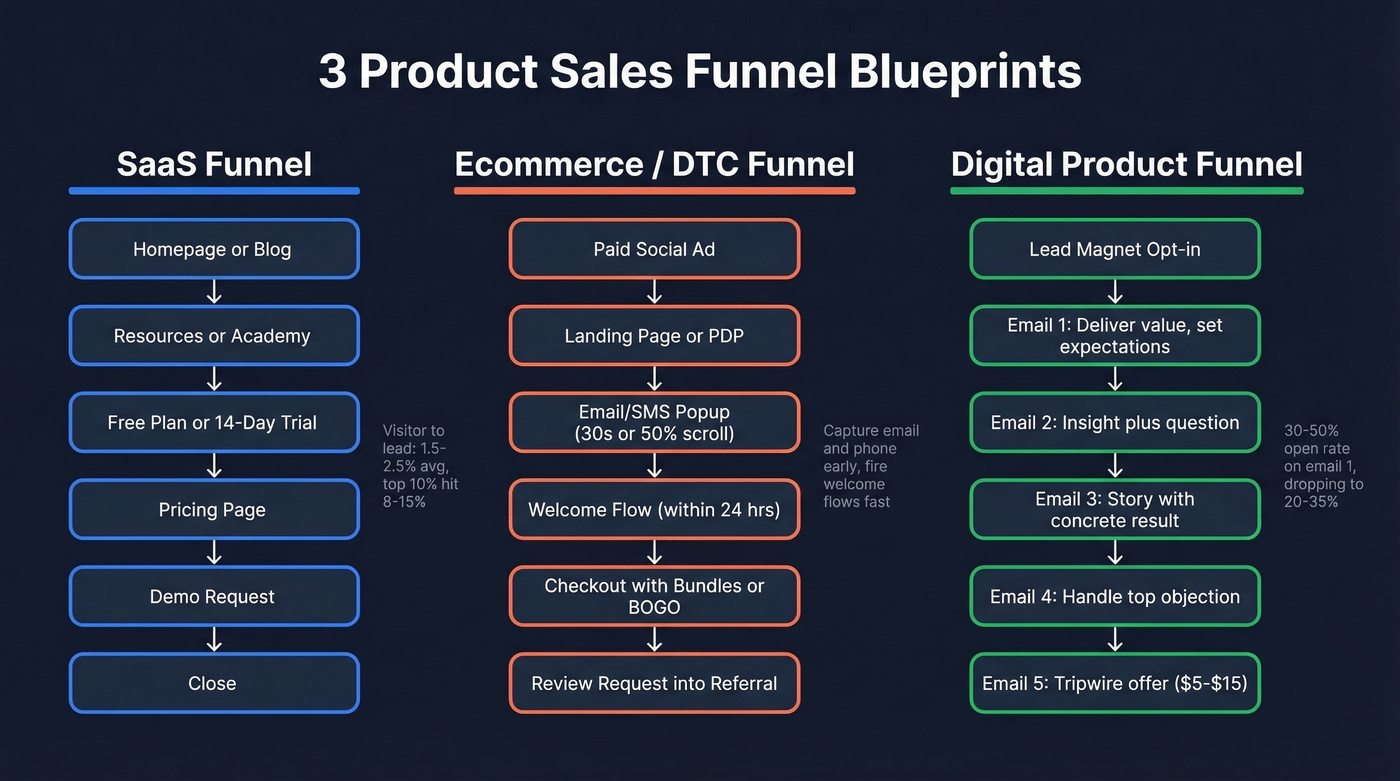
Harness runs a 14-day free trial backed by 50+ courses in "Harness University" - the product teaches itself. Bubble takes the opposite approach with an indefinite free plan that acts as a permanent trial, reducing friction to near zero. The typical SaaS flow moves from homepage to resources or academy, then into a free plan or trial, through the pricing page, and finally to a demo request. Visitor-to-lead averages 1.5-2.5% but hits 8-15% for teams with strong positioning and targeted traffic.
Ecommerce / DTC
| Element | What works |
|---|---|
| Traffic source | Paid social to landing page or PDP |
| Capture | Email/SMS pop-up after 30s or 50% scroll |
| Nurture | Welcome flow within 24 hours |
| Checkout | Bundles and BOGO to lift AOV |
| Post-purchase | Review request into referral program |
HexClad uses edutainment content to drive traffic to collections and product pages. Ten Thousand builds multi-asset landers - long-form pages, PDPs, and short-form influencer landers all running simultaneously. The critical tactic: capture email and phone early, then fire welcome flows fast.
DTC brands that build an evergreen funnel around their hero product - one that runs continuously rather than relying on seasonal promotions - tend to see more predictable revenue and lower customer acquisition costs over time.
Digital Products & Launch Funnels
The 5-email nurture framework that consistently outperforms single-send pitches:
- Deliver the lead magnet and set expectations
- Share an insight plus a question
- Tell a story with a concrete result
- Handle the top objection
- Introduce the tripwire ($5-$15)
Expect 30-50% open rates on email one, dropping to 20-35% on subsequent sends. Keep opt-in forms to name and email only - each extra field reduces conversions roughly 10-15%. One alternative worth testing: the reverse squeeze page, where you deliver value upfront and ask for the opt-in after. Teams using this approach have reported conversion lifts of up to 85%.
Whether you're running a launch funnel with a defined open-close window or an evergreen sequence that sells year-round, this email framework adapts to both.
Mistakes That Kill Product Funnels
Don't:
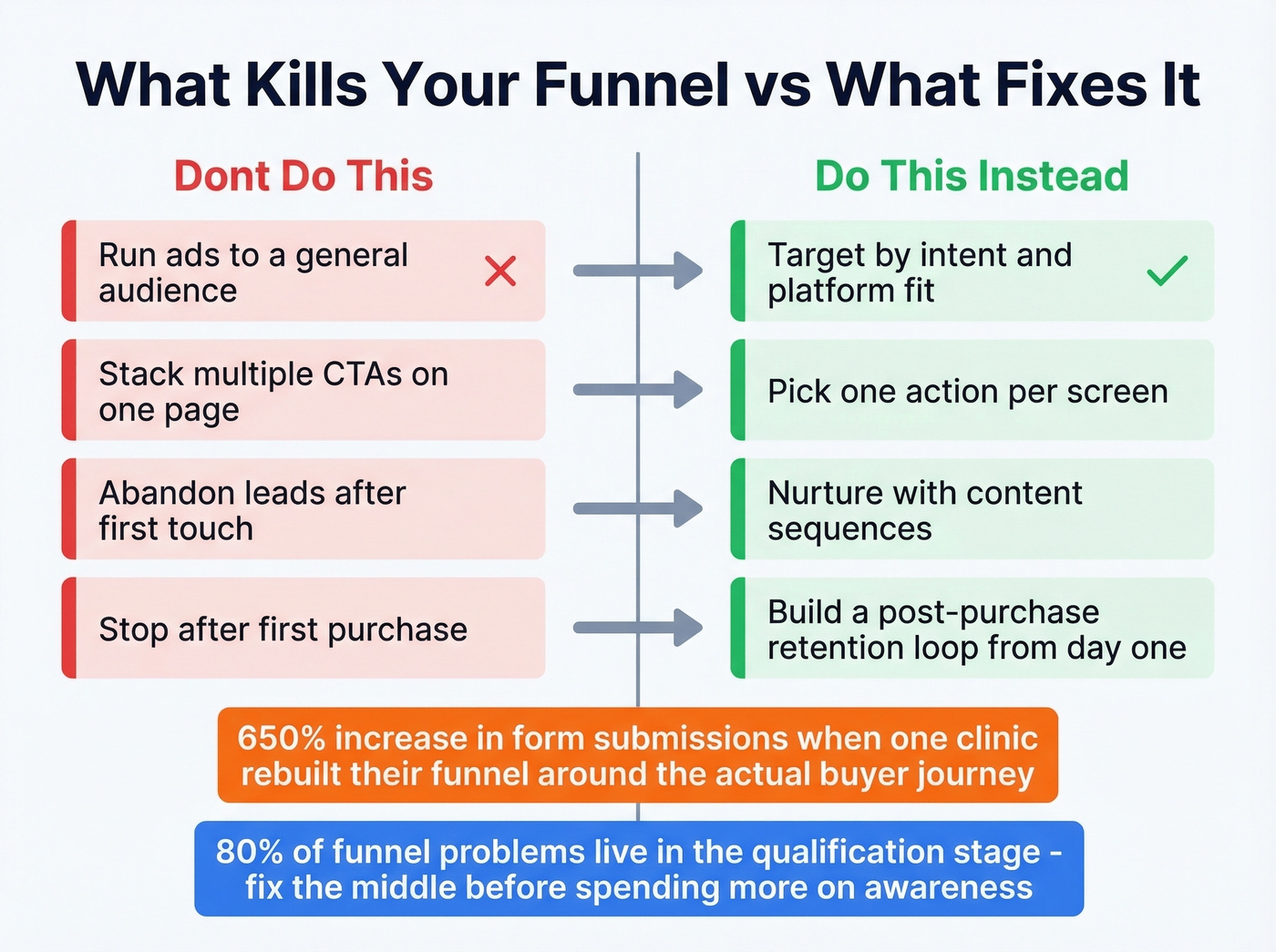
- Run ads to a general audience - target by intent and platform fit
- Stack multiple CTAs on one page - pick one action per screen
- Abandon leads after the first touch - nurture with content
- Stop after first purchase - that's where 72% of revenue lives
Do:
- Track stage-by-stage funnel metrics, not just top-line revenue
- A/B test landing pages and email sequences continuously
- Build a post-purchase retention loop from day one
One clinic saw a 650% increase in form submissions after rebuilding their funnel around the actual buyer journey instead of internal silos. In our experience, the qualification stage is where 80% of funnel problems actually live - but teams keep throwing money at awareness instead. Skip the awareness spend increase if your MQL-to-SQL rate is below 30%. Fix the middle first.
Tools Worth Using
You don't need a 15-tool stack. Three categories matter: funnel building, pipeline tracking, and data quality.
HubSpot's free CRM handles pipeline tracking for most teams under 50 reps. ClickFunnels runs about $97-$297/mo and is still the default for landing page funnels, especially for digital products and DTC. For the data feeding your funnel, Prospeo's database covers 300M+ professional profiles with 30+ filters including buyer intent, technographics, and job change signals. Its intent layer tracks 15,000 topics via Bombora, and a 7-day data refresh cycle - compared to the 6-week industry average - means your prospect lists don't go stale between campaigns. There's a free tier with 75 emails and 100 Chrome extension credits per month, paid plans from ~$0.01/email, no contracts.

Narrowing the top of your funnel is the highest-leverage move - and that starts with reaching real buyers. Prospeo's 30+ search filters (buyer intent, technographics, headcount growth) let you disqualify bad-fit prospects before the first touch. Layer in 125M+ verified mobiles with a 30% pickup rate and you compress your MQL-to-SQL window dramatically.
Disqualify early, connect faster, and close the deals your funnel was built for.
FAQ
What's the difference between a sales funnel and a marketing funnel?
The marketing funnel generates awareness and captures leads; the sales funnel qualifies and closes them. In practice, most teams treat them as one continuous pipeline with shared metrics at each handoff point.
How long does a product sales funnel take to convert?
SMB deals close in 30-45 days, enterprise averages ~120 days, and digital product tripwire funnels can convert in under two weeks. Higher price points require more touchpoints, so expect cycle length to scale roughly with deal size.
How do I know if my funnel conversion rates are good?
Compare against industry benchmarks: B2B SaaS runs 39% Lead-to-MQL and 37% SQL-to-Closed, while ecommerce runs 23% Lead-to-MQL but 60% SQL-to-Closed. If any single stage falls below half the benchmark, that's your bottleneck.
What's a good free tool for cleaning funnel data?
Prospeo offers a free tier with 75 email verifications and 100 Chrome extension credits per month - enough to validate a small campaign list. HubSpot's free CRM covers basic pipeline tracking. Together they handle data quality and deal management without upfront cost.