

The Only Prospecting Call Script You Need in 2026
A prospect picks up. You hear "Hi, this is Sarah." Your mind goes blank. You default to "How are you today?" and hear the click.
That first ten seconds is where most prospecting call script frameworks die - but here's what nobody tells you: your script is only the third most important variable. List quality and timing matter more. The average cold call success rate sits at 2.3%, with reps needing 8 attempts just to reach a single prospect. If your connect rate is hovering at 5-10%, bad data is the most likely culprit, not your talk track.
Here's a framework that actually works when someone picks up.
What You Need Before You Dial
- One adaptable framework - not 25 templates you'll never memorize. Structure beats monologue every time.
- Clean data. Your script doesn't matter if you're dialing dead numbers.
- Word-for-word objection rebuttals for the five responses you'll hear constantly. Prep these before you ever pick up the phone.
The Full Call Script Framework
Most cold calling guides hand you scripts. That's the wrong unit of value. A script tells you what to say when everything goes right; a framework tells you what to do when the prospect says "I'm not interested" four seconds in. We've tested dozens of variations across our team, and the structure below is the one worth memorizing.
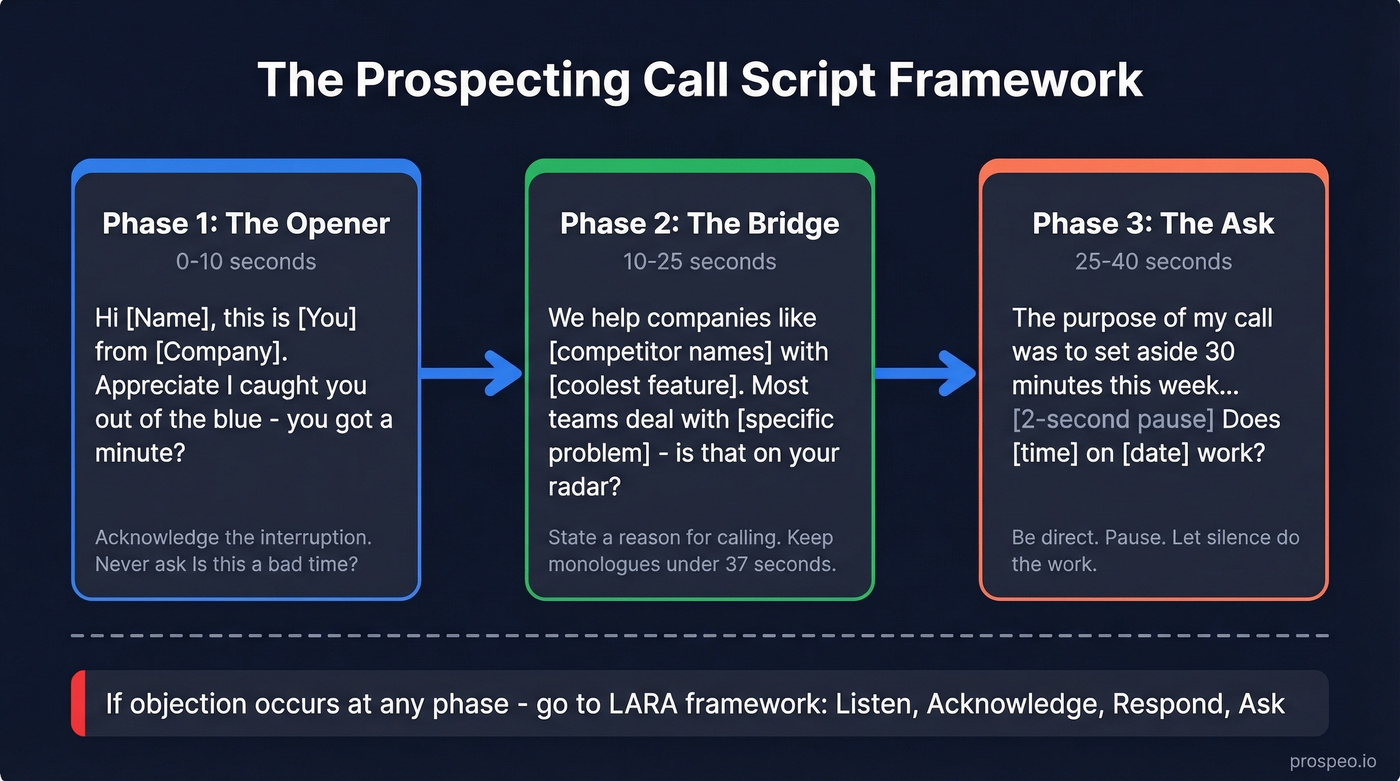
The Opener (First 10 Seconds)
Permission-based, direct, and human:
"Hi [first name], this is [your full name] calling from [company]. Appreciate I caught you out of the blue here - you got a minute?"
This acknowledges the interruption without apologizing for it. Don't open with "Is this a bad time?" - that opener carries a 60% guaranteed failure rate for booking meetings. Test your own variants, but start here. A strong opener always leads with respect for the prospect's time.
The 15-Second Bridge
Once you've earned the next few seconds, don't pitch. Bridge. Confirm the problem, reference their current approach, identify the gap, deliver a punchline, then ask for a small next step:
"We do [your coolest feature] for other companies in your space like [biggest competitors]. Most teams we talk to are dealing with [specific problem] - is that on your radar?"
Stating a reason for calling doubles your booking rate compared to jumping straight into a pitch. Keep this tight. Successful cold calls feature 37-second rep monologues at the longest burst. That's your ceiling, not your target.
The Meeting Ask
Direct. No hedging. Then silence.
"The purpose of my call was actually to set aside a half hour later this week... [2-second pause] Does [time] on [date] work?"
That pause signals confidence and gives the prospect space to respond rather than react.
A delivery note that makes a real difference: slow down. Speak almost uncomfortably slowly. Stand up if you can - posture changes your voice. Practice your opener 100 times before you go live. I know that sounds excessive, but delivery is the invisible variable that separates reps who book meetings from reps who read scripts.

Your opener is dialed in. Your rebuttals are sharp. But none of it matters if you're calling dead numbers. Prospeo's Mobile Finder gives you 125M+ verified direct dials refreshed every 7 days - not the stale data that tanks your connect rate to 5%.
Meritt 3x'd their connect rate to 20-25%. Your script deserves the same data.
Handling the 5 Most Common Objections
Most objections aren't real. They're automatic reactions to feeling interrupted. Your job isn't to "overcome" them - it's to slow the conversation down. Use the LARA framework (Listen, Acknowledge, Respond, Ask) as your backbone for every rebuttal below.
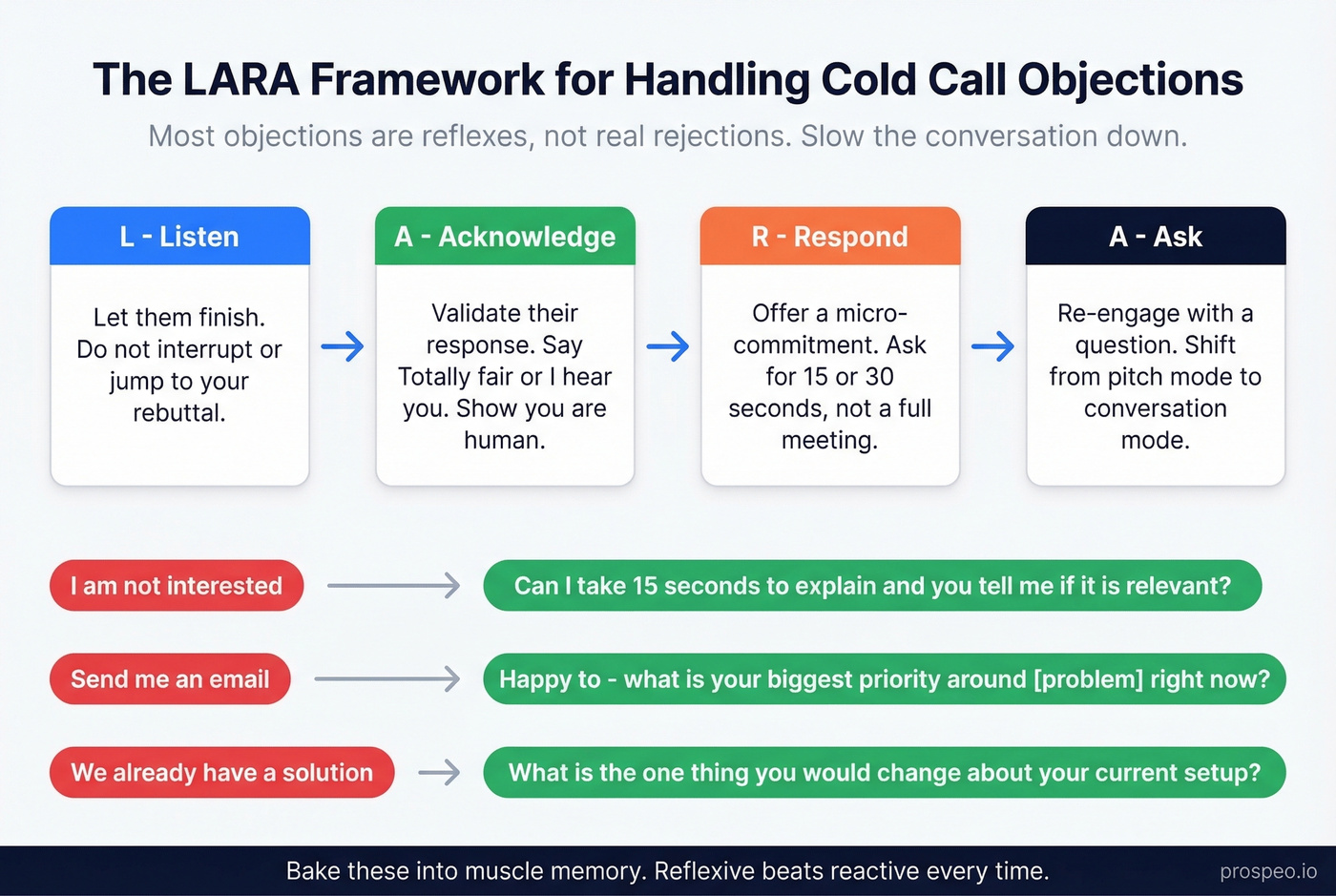
| Objection | Say This | Don't Say This |
|---|---|---|
| "I'm not interested" | "Totally fair. Can I take 15 seconds to explain, and you tell me if it's relevant?" | "But you haven't heard what we offer!" |
| "Send me an email" | "Happy to. What's your biggest priority around [problem area] right now?" | "Sure, what's your email?" |
| "I don't have time" | "Give me 30 seconds - if it's not relevant, I won't call again. Fair?" | "When's a better time?" |
| "We already have a solution" | "Good - what's the one thing you'd change about your current setup?" | "Our solution is better because..." |
| "I'm not the right person" | "No worries. Who handles [specific function]?" | "Can you transfer me?" |
The "30 seconds / fair?" structure on the time objection comes from Morgan J. Ingram. It works because it reframes the conversation from interruption to exchange - a tiny commitment that costs the prospect almost nothing. Bake these rebuttals into any sales call script you build so they become reflexive, not reactive.
What the Call Data Actually Says
Let's be honest: most guides get this wrong. You've probably heard the "70/30 rule" - let the prospect talk 70% of the time. That advice is for discovery calls, not cold calls.
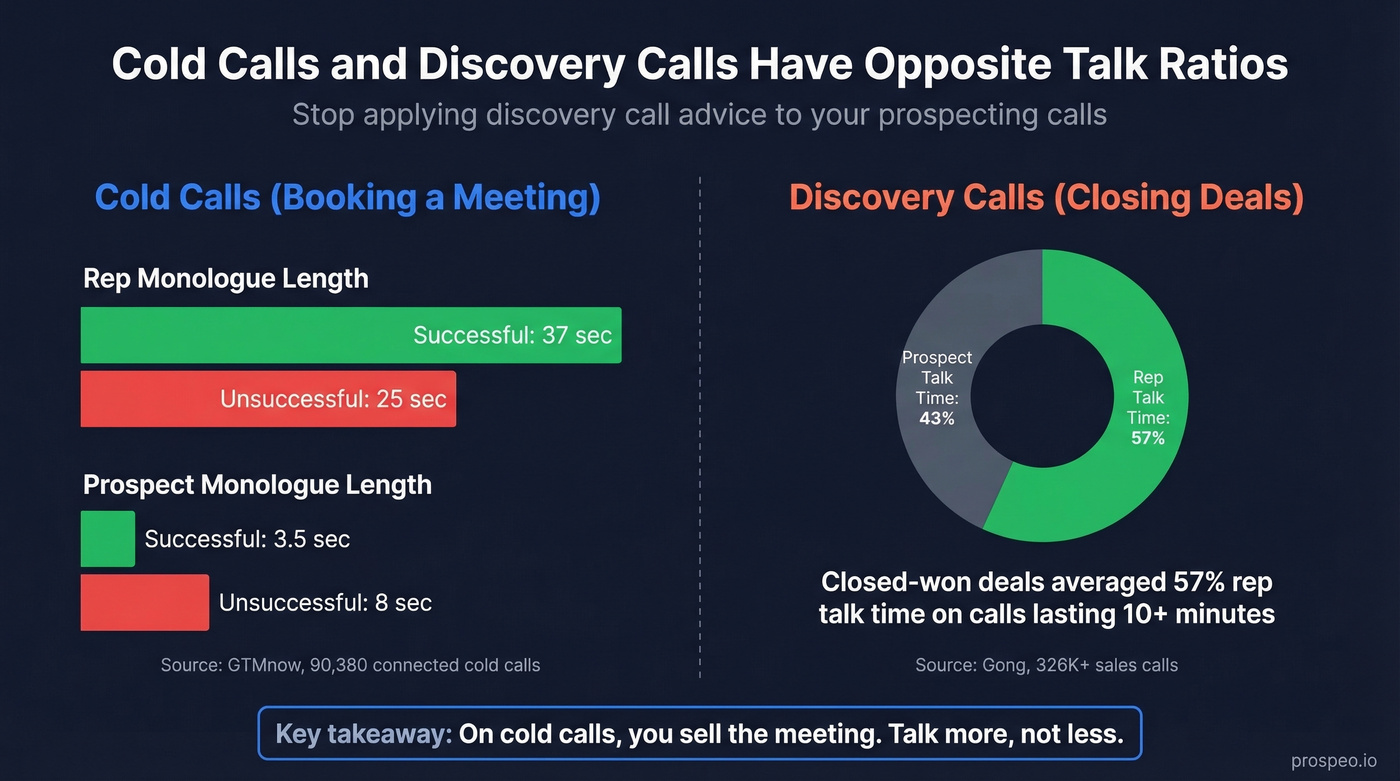
A GTMnow analysis of 90,380 connected cold calls found that successful calls had longer rep monologues (37 seconds vs. 25 seconds) and shorter prospect monologues (3.5 seconds vs. 8 seconds). On a cold call, you're selling the meeting, not running discovery. You need to talk more, not less.
Contrast that with Gong's 326K-call analysis, where closed-won deals averaged 57% rep talk time across sales calls lasting 10+ minutes. Cold calls and discovery calls have opposite talk-ratio dynamics. Don't confuse the two.
Here's a stat worth internalizing: 57% of C-level executives and VPs prefer phone over any other channel. The phone isn't dead. Your data might be.
Hot take: If your deal size clears $15k, a prospecting call script paired with verified data is the single highest-ROI outbound channel available to you right now. Email is drowning in AI slop. The phone cuts through.
But only if someone actually picks up - which brings us to the real bottleneck.
Fix Your Data Before You Dial
The hierarchy of what matters on a prospecting call is: who you call > when you call > what you say. Your script is third in line.
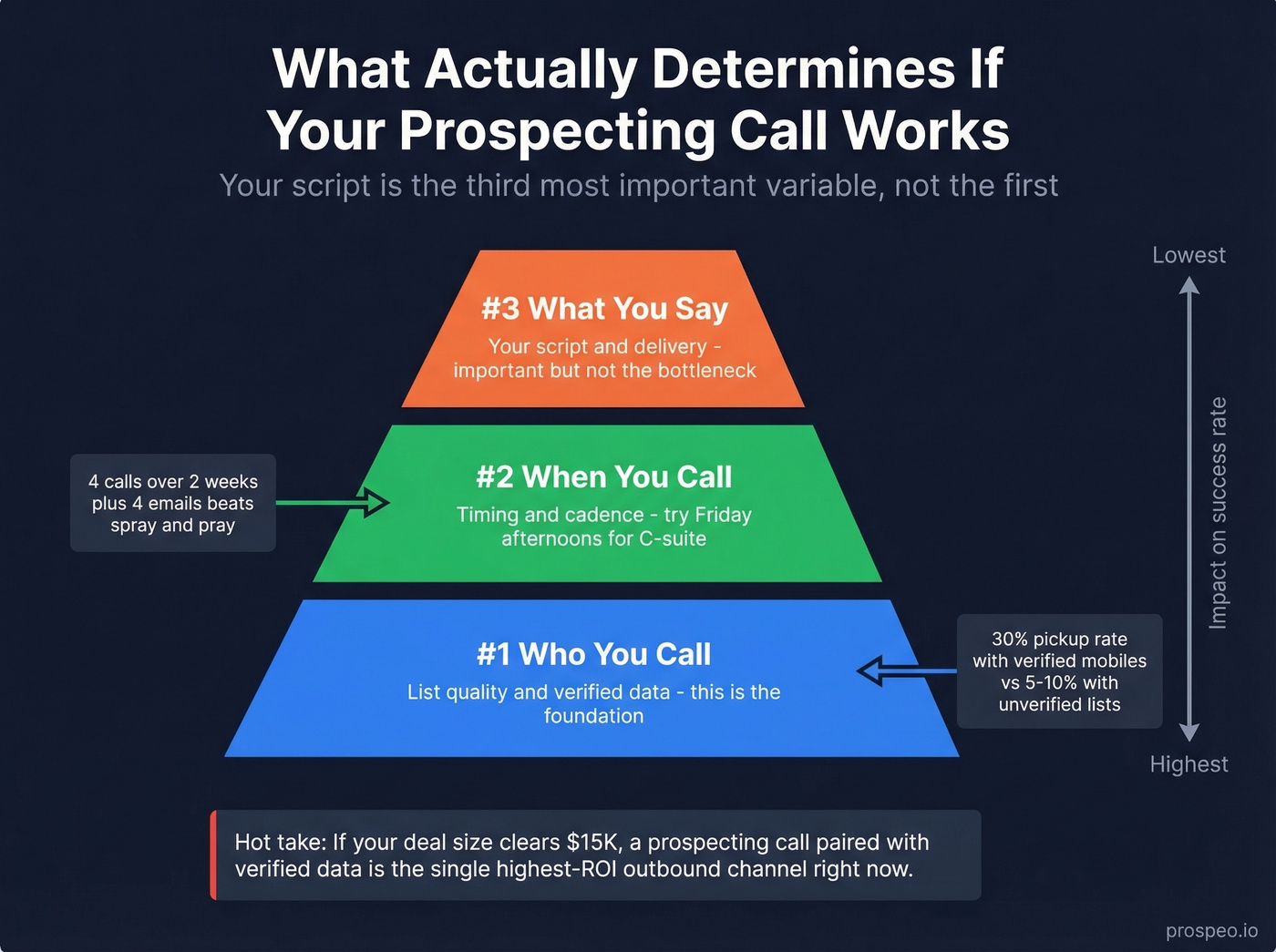
One timing tip worth testing: Friday afternoons work surprisingly well for reaching VPs and C-suite. Everyone else avoids Fridays, which means less competition for attention. We've seen this play out consistently - a simple cadence of 4 calls during a 2-week, 4-email sequence outperforms high-volume spray-and-pray every time. Even the best framework in the world can't compensate for dialing wrong numbers all day.
For the data layer, Prospeo's Mobile Finder covers 125M+ verified mobile numbers with a 30% pickup rate - versus the 5-10% range you'll typically see on unverified lists. Every record refreshes on a 7-day cycle. One customer, Meritt, 3x'd their connect rate to 20-25% after fixing their data quality, and their pipeline jumped from $100K to $300K per week.
Skip this section if your connect rates are already above 15%. But if you're burning hours dialing numbers that ring out or bounce to voicemail, the problem isn't your script.
If you're still struggling with list quality, start with data enrichment and a proper sales prospecting database before you touch your talk track.
The call data is clear: who you dial matters more than what you say. Prospeo delivers verified mobile numbers with a 30% pickup rate - 3x the industry average - at $0.10 per number. Stop burning hours on voicemail.
Fix the data layer and let your script actually do its job.
FAQ
Do I need a word-for-word prospecting call script?
No. Memorize the structure - opener, bridge, ask, objection branch - not exact words. Prospects detect scripted delivery instantly. The consensus on r/sales is pretty clear: if you sound like you're reading, you've already lost. The best call script sounds like a conversation, not a teleprompter.
How long should a prospecting call last?
Under two minutes. Your goal is booking a meeting, not running discovery. Keep rep monologues under 37 seconds and get to the ask fast. Gong data shows successful cold calls average 5:50 total, but most of that time is objection handling, not pitching.
What's the biggest reason prospecting calls fail?
Bad data. If half your numbers are outdated, even a perfect framework can't help. Fix your data source first, then optimize your talk track. The script is the last thing to worry about - and the first thing most reps obsess over.